I was much interested a few days ago in looking through an old book, entitled, “Works of Elder B. W. Stone.” On page 231, commenting on verse 12, chapter 5, of Matthew, he says: “There is one blessing that the generality of professors are not careful to obtain. The sects all think they are reviled and persecuted by others, and that all this is done falsely, and for Christ’s sake — for righteousness’ sake. Do they not rather return reviling for reviling, and persecution for persecution? Thus they lose the reward, and disgrace their profession, and cause that worthy name by which they are called to be blasphemed by the unbelieving world.” Again on page 232, he says: “I have long observed that where true religion more brightly shone, there persecution more furiously raged. This is a trite remark, and it is equally true that persecution sleeps where religion is languid and dead.” Are not the last two sentences truly manifested to-day in the religious world?
The foregoing thoughts are from an old and able pioneer of the so-called Christian Church,—one who was a co-laborer with Alexander Campbell, and also with John T. Johnson, of Kentucky. They seem so pertinent as showing the contrast between the false and the true religion, that I thought they might be interesting to the readers of the REVIEW.
THE EVOLUTION OF THE HOME.
The development of the home has kept pace with the advancement of civilization and Christian principles. The first home was a beautiful garden of God’s planting. It needed no walls and doors, for there were no threatening dangers from the natural elements or from unnatural violence. It was the abode of peace and beauty unmingled with anything that could give pain or cause alarm. In the mind loving confidence was closely associated with each spot, and no defense was required, because no danger was lurking there.
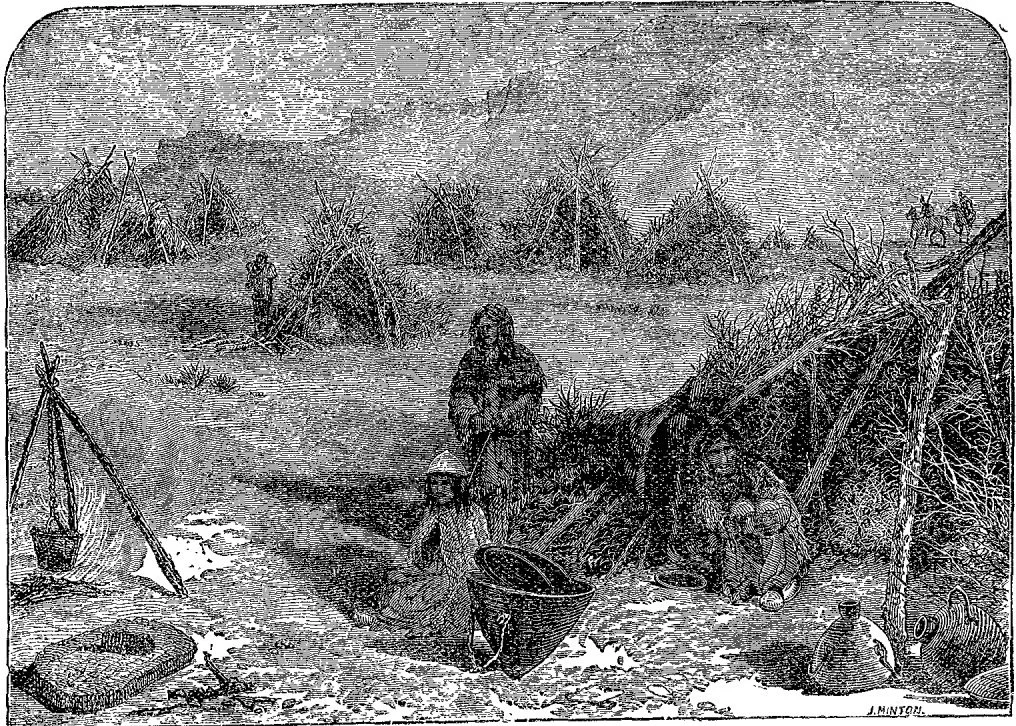
A CAMP OF UTE INDIANS.
Sin changed all that, and in the great transformation mankind found enemies to their peace, happiness, purity, and health lurking in every place. The balmy air, the inviting shade, the glowing sun, the biting frosts, the soaking rain, the stormy tempest,—all became agents of evil as well as mediums of blessing, from which man must seek a shelter. Man’s neighbors became his enemies, and watched him for hurt and not for good; the beasts of the forest became his foes, and even his own domestic pets must be restrained from doing harm.
In such a case, the family, drawn closely together by ties of mutual interest and sympathy, became an exclusive band, a unit in society. For protection, its dwelling-place became a local, definite spot, a fortification, beneath which protection, love, and happiness might peacefully and securely dwell.
Where the domestic instinct is but slightly developed, the family circle is less exclusive, the home is less secure. But true enlightenment promotes the sanctity of the family, and guards its peculiar interests more carefully. It is for the graces of Christ to furnish the crowning glory of home life in that perfect blending of interest that makes parents and children one.
But the defenses about our homes should by no means prevent the outflow of salutary influences into surrounding society. The home should be the conservatory of those plants of heavenly virtue which the rough elements of worldly society would quickly blight, but which, nurtured in those protected places, blossom and grow to bless the world at large.
Home to every one who is so fortunate as to possess or belong to a true home, is the dearest spot this earth can afford. To it the weary husband and father returns with eager steps. Its open door is to him as the gate of heaven. Its light is beautiful, though it be “ever so humble.” To the mother it is her workshop, her kingdom, her garden, and her laboratory. Here she does her life-work, modeling, cultivating, building, and adorning in the likeness of God, performing day by day a work in which angels take delight. To the sacred precincts of home the children flee with their troubles; to it they look for help and encouragement, and here, above all places, they should find their comfort and joy.
The illustration accompanying this article represents a home of the Ute Indians, of Utah and New Mexico, a race whose domestic ties are few and weak, whose dwellings are rudimental shelters. The Australian natives, about as low down in the scale as any to be found on earth, formerly dwelt in habitations even more rude, consisting of wide strips of bark stood on end against a pole. It is not possible for domestic love to live long in such abodes. The love for the beautiful finds there no encouragement, and the heart finds no home, no resting-place. Other savage nations exhibit the same principle, that the development of the home has always kept pace with the advancement of all that is permanent and desirable in society.
As we contemplate the comforts and blessings which constitute our homes in Christian lands, we have great cause for devout thanksgiving. The question as to what we may each do to show our appreciation of these blessings, and to make our homes more and more what they may be, is one that should deeply interest us.
NOT SHUT IN.
[THE following lines were written by a woman who had lain upon a bed of extreme suffering for many years.—S. ADDIE BOWEN.]
“Shut in!” did you say, my sisters?
Oh, no! Only led away
Out of the dust and turmoil—
The burden and heat of the day—
Into the cool, green pastures,
By the waters calm and still,
Where I may lie down in quiet,
And yield to my Father’s will.
Earth’s ministering ones come round me
With faces kind and sweet,
And we sit and learn together
At the loving Saviour’s feet;
And we talk of life’s holy duties,
Of the crosses that lie in the way.
And they must go out and bear them,
While I lie still and pray.
I am not shut in, my sisters,
For the four walls fade away,
And my soul goes out in gladness,
To bask in the glorious day.
This wasting, suffering body,
With its weight of weary pain,
Can never dim my vision,
My spirit cannot restrain.
I wait the rapturous ending—
Or, rather, the entering in
Through the gates that stand wide open,
But admit no pain or sin.
I am only waiting, sisters,
Till the Father calls, “Come home!”
Waiting with my lamp all burning,
Till the blessed Bridegroom come.
OBEDIENCE
By Mrs. W. T. Bland
BY MRS. W. T. BLAND.
(Mt. Vernon, O.)
“OBEDIENCE is a child’s religion” we say, and the child should be trained to form this habit at a very early age; for this must necessarily precede all other habits. If mothers would but recognize the truth and believe it, it is one of the easiest things in the world to form in the child a habit of implicit obedience; and when he is otherwise, it is because nature has been distorted and interfered with. Children are dependent and imitative, and as a result are naturally obedient. The reason why we see so much disobedience among children, is because from infancy they have been trained in that way, and the mother is often the one who gives her baby its first lessons.
At the age of but a few weeks the baby may be taught to go to sleep by himself, without rocking or singing, and to take his food regularly, only see to it that the little one is comfortable in every way when he is put down. The habit of yielding can be taught very early, thus laying a good foundation for a reverent youth and man. But sometimes the baby cries to be held. We get nervous and fidgety, and it is easier to take him up than it is to hear him cry. Finding that crying served his purpose well this time, he tries it again when circumstances are not just to his liking.
A mother, more than all people in this world, must exercise “sanctified common sense,” in the training of her children. She loves her little one most intensely, and it is so satisfying, so enjoyable, nothing can be sweeter than to have him respond with his tiny, uplifted face, to her request for a kiss. She never tires of the baby caresses, but he does, so if she will be careful not to teach him direct disobedience, she will not be always begging him for “just one sweet kiss,” especially when he is anxious to do something else, and he will become fretted by too many of them. It is most unwise to coax a child for a kiss until he hides his head or runs the other way, thus forcing an open disobedience.
It is not wise to familiarize a child too much with “don’t.” It is better that the mirror and hammer be not left in too close proximity, or within easy reach, than to command a live baby not to strike the mirror with the hammer. So also it is wiser to keep the coal pail out of his way, than to whip him for getting his clean dress black. “An ounce of prevention is worth a pound of cure” in the training of children as well as other important matters.
TEACHING CHILDREN SELF-DEPENDENCE.
By Rose Seeley-Miller
So many begin wrong with children. They teach them that everything must be done for them. They are not expected even to amuse themselves, and so, by-and-by, when the nurse-maid is dismissed because the baby has grown older, and the mother thinks she will manage alone, she finds she has made a rough path for her own feet.
I have in mind a child about three and a half years old. This child has never had a nurse-maid. When little, its mother had her housework to do, and was not strong, so baby was left to himself a great deal, the mother always near, but not taking him oftener than was absolutely necessary. When she sewed or wrote, the little one was in a chair near, and was smiled upon or spoken to occasionally, and encouraged to play and amuse himself. So it has been through the three short years of his life. The child has been taught self dependence. He expects to slip his own clothes on, and even button some of them himself, when he can reach the buttons.
Instead of mother running to wait upon the726child, the child is being taught to wait upon mother. He will bring spools of thread, and knows the colors, because he has been taught to get the thing sent for. He will run for his own hat and coat for going out, and he has a place in reach to put his every-day wraps and cap, and these are hung up when he takes them off.
It was not an easy task teaching him to pick up his playthings, but he expects to do it now. His blocks go onto the floor, and he knows that he will have them to put back in the box. He delights in the button bag, even if the buttons are to be picked up when he is through with them.
A model child?—No, not by any means; just a very commonplace little atom of humanity, but one that must be taught many things to make him fit for the battle of life that apparently lies before him.
Mothers are certainly to blame for the inefficient, dependent human beings in the world. I recall now a girl who was never expected to do things for herself. She would come in from her play, and sit down to the table, when a girl of twelve or fourteen years of age, and ask for a drink, and the mother, who had been working in the farmhouse kitchen, would obediently respond. This same girl never was taught to comb her hair, and was dressed until, well—I cannot say how old. I doubt if she ever waited on herself until she was sent from home to the normal school.
It is wronging the child to teach it such dependence; it is wronging the mother, but as we sow, so shall we reap, and this does not mean if we have sowed self-abnegation, we shall reap the same fruits in our offspring. On the contrary, we shall be obliged to reap self-abnegation by the hundredfold as the years go by, and the human being we brought forth reaches the acme of selfishness in the school of self-love and dependence, where the tuition has been constant from babyhood up to the present time.—Rose Seeley-Miller, in Household.
BANKING THE HOUSE.
By David Paulson
BY DAVID PAULSON, M. D.
(Sanitarium.)
The foundations under many houses are in a more or less crumbled-down condition. This makes it necessary when the cold season comes on to protect it by banking it up in one way or another. Otherwise the cold winds will pass in freely under the floor and up into the house, thus making it very uncomfortable and unhealthful. Unfortunately, whatever happens to be the most convenient is generally utilized for this purpose. Too often barnyard refuse, or anything which happens to be raked up in the vicinity, is packed around the house on the supposition that it will freeze through, and thus there will be no danger arising from it. This is true as far as the outside crust of it is concerned, but that which is nearest the house will part of the time be kept thawed out by the heat of the house, and as the noxious vapors and gases which are generated in this decaying mass cannot escape to the outside on account of the frozen crust which seals it up, they find their way through the defective foundation wall of the house, and up into the house to poison the air of the dwelling rooms. No matter how great precautions are taken to secure absolute cleanliness of the rooms and the furniture, if this condition of things exists, it is not a fit abode for human beings. The fact that what has already been pointed out is the common custom in country places, renders it necessary that this should be pointed out emphatically.
It requires some labor to throw up a bank of fresh earth, or clean, dry straw to be covered with earth, and it requires a longer time to clear the same away in the spring, but it does not require the time and perplexity and anxiety that are required to nurse and care for sick ones, upon whose sickness may be due only to this very fact.
In houses where there are no cellars underneath, if there are holes and cracks in the foundation wall, the space beneath the floor often becomes merely a place where small animals find their way and die, and where much material may be carried in by cats and dogs to decay, and thus give rise to those mysterious odors which are such a puzzle to so many housewives. It is well to have some place in the foundation where a temporary opening can be made at certain times of the year so that some one can examine the situation and clear out offensive matter if necessary.
BE YE THANKFUL.
“I FEEL so vexed and out of temper with Ben,” cried Dick, “that I really must—”
“Do something in revenge?” inquired his cousin Cecilia.
“No; just look over my Book of Thanks.”
“What’s that?” said Cecilia, as she saw him turning over the leaves of a copy-book nearly full of writing in a round text hand.
“Here it is,” said Dick, then read aloud: “‘March 8. Ben lent me his hat.’ Here again: ‘Jan. 4. When I lost my shilling, Ben made it up to me kindly.’ Well,” observed the boy, turning down the leaf, “Ben is a good boy, after all.”
“What do you note down in that book?” said Cecilia, looking over his shoulder with some curiosity.
“All the kindnesses that are ever shown me. You would wonder how many they are. I find a great deal of good from marking them down. I do not forget them, as I might do if I only trusted to my memory, so I hope that I am not often ungrateful; and when I am cross or out of temper, I almost always feel good-humored again if I only look over my book.”—Selected.
PASSING EVENTS AND COMMENTS.
By T.
Healers.—While we do not wish to discount in any degree that which our correspondent has said of the work of Schlatter, we are still of the opinion that a wonderful fame may be built upon a very narrow foundation of fact. There is nothing, apparently, that people love better than to be humbugged, notwithstanding the outcry they make when they find it out. It is727very easy for people who have for a long time had a bad feeling without the will or resolution to throw it off, to do so on being aroused by some impulse imparted by another or by an excitement. Such cases are frequently cured, for a mind-cure is all they need. Others may, by the violent agitation of the mind and action of the will, subdue the symptoms of their disease for a time, only to have those symptoms return. A very few cases of the above are sufficient to establish a wonderful reputation for an individual, and the more implicit people's confidence becomes in his ability to do what he professes to do, the more susceptible they are to his arts.
In this way we may account for much that passes for healing. But as we have often said, and as the Scriptures assure us, there will be great deceptions practiced in the last days, which will include the display of really miraculous power. So that if it be actually demonstrated that Schlatter, or Dowie, or others, effect or are the means of effecting organic cures of deformities, cancers, etc., we shall still understand how to account for them; for the Saviour has clearly forewarned us of these things. But how are we to distinguish between the true and the spurious? The Scripture anticipates this inquiry, and says: “To the law, and to the testimony; if they speak not according to this word, it is because there is no light in them.”
Strength of Sunday Laws.—That the enforcement of Sunday laws will be with a strong hand is indicated by many signs. The following from the New York World of Nov. 5 indicates the bold audacity with which even in the present state of affairs Sunday laws invade the rights of men:—
“The arrest of two reputable gentlemen on Staten Island for the offense of playing golf on Sunday in the private grounds of a country club, furnishes a valuable contribution to our information as to the condition of the Sunday laws of this State. Following as it does the recent raid on the Sunday golf players on Long Island, it should prompt the average citizen to ask whether he has any individual rights or liberties on Sunday. If the laws of the State of New York prohibit this innocent and harmless recreation on Sunday, the fact should be known for the purpose of correcting this and other wrongs in the way of blue laws. If the laws do not prohibit it, exemplary punishment should be meted out to the officials who have abused the authority of the State for purposes of persecution.”
The matter of Sunday prosecutions has as yet hardly been carried beyond the point of a joke in the minds of the public. But when the time comes that policemen invade the home circle and snatch its members before courts for engaging privately in harmless amusements, it is then time for the people to awake to the situation.
Pathos in War.—Rather a pathetic story, well vouched for, comes from Cuba. Several Spanish officers, with sixty-four soldiers, made a valiant stand against 1200 insurgents, but were vanquished, and sixteen were captured, including the officers. The insurgent leader, Rego, greeted the Spanish officers respectfully, and embracing Colonel Valle, the chief officer, said: “Return to your comrades, heroes. You are an honor to the Spanish nation, and I am proud to be able to boast of descending from such a people.” The Cubans and Spaniards then embraced each other on the field of battle, bidding one another farewell. As the Spaniards went away, the Cubans shouted, “Adios, valientes Espanoles!” Adieu, valiant Spaniards! The wounded Spaniards were well cared for, and ate at the same table with Rego until released.
Nor is this rare sentiment of pity confined to one side, for it is well known that General Campos persists in treating the captured insurgents humanely and even kindly, while the government at home insists that they shall be shot or beheaded as fast as captured. He has hinted that if this cruel policy is to be adopted, a new commander-in chief will have to be procured.
Should the combatants stop fighting and go to making love to each other, it would give a strange turn to affairs, leaving the authorities in Spain to fight their own battles. However, we presume they are not all of them ready to lay down their shooting arms and extend their hugging arms just yet.
The Tennessee Prosecutions.—The communications in our Progress department, giving the result of the cases pending in Rhea county, Tenn., court, against Seventh-day Adventists for Sunday labor, will be read with interest. The kind intervention of men of ability and influence in behalf of truth and justice, was timely and effectual, as it was noble and thankworthy. There can be no question as to the propriety of availing ourselves of such help when it comes along the line of God’s truth. The testimony of such men in favor of the downtrodden truth is weighty and powerful. Before it the cant and error of the Sunday cause melt like frost before the sun.
The points made by the attorneys are every one of them trenchant weapons against the giant fraud of Sunday-sacredness, enforced upon the people by law. The judge and prosecuting attorney in these cases have never manifested a vindictive purpose in reference to them, and have always been ready to grant to the defendants all the favors and considerations that a liberal interpretation of the law would permit. It is not as a personal grievance that we should regard this great question. The real issue is not between Seventh-day Adventists and the law. It is rather between the people and spirit of these last days, and the truth. God’s law is on trial. The great question is, Will the commandments of God be sacrificed by the people of this generation to uphold the institutions of men? And while personal spite and animosity may wax and wane with local circumstances, at large the conflict deepens.
Spirit of the Inquisition.—In the Literary Digest of Nov. 2 is a translated portion of an article copied by the Old Catholic organ of Germany from Analecta Ecclesiastica, a paper edited under the special supervision of the Vatican. Speaking of medieval times, the article says:—
“It is clearly proved that the Catholic historians are neither liars nor dreamers when they assert that there were apostates in those days who secretly favored Judaism and worked for its advance, while outwardly they pretended to be Christians, and even wore the garb of the priest. The laws of the Church and of the State, therefore, justly opposed them. Wolves should remain with the wolves; when they enter the fold in sheep-skins, they must be driven out with fire and sword. Far be it from us to follow the lines of befogged liberalism, and to fancy that the Holy Inquisition needs to be defended. Neither the rude ways of those times nor the blind zeal or the stern character of the priests need be mentioned in defense of our Holy Mother the Church. We need no sophism. The happy watchfulness of the Holy Inquisition preserved, in Spain and elsewhere, religious peace and that firmness of faith which is to this day the glory of the Spanish people. O blessed flames of the stake! Through them a small number of very cunning people were removed, but thousands upon thousands of legions of souls were preserved from the pit of error, and thus from everlasting damnation. Society was saved, and the country freed from the danger of civil war. Honor to the memory of Torquemada! He decreed that Jews and infidels should not be forced into baptism, but he also managed to prevent the spread of Judaism and apostasy among the baptized people.”
So there are those now-a-days who are accused of favoring Judaism while professing to be Christians, and the laws of the State are being brought to bear upon them. Society must be saved, now as then; and what is needed is another Torquemada.
T.
SELF-SACRIFICE
By Jennie Chandler
The word “sacrifice” originally meant an offering made to God; or among the old Greeks, to the gods. Any one who reads Homer’s “Iliad,” will be surprised at the amount of sacrificing going on constantly to one or another of those beings who they believed presided over particular domains of nature, or the activities of life. The Old Testament is also full of accounts of sacrifices to the Lord. In using the word here, however, I use it in another sense,—the giving up of something desirable for something considered more desirable, either for self or for others. There would be no getting along in this world if it were not for the constant sacrifices we must all make, but I sometimes think that women are called upon to give up more than they should for the benefit of others. Women have in all ages been the carers for young children, and no one can devote herself to these helpless ones without more or less self-sacrifice of time, of strength, of health. I am inclined to the opinion that one reason why motherhood is avoided by so many, is because it demands so much giving up for others.
Now a certain amount of sacrifice is necessary in order to make any character beautiful, but it is very doubtful if women are called upon to go so far or to ruin their health and destroy their happiness, except in perhaps rare cases.
It is not easy often to draw the line, to know exactly where to stop, but it certainly would be well for all of us if we gave some attention to the subject. So far as it relates to children, sometimes excessive sacrifice defeats the very object for which it is given, and makes them selfish and unappreciative. It would be far better for the child, after a few years old, to learn to sacrifice its wants, to a certain extent, for the mother, and learn by it an important lesson—that all is not for self. Children ought to learn to refuse sacrifices on the part of parents, which are beyond what is reasonable.— Jennie Chandler, in Journal of Hygiene.
THE SCHLATTER MATTER.
[In response to a letter of inquiry, as to the reliability of the reports in regard to the so-called “healer,” Schlatter, in Denver, we have received the following from Elder N. W. Kauble, of Denver. Brother Kauble states that on account of pressure of duties his opportunities for personal examination have not been all that might be desired; but the statements he makes are, we have no doubt, thoroughly reliable, and as we understand, from personal observation.—Ed.]
I visited the “healer,” and found a very pleasant, kind, and devout-appearing man, resembling in many respects the pictures we often see of Christ. I can scarcely imagine how one could appear more Christlike as far as the spirit can reveal itself on the countenance. I do not wonder that multitudes are being misled by this man. Thousands visit him daily, some coming long distances in wagons, others from all over Colorado and other States on the trains. In fact, one can scarcely board a train without seeing people coming to be healed.
As far as I can learn, he will not be interviewed, and scarcely ever utters a word. His lips continually move, however, as he takes the hand of the afflicted and passes on to the next. I sought an interview with him, but was refused on the grounds that he was too busy.
That this man is the greatest deception that we have ever seen, cannot be denied by any one who is acquainted with the facts. Not all are immediately healed who come in contact with him, but many wonderful things have been done. I will mention a few: A young man living two doors from our house, has for years been afflicted with epileptic fits, having one every night. His parents took him to the “healer,” who blessed some handkerchiefs, and told them to let the boy sleep upon these; since then the boy has not had a fit. Many cases of rheumatism have been cured. When I visited the “healer,” I saw a man who for months had been unable to use his hand on account of injury from falling from a load of hay; but he was instantly healed. This healing took place just as I approached the spot.
Occasionally, as he takes the hand, his face will take on certain grimaces and contortions, which remind one of a person suffering from some severe internal pain. But generally he maintains a calm, unruffled, mild air, that leads people to think him a saint. In fact, it is regarded by many as nothing short of blasphemy to say anything against him.
The man was brought up a Catholic, and attends the Catholic church, but claims he has no use for creeds. I was informed that he has also said that the “Father” told him not to heal on Sunday. Many reports claim that he assumes that he is the Christ; but Mr. Fox, with whom he resides, and who assists him daily, denies this report, and says he only claims to be a man.
THE NEGRO QUESTION.
By T.
The great question with the South since the abolition of slavery is and has been what to do with the Negro. At that time not less than four million people were released from bond-service. Their liberties and privileges, their protection and providence, had been in the custody of their masters. This was now transferred to themselves, thus placing upon them a burden of responsibility for which, by education or experience, they were unfitted. In numbers they have greatly increased since that time. While individuals among them have grasped the situation, and wisely and successfully grappled with the task of elevating themselves and their race, the great mass have been satisfied with a mere animal existence, without the impulse or ambition to rise above the low moral and intellectual level in which emancipation found them.
In some sections the dominant whites, accustomed only to being unquestionably obeyed by the class whom they held as chattels, now found themselves confronted and outnumbered by this class suddenly placed on a legal equality with them. In the letter of the law the vote of a black man was to count one; and the vote of a white man could not count more. One of two results must follow in such a case: The Negro must dominate in government, elect his officers, make and execute his own laws, and thus in a measure turn the tables upon the white people, or the supremacy of the whites must be maintained by intimidation or other unfair means. Both conditions have been experienced.
Another evil has caused deep trouble. The neglect of the moral and intellectual culture of the colored race has resulted very naturally in the abnormal development of the animal nature with its selfish passions. This lamentable state of things has borne terrible fruit; and it has become a question of deep concern how the brutal instincts of an ignorant and degraded race are to be restrained even sufficiently to render existence safe.
We do not believe for a moment that color has anything to do with this problem. The Negro race stands just where the German, the Irish, the American, or the English race would have stood had they been through a similar experience. Human nature is the same the world over. Differences between races are but skin deep, and consist only of the differences that circumstances and education create. The question with the Christian and philanthropist is, then, What can be done for the Negro, rather than, What can be done with him?
To this there can be but one answer: That gospel which is the power of God unto salvation to the Jew first, and also to the Greek, must be brought and taught to this poor people. A few degrees of Christian enlightenment is all that separates between us. Bring to them that enlightenment, and the problem is solved.
T.
THE MYSTERY OF GOD.
By Uriah Smith
When Is It to Be Finished?
In the course of the revelation vouchsafed to John on the isle of Patmos, the angel made to him this solemn announcement: “In the days of the voice of the seventh angel, when he shall begin to sound [the declaration of the oath angel of Revelation 10 was that], the mystery of God should be finished.” Rev. 10: 7.
The mystery of God is certainly some department of his work among men; and when the time comes that any division of God’s work is finished, and brought to a close, that is a solemn hour. Can we tell from this testimony when that will be? To answer this question let us consider the definition of the terms here used, and the scope of the trumpet under the sounding of which this is to occur.
The “mystery of God” is the gospel. Rom. 16: 25, 26; Eph. 3: 3; Gal. 1: 11, 12; Eph. 1: 9, 10; 1 Cor. 2: 7. The gospel has a certain definite work to do, that is, to gather out from all nations, during the time that sin is running its course, a people for God. This is not to continue forever; the time will come when its work will be accomplished, the gospel will no longer be proclaimed, and the mystery of salvation through Christ will be accomplished. The finishing of the mystery of God, therefore, is the closing of the work of the gospel for the world, which means the close of probation, and the fixing of the final destiny of every man.
This is to be accomplished “in the days of the voice of the seventh angel.” But the trumpet of the seventh angel is one, the sounding of which covers a great length of time. It embraces the entire time of the third woe. Rev. 11: 14, 15. It begins some little time before probation ends, according to Rev. 10: 7, and it extends to the close of that scene of destruction in which all sin and sinners will perish at the end of the thousand years of Revelation 20. This is shown by the testimony of Rev. 11: 18. It continues, therefore, more than a thousand years.
The question now arises, In what part of this long period does the finishing of the mystery of God come in? It is not at the close, nor at any intermediate division of that period; for the scripture reads, “When he shall begin to sound.” And does this mean that the finishing of the mystery is an instantaneous work, to be accomplished the very moment the trumpet begins to sound?—That cannot be; for there are “days,” plural, doubtless used in a prophetic sense, meaning years, allotted to this work: “In the days of the voice of the seventh angel.”
Two facts are thus established: first, that no part of the sounding of the seventh trumpet could be given before the work of finishing the mystery of God is entered upon; for in that case it would not be in the beginning of his sounding; and, secondly, that that work cannot be accomplished instantaneously; for in that case it could not occupy “days,” as the testimony says it will. So the conclusion is inevitable that the work of finishing the mystery of God, and the sounding of the seventh trumpet commence together; that is, the commencement of that work marks the time when the trumpet begins to sound; but the years in which the work will be accomplished are so few in comparison with the whole period of the sounding of the trumpet, that they may be called the “beginning” of his sounding.
The work of the gospel closes with a special work called the cleansing of the sanctuary. Dan. 8: 14. To this work, in the type, one day was allotted called the “day of atonement,” because the cleansing of the sanctuary was the making of the atonement. Lev. 16: 20, 29-34; 23: 27. This work in the antitypical ministry of Christ in the heavenly sanctuary, begins at the end of the 2300 days (Dan. 8: 14), which period ended in 1844. Then the temple of God, or the inner apartment of the sanctuary on high, where the ark is, was opened, as stated in Rev. 11: 19. This in the type, was the apartment in which the atonement was always made; and in the antitype this work is the closing up of the ministry of Christ, which of course synchronizes with the work of the gospel. Hence the cleansing of the sanctuary, the making of the atonement, and the finishing of the mystery of God, are all one and the same thing. And this work began at the end of the 2300 days in 1844, when the seventh trumpet began to sound, and the temple of God was opened in heaven. But this work is all to be finished, “in the days of the voice of the seventh angel, when he shall begin to sound.”
Fifty-one years have already elapsed since this closing work in the heavenly sanctuary began. How much longer can it continue? Only a portion of one day out of the year devoted to this work in the type, though it gives us no basis for any definite calculation, does reveal unerringly its comparative brevity in the antitype where we now are. And the finishing of this work draws the line of separation forever between the righteous and the wicked. Are we prepared for the issue? U. S.