The Youth’s Instructor, Vol. 43, No. 21.

NUGGETS FROM THE GOLDEN WEST

The Youth’s Instructor

May 23, 1895

S. D. A. Publishing Association · Battle Creek, Mich. · May 23, 1895

NUGGETS FROM THE GOLDEN WEST.

IN FIVE PARTS.—PART II.
FLOWERS—what are they? Whom shall we ask? Should we direct the question to Webster, he would say: “A flower is an organ, or combination of organs, of propagation isolated by a circle of foliar parts.” I hear some one say, “He could not have been a lover of flowers, or he would certainly have said something of their beauty.” But others, who, because of their love for flowers, have made them a life-study, define them thus: “Flowers consist of peduncles, the ends of which form receptacles from which the calyx, corolla, stamens, and pistils grow.” Another has said: “Since the office of flowers is to produce seed, a perfect flower may consist of pistils and stamens only.” Had we never seen a flower, think you we would now have a clear conception of what one really is? No doubt our mental picture would fall far short of representing the sweet mignonette or the smiling pansy. Then let us not ask others what they are, but study them for ourselves, and know what they are.
Who will now direct us to a place where we shall be able to find the greatest variety and the most beautiful specimens? One may say: “The meadows just beyond the old mill, where in childhood I once roamed, certainly have the most beautiful.” Another will direct us to the forest surrounding the country school-house, once so thickly populated with those “bright-arrayed children of the mountains.” But as I listen, I hear some one say: “Away across the Rockies, just beyond the snow-capped peaks of the Sierra Nevadas, there, sheltered from the chilling winds of the prairies, and refreshed by the balmy breezes of the great Pacific, lies a land of sunshine, fruit, and flowers.” It is the flower-garden of the world. Thither let us go to gather our roses. What a delightful time we shall have! Although the flowers here bloom continuously, just now spring with all her charms has arrived, and clothed nature with her richest attire.
BABY-BLUE-EYES AND FORGET-ME-NOT.
As we wander along the trails of the mountains and by the streams in the valleys, we can find no cliff so high and parched, no valley so deep and dense, but that flowers are seen all about us, bending their graceful forms in the breezes, as if waving us a welcome. Every variety of the East may be found growing in thick profusion along the coast.
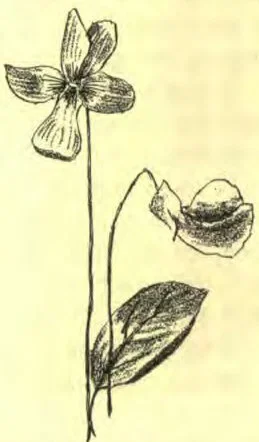
WILD VIOLETS.
WILD VIOLETS.
It is not my object to tire you with scores of orders and hundreds of species, but simply to describe a few of the most familiar, that you may welcome them as old friends; or if you are strangers, that they may serve as an introduction to you to the home of the beautiful wild flowers of the world.
The fields just before us appear as if spread with a mantle of purple and blue; for, peeping up from its profuse foliage is the Nemophila, or, as it is tenderly called by the children, “baby-blue-eyes.” Who knows but that it was these flowers, wet with the morning dew, that Longfellow had in mind when he wrote,—
“Others, their blue eyes with tears o’erflowing, Stand like Ruth amid the golden corn”?
The leaves of the Nemophila are pinnately parted into from seven to nine, and sometimes two or three lobed divisions. The corolla is from one half of an inch to an inch in diameter; it is bright blue to nearly white, and sprinkled with dark dots becoming more numerous as they near the center.
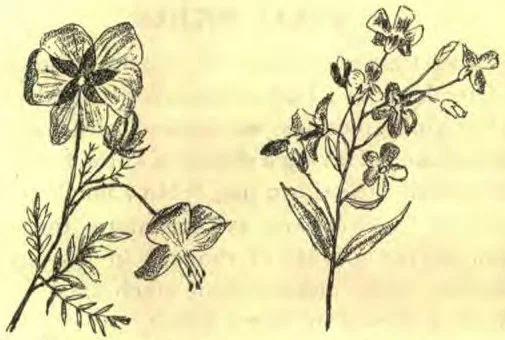
There are many flowers which I wish it were the privilege of all to pluck for themselves, and enjoy as we do. There are the pure white fragrant four-o’clocks, which are such welcome visitors to the children tired with their lessons; the lovely little Trifolium, or “bird’s eye”; the many varieties of daintily tinted primroses; larkspurs, pink, blue, and white; and snapdragons, as lovely as those found in the best cultivated gardens of the East, are found in great profusion in our open plains.
The wild violets are of three different colors,—blue, yellow, and white. The little blue ones are quite rugged, and often wander away out into the fields, while the white ones are more delicate, and seek the protection of the forest, where they may hide their sweet faces in the deep moss. The yellow ones resemble very much the wild pansy of the East, neither are they inferior to their fair sisters in beauty. The flower has the same shape as the cultivated violet, and is somewhat smaller than the Japanese violets found in every hot-house in the Eastern States and in every flower-garden in California.
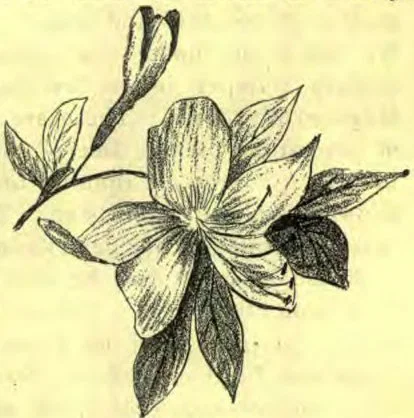
AZALEA.
AZALEA.
I next present to you the little fairy of the mountains, so suggestive of its name. There are many others more gaudy in appearance, more beautiful to look upon, but none more true to its mission than this one. The forget-me-not is seen in thick underbrush or in small crevices in the rocks modestly lifting its smiling face to greet you, and then, as if conscious of its appellation, blushing and looking to the earth. The color of the flower changes from a light blue to a pale pink. The leaves are pale green, ovate-lanceolate, and from two to four inches long.
Those who can welcome the Azalea, the queen of wild flowers, as an old friend, can better appreciate its beauty than can those to whom it may be a stranger. This fragrant blossom is nearly three inches long, and belongs to the order Rhododendron. It grows on a shrub which is from three to five feet high; its color varies from a pure white to a dark pink, and again from red to crimson. The leaves are ovate-oblong, bright green, and slightly pubescent. KITTIE WAGNER.

LOVE TRIUMPHANT.

When fresh from God's creative hand The world in beauty sprung, The flowers fair o'er all the land With bounteous love were flung.
And like the glory of the Lord O'er all the landscape shed, These silent tokens of his care With generous grace were spread.
And still, when sin had marred the scene, And brought decay and death, Lo! e'en the thorns and thistles dire Bore yet the flowers' sweet breath.
Thus, when to earth the Saviour came, From heaven's bright sphere to ours, He bore earth's curse in thorny crown, And gave to us hope's flowers.
And thus love triumphs over wrong, While pledge to man God gives; Though sin must bring its own sad sting, God's mercy ever lives.
Then strew them o'er the sleeping dead,— These flower pledges fair,— For Justice, e'en at death's cold gate, Shall greet sweet Mercy there.
JULIA H. DUFFIE.

THE KINGDOM OF GOD.

THE God of heaven will also set up a kingdom that shall not be broken to pieces as were these earthly kingdoms, but it shall stand forever. This kingdom is symbolized by a stone which was cut out without hands. This stone smote the image on his feet of iron and clay, and broke them to pieces. Then the whole image was broken to pieces together, and carried away by the wind like chaff from the threshing-floors, and it was found no more; but the stone that smote the image “filled the whole earth.” Dan. 2:34, 35. Thus the kingdom of God shall overturn all the kingdoms of this world. They shall be carried away like chaff from the threshing-floor, and never be found any more; but the kingdom of God shall fill the whole earth, and it shall stand forever.
Satan is the prince of this world. John 14:30; Eph. 2:2. He obtained this power by deceiving our first parents as they listened to his lies; and, sinning against God, they obeyed and served Satan. Thus they gave themselves into his hands, and he took their kingdom as they were subdued by him; but Jesus is stronger than the strong, and he will take away from him his spoil. Mark 3:27. The time is near under the seventh trumpet when great voices in heaven will exclaim: “The kingdoms of this world are become the kingdoms of our Lord, and of his Christ; and he shall reign for ever and ever.” Rev. 11:15. We are living under the sounding of the seventh trumpet, in the last days of the ten kings, or kingdoms. These are the last days of probation, or the time of the end. Dan. 12:4, 9. Many are running to and fro, and knowledge is truly increasing. Thus we know that the coming of our dear Redeemer is near.
Before Jesus returns, he receives the kingdom from his Father. Before that time he is a high priest. Then he comes as King of kings and Lord of lords to destroy all, both kings and servants, both small and great, who will not serve him. Rev. 19:16-18. This return the Lord illustrated by a parable, because some thought that the kingdom of God should immediately appear: “A certain nobleman went into a far country to receive for himself a kingdom, and to return.” Luke 19:12. He told his servants to make good use of the talents he gave them until he should return. “And it came to pass, that when he was returned, having received the kingdom, then he commanded these servants to be called unto him.” Verse 15. Jesus went to his Father to receive for himself a kingdom. When he returns to this earth, he has received the kingdom. His Father has then given him power and authority, and his enemies will be put under his feet. 1 Cor. 15:25.
This setting up of the kingdom by the God of heaven, placing the royal scepter in the hands of his only begotten Son before he returns to this earth, is beautifully presented in Dan. 7:9-14. The Ancient of days sits, the judgment is set, and the books are opened. Here the judgment is plainly described. Then we read: “And, behold, one like the Son of man came with the clouds of heaven, and came to the Ancient of days, and they brought him near before him. And there was given him dominion, and glory, and a kingdom, that all people, nations, and languages, should serve him: his dominion is an everlasting dominion, which shall not pass away, and his kingdom that which shall not be destroyed.”
The judgment here spoken of is the investigative judgment of the cases of the people of God. The heavenly judge decides now who are his people, and what reward each one shall have when Jesus comes to give the crown of glory to his faithful servants. The day of judgment is not a day of twenty-four hours; it embraces the whole time of the judgment, both of the righteous and the unrighteous. “We shall all stand before the judgment-seat of Christ.” Rom. 14:10; 2 Cor. 5:10. Jesus says: “And, behold, I come quickly; and my reward is with me, to give every man according as his work shall be.” Rev. 22:12. In view of these solemn considerations, may we live carefully and prayerfully. Let us walk in the light while we have the light; then we shall have an abundant entrance into the kingdom of light when Christ, the glorious Sun of righteousness, appears.
J. G. MATTESON.

GREAT RICHES.

Some time ago I had the pleasure of meeting a friend whom I had not seen for several years. After kind greetings, we chatted pleasantly for some time. Having a desire to know how I had prospered, he said to me, “How much are you worth?” Afterward, as I was alone, that question started a train of thought in my mind as follows: Sure enough, how much am I worth? What is the extent of my riches?
In the first place, the Ruler of the universe has given me “richly all things to enjoy.” He opens his bountiful hand, and says, “All things are yours.” That places unlimited wealth at my command. The fresh air and the sunshine are as free and gratifying to me as to the wealthiest monarch on earth. A wealth of nature is spread out before me, and I have free access to flower and bud and tree. There I find an abundance of the things that delight the eye and please the mind.
Language fails in telling of the good things God has given; but I can say with the psalmist: “The earth is full of thy riches.”
He has bestowed all these things with a lavish hand; yet, as if this were not enough, he has poured out all heaven in the gift of his dear Son, and, best of all, he is mine. “He became poor, that ye through his poverty might be rich,” and, thanks be to him, I am an heir to an eternal inheritance. I owed many debts, and was so poor that I could never hope to pay them; but when I accepted his blessed assurance,—“Ye shall be redeemed without money,”—he paid the debt, and made me free. He has also gone to prepare mansions where he designs that I shall dwell. Not only so, but now I have free access to him in whom are hid all the treasures of wisdom and knowledge.
The depth of the riches found there is so great that I need have no fears of ever exhausting them. While the uncertain riches of this world often bring sorrow and disappointment, I can look to him and say: “In thy presence is fulness of joy; at thy right hand there are pleasures for evermore.”
I possess but little of this world’s goods; yet I feel that He has given me wealth beyond computation. Then there is this blessed thought that when I get all I need of these things, there is just as much left for everybody else!
Dear reader, are you enjoying these riches? They are yours, if you will but reach out your hand and grasp them. The best that the universe affords is awaiting your demand and reception. The things of earth are fast passing away, but now eternal riches are freely offered you. Of those who accept them it is said: “They shall be abundantly satisfied with the fatness of thy house.”
In the words of another: “He may be poor, yet he possesses in himself a wealth and dignity that the world could never bestow. The soul, redeemed and cleansed from sin, with all its noble powers dedicated to the service of God, is of surpassing worth; and there is joy in heaven in the presence of God and the holy angels over one soul redeemed,—a joy that is expressed in songs of holy triumph.”
M. C. GUILD.

The Skeptic and the Italian Girl.

She sat behind her neatly arranged fruit stand—a girl of fourteen—absorbed in reading the Bible. She did not hear the footsteps of a gentleman who was passing by, and was startled by his question: “What are you reading that interests you so much?”
She timidly replied: “The word of God.”
“Who told you that the Bible is the word of God?” he inquired.
“God himself told me,” she replied, with childlike innocence.
“God told you! Impossible! How did he tell you? You have never seen him, nor talked with him. How, then, could he tell you that the Bible is his word?”
For a few moments the girl seemed confused, and was silent. The man, who was a skeptic, and took delight in undermining the faith of people in the Scriptures, felt confident that he had confounded the simple-hearted girl. She soon recovered herself, and her ready wit came to her aid. There was a flash in her dark eyes as she asked: “Sir, who told you there is a sun yonder in the blue sky above us?”
“Who told me?” said the man, smiling somewhat contemptuously, for he fancied that the girl was trying to hide her ignorance under an irrelevant question. “Who told me?—Nobody; I don't need to be told. The sun tells this about itself. It warms me, and I love its light; that is telling enough.”
“Sir,” cried the girl, with intense earnestness, as she stood before him with clasped hands, “you have put it right for both Bible and sun. That is the way God tells me this is his book. I read it, and it warms my heart and gives me light. I love its light, and no one but God can give such light and warmth through the pages of a book. It must be his. I don't want more telling; that's telling enough, sir. As sure as the sun is in heaven, so sure is God shining through this book.”
The skeptic was abashed. The earnest faith of the young fruit-seller amazed him. He could adroitly insinuate doubts into the minds of those who have given only an intellectual assent to the truth that the Bible is God’s book; but the girl’s heart-experience of the power of God’s word was an evidence he could not shake.—Selected.

Profit and Pleasure in Thought-Provoking Books

“I HAVE ever gained the most profit, and the most pleasure also, from the books which have made me think the most; and, when the difficulties have once been overcome, these are the books which have struck the deepest root, not only in my memory and understanding, but likewise in my affections.”

Books, Like Friends, Should Be Few and Well Chosen

“Books, like friends, should be few and well chosen.”

THE POPE'S APPEAL TO ENGLAND.

THE hope of a final reunion of all Christianity under the papacy is cherished by the present pope of Rome, though his great age must convince him that even if such an event should ever take place, he would not be alive to see it done. About a year ago he addressed a special encyclical letter to the Greek Church, praying them to come into what he holds to be the fold of Christ and of Peter. Little attention was paid to this letter by those to whom it was addressed. A few bishops in the Turkish empire, who would welcome almost any change, since they cannot be any worse off than they are now, received the pope's letter with favor; but the great bishops of Russia appear to have treated it with silent contempt.
But the pope was not disheartened at this failure, and now he has tried another church. He has addressed himself to the Church of England. It is evident that he goes as far as he can to indicate what concessions the papacy will make if the English Church will admit the authority of the Catholic Church, and the present incumbent of the papal chair as the head of the church. But the English people and the English Church have not yet forgotten the troubles that came to England in past ages through the interference of popes in the government of the kingdom; and while the pope's letter is attentively read, and due credit is given to it as the production of an old man with a much better spirit than many of the preceding popes, it makes very little impression upon the English Church. But should the members of the Church of England turn again to the papacy, it should be remembered that this church does not have the influence in England that it once had. There is a host of dissenters in England, who would stand like a wall of adamant against the passing of that land under the authority of the popes of Rome. Englishmen are lovers of freedom, and there is no freedom in countries dominated by the Church of Rome. The spirit of the old Rome of pagan times, which desired to subordinate and subdue everything to herself, is perpetuated in the papacy, and the liberties of every nation are in jeopardy in proportion as Rome directs the public affairs.

AFFAIRS IN THE EAST.

JAPAN has yielded to the powers of Europe, and will retire from the country where she has given the most signal evidence of her prowess in war. She has learned much of war, but does not feel equal to the task of fighting three of the great nations of Europe at the same time. Russia and Russian greed is the direct cause of this change of the program in the East. It has been sometimes said of very avaricious men that they want to own everything that joins them. This is the motto of Russia. In harmony with this plan, she has for years extended her dominions farther and farther in every direction possible. Under various pretexts she extended her conquests through Central Asia until she now looks England in the face through the mountain passes of Afghanistan. Not being prepared to carry her conquests any farther in that direction, she turned eastward, crossed the continent north of China, and established herself upon the China Sea. But her one port on those waters, Vladivostok, is locked with ice, and she has looked longingly and covetously at the warmer harbors of China and Corea. There was no pretext by which a claim might be made for these ports, and so Russia bided her time. But something happened. Japan and China went to war, and the very strongholds which Russia has coveted were seized by the young giant of the East; and when the terms of the treaty were announced, it was found that beside the indemnity that China must pay, these strongholds on her coast were to be given to Japan, at least for a season. Then Russia protested, threatened war, and, with the aid of Germany and France, has now succeeded in making Japan yield these ports back to China, where they will be easy for Russia to seize, or China may give Russia some good port or ports to pay her for her interference. Russia will be sure to demand something for her services, and China will, unless helped by other powers, have to give all that Russia desires.
The most remarkable thing about this whole transaction is the part that Germany and France took in it. Neither of these powers had any interests in the East that were the least endangered by the terms of the treaty between China and Japan. Russia gains all the substantial advantages; the other interfering powers gain nothing. Why, then, did they join Russia in her interference? Three words will tell the story,—hatred, hope, and fear. France and Germany both hate each other and England. The latter power is the great opponent which stands in the way of Russia in the East. France wants to please Russia, that she may have an ally should she be forced to fight the Triple Alliance. She would, also, like the help of Russia to compel England to evacuate Egypt. Germany wants to show herself friendly to Russia, so as to prevent an alliance between Russia and France. It is also probable that the emperor of Germany, seeing the rapid spread of socialism in his dominions, looks for an imperial alliance of the great emperors,—a kind of imperial conspiracy against the people,—which of course must include the czar and autocrat of all the Russias. But whatever the motive which actuated these powers, the deed is done, and Japan must accept half a loaf where she expected, and according to the usages of the world, had a right to receive, a whole loaf.
There may be another side to this affair in later times. Perhaps when Russia makes a move toward taking these ports, Japan may say, You would not let me have them temporarily, and now you cannot have them for good; and she may have England to sustain her. At such a time Germany and France would be out of the race; for they have not said that Russia should take these ports, but only that Japan must not hold them. Russia, by her course in this matter, has probably made Japan her implacable enemy; and she will be no mean foe to contend with.

Manitoba School Question Continues Dividing Canada

The Manitoba school question continues to be the absorbing theme of discussion in Canada. Both the Home government and the government of the Dominion have spoken, saying that the Catholic schools must be restored as they were before the public-school system was established; but appearances indicate that the Manitoba people will not yield. They say there were no schools worthy of the name in Manitoba until the public-school system was established in 1873; that the children of the Catholic, French, and Indians were growing up in ignorance; and that now there are school-houses all over the country, and education is open to all at the public expense. They do not propose to give up these houses to the Catholic Church for the teaching of the Catholic catechism and the neglect of real education.

Italy's Damage Claims Against Brazil After the War

The complications growing out of the war in Brazil have not yet come to an end. The Italian government has presented to Brazil a claim for damages growing out of the losses of Italians in Brazil because of the war. Some other claims reaching back many years are also being revived and presented. Italy now demands that the money be paid within seven days. Brazil, through her minister, replies that she does not believe in the “collection of debts by ultimatum.” Italy, no doubt, is in great need of money, and as it seems to be the fashion nowadays for one power to “hold up” another, and extort money from it, she will do the same. What success she will have remains to be seen.

Indian Troops and the British Campaign in India

THE war which Great Britain is waging in India has proved the faithfulness of her Indian troops. Her Sepoys and Sikhs have shown great steadiness and valor in the campaign. Even sick men left the hospital in Gilgit, the besieged town, and joined the ranks of the fighting men. The besieged garrison was in great distress when relieved, officers and men looking like corpses. The story of the relief of the garrison reads almost like that of the relief of Lucknow, so famous in the history of India. M. E. K.

BETTER TIMES.

There seems to be a fair prospect of a revival of business. Many articles have advanced in price. Those who have through fear of disaster refrained from doing business, evidently think that by longer delay to invest their means they will lose more than they will gain. Then, again, the scare is in the past, and after such a financial crash, there must be a gradual readjustment of affairs. Many men were doing business without money; the longer time there is between financial crises the more there are of such men. A panic drives this class of business men out of business, and of course there are many failures reported; but it should be remembered that many of those who failed would have failed anyway if their creditors had pressed them, even if business had gone on smoothly. Many enterprises which look very well, and seem to represent a large volume of business, are like bubbles. They are all outside, and a little pricking will cause a complete collapse, showing nothing but hollowness within. As intense heat often develops storms which clear the atmosphere and bring cooling and refreshing rains, so financial panics may bring about a new readjustment of affairs, with, in the end, excellent results. A man who starts out in business now must have some capital; he cannot run a business on wind.
One pleasing evidence of returning prosperity is the increase of wages paid to laboring men. Many large mills, whose men have been inclined to go on the usual spring strike, have advanced wages, and the strikes have been averted. All these are hopeful signs. There is a prospect of bountiful crops; these must be moved to market; the world's wants must be supplied by an interchange of commodities, and some one must act as the medium of exchange. Of course no one can definitely foretell the business outlook; but it is well to be hopeful.

STUDIES ON THE FIRST EPISTLE OF JOHN.

OUR ADVOCATE.

“My little children, these things write I unto you, that ye sin not. And if any man sin, we have an advocate with the Father, Jesus Christ the righteous; and he is the propitiation for our sins: and not for ours only, but also for the sins of the whole world.” 1 John 2:1, 2.

QUESTIONS ON THE TEXT.

Who is addressed in the opening of this chapter?
Why does the writer say he writes to them?
What words of comfort are spoken to those who sin?
Who is the Advocate?
What relation does he sustain to our sins?
For how many sins is he the propitiation?
“That ye sin not.”—Sin is the transgression of God’s law. Chapter 3:4. But to transgress the holy law of the Creator of the heaven and earth is rebellion. It is to be an enemy of God. Rom. 8:7. To be an enemy of God is to be a friend of Satan. 1 John 3:8. So the request that we sin not is not an unreasonable one. To those who have fellowship with him, the command is not a grievous one. It is just what the child of God desires. O, how often we have wished that we had not sinned! After the transgression is committed and the Spirit of the Lord impresses the word of truth upon our hearts, showing us that we have sinned and come short of the glory of God, how exceedingly sinful the sin appears! We promise ourselves and the Lord that we will not do so again—only to break the promise. Thus our lives are spent sinning and confessing, until we become discouraged. Our discouragement causes us to doubt God’s goodness. We begin to look upon him as a being who is watching us that he may condemn us. We see no goodness in ourselves, and, on account of our failures, we think there is no help in God for us. Others, who are not as weak as we, may have help; but we cannot have it. Reader, has this been, or is this, your condition? If so, read the text again.
An Advocate for sinners.—Inspiration has not left this promise so that it is uncertain. “If any man sin, we have an advocate.” Jesus, our advocate, did not come to officiate for the righteous, but for the sinner. “This is a faithful saying, and worthy of all acceptation, that Christ Jesus came into the world to save sinners.” You, who have failed, take courage, for the Lord Jesus Christ is on your side.
An advocate is one “who has been or may be called to help; a pleader who comes forward in favor of and the representative of another.” Such, according to the everlasting promises, is our Saviour. “We have not a high priest which cannot be touched with the feeling of our infirmities.” He is sympathizing with us. He is on our side. This is his desire toward us if we are willing to acknowledge him as our advocate. If we will confess him, he will confess our names before the Father. He will plead our cause,—not to argue that we have done no wrong, but to offer his righteous life in the place of our sinful one, if we are willing to accept it.
In a recent testimony I read the following words, which illustrate the work of Jesus as our advocate: “He is my living Intercessor before God. He prays in my behalf. He is my Advocate, and clothes me with the perfection of his own righteousness. He is all I need to enable me to bear the cross, to endure the shame and reproach, for his dear name’s sake. . . . If one who daily communes with God errs from the path, if he turns a moment from looking steadfastly unto Jesus, it is not because he sins wilfully; for when he sees his mistake, he turns again, and fastens his eyes upon Jesus; and the fact that he has erred does not make him less dear to the heart of God. He knows that he has communion with the Saviour, and when he is reproved for his mistake in some matter of judgment, he does not walk sullenly and complain of God, but turns the mistake into a victory.”
The propitiation for our sins.—“Propitiation” is from a Greek word which is defined as follows: “Conciliation, expiation. So Christ is called a propitiation, as it is he by whom, as by a sacrifice, sin is expiated.” In the Old Testament the Hebrew word means the covering of sin by means of a sacrifice. When sins are covered, they are no longer to be seen. Where they were, now abides Christ’s righteousness. “I have blotted out, as a thick cloud, thy transgressions, and as a cloud, thy sins,” says the Lord through the prophet Isaiah. By the sacrifice which he made he is able to cover our sins with a garment of his own righteousness, in which there is not a thread of selfishness. Covered with this garment, we are able to stand before the judgment uncondemned. Our Advocate can plead our cases, because we are the image of himself. O, the goodness and the love of God! Could we ever be ashamed of him? Should we not at all times confess him before our associates? He is righteous and harmless, so that there is no disgrace in acknowledging him. We are sinful by nature, yet he is not ashamed to acknowledge us. Reader, may the Lord help you to confess him before the world, and in every temptation remember that your Advocate is able to succor them that are tempted. J. H. D.

WHAT CONSTITUTES A SAVIOUR.

THERE are many persons who think that it makes little difference whether one believes in the miraculous birth of Christ or not, if he only lives a life which is loyal to the principles that he taught. Taking this view, the Outlook says:—
“The believer and the unbeliever may each follow Christ in practical life with equal loyalty, believe in him as a divine Saviour with equally unquestioning credence, and love and trust in him with equal enthusiasm.”
This is really saying that one who does not believe the words of Jesus,—“Before Abraham was, I am,” and “I come forth from the Father, and am come into the world: again, I leave the world, and go to the Father,” and many other similar statements,—can as truly believe in Christ as his Saviour as one who does believe them! Let no one be deceived by such sophistry. If Jesus is not the preëxistent Son of God, who came from heaven to earth to die in our place as a sacrifice for our sins, his death and his life are no more to us, as far as bringing salvation to us is concerned, than the life and death of any other person.
He is our Saviour because he is Christ the Lord,—the miraculously born, the crucified and risen, Son of God. To deny that he lived before he came to this earth is to brand him as a liar; and how can one truly believe that such a one is a Saviour? He that accepts Christ only as an example and who does not hope for salvation through his righteousness given to us, is a believer in salvation by his own works, thus making each one his own savior! This makes the salvation of Christ nothing but the salvation of himself. What folly, then, for such a believer to speak of Christ as his, the believer’s, Saviour!
Jesus, the Son of God, had a divine life to give for us and to us, and he is our Saviour because he gave his holy, sinless, and divine life for us; and those who believe receive that life in receiving him as their Saviour. Those who believe and know this, believe and know that they have a Saviour who not only is a perfect example, but, being divine, whose death satisfied the demands of the law for them, and whose life also meets the requirements of the law in their stead, so that he is “able also to save them to the uttermost that come unto God by him.”
The faith of those who accept Christ for what he is revealed to be in the Scriptures as contrasted with the belief of those who regard him as only a very good man and an example, is well expressed in the words of the following hymn, which has been the comfort of many a child of God:—
“Some take him a creature to be A man, or an angel almost; Sure such have no feelings like me, Who own myself wretched and lost.
“So helpless, so sinful am I, I dare not confide in his blood; Nor yet could I on him rely Unless I believed he was God.”
Continue reading: BLESSING IN TEMPTATION