The Lord through his servant James pronounces a blessing on the man,—on any one,—who endures temptation. James 1:2. There may be then a blessing in temptation. Whether there will be a blessing or not depends upon the way the one who suffers the temptation stands the test. The simple fact of temptation brings no blessing; it may bring the opposite, as when our first parents in the garden were tempted, and sinned, and were driven from the garden, subject to disease, sickness, and death. We may supply in our own personal experiences numerous instances where temptation has not brought a blessing, but sin, remorse, and great sorrow. All this was because of yielding to the temptation, instead of stoutly resisting it in the strength that God supplies. Enduring temptation is to be tempted but not give way to the evil. In that way, and that way alone, there is a blessing in temptation. When the Lord sees in us a fixed purpose of integrity and of loyalty to him,—a determination not to do any evil though the self-denial may cause us a continual struggle,—he comes to our rescue. He gives us victory over that which besets us, sometimes removing it, and always giving strength to bear it; and we receive knowledge of his help and approval that is exceedingly comforting. Still, the period of trial lasts through life, but there are blessings all the way for the overcomer, and finally everlasting life. Let us remember, then, that every temptation that we may have to meet covers a blessing, and that if we are faithful to God, that blessing will be ours. M. E. K.
Time: B. C. 553. Scene: Daniel the prophet has another view of national history as it was to be related to the people of God. As he once more views the work of Rome in its warfare against the Son of God and his people, he is entirely overcome, and is sick certain days. Gabriel explains a portion of the vision, but verses 13 and 14 are left unnoticed, and so Daniel says none understood the vision.
ANALYSIS.— Verse 1: Belshazzar—the same as in Dan. 5: 30; 7: 1, the last of the Babylonian kings. Verse 2: (1) Shushan—the capital city of Persia. Esther 1: 1–3, etc., seems to teach that the king’s palace was also called Shushan. (See also Neh. 1: 1.) (2) Elam—Persia. (Compare Isa. 21: 2; Esther 1: 3, etc.) (3) Ulai—a river in Persia which flowed near the king’s palace. Verse 3: (1) “A ram”—the Medo-Persian kingdom. Verse 20. (2) Two horns—the Medes and Persians, the two elements in the Medo-Persian kingdom. Same verse. Verse 5: (1) He-goat—Grecia. Verse 21. (2) Notable horn—Alexander the Great. Same verse. Verse 8: (1) Horn broken—death of Alexander. (2) Four horns—the four divisions of Grecia soon after the death of Alexander; same as “four heads” of Dan. 7: 6. (See Dan. 8: 22.) Verse 9: (1) “Little horn”—Rome (both pagan and papal). (2) South—Egypt; east—Syria; pleasant land—Palestine. Verse 10: “The host of heaven”—the rulers of the Jewish nation. (See note 1.) Verse 11: (1) “The prince”—Christ. (2) The daily—paganism. Verse 23: (1) “The latter time”—the closing days of Grecia. (2) “King of fierce countenance”—Rome. (3) “Dark sentences”—the Roman language, which the Jews did not understand. (4) “Stand up”—take the throne. (See Dan. 11: 2; 12: 1.)
IMPORTANT LESSONS.— 1. For the third time the Lord is bringing our minds back over the history of the past, and showing more and more clearly each time the character and history of the Roman empire. This shows that there must be a lesson of great importance here for those who live to see the reign of that power. We believe it is for the remnant now,—“whoso readeth, let him understand,”—and that in order to get all God has in it for our preparation, we need to study the lesson concerning this “little horn” from every standpoint possible; for we want the truth on every point. We need it, whether we want it or not. May God give us all a deep yearning desire for it. 2. Once more the Lord holds before his people the promise of deliverance: “But he shall be broken without hand.” Verse 25. (See Rom. 16: 20, etc.)
1. What experience did Daniel have in the third year of Belshazzar? Dan. 8: 1.
2. Where was he taken in this vision? Verse 2.
3. What did he see? Verse 3.
4. What did the ram represent? Verse 20.
5. Describe the horns of the ram. Verse 3.
6. What did the ram do? Verse 4.
7. What came from the west? Verse 5.
8. What did the goat symbolize? Verse 21, first clause.
9. Describe his conflict with the ram. Verses 6, 7.
10. What is said of his power? Verse 8, first clause.
11. When he was strong, what happened to the great horn between his eyes? Verse 8.
12. Whom did the great horn represent? Verse 21, last clause.
13. After it was broken, what came up in its place? Verse 8, last clause.
14. What did they symbolize? Verse 22. (See also Dan. 11: 1–4.)
15. What came out of one of these horns? Verses 9, 23.
16. What is said of it? Verses 9, 10. (See note 1.)
17. Against whom did he magnify himself? Verses 11, 25.
18. What did he take away? Verse 11.
19. What was given him? Verses 12, 24.
20. What is said of his work and power? Verses 12, 25. (See note 2.)
21. What will be his fate? Verse 25.
ADDITIONAL NOTES.
In the line of symbols which had previously been shown to Nebuchadnezzar, and also in those shown to Daniel, as recorded in the seventh chapter, Babylon was the first kingdom brought to view. The head of gold and the lion both stood for the Babylonian monarchy; but the line introduced in the eighth chapter begins with Medo-Persia. There are reasons for this failure to mention Babylon again: (1) It had already been noticed in two lines of symbols, and its location and character were plainly marked; and (2) Babylon was about to pass away. This vision was given “in the third year of the reign of king Belshazzar,” the last king of Babylon. At that very time God was weighing him in the balance (Dan. 5: 27); and preparation was making, both in heaven and in earth, for God to say to the king, as he did through his servant: “God hath numbered thy kingdom, and finished it.” This statement will, at the last, be made of the kingdoms now upon the earth. God is weighing them, and soon they will have passed their probationary state, will be “numbered,” and “finished.”
No more appropriate description in symbol could be found to represent the defeat of Persia by Alexander than the one shown the prophet. Says the prophet: “And he [the he-goat] came to the ram that had two horns, which I had seen standing before the river, and ran unto him in the fury of his power.” The Persian army was drawn up to dispute the passage of the Granicus River, when the Macedonian army, under Alexander, attacked it with great fury, and put it entirely to rout.
A fact which seems to be casually stated in the eighth verse is worthy of notice: “Therefore the he-goat waxed very great: and when he was strong, the great horn was broken.” This is entirely contrary to what would naturally be supposed to take place. One would naturally expect that a kingdom would fall when it had become weakened,—as we read of the “Decline and Fall of Rome.” But no; God said that this great change in the kingdom represented by the goat should come when the “notable horn,” representing Alexander, should be strong. And so it was. When at the height of his power, as the result of a drunken spree the conqueror of the world, conquered by his own evil passions, lost his life, and the Grecian kingdom was divided. Prophecy is very accurate, and it is often full of remarkable statements, which are fulfilled to the letter.
It is evident that the “little horn” of this chapter is identical with the “little horn” of chapter seven, with this difference. The horn of Daniel 7 is a symbol of the papacy only, while the horn of Daniel 8 is a symbol of Rome in both its pagan and its papal phases. That it applies to pagan Rome may be clearly seen by the following expression: “Yea, he magnified himself even to the prince of the host.” Jesus Christ is the Prince of the host. He is the “captain of the host of the Lord.” Josh. 5: 14. By pagan Rome was Christ crucified. Rome, in both its pagan and papal forms, has trodden the truth to the ground, and has “practised, and prospered.”
The increasing ratio of power manifested by the kingdoms which were represented by these beasts, is very clearly marked. The ram, which represented the Medo-Persian kingdom, was great. The goat, a symbol of the Greek, or Macedonian, kingdom, “waxed very great.” But its great power lasted but a short time, and at the death of Alexander it was broken into four pieces, and these four kingdoms continued until another power still greater arose. The little horn, or Rome, “waxed exceeding great.” Rome in her day was in many respects the greatest power the world had ever seen at her time, and she has left a greater impression upon succeeding generations than any other of the heathen nations of antiquity.
The question may arise as to how it can be said that Rome came forth from one of the horns of the goat. The following from “Thoughts on Daniel and the Revelation” will fully explain this point: “Earthly governments are not introduced into prophecy until they become in some way connected with the people of God. Rome became connected with the Jews, the people of God at that time, by the famous Jewish League, B. C. 161. . . . But seven years before this—that is, in B. C. 168—Rome had conquered Macedon, and made it a part of itself. It is therefore introduced into prophecy just as, from the conquered Macedonian horn of the goat, it is preparing to go forth to new conquests in other directions. It therefore appeared to the prophet, or may be properly spoken of in this prophecy, as coming forth from one of the horns of the goat.” M. E. K.
“MY BOAT IS SO SMALL.”
THE fishermen of Brittany, so the story goes, are wont to utter this simple prayer when they launch their boats upon the deep: “Keep me, my God; my boat is so small, and thy ocean is so wide.” How touchingly beautiful the words and the thought! Might not the same petition be uttered with as much directness every morning and evening of our daily life: “Keep me, my God; for my boat is so small, and thy ocean is so wide”? Keep me, my God; keep me from the perils and temptations that throng around me as I go about my daily duties. “My boat is so small”—I am so weak, so helpless, so prone to wander, so forgetful of thy loving-kindness! I am tossed to and fro at the mercy of the world; I am buffeted about by sharp adversity, and driven before the storms of grief and sorrow. Except thou dost keep me I must perish. Keep me, my God, for “thy ocean is so wide”—the journey is so long, and the days and the years are so many. “In thee, O Lord, do I put my trust. Deliver me in thy righteousness.”—Selected.
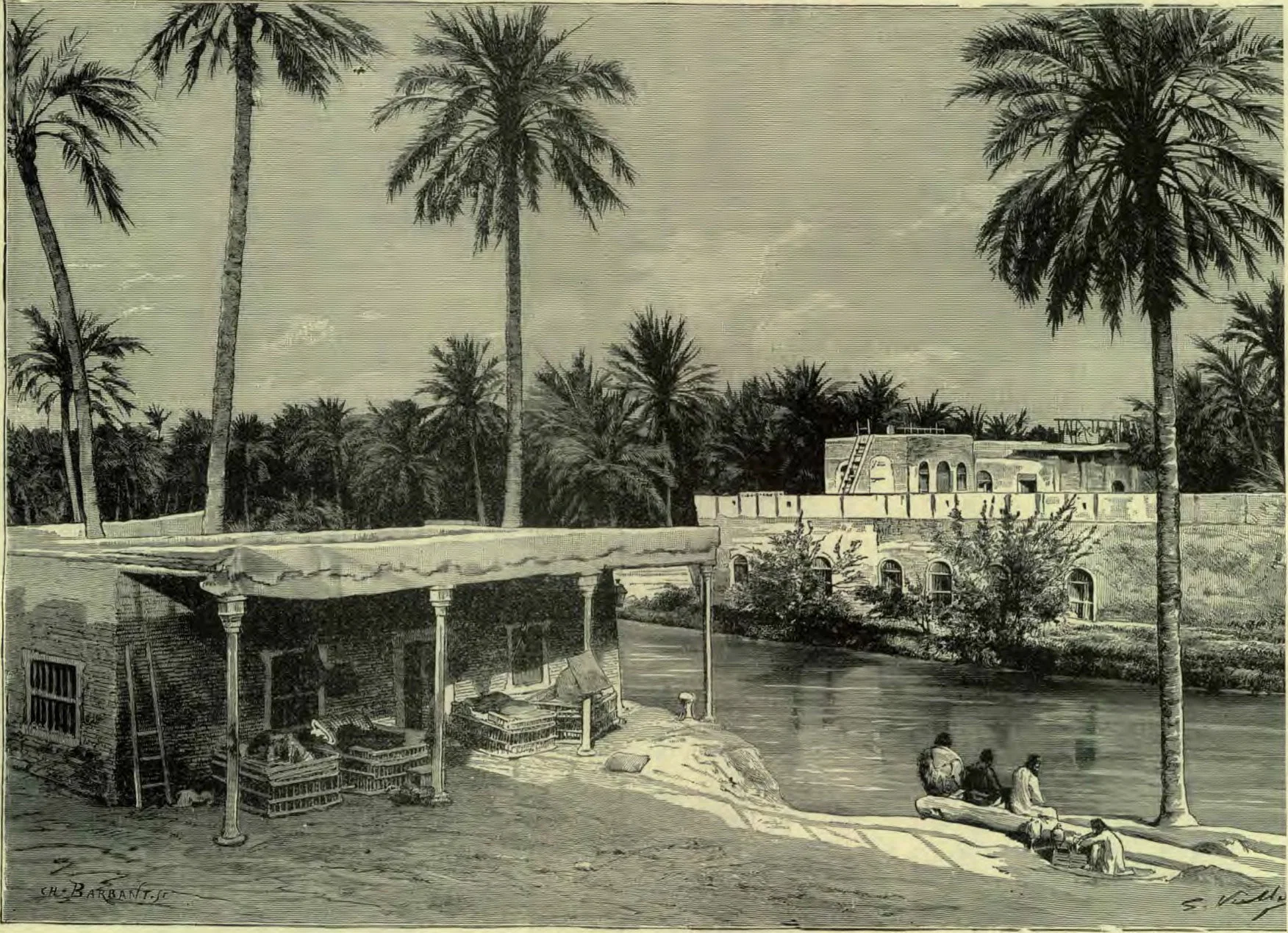
BASSORAH
By A. Kunz
Bassorah (Arabic, a “margin”), is a city of the Turkish province Irak-Arabee, half a mile distant from the west side of Shat-el-Arab (the conflux of the Tigris and Euphrates). Joined with these by a canal is the most influential seaport and trading-post for this part of the country, having been, in its most flourishing period, a great and rich city. In the middle of the eighteenth century it numbered upward of one hundred and fifty thousand inhabitants; but the population rapidly diminished, so that in 1825 it was reduced to sixty thousand, and the plague of 1831 reduced it to thirty thousand, and the plague of 1838 to twelve thousand. In 1854 it numbered only five thousand, and in 1862 from four thousand to four thousand and five hundred. Being neglected by the Turkish government, the place is becoming more and more abandoned, in spite of its natural loveliness and other attractions of no mean order. Its situation, for instance, is most favorable for commerce, and the country around is as fertile as any on earth.
GUARD-HOUSE AND PRISON AT BASSORAH.
The many stately ruins about the city tell of its former splendor; the present buildings, however, dilapidated as most of them are, tell the sad story of neglect and decay. The unexampled filthiness of the streets and the unimproved marshy districts in the environs, make Bassorah a most unhealthful place; and this unhygienic condition of things is heightened, especially in summer-time, by bad drinking water. Such are the fruits of neglect on the part of an imbecile government, when a little judicious labor in draining the marshes and cleaning the streets and watercourses, together with necessary repair on houses, might by the exceedingly great fertility of the soil, turn the place into a paradise. But as it is, the date-palm is about the only fruit raised for export; of this, however, large quantities are shipped. Rice is but little cultivated. Since 1862 an English steamboat company established a regular line between Bassorah and Bombay. The present Bassorah took its rise in the seventeenth century, after the complete abandonment of the site of the old city by that name, whose ruins can still be seen about two miles to the southwest of the Bassorah of to-day.
The older city was founded in 636 A. D. by the second caliph Omar, as a key to the Euphrates and the Tigris. As an emporium for the trade with India and Arabia, it reached its highest prosperity, and won for itself a name also as the home of distinguished poets and men of learning. In the fourth century of the hegira, one of the first Mohammedan academies of learning for the middle ages was founded here; but in the twelfth century the city seemed doomed to decay, which in later centuries increased more and more rapidly. At the conquest of Bagdad, by Murad IV—in 1638—this entire stretch of country fell into the hands of the Turks, and the present Bassorah became the seat of an important and influential paschali. Later it was alternately under the power of the Turks, the Arabians, and the Persians. From 1832-40 Mehemed Ali was in possession of it. Under the rule of Midhat Pasha (1868-72), governor-general of Bagdad and later grand vizier, the city began to rise in importance again, so that the number of its inhabitants is now estimated at over ten thousand.
Through the patronage of Midhat, the Turkish Steam Navigation Company “Oman” was founded, with headquarters at Bassorah. The water trade from Bassorah southward has, since the opening of the Suez canal in November, 1869, gained steadily in importance; but the increasing influx of sand into the river proves a fatal hindrance to its rapid extension. Being the most easterly point of importance toward East Arabia, it forms an excellent base of operation for the extension of Osmanic rule in this direction. Since the summer of 1874 the fortification of the mouth of the stream by means of coast batteries along its right bank, is begun.
The export, besides dates, is chiefly horses. The imports from India are coffee, indigo, rice, spices, and ship-timber for building the barges which ply up and down the Tigris and Euphrates. Two English and seven Turkish steamers run between Bassorah and Bagdad. A telegraph line connects it directly with India. Next to Bagdad, the ancient Bassorah plays the most important role in the history of the Mohammedan caliphs. A. KUNZ.
Compassion for Those Afflicted in Mind
We ought in humanity no more to despise a man for the misfortunes of the mind than for those of the body, when they are such as he cannot help.—Pope.
“HOW CAN WE KNOW?”
By Helen A. Steinhauer
IN TWO PARTS.—PART I.
“How can we know—know to a certainty—whether God wants us to do things or not? I mean things in our daily life or business,” said Reginald, soberly, his dark eyes full of earnest thought.
“‘If any of you lack wisdom, let him ask of God, that giveth to all men liberally, and upbraideth not; and it shall be given him.’ That is what the apostle says.”
“Yes, I know that; but the next text always takes all the strength out of my faith: ‘But let him ask in faith, nothing wavering: for he that wavereth is like a wave of the sea driven with the wind and tossed. For let not that man think that he shall receive anything of the Lord!’ Now I don’t really feel as if I were a ‘double-minded’ fellow,—‘unstable in *all my ways;’ yet I keep questioning whether I positively have faith sufficient to entitle me to that promise; for could I feel so uncertain about it without having in my heart some of the doubt spoken of in the text?’”
“I have been there myself, Regie, and know just how you feel,” I answered, sadly. “Indeed, I presume there are very few Christians that have not had our experience some time or other in their lives. But there are some things of which we may be confident. As sure as there is a right and a wrong to an act, just so surely will the Lord show us what the right is, if we ask with a spirit absolutely submissive as to the result. Some one has said: ‘It is not hard to know the Lord’s will; the hard part is to be willing to do it. Decide to do your duty, no matter how it may cut across inclination, and you will find no difficulty in ascertaining what the duty is.’”
“Aunt Helen, I don’t believe that! At least I think that very often I am honestly and truly willing to do the right thing, if I just were certain what it is.”
“Usually prayerful study of God’s word will help us to find out.”
“But sometimes things right in themselves may be wrong simply because they don’t happen to be the thing that the Lord wants us to do just then. It’s like a fork in a road; each may lead to a place where it would be good and proper for us to go, and yet we can’t go to both at once,—we must choose between them; they can’t possibly both lead to the place to which we intend to go, or to the place to which the Lord wants us to go then!”
“That is a very good illustration, Reginald. In such a case that great man of faith, George Muller, of England, gives this advice:—
“‘Whenever you are in doubt as to God’s will in any matter, wait! That is always safe. He who never is in a hurry will show you before you need to act.’”
“Aunt Helen, what about ‘fleeces’ at such times? Do you ever lay them? Do you think it right to lay them in this dispensation?”
“Many excellent people think not,” I answered, slowly. “I must admit that I myself think there is a better way; it is our privilege to keep so close to the Lord that we may know his will without resorting to them. It seems a little like insisting on sight, when he would rather teach us to walk by faith. Still, I confess I have often been so perplexed that I have spread them; and the dear Lord has graciously given me my desire, granting me the assurance that I craved, in that way.”
“Give me an instance, please, Aunt Helen,” he said, settling himself back in his chair, so as to hear it more comfortably.
“Some eighteen years ago found me in Newark, New Jersey. I had been dismissed uncured from an Eastern health institute, and was quite feeble,—very much of an invalid. I took board in a German family of my acquaintance, and was asking the Lord what step to take next.
“While in this condition, quite unexpectedly H. L. Hastings, of Boston, came to see me, and before leaving, proposed my going to that place, and assisting him.
“Although I had been writing most of my life, I knew practically nothing of newspaper work, and felt physically incompetent to undertake to learn a new trade. This I told him, frankly.
“He answered, in the deliberate manner peculiar to him:—
“‘Talk with the Lord about it, and do whatever he bids you do.’”
“‘But I am physically unequal to the undertaking,’ I replied, a little annoyed at his persistency. ‘There is no use in considering it, under the circumstances.’”
“‘If He wishes you to do the work, don’t you suppose he will give you the ability?’”
“‘Yes; of course I believe that,’ I replied, somewhat reluctantly, as I could see no light whatever in the project, and I again told him so.
“‘You need not be afraid that the Lord will tell you to do anything for which he will not give you the needed strength; all I ask is that you will lay the matter before him, and let him decide for you.’”
“After a little further conversation back and forth, I promised to pray over it. He was to call the next day (I think it was), when I was to communicate the result.
“When he came back, I had to tell him,—quite reluctantly,—that I began to think that it might prove duty to go. Still I lacked the faith to contemplate doing so with anything but hesitation and dread.
“In his slow, quiet way he said:—
“‘Then pray more. I do not wish you to promise till you are sure what the will of the Lord is. I shall be here a few days longer; I will call for your final answer before returning home.’”
“When he came, I was quite strongly impressed that I ought to go, and answered to that effect. Yet strange to say, my reluctance was in no wise removed, although I desired above all things not merely to know, but also to do, my Master’s will.
“He left the city, and I was to follow alone as soon as I could make my arrangements to do so.
“With a heavy heart and mind full of uneasy apprehensions, I started on my journey. At last I cried, impetuously:—
“‘Heavenly Father, I cannot stand this! The wings of my faith are weary, and I cannot soar above the fears that oppress me. Remove them, I pray thee, by giving me evidence of thy will in the matter. If it is indeed thy will that I go, give me, while on the journey, something to do for thee that no one else present is able to do.’”
“It seemed an odd fleece to lay, and quite different from anything I had ever done before, or even heard of any other person’s doing. I think the thought was given me of the Lord, as well as the answer—which was very marked and remarkable.”
Just then the clock struck.
“O Aunt Helen! I shall have to go now,” exclaimed Reginald. “But you will tell me the rest some other time, won’t you?”
“Yes, when we have more time, as it is quite a story.” HELEN A. STEINHAUER,
HIS MOTHER MADE HIM.
A wealthy business man, not long ago, paid a short visit to his native town, and while there was asked to address a Sunday-school on the general subject of success in life.
“But I don’t know that I have anything to say, except that industry and honesty win the race,” he answered.
“Your very example would be inspiring, if you were to tell the story of your life,” said the superintendent. “Are you not a self-made man?”
“I don’t know about that.”
“Why, I’ve heard about your early efforts. You went into Mr. Wilson’s office when you were only ten—”
“So I did; but my mother got me the place, and while I was there, she did all my washing and mending, saw that I had enough to eat, and when I got discouraged, told me to cheer up and remember tears were for babies.”
“While you were there you educated yourself—”
“O no! not at all. My mother heard my lessons every night, and made me spell long words, while she did her work. I remember one night I got so discouraged I dashed my writing-book, ugly with pothooks and hangers, into the fire, and she burned her hands in pulling it out.”
“Well, it was certainly true, wasn’t it, that as soon as you had saved a little money, you bought some fruit, and began to sell it at the railway station?”
The rich man’s eyes twinkled, and then grew moist over the fun and pathos of some old recollection.
“Yes,” he said, slowly; “and I should like to tell you a story connected with that time. Perhaps that might do the Sunday-school good. The second lot of apples that I bought for sale were specked and wormy. I had been cheated by the man of whom I had bought them, and I could not afford the loss. The night after I discovered they were unfit to eat, I crept down to the cellar, and filled my basket as usual.
“‘They look very well on the outside,’ I thought, ‘and perhaps none of the people who buy them will ever come this way again. I’ll sell them, and as soon as they are gone, I’ll get some sound ones.’
“Mother was singing about the kitchen as I came up the cellar stairs. I hoped to get out of the house without discussing the subject of unsound fruit, but in the twinkling of an eye she had seen, and was upon me.
“‘Ned,’ she said, in her clear voice, ‘what are you going to do with those specked apples?’
“‘Se—sell them,’ stammered I, ashamed to advance.
“‘Then you’ll be a cheat, and I shall be ashamed to call you my son,’ she said, promptly. ‘O, to think you could dream of such a sneaking thing as that!’ Then she cried and I cried, and I’ve never been tempted to cheat since. No, sir; I haven’t anything to say in public about my early struggles, but I wish you’d remind your boys and girls, every Sunday, that their mothers care more for them than they do for themselves. Tell them, too, to pray that their mothers may live long enough to enjoy some of the prosperity they have won for their children, for mine didn’t.”
—Home Guard.
Love and Kindness Soften Hearts
LOVE and kindness will soften most any heart.
HEAT IN THE EARTH.
THERE is an abundance of evidence that the interior of the earth is very warm, or, at least, some parts of it. Volcanoes show the natural efforts of these subterranean fires to escape from their smothering covering of earth. But for the vent which the volcanoes supply, the earth would undoubtedly be shaken much oftener than it is by earthquakes. Miners find that the earth grows warm in proportion to the depth of the shafts which they sink. This subject is now much talked of in French scientific circles; and a proposition has been made that, in connection with the exposition which the French nation expects to hold in 1900, the earth be bored to its center, if possible, to demonstrate its actual condition and temperature from the surface as far as they can bore. Some of the most eminent men of France favor this plan. This might be called deep-earth sounding. Man’s knowledge of the earth might very properly be stated to be a surface knowledge; for the deepest mines which have been sunk thus far are but as a scratch upon its surface. But the curiosity of man knows no bounds, and the perfected machinery of modern times makes investigations possible, that once could not have been thought of.
BOYS AND THE CIGARETTE VICE.
THE use of cigarettes is not merely the use of tobacco; it is a vice by itself. In reformatories where the cure of the opium, alcohol, and cigarette habits is a business, cigarette patients are not restricted from smoking cigars or pipes, which are regarded as comparatively harmless. The cigarette works a special evil of its own, which tobacco in other forms does not effect.
This evil result may be due to drugs, or to the paper wrappers, or to the fact that the smoke of cigarettes is almost always inhaled into the lungs, while cigar smoke is not. As to that, let the experts decide; about the fact of the effect, there is no doubt and no dearth of evidence. No other form of tobacco eats into the will as cigarettes do. It is the infernal cheapness of the cigarette and its adaptability for concealment, that tempt the school-boy’s callow intelligence.— Harper’s Weekly.
FARMERS’ TELEPHONES.
Several farmers living near Yankton, South Dakota, are utilizing their wire fences for telephonic purposes. Each farmer supplies himself with a transmitter, and connects his house with the wire of his fence. By the use of what are known as “cell batteries” he is able to converse with his neighbors for a radius of eight miles. The whole expense to each farmer is about twenty-five dollars. This is putting a fence to a novel use, but there must be many times when such a method of swift communication will be of great value to the farmers.
Our Young People and the Camp-Meetings
By J. H. D.
OUR YOUNG PEOPLE AND THE CAMP-MEETINGS.— NO. 1.
We have now reached another camp-meeting season. As is usual, a large number of our young people will attend these meetings. Some may have one object, and some another, according to their spiritual condition. There will be some who attend these gatherings that are unconverted. They may have thought seriously of giving their hearts to the Lord on this occasion; but Satan will do all he can to hinder them from taking this step. There will be attractions on or near the camp-ground that will divert the mind from the instruction given by faithful workers. There will be the influence of careless and gay associates, which will counteract much of the effort put forth.
There will be others at these meetings who are in a backslidden condition, and who expect to receive help at this time. They, too, will meet obstacles that will tend to discouragement. There are many things occurring around them that make it easy to find an excuse for continuing in a backslidden condition.
There is still another class that we wish to mention: they are those who have had good Christian experience, and are supposed to be in a condition to help others. They come to the meeting; but instead of going to work to help those who need help, they are influenced to be careless and light, so that they find themselves farther from the Lord when the meetings close than when they began; and they have been a stumbling-block to those who came for help. They should have been bodies of light, but they became bodies of darkness.
As another camp-meeting season is upon us, it might be well to offer some suggestions for our young people to consider, to aid them to steer clear of some of these stumbling-stones. It is not with the idea of criticism that we speak of these things as we do. We know that young people, as a rule, have good intentions. They do many things that they had not premeditated. The surrounding influences are too strong for them, and under the excitement of these influences, they go contrary to their better judgment. To such, a few words by way of suggestions may be of some assistance. To make the matter as plain as possible, we will ask a few questions for you to think of, and by a few remarks on each, seek to impress the importance of our relationship to the camp-meeting. The first question we shall ask, which will be considered in our next, is, Why do we have camp-meetings? J. H. D.
THE SHEPHERD OF THE SHEEP.
Great Shepherd of the sheep
Who goest on before,
To pasture and to keep
The flock on either shore,
Grant us the wisdom and the grace
In all the way thy steps to trace.
Great Shepherd of the sheep,
The lambs of thine own flock
Would climb the foot-path steep,
Or rest beneath the rock.
As staff or rod, in safety guide,
Until the waters shall divide,
And parted hands are one.
As the sweet tale is told,
The flocks are safely home
Within the heavenly fold,—
All one from every clime and shore,—
One fold, one Shepherd, evermore.
— N. Y. Observer.
Russian Intolerance.
The czar of Russia is giving painful evidence that he does not intend to grant any more liberty to his subjects than his father did, even if he did pose as a more liberal man at the beginning of his reign. This may be seen in his treatment of Madame Modjeska. This lady is a Polish actress of world-wide reputation. When at the World's Fair in Chicago, she gave utterance to some strong words against Russia for the way her country, Poland, had been treated. Lately she appeared at Warsaw, but she was immediately ordered to leave the country, and not to return. Still the world does move; for a hundred years ago she would have been sent to Siberia to work in the mines.
WILL AND WON'T.
An amusing story is told of the present crown prince of Germany, a boy of twelve years. Upon one occasion he was trying to make a donkey draw a cart. The animal refused to move, and all the efforts of the prince were fruitless. The emperor, seeing the condition of affairs, exclaimed: “Your donkey has a great deal of will power.” The little prince quickly replied: “It isn't his will power that troubles me; it is his won't power.”
This is a good illustration of what is the trouble with many people. Every person has a will power and a won't power. God has made the mind free. The mind is the servant of God or the slave of sin as it says “I will” to one and “I won't” to the other. Says Paul: “Know ye not, that to whom ye yield yourselves servants to obey, his servants ye are to whom ye obey; whether of sin unto death, or of obedience unto righteousness?”
Many times during our lives will we be obliged to make decisions between right and wrong. There will be privilege and duty to God and to our fellow-men on one side, and self-gratification and the service of Satan on the other. Then let the will be strong in God to do the right and to refuse the wrong. It may be done by the help of God, and this is what is called in the Scriptures overcoming. Turn to Revelation, chapters two and three, and read the promises to the overcomers.
Japan Mission Donations
JAPAN MISSION: Clifford and Mrs. C. M. Hart, $5.00.