The Youth’s Instructor, Vol. 35, No. 24.

THE MAORI NATIVES

The Youth’s Instructor

Jun 15, 1887

S. D. A. Publishing Association · Battle Creek, Mich. · Jun 15, 1887

THE MAORI NATIVES.
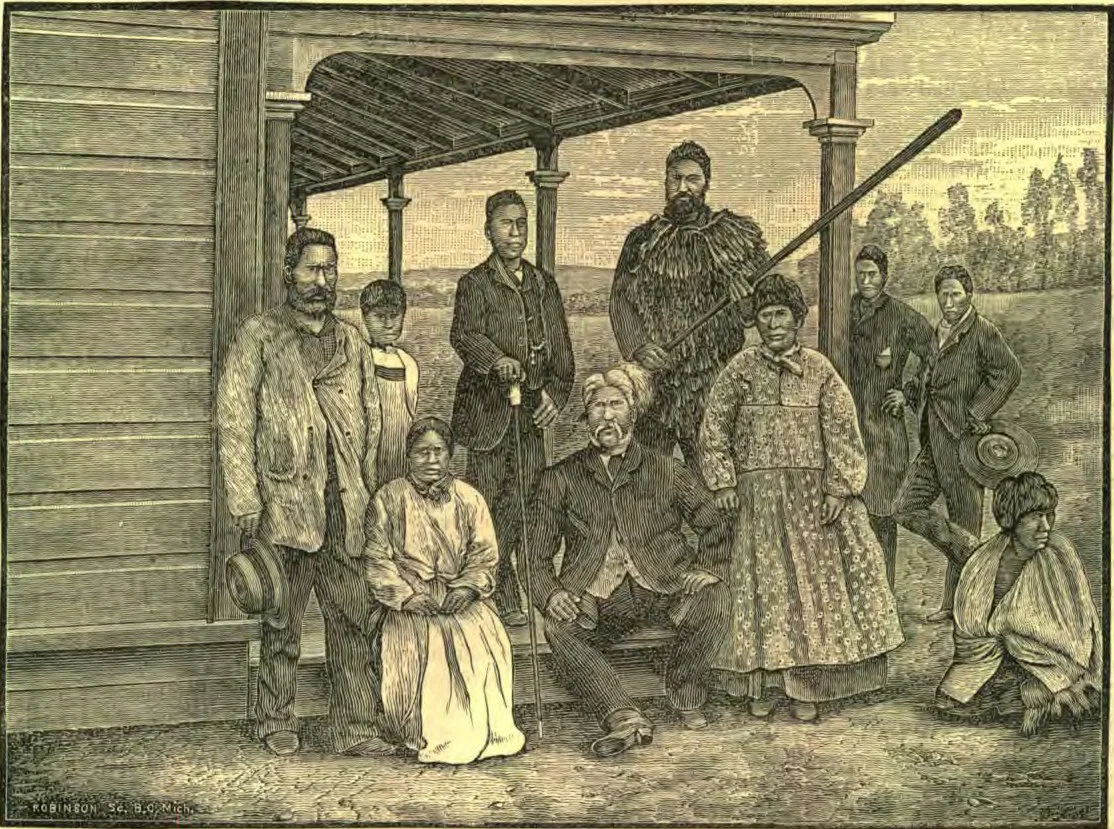
WHEN, about one hundred and eighty years ago, Captain Cook, the English explorer, visited New Zealand, he predicted that its agricultural advantages and pleasant climate would some day make it a prosperous British colony. Could he now rise from his grave amid the South Sea isles, and again view this place, no doubt he would find a prosperity far beyond anything he had anticipated. At that time the island was inhabited by a nation of cannibals; but to-day there are large cities and fruitful farms scattered throughout this far-away land. And not only is the land reclaimed from its wild condition, and the rich soil made to produce abundant harvests, but the Maoris, the aboriginal inhabitants, have been turned from heathenism to the worship of the true God.
In 1814 the first missionaries landed upon the shores of New Zealand; and for the next score or more of years, savage barbarism slowly retreated before the advance of the gospel, until in 1840 the whole land was nominally Christian. Now began the regular colonization of the English, land being purchased of the tribes; and for twenty years, at various intervals, the country became the scene of war and bloodshed, caused by dissatisfaction and jealousy on the part of the natives as they saw their land given up to the white man. For many years, however, peace has reigned, and the Maoris show themselves to be ready learners and open to civilizing influences. They still own millions of acres of land, and one class is intelligently represented in the Colonial Legislature by their own people. Another class inhabit what is known as the “King Country,” having little to do with their English neighbors, and keeping up their own government. Those chiefs who ally themselves to the Government are presented with a substantial frame house as a residence; and in the picture we see a typical Maori household of the more advanced order. In the background stands the chief of his tribe, having on his shoulders a tunic woven of the native flax, and holding in his hand the baton of his authority. The Maoris are fond of patterning after the English customs of dress, and many, as we see, are well clothed. Doubtless the old man in the foreground could tell strange stories of his boyhood days, and of the marvelous changes wrought before his eyes in the past half century. He must have been a young man when Hone Heke, the renowned Nagpuhi warrior, led his barbarian followers against the colonists; and in the prime of life when in 1864 the British troops were again called upon to quell insurrection among the natives. As Christianity brushes away from the minds of this people the trammelings of centuries of ignorance and sin, it brings to light a heart of honesty and integrity, a gem which sparkles none the less brilliantly for lying beneath the dusky breast of these children of nature. And all can but feel a sympathy for them, with a hope that many, because of their integrity and their faith in Christ, will be called to glorify God in his kingdom, and show forth the marvels of his grace.
W. A. SPICER.

JUNE

JUNE! delicious month of June! When winds and birds all sing in tune; When in the meadows swarm the bees, And hum their drowsy melodies While pillaging the buttercup, To store the golden honey up; O June! the month of bluest skies, Dear to the pilgrim butterflies, Who seem gay-colored leaves astray, Blown down the tides of amber day: O June! the month of merry song, Of shadow brief, of sunshine long; All things on earth love you the best,— The bird who carols near his nest; The wind that wakes, and, singing, blows The spicy perfume of the rose, And bee, who sounds his muffled horn To celebrate the dewy morn; And even all the stars above At night are happier for love, As if the mellow notes of mirth Were wafted to them from the earth. O June! such music haunts your name; With you the summer's chorus came! —St. Nicholas.

THE GRAY WOOLEN SOCK.

Many and varied were the exclamations that greeted Nell Erwin as she entered the school-room, and drew out her work,—a coarse, gray woolen sock.
It was “Fancy Friday” at Daisy Hill Seminary,—something peculiar to the place. Three Fridays out of the month were spent in the customary elocutionary exercises; but the afternoon of the fourth was spent in a cozy, informal way, the girls, both day scholars and boarders, bringing their fancy work, and Madame Lane reading to them from some standard work.
At the present time, she was in the midst of a translation of the Iliad; but I fear that, in spite of Madame’s clear and beautiful rendition, Jove, the Cloud-gatherer, Juno, the Ox-eyed, and the other Homeric worthies, were less fascinating than “rickrack” and “Kensington stitches.”
On this particular Friday there was a brilliant display of fancy work. Helen Grant was embroidering a pair of slippers—splendid purple and yellow pansies; Lulu Fletcher, a sofa pillow,—a cluster of lilies on cardinal satin; Katie Lee was at work on an elaborate stand-spread; Mary Morse was crocheting a fleecy white shawl; Carrie Evans was making an applique bracket; a dozen or so girls were deep in the delightful mysteries of “crazy quilts;” and— But, dear me! I have not the time to enumerate all the beautiful things. Seats and desks were covered with a dazzling array of silks and worsteds.
So you see it was no wonder that Nell’s humble gray sock created such a sensation. However, though she blushed a little at the pleasantries of her mates, she took her seat and courageously set to work.
“Why, Nell, I thought you were going to bring that lovely foot-rest!” said Helen Grant. “You told me yesterday that you were going to finish it to-day. Have you it already done?”
“Oh, no!”
“Then, why under the sun didn’t you bring it, instead of this solemn old sock?”
Nell blushed still redder. Then she said, hesitatingly: “Well, you see, girls, I did think I’d bring the foot-rest. In fact, I had it all done up in my work bag, and then I remembered that I would need a pair of scissors. So I went to mother’s work-basket; and, in rummaging around there, I got an idea!”
“An idea in a work-basket! How very remarkable! Now, I shall know where to go when I am obliged to write a composition, and can’t think of anything to say!” said Maud Hasket.
“What I mean is this,” said Nell, earnestly: “I found that work-basket full—yes, full to overflowing—with things to mend, make, and fix! There were Billy’s mittens to mend, the baby’s petticoats to be shortened, buttons to be sewed on Kitty’s apron, a patch on Tom’s jacket, and all for my dear little mother’s one pair of tired hands! And all to be done this afternoon or evening! I tell you, girls, I felt ashamed when I looked at my own nonsensical piece of fancy work. And then and there I made up my mind to do something toward lessening the contents of that basket. So I seized this sock, for I remembered hearing mother say, only a few days ago, that father needed a new pair. I’m not much of a hand at knitting; but I’ll do all I can this afternoon, working on the leg, and, when I get home to-night, mother’ll show me about fixing the heel.”
There was a short silence.
Presently Maud said: “Well, girls, I dare say the most of us have mothers whose work-baskets are in the condition of the one Nell has described. I’ve no doubt that I can find one in my own home. There are six of us children,—four younger than myself. It would take one woman’s time to keep our little Ben in anything like decent order. And Sister Flo is almost as bad. She’s a perfect tomboy! Tears regular barn-door holes in her apron!”
“Well, it’s pretty much the same at our house,” observed Maggie Gray. “Of course there are not so many of us; but still, mother’s sewing, mending, and darning, about all the time.”
“And mine, too!” said Laura Harris.
“It was only last evening that I heard father ask mother if she wouldn’t go to the lecture with him; and she said she would like to very much, but couldn’t go, because she had to patch Jack’s trousers, so that he could wear them to school the next day. And I sat there, like an unfeeling wretch, working on a silly, good-for-nothing lamp-mat! And mother did look so tired and wistful. Father seemed disappointed, too. Now, I might have offered to do the patching, and so given her a chance to go. It would have done her so much good!”
“Well,” said Maud, briskly, “I guess we’re all in the same fix. Suppose we all agree to go to our respective mothers’ mending-baskets, and get work from it for our next Fancy Friday?”
“All right! We will!” chimed the others. Further conversation on the subject was put to an end by the entrance of Madame, Iliad in hand; and for the next hour the girls were regaled by the account of Achilles dragging the body of Hector nine times around the walls of Troy.
“Four!” chimed the great clock in the hall.
“Young ladies, you are dismissed,” said Madame, closing her book. “Next time, I think we will have a little prose instead of poetry. It will be a change, you know. Good afternoon.”
“Prose instead of poetry,” Maud repeated, as they put on their wraps. “And we’ll have the prose of sewing instead of its poetry, won’t we?”
And Nell answered by a wave of the gray woolen sock. “You dear old sock,” she whispered, as she rolled it up, “how I did hate to bring you this afternoon, for I was so afraid the girls would make fun! But it will turn out nicely, after all.”—The Pansy.

MARY AND HER LITTLE LAMB.

MANY dear children have been pleased to read the poem entitled, “Mary’s Little Lamb.” And perhaps many persons have wondered whether the poem was founded on truth, or whether some poet wrote it to amuse himself, and to please the little ones. For the benefit of our young readers, we give below the answer to the questions: “Who was the author of ‘Mary Had a Little Lamb,’ and under what circumstances was it written?” Said the Inter-Ocean, recently:—
“Many readers will be surprised to learn that the well-known verses called, ‘Mary had a Little Lamb’ were founded on actual circumstances, and that its heroine, Mary, is still living. About seventy years ago she was a little girl, the daughter of a farmer in Worcester County, Mass. One spring the farmer brought a feeble lamb into the house, and Mary adopted it as her especial pet. It became so fond of her that it would follow her everywhere. One day it followed her to the village school, and, not knowing what else to do with it, she put it under her desk and covered it with her shawl. There it stayed until Mary was called up to the teacher’s desk to say her lesson; and when the lamb walked quietly after her, the other children burst out laughing. So the teacher had to shut the little girl’s pet in the woodshed until school was out. Soon after this a young student named John Rollstone wrote a little poem about Mary and her lamb, and presented it to her. The lamb grew to be a sheep, and lived for many years; and when at last it died, Mary grieved so much for it that her mother took some of its wool, which was “as white as snow,” and knitted a pair of stockings for her to wear in remembrance of her darling. Some years after the lamb’s death, Mrs. Sarah Hall, a celebrated woman who wrote books, composed some verses about Mary’s lamb, and added them to those written by John Rollstone, making the complete poem as we know it. Mary took such good care of the stockings made from her lamb’s fleece, that when she was a grown-up woman, she gave one of them to a church fair in Boston. As soon as it became known that the stocking was made from the fleece of ‘Mary’s little lamb,’ every one wanted a piece of it; so the stocking was raveled out, and the yarn cut into short pieces. Each piece was tied to a card on which ‘Mary’ wrote her full name, and these cards sold so well that they brought the large sum of $140 to the Old South Church.”
Do any of our readers think the poem would ever have been written if Mary had abused her lamb? I think not. And can any one tell why the lamb loved Mary, and had such satisfaction in following her from place to place?
“What makes the lamb love Mary so? The eager children cry. Oh, Mary loves the lamb you know; The teacher did reply.”
Some one has written:—
“A man of kindness, to his beast is kind; But brutal actions show a brutal mind.”
Is this true of children? Who will answer? “Even a child is known by his doings, whether his work be pure, and whether it be right.” Prov. 20:11.
A. S. HUTCHINS.

PUT TO THE TEST.

JOHN DEAN was on trial in a large business house. He had been engaged for a month; and the understanding was that if he proved satisfactory, at the end of the month he should be entered as one of the regular employés of the firm. Of course, as his future depended greatly on his conduct, the young man tried to do his best, and in every way sought to win the good-will of his employers.
One day toward the close of the month, Mr. Foster, the head of the firm, called John into his private office, and, bidding him be seated, began talking pleasantly to him about his work.
“Dean,” said Mr. Foster, “you have pleased us very much. You have been attentive to business, quick to understand what there is to be done, and faithful to our interests. If you keep on in this way, I think there is no doubt of our giving you a permanent engagement. I say this to you for your encouragement, and because I feel an interest in your welfare.”
“I am sure,” replied John, his cheeks red with the flush of joy Mr. Foster’s kind words had brought to them, “that I am very thankful to you for both your praise and your advice. I know I want to do my duty, and there is nothing I should like more than to remain in your employ.” He was about to rise and go back to his place in the store.
“Stay a moment,” said Mr. Foster; and, going to a small cabinet, he took out a bottle of wine and poured a glass full of the sparkling fluid. “Take this glass of wine before you go,” he said.
For a moment John’s mind was in a whirl. “If I refuse to take this wine,” he said to himself, “I may offend Mr. Foster, and upset all my chances for the future. But how can I take it? I have promised mother never to drink anything that intoxicates; and besides that, it is wrong.” He was a young man of principle, and his decision was soon made. Looking up to Mr. Foster, he said, quietly but firmly, “Excuse me, Mr. Foster. I never drink wine.”
“Why not?” said his employer. “A glass of good wine will not hurt you. Besides, it is not very polite to refuse an offer of this kind.”
“That may be, Mr. Foster,” said John, his cheeks again flushing, “but I promised my mother that I would never drink wine; and then, too, I am afraid that I might form the habit of drinking. You must excuse me, Mr. Foster. I really cannot take it.”
He said this so firmly that his employer turned to put the glass back into its place. He was a good while about it, and when he turned to speak, he said, “Dean, I wanted to see whether you could resist temptation. You have resisted it nobly. Give me your hand, my boy. Go home and tell your mother she has a son of whom she should be proud. When your month of trial is closed, you may consider yourself as a regular clerk in this house; and may God ever bless you and keep you faithful.”
It need scarcely be said that John Dean went out from the office of his employer a happy young man. The lesson he had learned proved a lasting one. When temptations came, he remembered the scene in the counting-room, and put them at once behind his back. In after years he was everywhere recognized as a man of sterling worth. God help all young men, when put to the test like him, to stand firm.—Our Young People.

TOUCH IT NOT.

CHILDREN, do you see the wine In the crystal goblet shine? Be not tempted by its charm; It will surely lead to harm. Children, hate it! -Touch it never! Fight it ever!
Do you know what causeth woe Bitter as the heart can know? 'Tis the self-same ruby wine Which would tempt that soul of thine. Children, hate it! Touch it never! Fight it ever!
Never let it touch your lips; Never even let the tips Of your fingers touch the bowl; Hate it from your inmost soul. Truly hate it! Touch it never! Fight it ever!
Fight it! With God's help stand fast Long as life or breath shall last. Heart meet heart and hand join hand, Hurl the demon from our land. Oh, then, hate it! Touch it never! Fight it ever!

LESSON FROM A PARSLEY LEAF.

More than a hundred years ago there lived a workman in the cotton districts of Lancashire, England, who was honest, hard-working, industrious, earnest in whatever he undertook, but only a poor man withal. Yet he was one of those poor men who rise to be rich men through their own energy, thought, and toil. He was rising now, just as you might rise, because he put his heart into his work. Little by little he moved upward, from a lower to a higher grade, to a more responsible position.
Cotton was not then what it is now; frocks were not so pretty, nor calicoes so cheap, as they are to-day. But things were improving; the work that had been done slowly by human hands was just beginning to be done swiftly by machinery, and every man who watched the course of things set his wits at work to see what new suggestions might be made. The worthy man of whom we have been speaking was of this kind. He was quick to perceive not only what to do, but how to do it, and his eyes were ever open to take in help and hints from every quarter.
One day he had gone into his humble room, and was pondering over what improvements might be made in the patterns on the prints. The patterns were large and coarse, and he wanted to make them more neat. Just then his little daughter came in from the garden; she had a parsley leaf in her hand, and she held it up for her father to look at. All at once it flashed across him to contrive a pattern like that—chaste, simple, and delicate in its graceful tracery, so different from the gaudy, flashy ones, which he was accustomed to see. He did so; there were many difficulties, his hand was rough and unsteady, his eye was not used to following such close details, but he conquered at last, and the result was admired and approved by all.
So this was one of the means by which the workman rose to fame and fortune. Perhaps without the parsley leaf he might never have been so rich and great a man as he became, nor might the world ever have known his still greater son, Sir Robert Peel, the statesman and prime minister of England.
So I want you, just like this, to try and keep your attention awake to everything that comes before you, since you know not to what it may lead. Don't go through the world with your eyes shut. We ought to be always taking impressions. You know the mark left behind by your footsteps when you have walked over the snow or the dewy grass; just so every fresh sight and every new event should leave its trace upon your tender minds. If they are on the alert, they will be continually taking in and gathering something, and you will find as you grow older that the reason why some people are more clever than others is very much because they observed everything, and others observe nothing.
Above all, I want you to have an eye open for the beauty God has spread around you, and a heart soft and tender to take in those impressions which his love and grace are waiting to make upon you.—Child's Companion.

HOW SUCCESS IS WON.

In the vast majority of instances, great men owe their brilliant successes not to some sudden stroke of genius, but to long and careful previous training.
Henry Clay, perhaps the most famous of American orators, gave the following account of the method by which he gained his mastery of the speaker’s art: “I owe my success in life,” he said, “chiefly to one circumstance—that at the age of twenty-seven I commenced, and continued for years, the process of daily reading and speaking upon the contents of some historical or scientific book. These off-hand efforts were made sometimes in a cornfield, at others in the forest, and not unfrequently in some distant barn, with the horse and the ox for my audience. It is to this early practice of the art of all arts that I am indebted for the primary and leading impulses that stimulated me onward, and have shaped and molded my whole subsequent destiny.”—Selected.

SACRIFICE

LESSON 1.—THE TRUE SPIRIT OF SACRIFICE.

1. WHEN the Philippians sent gifts to Paul to sustain him in the work of the Gospel, what did he say about the acceptableness of their offering? Philippians 4:18.
2. How does God regard such offerings? Last part of the same verse.
3. What admonition is given with respect to such offerings? Heb. 13:16.
4. What is the meaning of the word communicate as used in this passage?—To share our means and blessings with others, and hence to help the needy. See Webster.
5. Give examples to show that such sacrifices are expected in this dispensation. Acts 11:27-30; 2 Cor. 8:1-4; etc.
6. If such gifts are made from the heart, what will result to the giver? Phil. 4:17; Prov. 11:25; Matt. 19:21.
7. Can ordinary sacrifices, however costly, atone for a lack of genuine kindness and Christian sympathy? Matt. 9:13; 1 Cor. 13:3.
8. What other sacrifices does God require? Ps. 107:22.
9. What admonition does Paul give with respect to this kind of sacrifices? Heb. 13:15.
10. Which seems to stand first,—the sacrifice of praise and thanksgiving, or the sacrifice of means? Compare verses 15 and 16.
11. Could either be genuine without leading to the other?
12. What seems to be associated with the sacrifice of thanksgiving?—Prayer and the paying of vows. Ps. 116:17, 18.
13. What sacrifices seem to be particularly precious in the sight of God? Ps. 51:17.
14. Why is this called sacrifice?—Because it requires the giving up of one's own way, and to yield up the will is the hardest thing that any one has to do.
15. What encouragement is given to those who are contrite and humble? Isa. 57:15.
16. Will such Christians always be appreciated by their brethren? Isa. 66:2, 5.
17. Who promises to remember these humble ones that tremble at his word? Verse 2.
18. What does he say to the opposite class, who have no appreciation of this principle? Verses 3, 4.
19. How is this state of mind illustrated in the case of Judas? Mark 14:4, 5; Matt. 26:8, 9; John 12:4-6.
20. How was the opposite spirit illustrated by Mary? John 12:3.
21. How did the Saviour vindicate Mary? Mark 14:6-9.
22. What effect does this vindication of Mary and the accompanying reproof seem to have had upon Judas? Verses 10, 11.
23. What conclusion would we draw from this?—That the sacrifices of a heart subdued by grace, and broken by love, will constitute the costliest gift that any one can bestow.

NOTES.

OFFERINGS being regarded as an expression of gratitude and piety, and required as a necessary part of ordinary private life, were diligently and abundantly presented, failure in this point being held as a sign of irreligion; and deprivation of this privilege was among the calamities of the period of exile.—Kitto.
“God required of his ancient people three yearly gatherings. ‘Three times in a year shall all thy males appear before the Lord thy God in the place which he shall choose; in the feast of unleavened bread, and in the feast of weeks, and in the feast of tabernacles; and they shall not appear before the Lord empty. Every man shall give as he is able, according to the blessing of the Lord thy God which he hath given thee.’ No less than one-third of their income was devoted to sacred and religious purposes.
“Whenever God’s people in any period of the world, have cheerfully and willingly carried out his plan in systematic benevolence and in gifts and offerings, they have realized the standing promise that prosperity should attend all their labors just in proportion as they obeyed his requirements. When they acknowledged the claims of God, and complied with his requirements, honoring him with their substance, their barns were filled with plenty. But when they robbed God in tithes and in offerings, they were made to realize that they were not only robbing him but themselves; for he limited his blessings to them, just in proportion as they limited their offerings to him.”
“God requires no less of his people in these last days, in sacrifices and offerings, than he did of the Jewish nation. Those whom he has blessed with a competency, and even the widow and the fatherless, should not be unmindful of his blessings. Especially should those whom God has prospered render to him the things that are his. They should appear before him with a spirit of self-sacrifice, and bring their offerings in accordance with the blessings which he has bestowed upon them. But many whom God prospers manifest base ingratitude to him. If his blessings rest upon them, and he increases their substance, they make these bounties as cords to bind them to their possessions; they allow worldly business to take possession of their affections and their entire being, and neglect devotion and religious privileges. They cannot afford to leave their business cares, and come before God, even once a year. They turn the blessings of God into a curse. They serve their own temporal interests, to the neglect of God’s requirements.”
It is reasonable to suppose that it was upon the Sunday before the Saviour’s crucifixion that he sat at meat with Simon, whom he had cured of a loathsome disease, on one side, and Lazarus, whom he had raised from the dead, on the other, the feast having been prepared by Simon. Jesus in mercy had pardoned the sins of Mary, which had been many and grievous, and her heart was full of love for the Saviour. At a great sacrifice she had purchased an alabaster box of precious ointment, with which to anoint the body at his death. The costliest anointing oil of antiquity was the pure spikenard, drawn from an Indian plant, and exposed in flasks of alabaster for sale throughout the Roman Empire, where it fetched a price that put it beyond the reach of any but the wealthy. Of this Mary had bought a flask containing about twelve ounces weight. . . . Seeking to avoid observation, she anointed his head and feet with the precious ointment, and then wiped his feet with her long, flowing hair. Her movement had been unobserved by others until the odor filled the house with fragrance, which published her act to all present. Simon, the host, who was a Pharisee, was influenced by the words of Judas, who boldly expressed his disapprobation of such wasteful extravagance, and it filled his heart with unbelief. Judas was the prime instigator of this disaffection among those who sat at the table, but was a stranger to the deep devotion and homage which actuated Mary to her deed of love. “He had indulged in a spirit of avarice until it had overpowered every good trait in his character. This act of Mary’s was in such marked contrast with his selfishness that he was ashamed of his avarice, and sought to attribute his objection to her gift to a worthier motive. Turning to the disciples, he asked, ‘Why was not this ointment sold for three hundred pence and given to the poor?’ Thus he sought to hide his covetousness under apparent sympathy for the poor, when, in reality, he cared nothing for them.” The love of money had perverted the nobler nature of Judas, making him a fit agent for Satan to use in the betrayal of Christ. He was annoyed at the rebuke implied in Christ’s answer, and made it the occasion of at once proceeding to betray his Lord. “But the Saviour had observed all that had transpired, and knew the motives of all who were there assembled. He read the object of Mary in her costly offering. Though she had been very sinful, her repentance was sincere, and Jesus, while reproving her guilt, had pitied her weakness and forgiven her. Mary’s heart was filled with gratitude at the compassion of Jesus. Seven times she had heard his rebuke to the demons which had once controlled her heart and mind, and she had listened to his strong cries to the Father in her behalf. She knew how offensive everything impure was to the unsullied mind of Christ, and she overcame her sin in the strength of her Saviour. She was transformed, a partaker of the divine nature.”
This truly illustrates a heart of deep contrition. No act, however small it may be, passes by unnoticed; no sacrifice, however insignificant it may be, but is costly in the sight of God when proceeding from such a heart.

Spurious Modesty and the Shirking of Duty

THERE is a great deal of spurious modesty in the world which is simply cowardice. When a man shrinks from accepting a well-merited honor, that is modesty; when he shrinks from the performance of a recognized duty, that is cowardice, though he may call it a modest distrust of his own powers. True modesty shrinks from the reward of work well done; false modesty shrinks from the work itself. This affords an excellent test for ourselves and others. Is it the honor we shrink from? or is it the responsibility?—S. S. Times.

THE LIBERTY CAP.

The Inter-Ocean gives the origin and history of the liberty cap, and why it was placed on American coins, as follows:—
“The liberty cap is of Phrygian origin. The Phrygians were a people from the shores of the Euxine Sea, and they conquered and took possession of the entire eastern part of Asia Minor. To distinguish themselves from the natives, the conquerors wore a close-fitting cap, and had it stamped on their coins. The Romans took the fashion of wearing caps from the Phrygians, but they were only worn by freedmen. When a slave was set free, a red cap called the pileus was put on his head, and this was a token of his manumission. When Saturnius took the Capitol in the year 263, he had a cap set up on the top of a spear as a promise of liberty to all slaves who would join him. Marius used the same expedient to incite the slaves to take arms with him against Sylla. When Cæsar was murdered, the conspirators carried a cap on a spear, as a token of the liberty of Rome, and a medal was struck with the same device on this occasion, which is still extant. The statue of the Goddess of Liberty on the Aventine Hill carried in her hand a cap as an emblem of freedom. In England the same symbol was adopted, and Britannia was pictured carrying the cap on a spear. It was first used in this country as one of the devices on the flag of the Philadelphia Light Horse Guards, a company of militia organized some time prior to the Revolution. Aug. 31, 1775, the Committee of Safety, at Philadelphia, passed a resolution providing a seal for the use of the board, ‘to be engraved with a cap of liberty and the motto, “This is my right, and I will defend it.”’ During the French revolution the Jacobins made much use of this emblem; and it is sometimes supposed that this country took it from France, but this idea is an erroneous one. The symbol was not used in France until 1790, whereas in this country it was not only used much earlier in the instances we have mentioned, but was also put on American coins in 1783. The Jacobin cap of France was red. The British liberty cap was blue with a white border. The American is blue with a border of gilt stars on white.”

SOME DIFFERENCES IN PERSONS' TASTES.

Among some of the Pacific islanders, hens' eggs are saved to sell to ships, but are never eaten by the natives. Strawberries and raspberries are found, but they are never eaten. The Esquimaux generally dislike all the preparations of vegetables that the explorers bring among them. They think it is a perverted appetite that craves anything but meat. The natives of New Guinea cook a few cereals in their own fashion, but they made very wry faces when they attempted to eat some fresh-baked biscuits that the missionaries gave them. They finally wrapped their biscuits up in paper, intending to keep them as curiosities. The same tribes that are astounded at some of the articles white men put into their stomachs, very likely eat grasshoppers, ants, monkeys, elephants, and many other things that have not been introduced into our cuisine. The pure white salt of commerce is the one article in the nature of food that they are all glad to get. On some of the islands of the Malay archipelago there are hundreds of natives whose only industry is to collect the edible birds' nests, that are esteemed a great dainty by the Chinese. They wouldn't dream of eating them themselves, and they think the Chinese must be very peculiar people to use that sort of food. There are a number of tribes in Africa whose chief riches are their herds of cattle, but who never drink a drop of cow's milk in their lives. They think the milk of their herds is for calves and not for human beings, and they are disgusted at the idea that anybody should consider it a proper article of food. A few tribes near the great lakes think that it is a spectacle worth seeing to look at the missionaries milking cows and drinking the milk. The Esquimaux near Littleton Island once discovered a supply of bread and salt pork that Doctor Kane had cached, and they proceeded to enjoy a feast at the white men's expense. They liked the salt pork, and did not leave a morsel of it. This was probably the first chance they had ever had to vary the monotony of their meat diet. They nibbled the bread a little, promptly pronounced it a failure, and told Dr. Kane afterward that they would as soon swallow so much sand.—Selected.

CONCERNING NUTMEGS.

The nutmeg trees grow on the islands of Asia and tropical America, and look like small pear trees. They bear fruit seventy or eighty years. In Jamaica there is one tree that every year has on it over 4,000 nutmegs. The fruit is about the size of a peach; and when ripe, it breaks open and shows the seed, which is the article known to commerce as the nutmeg. Mace is the thin covering over the seed. The Dutch have not controlled the nutmeg trade for many years. They tried to confine the growth of the nutmeg to the Banda islands, which they owned, but the nutmeg pigeons carried the nuts into all the surrounding countries, and the trees grew and flourished in spite of the would-be monopolists.

Secrets of the Rough Ascent

He that hath climbed the rocks can alone tell you the secrets of the rough ascent.—Frederic W. Faber.
Continue reading: LAME SACRIFICES