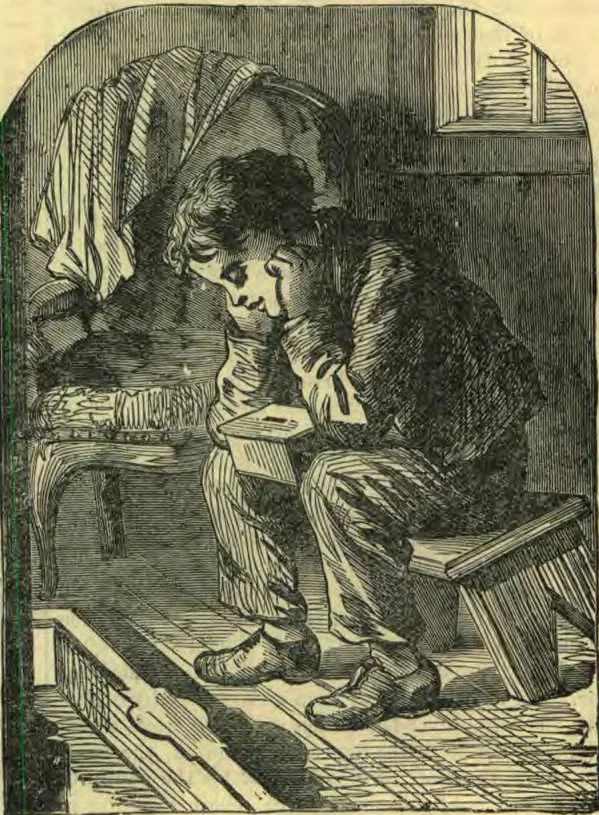
HARRY was having a fight—a fight with himself. The good and the bad were fighting together for the mastery, and it was hard to tell which would come off conqueror.
Harry sat before the open grate, in which a low fire was burning, and he held his money box on his knees. In the money box were bright pennies and nickles and dimes, that he had been saving for a long while. He liked to save his money; and, I am sorry to say, he was such a selfish little boy that it was very hard for him to give any of it away. Besides, he especially wanted to save it now, because he meant to buy a bat and ball, and he had almost money enough.
Harry hardly ever put more than a penny into the contribution envelope at Sabbath-school; sometimes he did not put in even that, though he often earned many pennies during the week.
Deep down in his pocket, under marbles, broken jack-knives, tops, and strings, lay a tarnished dime. It had had a hole drilled in it once, but this had been cleverly filled with lead; and now that the dime had lost its first brightness, this no longer showed. Like a great many other stingy people, Harry was anxious to be thought generous. When the rest of the boys gave their donations to the teacher, Harry imagined they laughed at him because his was no larger, though I don't suppose the boys thought anything about it.
“Now,” whispered the bad voice at Harry's elbow, “you needn't take any money out of your box. There's that dime in your pocket; just put that in. The boys won't be near enough to see the hole, and if they did, you could put your finger over it; and the teacher will never know, when she counts the money, which one gave it.”
“For shame!” cried the good voice on the other side. “It is wrong to give that which is of no use to you.”
“No one will know,” urged the bad voice.
“But you will know,” said the good voice. “You will know you cheated.”
“Pshaw! what of that,” replied the bad voice, “when you want that new bat and ball? May be they'll be gone before you can get enough money saved.”
“O dear!” sighed Harry. “I think I cannot take out any now. I'll put the box up till after supper.”
In Harry's home they were in the habit of reading a chapter from the Bible every evening, and they all took turns reading a verse or more apiece until the chapter was finished.
Grandpa took down the large family Bible this evening, and opened to the place; it happened to be the first chapter of Malachi. He talked some about the prophet and the people who lived when this book was written, so as to make it plain to Harry and the other children. Then they began reading. The eighth verse fell to Harry, and he read, very slowly, these words:—
“And if ye offer the blind for a sacrifice, is it not evil? and if ye offer the lame and the sick, is it not evil? offer it now unto thy governor; will he be pleased with thee, or accept thy person? saith the Lord of hosts.”
Then Harry thought again of the worthless dime. The bad voice was far away, and the good one whispered loudly in his ears, “It is a bad sacrifice; do not give it. The eyes of the Lord are in every place, beholding the evil and the good. He will see, if your teacher does not.”
And I am happy to say that Harry listened to the good voice; for the bad dime never went to Sabbath-school at all. Harry threw it so far away that he could not find it, and be tempted with it again; and in its stead a new, shiny one found its way into the contribution envelope.
Harry did not grow generous all at once. It took a long while for him to become willing to give; but I fancy he found it easier after he had had this battle with himself, and had conquered. And I wonder if there are not other boys and girls who would do well to remember that the Lord is displeased when we bring him lame sacrifices: but that when we give anything to him, it should be of the best we have.
W. E. L.
ALWAYS GROWING.
WHAT do you do in the ground, little seed,
Under the rain and snow,
Hidden away from the bright blue sky,
And lost to the madcap sparrow’s eye?
“Why, do you not know?
I grow.”
What do you do in the nest, little bird,
When the bough swings to and fro?
How do you pass the time away
From dawn to dusk of the summer day?
“What! do you not know?
I grow.”
What do you do in the pond, little fish,
With scales that glisten so?
In and out of the water grass,
Never at rest, I see you pass.
“Why, do you not know?
I grow.”
What do you do in the cradle, my boy,
With chubby cheeks all aglow?
What do you do when your toys are put
Away, and your wise little eyes are shut?
“Ho! do you not know?
I grow.”
Always growing! by night or day
No idle moments we see:
Whether at work or cheerful play,
Let us all be able to say:
“In the goodness of God,
We grow!”
—S. S. Times
GOOD-NIGHT
By Sydney Dayre
GOOD-NIGHT, pretty Sun, good-night; I've watched your purple and golden light While you are sinking away. And some one has just been telling me You're making over the shining sea, Another beautiful day; That, just at the time I am going to sleep, The children there are taking a peep At your face,—beginning to say, “Good morning!” just when I say good-night! Now, beautiful Sun, if they've told me right, I wish you'd say good-morning for me To all the little ones over the sea. —Sydney Dayre, in St. Nicholas.
A RICH GIFT.
The teacher of a girl's school in Africa wished her scholars to learn to give. She paid them, therefore, for doing some work for her, so that each girl might have something of her own to give away for Jesus' sake. Among them was a new scholar—such a wild and ignorant little heathen that the teacher did not try to explain to her what the other girls were doing.
The day came when the gifts were handed in. Each pupil brought her piece of money and laid it down, and the teacher thought all the offerings were given. But there stood the new scholar, hugging tightly in her arms a pitcher, the only thing she had in the world. She went to the table and put it among the other gifts, but before she turned away she kissed it.
There is One who watched and still watches people casting gifts into his treasury. Would he not say of this African girl, “She hath cast in more than they all”?—Mission Record.
Letter Budget.
Louis A. Adamson, of Palo Alto Co., Iowa, sends his first letter, in which he says he goes to Sabbath-school, and studies Book No. 6. He likes his teacher; also the INSTRUCTOR, which he takes.
Rena Root writes from Floyd Co., Iowa. She says: “I am a little girl six years old. I have three brothers. I go to Sabbath-school and day school. I study reading, arithmetic, language, and spelling. I wrote this letter all myself. Love to all the INSTRUCTOR family.”
Mary Wayman, of Otter Tail Co., Minn., had her mamma write for her, saying: “I am a little girl five years old and keep the Sabbath with my papa and mamma. I get lessons every Sabbath in Book No. 1, and learn a verse in the Bible. I have one sister and a baby brother. I am trying to keep God’s commandments.”
Maudy M. Fisher, writing from Lincoln Co., Neb., says they have a nice Sabbath-school, and a church which was organized in 1882. They also have a nice church building. She attends Sabbath-school regularly with her parents, two sisters, and one brother, and says: “I am trying to keep the commandments, so I can meet in the new earth all the little girls that write letters in the Budget.”
Lovina May Sherwood sends a letter from Crawford Co., Wis. She says: “I have never written to the Budget before, but I like to read it. I am ten years old. I have two sisters and one brother, and we all keep the Sabbath. My brother is at Battle Creek College. We have Sabbath-school every Sabbath at our house. We take six copies of the INSTRUCTOR, and we all like to read them. I was at the Madison camp-meeting last summer.”
Nettie Kinney, writing from Monona Co., Iowa, says: “This is my first letter to the Budget. I have been wanting to write for a long time. I have two brothers and a sister. I have a lamb which I call Bob. My sister has a lamb too. We have been keeping the Sabbath almost four years. I go to Sabbath-school almost every Sabbath, and learn lessons in Book No. 2. I am trying to be a good girl, so that I can meet the INSTRUCTOR family in the new earth.”
Here is a letter from Humboldt Co., Col., written by Mary Dillon. She says: “This is my first letter to the Budget, and I thought you would like to hear from me. We get our INSTRUCTORS from the church every Sabbath. It is a nice place where I live. It is on a hill, and we can see Humboldt Bay. I am going to write to Bessie Robertson because she writes such a beautiful letter to us. I would like to see all the INSTRUCTOR family saved when the Saviour comes, which I think will be in a little while.”
Arthur Howard Harmon writes a letter from Cumberland Co., Maine. He says: “I am eight years old. I have four brothers and three sisters. My sisters, Georgia, ten years old, and Florence, three, and my brother Eddie, six years old, all go with mamma and me to Sabbath-school. Brother Walter goes sometimes. He is thirteen years old. There are sixteen in all who attend our Sabbath-school. The school take the INSTRUCTOR, and the big class get their lessons in it. Please give my love to the INSTRUCTOR family; I like to read their letters.”
Linda Balcom sends a letter from Knox Co., Ohio. She says: “I have read the INSTRUCTOR with the letters in the Budget, and liked them very much. As I have not seen any from here, I thought I would write one. I am twelve years old. I go to school and Sunday-school. At day school I am in fifth reader, geography, arithmetic, grammar, spelling, and some other studies. For my pets I have two canary birds and a dog. I have a missionary box, into which I put all the pennies I earn. I want you to pray that I may be saved with the INSTRUCTOR family when Jesus comes.”
Mary Low Hartley, writing from Caldwell Co., N. C., says: “As I have never seen a letter from this place, I thought I would write. I take the INSTRUCTOR, and have much pleasure in reading it. Ed. Rees was here with his tent in July, and brought great light on the Sabbath. Since that time several are keeping the commandments of God. We have a nice, new church, and a good Sabbath-school, numbering twenty-five members. It is divided into three classes. I am secretary. I am trying to be a good girl, so that when the Lord comes he can say unto me, ‘Well done.’”