THE following is from a pastor in a prominent religious paper; and it well illustrates the coming in of the military spirit in religious circles:—
“Last evening we gave place in our service to the Boys’ Brigade and publicly recognized it as a department of church work. The boys formed in the chapel and at an early hour marched into the church and occupied seats reserved for them in front. The brigade of a neighboring church accompanied them and occupied seats behind them. The decorations of flags and flowers, the bright new uniforms of the boys and their officers, and their martial bearing, were pleasant and inspiring to see. It is wonderful in how short a time a group of untrained boys of all sizes, sorts, and dress can be harmonized and brought to appear and move as one under careful military drill. . . . Once started its own attractiveness is enough to keep it moving, and many who would otherwise be indifferent to church work are brought into active service. The public recognition exercises last evening were adapted to the occasion, and were participated in largely by the boys themselves. Commissions were formally issued to the officers, and warrants to the non-commissioned officers, and a pledge was taken from all to promote ‘the advancement of Christ’s kingdom among boys, and habits of reverence, discipline, self-respect, and all that tends towards a true Christian manliness.’ The interest in the movement was general and hearty, even among those who were less sanguine of it before it was undertaken, and on the weekly drill nights the boys are sure of an audience of spectators, who seem to enjoy it as much as the boys do themselves.”
But this will not put Christ in the heart. It simply builds up a sensuous religion. In harmony with this same principle we have the pope investing a prelate with ecclesiastical dignities, and making his special messenger a military officer, who appeared in his uniform, officially, at the ecclesiastical ceremony of making a cardinal. What else can we expect than war? What force is operative in society to prevent it?
“I CAN NOT GET AWAY FROM GOD.”
Not very many years since, says the Watchword, a coachman was living in a gentleman’s family near London. He had good wages, a kind master, and a comfortable place. But there was one thing which troubled and annoyed. It was that his old mother lived in a village close by, and from her he received frequent visits. You may wonder that this was such a trouble to him. But the reason was that whenever she came, she spoke to him about Christ and the salvation of his soul.
“Mother,” he at last said, “I can not stand this any longer. Unless you drop this subject altogether, I shall give up my place and go out of your reach, where I shall hear no more of such cant.”
“My son,” said the mother, “as long as I have a tongue, I will never cease to speak to you about the Lord, and to the Lord about you.”
The young coachman was as good as his word. He wrote to a friend in the Highlands of Scotland, and asked him to find him a place in that part of the world. He knew that his mother could not write and could not follow him, and, though he was sorry to lose so good a place, he said to himself, “Anything for a quiet life.”
His friend soon got him a place in a gentleman’s stable, and he did not hide from his mother that he was glad and thankful to get out of her way.
You may think it was a pity she thus drove him to a distance. Would it not have been wiser to say less, and thus not lose the opportunity in season? But she believed in her simplicity that she was to keep the directions given her in the word of God—that she was to be instant, not in season only, but also out of season.
The coachman was ordered to drive out the coach and pair the first day after his arrival in Scotland. His master did not get into the carriage with the rest of the party, but said he intended to go on the box instead of the footman.
“He wishes to see how I drive,” thought the coachman, who was quite prepared to give satisfaction. Scarcely had they driven from the door, when the master spoke to the coachman for the first time. He said:—
“Tell me if you are saved.”
Had the Lord come to the coachman direct from heaven, it could scarcely have struck him with greater consternation. He simply felt terrified.
“God has followed me to Scotland,” he said to himself; “I could get away from my mother, but I can not get away from God.”
And at that moment he knew what Adam must have felt when he went to hide himself from the presence of God behind the trees in the garden. He could make no answer to his master, and scarcely could he drive the horses, for he trembled from head to foot.
His master went on to speak of Christ, and again he heard the old, old story so often told him by his mother. But this time it sounded new. It had become a real thing to him. It did not seem then to be glad tidings of great joy, but a message of terror and condemnation. He felt that it was Christ, the Son of God, whom he had rejected and despised.
He felt for the first time that he was a lost sinner. By the time the drive was over, he was so ill from the terrible fear that had come upon him, that he could do nothing else. For some days he could not leave his bed; but they were blessed days to him. His master came to speak to him, to read the word of God, and to pray; and soon the love and grace of the Saviour he had rejected became a reality to him, as the terror of the Lord had been at first.
He saw there was mercy for the scoffer and despiser, and he saw that the blood of Christ is the answer before God even for such a sin as this had been; and he now felt in his soul the sweetness of those blessed words, “We love him because he first loved us.”
He saw that Christ had borne his punishment, and that he had tried to harden his heart against God and against his own mother, and was now without spot or stain in the sight of God, who so loved him as to give for him his only Son. The first letter he wrote to his mother contained the joyful tidings:—
“God has followed me to Scotland, and has saved my soul!”
“Whither shall I go from thy spirit? or whither shall I flee from thy presence? If I ascend up into heaven, thou art there; if I make my bed in hell, behold, thou art there. If I take the wings of the morning, and dwell in the uttermost parts of the sea; even there shall thy hand lead me, and thy right hand shall hold me.”—Union Gospel News.
HOW TOM WON A SOUL.
Tom said, “It won’t do to keep all this blessed news to myself,” so he thought how he could bless others with it. His bed stood close by the window sill, which was low, and somehow he got a pencil and paper and wrote out different texts, which he would fold and pray over and drop into the noisy street below, directed, “To the passer-by—please read.”
He hoped that by this means some might hear of Jesus and his salvation. This service of love faithfully rendered, went on for some weeks, when one evening he heard a strange footstep, and immediately afterward a tall, well-dressed gentleman entered the room and took his seat by the lad’s bedside.
“So you are the lad who drops texts from the window, are you?” he asked kindly.
“Yes,” said Tom, brightening up. “Have you heard as some one has got hold of one?”
“Plenty, lad, plenty. Would you believe it if I told you that I picked up one last evening, and God blessed it to my soul?”
“I can believe in God’s word doing anything, sir,” said the lad humbly.
“And I am come,” said the gentleman, “to thank you personally.”
“Not me, sir. I only does the writin’; he does the blessin’.”
“And you are happy in this work for Christ?” said the visitor.
“Couldn’t be happier, sir. I don’t think nothin’ of the pain in my back, for shan’t I be glad when I see him, to tell him that as soon as I know’d about him I did all as I could to serve him? I suppose yer gets lots of chances, don’t yer, sir?”
“Ah, lad, but I have neglected them; but, God helping me, I mean to begin afresh! At home in the country I have a sick lad dying. I had come to town on pressing business. When I kissed him good-by, he said, ‘Father, I wish I had done some work for Jesus; I can not bear to meet him empty handed,’ and the words stuck to me all day long, and the next day, too, until the evening, when I was passing down the street, your little paper fell on my hat. I opened it and read, ‘I must work the works of Him that sent me, while it is day; the night cometh, when no man can work.’ John 9:4. It seemed like a command from heaven.”
“I have professed to be a Christian for twenty-five years, my lad, and when I made inquiries, and found out who dropped these tracts into the street, and why it was done, it so shamed and humbled me that I determined to go home and work for the same Master that you are serving so faithfully.”
Tears of joy were rolling down the lad’s face. “It’s too much, sir,” he said, “altogether too much!”
“Tell me how you managed to get the paper to start it, my lad.”
“That warn’t hard, sir. I jest had a talk with granny, and offered to give up my ha’-porth o’ milk she gives me most days, if she would buy me paper instead. You know, sir, I can’t last long. The parish doctor says a few months of cold weather may finish me off, and a drop of milk ain’t much to give up for my blessed Jesus. Are people happy as has lots to give him, sir?”
The visitor sighed a deep sigh. “Ah, lad, you are a great deal happier in this wretched room, making sacrifices for Jesus, than thousands who profess to belong to him, and who have time, talents, and money, and do little or nothing for him!”
“They don’t know him, sir. Knowin’ is lovin’, and lovin’ is doin’. It ain’t love without.”—Selected.
SWALLOWING DIRT.
The humorist, Bob Burdette, gives this recipe for swallowing dirt:—
“My homeless friend with the chromatic nose, while you are stirring up the sugar in a ten-cent glass of gin, let me give you a fact to wash down with it. You may say you have longed for years for the free, independent life of a farmer, but you have never been10able to get money enough to buy a farm. But there is where you are mistaken. For some years you have been drinking a good improved farm at the rate of one hundred square feet at a gulp. If you doubt this statement, figure it out for yourself. An acre of land contains 43,560 feet; estimating, for convenience, the land at $43.56 an acre, you will see that it brings the land to just one mill per square foot. Now pour down the fiery dose and imagine you are swallowing a strawberry patch. Call in five of your friends and have them help you gulp down that 500-foot garden. Get on a prolonged spree some day and see how long it will take to swallow a pasture land to feed a cow. Put down that glass of gin; there is dirt in it—three hundred feet of good, rich dirt, worth $43.56 per acre.”
WHILE WE MAY.
THE hands are such dear hands; They are so full; they turn at our demands So often; they reach out, With trifles scarcely thought about, So many times; they do So many things for me, for you— If their fond wills mistake, We well may bend, not break.
They are such fond, frail lips That speak to us. Pray, if love strips Them of discretion many times, Or if they speak too slow or quick, such crimes We may pass by; for we may see Days not far off when those small words may be Held not as slow, or quick, or out of place, but dear, Because the lips are no more here.
They are such dear familiar feet that go Along the path with ours—feet fast or slow, And trying to keep pace—if they mistake Or tread upon some flower that we would take Upon our breast, or bruise some reed, Or crush poor Hope until it bleed, We may be mute, Not turning quickly to impute Grave fault; for they and we Have such a little way to go—can be Together such a little while along the way— We will be patient while we may.
So many little faults we find, We see them; for not blind Is love. We see them, but if you and I Perhaps remember them some by and by, They will not be Faults then—grave faults—to you and me, But just odd ways—mistakes, or even less— Remembrances to bless. Days change so many things—yes, hours, We see so differently in suns and showers— Mistaken words to-night May be so cherished by to-morrow’s light. We may be patient; for we know There’s such a little way to go.
—Selected.
TRIBES OF SOUTH AFRICA.
By E. B. Miller
BY PROF. E. B. MILLER.
The country designated South Africa is that part of the continent which lies south of the Zambezi River. We think of Africa as a dark continent—so it is mentally—physically it is a land of great resources and pleasing prospects. For this reason, the nations are striving for possessions here, and England, Germany, and Portugal have each obtained large territories. Germany's claim lies on the western side, that of Portugal on the east, while the English bear sway over the central portion.
Two great races are found in Africa. In the northern part are the Negroes, the kindred of our American black man; in the south live the Bantus. The latter race coming in from the east divided the Negroes, sending them north and south, while they took the center for themselves.
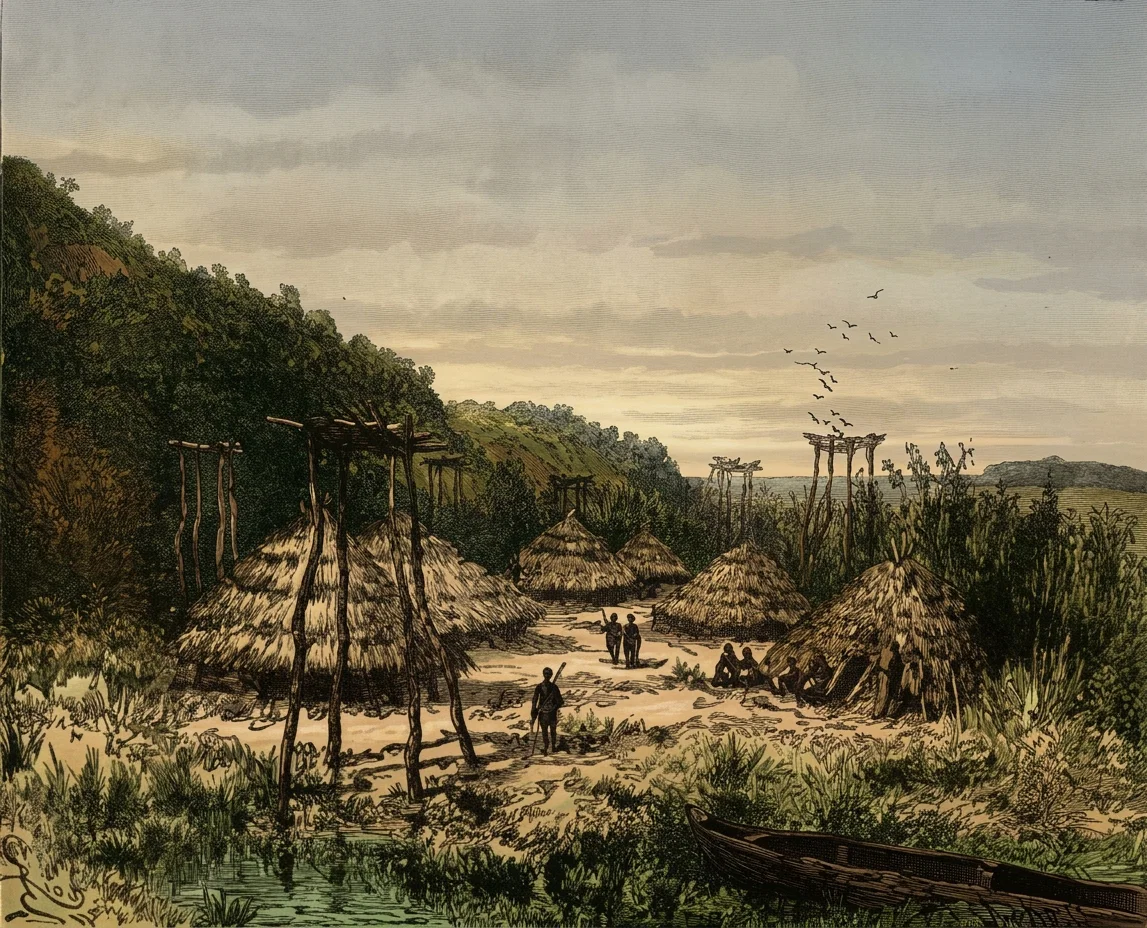
There are two tribes of Negroes near the settlement at the Cape, the Bushmen and the Hottentots. French Huguenots came from France, driven by persecution, but were soon absorbed by the Dutch. The Dutch did no missionary work. This was left for the Rhenish missionaries, who labored with the Bushmen, and the Moravians, who tried to open the Gospel to the Hottentots. One effort was made by Schmidt, who settled about 150 miles from Cape Town, but he was obliged to return to Europe, and other missionaries coming later found his residence in ruins. Now, however, the village contains 4,000 Hottentots, their teachers being the only white inhabitants. In a hot, sandy, stony place, almost devoid of water, live these Bushmen, the lowest of the human race. In stature about four feet, their skin resembling a withered tobacco leaf, nails like claws, they remind one of an animated mummy. Their small eyes are obliquely set and cheek bones high.
The speed and endurance of this little people is remarkable, and when hungry they tighten a belt which they continually wear. Their food is roots and game, even reptiles if necessary. They seek at night some cave or tree, or with their hands dig out a place to sleep in the ground. They have no government; they repay kindness by treachery, leave the aged and infirm to die, often kill their children, and the only remedy for disease is the amputation of the little finger. Yet these people, though ignorant of perspective, have skill in drawing with clay upon the rocks, and have quite an extensive knowledge of poisonous plants.
The Hottentots are a step higher in the scale of humanity, as seen by their frame,11greater stature, small hands and feet. They are more quiet, even weak under the influence of music.
These people migrate in search of pasturage, building their huts like beehives and covering them with leaves. They live upon roots, honey, curdled milk, and locusts, which they grind and make into bread. Their language contains three click sounds, representing c, k, x. The Arabs named all the inhabitants of Africa Kafirs, meaning infidels.
The Bantu race claims descent from Ishmael. Of these there are fifty tribes, living mostly north of the Zambezi. The Bantu's six feet in height, broad shoulders, and easy carriage, place him above the other classes. His skin is dark brown or black with a reddish tinge, the last being the ideal complexion; his features may be either Roman or Grecian. The skin is kept soft and glossy by daily baths and ointments; the teeth are white, beard heavy. Their garment, of one piece, resembles the Roman toga. Except in war they use no animal food; then they use both flesh and blood to make them fierce. They distinguish between clean and unclean flesh, never using pork or fish. Usually they live upon corn, vegetables, and milk. The Bantus have crude musical instruments upon which they beat, and to the music of which they dance. They sacrifice to their deity, sometimes even taking human life. Their belief that the spirits of the dead enter the living, both persons and animals, causes them to regard the crocodile as sacred. They revere certain mountains, have a special reverence for prophets, and one tribe regards the seventh day.
A Hottentot Village. Kartagan, Africa.
A man has as many wives as he is able to buy. When he wishes one, the court assembles and decides her worth, and she is exchanged for so many cattle.
Each wife has a hut for herself and children; these have one apartment and only a door for entrance and light. This door is about four feet by eighteen inches, and through this the smoke must pass out, for the fire is built in a basin in the center of the hut.
The wealth of the Bantus is in cattle, which are so sacred that a woman is punished for touching one; the men always milk; watertight baskets are used instead of vessels of tin, etc., and are washed by the dogs. A leather strap is put through the cartilage of the cow's nose, and on the animal's back the natives speed over the hills. These useful beasts are all given names and come when called. The laziest one is named England, because of the hatred of the Bantus for that nation. The language of this race is soft and melodious; a grammatical error is not possible.
In their tribal government the king is absolute, and the chief who obtains his position by inheritance is supposed to rule by divine right; he has ten counselors.—The Reaper.
SAVING THE HEART.
By Dr. C. W. Lyman
BY DR. C. W. LYMAN.
Hurry and worry are a pair of evils that wear out hearts early in life. To take a cup of coffee, a chop, and a roll at breakfast, to make a train to town, to begin to think on business all the way in, to go into full swing when the office is reached, stopping but a moment for lunch, to make a train home at five o’clock, then to eat a hearty meal, ending with coffee or tea, and then to go out for the evening—here is presented a common daily routine in city and suburban life. This means that the heart is kept going at high tension for say fifteen hours at a stretch. A young man ages fast in this sort of life, and often, when in the forties, he can not run two blocks’ distance without distressing palpitation and loss of breath.
Continuous worry acts on the heart in the same way as incessant hurry, only if anything more injuriously. Large numbers of the victims of high-pressure civilization (which commonly means, so far as the heart is concerned, too long hours of work and amusement, stimulation, and some indiscretions at table) come to a still more serious end without knowing what it is. Between the ages of forty and fifty they develop fatty degenerations of the heart and arteries. Those tissues that are being worked past endurance break down, and are replaced by an inferior tissue, namely, fat. These persons are thenceforth crippled for life, and become old, in both appearance and reality.
Corsets and tight vests cramp the chest, and so the heart and its motions. Thus they increase its work in keeping the blood moving. A person who bends over a desk till he becomes narrow-chested, brings about the same result in another way.
Let us save our hearts from each and all of these common abuses. A strong heart action throughout life is too much of an essential to be parted with. Hearts that have become weak can be made stronger. Good, new muscular tissue can be made to grow in them. But it is a careful process that does it, named after the German who introduced it, Oertel. It consists in putting the person on a very limited and simple diet for some days. Then on the same carefully restricted diet, daily walks are taken up the side of a declivity, with many stops, but going a few feet farther each day. Any gentle and graduated exercise would do. The pure and somewhat rarified air of a mountain side, as advised by Oertel, with the views and the stillness of such a place, give it advantages, on the whole.
It is of great moment in saving and resting the heart that the supper should be a light one, so at least that at bedtime the stomach shall have come to rest. A loaded stomach keeps the heart at high tension far into the night, and thus its one period of relative let-up is infringed upon. This is found to count seriously even with very strong men, Hence the rigidity with which athletes in training are restricted in their evening meal. The trainers have found it indispensable to the success of their men. Why should not other men and women who mean to succeed in the race?—The Voice.
A HOME CHAT.
PEOPLE are apt to go long distances and pay extravagant sums of money to see and hear what are, in reality, the commonest things.
Mr. A. suddenly makes a fortune by speculating in wheat, and himself and wife betake themselves to foreign lands, where she raves over sunsets no more lovely than those in plain sight from the door of her humble home all the years past. He buys famous paintings, for which he pays thousands of dollars, their one great merit consisting in their being true to nature; but far lovelier and “truer” pictures have been framed for a score of years by the window casements of his rural cottage.
It was something worth while for the country dweller to travel to the city to hear a Patti sing, yet sweeter strains are poured forth every summer morning just outside her window, but she never rouses herself to listen. A bit of cunning legerdemain will set a whole neighborhood agog with wonderment, and yet it gives never a thought to the miracles of nature all about it—such miracles as the birth of a flower, the springing of grain, the metamorphose of a caterpillar into a butterfly.
Some one claims to have been cured of a bodily malady through faith and prayer. Incredulous Christians shake their heads, forgetting that a still greater miracle hath been wrought in them, for “whether is it easier to say, . . . . Thy sins be forgiven thee; or to say, Arise, and take up thy bed, and walk?”
Faith seems a natural thing to exercise in some instances, an unnatural thing in others.
While it is our duty to employ means provided, it is none the less a duty to recognize that the same Infinite One who brings satisfactory results from the use of means, is able to bring about the same results without the means. Above everything else, he would have us recognize his omnipotence.
There is a deal of unrest and discontent in the world because none of us have eyes to see the beauty all about us, or ears to hear the music in the air. Children are now being taught to use the physical eye and ear; would that they, as well as we older ones, might learn to use the spiritual eye and ear.
The humblest laborer has the beautiful sky above, the magnificent landscape about, the glorious sunlight, the pure air, the song of birds, the perfumed flower, the rain, the dew, and, above all, he has God himself, and as clear a title to an equal inheritance of the riches over there as has the millionaire. Not one of us but is abundantly blest if we could but realize it, if we would once stop looking over into “someone’s else garden.”—The Word and the Way.
THE SPIRIT OF GOD
By Joseph Harvey Waggoner
ITS OFFICES AND MANIFESTATIONS TO THE END OF THE CHRISTIAN ERA.
BY ELD. J. H. WAGGONER.
This is a brief but comprehensive argument on the solemn and important subject of the Spirit of God. Its chapters embrace the following heads: The Holy Spirit of Promise; The Power from on High; Circumcision of the heart; The Unity of the Faith; The Law and the Testimony; Try the Spirits; The Great Commission; Gifts in the Reformation; In the Present Century; Spirit of Prophecy Restored. These are subjects of vital importance to all and especially to those who are looking for the return of their Lord. 144 pp. Price, 15 cents.
Address. PACIFIC PRESS, Oakland, Cal.
STEPS TO CHRIST.
The Pacific Press Publishing Co., Oakland, Cal., have received an entirely new stock of the latest edition of that excellent book entitled “Steps to Christ,” by Mrs. E. G. White. The price, postpaid, is only 75 cents. Address as above.
PRAYER
If there be some weaker one,
Give me strength to help him on;
If a blinder soul there be,
Let me guide him nearer Thee.
Make my mortal dreams come true
With the work I fain would do;
Clothe with life the weak intent;
Let me be the thing I meant;
Let me find in Thy employ
Peace that dearer is than joy,
Out of self to love be led,
And to heaven acclimated,
Until all things sweet and good
Seem my natural habitude.
— Whittier.
THE POWER OF THE WORD.
At one time it was very popular in some of the leading colleges of our country for the young men to organize themselves into “infidel clubs.” They usually met once a week and discussed the demerits of the Bible, using all possible arguments to prove its fallacy.
It was in one of these colleges, an eyewitness tells us, that several young men met in such a club for the first time, and they chose for the leader one of the most advanced students.
The duty of the “leader” was to read the Scripture, after which the others were to discuss the word, in the attempt to pick it to pieces.
Strange to say, the young man selected that wonderful fourteenth chapter of John, which has been such a comfort to so many Christian hearts. With a sneer on his face and a contracted brow, he commenced to read.
Very soon one of the students exclaimed, “That is wonderful!”
The reader looked up in surprise, but continued to read.
It was not long before another said, “That is beautiful!”
Again the reader elevated his eyebrows superciliously, but at once a third exclaimed, “That is grand!”
A new spirit was manifested, for the great Searcher of hearts was busy probing the consciences of these young men.
The Holy Spirit was setting their hearts and intellects on fire!
At last, with a look of mingled joy and shame on his face, the leader closed the Book, laid it on the table, and said in tones of intense earnestness, “Gentlemen, that Book is divine.”
The consequence was that the following week the club was disbanded and nearly all the members accepted the word of God as truth, and gave their hearts to the Saviour.—Young People’s Weekly.
GIVING—HOW DO YOU GIVE?
AMONG our duties, the proper, scriptural standard of giving comes into front rank, and its corner-stone is found in a conception of our divine stewardship. Our possessions are in trust for God, and to be used as trustees. We have giving, but not of a godly sort. There are at least ten ways of contributing to benevolent purposes, some of which are a reproach and a shame:—
1. The heedless way; giving something to any object presented, without inquiry into its claims, or merits, or needs, or proportionate demands as to other causes.
2. The impulsive way; giving as the caprice of the moment leads, as often or as much or little as feeling may prompt.
3. The lazy way; shirking all self-denial, and resorting to fairs, festivals, and various panderings to the carnal nature to raise money “for the Lord’s cause.”
4. The calculating way; giving with reference to some expected returns in pecuniary prosperity or indirect self-emolument.
5. The selfish way; giving from desire and expectation of the reward of human praise and glory, or personal prominence and reputation as a giver.
6. The systematic way; laying aside as an offering to God a definite proportion of income—one-tenth or more, as conscience indicates. This is adapted to both rich and poor, and insures large aggregates.
7. The intelligent way; giving to each object after a personal investigation into its comparative merits and claims, and without dependence on the happy appeal of its representative or agent.
8. The self-denying way; saving what luxurious taste or careless outlay would squander, and sacredly applying it to purposes of piety and charity.
9. The equal way; giving to the Lord’s cause as much as is spent on self, balancing personal expenditures and benevolent outlay as a corrective to all extravagance.
10. The heroic way; limiting outlay to a certain sum, and giving away the entire remainder. This is stewardship in exercise. It was John Wesley’s way, who never exceeded his fixed sum of personal outlay. It is Hudson Taylor’s way. It makes a habitual, conscientious, proportionate, prayerful, liberal, unselfish, consecrated giver. Adopted as a rule, it would turn God’s people into a body of givers whose unceasing contributions would be a river of water of life to a dying world. Such giving would insure praying, and be the handmaid of holy living. With such giving of money, giving of self would inevitably follow, if it did not precede; and with a rapidity now incredible a world’s evangelization would move toward its consummation and the coronation of the coming King.—Missionary Review.
CHRIST, OUR ADVOCATE
His Ministry in the True Tabernacle
An up-to-date pamphlet on the work of Christ in the sanctuary in Heaven. Bible Students' Library No. 128. Fully illustrated. Paper covers. Price, 10 cents.
Address,
PACIFIC PRESS PUBLISHING CO.
OAKLAND, CAL.
Kansas City, Mo.
New York City, N. Y.
CHURCH SERVICES.
All of our churches, especially on this coast, who desire their regular weekly services announced in this column, may have it done by reporting through the proper officers.
San Francisco.—Church at 914 Laguna Street. Regular preaching services at 7:30 P.M. Sunday and 11 A.M. Sabbath. Sabbath school at 9:45 A.M. Prayer meeting Wednesday 7:30 P.M. Missionary meeting Thursday 7:30 P.M. Seats free.
Oakland.—Church at corner of Twelfth and Brush Streets. Regular preaching services or Bible study. Sunday at 7:30 P.M. and Sabbath at 11 A.M. Sabbath school at 9:30 A.M. Sabbath. Prayer and missionary meeting Wednesday at 7:30 P.M. All are cordially invited.
Chicago, Illinois.—Church on Forty-sixth Street between Michigan and Wabash Avenues. Sabbath school 9:30 A.M.; preaching service 11 A.M. Prayer meeting 3:30 P.M. every Sabbath, also Tuesday evening 7 P.M. Missionary meeting Thursday evening 7 P.M. All are cordially invited.
Los Angeles.—Church at 145 Carr Street, between Main and Hill Streets. Sabbath school on Sabbath at 9:45 A.M., and preaching service at 11 A.M. Prayer meeting Tuesday evening. Missionary meeting Thursday evening. All are welcome. 926 Hill Street. BELLE P. BAKER, Clerk.
East Portland, Oregon.—Church at corner of Eleventh and East Everett Streets. Services every Sabbath 11:30 A.M. Sabbath school 10 A.M. Missionary meeting evening after Sabbath 7 P.M. Prayer meeting every Wednesday evening 7 o’clock. All welcome. Seats free.
Washington, D. C.—Church on Eighth Street between F and G Streets, N. E. Regular preaching service at 11 A.M. Sabbaths. Sabbath school, 9:45 A.M. Sunday, 7:30 P.M., Bible study. Prayer meeting Friday at 7:30 P.M. All are welcome. H. W. HERRELL, Clerk.
St. Paul, Minn.—Church on Greenbriar Avenue, between Jenks and Clawson Streets. Regular preaching services on Sabbath at 11 A.M. Sabbath school at 9:45 A.M. Prayer meeting Tuesday evening at 7:45. All are cordially invited. NETTIE McSTAY, Clerk.
Kansas City, Mo.—Church on corner of Twelfth and Woodland Ave. Sabbath school at 10 A.M. and preaching service at 11 A.M. Missionary meeting Tuesday, 7:45 P.M. All are cordially invited.
Detroit, Mich.—Church at 424 Trumbull Ave., between Perry and Bagg streets. Preaching Sabbath 10 A.M. Sabbath school 11:15 A.M. Prayer meeting Wednesday 7:30 P.M. Preaching Sunday 7:30 P.M. H. M. KENYON, Pastor.
Sacramento.—Church on G Street between Eighteenth and Nineteenth Streets. Regular services: Sabbath school at 10 A.M., preaching service at 11 A.M., Sunday at 7:30 P.M. Prayer and missionary meeting Wednesday evening at 7:30. Seats free. All are cordially invited.
Pasadena.—Church at corner of Summit Ave. and Mountain Street. Sabbath services every Sabbath at 11:30 A.M. Sabbath school 10 A.M. Prayer meeting every Sunday evening 7:30. Missionary meeting Tuesday 7:30 P.M. All are cordially invited. Box 261. O. S. SMYTH, Clerk.
Boston, Mass.—Church worships at United Fellowship Hall, 1371 Washington Street. Regular services: Sabbath school at 10 A.M., preaching at 11 A.M. All are welcome. George B. Wheeler, pastor. Residence at 45 Waverley Street, Everett, Mass.
Louisville, Kentucky.—Church worships at Markers’ Hall, corner Seventeenth and Main Streets. Regular preaching services at 7:30 P.M. Sunday and 11 A.M. Sabbath. Sabbath school at 10 A.M. All are welcome. J. W. COLLIE, Pastor. Residence, 2151 West Broadway.
Cleveland, Ohio.—Church at 249 Cedar Ave., between Sterling and Hayward. Regular services as follows: Sabbath school at 10 A.M. (sun time). Preaching at 11 o’clock, also on Sunday evening at 7:30. Prayer meeting at 7:30 Wednesday evening. WILLARD H. SAXBY, Pastor.
St. Joseph, Missouri.—Church on corner Fifteenth and Locust Streets. Sabbath school at 10 A.M. Church services at 11 A.M. Prayer and teachers’ meetings, Wednesday evening, 7:30. All are cordially invited to attend. MRS. HARRIET W. TALBERT, Clerk.
San Diego.—Church corner of Eighteenth and G Streets. Regular services at 11 A.M., Sabbath. Sabbath school at 9:45 A.M. Prayer meeting, Wednesday, 7:30 P.M. Missionary meeting, Sunday, 7 P.M. MARY J. DIMOCK, Clerk. National City, Box 136.
Stockton, Cal.—Church at corner of Miner Avenue and Stanislaus Street. Services every Sabbath (Saturday) at 11 A.M. Sabbath school at 10 A.M. Prayer and teachers’ meetings at 2:30 P.M. every Wednesday. H. S. GUILFORD, Elder.
Providence, R. I.—Church worships at Library Hall, room 6 Olneyville Square. Regular service: Sabbath school at 1:30 P.M.; Bible study and social service at 3 P.M.; prayer meeting every Friday evening at 7:30. All are welcome. 36 Buch Street, Providence. WM. H. WARFIELD, Clerk.
Salt Lake City.—Church, room No. 30 East Fourth South Street. Sabbath school at 10 A.M.; services Sabbath at 11 A.M. and Sunday at 7:45 P.M.; prayer meeting at 7:45 Wednesday evening; missionary meeting 7:45 Saturday evening. All are cordially invited. J. M. WILLOUGHBY. Residence, Water Street, Waterloo, Salt Lake City.
Philadelphia, Pa.—Church worships at hall, 1722 N. Broad Street. Regular services: Sabbath school, 9:30 A.M.; preaching Sabbath, 10:30 A.M., Sunday, 7:30 P.M. All are welcome. E. A. MEHRELL, Pastor. Residence 1737 Edgely St., north of Diamond.
Tacoma, Wash.—Church corner Sixteenth and K Streets. Sabbath service, 11 A.M.; Sabbath school, 10 A.M.; Sunday evening, 7:30; prayer and missionary meeting Wednesday evening 7:30. All are cordially invited. F. H. SMITH, Elder.
Omaha, Neb.—Church corner Eighteenth and Cummings Street. Sabbath school at 10:15 A.M., preaching at 11 A.M., and on Sunday at 5 P.M. J. H. ROGERS, Pastor. Residence cor. Twenty-seventh and Seward Streets.
Brooklyn, N. Y.—Church meets at Wurzler’s Hall, 315 Washington Street, near city post office. Regular services: Sabbath school, 10 A.M.; preaching, 11 A.M. All are cordially invited.
Kansas City, Kansas.—Church, room at Park Junction, cor. Fifth Street and Virginia Avenue. Regular services: Sabbath school at 10 A.M.; preaching at 11 A.M.; Christian Help Band, Wednesday at 2:30 P.M., and prayer meeting at 7 P.M.; Bible study at Mission, 721 Troup Avenue, Mondays, at 7 P.M. L. NEAL, Pastor.