The Youth’s Instructor, Vol. XLIX, No. 38

A NEW HEART ALSO WILL I GIVE YOU

The Youth’s Instructor

September 26, 1901

Review and Herald Publishing Company · Battle Creek, Mich. · September 26, 1901

“A NEW HEART ALSO WILL I GIVE YOU”

“Then will I sprinkle clean water upon you, and ye shall be clean: from all your filthiness, and from all your idols, will I cleanse you. A new heart also will I give you, and a new spirit will I put within you: and I will take away the stony heart out of your flesh, and I will give you an heart of flesh.”
Many who speak to others of the need of a new heart do not themselves know what is meant by these words. The youth especially stumble over this phrase, “a new heart.” They do not know what it means. They look for a special change to take place in their feelings. This they term conversion. Over this error thousands have stumbled to ruin, not understanding the expression, “Ye must be born again.”
Satan leads people to think that because they have felt a rapture of feeling, they are converted. But their experience does not change. Their actions are the same as before. Their lives show no good fruit. They pray often and long, and are constantly referring to the feelings they had at such and such a time. But they do not live the new life. They are deceived. Their experience goes no deeper than feeling. They build upon the sand, and when adverse winds come, their house is swept away.
Many poor souls are groping in darkness, looking for the feelings which others say they have had in their experience. They overlook the fact that the believer in Christ must work out his own salvation with fear and trembling. The convicted sinner has something to do. He must repent and show true faith.
When Jesus speaks of the new heart, he means the mind, the life, the whole being. To have a change of heart is to withdraw the affections from the world, and fasten them upon Christ. To have a new heart is to have a new mind, new purposes, new motives. What is the sign of a new heart?—A changed life. There is a daily, hourly dying to selfishness and pride.
Some make a great mistake by supposing that a high profession will compensate for real service. But a religion which is not practical is not genuine. True conversion makes us strictly honest in our dealings with our fellow men. It makes us faithful in our every-day work. Every sincere follower of Christ will show that the religion of the Bible qualifies him to use his talents in the Master’s service. “Not slothful in business.” These words will be fulfilled in the life of every true Christian. Even though your work may seem to be a drudgery, you may ennoble it by the way in which you do it. Do it as unto the Lord. Do it cheerfully, and with heaven-born dignity. It is the noble principles which are brought into the work that make it wholly acceptable in the Lord’s sight. True service links the lowliest of God’s servants on earth with the highest of his servants in the courts above.
It means much to be a consistent Christian. It means to walk circumspectly before God, to press toward the mark of the prize of our high calling in Christ. It means to bear much fruit to the glory of him who gave his Son to die for us. As sons and daughters of God, Christians should strive to reach the high ideal set before them in the gospel. They should be content with nothing less than perfection; for Christ says, “Be ye therefore perfect, even as your Father which is in heaven is perfect.”
Let us make God’s holy word our study, bringing its holy principles into our lives. Let us walk before God in meekness and humility, daily correcting our faults. Let us not by selfish pride separate the soul from God. Cherish not a feeling of lofty supremacy, thinking yourself better than others. “Let him that thinketh he standeth take heed lest he fall.” Peace and rest will come to you as you bring your will into subjection to the will of Christ. Then the love of Christ will rule in the heart, bringing into captivity to the Saviour the secret springs of action. The hasty, easily-roused temper will be soothed and subdued by the oil of Christ’s grace. The sense of sins forgiven will bring that peace that passeth all understanding. There will be an earnest striving to overcome all that is opposed to Christian perfection. Variance will disappear. He who once found fault with those around him will see that far greater faults exist in his own character.
There are those who listen to the truth, and are convinced that they have been living in opposition to Christ. They are condemned, and they repent of their transgressions. Relying upon the merits of Christ, exercising true faith in him, they receive pardon for sin. As they cease to do evil and learn to do well, they grow in grace and in the knowledge of God. They see that they must sacrifice in order to separate from the world; and after counting the cost, they look upon all as loss if they may but win Christ. They have enlisted in Christ’s army. The warfare is before them, and they enter it bravely and cheerfully, fighting against their natural inclinations and selfish desires, bringing the will into subjection to the will of Christ. Daily they seek the Lord for grace to obey him, and they are strengthened and helped. This is true conversion. In humble, grateful dependence he who has been given a new heart relies upon the help of Christ. He reveals in his life the fruit of righteousness. He once loved himself. Worldly pleasure was his delight. Now his idol is dethroned, and God reigns supreme. The sins he once loved he now hates. Firmly and resolutely he follows in the path of holiness.
Mrs. E. G. White.

THE LEAF ARMY

ONE night a fleet of winds came down, And brought a host from Autumn Town. When morning, ten thousand sail Filled every lake in every vale, And down the brooks ten thousand more Swept bravely to the ocean shore; And in the meadow, in the wood, And on the hills, an army stood. The regiments of leaves had come Without the sound of fife and drum, As allies of the year, to keep Close guard while Summer lay asleep; To watch the gardens, and to share, The roots’ defenses everywhere. At this glad news on vale and hill, The voices in the trees were still, And while the leaves their long watch kept, The gardens and the meadows slept.
AN AUTUMN DAY
AN AUTUMN DAY
FRANK WALCOTT HUTT.

CHAPTER IV

The Cycle of the Week

§ 37. THIS period of time is in no way derived from the movements of the sun or the moon, but is marked off by the recurrence of the Sabbath. Amid all the changes to which the year and months have been subjected (see sections 33-35) the days of the week have been preserved, and brought down to us as first given in the garden of Eden. The futile attempt of France, near the close of the eighteenth century, to establish a weekly cycle of ten days, stands as a monument to the inability of a powerful nation to change this divinely appointed and preserved institution.
§ 38. The Sabbath observed upon this earth was instituted at the time of its creation (Gen. 2:3), and was given to the whole human family (Mark 2:27) to regulate our periods of rest and labor. Several years after Adam and Eve were driven from the garden of Eden, we find their posterity coming with their offerings, to present themselves before the presence of the Lord, upon the Sabbath day, or at the “end of days.” Gen. 4:3, margin. At the time of the flood, more than one thousand seven hundred years this side of creation, we have the week several times mentioned (Gen. 7:4; 8:10); and nearly a thousand years farther down the stream of time, when the Hebrews came to Mount Sinai, thirty-three days before the giving of the law, we find them understanding and observing the Sabbath and the weekly period. Ex. 16:21-30.
§ 39. The keeping of the Sabbath has always been the special sign, or token, of obedience to God by his people. It is the seal, or sign, of his presence and authority, and is that which distinguishes him as the Creator of the universe, and the only God entitled to our service (Ex. 20:8-11); and as such it is to continue as a perpetual covenant just as long as the Lord has a people on this earth to serve him. Compare Ex. 31:13, 16, 17, and Eze. 20:12, 20, with Gal. 3:29.
§ 40. In regard to the observance of Sunday, we know that it antedates the earliest day of recorded history, and has always stood in opposition to the true Sabbath of the Lord. Nations have legislated, and will continue to legislate, to the upbuilding of Sunday as a religious institution, and the depressing of the Sabbath; but what of that? We shall all eventually give an account of our lives at the bar of God, and be judged by the requirements of his law (Eccl. 12:13, 14), and not by the ever-changing customs of men. On March 7, 321 A. D., Constantine, a pagan ruler of Rome,—this being three years before even his pretended conversion to Christianity,—issued his famous Sunday edict:—
“On the venerable day of the sun, let the magistrates and people rest, and let all workshops be closed. In the country, however, persons engaged in agriculture may freely and lawfully continue their pursuits; because it often happens that another day is not so suitable for grain-sowing or vine-planting; lest by neglecting the proper moment for such operations, the bounty of heaven should be lost.”
At the Council of Laodicea held 365 A. D., the Catholic Church set aside the Sabbath of the Lord, condemning all who should obey it, and required the observance of the Sunday, called by them “Lord’s day.” This law reads as follows:—
“Christians must not Judaize by resting on the Sabbath, but must work on that day, rather honoring the Lord’s day, and, if they can, resting then as Christians; but if any shall be found to be Judaizing [resting on the Sabbath], let them be anathema [accursed] from Christ.” But Sunday observance did not originate here; it was merely the grafting in of a heathen custom upon the already apostate Church of Rome. Sunday was always, as the North American Review so aptly puts it, “the wild solar holiday of all pagan times,” and has ever stood as a counterfeit of the true Sabbath. That this was true in the days of Israel, see 2 Kings 23:4-11; Deut. 17:2-5.
§ 41. In Gen. 4:16 we read that “Cain went out from the presence of the Lord, and dwelt in the land of Nod, on the east of Eden.” Before the flood the garden of Eden was situated “eastward,” in the place called “Eden” (Gen. 2:8), and the way of approach to the tree of life, which was in the midst of the garden, was from the east (Gen. 3:24), so as the worshipers of the antediluvian age came with their offerings to present themselves before the presence of the Lord, they would have to appear before the garden on the eastern side, and worship looking westward, toward the “way of the tree of life.” When the record says that “Cain went out from the presence of the Lord,” after having killed his brother Abel, it evidently means that he then fully determined not to serve and obey the Lord, his Creator, any more; for we read in Jude 4, 11, of certain persons who are “denying the only Lord God, and our Lord Jesus Christ,” that “they have gone in the way of Cain.” So Cain must have deliberately denied the Lord, and refused the offered pardon and salvation through Jesus Christ, for his great sin; and must also have joined company with the great rebel leader, Satan, in the establishment of his government here in this earth against the government of God. For we are exhorted to be “not as Cain, who was of that wicked one, and slew his brother.” 1 John 3:12. When it says that he “went out, . . . and dwelt on the east of Eden,” it evidently means more than merely to give the direction in which he went; for we read in Eze. 8:12-18 of a company “with their backs toward the temple of the Lord [toward the west, the direction in which they, like the people before the flood, would have to look in order to appear before the visible presence of the Most High], and their faces toward the east; and they worshiped the sun toward the east,” which the Lord there says was an abomination unto him. Thus Cain, in leaving the presence, or worship, of the Lord, and going toward the east, or place of the sun-rising, was evidently the first of our race to worship the creature—the sun—rather than the Creator. Rom. 1:25. In “Patriarchs and Prophets,” pages 84, 85, we read: “The Sabbath was honored by all the children of Adam that remained loyal to God. But Cain and his descendants did not respect the day upon which God had rested. They chose their own time for labor and rest, regardless of Jehovah’s express command.”
§ 42. That the present Saturday is the original seventh day, given to Adam, kept by the Jews, and honored by Christ himself when here on earth, we quote the following from Newcomb’s Astronomy, page 187: “The Jewish Sabbath, for instance, commenced as soon as the sun set Friday, and ended when it set on Saturday.”
Thus the weekly cycle has been divinely preserved and brought down to our time with the Sabbath of Jehovah as the great memorial of the creation of this world.

QUESTIONS

Upon what does the cycle of the week depend? Trace the week throughout the history of the world. Who was Constantine? Quote and give date of his Sunday law. Tell all you can of the Council of Laodicea. Tell the story of 2 Kings 23:4-11 and Deut. 17:2-5. Which way did the garden of Eden, the sanctuary, and the temples of the Lord face? Which way must their worshipers have looked? What connection has Eze. 8:12-18 with this question? What astronomical proof have we that Saturday is the Sabbath of our Saviour’s time? DR. O. C. GORMARE.

Speaking of Christ to Those Who Need Him

SUPPOSE every Christian who has been intending to speak of Jesus Christ to some one who needs the message, but has been putting it off from sheer cowardice, should actually confess the love of Christ, and extend the gospel invitation to-day. A few would undoubtedly meet with some rebuff. This would be due both to a lack of tact and to the fact that not every one may be expected to press into the kingdom the moment the open door is seen. But the greeting in the overwhelming majority of cases would be: “I've been waiting all these years for somebody to lead me to the Saviour. Why didn't you speak to me before?”—Selected.

ELO, THE EAGLE

Nearly seventy-five years ago, somewhere in the wilderness of the Mississippi Valley, was born a veritable king among birds—a giant gray eagle. I know nothing of his early life,—of the romance of his choosing a mate, or of their setting up housekeeping. I would like very much to have known these things; but if they were observed at all, it was by some Indian.
At the close of the Black Hawk War, when eastern Iowa was opened for settlement, my father, a mere lad, moved with his parents to the extreme western limits of the purchase, near the village of Richland, Keokuk County. And here begins my knowledge of Elo.
On a sort of island in the Skunk River stood a mighty tree, perhaps the largest within a hundred miles. It was difficult of access from all sides, and none could ever climb it. Here, out of range of the best guns of the country, Elo and his mate built their nest,—and such a nest! First, deftly placed in the shape of a rude triangle, were three small fence rails; then branches of wild grapevines, fifteen or twenty feet long, were wound about great limbs to form the outlines of the nest; finally it was finished with smaller sticks and poles. Here, season after season, Elo and his mate reared their young. Here, year after year, could be watched the sight so graphically described in Deut. 32:11. Taking an eaglet on his back, Elo would soar upward until he was thousands of feet above his nest, then suddenly swoop out from under it, and let it flutter and fall till it came almost within gunshot of the ground, when he would dart under it, and carry it back again. From the first lesson in flying, as far as my father could observe, it was less than two weeks till the brood could care for themselves. Where they went, no one knew; I myself have never heard of more than the one gray eagle's nest in that region.
The eaglets were fed mostly on fish brought from the Mississippi River. During the brooding season, Elo usually carried food to his mate as well as to his babies. He would soar around and around, mounting higher and higher, till he looked a mere speck, then would make a dash toward the east. In from two to three hours, he would return, flying low, and flapping his wings wearily, carrying a large fish. Hardly could he stop to rest before he must start back for another.
He was never known to commit any depredations in the vicinity, though he was once accused of stealing a lamb about twenty miles away. Finally a Mr. Goodheart, who owned a mill on the bank of the river just opposite the old nest, bought a new long-range rifle.
One morning he stepped out on the porch, and seeing the mother eagle—pride of the whole country, though she was—on her nest, he could not resist the temptation to try just one shot at her. One was enough to kill her. Elo was away, and she fell out of the nest, so that he never knew what became of her. All summer long he would soar up and down the river and scream, hunting for his beloved mate. Then he left the neighborhood; but every year, for thirty years, he would return; and many a time have I watched him soar back and forth, up and down the river, and scream, still hoping against hope, seeking the happiness that was gone forever. It made a deep impression on my mind. How little do men think of the sorrow they thoughtlessly cause God's creatures!
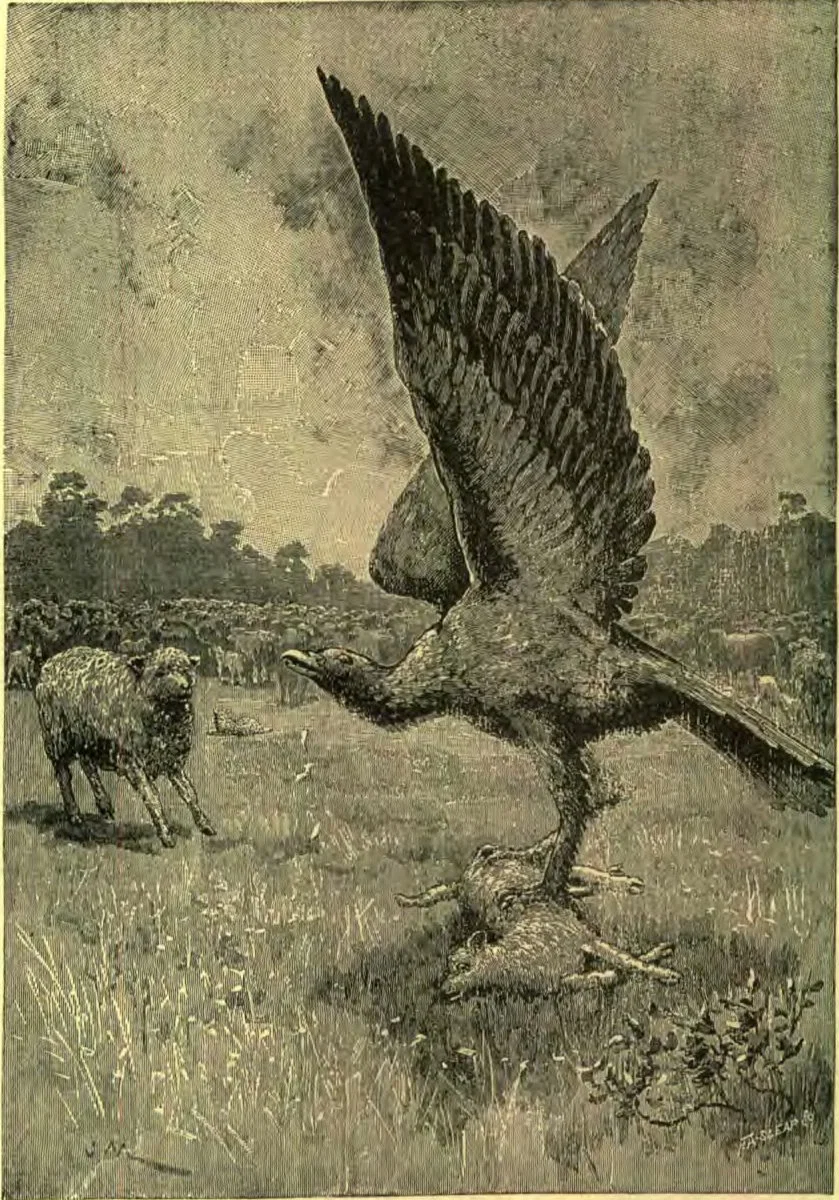
A POWERFUL EAGLE
A POWERFUL EAGLE
One spring morning thirteen years ago a neighbor boy shot Elo, breaking the small bone of his wing. He was captured, and kept for more than two years in a cage. But captivity could never tame that kingly spirit, and no one ever dared come within reach of those powerful talons. He was a mighty bird, and measured seven inches from the end of his beak to the top of his head. He measured ten feet, two inches, from tip to tip of his outspread wings, being considerably the largest eagle I have ever known.
Finally he escaped. At the same time the old eagle tree was cut down, the last remains of his once happy home being thus destroyed. Only once since that time has he been seen circling and soaring about over his former home.
FLOYD BRALLIAR.

AS AN EAGLE—SO THE LORD

WILLIAM J. LONG, author of “Ways of Wood Folk,” has a new book of animal stories called “Wilderness Ways.” In the chapter on “Cloud Wings, the Eagle,” he tells an incident which clearly interprets and illumines a Bible verse.
A mother eagle had tried in vain to tempt her little one to leave the nest on a high cliff. With food in her talons, she came to the edge of the nest, hovered over it a moment, so as to give the hungry eaglet a sight and smell of food, then went slowly down to the valley, taking her food with her, and telling the little one to come, and he should have it. He called after her loudly, and spread his wings a dozen times to follow. But the plunge was too awful; he was afraid, and settled back into the nest. What followed, Mr. Long describes thus:—
In a little while she came back again, this time without food, and hovered over the nest, trying every way to induce the little one to leave it. She succeeded at last, when with a desperate effort he sprang upward, and flapped to the ledge above, where I had sat and watched him with Old Whitehead. Then, after surveying the world gravely from his new place, he flapped back to the nest, and turned a deaf ear to all his mother’s assurances that he could fly just as easily to the tree tops below, if he only would.
Suddenly, as if discouraged, she rose well above him. I held my breath, for I knew what was coming. The little fellow stood on the edge of the nest, looking down at the plunge which he dared not take. There was a sharp cry from behind, which made him alert, tense as a watch-spring. The next instant the mother eagle had swooped, striking the nest at his feet, sending his support of twigs, and himself with them, out into the air together.
He was afloat now,—afloat on the blue air in spite of himself,—and flapped lustily for life. Over him, under him, beside him, hovered the mother on tireless wings, calling softly that she was there. But the awful fear of the depths and the lance tops of the spruces was upon the little one; his flapping grew more wild; he fell faster and faster. Suddenly—more in fright, it seemed to me, than because he had spent his strength—he lost his balance, and tipped head downward in the air. It was all over now, it seemed; he folded his wings to be dashed to pieces.
Then like a flash the old mother eagle shot under him; his despairing feet touched her broad shoulders, between her wings. He righted himself, rested an instant, found his head; then she dropped like a shot from under him, leaving him to come down on his own wings. It was all the work of an instant before I lost them among the trees far below. And when I found them again with my glass, the eaglet was in the top of a great pine, and the mother was feeding him.
And then, standing there alone in the great wilderness, it flashed upon me for the first time just what the wise old prophet meant, though he wrote long ago, in a distant land, and another than Cloud Wings had taught her little ones, all unconscious of the kindly eyes that watched: “As an eagle stirreth up her nest, fluttereth over her young, spreadeth abroad her wings, taketh them, beareth them on her wings: so the Lord alone did lead him. . . . He made him ride on the high places.”—Young People’s Weekly.

NIGHT

STARRY, starless, clear or clouded, Rest us, Night! and let us sleep. We are weary, we are languid, There are those whose tired eyes weep.
Night for slumber, night for silence Of the voices of the day; Fold us in thy robes of darkness; Hide us from all care away.
Night! we thank our Heavenly Father For thy balm at evening’s close, When we lay us in thy bosom, In contented, sweet repose.
B. F. M. Sours.

WHO SHALL LEAD?

Surely the Lord would have in every company of young people those who will lead in the work, conduct the meetings, and have the oversight; but unless he is allowed to lead those who bear these responsibilities, they will fail.
We may think it desirable to hold these positions; we may have aspirations to go before our fellow associates among the young, to conduct their work, but let us step carefully.
It is a great responsibility to live, just to live from day to day a Christian life; to stand ready to help anybody, at any time, who may be in need of help; to be ready always to be looked at, as an example of the believers, as Timothy was exhorted. This is the life and lot of every one who is a possessor of Christianity. Unless we have learned to do well this much, how shall we entertain, for a moment, thoughts of standing in a position where we should be responsible for our own life and conduct, and, as well, able to help every other young person in the body to live the same kind of life, and bear well the same responsibilities?
Those who are older in experience, and know, will tell us that to be a leader or an officer in a position of responsibility brings added cares and burdens, and sometimes even heartache and sorrow. To endure these in patience, and to discharge every duty faithfully, requires strength of purpose, consecration, and a continual leaning upon God.
Perhaps we have seen those who apparently were much interested in a certain work while they remained in positions of leadership; but when their office was given to another, they lost all zeal, or care, or thought for the work, and soon their seat was vacant. Why the change? It must be that something was wrong, that the fountain which supplied their seeming interest was not a living fountain.
Shall we be leaders in this work?—O, no! Let God lead. Let the great Captain of the hosts of Israel go before, and lead the way, and let you and me follow, not only to-day, but to-morrow and to eternity. Let us fill well the place we are called to fill, though it be humble; and if asked to carry added responsibilities, be sure the power and grace are supplied from above.
LAURA S. FISK.

FAITHFULNESS

(September 29 to October 5)
God’s faithfulness to us. Lam. 3: 23, last part.
Is constant. Job 7: 17, 18.
Like a parent’s. Ps. 103: 13, 14.
Faithfulness required of us. 1 Cor. 4: 2.
In little things. Luke 16: 10, 11; 19: 17.
In using our talents. Matt. 25: 20, 22.
Unto the end. Rev. 2: 10, first part.
Worthy examples of faithfulness:—
Daniel. Dan. 6: 1–4.
Reward of faithfulness. Rev. 2: 10, last part; Matt. 25: 21, 23; Rev. 17: 14.

THOUGHTS ON THE TOPIC

1. “Faithfulness to principle is proved only by faithfulness in detail.”
2. “All should learn to be faithful in the least as well as in the greatest duty. Their work can not bear the inspection of God unless it is found to prove a faithful, diligent, economical care for the little things.”
3. “As God is perfect in his sphere, so man may be perfect in his sphere. Whatever the hand finds to do, should be done with thoroughness and dispatch. Faithfulness and integrity in little things, the performance of little duties and little deeds of kindness, will cheer and gladden the pathway of life; and when our work on earth is ended, every one of the little duties performed with fidelity will be treasured as a precious gem before God.”
4. “It is the conscientious attention to what the world calls little things that makes the great beauty and success of life. Little deeds of charity, little words of kindness, little acts of self-denial, a wise improvement of little opportunities, a diligent cultivation of little talents, make men great in God’s sight. If these little things be faithfully attended to, if these graces be in you and abound, they will make you perfect in every good work.”
5. The lesson of the parable of the talents is applicable in our day. “From the lowest and most obscure to those placed in highest positions of responsibility we are God’s property. We are all intrusted with the goods of heaven,—talents of intellect, wealth, reason,—and are not to regard lightly any of these gifts. They are the Lord’s capital, to be used, sanctified, and returned to the Lord improved by use. To every man God has given his work, and all will have to stand before the judgment-seat of Christ to give an account of what they have done for their Master.”
6. “God has appointed every member of the human family to represent the truth. He has given men and women capabilities and faculties, and has endowed them with ability to improve these powers. The voice, the affections, influence, property,—all are intrusted to man to be returned to God.”
7. “There are few who realize the influence of the little things of life upon the development of character. Nothing with which we have to do is really small. The varied circumstances that we meet day by day are designed to test our faithfulness, and to qualify us for greater trusts. By adherence to principle in the transactions of ordinary life, the mind becomes accustomed to hold the claims of duty above those of pleasure and inclination. Minds thus disciplined are not wavering between right and wrong, like the reed trembling in the wind; they are loyal to duty because they have trained themselves to habits of fidelity and truth. By faithfulness in that which is least they acquire strength to be faithful in greater matters.”

OUR BIBLE STUDIES

It will be noticed that our study for the Young People's meetings this week is on the subject of Faithfulness. Next Sabbath, as announced in last week's paper, a missionary program will be prepared, based on the October number of the Missionary Magazine. All who have not already supplied themselves with copies of this periodical are urged to do so at once. They will be sent free upon receipt of a card bearing your name and address, and stating the purpose for which the Magazine is wished.
An outline of the subjects to be considered in the Young People's meetings for the remaining Sabbaths of the quarter will be given next week.

OUR NEED APPEALS TO GOD

The experience of Hagar and her child when she was sent away from home, illustrates in a striking manner the principle that our needs appeal more strongly to God than our words. Hagar was wandering in the wilderness. Her scanty water supply was soon spent. Partially to shield her child from the burning sun, she placed him in the shade of some shrubbery; and then to save herself the agony of seeing him die, she retired a short distance, weeping in hopeless despair. The divine narrative states that “God heard the voice of the lad; and the angel of God called to Hagar out of heaven, and said unto her, . . . Fear not; for God hath heard the voice of the lad where he is.” It was the child’s need, rather than the voice of Hagar, that appealed to Heaven. This should teach us that it is our necessities that touch the heart of God, more than the presentation of our case.
It was one of the most cherished ambitions of my early boyhood to possess a pony, and I earnestly prayed for one; but the pony never came. I can now see that the physical exercise gained in walking was a far greater benefit to me than I could possibly have derived from merely riding around the country on the back of a pony.
We have scarcely begun to enjoy the satisfaction there is in the Christian life until we have learned the absolute truthfulness of that wonderful declaration, “No good thing will he withhold from them that walk uprightly.”
DAVID PAULSON, M. D.

Youth Helping Youth in Simple Gospel Work

The youth should help the youth; and as they seek to do this work, they will gain an experience that will qualify them to become consecrated workers in a larger sphere. Thousands of hearts can be reached in the most simple, humble way. The most intellectual, those who are looked upon and praised as the world's most gifted men and women, are often refreshed by the simple words of those who love God, and who can speak of their love for him as naturally as the worldling speaks of the things which his mind contemplates and feeds upon.—Mrs. E. G. White.

Youth Share in Labor and Responsibility

LET the youth . . . share in the labor and responsibility. Let them feel that they have a part to act in helping and blessing others. Even the children should be taught to do little errands of love and mercy for those less fortunate than themselves.—Mrs. E. G. White.

Young People Preparing to Work for Souls

The young people among us should be preparing to work for the Master in the saving of souls for whom Christ died. Attention to mere conventionalities, or even to mental and social improvement, should be regarded as of secondary importance.—“Gospel Workers.”

Serving God in Little Things

THE most successful toilers are those who cheerfully take up the work of serving God in little things. Every human being is to work with his life thread, weaving it into the fabric to help complete the pattern.—Mrs. E. G. White.

THE SACRIFICES OF GOD

This which my heart has wished, and can not win, This which my eyes have sought, and shall not see, Unto thy temple altars entering in, I bring for offering, O my God! to thee.
What though my hearth be colder from this night, If purer on thine altar burns the fire? What though mine house shall lack a little light, If from my beaten oil thy lamps burn higher?
Thou wouldst not gifts of spice and myrrh and gold, Else had I heaped them gladly at thy throne: Thou wouldst not pearls and treasures manifold, Else had I given these, and kept mine own.
My tears which were, and at thy touch have passed; My loss, which now I see not, seeing thee; My hope, which I shall find in heaven at last,— These be the gifts thine altars claim of me.
— Mabel Earle, in C. E. World.

WHO SHALL BE GREATEST?

THE autumn sun was shining down O’er old Capernaum’s busy town, Till minaret and temple spire Seemed glowing with celestial fire.
The mellow sunbeams kissed with glee The billows of blue Galilee, While eastward, like a silvery tide, The rolling waves of Jordan wide, Hemmed in by banks of gray and white, Gleamed like the “milky way” at night.
Look! o’er the hills of Galilee A little band of men I see, And ’mong His followers, I ween, I see the godlike Nazarene. I listen to the words they say: “Who shall be greatest, Master, pray?”
“I! I!” cried Peter; “surely I Shall be the greatest by and by.” Quoth John, “I’m greater than the rest,— I oft have leaned upon his breast.” Then cried a voice so hard and bold: “The greatest hath the bag of gold!”
Then in Capernaum’s busy town The Master paused, and sat him down. A little lad with deep-blue eye And golden curls was passing by. The Master spake, and raised his head: “Come hither, little child,” he said; Then, with a voice so soft and mild, He said: “Behold this guileless child! Wouldst thou be great? then must thou be As humble and as meek as he.”
A hush fell on the waiting band,— A shame they scarce could understand,— Their very hearts seemed more defiled In presence of that little child.
MRS. L. D. AVERY-STUTTLE.
Continue reading: THE MESSAGE OF THE LILY