"We have also a more sure word of prophecy; whereunto ye do well that ye take heed, as unto a light that shineth in a dark place, until the day dawn, and the day-star arise in your hearts." 2 Peter 1:19.
"But there is a God in heaven that revealeth secrets, and maketh known . . . what shall be in the latter days." "He that revealeth secrets maketh known to thee what shall come to pass." Dan. 2:28, 29.
2. What great lines of prophecy are given us in the Scriptures?
There are the second chapter of Daniel, the seventh chapter, the eighth and ninth chapters, the eleventh chapter, and not less than seven in the book of the Revelation, besides our Lord's great discourses in Matthew 24, Mark 13, Luke 21. Each of these begins at a different date of the world's history, but all of them carry us forward to the glorious consummation of the kingdom of Christ. The chapters in Daniel will soon be considered in the "Studies in Daniel" now running in the paper.
3. To what particular point of time does the fulfilment of some of these prophecies bring us?
NOTE.—There are certain periods of prophetic time in the books of Daniel and the Revelation which reach their endings during a period of time beginning A.D. 1798, when the time, times, and half a time ended. Mark that this is not the end of time, but "the time of the end," a period during which the study of God's word should be revived, and the wise should understand.
4. What occurrences would take place during this period?
"And there shall be signs in the sun, and in the moon, and in the stars; and upon the earth distress of nations, with perplexity; the sea and the waves roaring: men's hearts failing them for fear, and for looking after those things which are coming on the earth: for the powers of heaven shall be shaken." Luke 21:25, 26.
NOTE.—In other words, God would hang out these signs everywhere. First, He would write them in His word as PREDICTIONS OF EVENTS TO COME; and secondly, He would in His providence so overrule that they would again be written in the physical, social, religious, commercial, and political worlds, in order that men everywhere might read them.
5. What great event would these predicted signs herald?
"And then shall they see the Son of Man coming in a cloud with power and great glory." Luke 21:27.
6. What is one of the noted signs predicted for the last days?
"Go to now ye rich men, weep and howl for your miseries that shall come upon you. Your riches are corrupted, and your garments are moth-eaten. Your gold and silver is cankered; and the rust of them shall be a witness against you, and shall eat your flesh as it were fire. Ye have heaped treasure together for the last days ["in the last days," R.V.]. Behold, the hire of the laborers who have reaped down your fields, which is of you kept back by fraud, crieth: and the cries of them which have reaped are entered into the ears of the Lord of Sabaoth. Ye have lived in pleasure on the earth, and been wanton; ye have nourished your hearts, as in a day of slaughter. Ye have condemned and killed the just; and he doth not resist you." James 5:1-6.
7. What does this prophecy predict?
"Miseries that shall come upon [the rich]."
8. What is said of their riches?
"Cankered," "rusted," "moth-eaten;" in other words, not used for God and humanity.
9. What has been a characteristic in obtaining this wealth?
"The hire of the laborers . . . is of you kept back by fraud."
NOTE.—But one class of laborers is here named; not that this class alone suffers; but this class is representative of all others.
10. How has much of this wealth been used?
"Ye have lived in pleasure on the earth, and been wanton."
NOTE.—Increase of wealth brings increase of responsibility. But in how many cases do the immensely rich grow more tyrannous, more exacting, more careless of the needs of their fellows! As soldiers in a besieging army when they have slaughtered the enemy and become possessed of his riches cast off all restraint, so do many of the rich. See article in this department.
11. When does all this occur?
"In the last days."
12. What is the duty of God's children at such a time?
"Be patient therefore, brethren, unto the coming of the Lord. Behold, the husbandman waiteth for the precious fruit of the earth, and hath long patience for it, until he receive the early and latter rain. Be ye also patient; stablish your hearts: for the coming of the Lord draweth nigh." James 5:7, 8.
13. What description of the work of the selfish rich is given by another prophet?
"Thou [God] art of purer eyes than to behold evil, and canst not look on iniquity: wherefore lookest Thou upon them that deal treacherously, and holdest Thy tongue when the wicked devoureth the man that is more righteous than he? And makest men as the fishes of the sea, as the creeping things, that have no ruler over them? They take up all of them with the angle, they catch them in their net, and gather them in their drag: therefore they rejoice and are glad." Hab. 1:13-15.
"Yea also, because he transgresseth by wine, he is a proud man, neither keepeth at home, who enlargeth his desire as hell, and is as death, and can not be satisfied, but gathereth unto him all nations, and heapeth unto him all people." Hab. 2:5.
NOTE.—What a picture it is of the predatory9trusts. Men to them are fishes to catch; their schemes are nets in which to take them. As they get much they desire more, reaching out of their own legitimate field, with an ambition as unsatisfied as Sheol. As Isaiah expresses it they "join house to house, and lay field to field, till there be no room." Isa. 5:8.
14. Is it the will of God that His children should be made thus to suffer?
"Behold, is it not of the Lord of hosts that the people shall labor in the very fire, and the people shall weary themselves for very vanity?" Hab. 2:13.
15. Of what does God warn the rich?
"Wo to him that coveteth an evil covetousness to his house, that he may set his nest on high, that he may be delivered from the power of evil!" "Wo to him that buildeth a town with blood, and establisheth a city by iniquity!" Hab. 2:9, 12.
"Hear this, O ye that swallow up the needy, even to make the poor of the land to fail, saying, When will the new moon be gone, that we may sell corn? and the Sabbath, that we may set forth wheat, making the ephah small, and the shekel great, and falsifying the balances by deceit?" Amos 8:4, 5.
16. What will the mass of those who are oppressed and wronged at last do?
"Shall not all these take up a parable against him, and a taunting proverb against him, and say, Wo to him that increaseth that which is not his! how long? and to him that ladeth himself with thick clay ["pledges," R.V.]! Shall they not rise up suddenly that shall bite thee, and awake that shall vex thee, and thou shalt be for booties unto them? Because thou hast spoiled many nations, all the remnant of the people shall spoil thee." Hab. 2:6-8.
17. What does another say of the last days?
"And he said, Amos, what seest thou? And I said, A basket of summer fruit. Then said the Lord unto me, The end is come upon My people of Israel; I will not again pass by them any more. And the songs of the temple [literally, "palace," as in margin of R.V.] shall be howlings in that day, saith the Lord God: there shall be many dead bodies in every place; they shall cast them forth with silence." Amos 8:2, 3.
NOTE.—The above are a part of the predictions of God's word concerning the vast increase of wealth and the consequent class troubles which grow out of the conditions. Labor unions claim that they have greatly helped conditions by "pitting" great combinations of labor against the great combinations of wealth. It is a serious question whether they have helped matters even within their own unions. True, they have shortened hours of labor and increased wages, but in most cases the cost of living has increased more rapidly than wages, and serious class bitterness and hatred have resulted. Labor unions have often been deceived by their own trusted men, and the proportion of successful strikes are counter-balanced by the unsuccessful. Since Jan. 1, 1881, the open struggles between the representatives of capital and labor have cost more than $285,000,000, and thrown out of employment 3,714,406 persons. Each striker lost on an average $44.00; and 366,690 persons lost on an average $73.00 each by lockouts. In the anthracite coal strike of 1902, 183,500 miners were out of work for five months. The loss to miners in wages amounted to $30,000,000; to operators, $69,000,000; to merchants in mining towns, $23,000,000; to factories closed for lack of fuel, $7,000,000; to merchants outside, $16,000,000; to railways, $34,000,000; business permanently abandoned, $8,000,000; troops in service, $2,000,000; police in patrolling district, $35,000,000; in railway men's wages, in protecting non-union workers, in fires and flooding of mines, $5,820,000: the total cost of the one strike in money alone, saying nothing of the loss of life, is $200,000,000.
There is still a larger class of professional men, of farm workers, and workers in other lines who have not been benefited, and in the nature of the case could not be. They have seen little or no rise in wages, little or no increase in business, with constantly rising prices in the necessaries of life.
Those who control the markets will continue to control prices; and times for the many as compared with the few will grow relatively harder. Add to this losing faith in God and religion. The next thing is revolution and misery to the rich. We are not stating that which we wish to come. We welcome no bloodshed or violence. We are willing to leave all adjustments of that which can not be righted by ordinary means to God. But we must give His warnings.
18. Is there anything to be gained in uniting to oppose these evils?
"Associate yourselves, O ye people, and ye shall be broken in pieces; and give ear, all ye of far countries: gird yourselves, and ye shall be broken in pieces; gird yourselves, and ye shall be broken in pieces. Take counsel together, and it shall come to naught; speak the word, and it shall not stand." Isa. 8:9, 10.
19. What counsel does God give us in this respect?
"For the Lord spake thus to me with a strong hand, and instructed me that I should not walk in the way of this people, saying, Say ye not, A confederacy, to all them to whom this people shall say, A confederacy; neither fear ye their fear, nor be afraid." Verses 11, 12.
20. What is our hope?
"Sanctify the Lord of hosts Himself; and let Him be your fear, and let Him be your dread. And He shall be for a sanctuary." Verses 13, 14.
Increase of Wealth.
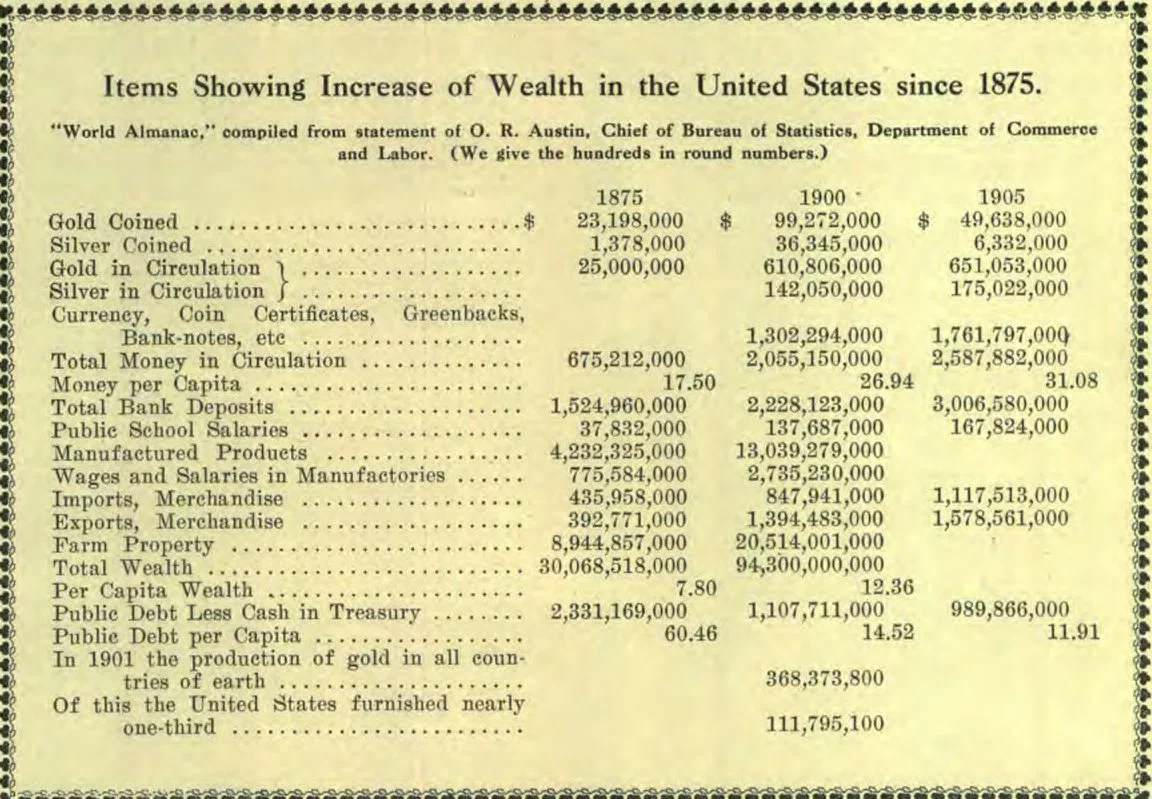
IN the table on the opposite page will be seen something of the vast increase of wealth from a national view-point. This of course has been the development to a great extent of the tremendous natural resources of the country and to the immense industrial establishments which have been organized in late years. It means much when the total wealth has increased in twenty-five years from $7.80 per capita to $12.36 per capita. That was in 1900; it would probably be far greater than that at the present time. The great country is rich, and over-rich. Still over this there could be little complaint if the wealth were equally distributed; there the sad thing comes. Instead of an equable distribution of wealth, this wealth is found in the hands of the few.
It was estimated some time ago by Thomas G. Shearman that $43,267,000,000 of the $56,200,000,000 total wealth of the country was owned by 182,000 families, or by only 1.4 per cent of the population; 9.2 per cent of the families own 12 per cent of the wealth; while the rest of the families, 89.4, own but 11 per cent of the total wealth. The United States of America is practically owned, Mr. Shearman says, by less than 250,000 persons, constituting less than one in 60 of the adult male population. Since this was given publicity in Waldron's "Handbook on Currency and Wealth" in 1891, private fortunes have piled up with a rapidity which is staggering.
For instance, Mr. Rockefeller is said to be worth one billion dollars. Other fortunes range from five hundred million down. A millionaire is no longer considered a rich man; he is merely well-to-do, and the multimillionaire is common in every large city.
The men who laid the foundations of these fortunes were generally frugal and prudent men, such as A. T. Stewart, Commodore Vanderbilt, and others; but the later generations have lived with an extravagance that parallels or exceeds the greatest excesses of royalty. Banquets are spread in palaces, which cost from $100 to $300 a plate or guest, while in the very shadow of these palaces men and women in the image of God famish. Ten thousand dollars apiece is paid for pet dogs, for whose benefit footmen and maids are employed, while little children die for want of proper food and housing.
These wealthy men connected with great syndicates and trusts control the commodities and necessaries of life and the very life-current of commerce—money—is almost absolutely controlled by them. Many times this is used in the wildest speculation, contrary to all law, and the men who thus risk the money of others which has been entrusted to them for safe keeping are not called to account for their crime. Even the very government itself is held up and made to pay tribute to their financial schemes. Their immense profits gathered from the public, from the millions, are used in the greatest extravagance.
For instance, Mr. J. Pierpont Morgan is able to give for a Christmas present a brown stone house to his son, worth $600,000, the costliest that was ever made on the island of Manhattan. A spoiled beauty demands a new automobile, and $16,000 is expended as a sum scarcely worthy of mention. Just recently $27,000 was paid for a special auto-car. For diamond tiaras as high as $100,000 has been paid, and the salesmen in the diamond houses tell us that such sales are not uncommon. A solitaire ring costing less than $5,000 is considered mean, and a cluster of diamonds at less than $6,500 or a vanity bag or mesh purse at $4,000 is cheap. A vanity bag with sapphires, said to be cheap by the clerk who sold it, went for $6,000. A $350 umbrella handle or a wrist bag worth $265 are considered mere trifles. A string of black pearls at $10,000, white pearls at $25,000, Australian or California pearls at $7,000 are considered cheap. From $15,000 to $50,000 is paid for a single piano. A cloak of sable and silver fox costs the mere sum of $18,000; a lace coat, $12,000; an emerald collar with diamond ornaments, $125,000; a cluster of turquoise, sapphires, pearls and diamonds, $20,000; a tiara of diamonds, $200,000; a little dressing case with hair brushes, combs, bottles of perfume, etc., $650. These items indicate in a small way how the millions are expended. Millions more, estimated at $150,000,000, are paid out in European travel, other millions in races and sports and various kinds of amusements.
In one of the large cities the other day a young woman was found who had tried to commit suicide. She had walked the streets day after day, as recorded in her diary, to find work, willing to do anything to keep soul and body together, except to sell herself to a life of shame, and came to the conclusion that she could do nothing else than to die.
What wonderful opportunity is placed before these rich men of doing worthy deeds of beneficence for their fellow men with the vast incomes which they receive from the public. If they feel justified in taking their vast profits, why should they not feel obliged to return them in a way that would benefit the public? The average income is sufficient to keep every soul in this country from want. The colossal extravagance is the reason why it does not. Much of this money is gotten in ways that are absolutely indefensible, by various schemes of finance which men who have given their whole lives to the study of the question know how to manipulate. Enabled so to do by large combinations of capital, whole commodities are controlled by them. The ordinary citizen and the extremely poor must purchase and pay the price.
Take, for instance, the coal situation the last year in the West and the Northwest: Coal abundant in the mines, close to railway and shipping, that mined at the same price as for years at $1.50 to $2.50 a ton, and yet the men who control this necessity of life charging from $14.00 to $20.00 a ton for bituminous coal. It is simply outrageous, and no wonder that it arouses the highest indignation on the part of the people in general, and yet, with absolute indifference seemingly, the great trusts give these utter needs of the people no thought save that which will increase their already colossal fortunes. There is no wonder that Socialism is growing, and following Socialism will come anarchy. Conditions in France of a little over a century ago will be repeated, even as the word of God has predicted.
We are not wishing it to come, we still plead just as far as our influence can extend to all to be law-abiding, it matters not how much they may suffer. There is a just God who presides over the destinies of humanity, and some time, in His own good time, will render to every man according to his works. Yet if we are faithful to Him we shall receive a due reward, while those who have been utterly regardless of their stewardship, and who in His providence have been permitted to amass great wealth will have to give an account before a court in which juries can not be bought or judges bribed.
Preparing for War
IN the year 1899 the theories of the world favoring a universal peace among the nations were crystallized into the first Hague Peace Congress. At the time of the convening of that congress of peace it was considered necessary to have at least from three to four years in which to build and put into commission one of the large battle-ships.
Germany was at that time forging ahead to make herself the leading naval power of the world. It was an open secret that she had strong ambitions in that direction. So long had the song been sung, "Britannia rules the wave," that Germany had fully determined to have a change in the musical program. She would set the world singing that the kaiser is ruler of both land and wave.
While all this was going on, and while the echoes of the concluding speeches of the first Peace Congress had scarcely died away, the nation that had called the congress had gone to war with what had until recent days been considered one of the "insignificant heathen nations of the effete Orient." The issues of that war were largely determined by the successes of Japan's navy on the high seas.
Thru the courtesy of the Japanese Government, some of England's leading naval students were permitted to go aboard her battle-ships to watch and study the conflict.
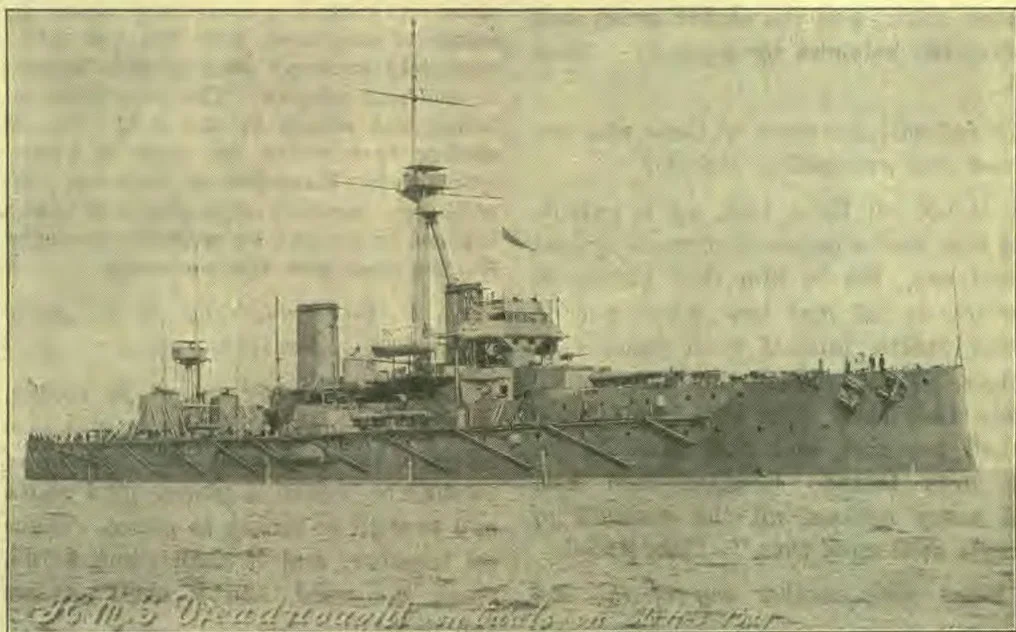
As a result of this study and the suggestions that were made, England surprised and shocked the whole community of nations by launching the great "Dreadnought" in twelve months from the time when her keel was laid. The "Dreadnought" was planned after the war between Japan and Russia, and not only was she built in far the quickest time of any battle-ship that had been launched, but she was at the same time away ahead of anything in strength of armor to resist attack as well as the effectiveness of her guns in raining destruction upon the enemy. Her launching put consternation in the minds of the naval experts of all the other nations.
The powerful effectiveness of the guns of the "Dreadnought" as was shown by actual test, seemed to paralyze the leading naval architects and constructors for the time. There was a lull, and then a silence. Some thought that the acme of the death-dealing destructiveness of the war-ship had been reached.
But "the latest issue of 'Fighting Ships,' the naval encyclopedia of Fred T. Jane, proves it to have been nothing but the lull preceding the storm—a storm of new battle-ship designs which leave the Dreadnought as far behind as she left any of those ships she was supposed to render obsolete." Compared with the new ships now building for foreign powers, as well as some that are being planned for the United States, the "Dreadnought" is inferior.
The "Dreadnought" carries ten twelve-inch guns capable of firing about 25,500 pounds of steel projectiles every two minutes. One of the best previous records was to fire 23,000 pounds in the same length of time. That gave a superiority of practically eleven per cent in favor of the "Dreadnought" over any ship afloat when she went into commission.
But Japan springs far to the front rank by launching recently a battle-ship that is larger than the "Dreadnought," and she built the monster floating fortress in eight months as against the year it took England to build her ship. And Japan has two other monster ships in construction that will put her still farther ahead. One of the vessels she has under way will be armed with twelve twelve-inch guns, and she will be able to discharge 48,840 pounds of steel projectiles in two minutes.
This makes her almost double in her striking force to what the "Dreadnought" can do. The "Dreadnought" was about eleven per cent ahead of any other fighting craft when she was launched, but here come the Japanese with a ship that is 91 per cent ahead of the "Dreadnought."
These efforts in the naval field have stirred the United States, and so the naval department of this country has just come out with a statement of a program that they think should be carried thru that will put everything now existing in the obsolete class. It is proposed to expend the necessary millions in building ships that will distance the "Dreadnought," as well as any of the ships that Japan is building.
It is, furthermore, a fact that about $500,000,000 (half a billion dollars) is being expended this year in the military and naval program of seven of the leading nations of the world over and above the yearly expenditure of ten years ago. And when we stop to think that it is scarcely over a year since the "Dreadnought" had her trial and was accepted by the British Government, only to be outclassed and rendered obsolete by battleships that have been put in commission by Japan, and that the Japanese ships are being still further outclassed by ships that they are building themselves, it is no wonder that it takes half a billion a year more to keep this up than it did ten years ago.
But right in the midst of this terrible din of war we hear the sounds of those who are saying that we are coming up to an era of peace and that the nations will not go to war any more. They even tell us that the great engines of death that are being builded are "peacemakers;" that they are so terrible in their powers to spread death and destruction that no nation will ever face them.
The efforts of those who are talking for peace are in most cases, no doubt, sincere. And their efforts will doubtless postpone the awful clash on the field of blood that is surely coming on. But we must not overlook the fact that the word of God declares that "when they are saying, Peace and safety, then sudden destruction cometh upon them, as travail upon a woman with child; and they shall in nowise escape." 1 Thess. 5:3.
The facts all show that the world is plunging madly into war preparations. The facts also show that the broils that cause wars are continually coming up among the nations. And God's word tells in no mistakable language that the last days are to be marked, not by peace, but by the most awful war of all the world's history. With all this evidence confronting us, it is well to look the facts squarely in the face and be governed accordingly.
There is, indeed, a great era of perfect peace before the world. But it will not come in the way in which the great mass of mankind is looking for it. The peace that is before this world is to be ushered in by the second coming of Christ. He is the Prince of Peace, and when He comes, all who are prepared to meet Him will enter upon an eternity of peace. There is no prospect of peace in any other quarter. To look for peace in any other direction is to invite the destruction that will come according to the words of the apostle quoted in the preceding paragraph. God's word tells exactly how things will be. The only safety is in standing securely upon that word. T.
Ten men, one of whom is prominent in business circles in Newark, were recently arrested in New York city and charged with "high misdemeanors" against little girls ranging from ten to fifteen years of age. The prominent business man is fifty-three years old, and probably has dragged a family into the disgrace with himself. Instances of this kind, along with many other such things that are so much in evidence in these last days, show how clearly the Lord's words are being fulfilled which tell us that the licentiousness of Sodom will characterize the closing years of time. Any one who will stop to consider seriously the condition of this world, not merely as regards licentiousness, but in every other characteristic as well, can not fail to have the conviction come over him that the God of justice and righteousness must soon arise in His majesty to strike down the evil.
Sunday Law in Kansas City.
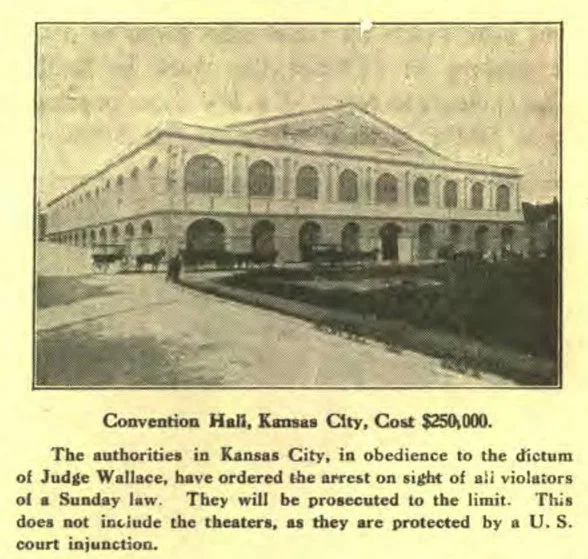
THE Sunday-law campaign is by no means settled in Kansas City. The Kansas City Star gives a report of an address by Judge William H. Wallace, of the criminal court, before the Kansas City Bar Association. The judge is reported to have said:
"Now I am going to warn you; I am going to tell you; you had better climb into the band wagon. The day of reckoning has come. Over this country there is sweeping a tidal-wave of reform . . . that will pick upon its crest the enforcement of Sunday laws and carry it to success."
Then after a diatribe against the Jews, the judge continues:
"This open defiance of the law and this wanton desecration of our Sabbath is in direct opposition to the laws of Moses and the Old Testament which the Jews themselves brought down for us to accept."
The judge fails to observe what is as plain as words can make it that, in the first place, the Sabbath which comes down to us thru Moses and the Bible is the seventh day and not the first day; and secondly, that Israel started out from Sinai a theocracy, while this government is a republic. The people of that government were all worshipers of Jehovah, professedly, while this is a government composed of all classes of people, from all nations and religious beliefs. But this does not seem to affect the judge. He tells us that the citizens will "abide by the law as I construe it until a higher court reverses me, and I think the chances for that are about one in a thousand." He is said to have cited various decisions to uphold his Sunday law and support his hypothesis that this is a "Christian nation" and that its laws are based on Christianity, and yet he tells us, "This is not a question of the church or religion;" and again, "The Jews can not see the wrong of desecration of the Sabbath or of the defiance of the law," which very clearly shows that it is a matter of religion with the judge.
If this were a "Christian nation" it certainly would not need laws to enable it to do what is right. Christianity is made all that it is, obtained all its power, not from the enforcement of human law, but from the Gospel which is the power of God.
The Kansas City Post presents a reply of a rabbi to the judge, and also an editorial which strongly attacks him because of his strong utterances against the Jews. The Ministerial Alliance, however, passed resolutions commending Judge Wallace for the stand that he has taken. The matter has been appealed, however, to the presiding judge of the circuit court, Hermon Brumback. He has taken the matter under advisement. How he will decide no one knows, but according to the Times of November 16 it is stated that he may count the Sunday law in part unconstitutional, especially that part that condemns a person who observes any other day as the Sabbath, such as orthodox Jews and Seventh-day Adventists.
The trouble is that the whole law itself is unconstitutional, as is every law which seeks to uphold dogmas or religious institutions.
Men forever go astray when they get to looking upon any insensate thing whatsoever as having rights, rights that should be guarded and rights that should be conserved. There is but one object in government in this respect, and that is to conserve the rights of humanity, entirely irrespective of religious opinion; but the rights of this or that dogma, the rights of the Sunday law, or the rights of property, should have no bearing in the question whatever. All these things are incidental to the rights of humanity, which ought to be so considered by every government.
Prohibition and Sunday Closing.
THERE is an anti-saloon sentiment springing up in Nebraska, say the despatches, that is likely to sweep that commonwealth into the ranks of the prohibition states. There seems to be a veritable prohibition wave sweeping over many sections of the country. For this good work, every one who knows anything about the curse of the saloon should be thankful. Every Christian should work in all Christian ways for the cause of prohibiting the liquor traffic in every place. He should advocate it untiringly and unceasingly.
There is another item in the news despatch from Nebraska that is not so good or encouraging. It is stated that there is also a strong sentiment being worked up in favor of "Sunday closing." It does not hurt the saloon materially to be closed on Sunday only. If it can run on the rest of the week it is educating the community in the drink habit and carrying its stream of young men into the awful abyss of drunkenness. The saloon should be closed seven days out of every week, and not one day only.
If those who are working for prohibition of the liquor traffic would not keep bringing the Sunday issue into it they could have the earnest support of a great many strong temperance people who can not conscientiously work to advance the interests of Sunday, for they do not consider it a sacred day. On the contrary, they believe that Sunday has been made to usurp the place of the true Bible seventh-day Sabbath of the commandment.
And even if Sunday were the true Bible Sabbath, still it would be wrong in principle to require anything on that day by civil law that it would be agreed would be perfectly proper on any other day in the week. If any act or any business is wrong on one day in the week it is wrong on all days of the week so far as the civil law is concerned. To take any other position is to try to compel the government to settle a religious controversy by law. And all history attests that wherever this has been attempted it has resulted invariably in persecution and tyranny. It has never resulted in good to any one. It is the ground work of intolerance and bigotry. T.
London’s Increasing Pauperism
London's big pauper-list is said to be on the increase; the returns for 1906 show an increase over the previous year of 2,461. One person in every thirty-nine of London's population is already a pauper. If this increase keeps up for very long it will certainly bring some sad results.
Young Ireland’s Anti-Drink Crusade
There is a new organization, the Young Ireland Party, in the Emerald Isle that is to be commended at least in one feature of its agitation. They are endeavoring so to take hold of the rising generation in the anti-drink crusade as to entirely eradicate the drink habit. They adopted an anti-treating pledge, and now there are said to be hundreds of thousands in Ireland who are pledged against treating. It certainly is a noble stand.
Tea Drinking and Insanity in Ireland
Insanity is said to be on the increase in Ireland. In 1871, England and Wales had 30.4 per cent per ten thousand; Scotland, 34; Ireland, 30.5. But in 1901 the figures were: England and Wales, 40.8; Scotland, 45; and Ireland, 56.2. There is a feeling of conviction that in the north of Ireland tea-drinking has very much to do with it. Large quantities are consumed. Certainly it would hardly seem as tho the other contributory elements should be left out, such as tobacco and whisky.
The Czar and Spiritualism
A student who has just returned from Russia says that he has information to the effect that the czar is not only addicted to strong drink, but he is also a consulter of the spirit mediums. He claims that the mediums have a controlling influence over his life and actions. Rev. 16:14 tells of the “spirits of demons, working signs; which go forth unto the kings of the whole world, to gather them together unto the war of the great day of God, the Almighty.” This is the great age of Spiritualism; it has taken possession of the men in the highest positions of the world. The prophet says that it will be thus in the time preceding the great day of God. Is it not amazing how that God thru His prophets could picture all these things out so clearly, and so many centuries in advance!