EYES of blue and hair of gold,
Cheeks all brown with summer tan,
Lips that much of laughter hold,
This is mother's little man.
Shining curls like chestnuts brown,
Long-lashed eyes, demure and staid,
Sweetest face in all the town,
This is mother's little maid.
Dainty room with snow-white beds,
Where, like flowers with
petals curled,
Rest in peace two dreaming
heads,
This is mother's little world!
—Robert F. Roden.
Two Boys Who Meant Business
THIS is a true story of two boys who represent the independence and grit of the American spirit.
James Hackett was not in need of additional help, but something about the latest applicant compelled his attention.
“So you want work,” he said, after a moment’s thought.
“Yes, sir,” came the quick and decisive reply from the lips of the applicant.
“It strikes me that you’re pretty young for a lumber-mill man.” Mr. Hackett could not refrain from smiling at the thought.
“I’m eleven, sir, and if you’ll give me a chance, I will show you that I can work.”
Mr. Hackett was evidently in good humor, for he called the foreman, and told him to give the boy something to do. Thus it was that John Arola gave the first evidence of the character which should some day make him a power in the State of Washington. His mother was dead, and his father was away in the woods, thus leaving John and his brother Carl, aged thirteen years, to fight their battles with the world. One day the foreman of the mill said to Mr. Hackett, “That’s a bright boy you turned over to me.” “Good,” said Mr. Hackett. “Raise his wages to one dollar a day.”
“He is worth it,” replied the foreman.
John was elated at the turn in affairs, but to the surprise of Mr. Hackett he requested permission for his brother Carl to take his place at the mill.
“If he is like you, it will be all right,” said Mr. Hackett.
“Indeed, sir, he is just as good a worker as I am,” said John, and his face lighted with a look of pride.
Here was loyalty unadulterated.
Carl went to work. He gave satisfaction. John disappeared, and in the rush of business Mr. Hackett forgot to inquire about him until one day he chanced to meet Carl.
“Where is John?” asked Mr. Hackett.
“O,” said Carl, “he is attending school.”
This was a new phase of the case, and Mr. Hackett became intensely interested in the two boys, who were not only anxious to earn their own living, but who also were planning to acquire an education. By inquiring he learned that the boys were living in a little tumble-down “shack,” and that the one who worked in the mill earned enough money to keep both supplied with food and clothes while the younger one attended school. Out of school hours John did the housework and cooked the meals. Everything about the old “shack” was tidy. Here was honest effort, youthful independence, and happiness. A few days later Carl requested for himself a short vacation.
“What for?” asked Mr. Hackett.
“Well,” said Carl, in a burst of youthful confidence, “John and I are building a house.”
“You may have your vacation,” was all that Mr. Hackett said, but he did a lot of thinking; and before he went home that night, he instructed the foreman to see that Carl’s salary went on just the same. In due time John and Carl completed their “mansion.” It has two rooms and the same number of doors and windows. The roof is well shingled. Carl has returned to work in the mill, and John continues to attend school when not engaged in household duties. In the evening the two lads study and read. They are happy in their independence.—Success.
Jean's Bunch of “Ragged-Robins”
By Anne Guilbert Mahon
“Two large bunches for two little girls,” said Aunt Alice, laughingly, as she laid two great bunches of bright blue “ragged-robins” down in Jean's lap.
“Oh! aren't they pretty?” cried the little girl, burying her nose in one of the bunches.
“As long as Grace is out, you may take your choice,” said Aunt Alice; “besides, you're sick and should have the first choice, anyway. Grace can go out and play, while you have to stay in with your poor little lame leg. Now, good-by, dear. Hurry and get well so you can come to see your auntie,” and, with a kiss, cheery Aunt Alice left.
Jean looked at the two bunches in her lap. They were of the same size, but one had five or six delicate pink flowers scattered in among the deep-blue ones. They were such a pale, beautiful pink, and they stood out in contrast to the blue one, and Jean had never seen any pink “ragged-robins” before. The other bunch was all blue flowers and buds, but there was not a pink one to be seen in it.
“I'm to take my choice,” said Jean softly to herself. “I do want the pink ones, and I'm sick, too. It's hard to sit here with a sprained ankle while Grace is out having a good time. I ought to have the prettiest,—Aunt Alice said so,” and then she made a doubtful little face.
She held up the two bunches and looked at them closely.
“Grace may like the blue bunch just as much, or, maybe I might take one or two of the pink ones out and put them in the other bunch.”
She tried to pull out a pink flower, but the bunch was tied together so tightly that the slender stem snapped and the flower fell.
“Oh, dear, that's too bad!”
Just then a girl a little older than Jean bounced into the room, her cheeks rosy and her eyes sparkling from her play outdoors. She ran up to the chair where her sick little sister sat propped up in the pillows.
“Was Aunt Alice here? Did she leave those flowers? Aren't they pretty? Which is mine?”
In that minute Jean decided. She handed the bunch with the pink ones in it to her sister.
“That's yours,” she smiled.
“Oh, but that's the prettiest,” began Grace.
“Well, Aunt Alice said I was to choose, and I took the blue ones, so this is yours. Oh, yes! you must take it, 'cause I said so, and I've chosen.”6
Grace did not fully appreciate the sacrifice, but she did admire the flowers. She ran and got two vases of water, and put both bunches into them, then put them on the table beside her sister, and ran out again.
“I guess I feel better than if I had kept the prettiest,” said Jean to herself after Grace had gone, “and, anyhow, I can look at them and enjoy them, even if they are hers.”
The next morning, while mother was helping her sick little girl to dress, Grace, who had dashed into the sitting-room to get her school-books, came running in to her sister, exclaiming:—
“O Jean, what do you think? I can't tell the bunches apart. They've both got pink flowers in them!”
Mother carried the little lame girl over to the sitting-room, and there, sure enough, the buds had come out in the night, and one bunch had just as many pink flowers in it as the other.
Jean laughed delightedly, and said: “Mine was the nicest after all, for it was a surprise.”— Anne Guilbert Mahon, in Sunday School Times.
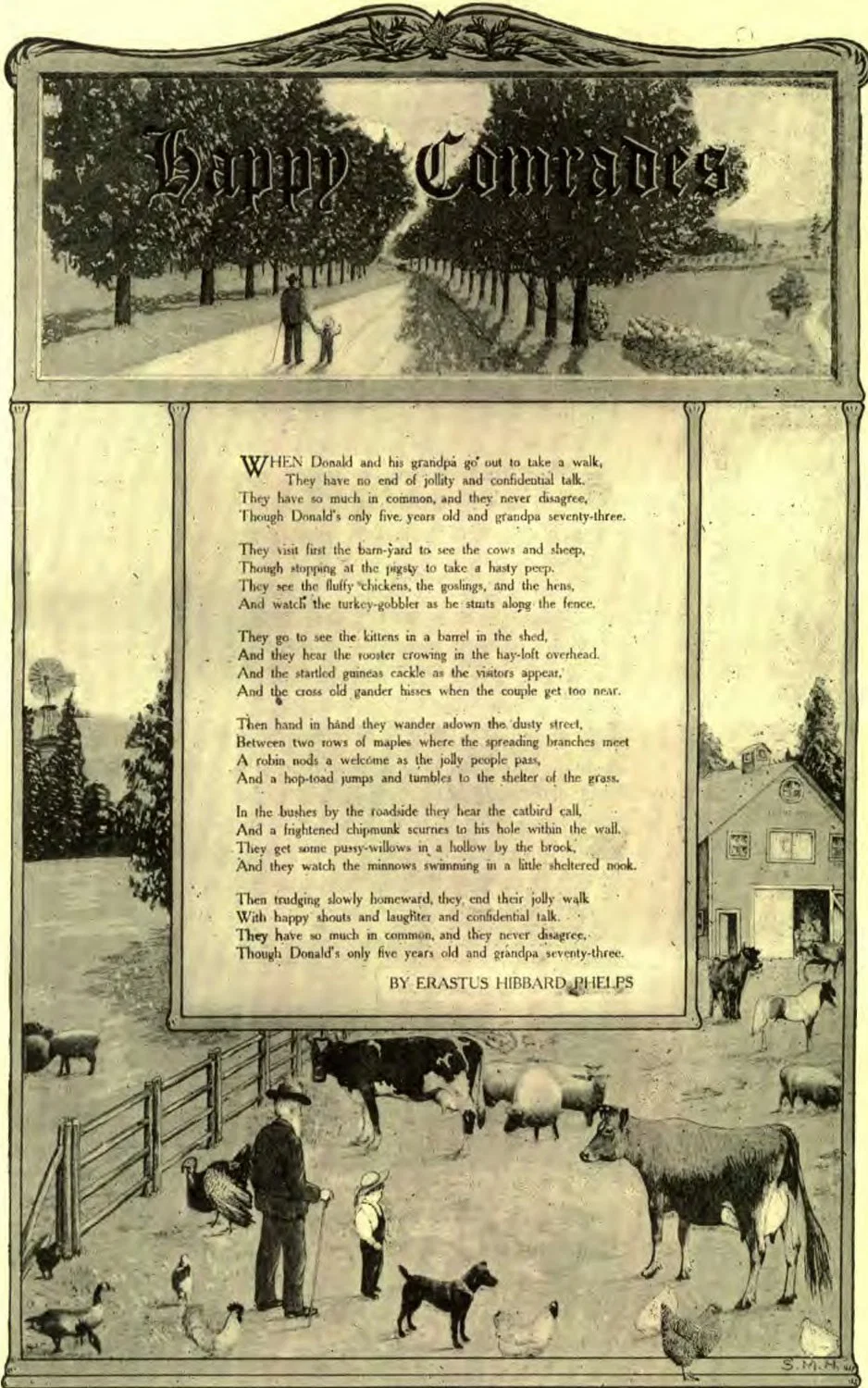
Donald and Grandpa's Jolly Walk
By Erastus Hibbard Phelps
WHEN Donald and his grandpa go out to take a walk,
They have no end of jollity and confidential talk.
They have so much in common, and they never disagree,
Though Donald's only five years old and grandpa seventy-three.
They visit first the barn-yard to see the cows and sheep,
Though stopping at the pigsty to take a hasty peep.
They see the fluffy chickens, the goslings, and the hens,
And watch the turkey-gobbler as he struts along the fence.
They go to see the kittens in a barrel in the shed,
And they hear the rooster crowing in the hay-loft overhead.
And the startled guineas cackle as the visitors appear,
And the cross old gander hisses when the couple get too near.
Then hand in hand they wander down the dusty street,
Between two rows of maples where the spreading branches meet
A robin nods a welcome as the jolly people pass,
And a hop-toad jumps and tumbles to the shelter of the grass.
In the bushes by the roadside they hear the catbird call,
And a frightened chipmunk scurries to his hole within the wall.
They get some pussy-willows in a hollow by the brook,
And they watch the minnows swimming in a little sheltered nook.
Then trudging slowly homeward, they end their jolly walk
With happy shouts and laughter and confidential talk.
They have so much in common, and they never disagree,
Though Donald's only five years old and grandpa seventy-three.
BY ERASTUS HIBBARD PHELPS
The Oil Seed
By Oliver R. Willis
THE sesamum, or oil-seed, was known in the Levant and southern Europe and Egypt at least four centuries before the Christian era. It was taken to the West Indies by Europeans, and one variety has found its way to Florida and other Southern States, and has crept along as far north as the vicinity of Philadelphia. It was detected by Judge Addison Brown in the ballast heaps at Communipaw, New Jersey. It is known as the thunderbolt flower. The plant is used in Europe and India for a pot-herb, but it is most valuable for the oil it produces. The oil resists putrefaction longer than any other fixed oil, and is considered the most delicate of all the sweet oils, except olive-oil. It is used in India for food and for anointing the body, and for the fragrant oils used in religious ceremonies. It is used in all civilized countries for the same purposes for which olive-oil is used. It is applied to illuminating purposes, to the manufacture of cosmetics and hair dressings, and especially to the manufacture of fine toilet soaps.
It congeals at a much lower temperature than other oils, and is therefore well adapted to cold climates. It has of late years been largely employed in the manufacture of spurious butter, or oleomargarine. The natives of India make an article of diet of the seeds; and they place the seeds in the graves with their dead relatives.—Oliver R. Willis.
How Some Common Things Are Made
By Edward Williston Frentz
MANY a boy has tried, at one time or another, to make shot by pouring melted lead from a height into a basin of water. If he failed, as doubtless he did, it was because of faulty methods rather than a mistaken theory. Shot is so made, and has been for more than a hundred years, but special apparatus is necessary.
Previous to 1782 shot was made by cutting sheet lead into strips of a width equal to the desired diameter of the shot. These strips were then cut into squares, and the cubes thus formed were thrown into revolving cylinders, and left there until the friction and attrition had worn the cubes roughly into the form of spheres.
According to tradition, the present method is the realization of a dream. A Mr. Watts of Bristol, England, dreamed one night that he was caught in a shower, the drops of which were round leaden pellets. He knew that all liquid bodies when they fall have a tendency to assume the spherical form, and the more he thought about his dream, the more it seemed possible of realization. He therefore began experimenting.
His first experiment was made by pouring melted lead from the top of St. Mary Redcliffe church into water. It so far succeeded as to warrant further investigation, and the present method of making shot in specially constructed towers is the outcome.
A shot-tower is usually about one hundred and eighty feet high and thirty or forty feet in diameter. The great height is necessary in order to give the falling globules of lead time to cool before they strike the well of water which forms the bottom of the tower. The larger shot, of course, require a longer time to cool, and therefore a higher tower than the small sizes.
The lead is melted in kettles set in brick ovens at the top of the tower. With it is mixed a small quantity of arsenic or of antimony, which have the effect of hardening it and making it cool more quickly.
The center of the top of the tower is occupied by metal colanders, the size of the holes depending upon the size of the shot which it is desired to make. The colanders are moved back and forth automatically by machinery, as a corn-popper is moved over a fire, but with a quick, jerky motion. The melted lead and arsenic flow through a pipe with an automatic cut-off to the surface of the colander. As the layer of molten metal touches it, the colander jerks sharply forward or backward, thereby freeing the metal cleanly and before it can display a tendency to “string out,” The solid portion of the bottom of the colander separates the lead into globules, or drops, which cool as they fall,— and by the time they reach the surface of the water are shot.
The processes of sorting for imperfections and according to size are largely automatic, and are interesting because of the extreme simplicity of the devices which do this apparently difficult work.
By a bucket elevator, that is, an endless chain to which are attached small buckets, the shot are brought from the well to the top of an inclined plane. Down this they roll by the force of gravitation; but the lower end of the plane does not quite reach the receptacle toward which the shot is directed. A space, the size of which has been exactly determined by experience, intervenes. As the shot rolls down this plane, the perfect ones, that is, those which are truly spherical, attain sufficient momentum to leap the space at the bottom and fall into the receptacle. The imperfect shot drop through the open space and are remelted.
Sorting for size is accomplished almost as easily. The mixed shot is poured into the top compartment of a device not unlike a case of drawers, each “layer” or “story” of which is a box with a sieve bottom. These drawers are continually oscillated by machinery, so that the shot fall through one layer after another until they reach one the meshes of which will not allow them to pass. When the “bureau” is emptied, therefore, each drawer will be found to contain shot of uniform size.
The only remaining process is the blackening and polishing. This is accomplished by pouring the shot into revolving cylinders called “tumblers,” which are partially filled with powdered graphite or black lead. The motion and the consequent shifting of the shot upon each other both blacken and polish them.—Edward Williston Frentz.
The Hearing Ear
It has been said that we have two ears and only one mouth, to teach us that we should hear twice as much as we speak. We miss a great deal by not being good listeners. The world is full of sweet music,—bird songs, the chirping of insects, the sweet murmur of all nature, the breathing of the wind through the trees, the plashing of the waters,—and yet some people never hear one melodious sound as they go through the fields and forests of earth.7
God is ever speaking in our ears, in conscience, in his Word, in the gentle voice of his Spirit, but many of us miss all this wonderful divine speech. We ought to train ourselves to listen, to be “swift to hear.” Truth comes to us from all sides. Wordsworth says:—
“To me the meanest flower that blows can give Thoughts that do often lie too deep for tears.”
Unless we go about ever listening, we may miss many a valuable lesson, turning away unawares many an angel who comes from God with a message for us.—Selected.
Fresco-Painting
THE term “fresco” means fresh, and, strictly speaking, is applicable only to paintings executed on fresh or moistened plaster.
Fresco-painting is employed chiefly for large pictures on walls and ceilings. This art was understood by the ancients, but was first made of real importance by the Italians in the sixteenth century. Then buon fresco, or painting on undried plaster, became the favorite art of the great Italian masters.
The subject to be painted on the wall was first carefully drawn on paper backed with cloth. This “cartoon,” as the drawing was called, or a tracing from a portion of it, was then applied to the wall, the outlines were pricked through the paper and cloth into the wet plaster; then a very fine, smooth black powder was blown into the pricked places, and when the original drawing was taken from the wall, a perfectly distinct tracing of it was left behind.
A number of these old pricked cartoons are still extant, and the black dots can be detected in the outlines of some of the most beautiful of the famous old frescoes. Fresco-painting demanded and permitted the exercise of the very highest artistic facilities. As the rapid drying of the plaster required great swiftness of execution, it was impossible to correct a mistake without removing a portion of the plaster, and there were vast spaces to be filled.
The plasterer was obliged to put on the plaster from day to day, as the artist covered it, and a careful examination of some of the noted frescoes will often show where the work of one day is joined to that of another.
Michael Angelo gloried in fresco-painting. The Sistine Chapel, at Rome, is, by many, considered his crowning work.
A large proportion of Italy’s finest pictures are frescoes painted by such wonderful artists as Raphael, Correggio, Demonias, Luini, Michael Angelo, Francia, and others equally as noted. Because of the absence of all gloss of surface, a fresco-painting may be seen equally well from every point of view.
One great objection urged against frescoes is that they are not movable. It is, however, possible to transfer them from the wall to cloth in much the same way that oil-paintings are transferred from one canvas to another.—Selected.
What Chicago's Great Strike Cost
FOR fifteen weeks the teamsters of Chicago kept up a strike, and now they are to go back to work if they can find any. There were 4,250 men thrown out, of whom 2,000 are still without places, the remainder having secured work in other lines or with houses that were not affected by the strike-bound orders or doing business with strike-bound houses. The strike was called on April 6. There are 35,000 union teamsters in Chicago. The cost of the strike to the unions was $300,000. The wages lost is $750,000.
The cost of the strike to the employers is $2,100,000 in wages, and the loss of business is estimated at more than $12,000,000. The cost of the strike to the city is $175,000, and to the country, $100,000. Persons injured by the strike number 450; deaths, 21. To preserve peace there were 2,300 policemen, 1,400 specials, and 3,400 deputy sheriffs. The strike started over an attempt to hold sixteen little tailors who went out on a strike. There was no question of wages or hours among the teamsters, but they went out on a sympathetic strike.—The Search-Light.
MEMORY VERSE: “And as he prayed, the fashion of his countenance was altered, and his raiment was white and glistening. And, behold, there talked with him two men, which were Moses and Elias.” Luke 9: 29, 30.
“And he said unto them, Verily I say unto you, That there be some of them that stand here, which shall not taste of death, till they have seen the kingdom of God come with power. And after six days Jesus taketh with him Peter, and James, and John, and leadeth them up into an high mountain apart by themselves: and he was transfigured before them. And his raiment became shining, exceeding white as snow; so as no fuller on earth can white them. And there appeared unto them Elias with Moses: and they were talking with Jesus. And Peter answered and said to Jesus, Master, it is good for us to be here: and let us make three tabernacles; one for thee, and one for Moses, and one for Elias. For he wist not what to say; for they were sore afraid. And there was a cloud that overshadowed them: and a voice came out of the cloud, saying, This is my beloved Son: hear him. And suddenly, when they had looked round about, they saw no man any more, save Jesus only with themselves. And as they came down from the mountain, he charged them that they should tell no man what things they had seen, till the Son of man were risen from the dead. And they kept that saying with themselves, questioning one with another what the rising from the dead should mean. . . .”
“And when he came to his disciples, he saw a great multitude about them, and the scribes questioning with them. And straightway all the people, when they beheld him, were greatly amazed, and running to him saluted him. And he asked the scribes, What question ye with them?”
“And one of the multitude answered and said, Master, I have brought unto thee my son, which hath a dumb spirit; and wheresoever he taketh him, he teareth him: and he foameth, and gnasheth with his teeth and pineth away: and I spake to thy disciples that they should cast him out; and they could not. He answereth him, and saith, O faithless generation, how long shall I be with you? how long shall I suffer you? bring him unto me.”
“And they brought him unto him: and when he saw him, straightway the spirit tare him; and he fell on the ground, and wallowed foaming. And he asked his father, How long is it ago since this came unto him? And he said, Of a child. And ofttimes it hath cast him into the fire, and into the waters, to destroy him: but if thou canst do any thing, have compassion on us, and help us. Jesus said unto him, If thou canst believe, all things are possible to him that believeth. And straightway the father of the child cried out, and said with tears, Lord, I believe; help thou mine unbelief.”
“When Jesus saw that the people came running together, he rebuked the foul spirit, saying unto him, Thou dumb and deaf spirit, I charge thee, come out of him, and enter no more into him. And the spirit cried, and rent him sore, and came out of him: and he was as one dead; insomuch that many said, He is dead. But Jesus took him by the hand, and lifted him up; and he arose. And when he was come into the house, his disciples asked him privately, Why could not we cast him out? And he said unto them, This kind can come forth by nothing, but by prayer and fasting. And they departed thence, and passed through Galilee; and he would not that any man should know it.”
Questions
1. What did Jesus say to his disciples one day as he was talking with them? After six days what three disciples were chosen to go apart with Jesus? Where did he lead them? For what purpose did they go to this quiet place? Luke 9: 28.
2. As Jesus prayed, what change took place in his appearance? Who were seen with him? What did they talk with Jesus about? Luke 9: 31. Can you explain how it is that Moses is now in heaven? Tell how Elijah was taken to heaven in a chariot of fire. Why do you suppose these two men instead of angels were sent from heaven to comfort Jesus at this time?
3. While Jesus was praying, what had the disciples whom he had chosen to go with him been doing? Luke 9: 32. When they awoke, what did they see? What did Peter at once say? Did he realize what he was saying? How did the disciples all feel?
4. What overshadowed them? What was now heard? Whose voice was it that spoke? What did he say? When the disciples looked again, whom alone did they see? As they came down from the mountain together, what charge did Jesus lay upon them? What did they question in their hearts?
5. When Jesus and the three again joined the other disciples, what did they see? What did the people all do when they saw Jesus? What did he ask the scribes?
6. How did one of the multitude answer Jesus? Describe the dreadful condition of this boy. What had the father asked the disciples to do? What did Jesus tell them now to do with the boy? When he was brought into the presence of Jesus, what did he do?
7. What did Jesus ask the father of the boy? What reply did he make? With what touching prayer did the father now address Jesus? How did Jesus answer him? What did the father immediately cry out? How earnestly was his petition made?
8. When Jesus saw the people come running together, what did he do? What did the evil spirit do when it came out of the boy? What did Jesus then do to the child?
9. What did the disciples ask Jesus when they had entered into a house? What did he tell them? Through what country did Jesus and his disciples now pass?
XII—Responsibility of Parents and Church Officers
(September 16)
MEMORY VERSE: “It is good for a man that he bear the yoke in his youth.” Lam. 3: 27.
Questions
How should parents train their children? Eph. 6: 4.
What promise is made to those who do this? Prov. 22: 6.
How should parents instruct their children in the way of the Lord? Deut. 6: 5-7; note 1.
What part will the children have in preparing the world for Christ’s second coming? Mal. 4: 5, 6; note 2.
For what should the children be trained? — To be good soldiers of Jesus Christ, ready to go anywhere the Lord may call them to serve. Lam. 3: 27; 2 Tim. 2: 3.
What instruction has the Lord given concerning the duties and qualifications of church officers, and their relations to members of the church? Titus 1: 5-9.
What kind of persons were chosen to bear responsibility in the early church? Acts 6: 3.
What noble example of sacrifice, patience, and faithfulness, does the Lord present for us to study and imitate? Heb. 11: 24-26.
1. We are to acknowledge the Lord in all our ways. We are to teach our children to acknowledge Christ as the One that has bought us with his own precious life. To him we should render a tithe of all our income as a confession of his ownership and our loyalty to him. The children should be taught at an early age to be helpful in the home, and an opportunity should be given to the child, by some means, to earn something. He should be taught to lay aside the tithe unto Christ, and, by practising self-denial, to make offerings to his cause. The amounts may be small, but the results of this training will be lasting. The children should be represented in the quarterly and annual report of the tithe received by the treasurer of the church.
“Not only does the Lord claim the tithe as his own, but he tells us how it should be reserved for him. He says: ‘Honor the Lord with thy substance, and with the first-fruits of thine increase.’ This does not teach that we are to spend our means on ourselves, and bring to the Lord the remnant, even though it should be otherwise an honest tithe. Let God’s portion be first set apart. The directions given by the Holy Spirit through the apostle Paul, in regard to gifts, present a principle that applies also to tithing. ‘On the first day of the week, let every one of you lay by him in store, as God hath prospered him.’ Parents and children are here included. Not only the rich, but the poor are addressed. ‘Every man according as he purposeth in his heart [through the candid consideration of God’s prescribed plan], so let him give; not grudgingly, or of necessity: for God loveth a cheerful giver.’ The gifts are to be made in consideration of the great goodness of God to us.”—Mrs. E. G. White, in Review and Herald, Nov. 10, 1896.
2. “As the children sang in the temple courts, ‘Hosanna! Blessed is he that cometh in the name of the Lord,’ so in these last days, children’s voices will be raised to give the last message of warning to a perishing world. When heavenly intelligences see that men are no longer permitted to present the truth, the Spirit of God will come upon the children, and they will do a work in the proclamation of the truth which the older workers can not do, because their way will be hedged up.”—“Testimonies,” Vol. VI, pages 202, 203.
Lending to the Lord: Charity to the Poor
He that hath pity upon the poor lendeth unto the Lord; and that which he hath given him shall he pay him again.—Proverbs.
A Glad Good Morning
By Carlotte Perry
It was only a glad good morning
As she passed along the way;
But it spread the morning’s glory
Over the livelong day.
— Carlotte Perry.
One Step Enough
WE never know what lies before us. Sorrow may be waiting, or sore temptation, or death. We see not a step before our feet. But no matter, if God is leading; for he knows all that lies before us. As we go on, he makes each step plain; and is not that enough?
A young man had almost decided to become a Christian; but one doubt held him back; he did not see how he could continue faithful all through his life. He spent an evening with his minister, talking on the subject; but still his indecision remained. As he left, the pastor observed how dark it was, and getting a lantern, handed it to the young man, saying, “This little light will not show at once the whole way to your home, but only one step at a time; yet take that step, and you will reach home in safety.” As the young man walked homeward, he pondered, “Why can I not trust my Heavenly Father, even if I can not see my way to the end, if he gives me light for one step?”—Selected.
My Garden Neighbors
A NEW book is just being issued from the press of the Review and Herald Publishing Association, entitled “My Garden Neighbors.” It is written by Dr. L. A. Reed, who is well known to readers of this paper. This new book will especially interest all who love nature. It tells of certain birds, animals, and other creatures which at one time or another made their abode in the author’s garden. You will want to read of the sparrows who learned to imitate the bluebirds, of the cat that went wild and got too smart to live, of the little chipping sparrow that was miserably imposed upon by a great lazy cowbird, of the bug that was once a god in Egypt,— in short, you will want to read the whole book.
“My Garden Neighbors” contains 256 pages, and over fifty illustrations, of which twelve or more are full page, and four are colored plates, showing seven birds in their natural colors. The frontispiece is a picture of a bluebird sitting on a spray of wild roses, all beautifully colored. The price of the book is one dollar. It will be ready soon, and advance orders are solicited.
Address Review and Herald Publishing Association, Washington, D. C.
A Scarred Hand
A LITTLE fellow was playing with his mother's finger, on which she had a beautiful ring. As he was twisting it round and round, he noticed an ugly scar upon the back of her hand. “O mother,” said he, “what an ugly hand that is!” Her eyes filled with tears.
“Charlie, would you like to have me tell you about that hand?”
“Yes, mother,” said he.
“Well, when you were a baby boy, you were romping about the room one day, and you struck your toe against the fender, and fell into the fire. I dropped my work and pulled you out of the fire with that hand. The hot bars and coals made that scar upon it.”
“O mother, that is the loveliest hand in all the world, because it is the hand that was in the fire for me.”
Jesus has passed through the fires for us; and so he is the one “altogether lovely;” he is the chiefest among ten thousand.—Record of Christian Work.
The Storm
By Mary Martin Morse
The rain is dashing with sheets of sleet,
Where island ledges and lake-line meet,
Waves, like warriors with spear and knife,
Rush like gnomes with quivering life.
Lofty evergreens, sunlight tipped,
Ledges and shrubs in opals dipped,
Birds that caroled in morning’s flush,—
All are swept by the storm’s onrush.
The trees stand firm in their island home;
The birds have faith that the sun will come,
For eons have passed since the first great flood,
Yet the island sturdy and strong has stood.
Heart o’er-swept by the breaking wave,
Trust God! Look up! Be strong and brave;
Tempest tossed, or by “Fear not” stilled,
All is well that the Master willed.
Clouds and blackness will pass away;
Sometime dawneth a fairer day;
Though the Father be veiled, he smileth not less,
And in sunshine or storm stands ready to bless.
MARY MARTIN MORSE.
Miss Cook's Letter with Suggestions for Rainy Days
THE Letter Box seems to be almost as popular as any part of the INSTRUCTOR, even men and women with gray hair read its contributions; so Miss Cook’s letter of valuable suggestions has been placed in that department this week. All will be interested to note her suggestions for rainy days.
ONE of our ministers who is able to present the truth to the people in a very forcible way, read the Bible through thirteen times before he was of age, and read all our publications as they appeared. It is evident that he thus laid in youth the foundation for his life of service in the cause of truth.
A LITTLE fellow eight years old who is canvassing in Battle Creek, says he expects this year to have money to put in the offering for China and India, because he is doing so well selling papers. He has sold, out of school hours, nearly two hundred papers. Are there not other boys and girls who are thinking of the millions of heathen in China and India?
A WOMAN who could remember only one thing about Mr. McCheyne, said, “I do not remember the texts he used, nor what he said, but he always preached like he was dying to have men converted.” If we who believe the third angel’s message would preach and work as though we were “dying to have men converted,” surely many would be brought into the fold of Christ. Let us do it.
“BEHOLD, I come quickly: hold that fast which thou hast, that no man take thy crown.” A man was riding on the outside of a car, which was making good speed. The conductor presently called out, “Hold fast!” He knew there was a dangerous curve ahead, so gave the warning. Our Father sees the dangers of the closing hours of earth’s history, and he sends to us the admonition to “hold fast that which thou hast, that no man take thy crown.” Heaven is jealous lest we lose our crowns.