DURING the past year we have prayed that the spiritual life of our people might be quickened, and we are glad to see indications that our prayers are being answered. And though our growth has not been so great as we would have liked, yet there are signs of an earnest awakening to the stern realities of our day. Was there ever a year so full of the signs that mark the end, as the year just closed? We think not; and as our eyes are opened to see these things, our souls are stirred with a desire to hasten on the work which must be finished before the trumpet shall sound, heralding the coming King, and we desire above all else to have a part in carrying it to those who are now in darkness.
At Cardiff the Lord has blessed us with precious fruit, for which we thank him. Sixteen have been baptized there, several have been added by vote, and there are still a number who are expecting to unite with the church soon.
Since our last annual meeting we have organized a church at Blaenavon, which also includes the company from Abergavenny. There are indications that others will come to swell their numbers in the near future.
The company at Aberdare has grown under the fostering care of Brother and Sister Buchman, and has been added to the church at Pontypridd.
In the district where Brethren Rodd, Carscallen, and Shafer, and Sister Swann have labored, the work has gone hard, and would often have discouraged the workers had they not known that they had done what they could. However, a few souls have taken their stand for the truth, and are filled with zeal to carry the precious seed to others. Throughout the field strong efforts have been made by the enemy to keep the people from hearing. Again and again the canvasser has been repulsed, and has been told that the people are being instructed by their pastors not to buy our literature. Thank God, they can do nothing against the truth. It will withstand all the fiery darts of the enemy.
We heartily welcome Brother Penrose, of Pembroke. The Lord blessed his soul with the truth, and enabled him to preach it to his flock,—the members of the Martletwy Baptist church,—and a few good souls have decided to walk in the path of truth, amid great trial and tribulation.
We would like to bear testimony to the faithfulness of our church leaders, and all who have in any way helped to hold together what has been gathered, as well as endeavored to reach others. Much patience has been manifested throughout our companies; for we have not been able to visit them as much as we would have liked. God watches the faithful work done by the lay brethren, and he will grant the reward by and by.
Since last July Brother and Sister Bailey have labored in connection with our Bible van. The Lord has blessed their efforts, and all the good accomplished will be revealed only when the records of heaven are opened. Up to Dec. 31, 1906, they had sold two hundred and twenty copies of “Our Paradise Home,” thirty-five of “Great Controversy,” twenty-seven of “Christ Our Saviour,” and many others. In addition, they sold 1,312 tracts and pamphlets. A large number of meetings were held from the van platform, also in the homes of the people, and a few times in the chapels and schoolrooms in the neighborhood. Several have become deeply interested in the truth, and one lady is rejoicing in it, as a result of the van work. The increase of membership during the last year has not been large. Forty-one were baptized during 1906.
We rejoice in the signs that indicate plainly that the Lord is coming soon. We are still ready to “spend and be spent” in this blessed work. To us there is nothing else worth working for—no other work worthy of our attention.
Korea
By Mimi Scharffenberg
MIMI SCHARFFENBERG
The trip from America to Japan was a very pleasant one. From Japan we went across the Korean Strait on a Japanese boat. In the hallway of the ship we had to take off our shoes. Many sleep in one room, on the floor.
Landing in Fusan, Korea, we took the train to Sunan. But in this country trains run only during the day, and at night we had various experiences in getting a lodging.
This is a very hilly country, and it seemed strange at first to see the long rows of people, dressed in white, coming down the hills, and finally to find ourselves right among them. It is the custom for both men and women to dress in white.
As soon as we reached Sunan, the Koreans came in great numbers to visit us. Elder Smith and wife and myself are the only foreigners in this city. The natives will not knock at the door, but open it, and walk right in, and seemingly do as if they were at home. The women almost always go out visiting in bands. From ten to thirty have come here at one time. They usually have a routine of questions to ask, such as, “What is your name?” “How old are you?” “Have you an elder brother?” and other questions similar to these. They will not ask about sisters, for girls are of no account.
Our home is on a hill, away from the impure air. It is a pleasant location. From here we can see as many as twenty villages. These are different from those at home. The houses are very close together. A village may not take in any more room than one of our large camp-meeting grounds at home, and still have a population of from one thousand to fifteen hundred. The houses are built of clay, are about eight feet high, and have straw-covered roofs. They usually have a small kitchen and two other rooms, each room eight feet square. Churches, post-office, and other buildings can not be distinguished from the dwellings or from one another.
We have a very nice little company of believers in Sunan. The first meeting I attended seemed strange. The men enter through one door, the women by another. All take off their shoes before entering, and are seated on the floor. The men keep on their hats. We women can not see the speaker, because a curtain is drawn in front of us. According to the custom of this country, women are not allowed to be in the same room with the men. They have been kept down in every way, and there is great need of workers to labor among them.
Perhaps it would be interesting to know how I try to put into practise what I learn of the language. All I have to do is to go for a walk through the village. First the dogs begin to bark; every family has a dog. I soon found that if I turned around, they would run, and act as if they were afraid of a foreigner. Next, one will have several dozen children following, and often women. The latter will begin to ask questions. I answer what I know, and when I do not know, they go through various performances to try to make me understand. Several times I have been invited to come into their homes. After being seated—on the floor—they will try to find out what I have learned, and do their best to teach me something more. I enjoy this very much, for it gives me an opportunity to get acquainted with their customs little by little.
They all have black hair, and seemingly can not understand why mine is light. They wanted to know if it was my own; so one day I had to take it down for them to pull at, to satisfy them that it would not come off.
In their homes they have no kind of furniture. All I have seen is what we might call a trunk, in which they keep their clothes. The floors are covered with straw matting, on which they also sleep.
The more I am among them, the more I see their great need. I am very thankful that the Lord has sent me here, and my whole desire is that I may learn the language, so I shall be able to tell them of the love of Jesus, and the great and precious truths that have been committed to us. Since being here I have15thought that if our people at home could but see the conditions here, they would never feel like shirking their part in this work. None could or would wish to be idle.
Breaking Ground in Austria
By JOHN WOLFGARTEN
JOHN WOLFGARTEN
At the time of the last conference in Friedensau, it was voted that we make Austria our field of labor, and we accepted the call in faith, believing it to be of God. In September we took up our abode in Vienna, the capital of Austria, where the Lord helped us in finding a suitable dwelling, although we had arrived in rather an unfavorable time to choose a good house. Shortly after getting well settled in our new quarters, I went to Prague, to cast out the gospel net there for a few months. In December Brethren Conradi and Boettcher visited us, and the little company of believers was strengthened by their presence, and several were baptized, while three or four others expressed their desire to follow later.
Unfortunately, we have no freedom in this land,—at least not such liberty as we enjoy in the greater portion of Germany,—and yet our work must be done. If one plan does not succeed, we must try another way to attain our object, and keep on trying until our effort is crowned with success. The laws of this land are so formed, as far as religious liberty is concerned, as to be of advantage only to the Romanist, and therefore the spiritual darkness is so great that it can be broken only through the third angel's message. Liberty of speech we do not enjoy, for we can not come freely together and speak of God's Word; the colporteur dares not scatter the printed page, for with that is forbidden; we do not have the liberty even to give away our literature, to say nothing of attempting to sell it; and yet the Lord opens avenues through which we may circulate our tracts and periodicals and books among the people.
We now have Bible studies with some interested persons, right in our own home. Not long ago we had the joy of seeing a young Rumanian baptized. His uncle is minister of justice in Rumania; and now the young man, who came to us from the Greek Catholic Church, is in the Friedensau School, preparing himself to carry the message to the people of his own land.
VOTIF CHURCH, VIENNA
That I might get in touch with people in various cities, who are interested in the genuine gospel of Christ, I have placed in newspapers such insertions as this: “Such as would like to seek for religious truth, and gain information with reference to the signs of the times and coming events, are invited to confidentially apply to ——.” One gentleman wrote in reply: “I would like to find peace for my troubled heart.” Another wrote: “It is very hard to seek for the true faith among the many opinions and confessions of to-day. The Christian faith has so changed that it contradicts itself, and one finds no comfort in it; one is in continual unrest.” A lady wrote: “I am much interested in what you say with reference to the future. Have you possibly read the Revelation of St. John? It appears to me that the world must soon come to an end.” Yet another: “O, I would like so very much to know what truth is, but I can not imagine what it can be! I plead for the truth. Hasten, hasten!” Another: “Our Christianity of to-day is altogether too superficial, and mostly outward formalities.”
These replies speak for themselves. I correspond with these persons, and send them our publications through Hamburg. The Lord certainly has a people here also, that will answer the call, “Come out of her,” as soon as the call reaches them.
We feel happy to be found doing what we can for the Master in this difficult field. Our responsibility is great.
Twenty-nine million people, speaking five or six different languages, must be warned in this land; and after the truth has gone to all the world, “then shall the end come.”
Vienna.
Fat Shan, China
By LAW KEEM, M. D.
LAW KEEM, M. D.
It has been nearly a year and a half since we came to China. The Lord has kept us through dangers seen and unseen, and many have been his blessings. We are thankful to be here and have a part in his great closing work.
The greater portion of this time we have spent in Canton; this has enabled my wife to get a good start on the language, and has given me an opportunity to study the field and find a good location for the work. After visiting several places, we decided to locate in Fat Shan, a city of nearly one million inhabitants. This city is ten miles from Canton, and is connected with that place by railway.
After deciding to settle here, I looked for several months before finding a suitable dwelling, as house-hunting is no easy task in China. We found one at last, with the help of a friend, and after making needed repairs, we moved in, the tenth of last December.
Before our chapel was ready, we held services each Sabbath in our sitting-room, and invited a few persons to come. The first Sabbath ten came.
I have visited among the people, and find them very friendly toward our work. We have also had many visits from members of the London and Wesleyan Missions. Some are inquiring already about the Sabbath and other points of our faith. One minister especially is in earnest. He has accepted the Sabbath, and is trying now to gain his father and mother also. He wishes to join us, but greatly desires his whole family to accept the truth with him. His father is also a minister. We are praying that he will take his stand firmly for the truth. Opposition against the work only creates a desire to learn more of what we believe.
To-day (February 4) we held our first service in the chapel, with fourteen in attendance, one being a Wesleyan minister. With this exception, they have not attended church services before, and, consequently, know little or nothing of church etiquette. They talked out loud. The women compared their clothes with those of my wife, making all comments aloud. One young man called out to them that it was not good to talk out16loud — of course forgetting what he himself was doing. When we sang, they all tried to sing, too. I talked to them about Christ and his soon coming, and on the whole, they paid very good attention.
The men looked up each text. Sometimes I had to stop talking, to find a text for some one. Some seemed to listen with real interest. The Lord grant that I may be able to give them the plain, definite message, and that it may find good soil in some hearts, and take root, bearing fruit to his glory.
Through the kindness of the San Francisco church, and a brother, we have a good organ. This is a great attraction, as well as a help in the singing. Our chapel will seat sixty persons comfortably.
We have done very little medical work so far, for lack of a place; but we are getting the bath-room and dispensary ready for earnest work as soon as I return from the Shanghai meeting. We have two earnest young men who will take up the nurses' work on my return, one coming from Amoy. My wife has more invitations than she can respond to for visits among the women. We are sure the Lord called us to this place, and we see many evidences of it already.
On my way from Hongkong last week, I had the good fortune to meet Mr. Wu Ting Fang, ex-ambassador to the United States, who returned to China not long since. He is over sixty years of age. He inquired where I came from, etc. On learning that I was a physician, graduated in the States, he said, “Well, you fellows are behind the times. Nowadays the best-read men do not use much medicine. They depend more on rational methods, diet, and nature. Just look at me — over sixty years old. I do not eat flesh foods, or use any medicine. I live on vegetables, grains, and nuts. I take a cold bath every morning, and walk several miles before breakfast. Why, I feel as hale and hearty as a young fellow,' and believe I can live to be over one hundred years old.
“A few years ago, while in America, I had the rheumatism, with my joints swollen and sore. I heard that a flesh diet caused it, by forming uric acid in the system, and I quit eating meat. Now I have no rheumatism nor anything. All medicine went with the meat. I do not go to these big feasts, either — I have no use for such nonsense.”
I told him we were of the same belief on these points; that I, too, did not use flesh foods, and used very little medicine in my practise, treating more with hydrotherapy. “O, is that so? Well, now, you must teach this to the people here. Teach them physiology, and how to take better care of themselves; that's what I want.”
He asked me to what denomination I belonged, also where I was located. He took my address, and wished to correspond with me. This man holds high positions in the government at Peking, yet he is a real Daniel, so far as the principles of physical living are concerned. He is certainly a healthy-looking old gentleman, and walks as briskly as I can. It did me a great deal of good to meet him. Of course I shall write to him, and send him some of our papers and books, as he is well educated in English, as well as in Chinese, and can read anything I could send him. Perhaps the Lord will have a follower in the courts of China's palace some time. All things are possible with him. We are of the best courage, and trust in the near future to have something much better to write than heretofore.
The Kimberley Diamond Fields
By G. A. Irwin
G. A. IRWIN
Kimberley contains a population of 34,260. It is the center of the diamond fields of South Africa, and the diamond-mining industry is what has made and still keeps it one of the most prosperous towns in all South Africa. In December, 1905, there were 17,260 natives and 3,192 Europeans employed in the Kimberley mines. All the mines in and about Kimberley were, in the days of Cecil Rhodes, consolidated into what is now known as the “DeBeers Mining Company.” This company owns and controls not only the mines now open, but thousands of acres of land at present lying waste. A very large proportion of the property in the city itself is under their control in some degree. The rights and privileges of the company seem to have scarcely any limit. Yet notwithstanding all this, the directors of the company pursue a liberal course, both toward the town and toward its own employees.
For the double purpose of protecting both themselves and the natives they employ, the company has gone to the expense of building and properly equipping large compounds. Each of these compounds encloses several acres of land, and has rooming capacity for from one thousand to three thousand natives. Each contains within its limits a store, stocked with provisions, clothing, etc. These supplies are sold to the employees on the same margin of profit as is charged by the outside dealer.
In addition to the store, there is a large, light, and neatly kept hospital for the accommodation of the sick and wounded. A physician and a medical matron, who give their whole time to this work, are supplied by the company. In case an employee loses a limb while doing his duty, the company pays for an artificial limb.
For its officers and white employees, the company built upon its own land a beautiful suburb to the city, known as Kenilworth. Large public vineyards and orchards were also planted. Hundreds of nice brick cottages were erected on commodious lots, which were planted to fruit and ornamental trees. Schoolhouses, churches, and other public buildings were built; in fact, everything necessary for comfort, convenience, and the pleasure of the employees was provided. The trees planted in this large area have made a marvelous growth, and this suburb, in contrast with the bare and desolate country around, seems like a miniature Eden.
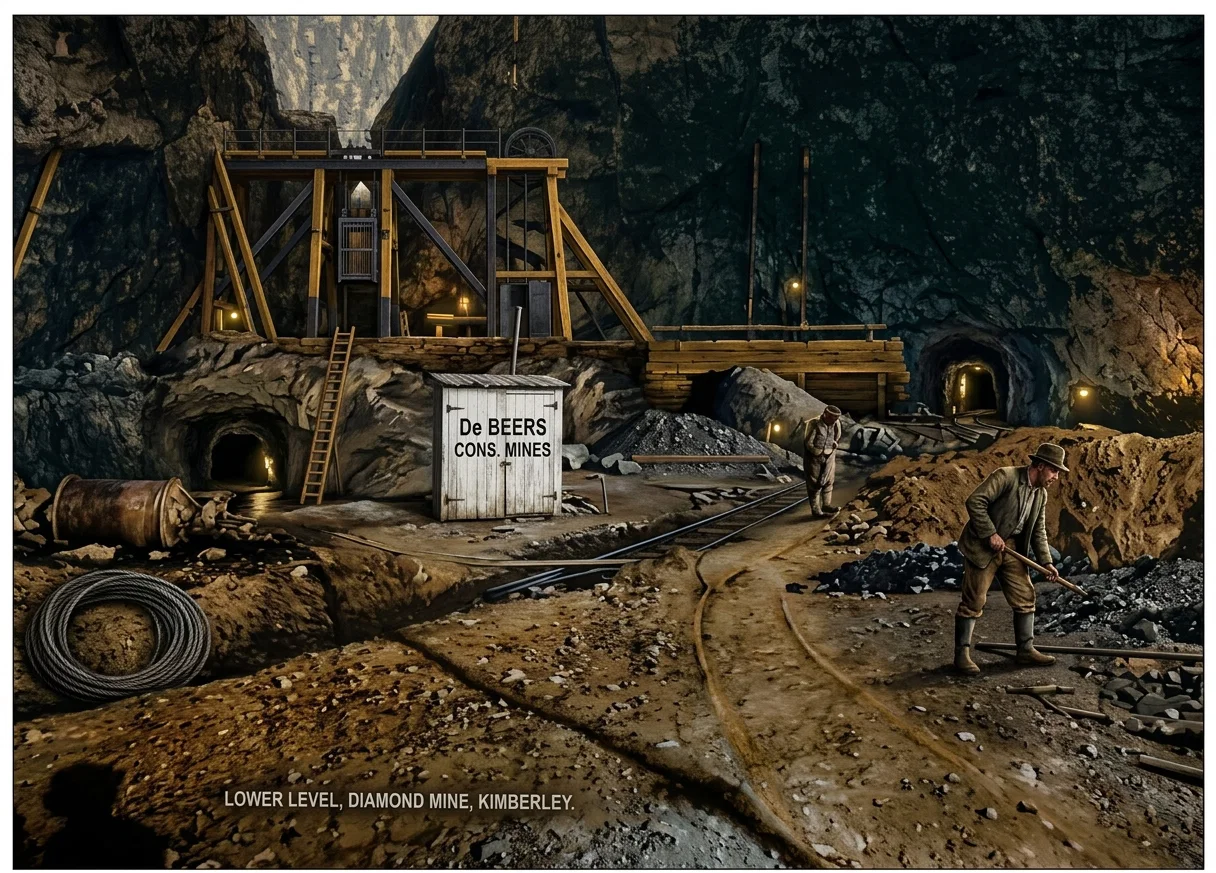
On my visit to one of the large diamond mines, I was profoundly impressed by the great amount of work and expense incurred in mining and hoisting tons upon tons of earth and passing it through various processes and scores of machines, to get a few jewels. This diamond-mining business has reached such a degree of perfection through the scientific machinery and methods employed that not one single jewel goes out with the waste, even though it is no larger than a small pin-head. The analogy between the true Christian and the diamond itself and the necessary methods employed to release it from the rock and clay in which it is embedded, is so striking that I can not forbear giving some facts and details that will make the analogy clear to the reader.
In the first place, the diamond is formed by intense heat and pressure. In some instances the pressure has thrown the diamonds to the surface of the earth, where they may be found in gravel and sand-banks, and in river beds. But the greatest number are found deep down in the earth, imbedded in rock and tough, bluish clay surrounding the hole that gave vent to the intense heat and pressure that formed the diamond, and gave it its hardness and luster. This rock and clay is dug out with pick and shovel, and elevated to the surface by means of lifts, and dropped into small cars, which are hauled out to what is known as the farm, or floor, where it is dumped from the cars onto the ground.
Thousands of acres are thus covered from one to two feet deep. In this condition it is allowed to remain for months, exposed to the sun, rain, and other atmospheric conditions. The whole mass is stirred at intervals, so as to expose all parts to the sun and air. This is done in order that the action of the elements may pulverize, or so change the nature of this tough, rocky clay, that in the grinding and various other processes to which it is submitted later, the particles will separate and release the diamonds, and make it possible, through a multiplicity of stirrings, washings, shakings, and siftings, to obtain every genuine diamond contained in the clay thus manipulated. The last shaking and sifting machine, over which the diamonds and small pebbles of a similar size and weight are carried by the shaking of the machine, and the constant flow of a stream of water, is covered with a kind of grease that catches and holds every diamond, while the pebbles and some small stones, which look like diamonds, are carried on by the shaking and washing, and are borne away by the lift, and deposited in one of the great piles of waste that have accumulated around each mine, resembling the foot-hills around some gigantic mountain peak.
It is the golden oil that flows from the two olive-trees through the two golden pipes that catches and holds the true Christian in the last shaking, just as the grease catches and holds every real diamond as it traverses the last machine.17
Just as the smallest diamond is caught and held by the grease, so, in the mighty sifting that is to take place among God’s people, not the least grain shall fall upon the earth. Amos 9:9. I could easily hold in the hollow of my hands all the diamonds obtained from a day’s work of one of the largest mines in Kimberley, yet their value in the rough was estimated by an expert to be six thousand pounds. The amount of dirt handled in obtaining this handful of jewels is beyond my power to describe other than by the use of the word “immense!” In the beginning of this mining industry in Kimberley, all the work of elevating the clay to the surface was done by hand, or by very rude hoisting devices. Yet in this way, clay and rock sufficient were removed to leave a hole right in the edge of the city eighteen hundred feet deep, and half a mile wide across the top. As I stood upon the brink, peering into the depths of this great hole, the force of the figure used in Isa. 51:1, 2, came to me with great vividness: “Harken to me, ye that follow after righteousness, ye that seek the Lord: look unto the rock whence ye are hewn, and to the hole of the pit whence ye are digged. Look unto Abraham your father, and unto Sarah that bare you: for I called him alone, and blessed him, and increased him.”
DOWN IN THE MINE
Many of God’s jewels of past ages, as well as in the present generation, have been buried very deep in heathenism and worldliness. As we stand to-day upon the very brink of eternity, and gaze into the dark pit of sin whence we have been digged, we can see that it has been alone by the mercy, goodness, and blessing of God that we have been rescued from such conditions and surroundings, and brought thus far on our journey. In comparison with the multitudes of people by whom they have been surrounded, God’s true people have always been few in number. In this last generation they are spoken of by our Saviour as “a little flock.” The number that will be redeemed from the earth through obedience to the principles and teachings of the third angel’s message will be in comparison to the population of the world as one to eleven thousand. It is a comforting fact to know that while God’s jewels are scattered here and there all over the world, among “every nation, and kindred, and tongue, and people,” he has provided a scheme, known as the third angel’s message, that will bring to the surface, and separate from the mass of rubbish and worldliness in which they have been imbedded, all the hidden jewels; and those on the surface, or only slightly covered, will be hunted, or fished out, as the Lord has promised in Jer. 16:16: “Behold, I will send for many fishers, saith the Lord, and they shall fish them; and after will I send for many hunters, and they shall hunt them from every mountain, and from every hill, and out of the holes of the rocks.”
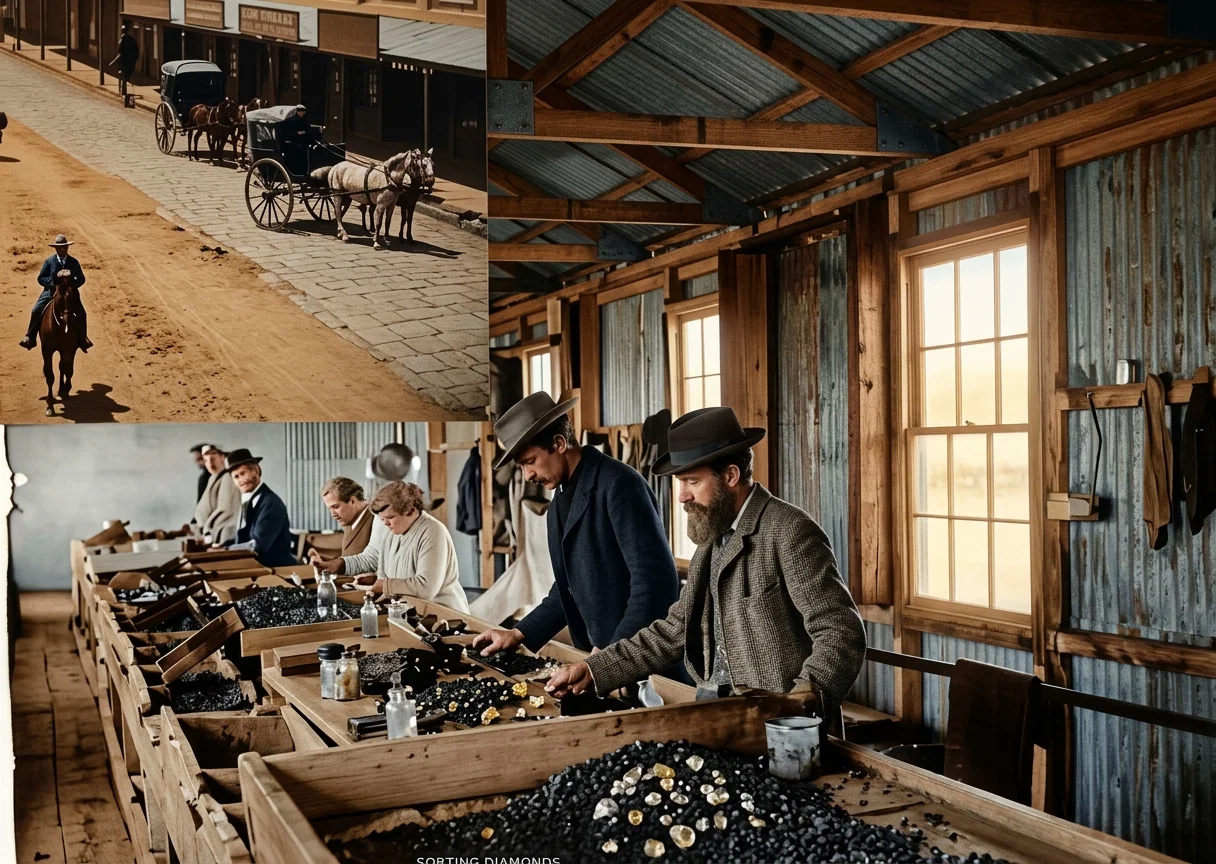
STREET IN KIMBERLEY
The finding of the diamonds, laborious and expensive though the process is, is not the end of the operation. Before they will shine and emit the luster that is in them, they must be cut, polished, and shaped. So with the Christian. The finding may have cost the sacrifice of men and means, and been accompanied by the tears, prayers, and heartaches of the hunters and fishers, yet before he can “shine as the brightness of the firmament” or “as the stars forever and ever,” he must be hewed and squared by the prophets, that he may be fitted for a place in the spiritual temple that God is erecting of human beings, who, as living stones, “polished after the similitude of a palace,” are to be the outshining of his glory. “The trials of life are God’s workmen, to remove impurities and roughness from our character. Their hewing, squaring, and chiseling, their burnishing and polishing, is a painful process; it is hard to be pressed down to the grinding wheel. But the stone is brought forth prepared to fill its place in the heavenly temple. Upon no useless material does the Master bestow such careful, thorough work. Only his precious stones are polished after the similitude of a palace.” Of those who submit to this polishing process, as does the inanimate diamond, the Lord has said, “And they shall be mine, saith the Lord of hosts, in that day when I make up my jewels; and I will spare them, as a man spareth his own son that serveth him.”
SORTING THE DIAMONDS.
Mission Notes
THIS incident is related in a letter from Elder Babcock, of West Africa: “A young minister, formerly of the United Brethren Church, visited me, and finally decided in favor of the truth. His wife was much opposed. A few months ago she dreamed of seeing a large tent, and people coming to receive the ‘seal’ of God. She was unable to find out just what the ‘seal’ was. She said that in her dream she could not find her husband for some time, but at last he came, and was ‘sealed.’ For a while she would not come to the meetings in the tent. At the very first meeting she attended, I spoke on the ‘seal,’ and her heart was opened to the truth. She and her husband have had experience in mission work.”
WILLIAM CAREY, in point of winsomeness, was the very opposite of Robert Morrison. On Carey’s leaving his pastorate in Leicester, England, it is recorded that one of the obstacles presented to his going to India was: “The congregation to which Carey had ministered was loath to lose the services of their pastor; and so Thomas and Sutcliff had to visit Leicester to conciliate his hearers. With many heart pangs his congregation consented to the severance, a sense of duty prevailing. ‘We have been praying,’ said one of the members, ‘for the spread of Christ’s kingdom among the heathen, and now God requires us to make the first sacrifice to accomplish it.’ And upon their pastor’s leaving, they made an entry in their church book, so that his love to his poor miserable fellow creatures might be put on record; at the same time stating that while they concurred with him, it was at the expense of losing one whom they loved as their own souls.”
Forward Movement with Our Pioneer Missionary Paper
By Editor
THE special campaign inaugurated in behalf of our pioneer missionary paper, the Signs of the Times, is meeting with grand success. On one day, May 1, over fifteen hundred subscriptions were received, and scores of letters expressing hearty approval of the special series, and promising orders later on.
The increase in the subscription list for the week ending May 1 was 5,151 copies, and for the following two weeks 10,135, making the total of additional subscriptions 15,286. We first printed forty thousand copies of the first number of the special series, and are having to order another edition.
The pages for the first few numbers of this series are electrotyped, so that copies of the entire series of twenty-six special numbers can be furnished to all who send in their subscriptions on or before June 1.
One man emphasized his approval of the plan by subscribing for seventy-five copies to be sent to his friends in the East. The Los Angeles church takes 1,257 copies, the San Francisco church over 1,000 copies, the Pacific Press employees 750 copies, and so on.
The Atlantic and Pacific Unions have united with the General Conference in sending a club of five hundred to the American school-teachers in the Philippine Islands. We believe it will be one of the best investments they have ever made.
Churches and individuals in all parts of the country are ordering clubs for missionary work; and the number who regularly sell large numbers each week has more than doubled. Two city workers write, the first from Kansas City, Mo., the other from Los Angeles, Cal.:—
“It seems that the longer we work with the Signs, the greater success we have. Last Monday we had wonderful success. After we have been in a place and sold one or two papers, we either have to stop or are treated very kindly. We feel and know that the Lord is wonderfully blessing our efforts.”
“I am having blessed experiences in this work. I sell one hundred papers, and give away one hundred tracts each day. The Signs of the Times is a good seller. The people seem anxious to hear the truth. This work is the pleasure of my life, but I am able to work only about five hours a day. If I could work eight hours, I could sell nearly or quite two hundred a day.”
We quote the following from a letter just received from a person evidently not of our faith:—
“Dear Editor of the Signs of the Times,—
“We received yours of recent date. Yes, you may consider me a subscriber for your paper while I live. I consider it the best paper in the United States, and fully indorse its teachings. It throws more light on the prophecies than any other work I have seen.
“Mr. Williams introduced the Signs of the Times in this section about twelve months ago; and where it is read, it has a wonderful awakening effect upon the people. Enclosed I send one dollar to continue the paper.”
Our ministers are also taking an active part in this work, as may be seen from the following letter, which is only one of many received:—
“Find enclosed draft for eighteen dollars and post-office order for four dollars, for which please send to Mrs. A. P. Heacock, Little Rock, forty-four copies of the Special Signs for six months, beginning May 1.
“We handled the Signs work in St. Joseph, Mo., and are glad to renew our work with it in this place.
“Yours in the truth,
“A. P. HEACOCK.”
In addition to the special series of articles on present truth, particular attention is given to the “Outlook Department,” calling attention to current events, and showing their meaning in the light of prophecy.
Just at present the Peace Conference in New York and the coming Peace Congress at The Hague are attracting public attention. The Signs is containing reports of the first meeting, by special representative, and will have two representatives at The Hague.
It is our purpose to make the Signs the very best missionary journal in all the world. Will you not join in the great forward move to give thousands more the opportunity of reading it?