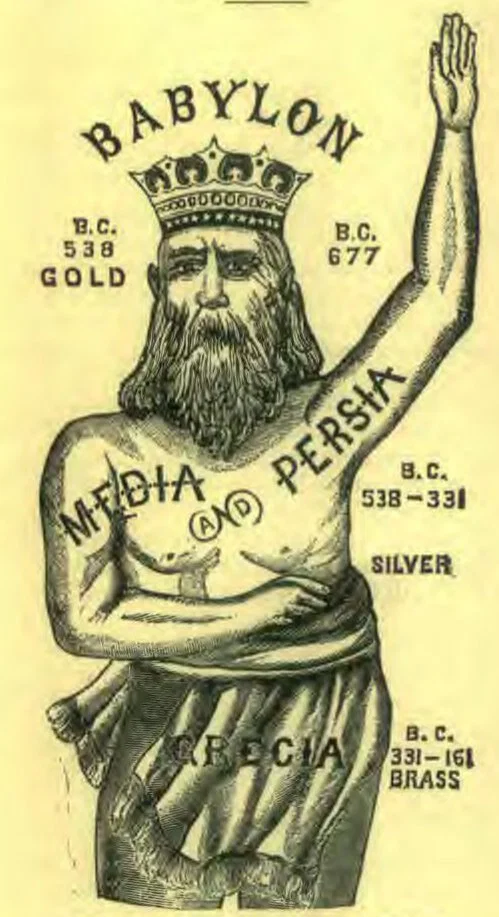
LEAVING for a while the empire of Persia, we turn our attention to that instrument by which this empire was subverted, and upon its ruins another, a third, kingdom erected, which bore rule over all the earth. God had declared by the mouth of the Prophet two hundred and seventy-two years before it happened, that a third kingdom should be erected upon the ruins of the second; and we, from our later stand-point have the privilege of tracing the historical steps by which it was accomplished.
Alexander the great was born at Pella in Macedonia, B. C. 356. This prince and Darius the Persian, were the two principal actors on the stage when the empire of the world for the second time exchanged hands. Of the history of the Greeks therefore, their gradual growth, their wars with the Persians, &c., previous to Alexander's time, we need not particularly speak further than this:—
"Philip, king of Macedon, the father of Alexander, having overthrown the Thebans and Athenians, in a great battle at Chaeronea, made himself thereby in a manner lord of all Greece; and therefore calling together at Corinth an assembly of all the Grecian cities and States, he there caused himself to be chosen captain-general of all Greece for the carrying on of a war against the Persians, and made every city to be taxed at a certain number of men, which each of them was to send and maintain in this expedition." But being slain by one of his guards the next year, just as he was ready to set forward, Alexander his son succeeded him in the kingdom, being then twenty years old. He soon called a general council of all Greece to meet again at Corinth, and there prevailed with them to be chosen also the successor of his father in the same general command which they had conferred on him before his death, for a war against the Persians.
Having by the next spring gotten together his forces, which according to the highest account amounted to no more than thirty thousand foot, and five thousand horse, he commenced, with this small number, his daring career against the throne of Persia. His progress perhaps cannot be better shown than in the following brief synopsis of his course, given by Rollin:
"Alexander set out from Macedonia, which is part of Turkey in Europe, and crossed the Hellespont, or the Strait of the Dardanelles. He crossed Asia Minor, (Natolia,) where he fought two battles, the first at the pass of the river Granicus, and the second near the city of Issus. After this second battle he entered Syria and Palestine; went into Egypt where he built Alexandria on one of the arms of the Nile; advanced as far as Libya, to the temple of Jupiter Ammon; whence he returned back; arrived at Tyre, and from thence marched towards the Euphrates. He crossed that river, then the Tigris, and gained the celebrated victory of Arbela, possessed himself of Babylon, the capital of Babylonia, and Ecbatana, the chief city of Media. From thence he passed into Hyrcania, to the sea which goes by that name, otherwise called the Caspian sea, and entered Parthia, Drangiana, and the country of Paropamusus. He afterwards went into Bactriana and Sogdiana; advanced as far as the river Iaxarthes, called by Q. Curtius, the Tanais, the farther side of which is inhabited by the Scythians, whose country forms a part of great Tartary.
"Alexander, after having gone through various countries, crossed the river Indus, entered India which lies on this side the Ganges and forms part of the grand Mogul's empire, and advanced very near the river Ganges, which he also intended to pass, had not his army refused to follow him. He therefore contented himself with marching to view the ocean, and went down the river Indus to its mouth.
"From Macedonia to the Ganges, which river Alexander nearly approached, is computed at least eleven hundred leagues. Add to this the various turnings in Alexander's marches; first, from the extremity of Cilicia, where the battle of Issus was fought, to the temple of Jupiter Ammon in Libya; and his returning from thence to Tyre, a journey of three hundred leagues at least, and as much space at least for the windings of his route in different places; we shall find that Alexander, in less than eight years, marched his army upwards of seventeen hundred leagues, [or more than fifty-one hundred miles,] without including his return to Babylon."
Ptolemy the Egyptian astronomer begins the reign of Alexander over the East with the building of Alexandria, B. C. 332; but it was not till the battle of Arbela, the year following, that he became, according to Prideaux, "absolute lord of that empire to the utmost extent in which it was ever possessed by the Persian kings." On the eve of this engagement, Darius sent ten of his chief relations to sue for peace for which he had twice sought in vain before; and upon their presenting their conditions to Alexander, he replied, "Tell your sovereign . . . that the world will not permit two suns, nor two sovereigns! Let him therefore choose, either to surrender to-day, or to fight to-morrow." Such was the indomitable pride and haughtiness by which he was governed. Having assembled his general officers and requested them to represent to the soldiers that they were to fight on this occasion not for Phoenicia or Egypt only, but for all Asia, and that the whole empire hung upon the issue, he led them against the army of Darius and gave him an irreparable overthrow. Darius hereon fled towards Media, and was shortly after traitorously slain by his attendants.
Thus ended the reign of Darius, and with it the Persian empire, after it had continued from the taking of Babylon by Cyrus two hundred and seven years.
Alexander, after his conquests in the far East, mentioned above by Rollin, returned to Babylon. While he remained there, which was nearly the space of a year, he gave himself up to the pleasures, luxuries, and drunkenness of the place, till at length he drank himself into a fever of which in a few days after, he died, B. C. 323. After his death, he having left no heir, great confusion arose about the succession. The governments of the empire were at length divided among the chief commanders of the army, who took at first the name of governors, but finally that of kings. Soon after they were settled in their provinces, they warred among themselves, till, after some years, all were destroyed but four; Cassander, who had Macedon and Greece in the west, Lysimachus who had Thrace and the parts of Asia on the Hellespont and Bosphorus, in the north, Ptolemy who had Egypt, Libya, Arabia, Palestine, and Cœle-Syria, in the south, and Seleucus, who had Syria and all the rest of Alexander's dominions in the east.
BOOKS, PAMPHLETS AND TRACTS, ISSUED BY THE SEVENTH-DAY ADVENTIST PUBLISHING ASSOCIATION, AND FOR SALE AT THIS OFFICE.
The Sanctuary and the 2300 Days of Daniel 8:14. By Elder U. Smith. This question has developed the people known as Seventh-day Adventists, and is the pivotal doctrine upon which their applications of prophecy largely depend. 352 pp. $1.00
Thoughts on Daniel, critical and practical. By Elder U. Smith. An exposition of the book of Daniel, verse by verse. 364 pp. 1.00
Thoughts on Revelation. By Elder U. Smith. With notes or remarks on every verse in the book of Revelation. 352 pp. 1.00
Life of Wm. Miller, with portrait. Interesting sketches of the life and public labors of this pioneer in the Advent movement in this country. 416 pp. 1.00
The Biblical Institute. A synopsis of the lectures given at the Institute held at Oakland, Cal., April, 1877, covering the main points of our faith. 352 pp. 1.00
History of the Sabbath and First Day of the Week, for the period of 6,000 years. By Elder J. N. Andrews. This is a work of unusual interest, prepared with great care, and is full of historical and Scriptural facts. 528 pp. 1.00
The Nature and Destiny of Man. By Elder U. Smith. This work treats on the conditions of man in death, and his final destiny. 356 pp. 1.00
The Constitutional Amendment. A Discussion between Elder W. H. Littlejohn and the editor of the Christian Statesman, on the Sabbath. 1.00
The Spirit of Prophecy; or the great controversy between Christ and his angels and Satan and his angels, in four volumes. By Mrs. E. G. White. These volumes cover the time from the fall of Satan to the destruction of sin and sinners at the close of the one thousand years of Revelation 20. Each 400 pp.—
Vol. I. Old Testament facts to Christ.
Vol. II. Life and Ministry of Christ.
Vol. III. The Death, Resurrection and Ascension of Christ, with the Lives of His Apostles.
Vol. IV. (In preparation). Each, 1.00
Life of Elder Joseph Bates, with portrait. 352 pp. 1.00
The Bible from Heaven. By Elder D. M. Canright. An argument to show that the Bible is not the work of men, but is of God. 300 pp. 80 cts. Revised edition (in preparation). 1.00
Spiritual Songs. A choice collection of hymns and tunes. 416 pp. 1.00
The United States in the Light of Prophecy. An exposition of Revelation 13: 11-17. By Elder U. Smith. Applying to our own land and time, this prophecy possesses surpassing interest for every American reader. 200 pp. 40 cts. Paper covers, 20 cts
Thoughts on Baptism. By Elder J. H. Waggoner. A careful examination of the subject of Christian Baptism in the light of history and the Bible. It presents strong arguments against the notion of trine immersion. 186 pp. Bound in flexible cloth, 35 cts
Paper covers, 25 cts
Song Anchor, for Sabbath-school and Praise Service. By J. E. White. A new book, with excellent new words and music. 164 pp. Per hundred, $30.00. Single copies, 35 cts
The Atonement. By Elder J. H. Waggoner. An examination of a remedial system in the light of nature and revelation. 168 pp. 20 cts
The Ministration of Angels, and the Origin, History and Destiny of Satan. By Elder D. M. Canright. 144 pp. 20 cts
The Nature and Tendency of Modern Spiritualism. By Elder J. H. Waggoner. A thorough exposure of Spiritualism; application of the Scriptures, and copious extracts from a library of Spiritualist publications. 184 pp. 20 cts
Our Faith and Hope. Sermons on the Coming and Kingdom of Christ. By Elder James White. 182 pp. 20 cts
The Spirit of God, its Gifts and Manifestations to the end of the Christian age. By Elder J. H. Waggoner. 144 pp. 15 cts
The Three Messages of Revelation 14 : 6-12; particularly the third angel's message and the two-horned beast. By Elder J. N. Andrews. 144 pp. 15 cts
The Two Laws, as set forth in both Testaments. By Elder D. M. Canright. 104 pp. 15 cts
Matthew Twenty-four. A clear and forcible exposition of our Lord's discourse upon the Mount of Olives. By Elder James White. 64 pp. 10 cts
The Sunday Seventh-day Examined. A refutation of the teachings of Mede, Jennings, Akers and Fuller. By Elder J. N. Andrews. 88 pp. 10 cts
The Seven Trumpets. An exposition of the subject as set forth in the 8th and 9th chapters of the Revelation. 96 pp. 10 cts
Refutation of the Age to Come. By Elder J. H. Waggoner. A most decisive refutation of the view that men may find pardon after the Saviour has closed his work in the Sanctuary alone. 168 pp. 20 cts
The Morality of the Sabbath. By Elder D. M. Canright. A complete refutation of a common objection against the Sabbath. 96 pp. 15 cts
The Resurrection of the Unjust. A vindication of the doctrine. By Elder J. H. Waggoner. 100 pp. 15 cts
A Word for the Sabbath, or False Theories Exposed. A poem. By Elder U Smith. 60 pp.
Vindication of the True Sabbath. By Elder J. W. Morton, formerly missionary of the Reformed Presbyterian Church, to Hayti. 68 pp. 10 cts
Sermon on the Two Covenants. By Elder J. N. Andrews. An able argument on an important subject. 48 pp. 10 cts
The Truth Found. The nature and obligation of the Sabbath of the fourth commandment. By Elder J. H. Waggoner. 64 pp. 10 cts
Christ and the Sabbath: or, Christ in the Old Testament and the Sabbath in the New. By Elder James White. 56 pp. 10 cts
Redeemer and Redeemed. By Elder James White. This work sets forth the plan of redemption in its three stages. 40 pp. 10 cts
Systematic Benevolence. Setting forth the Bible plan of giving for the support of the ministry. 64 pp. 10 cts
Redemption. The fall and its results, and the methods by which we are brought back to the favor of God and to immortality. 32 pp. 4 cts
The Second Advent. Manner, object, and nearness of the event. 32 pp. 4 cts
The Sufferings of Christ. A most graphic and touching description of what the world's Redeemer has suffered for us; calculated to incite every one to new devotion and consecration to the cause of Christ. 32 pp. 4 cts
The Present Truth. Showing that every age has a truth applicable to it alone, and what is the present truth of this generation. 32 pp. 4 cts
The Seventh-day Adventists. A sketch of their origin, progress, principles, etc. 32 pp. 4 cts
The Two Thrones. Representing the kingdoms of grace and glory; showing the distinction between these two kingdoms. 32 pp. 4 cts
The Seventh Part of Time. An exposure of the sophistry of that reasoning which would make the commandment indefinite. 32 pp. 4 cts
ADDRESS, SIGNS OF THE TIMES, OAKLAND, CAL.
Beautiful Are the Admonitions
BEAUTIFUL are the admonitions of him whose life accords with his teachings.