The Youth's Instructor, Vol. LI, No. 32

The Election of a New Pope

The Youth's Instructor

Aug 13, 1903

Review and Herald Publishing Company · Battle Creek, Michigan · Aug 13, 1903

The Election of a New Pope
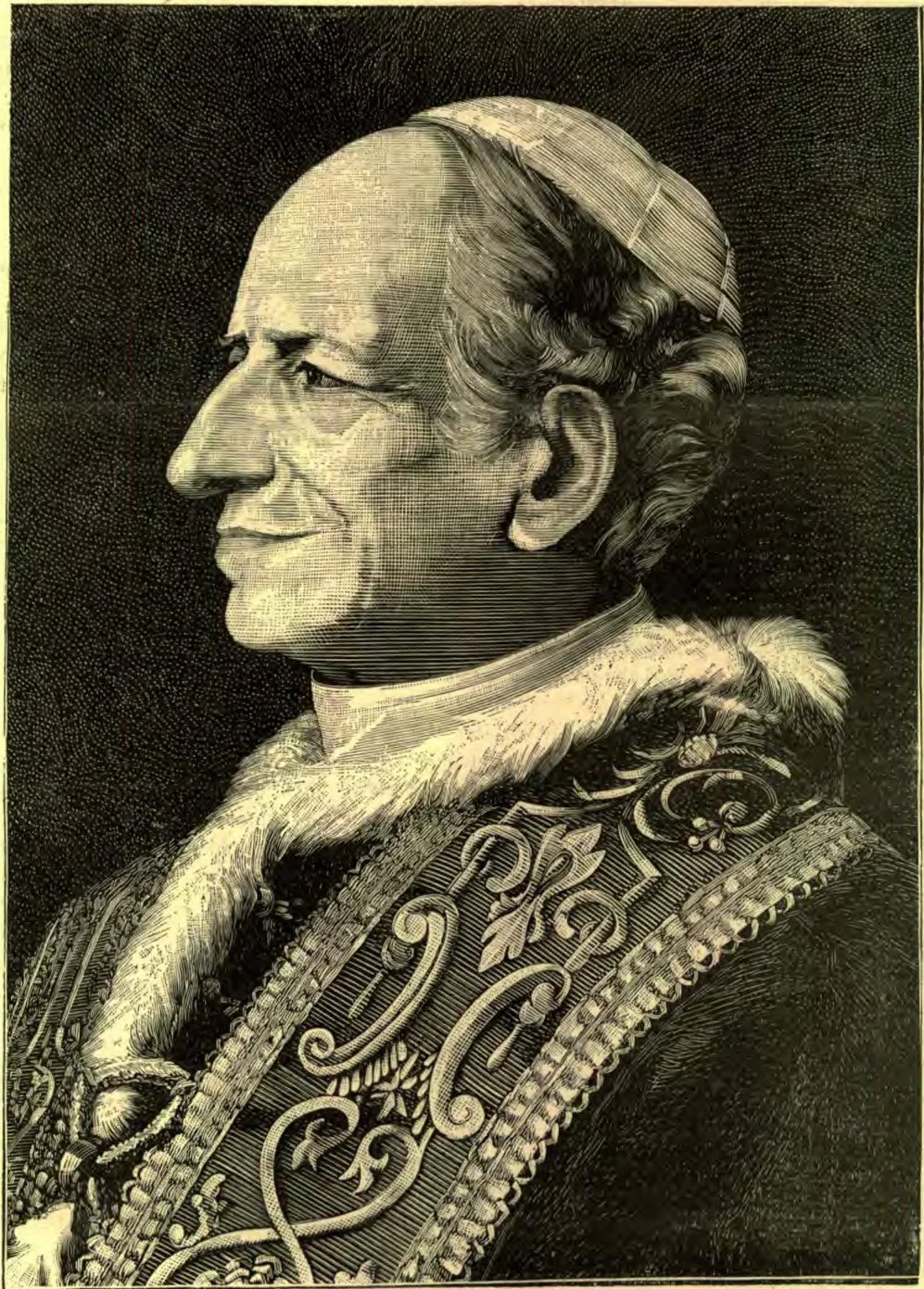
DURING the last sickness of Pope Leo XIII, and especially since his death, the entire world has been told again and again, through the newspapers and magazines, of the interesting ceremony of electing a new pope; but it may be quite as interesting to the readers of the INSTRUCTOR to read the story as it was told to us a few months ago by one of the leading official guides of the Vatican, as we stood in the magnificent assembly-room of St. Peter’s, facing the beautiful marble sarcophagus which will be the temporary resting-place of the pope, while the permanent tomb and the ornamental decorations and statuary are being prepared.
We were fortunate in obtaining the services of an intelligent guide, who had long been in the service of the Vatican; and while we can not vouch for the accuracy of his statements, we were impressed with the apparent sincerity of his effort to give a faithful narration of the interesting proceeding.
When the attending physicians have made their final examination, and have declared life to be extinct, they retire from the death chamber, and the doors are securely locked; then the Cardinal Chamberlain, who has stood next to the pope as the highest and most trusted official of the Vatican, approaches the door, and knocks three times. On receiving no answer he enters, and with a silver hammer taps lightly three times upon the forehead of the dead man, and calls him by name. There still being no answer, the Chamberlain retires from the room, and announces officially that the pope is dead.
The Cardinal Chamberlain immediately assumes the high office, and takes charge of affairs until the election of a new pope has taken place; but as a precaution against an abuse of this temporary power, three other trusted cardinals are appointed to guard the interests of the church.
According to the laws of the church, the balloting for the election must begin in ten days, or in twelve days at the latest, after the pope’s death.
Through the ambassadors of the countries where they reside, the death of the pope is immediately announced to the seventy cardinals of the church, known as the Sacred College, who alone are eligible to office; and they are summoned to hasten to Rome in order to participate in the election. In the meantime the embalmers are summoned; the body is removed from the death chamber to the throne-room adjoining, and is there prepared for the tomb. Then the body is removed to the auditorium of St. Peter’s, and placed in the marble sarcophagus previously mentioned.
POPE LEO XIII
POPE LEO XIII
The funeral lasts nine days, during which time thousands assemble to pay their last respects to this great sovereign of the Catholic Church. As the cardinals arrive, they are assigned to their apartments, each being allowed two rooms and a kitchen. Each cardinal may have with him two attendants, one an officer of the church and the other a layman, besides a cook and any other necessary attendants; but all are closely guarded, and are actually held as prisoners, so that they may have no communication with the outside world until the solemn conclave is over. The election is held in the beautiful Sistine Chapel of the Vatican, a little private assembly-room, beautifully decorated with paintings by Michelangelo and other celebrated masters.
On the day fixed for the sitting of the conclave, the cardinals assemble to hear the mass of the Holy Spirit, and take the oath of allegiance, faithfulness, and secrecy. Then they march in double file to the Sistine Chapel, which has already been made secure from all outside worldly influences by every window and every door except the main entrance being walled up solid with bricks and mortar; and every aperture of the room, by which communication with the world might be had, being securely closed. When the cardinals with their attendants and the six scrutineers have assembled, the entrance door is also walled with masonry, with the exception of a small square opening, through which food and other refreshments may be passed in. “So you see, my friends,” said the guide, “the cardinals must elect a new pope, or they will never get out.” The cardinals are thus confined to insure the election being purely ecclesiastical, and free from political influences or intrigues; for there have been times when the election of a pope has been made the occasion for an uprising or revolution, with the hope of influencing the election for political purposes.
Before the balloting begins, each cardinal is required to make a declaration in writing, indicating whether he is willing to accept the sacred office as head of the church, and be bound through life by the many oaths to which a pope must subscribe; one of the most important of which, and the one most likely to be embarrassing to the cardinals, being the oath of self-imprisonment until death within the walls of the Vatican; for it is well known that after his election the pope can never again set foot outside his temporary dominion, which consists of St. Peter’s, the Vatican, and their adjacent gardens. Only those who are willing to be thus bound are eligible to the high office; and the number is usually quite limited.
A two-thirds vote is required for the election of a pope; and any one of three methods may be employed,—acclamation, compromise, or ballot. Pope Leo XIII was elected by acclamation, or by “inspiration,” as the church is pleased to term it, “when all the cardinals, as if by the inspiration of the Holy Ghost, proclaim one candidate pontiff by voice and unanimously.” Election by ballot is far more common. In that case balloting papers are distributed, as in a political meeting, and each cardinal writes his preference in the following words: “I, Cardinal ——, elect my Lord Cardinal —— to be supreme pontiff.” Then the cardinals, one by one, step forward to the altar, hold the ballot aloft in the right hand, and with the left hand upon the Bible, say, “I call to witness Christ the Lord, who is to be my judge, that I elect him whom I judged according to God ought to be elected, and that I do the same at the succession.” The ballot is then placed in the chalice.
When the full number of votes has been cast, the six scrutineers come forward and examine the ballots. If less than a two-thirds vote for any one cardinal has been secured, the ballots are placed upon a quantity of wet straw in a little fireplace used only for that purpose, and are burned. Thousands of people assembled outside watch for the smoke from the chimney, which by its appearance will announce to them the result. When the heavy black smoke from the damp straw is seen, they know that the ballot has not been successful. Sometimes the balloting continues for several days. If at the close of the first day no successful ballot has been taken, an announcement is made of the name which has received the largest number of votes; and when the cardinals renew their balloting on the following morning, chief consideration is given to the most favored cardinal, and an attempt made to secure a two-thirds vote for him. On the ballot being successful, the Cardinal Chamberlain comes forward, and announces the result. The favored cardinal receives the congratulations of his fellows, and announces to them the ecclesiastical name by which he chooses to be known. Then he retires to the dressing-room, and is arrayed in the pontifical garments.
In the meantime the successful ballot papers are sprinkled with holy water, and burned; and the cloud of vapor ascending from the chimney announces to the crowd without that the ballot has been successful. The masons come with their hammers and remove the bricks and mortar; and the cardinals are set free. The new pope is ushered out to the great balcony in front of St. Peter’s, and there introduced by his new name to the people. The First Cardinal Deacon presents the pope to the people in these words: “I bring you tidings of great joy. We have a pope, the most high and reverend [giving the name of the new pope]. He has taken upon himself the name of [Pius X or Leo XIV or whatever the name may be].” Then the people hasten to the great auditorium of St. Peter’s, there to receive the blessings of their Sovereign Pontiff, and witness the grand parade, as the successor of St. Peter passes before the assembled thousands, wearing the triple tiara, arrayed in the richest gold-wrought vestments, and followed by all the great cardinals and highest princes of the church. Then, attended by the Noble Guard, the fine body of Swiss Highlanders who are the bodyguard of the pope and the protectors of the Vatican, the newly elected head of the church is escorted to his royal apartments.
E. R. PALMER.

Lesson from the Swaying Bird. Matt. 10:29-31

On a bough so lowly bending, Mirrored in the water blue, Sits a trustful singer, swaying, Trilling songs for me and you.
Clouds above are lowly hanging, Often comes the lightning’s flash; Fiercely now the winds are blowing, With anon a thunder crash.
All its heart is melting, pouring; Falls the tempest, still it clings; I can see its slight form quiver, As it bravely sits and sings.
Spirit of the upper heavens, Pray translate the singer’s song; Help me read the God-sent message, As its billows roll along.
“What have I to fear? my Father Holds the storm-king in his hand; I could surely not be safer, In my nest upon the land.
“O thou earth-born child of promise! Why so often all affright, When thy Father’s hand upholds thee, Brightest day or darkest night?
“When he speaks, the raging tempest, All its angry tossing stills. His alone the gold and silver, Cattle on a thousand hills.
“I can trust him in the sunshine, Drenching rain, and dreary storm; Even in the ice-bound winter, He it is that keeps me warm.
“I that only gather insects, Singing songs ’neath heaven’s blue, He remembers; and he careth Much more, child, for such as you.
“He that keeps thee can not slumber, His hand holds thee, plant of dust; All thy head’s hairs he can number, Cling to him, and rest, and trust.”
MARY MARTIN MORSE.

Two Ways

Once while riding on the train an aged couple boarded the cars at a quiet country station. They seemed somewhat timid, and apparently had traveled but little. After the first excitement of getting a seat and putting their belongings in place was over, the old man settled back in the seat with a very dignified air, while his companion gazed through the window with a contented, happy smile. From their conversation with the conductor I learned that they were on their way to visit their son, who for fifteen years had not missed making them an annual visit at that season, but owing to an accident was not able to come that year.
The train boy passed to and fro with his usual supply of gum and oranges; but none of his wares attracted the old farmer’s attention until he appeared with the daily newspaper.
“How much are your papers?” he asked.
“Three cents,” replied the newsboy.
“Three cents,” said the farmer, in surprise. “Why, I can get the Bloomfield Gazette right in our town a hull year for one dollar.”
“You can’t get a Daily News for that,” answered the boy, sharply.
“The Gazette has news from over the hull earth,” persisted the old man.
“Well, you don’t need to take the paper, hayseed, if you don’t want it,—but here, I’ll donate you one if you can’t afford it,” insultingly said the boy, holding the paper toward the old man, who waved him off, saying, “No, sir, I pay for what I get. I would not have your paper.”
The newsboy moved on, muttering surlily.
The farmer looked disturbed. His wife hastily brushed a tear from her eye; had she not told him that very morning how well he looked in his best suit, bought fifteen years before in honor of their Charlie’s wedding?
A gentleman seated just behind the two comprehended the situation, and laying aside his newly bought paper, he leaned forward, and soon engaged the old man in an animated conversation. Even grandma forgot her grief when they touched upon the subject of butter making, and in her quiet way offered her opinion. Later, after perusing the paper, he said, politely, “Would you like to look over my paper? I do not care for it any longer.”
“Thank you, I believe I will,” the old man said, appreciatively.
And soon the old couple were both reading from the same page, happily commenting upon the different topics. VINA M. SHERWOOD.

Do Not Hurry, Do Not Worry

“THE world is wide In time and tide, And—God is guide; Then, do not hurry. That man is blest Who does his best And leaves the rest; Then, do not worry.”

Our Three-Story House

It has been said that man lives in a three-story house, the lower story being the part inhabited by his animal nature, the second by his intellectual nature, and the third by his spiritual nature. The comparison is an excellent one. In the basement, or lower story, are the kitchen and dining-room; in the second is the library, and in the third is the oratory where one holds communion with God. The majority of people spend most of their time in the basement. Their thoughts are centered upon having good times in this world. They are almost wholly concerned with what they shall eat and drink and wear. Necessity may cause them to work, but, in so far as they can, they eat, drink, and are merry. They do not care for books and for learning enough to make them more than passably intelligent. In tastes and in knowledge they are above the brutes, it is true, but it is the animal nature that rules over them.
It is a lesser number of people who spend a large part of their time in the library in the second story. There are some who go up and down so often, from the first to the second floor and back again, that it is hard to tell in which story they spend most of their time. When one comes to value learning; when he is consumed with a desire to know the great secrets that nature hides where they are sure to be discovered by the wise and persistent seeker; when he likes to commune with great minds who have opened the storehouses of their wisdom to all who will enter, his animal nature has ceased to dominate him, and his living room is in the second story.
Still fewer find their way into the third story. That is the sanctuary of the soul—its holy of holies. Here man's higher nature is stimulated by great draughts of truth. Here he is inspired by communion with the Holy Spirit to feel a great love and to do great deeds for his fellow men. Here he finds himself uplifted by fellowship with the good of all ages. The Scriptures are an open book in that upper story. The world-fever is calmed there, and the atmosphere of the place is peace. It is far above the contentions, scramblings, and clashings of the first story. It has deeper and more lasting joys than are to be found in the second. The outlook of the third story is upon the life beyond.
As has been said, not so many mount up to this last story. There are some who go up to it once in a while,—say once a week,—and then hurry down, locking the door behind them. Others have no regular time for visiting it, and in many cases do not return to it for months or years. But there are some who dwell in it all the while. You can be sure of the fact by their serene and radiant faces. They have found the secret of joy forevermore. That upper story is a Beth-el, a house of God, the very gate of heaven.
There are three stories, remember.—Selected.

In and About San Francisco—II

Fisherman's Wharf
THERE is a subtle charm about the “water-front” of all seaport cities that seems to draw all mankind to it, and hold their interest when they are there. If one is a seaman out of work, he goes to the water-front to find employment, to meet old friends, or to see familiar sights. If he be a landsman at leisure, he goes to see that which is new, or at least strange,— to watch the stevedors at their work, landing or embarking cargo; to have a part in the excitement that attends the incoming or the outgoing ship; to inspect and admire the stanch and trim vessels that lie at anchor, or are tied to the wharves; to see the yachts and launches scud hither and thither; or perhaps, if he be a dreamer, to sit down in some quiet corner, and, as he watches the restless waves, muse on what might have been, or dream of what yet may be.
The water-front of San Francisco is cosmopolitan in character and varied in attractions. But the quaintest, most romantic spot among the miles of docks is Fisherman's Wharf. Here all the small fishing-craft of the city land their catch and tie up between trips.
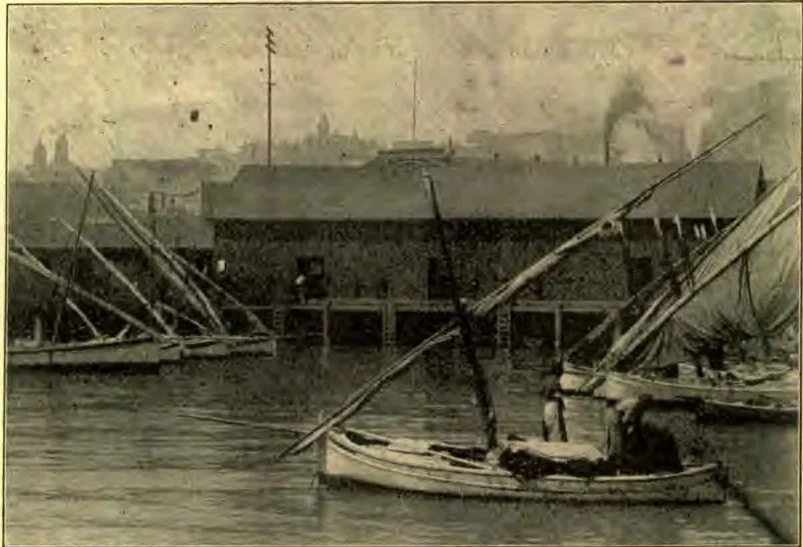
FISHERMAN'S WHARF
FISHERMAN'S WHARF
The picture will give you an idea of what Fisherman's Wharf looks like at first glance. But this picture was taken in the morning, before the boats were all in; and in order to get life in it, I photographed only a part of the dock, so that some of the fishermen could be seen at work. Later in the day the boats line both sides of the dock, lying as close together as they can without bumping against one another. They are all built on the same lines, and rigged in the same manner. Most of them are of the same size, and painted identically alike. When the boats are all in, each occupies its own “berth,” with the bow made fast to a pile of the dock and the stern held by its anchor. Then the boats look as if they had all been cast in the same mold and distributed by machinery.
The best time to visit the wharf is very early in the morning. If you find it as interesting as the writer always has, you will be likely to stay there till hunger or darkness drives you away.
When a boat comes in, and is made fast in its place, one of the two or three men that man it will scramble up on the dock bearing one end of a rope, at the other end of which swings a basket or bucket. Into this the fish are shoveled, and the man on the dock hauls them up, and dumps them into boxes to be carted away to market. The day's catch landed, some of the fishermen hurry away to their homes, while others may be seen frying fish and making coffee on braziers filled with burning charcoal.
Many of the fishermen live in their boats, and even those who have homes are compelled to spend most of their time upon them. There are nets to overhaul and mend, and get ready for the next day's work. There are torn sails to sew, broken ropes to splice, and a dozen and one other things to be attended to,—things that only a fisherman can see the necessity for. All the time there is a constant hum of conversation carried on in some foreign tongue. It may be Italian or Portuguese, Russian or Greek, but it is never English; for the fishermen, one and all, are foreigners.
The vocation of a fisherman is among the last that a man who was given a choice would select. It is one continual round of toil, hardship, exposure, and danger. But to an outsider the life and the ways of the fisherfolk are always surrounded with a halo of romance, and in this lies the chief charm of Fisherman's Wharf.
J. EDGAR ROSS.

A Rare Book

EVERY week one reads of the sale of rare books for great sums of money. A small fortune is not infrequently paid for a volume originally published for a few shillings.
But in the fair island of Porto Rico, miles from any library and from the zeal of any collector, is a book that might be more precious to the student of life than the most costly treasure of the British Museum. It is a copy of the Spanish Bible, worn by the daily use of many years. Here is the story of its recent discovery:—
A missionary went one day to hold a service at Adjuntas, a pretty mountain town seventeen miles from Ponce. He made the service into a sort of Bible reading, and an explanation of the most elementary facts of Christianity; for he supposed his hearers to be ignorant mountaineers, scarcely knowing the name of Christ.
After the service a middle-aged woman lingered to speak with him. She was more neatly dressed than most of her neighbors, and her face was happier. She greeted the missionary modestly but warmly, and said, “I was glad to hear you read out of the book and talk about it. My husband reads it to me every day.”
The minister was surprised to find a Bible-loving household among the mountains, and asked the woman to tell him how she had heard of the Bible. It seemed that years before a traveler had stopped at their hut for food and rest. They gave him both; and as he left them, he tossed them a little book. He had spoken no word of explanation as to its character. They did not even know whether he had been a Christian. Certainly he had said nothing to lead them to value the book.
The man could read a little, and one day, out of idle curiosity, he opened the volume. He soon became deeply interested in it. He read it to his wife, and at last they began, half unconsciously, to adopt the principles of Christ’s teaching. They worked more steadily. They kept their house and their persons more carefully. They were more compassionate. Their progress soon attracted the attention of their neighbors, and they, too, listened to the wonderful story of the New Testament. When the missionary reached the mountain settlement, miles away from the little village of Adjuntas, he found a community ready and hungry for his teaching. The single Spanish Bible had been their only guide to Christianity, but out of the small, shabby volume they had learned that which makes life best worth living.
So, since the day when Philip climbed into the chariot of the man of Ethiopia and expounded to him the Scriptures, which, unaided, he read but blindly, the Book of books has been working its miracles and enriching and sweetening life.— Youth’s Companion.

The Lick Lens

SOME years ago the writer paid a visit to Alvan Clark, at Cambridgeport, to witness the testing of the huge lens for the famous Lick telescope. At the end of a long, dark room the largest flint glass then in the world was set up on edge. From a distance of about fifty feet a pencil of light was flashed into the heart of the disk, and reflected into the observer’s eye. The slightest imperfections, if any, in the glass, would then be revealed by the curves of light and the lines of polarization.
“Now,” said Mr. Clark, “I will show you the wonderful sensitiveness of the lens to outside influences. Every human body gives out heat, and when brought near to extremely sensitive substances, affects them to a greater or less extent. Now watch.”
He walked down to the lens, and held his hand under it about two feet away. Instantaneously a marvelous spectacle burst into view. It seemed as if the great glass disk had become a living volcano, spurting forth jets of flame. The display was dazzling. Waving, leaping, dancing, the countless tongues of light gleamed and vibrated. Then, fitfully, reluctantly, they died away, leaving only an untroubled light.
“What is it? How do you account for the wonder?” were the eager questions.
“It is only the radiation of heat alternately expanding and contracting the glass. If I had put my hand upon the lens itself, the phenomenon would have been even more violent.”
To a person ignorant of lenses the almost supernatural sensitiveness of a mass of glass weighing several hundreds of pounds was astonishing. But to the scientist it is an every-day matter, for he has instruments that will register with unfailing nicety the approach of a person fifty or a hundred feet away.
The human heart is not unlike the great lens. It is similarly sensitive, and so can not afford to surround itself with evil. The radiations of influence are infinitely fine. Inevitably we vibrate to “the company we keep.” Before we know it, we have taken the color and tone of our neighborhood.—Companion.

Not Worth While

THERE'S nothing worthy a broken heart Excepting its own sad state, When bitter, and cold, and hard like steel, Which neither will bend nor break; There's nothing worthy a tearful eye, Excepting its vision be Dim to the sweetness of joy and truth And beauty on land and sea.
There's nothing worthy a troubled mind Except that its currents flow Out of a spring that's clear and pure Into mire and marsh below; There's nothing worthy a restless soul, Except when its own hands tear Love's hopes apart like a red, red rose Flung loose on the desert air.
There's nothing on earth that is worth distress Of spirit or heart or mind, Except the mistakes that each one makes And that each must bear in kind; But rose-leaves blow to their native soil, And steel may be fused and run, While turbid streams may trickle with tears To the ocean and shining sun.
MINNIE ROSILLA STEVENS.

The Dead Sea

I LOOKED upon a sea, And lo! ’twas dead, Although by Hermon’s snows And Jordan fed.
How came a fate so dire? The tale’s soon told: All that it got it kept, And fast did hold.
All tributary streams Found here their grave, Because this sea received But never gave.
O sea that’s dead! teach me To know and feel That selfish grasp and greed My doom will seal.
And, Lord, help me my best, Myself, to give, That I may others bless, And, like thee, live. — Wm. P. Finney.

THE WEEKLY STUDY

The Result of Rejecting God

The Destruction of Jerusalem

(August 16-22)
PARALLEL READING: “Great Controversy,” Chapter One.
In your reading and study of this lesson, endeavor to draw distinct parallels between the experiences of Israel which led up to the destruction of their glorious city, and the experiences through which the people of God must pass during the last days of human history. Instead of studying the past for its own sake, let us study the vital present in the light of this inspired history.
Jerusalem was destroyed because she refused salvation. “God had sent to them by his messengers, rising up betimes, and sending; because he had compassion on his people, and on his dwelling-place. When remonstrance, entreaty, and rebuke had failed, he sent to them the best gift of heaven; nay, he poured out all heaven in that one gift. The Son of God himself was sent to plead with the impenitent city.” “To all classes alike was addressed the gracious call, ‘Come unto me, all ye that labor and are heavy laden, and I will give you rest.’ But they would not.”
Study the fourth paragraph in our parallel reading lesson, and observe that God’s special favor and guardian care for more than one thousand years did not save Jerusalem from destruction when Israel turned away from her Lord. The site of the glorious city had been hallowed by Jehovah’s presence. The Lord had “chosen Zion,” he had “desired it for his habitation.” But when its real glory departed, when the Most High could no longer find a dwelling-place in the hearts of his people, he had no abiding-place among them; and their temple, in whose glory they had trusted, and “Mount Zion,” “the city of the great King,” behind whose walls they had felt secure, became the plunder and by-word of the heathen.
There is no security in places, institutions, or forms; neither can we rely upon them for power, influence, or standing in this world. The power of God and the strength of his people is a life,—that presence formed within where man accepts his Saviour as his all in all, his substitute. To receive him is life; to reject him is death. Israel “would not” accept the proffered life, and her house was left unto her desolate. And when the world’s probation shall finally close, none will be lost except those who have refused to be saved.
But nations, and cities, and churches do not, as such, in a body, depart from the Lord and become corrupt. Backsliding begins in the heart of the individual. The apostasy of a nation or a city is the sum total of the heart wanderings of the people. The responsibility is individual, and every sin in the whole dark record can be traced to a personal experience in wandering from God. In the mad race for gain, the fathers and mothers have joined, little by little, in the world’s methods and work; sons have faced the parting of the ways—the choice between wealth and honor, and the self-sacrificing way of love—and have chosen the former; daughters have turned away from their high privilege as comforters and nurses of the world’s sorrow and sickness, and have followed after pride and pleasure; and thus homes have become dark, churches are spiritless, cities are corrupt, nations—yes, the whole world—are rejecting God.
There is death in rejecting God; for he is life and light. That which is light and life and power, if accepted, becomes the swift agent of destruction if rejected. The blessed sunlight, which gives health and life to all nature, increases the corruption of the stagnant pool, and hastens the decay of everything which is separated from the channels of life. Even “heaven’s blest beam makes vinegar more sour.” Thus God hardened Pharaoh’s heart by giving him the light; for light becomes darkness and hardness of heart to all who reject it.
But the Saviour, who has given his life freely for us, is patient and long-suffering. He lingers all the day, and life’s gathering twilight finds him still knocking for admission.
“His locks with dews of night are wet, But at thy heart he lingereth yet.”
How full of sorrow and tender love are his words of lament over the rebellious city, “How often would I have gathered thy children together, even as a hen gathereth her chickens under her wings, and ye would not!” He calls you to-day. The Spirit and the Bride say, Come.
“To the Saviour’s tender pleading Close thy heart no more; Now the call of mercy heeding, Open wide the door. While the lamp of life is burning, And the heart of God is yearning, To his loving arms returning, Give thy wanderings o’er.”

Progress of the Work

FIVE Societies report from Indiana. These are connected with the churches at Indianapolis, Wolf Lake, Mt. Vernon (near Winamac), Anderson, and South Bend. The total reported membership is ninety. Each of these Societies seems to have been holding successful meetings. The subjects considered in addition to the INSTRUCTOR lessons are all excellent. These youthful workers seem to cherish the missionary spirit, and realize that there is no better way to give the advent message to the world than to distribute literature. The reports give a good record of papers and tracts sold and given away. A little word of testimony from each will be read with pleasure.
The secretary of the Anderson Society writes: “Our interest is good, and the children have a mind to work.”
Miss Alta Custer, reporting for South Bend, says: “All our members are taking part in the work. Not long ago two were baptized. We want to do all that we can to give the message to the world in this generation.”
The report from Mt. Vernon gives this testimony: “Good interest is manifested. There is a spirit of willingness upon the part of all. The members are of good courage, knowing that this work fits them for more active labor in His cause.”
And what could be better than this from Indianapolis? “Every member is engaged in some line of work. Thus we are trying to lead a life of real service.”
An excellent spirit is shown by the young people at Wolf Lake: “The interest is good. The members seem willing to do most anything they are asked to do.”
We wish that each Society might do as these seem to have done,—study the different kinds of missionary work within their reach, and plan so that each member shall have some definite work to do each week. Begin with small things, even though they may seem commonplace. All need not work in the same way, but all should work. There is a definite call to our young people to organize themselves for a definite work. It is not a sensational waving of flags or banners, or wearing of badges, that is wanted. It is a call to service. Sensible, straightforward missionary work is what is needed. L. F. P.

Oakland Junior Missionary Society

We have just received a statistical report in detail of the Junior Missionary Society of the church at Oakland, California. The time covered by the report is the months of April and May. The quarter was cut short by the coming of vacation time, when a good many members, as well as the leader, are away from home. It was thought best for this reason to suspend organized work until the proper persons were on hand to attend to their duties. Accordingly, officers were chosen and topics selected for the autumn months, so that the work may be resumed without confusion.
The topics were assigned in order that the members might have time to prepare on the various subjects. We note the following: Christ and His Work; Capital and labor; Signs That Foretell His Coming; Tithing; Work of the Angels; The Papacy; Last-day Combinations; The Resurrection; Religious Liberty; Origin and Destiny of Satan; Sin and Righteousness; Coming of the Lord.
The statistical report suggests that there has been much concentrated, well-organized effort on the part of these young people. We wish there might be scores of just such reports coming from all over the land. We trust that erelong results will be seen from their faithful efforts. It is not for us to be impatient for results; “patience,” we remember, is one of the virtues of those who are seeking to spread the everlasting gospel. God will take care that his word does not return to him void. We have but to sow the seed, and water it well.
The following is the statistical report:—
Missionary visits............................... 37 Persons supplied with food....................... 2 Sick persons assisted............................ 2 Readings from books, etc........................ 1 Tracts given away or loaned...................... 52 Papers mailed or given away.................... 1,178 Letters written.................................. 21 Letters received.................................. 7 Papers sold...................................... 588 Bible readings held............................... 2 Copies of the Life Boat sold.................. 400 Literature placed in various reading-rooms.... 2,121
Over thirty-five dollars was raised during the quarter, of which twenty dollars was given to the Southern Sanitarium, and fifteen dollars was devoted to the new church building in Trinidad. The surplus in the treasury will be devoted to the Washington (D. C.) church. The Society has dispensed over one hundred dollars in two years.

A Word to the Leader

This study covers a wide range; yet the presentation need not be long or tiresome. Hold directly to the subject, “The Result of Rejecting God,” and make that lesson strong.
The study might well be divided between three persons, each occupying from ten to fifteen minutes.
First: A study of the subject from the scriptures given.
Second: A study based on history, as presented in the parallel reading.
Third: Practical lessons, and parallels between the past and the present.

Do Today's Duty and Trust the Unseen

Do to-day’s duty, fight to-day’s temptations, and do not weaken and distract yourself by looking forward to things you can not see, and could not understand if you saw them. God gives nights to shut down the curtain of darkness on our little days. We can not see beyond. Short horizons make life easier, and give us one of the blessed secrets of brave, true, holy living.—Christian Work.

Boy Wanted

by Frank Walcott Hutt
A sign in the world's big window Is readable and clear, A simple and quiet legend— A boy is wanted here.
A boy who'll never falter, Whatever he's toiling at; Who will not stop to grumble "I was not hired for that".
A boy who finds no labor To him inferior, And will not halt at duty He "was not hired for".
A boy of sturdy purpose— A boy of brain and brawn— A boy who's always ready Where'er he's called upon.
Continue reading: Lost in the Woods