THE change in the person of the monarch continues to be for the present the central point of interest in English public life. It has put a new aspect upon the constitutional crisis, and it has also brought to the front the question whether the form of the Accession Oath shall be changed, an issue in which all the churches are taking a lively interest.
So far there has been but little chance to discover what manner of king George V will make, but there is good hope that he will justify the favorable account given at his accession by those who were acquainted with him. He does not seem to care for prominence, but is devoting himself with considerable energy and thoroughness to the duties of his new position. In many ways he is evincing the kindly consideration for others that made his father so popular.
It was considered generally to be inadvisable to involve the new king in the political struggle that was in progress over the House of Lords. The strength of the two contending parties was so nearly equal that much would depend upon the course taken by the sovereign, and this fact made the situation a very delicate one for a new and inexperienced ruler. There was a strong feeling that a friendly attempt, at least, should be made to reach some conclusion satisfactory to all parties; and in response to the general demand, Mr. Asquith and Mr. Balfour met and agreed upon arrangements for a conference. Four representatives of each side were chosen, and the conference has now been in progress for several weeks. Whether anything in the way of a satisfactory compromise can be devised remains to be seen. Mr. Asquith has promised a statement on the subject in a week's time.
The Coronation Oath
While the accession of George V has for a time silenced controversy in the political world, it has had the opposite effect in the religious world. The proposal to change the form of the Declaration to be made by the king at his coronation is the cause. When King Edward was crowned there was a great outcry on the part of Roman Catholics, both in Parliament and in the press, against the language of the Declaration, which was said to be grossly insulting to Rome, inasmuch as it plainly insinuated that an oath which would be sacredly binding on the ordinary conscience was not sufficient to commit an adherent of the Church of Rome. Not only did the Declaration call upon the sovereign to renounce solemnly and sincerely, in the presence of God, the doctrine of transubstantiation, and to assert that the invocation and adoration of the virgin Mary and the saints, as practised in the Church of Rome, was both superstitious and idolatrous; it also exacted from the sovereign an explicit assertion that he made the Declaration in the plain and ordinary sense of it, as the words were commonly understood by English Protestants, "without any evasion, equivocation, or mental reservation whatsoever," and without any dispensation already granted him for this purpose by the pope, or any hope that such a dispensation would be granted in the future.
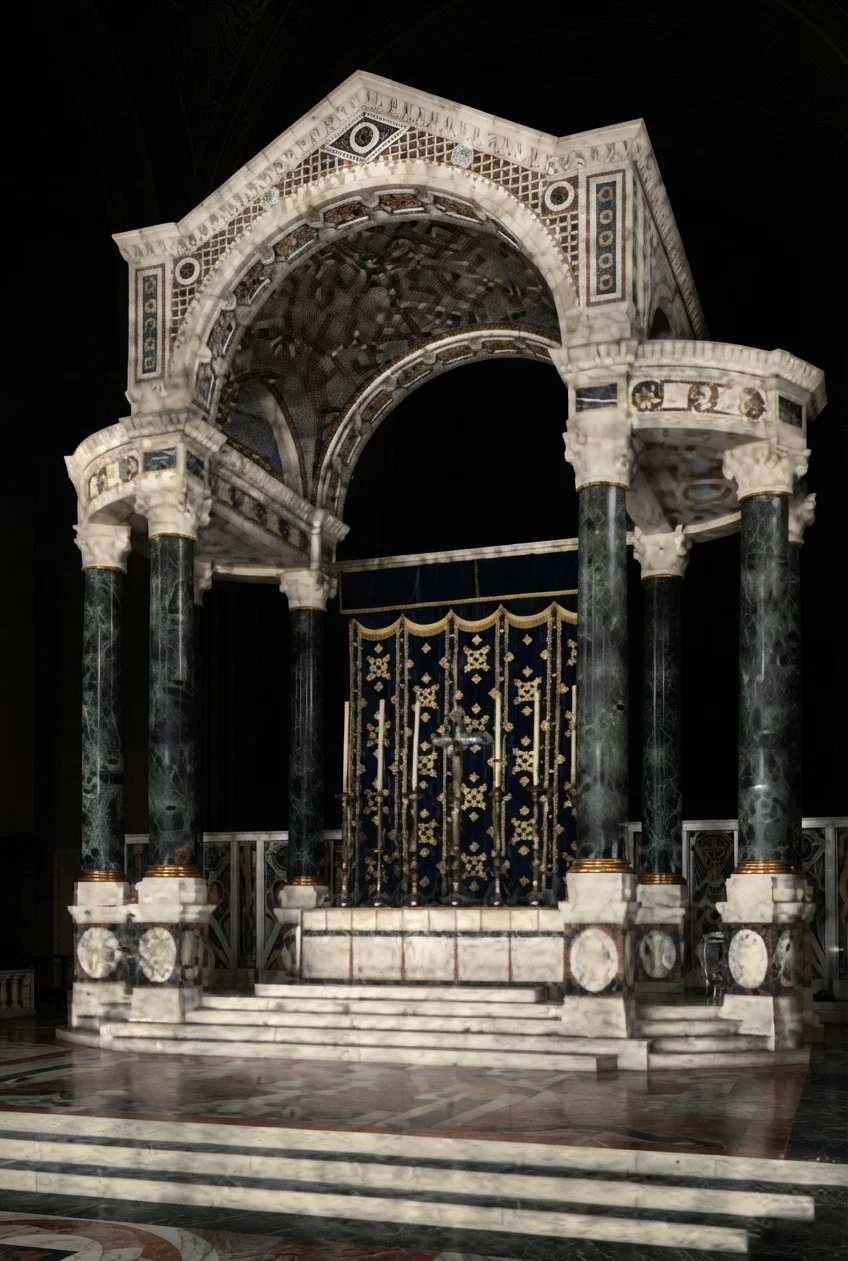
Baldachino of Westminster Cathedral
The men who framed this Declaration had a vivid remembrance of the experiences through which they had lately passed in the reign of James II, and they felt the imperative necessity of wording the Declaration in such a manner that it would be absolutely impossible for a papist to subscribe it. They felt that they were dealing with an utterly unscrupulous and mendacious power, with which all ordinary securities, however sacred, were valueless. They would have probably admitted without hesitation that the language of the Declaration was insulting, but they would have added that it was necessarily so in view of the character of the power with which they were dealing; that the Papacy by its course had forfeited all right to be considered as truthful and honorable in its dealings.
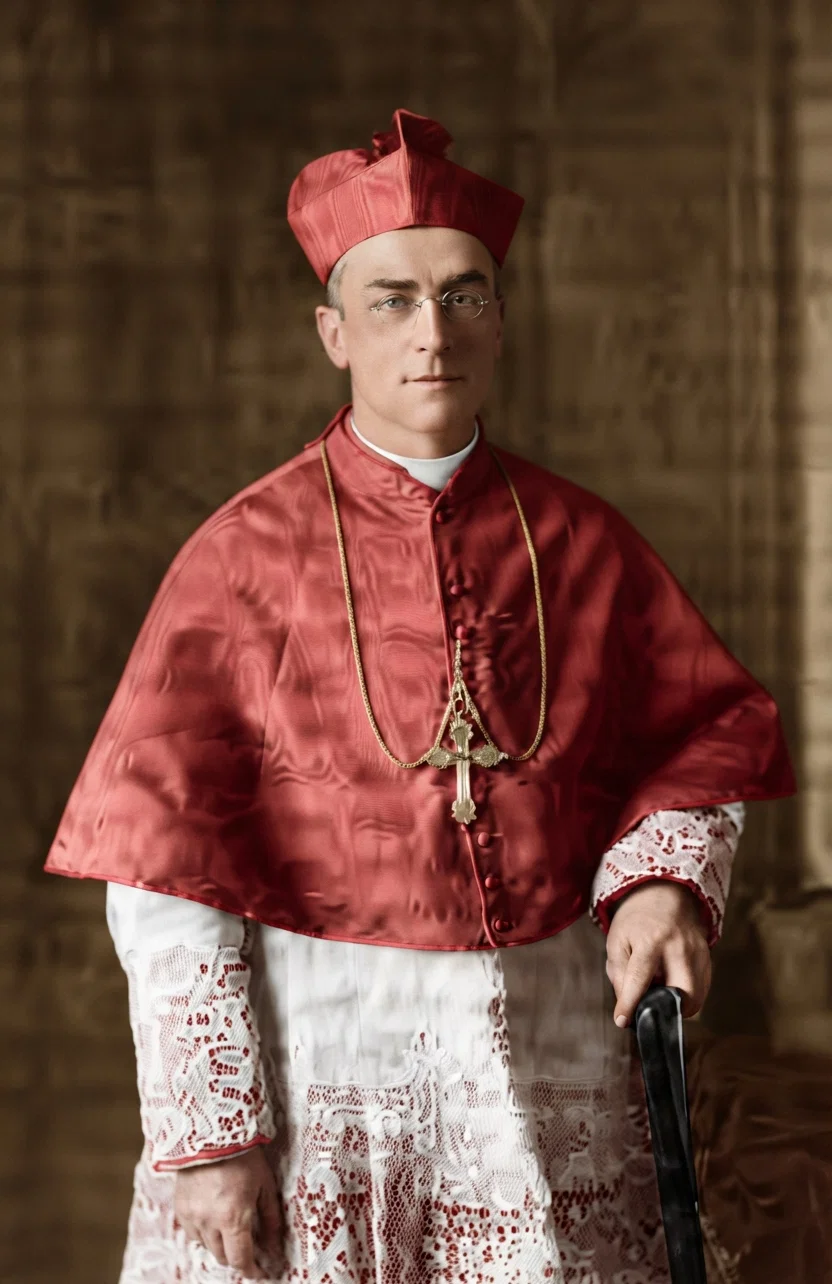
Dr. Bourne, Archbishop of Westminster
The ancient feelings of bitterness against the Papacy, however, have largely passed away; and when the outcry was raised nine years ago the Roman Catholics were encouraged to think that before another accession some change would be made in the terms of the Declaration. The time has now come to make good this undertaking, and the Liberal government has brought in a bill to revise the Declaration and omit all the phraseology offensive to Roman Catholics. The new form simply requires the king to declare himself a faithful member of the Protestant Reformed Church of England as by law established.
Not Satisfactory to All
The Roman Catholics profess themselves entirely satisfied with this change, and at first the larger part of the other churches appeared willing to assent to it. There is still, however, a considerable body of militant Protestants in England, and these are standing out stiffly against any concession to Romanism. Mass-meetings have been held, and much literature has been circulated calling on the people to resist the proposals of the government, and asserting that any weakening of Protestant safeguards will surely lead in time to the reestablishment of Rome in this country, and to the loss of civil and religious freedom.
It is an undeniable fact that the Church of Rome has greatly strengthened its position and influence in this country of recent years; and while this fact tells against the ultra-Protestant agitation, it at the same time confirms the opponents of the change in their conviction that the maintenance of the old form of Declaration is of vital importance to England.
The problem is further complicated by the fact that outside the Church of Rome there has developed general dissatisfaction with one feature or another of the proposed new Declaration. The "High Church" party of the Established Church, the ritualistic, Romanizing section, strongly object to being described as "Protestant." They hate this term, and detest its application to themselves. On11every occasion they insist that they are the "Catholic" Church. There is a continual wordy warfare between the Roman Catholics and the Anglicans over the right to this title of "Catholic," and the Anglicans now say that to apply the term "Protestant" to their church by an act of Parliament will mean the surrender to Romanism of the very position they have been so warmly contending for.
On the other hand, the Nonconformist bodies object to the new Declaration on the ground that it requires the king to be a member of the Church of England as by law established. They demand freedom of conscience for the king, and ask that he be at liberty to profess himself a Methodist or a Baptist if he so desires. One argument that favors this contention is that, at the present time, the king of England becomes a Presbyterian whenever he journeys into Scotland, for by the constitution of the Established Presbyterian Church in Scotland the king is the head of that organization. It is only in a partial sense that he can declare himself to be a faithful member of the Church of England as by law established.
How the matter will end it is impossible to say at the present time. One thing is certain, there will be plenty of dissatisfaction whichever way the final decision goes. That is inevitable under a church and state régime. The whole discussion is largely one over "hollow forms." Notwithstanding the vigorous denunciations of the present Declaration, Rome has made substantial progress under it in this country; and Mr. W. T. Stead has pointed out that in the case of the prime minister, who wields enormous power in ecclesiastical matters, having the right to nominate the bishops and archbishops, no declaration at all is demanded.
Matters over Which Catholics Are Rejoicing
The Roman Catholic Church has been rejoicing greatly over the turn things have taken, and her orators have freely extolled the beauty of religious liberty under which so bright a prospect is now opening up before her in this country. That church has just been celebrating a threefold occasion for thanksgiving. One is the prospective change in the Royal Declaration; a second is the dedication of the new cathedral at Westminster, which was begun by the late Cardinal Vaughan, and which is still far from being completed. The dedication services were celebrated with great magnificence of ritual. The third is the sixtieth anniversary of the restoration of Roman bishoprics in England. It is just sixty years since Cardinal Wiseman was commissioned by the Papacy to set up again a Roman Catholic hierarchy in this country. Great annoyance was felt at the time at the presumption of this step, and an act of Parliament was promptly passed to prohibit the use of such ecclesiastical titles. But the act was never enforced, and from that day to this the Church of Rome has flaunted her ecclesiastical dignities in England as though she were the one acknowledged church of the land. Rome has never lost anything for want of audacity, and it is the knowledge of this that makes the Protestants who are familiar with the history of the past so unwilling to concede her the smallest advantage. They are retorting now to the Roman Catholic eulogists of religious liberty that the beauty of the principles might with profit be commended to the notice of the holy father as a guide in his dealings with the Spanish Government. There the Vatican is protesting vigorously against the smallest concessions to Protestant worshipers.
In the Military Realm
The agitation for the increase of armaments goes on. Military and naval experts declare that we are endangering our national security by not taking even more active measures for the strengthening of our forces. On the other hand, the reformers of the Liberal government hold up their hands in horror at the insane waste of money in such expenditure. Nevertheless, the government is impelled helplessly forward. On the 15th of July Mr. Lloyd George, the chancellor of the exchequer, said:
"Twenty years ago our national bill for armaments was £30,000,000; to-day it is £70,000,000. . . . The countries of the world are spending annually £450,000,000 upon this machinery of destruction. In twenty years there has been an increase of £200,000,000 per annum. All nations seem to be affected with an epidemic of prodigality which is sweeping over the land and sweeping to destruction. We take the lead, but, after all, we have got the greatest empire to defend; we have got that excuse. But if the nations increasingly spend their money upon matters that give neither sustenance nor support to their people on the road that leads to higher civilization, we will suffer. You may have newer and better and easier methods of taxation. It makes no difference. Until you drain this quagmire, the result will be that the money will sink out of sight without leaving a trace or an impression behind it. I think it is a great and a growing misfortune. No single nation is alone responsible, and we must look to the day when there will be a better understanding between the peoples."
Unfortunately, while dreams of future peace are indulged, the preparations for war are steadily increasing. If deeds speak louder than words, the world is certainly rushing on toward a struggle of unprecedented dimensions.
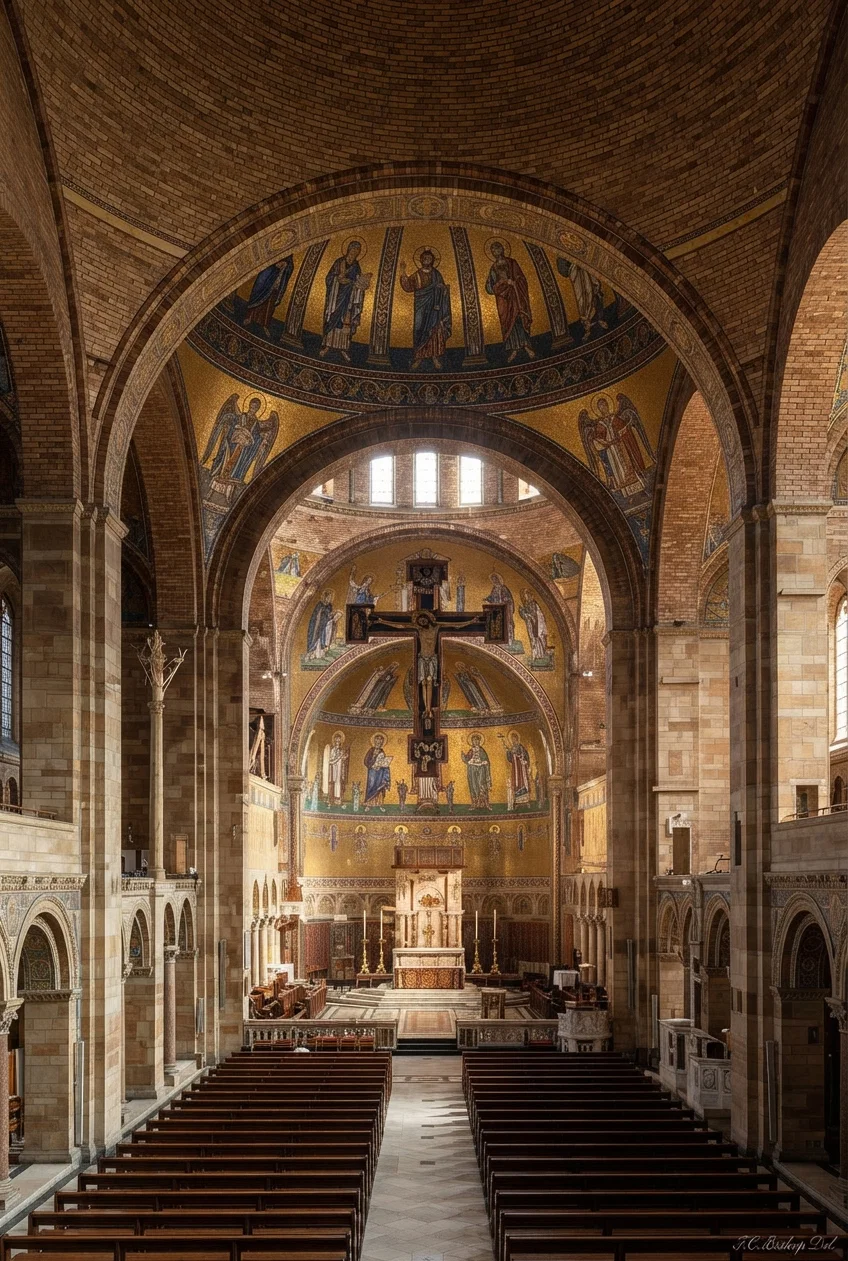
Westminster Cathedral
Women’s Hats and Baldness
A despatch from London declares that there must be some change in women's hats or women will become bald; that as grass turns yellow under a mushroom, so women's hair will lose its color and deteriorate under the gigantic hats which are now the mode. A specialist declares, "These enormous mountains of millinery shut out the health-giving sun and air; and then, too, they present such vast surfaces to the wind that they tug against the retaining hat pins like a kite on a string." He declares that the finest heads of hair in the world are to be seen in the South Sea Islands, where the women fish with uncovered heads under the rays of the sun and pour cocoanut oil on their hair.
New York’s False Weights
Mayor Gaynor of New York instituted a campaign against false balances and weights. As a result, many fake measures were smashed and a ton of confiscated scales were dumped into the bay. The businesses mostly involved in this petty thieving were fish-markets, push-carts, and ice wagons. One paper estimates, however, that the saving which the use of just measures gives New York's people, will be about $5,000,000 a year.
Portugal and the Vatican
Newspaper reports state that the Portuguese Government contemplates severing its connection with the Vatican, who, it is declared, has been meddling in the internal affairs of Portugal more than to the liking of the little kingdom. Cardinal Merry del Val ordered the Bishop of Braga to suppress a journal published in Portugal.
International Meetings
International Meetings.— During the first few days of August, the International Road Congress met at Brussels. Thirteen various national and international associations are meeting in Chicago during August. They range all the way from the National Coopers' Association to the International Order of Good Samaritans.
Argentina’s Failed Harvest
It is not all over the world where good times are prevalent. It is said that the failure of the harvest in Argentina is serious, and that there are hundreds of large tramp steamers tied up that had hoped to get freight, but there is none to carry.
Two Giant Cunard Ships
The Cunard Company announces the building of two 60,000-ton ships, whose displacement will be about 90,000 tons. They will be 900 or 1,000 feet long — longer than the longest dock of New York. The largest battle-ships ever planned will have about 32,000 tons displacement.
The Education of Edward VII
In a recent issue of the "English Quarterly Review," Lord Esher contributes an article on the education of Edward VII. He was reared with Puritan rigor. Not an hour of the youth's time could be wasted. Novels, even Sir Walter Scott's, were out of the question. His study hours all had to be devoted to modern languages, or history, or something of that nature. His manners and deportment were under the constant guidance of his parents, who planned to make their "boy a model of all the virtues, and a storehouse of all wisdom." Would that the parents of to-day had the same solicitude for their children.
Eastern Cotton Mills Consolidate
Twenty-two Eastern cotton-mills have consolidated. Their aggregate yearly output is about $18,000,000. The International Cotton Mills Corporation — the name of the combine — has an authorized capital of $10,000,000. This corporation is the largest of its kind in the United States.
Wreck on the Northwestern Pacific
Fourteen dead and twenty-five injured is the result of a wreck on the Northwestern Pacific near Ignacio, California. The passenger-train crashed into a work-train, the baggage-car tearing its way through the smoker. It is one of the worst wrecks California has ever had.
Wireless Required on Passenger Steamers
The Secretary of Commerce and Labor has made the ruling that no ocean-going steamer which carries more than fifty persons will be allowed to sail after July 1, 1911, from any port of the United States unless it be equipped with wireless telegraph apparatus.
Tracing Alexander’s Marches Through Persia
Prof. A. V. W. Jackson of Columbia University has just returned from Persia, where he had traced the marches of Alexander the Great through that country. Several important discoveries were made that will throw light on Oriental history.
Indian Coolies Arrive in California
Two steamers in one day brought 188 Indian coolies to San Francisco. This class of people are coming to California in increasingly large numbers. And it is to be feared that they will be made a source of trouble.
Skyrocket Mail in the South Seas
In the South Sea Islands, where often large mail vessels can not approach the coasts on account of reefs, the letters are attached to a large skyrocket which brings them to the shore in safety.
Chinese Marksman at Bisley
A Chinese was a marksman at the International Rifle Meeting at Bisley. This is the first time a Chinese has entered. It is an indication of the increasing military growth of China.
Cheaper Cable Messages
A Danish inventor, Hans Knudsen, claims to have discovered a method by which cable messages can be sent at one third the present cost and at one fourth the present speed.
Professor Miller’s Sixty-Two Years of Teaching
The professor of mathematics and astronomy at the University of Kansas, Dr. Ephraim Miller, has taught sixty-two years. He began to teach at the age of fourteen.
A New Guillotine for China
The occupation of the Chinese headsmen is likely soon to go. In the place of the individual executioner a new guillotine has been inaugurated, purchased in Paris.
A Church for Music, Merriment, and Laughter
The purpose of a new church organization at Washington, D. C., according to its incorporation papers, is the promotion of "music, merriment, and laughter."
The Reign of Edward VII
The reign of Edward VII will be the theme of the latest volume of "The History of Our Own Times." Justin McCarthy is already at work on it.
The Banished Dogs of Constantinople
The dogs of Constantinople, which were formerly the scavengers of the city, have been banished to an island in the Sea of Marmora.
Cholera Spreads in Russia
Cholera is rapidly spreading in the southern mining districts of Russia. 6,944 deaths were reported for the week ending July 30.
Aviator Struck by Lightning
A Massachusetts aviator narrowly escaped death when his aeroplane was struck by lightning and hence fell to the ground.
Roosevelt Reportedly Plans China Visit
A Chinese prince says Roosevelt promises to visit China next year.
Shiloh: the Man of Sorrows
By Mrs. L. D. Avery-Stuttle
Chapter XXV.—Rejected by His Own
ABOUT three days after this occurrence at Nazareth, Bar-jona the fisherman was at home in Bethsaida, and with his customary enthusiasm, he related the strange experiences. The members of his family, Sylvanus, Esther, and Perpetua his wife, gathered about him to listen. Matthias was also present; for having followed the Master as far as Nazareth, he had thence proceeded to Bethsaida, to visit his parents.
Over this otherwise happy family, always rested a shadow. Poor Heber lived and wandered a wild, demented outcast. But we will listen to the tale of Bar-jona.
"I had not intended to visit Nazareth," he began; "but after the Master had departed thither, I followed Him. On the day before the Sabbath, the preparation day, at about the tenth hour, I reached Nazareth. On the principal street of the village I found many people assembled, to whom Shaphan the rabbi and his son Tubal were speaking, that they might turn the hearts of the people from the Master, whom they called the 'Pretender,' by speaking lightly of those miracles which He hath already done. But on the morrow—the Sabbath day—the synagog was crowded with an anxious and inquiring multitude; for most of the people understood plainly that Shaphan the rabbi was bitterly opposed to the new Teacher, and in truth they wondered what the outcome would be, for they knew of His presence in the village, and expected that He would be at the synagog on the Sabbath.
"Now, Rabbi Shaphan, the possessed of a bitter and ungenerous disposition, hath great influence over the people, for he hath a learned and eloquent tongue. When the third hour of the day had come, Rabbi Shaphan took his place. The congregation stood with solemn faces toward Jerusalem. The customary eighteen prayers were recited, and the responses faithfully echoed in their proper places by the worshipers. The first lesson of the day, on the law, was given. Then the minister of the synagog, standing by the side of Shaphan the rabbi, at his suggestion, handed the roll of the prophet Isaiah to the Master; and verily," continued Bar-jona, "I have never seen the face of the Man so like unto the face of a god."
"What read He, my son?" questioned Sylvanus; "for of a truth the prophet Isaiah hath written many words concerning the Messiah. What read He?"
"Thou rememberest the place, my father, where it is written, 'The Spirit of the Lord God is upon Me; because He hath anointed Me to preach good tidings unto the poor; He hath sent Me to bind up the broken-hearted, to proclaim release unto the captives, and the opening of the prison to them that are bound, and to proclaim the acceptable year of the Lord.'"
The face of the old man Sylvanus lighted up with a deep joy as Bar-jona repeated the words of the prophet.
"Ah, my son, let us rejoice and be glad in the Lord; for, behold, we know how that John the Baptizer hath been shut in the prison-house at Tiberias, by Herod Antipas. Now of a truth this Jesus of Nazareth, the Shiloh for whom Israel hath long waited, will go to Tiberias and fetch thence the prophet; and thus will He open the prison to them that be bound."
"Even thus I have thought, my father," responded Bar-jona, "for the Man is very great, and His ways are marvelous. Verily, I have thought that He must soon go up to Jerusalem and take the throne of David—but already He speaketh words which I know not, and which I can not understand;" and the speaker bowed his face in his hands and paused a moment, as if trying vainly to recall some spoken word of his Master.
"Come, come, Bar-jona, thou art a dreamer!" exclaimed Perpetua. "Verily we wait to hear thy words concerning that which befell at Nazareth.
"As soon as the Master had finished reading these words," resumed Bar-jona, "He sat down; for even thus ye know that it is the custom among us when one would teach in the synagog. The words of the Man were marvelously gracious, and even Shaphan seemed at first constrained to listen unto Him.
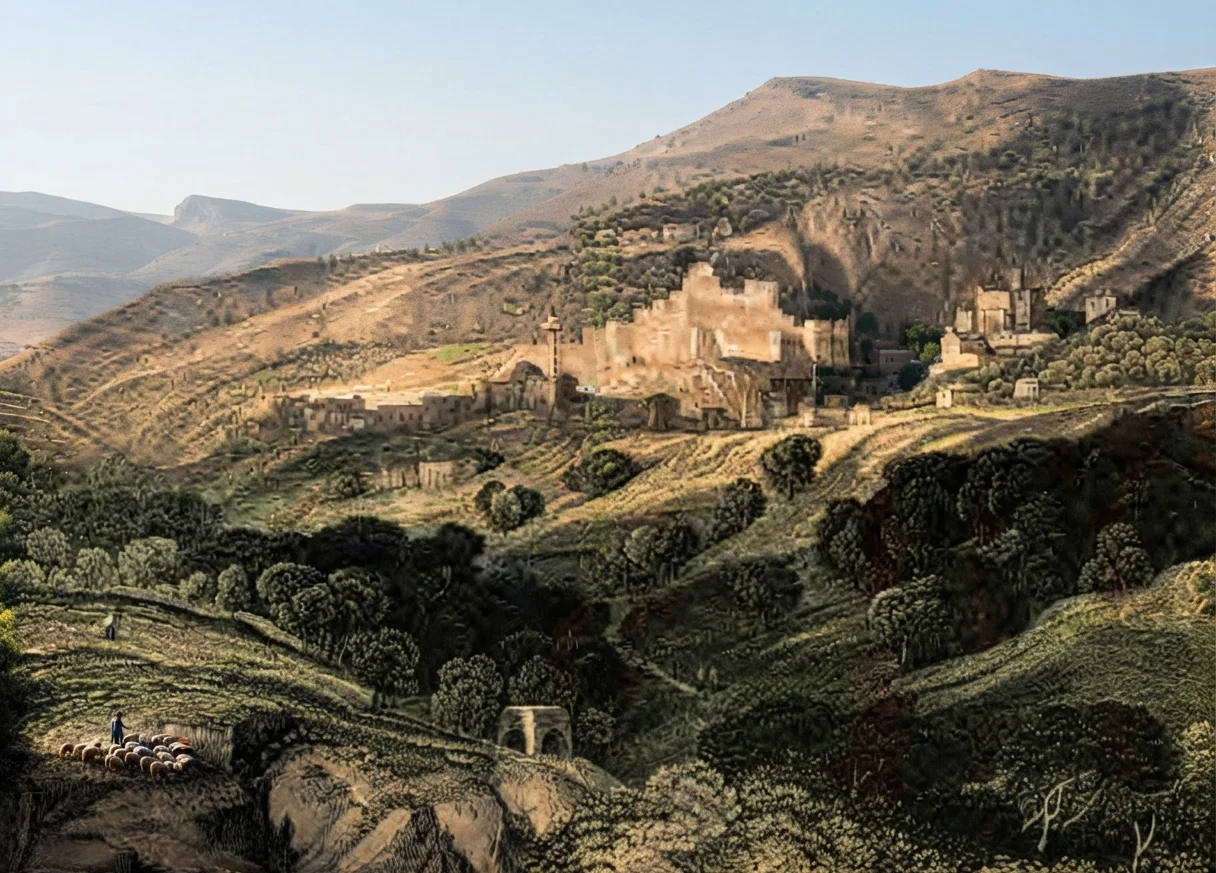
Nazareth, from a steel-engraving by F. Finden with drawing by A. W. Colcott
"'This day is this scripture fulfilled in your ears!' declared the Master; and verily He seemeth to be able to read the secret thoughts of the heart; for He said unto the people: 'Ye will surely say unto Me this proverb: Physician, heal Thyself. Whatsoever Thou hast done in Capernaum, do here in Thine own city.'
"And when He had said this, each man looked into the eyes of his neighbor astonished,—for even thus had he thought. But the Man continued speaking to the people: 'Elijah the prophet was not sent to any of the widows of Israel, but unto a woman who was a Gentile. Neither were any of the lepers of Israel healed, tho there were many; but Naaman, the Syrian, he was cleansed.'
"Even thus said the Master; and indeed I understood not His words, for it was as if Jehovah favored others also as well as the seed of Abraham. Even as I listened to His words, I myself was sorely perplexed thereby;" and Bar-jona glanced inquiringly at Sylvanus.
The old man had listened intently, but for a full minute none made answer. Then Sylvanus replied, while his voice shook with the intensity of his feeling:
"There be many things, Bar-jona, which as yet neither thou nor I may understand. But verily the Almighty doeth well, tho His ways be hid in clouds and darkness. Truly the seed of Abraham be the chosen people,—but if Israel choose not the Lord, then must He raise up unto Himself another people. But even as He is infinite and we be finite, how can we understand His full counsel? But what did the people, my son?"
"What did they? As soon as the Man had thus said, a loud, shrill cry filled the synagog from the one end even unto the other:
"'The Man blasphemeth!' I turned and looked upon the face of Shaphan the rabbi; for behold, it was his voice, and his countenance was like unto that of a demon. The usually yellow, parchment-like face was purple with rage, and the sunken eyes glared horribly. At once Tubal, his son, took up the cry, which was echoed by a band of men whom I had seen in close conversation with the rabbi and his son the evening before. One of these men I especially recognized. Dost thou remember, father Sylvanus, the day when we were with Simeon the prophet, and he died, that there was a man named Demas, whom the high priest had sent to spy and to listen to the words of Simeon in his own house?"
"Yes, and verily the fellow followed us and railed upon us even till we came to the gate of the city,—more than a score and a half years ago."
"Yet I knew the man,—the same cowardly eye and blatant manner,—the spy Demas. This man and his fellows took up the cry of Shaphan and his son. In a moment of time it was as if the synagog were filled with demons. Almost every mouth cried out against the Nazarene.
"'To the cliff with Him—to the cliff!' screamed Shaphan, and the words were echoed by the excited multitude: 'To the cliff with Him! to the cliff with the Blasphemer!'
"A thrill of horror almost stopped the beating of my heart. I looked to find a friendly face in the multitude, but verily I found none save a few women with wild eyes and horrified faces, and a man named Uriah. In a moment the rabble was upon Him. The infuriated rabbi and his son, together with the man Demas, were in the lead. Quick as thought their murderous hands were upon Him. My father, before I knew what I did, my fingers were at the throat of the foremost—the ruffian Demas. Behind me hurried Uriah, he of the kindly eyes. I know not what I might have done, had not the eye of the Master arrested me. He spake no word. But in that glance I read pity and forbearance and love unspeakable, infinite—and this for the hardened mob which sought His life. Verily I saw the shining forth of an almighty power.
"When I saw this, my hands fell helpless at my side, and I heard the man Uriah, who was close behind me, cry: 'Verily, thy Master is the Son of the Eternal God—why should we protect Him? Of a truth the Almighty will protect His own!'
"By this time the crowd had reached the highest point of the cliff, and were about to hurl the Nazarene downward. I knew this must be certain death,13and turned me about, for verily it seemed that I must put forth my strength to save my Master; but when again I turned my startled eyes toward Him, behold, He was gone!
"I called His name: 'Master, Master!' fearing that He had been slain by the mob. But the look of astonishment and baffled rage upon the faces of the rabble, told me that their Victim had escaped them, and that the words of the man Uriah had come to pass; for indeed the Almighty had preserved His Anointed.
"For He, passing through the midst of them, went His way."
(To be continued)
ELO THE EAGLE
By Floyd Bralliar
AND OTHER STORIES
BY FLOYD BRALLIAR
THIS new animal book for young folks is receiving an eager welcome by all nature lovers. ELO THE EAGLE is the first of a series of ten interesting stories of animals, wild and otherwise; being, with one exception, the life histories of boyhood friends of the author. Many strange and laughable anecdotes are related by Mr. Bralliar, all of which are strictly true and vouched for by reliable witnesses.
The book is lavishly illustrated by special drawings, with a full-page half-tone design printed in Luxotype at the beginning of each chapter. Two hundred pages, printed on egg-shell paper, beautifully bound in red cloth. Price, post-paid, $1.00.
Easily sold by young people. Agents wanted.
Pacific Press Publishing Assn.
Mountain View, California
Portland, Ore. Calgary, Alberta Kansas City, Mo.
The Passing of Protestantism
By Editor
Preparing for Armageddon—Fifty Years of Naval Progress—Astronomy: Arcturus, an incomprehensibly big star—The Great Reformation—Shall Meat Be Abandoned?
These are some, not all, of the articles appearing in the September Signs of the Times Monthly.
THINK OF IT! for 10c, the price of a single copy, one may become quite well informed on any one or all of these subjects. The yearly subscription rate is $1.00.
Some of our agents are earning from $1 to $5 a day. They pay 4c a copy for 50 or more copies and sell the magazine for 10c, thus netting 6c a copy. They enjoy this clean, dignified, soul-winning work. There is room for others. We help you get started.
The September number with its beautiful cover and excellent contents is a good number to begin with. Why not write to your tract society secretary about it today?
OUT OF DOORS
"OUT-OF-DOORS, under the blue dome of heaven, where the sun shines and the fresh breezes blow, where the grass springs up under foot, and the silent stars look down by night—here amid life's great 'primal sanities,' with energy, gladsomeness, and health teeming on every side, man had his ancient home. Here he toiled, and here he also enjoyed the fruits of his labors, his wants being few and easily satisfied, his pleasures natural and wholesome." So reads the first paragraph of this beautiful little volume by M. Ellsworth Olsen. Its chapters are as follows:
A Sedentary Race
The Problem of the Children
The Young Man's Needs
Beauty Culture Out-of-Doors
More Fresh Air and Less Furniture
"Too Much House"
The Higher Ministry of Field and Wood
Around the Camp-Fire
"The Long Brown Path"
Back to Nature and the Soil
Get a copy of this health-provoking booklet, read it, and then give it to some one else to enjoy. Cloth bound, 60 cents, post-paid. In Canada, 75c.