The workers in Canton have enjoyed a double week of prayer season. From December 15 to 30 we had our Bible institute in Chinese, one hour each morning being devoted to prayer and social meeting, and three other meetings daily for Bible study. This was indeed a precious season for us all. Later we received the REVIEW AND HERALD containing the regular readings for the week of prayer, and from January 14 to 21 our workers met together each evening to listen to the precious instruction that the Lord had prepared for us, and to unite our voices in prayer and praise.
Beginning with the first day of the special prayer season (Sunday, January 14), our workers went out daily on the streets of Canton and sold our new Sabbath calendar. Though our workers were few, and the work was hard, the Lord richly blessed our efforts. After being jostled about for several hours in the crowded streets of Canton, we came together at night with thankful hearts for what the Lord had done for us. The people, as a rule, received us kindly, but compared with the great mass of people whom we met, the purchasers were few. However, in the seven days our workers sold nearly fifteen hundred calendars, at one cent each (one half of an American cent), which is a trifle above the cost. The work was carried out systematically, quite a thorough canvass being made on all the important streets of the city. This had never been done before with our literature.
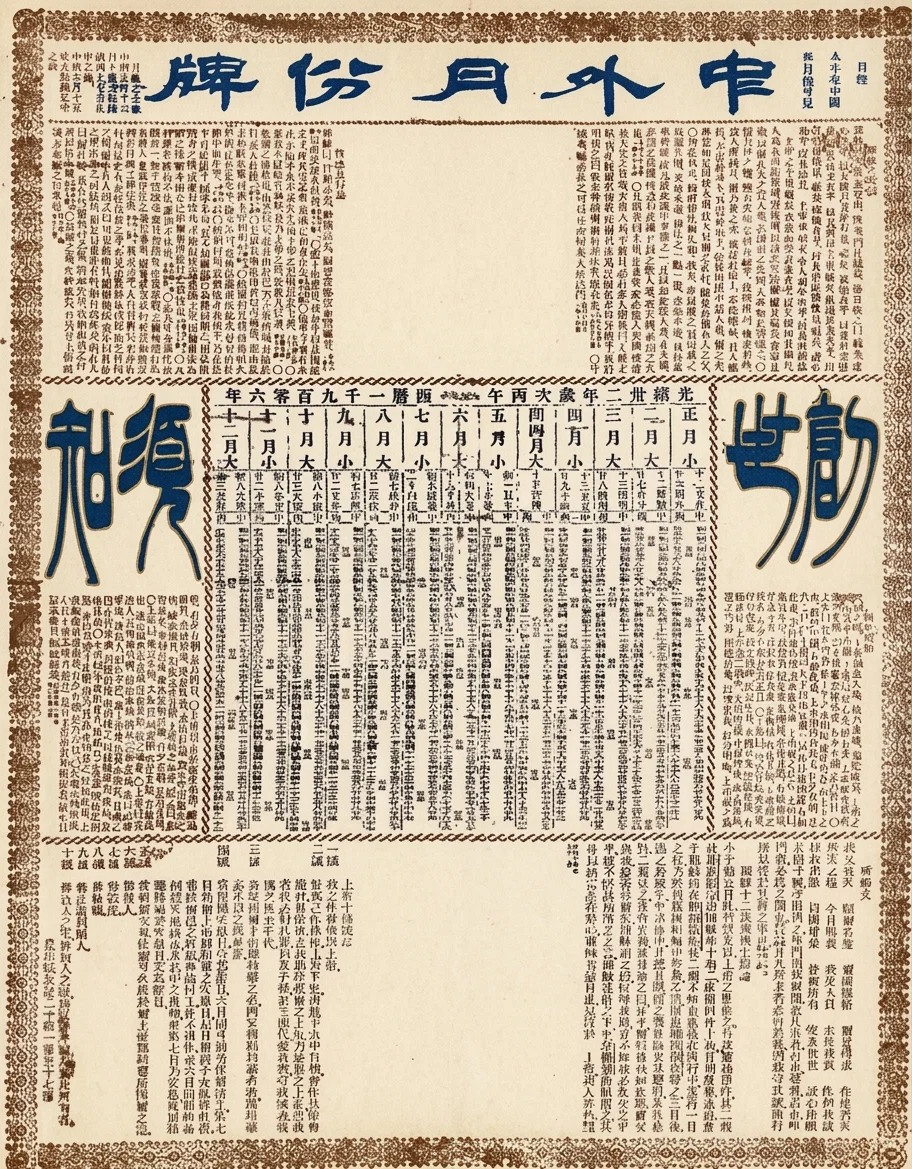
SABBATH CALENDAR IN CHINESE
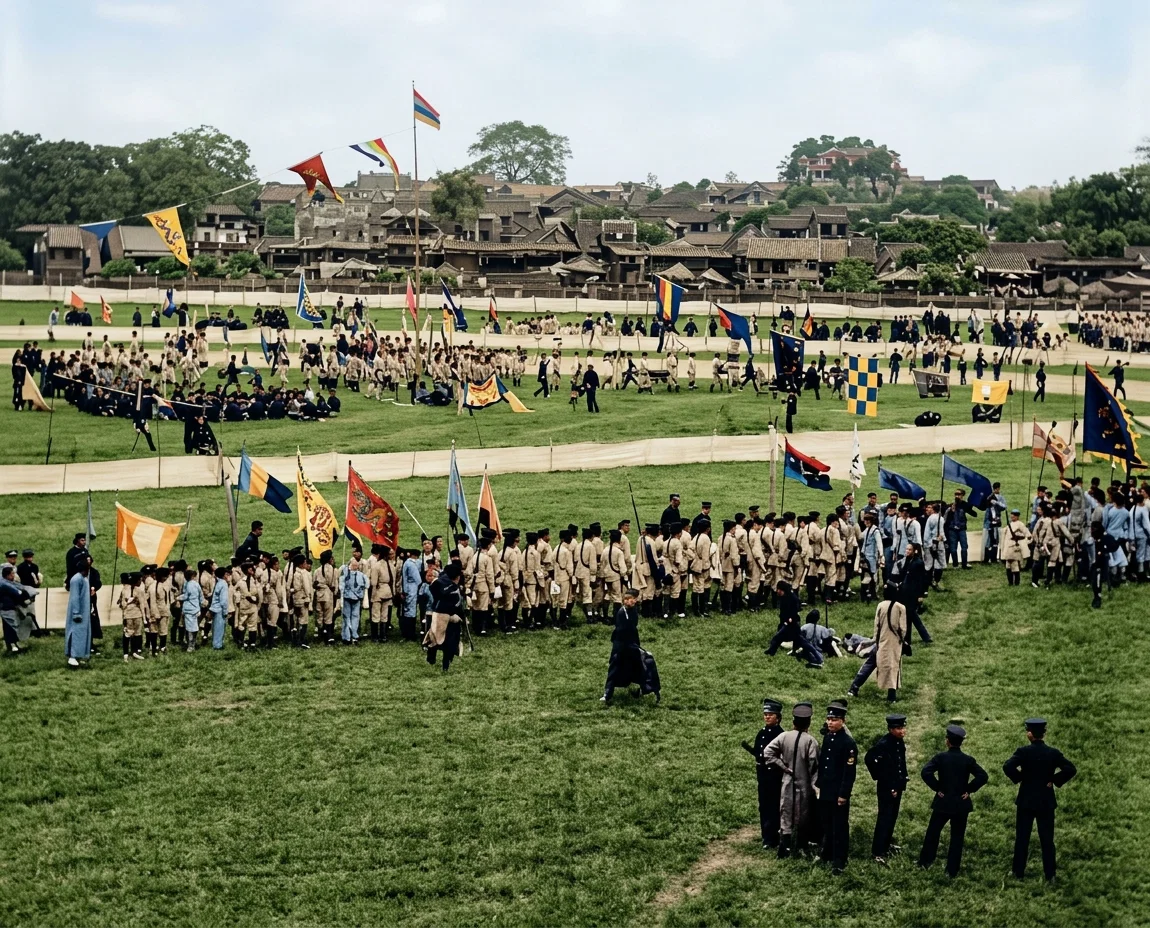
STUDENTS’ MILITARY DRILL, CANTON
This calendar is printed in the book language, and therefore can be understood in all China and Korea. The days of the European and Chinese months are printed in parallel columns, with the words “On Sik” (Sabbath) opposite the date of each Sabbath in the year. All other calendars now contain the words “Lai Bai” (Worship Day) for Sunday, though ten years ago, I am told, the words “Lai Bai” were not printed in the native calendars or almanacs of China. Our calendar also contains two pictures of Jesus (taken from “Christ Our Saviour,” and kindly loaned us by the brethren in Japan), one as he is giving the sermon on the mount, in connection with which is quoted Matt. 5: 1-19; 7: 21-23; and the other showing Jesus at twelve years of age, explained by Luke 2: 40-52.
Besides this, the calendar contains the ten commandments, the Lord’s prayer, an account of creation (Genesis 1 and 2: 1-3), and twelve references on “Faith and Works.” In connection with the quotation from Genesis we used four large ancient characters meaning, “You ought to know the Creator.” The Chinese have great reverence for their characters, either written or printed, and that is in our favor.
The people are beginning to discover that the Sabbath day of our calendar is not the same day as the “worship day” indicated on other calendars, and we are receiving many inquiries as to the reason. We shall follow the interest with what tracts we have, but O, how much we need funds for establishing the publishing work in southern China! Our press in central China is nearly fifteen hundred miles away by water route, and their local Mandarin literature can not well be understood here.12
Our hearts are full of courage as we enter upon the work of the new year, and we are thankful to know that we have the prayers and co-operation of the dear brethren and sisters in other lands. The changes in China in 1905 were equal to those of ten years previously. One of the most important of these was with reference to the system of education. The old plan of private instruction and public examinations has been superseded by the establishment of free intermediate schools. Every one of these schools will give military training, and thus China, like other nations, is preparing for the last great battle.
A significant event occurred a few weeks ago, when the students of the various schools of the city met on the parade grounds in the eastern suburb for a general military drill. Thousands of people witnessed this new movement. Now while Satan is stirring up his forces to prepare war, we must work mightily to prepare a people for the soon coming of the Saviour. China is ripe for the message. Who will come to help gather in the sheaves?
Canton, China.
J. A. MORROW
By J. A. Morrow
Bermuda
AT the time I first wrote, I thought that if we could make an effort in St. George during the winter, then we could possibly bind off the work, so that we could be spared for a more needy field, while the brethren would go on seeking out others here. But the work among the Portuguese people has developed so that we can do nothing in St. George just now. This work among this people is nothing that we planned, but how could we help but follow the leadings of the Lord, when we found souls so eager and hungry for the truth? I would be glad if I could give you the particulars in full, but that is hard to do on paper.
Our work began something like this: I stopped at a house to inquire my road. I found two Portuguese men cutting potatoes. I stood and talked with them for a few minutes about the signs of Christ's coming. They invited me back. I told them I would come the following Sunday afternoon. When I reached the place upon this Sunday, I found a congregation of about twenty-five gathered upon the veranda. I continued the Bible readings, through an interpreter from among their number.
Two kept the Sabbath before the first Sabbath of the week of prayer, one a Catholic. The first Sabbath of the week of prayer we had six of these brethren and sisters with us for the first time, and two at home. The number has since increased to a score, besides children. Others are deeply interested, for whom we have good hopes. There are five families represented among those who have already begun to keep the Sabbath. In one of these are the parents and twelve children and a niece. We do not count any except those who are grown, and have intelligently decided to obey the truth. This week I am to answer a call in an entirely new neighborhood, among Catholics. To us this work is truly marvelous. We praise God for it all.
J. A. MORROW
GEO. W. CASEBEER
By GEO. W. CASEBEER
Ecuador
POSORJA.—Besides studying the language, we find many friendly people, and a few who like to study Bible themes. A short time before removing from Guayaquil, we had a very encouraging experience. Brother Davis and I were walking along one of the main streets of the town when we met a man with a hand satchel of books, besides some under his arm. We were curious, of course, to find out what kind of books he had. Upon inquiry, we found that he was a member of one of the Protestant churches here, and was selling Bibles and books for them. As he did not seem to be having very great success, Brother Davis offered to show him where he might sell a Bible. As they walked, he began asking about the truth. He became so interested that they studied all the afternoon and evening. He seemed ready for the message, and accepted the Sabbath, and kept the next one with us. As we presented the other points, he soon grasped them, and with the reading-matter—Senales de los Tiempos and Spanish tracts—he seemed quite well established, and is now selling small books for us, also talking to the people.
We expect to keep in touch with him by correspondence, and occasionally a visit, and I believe if he continues faithful, he will soon be a great help to us here. He is very poor, but has the true spirit of sacrifice. The first week he gave us fifty cents gold, and the next $2.40, for First-day offerings, although he had scarcely enough to live on, and had no work in sight. We truly thank God for this token of his guiding hand, and are assured that this message will soon reach the utmost bounds of this dark land, although now just beginning.
The revolution through which this country has just passed has changed the government somewhat, and it, perhaps, is now more liberal than ever. In nineteen days from the first battle, the country was in the hands of the Revolutionists, but not without hard fighting and much bloodshed, nearly one thousand being killed, and many more wounded. Guayaquil was the last place taken. It was assaulted Friday afternoon13noon, January 19. Our house, also Brother Davis's, was situated close to the strongest fort in town. The other four barracks were taken in the evening, but this not until morning, so we had fighting around us all night. Many were killed near our home, and several stray balls entered the house, but none in our departments.
The second story of the bamboo houses here is built protruding over the sidewalks, so stray balls had a good opportunity to strike. But the Lord's protecting hand was over us, while many were shot in their homes.
We find that the people in the small towns are more under the hand of the priests. As Brother Davis was sick, my wife and I came down one week ahead, to find quarters for both families. We made arrangements with a man for a house, paid something down on the rent, moved in, and were well settled when he received word from the priest that there was another family wanting the house. We at once received orders to move out. But as I had a receipt for the money, and witnesses to the arrangement, he could do nothing. He finally said that if we would live very tranquilamente, and not play the organ, or practise our religion in any way, we might stay there. He was informed in a very kind way that we believed in liberty to every one, and that wherever we lived, we would serve God as we believe to be right. We saw, of course, the feelings that would exist if we should stay, so we told him that if he would find another house, pay back our money, and move us, we would go. In order to obey the priest, this was done quite willingly.
The majority of the people here, I believe, are breaking away from the power of the priests. But this does not destroy the effects of their training, and they are very hard to reach.
GEO. W. CASEBEER
Signs of Opening Lands
By Editor
WE are bound to study the meaning of signs. The word of Jesus still stands, which rebuked men for not reading the signs of the kingdom, although they quickly read the signs of the seasons and of the weather. The opening of long-closed lands is a sign of these early years of the twentieth century. Signs of this sort crowded into the last five years deserve careful attention: Tibet has received within the past year the first shock it ever received strong enough to dislodge the bars of its gates. No door is yet open, but the bars are shattered beyond restoration. Arabia is now undergoing a similar experience. Rebels have defeated the Turkish troops, and surround the great fortress of Sana, capital of Yemen. This rebellion against the sultan, who has steadily stirred fanaticism against Christian visitors to Arabia, is the beginning of the end of exclusiveness there. The bars of the gates are dislodged. Abyssinia has been as obstinate as Tibet and Arabia in barring out influences from outside that might disturb the self-sufficiency of its lazy and ignorant priests. Within a year the archbishop of Abyssinia has allowed preachers connected with the Swedish national mission to enter the country with the Bible and with schools. The door is ajar. China is open, for the moment at least, and longs for instruction from educated foreigners. Japan is opened by the war as never before, and in some way Christian ministers reach the soldiers in hospital and in camp. Manchuria a year ago was in the iron grip of Russia. All these great occurrences of one trend toward the opening of doors of intercourse, give us a right to believe that God himself is shaping the future of the nations. Let us understand the signs of his will, and say, “Here am I; send me.”
W. JAY TANNER
By W. Jay Tanner
Hayti
CAPE HATIEN.—Since my last report for the REVIEW I have baptized six persons at Grande Riviere, and expect to baptize three more there this week. As others are beginning to obey the Lord at that place, the prospects are that we shall soon have a strong church in Grande Riviere. Our native worker has recently spent some time at Port Margot, a town a few miles up the coast, where heretofore Protestantism had made no entrance. He had to hold his meetings in private houses and in the open air, as in Hayti there are no halls available for such purposes. A well-to-do lady opened her house for this purpose, and large crowds attended, filling the yard and street outside. The priest, hearing of it, sent word to the lady that she, being a Catholic, should not lend her house for Protestant meetings. She answered him rather pertinently: “It is my house, and I shall lend it to whomsoever I please.”
As a result of the small effort at Port Margot, Brother Isaac is able to report two leading men keeping the Sabbath, and the interest is still good. While there, he also heard of a man far in the interior who has been keeping the Sabbath for some time. The man has been considered crazy, but from subsequent correspondence we conclude that the only ground for this claim is that he is keeping the ten commandments. From the outlook in this quarter of the field we feel convinced that the Lord is about to do a “quick work” in the earth, and it is our desire to keep abreast with the Spirit’s movings.
W. JAY TANNER
Trinidad
By D. E. Wellman
PORT OF SPAIN.— We met in council for nearly two weeks, the latter part of January. This was a profitable season, not only for the committee, but also for the Port of Spain church. Nearly every point of interest connected with the conference was carefully considered, including the publishing work and the medical missionary prospects. Our brethren can, I am sure, appreciate the many difficulties that confront us because of our isolation from one another in the conference, by miles of water, every island a world by itself, each with a peculiarity of its own, as to dialect, manners, customs, laws, etc.
Above all, we felt grateful for the divine guidance. The spirit of union exists among our people. The careful canvass of every question of moment in each island field has given each member of the committee the knowledge so much needed to be in touch with the demands of the work as a whole.
We all appreciate the heavy drain made on the General Conference treasury, and are determined to press the matter of making this field self-supporting as rapidly as possible. Many portions are in great poverty, and will never bear their own burdens; others, however, will be able to do more in time. We appreciate very much the promise of the coming of Brother Davis.
Our Indian brethren are very happy to think they are to have a teacher, and I am sure they can not be much more pleased than we are that they are to have one. What we need now, and must have in the immediate future, is a man for the East Indian work. Our hearts go out to the poor people, who number over three hundred thousand in this field, with no one to head the work and push it forward. D. E. WELLMAN.
South Carolina
By WM. C. RAHN.
As it was a short report from this State which I read in the REVIEW that brought me to this needy field, where I am receiving so much of God's blessing, I can not help telling of some of the rich experiences that the Lord has given me since I have been here. I hope it may be an encouragement to some dear brother who is hesitating to enter the cause of God.
The Spirit of God had brought me to the point where I was willing to do anything or to go anywhere if the Lord would use me as a coworker with him. The Lord heard my prayer and accepted my offering, and as I had been reading in the REVIEW of the great need of laborers in South Carolina, the Spirit of the Lord told me to come here. February 19 I started from California for this field. The peace of God filled my heart on the way, and when I saw the great need of this field, I earnestly asked the Lord to give me his Spirit and power. He did so, and I have had some of the most blessed experiences I ever had in all my colporteur work.
One afternoon I came to a large plantation, and the Lord brought many people from the neighborhood to me. They were anxious to get the book which I presented, and in a short time, with the orders I had already taken that day, I had thirty orders for “Coming King.” The owner of the plantation agreed to deliver the books for me, and gladly kept me overnight.
The Lord went before me. The next day in the afternoon while I was showing the book to a man and two boys, the power of God was present. When I was about to leave them, they said, “Don't go away; we want you to pray for us.” I promised to return and stay overnight. O the good meeting we had together!
Again the Spirit of the Lord led me on my way, and in the evening I stopped at a house where a Baptist minister and another man lived. I gave them a canvass, and again the Spirit of God witnessed to the truth in the book. I took both of their orders. They said, “We have prayer-meeting to-night, and we want you to go.” I was tired, but I went, and we had a good meeting. After its close I presented my book, which brought me another rich harvest of orders. The people did all they could for me. The next morning wherever I showed the book, the Spirit of the Lord pressed the truth to the hearts of the people. This past week was the best of any I have had. People forgot their work, and with tears in their eyes held to my hand, urging me to stay longer and pray for them.
A few weeks ago a rich plantation owner refused to give me his order, but on meeting him again, I showed him the book. He said, “I have seen that book before. You are the one who showed it to me. It made a deep effect upon me.” He took me to his house, and we had a good time together. In the morning I had no trouble to get his order. O the love of God to man is great! The next noon I had another most blessed time. While at the house of a wealthy lady, the Spirit of the Lord came near. I stayed to dinner, after which she wanted me to talk with her son, and I believe our conversation had a lasting effect.
When I first came here, I could not reach the higher class of people, so I asked the Lord for grace for them. He heard my prayer. O the Lord is good! He gives me strength. This people are much dearer than all home comforts.
Let us do what we can to finish the work, and hasten the coming of the Lord. If only some of my young brethren who are crowded together in the large churches could know how good it is to go from house to house and carry the last warning message to a dying world, they would not be satisfied to stay where they are. To labor for the salvation of souls is a precious work. The few laborers in this State need your prayers.
WM. C. RAHN.
Laurens, S. C.
HUBERT FLETCHER
By Hubert Fletcher
Jamaica
MOORES.—Moores is a remote country district on the bank of the Rio Minho, in the parish of Clarendon. It will be of interest to note the rise and progress of the work at this place. In the year 1902 a spark of present truth was kindled in the heart of a brother, by his brother, who was at that time a Sabbath-keeper. He then remembered that in his boyhood days he had questioned his father on the fourth commandment, why it was not observed as it read. But he was scolded, and the matter slipped from his mind. Now, said he, “This is what I have wanted all these years.” And with joy he began the observance of the Sabbath, and for nearly two years he kept it alone, mocked, jeered, and persecuted. He was called “the old fool.” Yet all these things did not discourage the faithful brother. He kept praying and loaning tracts to the people until the fall of 1904, when he had the joy of seeing his family and two others join with him. No minister ever visited them until the end of 1904, when the number was about seven.
In April of 1905 the number grew to twelve. The spark was then becoming a blaze, and its sparks flew over to an adjoining district named Budd’s Hill. And praise the Lord, there is quite a conflagration at this place at the present time. These two districts have united their forces, and are pressing the battle even to the gates of the enemy. The number has grown from twelve to fifty-four adults besides more than a score of children. On Sabbath, April 7, 1906, I baptized nine dear souls, and others are expecting to follow soon. They have also begun work on their church building, which is to be twenty feet by forty feet. The lime and some of the lumber are already on the ground, and the foundation work will be started in two weeks. The believers are all of good courage, zealous for the cause they love. Brethren, pray for the church at Moores.
HUBERT FLETCHER
Earthquake Experiences
The Pacific Press Plant Wrecked
Last Wednesday we received the first detailed information concerning the results of the earthquake to our institutions on the Pacific Coast. A letter written the day of the disaster, accompanied by photographs, conveyed such particulars of the catastrophe as could be given in reasonable space. The mental strain under which this communication was prepared may be appreciated in a measure from the fact that while confronted with the desolation wrought by the main shock, there were not less than six additional shocks felt while this letter was being dictated. We know that all our people will read this statement with painful interest. It runs as follows:—
“MOUNTAIN VIEW, CAL., “April 18, 1906. “To the Officers of the General Conference.
“DEAR BRETHREN:
You have doubtless learned through the papers and from telegrams of the appalling disaster which visited the Pacific Coast this morning. We hasten, however, to give you definite information at our earliest opportunity, knowing how anxious you will be to learn how the Pacific Press, among other institutions on the Coast, has suffered. We have the following telegram written, and will send it as soon as the telegraph lines are sufficiently repaired:—
“General Conference, Takoma Park Station, Washington, D. C.
“Cities and towns on Coast largely wrecked by tremendous earthquake five fifteen this morning. Pacific Press building practically ruined. Machinery mostly safe. No lives lost. Great calamity. Need counsel and help. Particulars by letter.”
“Our information up to the present is meager except from our own immediate surroundings. We will tell you briefly that which we know, and shall be able to write more details in a day or two. However, words can not describe the experience, nor can the loss in property and life be estimated. The loss of property is probably almost beyond computation.
“At precisely fifteen minutes past five this morning we heard the awful roar and rumble of the earthquake, and the shaking began. It lasted probably about one minute, and when it was over, nearly all brick and stone buildings were pitiful wrecks.
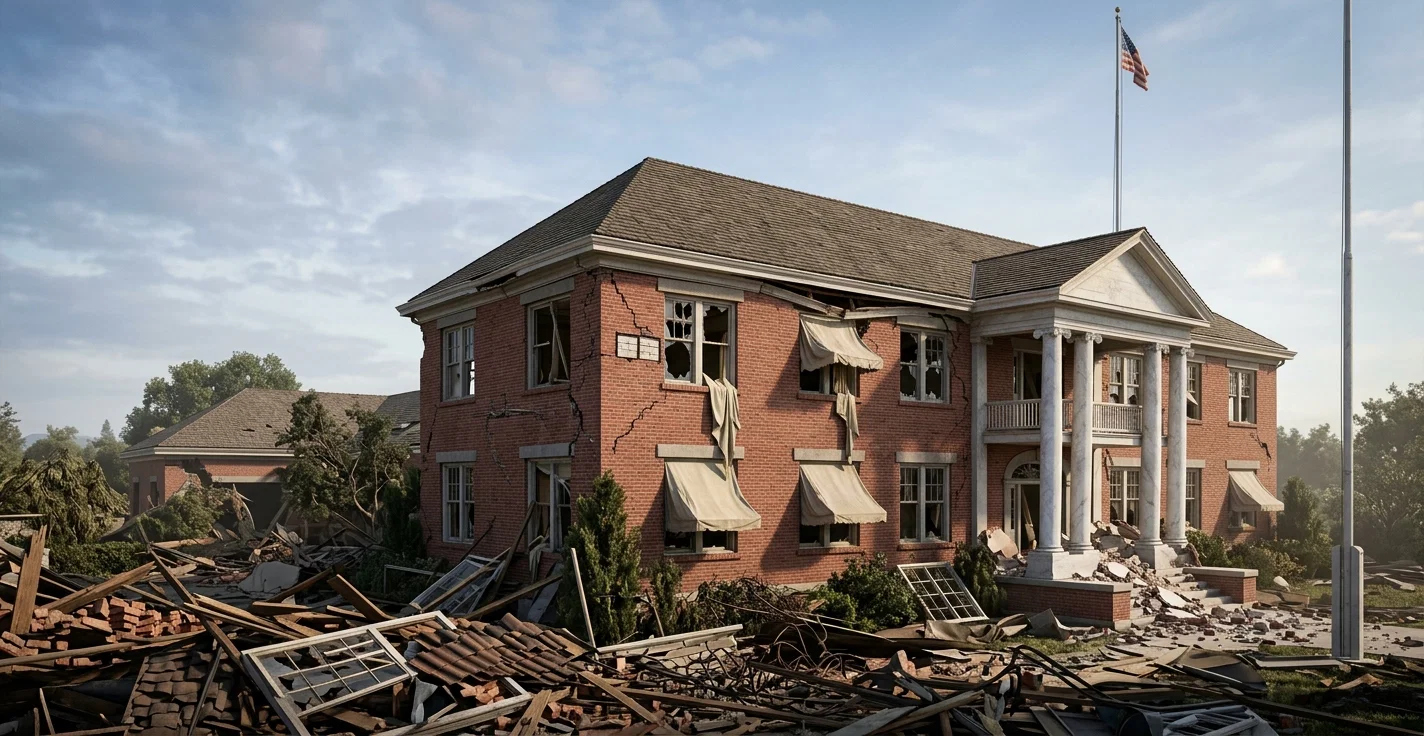
WEST END OF PACIFIC PRESS OFFICE AFTER THE EARTHQUAKE
“Here in Mountain View, the post-office, the largest general store, a rooming-house and restaurant, and a large brick building under construction were smashed together into a heap of ruins. A large saloon and theater across the way also crashed into a shapeless heap.
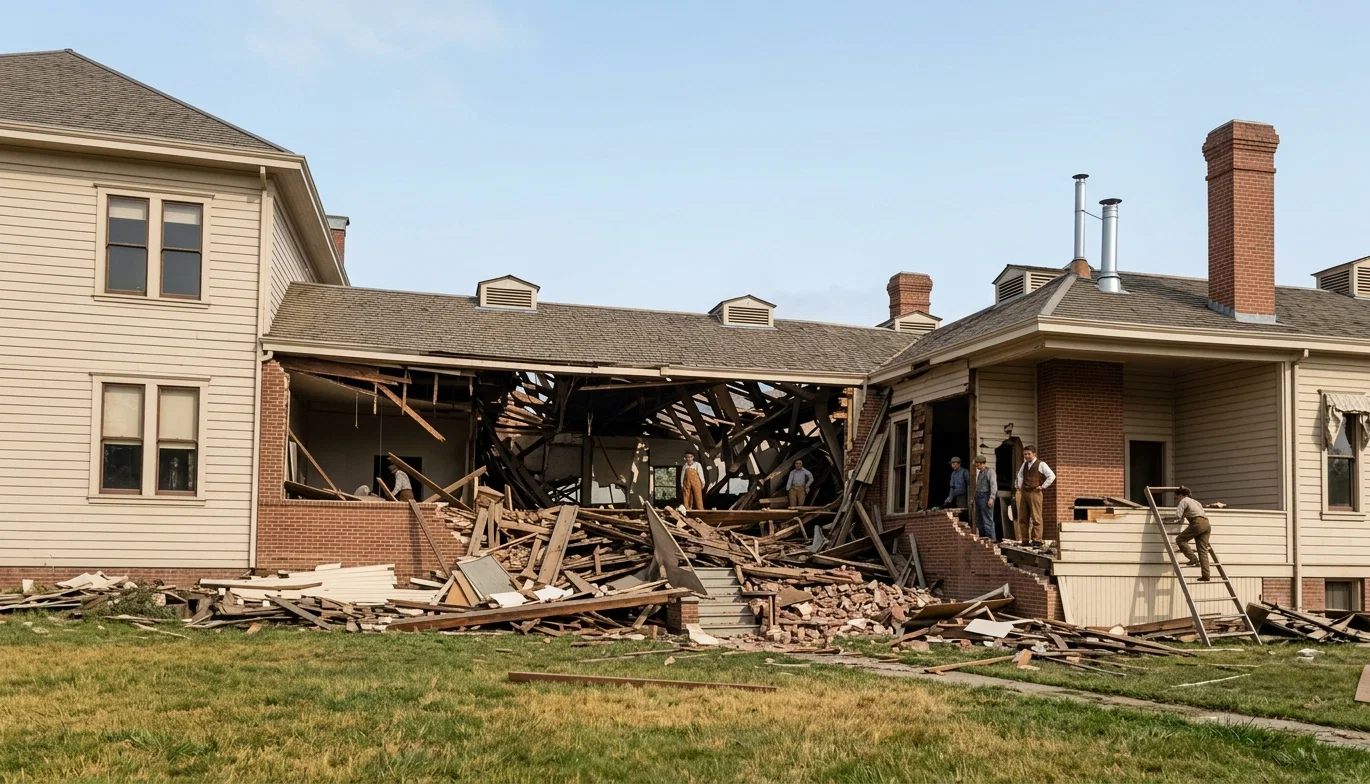
EAST END OF PACIFIC PRESS OFFICE AFTER THE EARTHQUAKE
A furniture store was so demolished that hardly two bricks were left hanging together, and there is not so much as a piece of a wall standing. The large fruit exchange, and many other buildings were also wrecked. Nearly every house in town lost one or more chimneys, and even the strongest and best houses were moved from one to six inches on their foundations. The water-tower which supplied the town, fell with a tremendous crash, and is only a shapeless heap of splinters. Scores and scores of water-towers and windmills are demolished.
“There is no evidence that Mountain View has suffered the worst. From towns all around we hear that the devastation has been fully as complete as here. Stanford University is in ruins. The chapel, which cost two hundred thousand dollars, is a part of the heap of waste. San Jose, eleven miles southeast, which has a population of about thirty thousand, is very largely leveled.
The Hotel Vendome fell, burying many sleeping inmates beneath the ruins. Up to the present the bodies are still being removed. Nearly the whole city, with the exception of strong, low frame buildings, is a shapeless wreck, and a portion of the city is on fire.
“The Agnew asylum for the insane, six miles from here, is a total wreck. Nearly all the inmates were buried in the debris. Seventy-five not seriously hurt escaped, and one was caught in Mountain View a few minutes ago. Up to two o’clock a hundred bodies had been removed from the wreckage.
“All the wires are down, so we can not hear from towns farther away. No trains can get nearer San Francisco than San Mateo, for the track is piled high with the wrecked buildings. Telephone connections have just been restored with central at Oakland, but we are unable to get connection with any private residences. Central informs us that San Francisco and Oakland are wrecked beyond description, and that probably all the rumors are true. Quite a large section of the city is on fire, and great clouds of smoke are pouring down over this valley forty miles away. We hear that it is impossible to hire sufficient conveyances to carry away the dead from15the streets of San Francisco. This may be wild rumor, but it is all we have at the time of writing. This we know, if San Francisco was shaken as this section was, few buildings are standing. Naturally we would fare much better than such a town, for the most of our buildings are just one-story frame structures.
“Your hearts will be made sad as we tell you of the damage to the Pacific Press. The building is practically ruined. Only a portion of it has fallen, but the rest of it is so strained and wrecked that it will have to be taken down. Of course the ground floor and the foundations are all right. Fortunately the machinery was in the one-story section, the roof of which remained standing. Both ends of the building fell. The corner near the manager’s office and the editorial rooms is split off, and stands in a very precarious position. The libraries and bookcases fell. Much of the plaster was shaken off the walls. The books were emptied from their bins, and nearly everything movable was thrown into a heap. Fortunately, little damage was done to the machinery. It all being on the ground floor and strongly anchored, it stood the shaking very well. The linotypes were probably ruined. A brick wall fell on them, and smashed them both seriously.
“Fortunately, the water-towers remained standing. It seems almost a miracle that they did. The engines also are in working order. Of course the brick chimney fell. No brick chimney could stand such a rocking; in fact, nearly everything made of brick went to pieces. We feel very thankful indeed that so much can be saved from this wreckage. The books are mostly all right, and by propping up portions of the building a part of the work can go on. But the loss is a great calamity, particularly coming to the Pacific Press as it does after two years of financial struggle following the moving from Oakland to Mountain View.
“A meeting was immediately called, and a committee was appointed to write up particulars and furnish them to the General Conference, to Brother and Sister White, and to others who will be particularly interested. It was also decided to send telegrams to several places.
“We do not know what the extent of this disaster may be, nor how many of our institutions along the coast may have suffered. We hope that it is comparatively local, and that the St. Helena Sanitarium and the sanitariums south have escaped. We dread to hear from St. Helena and Healdsburg and other places where, if the earthquake was as severe as here, many at that time of morning would surely be buried beneath the ruins of those old buildings.
“We are hardly in a condition to write you of this catastrophe, and it seems almost impossible to put it in words. Neither is it easy to write when the house is being shaken by earthquake tremors every few minutes. The building has been shaken no less than six times while this letter was being dictated. It is probable, though, that these tremors are the return waves of the great shock. We hope that the worst is over.
“As we have walked around the ruins of the Pacific Press and seen what devastation has been accomplished in only one short minute of time, we feel that the weight of this loss is almost too much to be borne just at this time, and naturally we ask ourselves the question whether our people all over the United States, as they hear of this calamity, will not come to the rescue and help to restore this institution. Only a few months ago in the very chapel which is now such a wreck, the ‘surprise party’ movement was started. It has occurred to some, and particularly to us who are outside the Pacific Press, that this would be a timely opportunity for the wave of liberality to roll back from the East to the West in behalf of a loyal institution which lies in ruins.
“Of course we can recover nothing from insurance companies for this damage. It is classed as one of the acts of God for which the insurance companies are not liable.
“We do not make this suggestion to the General Conference definitely as a request, for we do not know how great the needs may be in other places; but if conditions would justify such a course, it would be a great blessing if the facts concerning this situation could be placed before our brethren, by special communication, in all the churches, and if they could be asked to come to our relief. And not only do we need financial help, we need counsel. We have invited Brother and Sister White, by telegram, to come to Mountain View, if the needs are not greater elsewhere, and advise as to the course that should be followed. The managers are endeavoring to know what the Lord wants them to do in this time of distress, and every member of the Board will stand loyally by the counsel of the Lord. We are very thankful that no lives were lost. Many people were in danger in their homes, from chimneys falling through the roofs, but there are no serious casualties among our own people.
“Petitioning most earnestly an interest in your prayers that we may be guided by the Lord’s unerring counsel, we are, dear brethren,
“Yours in Christian love, “M. C. WILCOX, “E. R. PALMER, “I. O. CORLISS, “W. T. KNOX, “E. A. CHAPMAN, “Committee.”