The Youth’s Instructor, Vol. 65, No. 5.

Fifty Reasons Why I Shall Vote for Prohibition
The Youth’s Instructor

Jan 30, 1917

Review and Herald Publishing Assn. · Takoma Park Station, Washington, D. C. · Jan 30, 1917

Fifty Reasons Why I Shall Vote for Prohibition

Because scientists have proved alcohol to be a poison, lowering vitality, lessening efficiency, and causing degeneration and destruction of both body and soul.
Because alcohol has no food or medicinal value.
Because even though I myself eschew alcohol, yet if I vote to license the liquor traffic, my vote is an invitation to others to partake of the accursed thing.
Because of the alcohol-wrecked lives all about me.
Because American boys and girls would be ruined by the traffic if it were licensed, that would not be if it were prohibited.
Because it makes orphans of hundreds of thousands of children.
Because our drink bill, which is worse than wasted, would pay a five years’ course of instruction for 2,000,000 children.
Because alcohol is largely responsible for the mentally defective, deformed, epileptic, and insane.
Because it destroys homes, causing indescribable woe and suffering to mothers and children.
Because of the beneficent results shown wherever prohibition has been tried.
Because the Newcastle Courier says of Warsaw, Ind.:—
“Taxes have not been raised, and assessed property valuation shows rapid increase. At least $300,000 has been spent in improvements in the business section, many new buildings taking the place of old ones. Six new factories have located in the city during the last six years of prohibition. Over ten miles of pavement have been laid, at a cost of many thousand dollars, and the property owners have welcomed the expenditure, which during the license period seemed too heavy to be shouldered. The city’s pay roll has had considerable increase each year. The population has increased approximately 1,500 under no-license, banks show heavier deposits, business houses have enjoyed unusual prosperity and have never had fewer unpaid bills. Plans have been made for the erection of public buildings this year which will mean an expenditure of between $250,000 and $300,000.”
Because the vice president of the Aberdeen, S. D., National Bank says:—
“Our city is cleaner, better, and more prosperous than when we had license; homes, mothers, and children are better cared for; merchants report bigger sales and more prompt collections; and savings accounts have been started by those who heretofore, or under the license period, could not even pay for the necessities of life, to say nothing of trying to save. Buildings that were formerly occupied by saloons are now being used for legitimate business, and the demand for both business and dwelling locations is steadily increasing.”
The manager of the Narregang Investment Company says after eighteen months of the dry régime:—
“The call for real estate is greater this spring than for the past five years. One Main Street lot sold this month for $6,000 more than it could have been purchased for when we were wet.”
Because the chief license commissioner, J. N. MacLean, who has taken the records from the five judicial districts of Manitoba and the police department of the city of Winnipeg, says:—
“Drunkenness in Winnipeg has been decreased 80 per cent, and crime throughout the whole province has been reduced 58 per cent.”
Mr. MacLean found that there had been no increase in the amount of liquor sold at the drug stores, exploding the lullaby the liquor interests sang during the campaign:—
“Hush, little drug store, don’t you cry, You’ll be a barroom by and by.”
The chief of police of Winnipeg says that there are not more than three arrests a day now compared to twenty or thirty per day under the wet régime.
Because under prohibition it cost Alabama $8,975.40 less to feed prisoners confined in Jefferson County jail during the last six months of 1915 than under nonprohibition for the corresponding six months of the previous year, or a saving of $1,495.90 per month.
Because, according to the police inspector of Birmingham, Ala., there were 1,045 fewer arrests in 1915 than in 1914 when the saloon, distillery, bottle-house, and social-club systems were in operation.
Because Birmingham, according to George B. Ward, president of the city commission, says that homicides have been reduced 33 1-3 per cent and suicides 60 per cent; and that the city has never before in its history been so quiet and orderly; that the normal number of prisoners confined within their jail, the handsomest city jail in the South, before prohibition, was 200 and upward. Now the number ranges from 60 to 70.
Because Mr. Ward further says of Birmingham, declared to be the driest city of its size (200,000 inhabitants), that—
“Every passing month demonstrates more clearly that the monetary loss from prohibition is being offset in so many other ways, both direct and indirect, both financially and morally, that the result is startling.”
Because there were only one half as many suicides and murders in Seattle, Wash., in the first six months of 1916 as in the corresponding time of 1915.
Because the editor of the Spokane Daily Chronicle, who thought that the liquor people were right when they said that a prohibitory law would stifle liberty and injure business, and who would not help the drys in their campaign, said after only four months’ trial of prohibition:—
“This paper is ready at ten seconds’ notice to fight its best against any serious effort to repeal or cripple the prohibition law. For four months now, Spokane has honestly tried prohibition; and liquor was prohibited. Not perfectly; but better than speed laws prohibit fast driving or larceny laws prohibit theft. Add to this that unemployment, destitution, and poverty are less than twelve months ago; divorces are fewer; collections are better; dives have closed; white slaves are not to be found; burglaries and holdups have dwindled; the panhandler has vanished; grocers, clothing merchants, and shoe dealers report gains in business, ranging from 5 to 35 per cent; new business blocks are being built; the banks hold millions more in deposits than they held last April; and hotel men, who at that time were near panic over the coming law, are wearing smiles as they turn away surplus guests. The dry way is the way of economy, safety, and righteousness.”
(Continued on page sixteen)

Fifty Reasons Why I Shall Vote for Prohibition

(Continued from Second Page of Cover)
Because the Spokane prison last March had 41 prisoners to feed instead of 230, as in the previous March; because it had one woman drug fiend instead of 25; because on a certain date it had not one drug or whisky fiend instead of 100 such cases, as on that date a year before.
Because within four months after the simultaneous closing of 305 saloons in Seattle, practically every one of the vacated properties had been occupied by a useful and legitimate industry; and because there were fewer vacant stores in the city than before the dry law went into effect, and rents had not decreased.
Because prohibition when tried, draws to its side intelligent men who strenuously opposed it before it was allowed to prove its virtues. For example, Mayor C. B. Blethen, of Seattle, says:—
His last good-by. To save our youth, kill the liquor monster with the ballot.
“We fought prohibition on economic grounds alone. We believed that in a great seaport city, with a population of upward of 300,000, prohibition would be destructive; that it would bring on economic disaster. We believed that under the license system we had the liquor traffic as well controlled as it could be; we wanted it let alone, and we fought as hard as we could fight. But in spite of all we could do, prohibition carried and went into effect the first of January. We already know that it is a great benefit morally and economically. Its moral effect has been tremendous. We had an average of 2,600 arrests a month for crimes and misdemeanors growing out of liquor drinking. In January we had only 400 arrests, and 60 of these were made January 1, and were the result of hangovers from the old year. That in itself is enough to convince any man with a conscience that prohibition is necessary. There can be no true economy in anything that is immoral.”
“On top of the great moral result we have these economic facts: In the first three weeks of January the savings deposits in the banks of Seattle increased 15 per cent. There was not a grocery store in Seattle that did not show an increase of business in January greater than ever known in any month before in all the history of the city, except in holiday time. In all the large grocery stores the increase was immense. Every dry-goods store, except one, and that I have no figures from, had a wonderful increase in business.
“I wished to know in what class of goods the sales increased so greatly, so I went to all the grocery and dry-goods stores to find out. And to me it is a pitiful thing—and it makes me sorry we did not have prohibition long ago—that the increase in sales in all the dry-goods stores was in wearing apparel of women and children, and in the grocery stores the increase was made up chiefly of fruits and fancy groceries. This proves that it is the women and children who suffer the most from the liquor business, and it is they who receive the greatest benefit from prohibition. Yes, sir, we have found that it is better to buy boots than booze.”
Because many in Des Moines, Iowa, and in Denver, Colo., and in every other new recruit to the prohibition ranks, are learning the way to the bank since saloons have been outlawed. Governor Carlson asserts that “in the Denver Savings Bank, 2,050 new accounts were opened during January, 1916. In Seattle, months before the first year of prohibition closed, 7,165 new savings accounts had been opened.”
Because L. A. Fare, juvenile court judge of Columbiana County, Ohio, has testified that—
“Eighty-three out of every one hundred children brought into the probate court of that county are there because of drink, and that sixty-five per cent of the abnormal and defective children brought into court are there because affected through drink.”
Because post-office receipts in Denver for the month of June, under prohibition, were $18,160.24 more than for the month of June, 1915, under license—an increase of 16.2 per cent. For the first time in Colorado’s history Denver’s post-office receipts have exceeded a million and a half dollars in a year—and the increase has come under prohibition.
Because in no place has prohibition brought the disasters predicted by its enemies, but in every place has demonstrated its efficiency as a true servant.
Because we “face the astounding actuality that if to the annual product of all the lumber mills were added the output of all the coal mines saturated with the petroleum from all the wells, and the entire mass consigned to the flames, still the amount of loss would actually be less than the annual loss due to the liquor traffic.”
Because in Tacoma, Wash., a city of 100,000, there was an unprecedented boom in the sale of children’s shoes after Jan. 1, 1916, and because, according to the mayor, A. V. Fawcett,—
“The city is in better shape economically than it has been for years; workingmen who were looking for work last year are employed; grocers report increase in business; contractors report more building than for the past five years; old shacks are being replaced by modern business houses; vagrancy has decreased 63 per cent, and fighting and disorderly cases 100 per cent.”
Because the mayor of Walla Walla, Wash., said that he had not been called upon to settle a drunken family row since the saloons were abolished, and that bank deposits had increased, arrests decreased, and bills were paid more promptly. Another mayor says that 99 per cent of all cases of trouble brought to his office are due to drink.
Because bakers say they sell more bread and cakes than during the wet régime.
Because the dry régime makes unnecessary the long line of women at the pay window of some industries, waiting to get their husbands’ checks.
Because Governor Alexander of Idaho says:—
“Prohibition is a success. Boise is in better condition financially today than ever before.”
Because for the first time in many years there was not a single criminal case filed in Denver, Colo.; and the Denver Dry Goods Company reported in one month a 30-per-cent increase in its sale over the same month for the past few years.
Because the passengers of the “owl” cars of Denver dropped 40 per cent in the first few months of prohibition. Thirty per cent of the midnight passengers had been intoxicated women and girls.
Because Denver’s largest laundry received 401 new family wash patrons. These families had had their washings done by washerwomen who surrendered their jobs when their husbands brought their pay envelopes home instead of giving them to the saloon keeper.
Because Denver three years ago had 2,653 vacant houses, including apartments. Today it has not 300 houses in good condition for occupancy. From one and one-half to two families are moving into Denver for each one moving away.
Because Denver’s bank clearings in one week of June, 1916, were $15,413,000, an increase of 42.7 per cent over the corresponding week of the previous year under saloons.
Because Crystal Falls, Mich., the county seat of the wettest of the wet counties, was $10,000 in debt when Iron County went dry. Though it had but $7,000 in the treasury, and lost the $12,500 annual license fee, it has paid off all its saloon-accumulated debts; has spent $4,000 for a new fire truck, and has $14,000 in the treasury.
Because the Colorado Motor Company reported a gain of 400 per cent in January, 1916, over January of 1915. Salesmen of all the leading automobile companies report a great gain in sales due to prohibition.
Because commissioner of safety, Alex. Nisbet, of Denver, says:—
“The habitual loafer has disappeared. The crowds that used to hang around the lower end of the city at free-lunch counters are gone. Where, I haven’t the slightest idea. Like last summer’s flies, they just disappeared. Again, the winerooms are no more and the ‘after the theater’ dinners are over.
“When any one uses the word ‘money’ as an argument in the liquor traffic question he loses sight of the real question, for after all it is a question of humanity, and I have come to realize this through twelve years of service while Denver was wet and two and a half months of service as sheriff since the city has been dry.”
Because Portland, Oregon, reports the elimination of the “night rider” and the “joy rider.” In February, 1916, there was only one arrest for operating a machine while intoxicated, while in December, 1915, there were thirteen such cases, and two citizens were killed. Portland also reports the usual prohibition increase in savings, collections, grocery and dry-goods sales.
Because Spokane’s leading daily says that “the records at the county courthouse show that to aid the unemployed it has cost $9,000 less in February, 1916, than it did in the same month of 1915.”
Because Findlay, Ohio, has not had liquor revenue for seven years, yet it has the lowest tax rate of any city in the State.
Because wet Fostoria and dry Findlay, near neighbors, the former, with 9,597 population, showed 375 arrests for drunkenness within a given time; while the latter, with 14,858 population, had only 122.
Because Berkeley, Cal., ten years ago, with a population of 26,000 and saloons, had 310 arrests for the year; while last year with a population of 65,000 and no saloons, there were but 291.
Because in Portland, Oregon, the Workingmen’s Club, maintained by private philanthropy for the unemployed, has closed its doors because the number of unemployed in Portland had become so small that the club’s mission was considered to have been fulfilled. During its career of sixteen months the club furnished 400,000 meals at five cents each, besides food to hundreds of men; and because at the Italian Mission in Denver, where ladies at the Highlands Methodist church have been furnishing free meals for 150 children, under license conditions, “no more free meals are furnished, since the children are getting all the food they need at home.”
Because prohibition reacts unfavorably upon the houses of ill fame. One madam declared that since the prohibition order went into effect, her income of $4,000 a month had been reduced one half. Others said if they were not permitted to sell liquor, they would have to go out of business.
Because the workman would be benefited by the wiping out of the liquor traffic and its allied industries.
Because cobwebs are hanging from the walls of the Macon, Mo., police court. The city attorney, elected when saloons were running, formerly received in fees from $65 to $75 a month. He says that now he is doing well if he gets $5. The average is $2. He says that he thought they had not tried a case at the courthouse for six or eight months.
Because from extended observations throughout the country, pawnshops, jails, houses of prostitution, gambling dens, and the morgue are the only institutions that show a decrease in patronage through prohibition.
Because whether the workings of prohibition are observed in towns, cities, counties, States, or nations, and whether these are east, west, north, or south, it is found to produce always the same beneficent results, and never any unhappy results.
Because it is time to stop making criminals, paupers, and insane through a traffic fostered by law.
Because “many of our social evils which overshadow the land like so many upas trees, would dwindle away and die if they were not so constantly watered with strong drink.”
Because the Austin Herald of Minnesota says that while its files in other years are full of stories of fights, family quarrels, beating of wives, children going wrong, men being robbed while drunk, since the passing of the saloons it finds little to report in the criminal line. Lawyers of Austin say they have no longer to evict families for nonpayment of rents, and rents that were two and three months behind, are now paid on time.
Because prohibition has changed breweries and distilleries into successful tearooms, ice factories, milk companies, yeast factories, a paint, oil, and varnish company, fruit and by-products company, chemical and soap plant, creamery and produce company, loganberry-juice manufacturer, and into flourishing Y. M. C. A. rooms.
Because saloon men who have been forced into respectable business by prohibition, have become its stanch friends, are happier, and declare they would never enter their old business again.
Because I desire to see men have the opportunity to be and to remain men; because I want women and children to be tenderly and generously cared for; because I want to see, as far as possible, tramps, bums, criminals, paupers, insane, epileptics, and the unemployed eliminated; because I want to see disease and death lessened; because I want to see the moral and social standards raised; because I want to see financial prosperity together with every other laudable kind of prosperity throughout the nation, I shall vote for State-wide and nation-wide prohibition, and so should you. Will you?

The Onward March of Prohibition

THE progress of the prohibition movement is so rapid that one has difficulty in keeping pace with it. On January 8 the Supreme Court of the United States ruled in favor of the Webb-Kenyon law, emphatically declaring it to be Constitutional. This decision makes it possible for the States now having prohibition to prohibit the receipt, possession, sale, and use of intoxicating liquors without being hampered by the agencies of Interstate Commerce acting as bartenders to bring liquor into the States.
The day following this great victory for law enforcement witnessed another advance step,— the passage by the United States Senate of the Sheppard bill by a vote of 55 to 32, thus prohibiting the sale or barter of intoxicating liquors of any kind within the District of Columbia, and their importation for any of these purposes. The bill is expected to poll even a larger favorable vote in the House of Representatives.
Surely these victories are but gleams from the rising sun of national prohibition. Let us all gird on the armor of service with renewed energy, that that day may come before 1920, the present goal.

Every three minutes one man staggers to a drunkard's grave
“Prohibition does not confiscate property, but merely forbids its misuse.”
Four times as much is spent in this country for liquor as for education.
A man who drinks 1 pint of beer a day drinks in one year 14.7 pints, or about 7½ quarts, of pure alcohol. Much of this remains in the system unoxygenized.
A missionary in Africa ordered a case of Bibles for his work of evangelization. When he went to the freight office to get the Bibles, he was informed that in order to get the box, sixteen thousand cases of liquor had first to be moved.
The manager of the Reo Motor Company, of Lansing, Mich., says that “statistics for five consecutive pay days show that the total time lost to employees through drink was 325 days; and that the total wage loss to the men was $731.25.” The Reo Company is therefore on the trail of the liquor traffic.
For every dollar put into new churches in the United States in 1905, $2 were spent in building breweries and distilleries. In 1915, for every dollar spent in building new breweries and distilleries, $38.20 were spent in building new churches. Evidently prohibition prohibits.
The world's mortality averages seventy per minute, or 100,800 persons a day. Our own national death and sickness bill is $3,000,000,000 a year. One third of this is declared to be preventable. Since one death in every twenty in this country is estimated to be due directly or indirectly to drink, the abolition of the liquor traffic would greatly decrease the high cost of dying.
If you do not rise up and put the saloon out of reach of the boys, this nation is going to fail. The American home is ours, and it is threatened with destruction. That is not all. The American home is that upon which rests the American government. A nation or a country is not great because of its great mines, minerals, or money. It is great only because it has great sons, and if this American government is ever to go farther in the years that are to come, and preserve peace for the world, it will be because the American home has been preserved, a safe place for the American boy to grow up to the splendor of his mature manhood.—Carolyn E. Geisel, M. D.

A Covenant with Death

THE liquor traffic is in business for the money that is in it, and that comes easily and abundantly. It is in politics to protect itself from the assaults of those who would destroy it. It therefore has both financial and political power. With these it controls large numbers of voters and dominates political parties. Through these parties it influences government, and prevents legislation that would do it harm. The “good” citizen acquiesces in all this, and votes to support the saloon program, chiefly because he thinks such a course will enhance his business interests or secure him political favors.
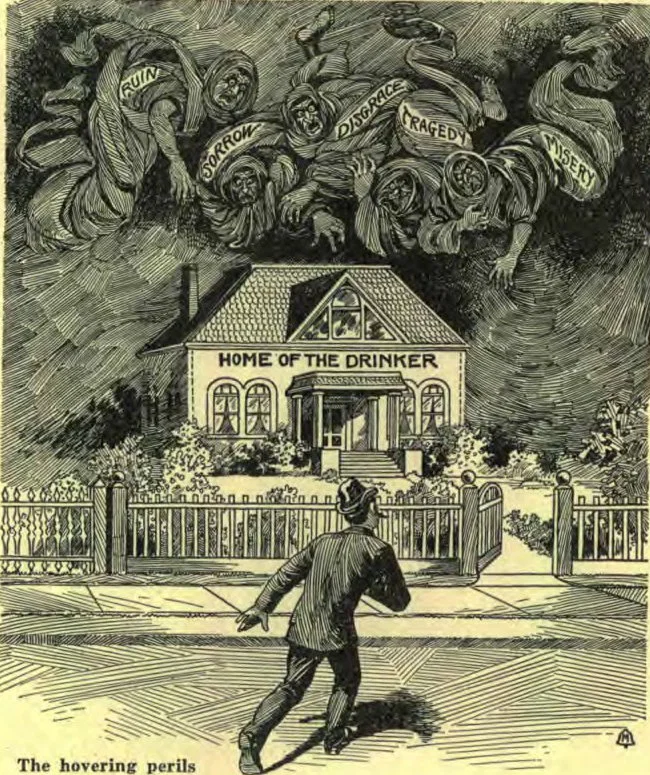
The hovering perils
The hovering perils
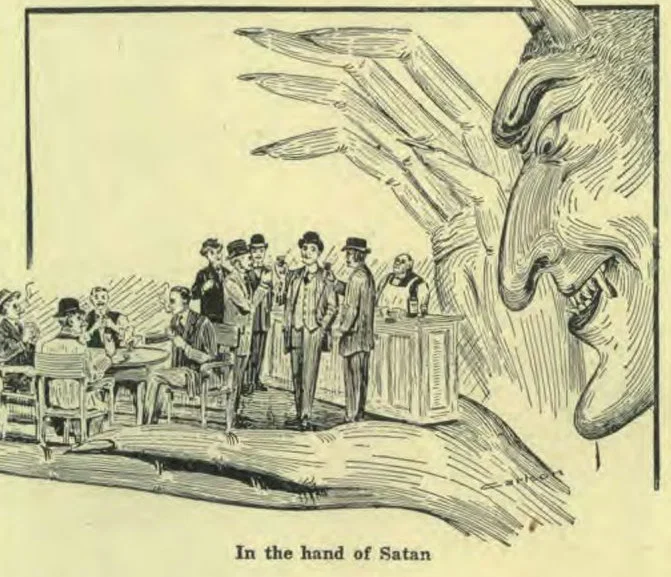
In the hand of Satan
But go, Christian voter, where night is darkest, and where broken hearts are bleeding over the ruin which your party-protected and legalized saloons have wrought, and sing the song of the almighty dollar. Tell them that for gold and party success, voters professing the sacred name of Christ stand ready to lick the dust off the heels of saloon keepers and to crawl through all the slimy sewers of political sin. Tell the shivering and hungry children that you have taken the food from the mouths and the clothing from the bodies of these helpless little ones, and transmuted all into votes for your party and into gold—licensed gold!
Tell the weary, haggard wife that the license for which your party stands has put into your bank account a paltry percentage of the rose that once bloomed upon her cheek, her health, her home, her happiness, her husband’s manhood and love,—all gone, and gone forever, but you hold ten per cent of it, changed by the God-defying alchemy of saloon politics into yellow gold!
Tell the shivering drunkard, as in wild delirium he dreams that he can yet beat back the serpents that sting him and the volcanic fires that consume him, that you have in your pocket the price of his shame and damnation in yellow gold! Stand at the threshold of the asylum, and mockingly taunt the hungry, the deformed, the squalid, the idiotic, with the news that out of their misery and ruin you have put your party in power and gathered a harvest of gold. Listen to the remorseless hinge of the prison door that slams and shrieks after its entombed victim, and cheer thy brother’s desolation with the news that a great Christian [?] commonwealth has deliberately sold him to crime and shame for gold, and that the infamy is annually sanctioned at the ballot box without protest by millions of professed Christian voters!
Tell the ragged orphans in the streets that for a handful of yellow gold you became particeps criminis to the accursed infamy that robbed them of food and clothing, of parents, home, and education, and that your vote and your party deliberately sold them for gold and the unspeakable reward of a political victory! Tell the sixty thousand girls who, from the homes of America, are annually entrapped in the saloons, winerooms, and beer dens protected by your party, and through these awful gateways, these licensed hells, whirl into the brothel and onward to the dark river of death—tell them that the crime and shame must remain in order that your political party may stay in power and its heelers may fatten upon the tribute, extortion, and graft! Stand by the more than one hundred thousand new graves of the last twelve months’ harvest, and from your open Bibles read that no drunkard shall inherit the kingdom of God, while before you reel the ghosts of uncounted thousands slain in saloons licensed by Christian [?] voters, each lost soul justly taunting you with the awful responsibility of his ruin; then tell them that the price of their eternal doom has all been paid in license fees and political victories!

To be Weighed in God’s Balances

As this grim procession of lost and ruined souls moves on to the Court of Last Resort, let no one be deceived. They will not go there alone. Those responsible for their ruin will go there also. The saloon keeper, who day by day sees his victim shivering and trembling under the fiery draft which he clutches from the bar, sees him waste and shrivel away, scorched by the breath of the consuming poison, cannot possibly escape his just share of the responsibility. What shifty plea can extenuate the crime of those who granted the license to sell this liquid death?
Judas did not nail Christ to the cross, but he sold him for thirty pieces of silver, to those who did, and for nearly two thousand years the judgment of mankind has justly execrated him for the infamy. The legislator who dared to enact a law to license crime which God had forbidden, must bear his full share of responsibility. The law, instead of preventing drunkenness and crime, protects and perpetuates the means and incentives for both; yet he voted for that law. How can he hope to escape the frown of Infinite Justice?
The voter who voted for that legislator to make the law, and who continues to support the party in power to execute that policy,—what will be his share in the final retribution? Is he not just as responsible as any man in the line? Is he not the only man in the system who has power absolutely and with one swift blow to put a stop to the entire Juggernaut of drunkenness and crime under the sanction and protection of law?
The voter is the only man who can slay the monster. The initiative is in his hands; but he refuses to use it. Yet he professes to love God and his fellow men; and he fully intends at the final judgment throne to lay the entire blame for the murder of those slaughtered millions upon the saloon keeper! What can that voter say when the Judge shall ask, “Where is Abel thy brother?” By washing his hands of the saloon infamy he may avert that calamity now; then it will be too late!—E. L. Eaton, D. D.

Spurious Pleas

BEFORE Peru enacted her recent religious liberty law, an American missionary had for a number of years conducted a successful mission station among the Indians on Lake Titicaca. These natives were strongly devoted to the missionary and to the gospel truths which had transformed their lives, giving them power to relinquish the evil habit of drinking alcoholic liquors, chewing the coca leaf, and practicing immorality.
The state religion, which had failed to hold up a high gospel standard before these Indians, was therefore losing its grip upon them, and as a result the Indians were having to meet much opposition and persecution at the hands of the clergy and friends of the state religion. Some had been imprisoned, terribly beaten, and otherwise persecuted and humiliated. Finally a remonstrance against the work of the mission was presented in writing to the state authorities. One of the indictments brought against the mission director was that he taught “the Indians to settle their differences by arbitration instead of through the courts, and so robbed the lawyers of their rightful fees.”
Bad for the lawyers, it is true; but what about poor Lo? Was it better that he should quarrel and fight, go to court, and allow the lawyers, through exorbitant fees, to rob him, rather than through the forgiving grace of God to settle his difficulties at home peaceably?
Is not the American liquor traffic’s accusation against the temperance forces the same in character? namely, that by persuading the people to outlaw the traffic so that men may keep their health and character and their hard-earned money for themselves and their families, the liquor dealer, in the effort to fill his own coffers, is robbed of his legitimate right to rob and bleed to death his fellow men.
Shame on Peru’s unchristian plea! but double shame on the American citizenship that claims the right to get gain to itself through the wreckage of human life and character! These are both pleas for personal gain through public debauchery, pleas direct from the bottomless pit.
Let prohibition quickly throw its protection over every man, woman, and child of the nation; and let all who would seek to debauch childhood and manhood for material gain, be converted, and turn from their evil course before the judgments of God fall upon them.

“The Sum of All Villainies”

The liquor traffic is the great instigator, abettor, and defender of vice. In moral surveys and investigations in more than a dozen States, I have found that the trail of crime almost unfailingly leads to the liquor traffic or the saloon, whether the issue under investigation is gambling, prostitution, drugs, or any other promoted vice.
At New Orleans we found the greatest vice district in America under the manipulation of a liquor dealer, who annually issues a hundred-page vice directory. At Cumberland, Md., the gambling which we prosecuted to conviction, was in a saloon. Every poolroom (race betting) which I have ever seen, was connected with a saloon. The largest brothel in Erie is owned by a brewer. The liquor traffic is habitually associated with various promoted vices.
The use of intoxicating liquors instigates crime, and when their consumption ceases, as by sudden closing of the saloons, crime diminishes. About ninety per cent of the Monday morning grist in the police courts of America is the direct result of drink. Not only affrays, assaults, and disturbances of the peace come from intoxication, but also many larcenies, embezzlements, desertions, and divorces are traceable to drinking. While prohibition of the liquor traffic might not be a panacea for human ills, it would be a great alleviation.
The liquor traffic abets vice, because it derives a large portion of its revenue from the assiduous exploitation of appetites, passions, and human frailties. The chief profits from many saloons come from rear rooms, where womanhood is bartered and drunken men are robbed. In Boston, Bridgeport, Buffalo, and many cities the liquor dealers’ cafés and cabarets are places of assignation. The female entertainers in a score of saloons at New Orleans are listed by name in the vice directory as prostitutes.
The liquor traffic defends crime, while pretending to oppose it. In a certain city on the Great Lakes is an organization known as The Orderly Liquor Traffic Association. It is domiciled in a bank building, and is appointed the task of compelling the liquor dealers of that city to conduct their business lawfully. The head of that association repeatedly urged that I prosecute licensees who were violating the laws, and asked me to make complaints against nearly forty unlicensed dealers. He frankly stated that he could not take such action, because it might rend his association.
The saloon knows what moral and physical havoc it causes, but shuts its eyes and ears to the pleadings of its victims, and goes on degrading and maiming, because of the tremendous profits. One of our college presidents refers to this in his definition of a saloon: “A place where men go for a cent’s worth of whisky and a dollar’s worth of degradation for a dime.”
H. N. PRINGLE,
Asst. Supt. National Reform Bureau.
Continue reading: A Bird’s-eye View of the World