EUROPE is “alcohol-sick; the nations are deeply gangrened with alcoholism.” Yet there is a widespread, deepening feeling against the liquor traffic, resembling, says Mr. Ernest Gordon, “the bursting of a forest’s branches into greenery after a few days of spring warmth.”
Absinth has been prohibited in Belgium, Switzerland, Holland, and France; and the French government is looking toward the complete suppression of alcoholic beverages after the war.
Recently a national prohibitory law was enacted in Norway.
Russia has prohibited the manufacture and sale of vodka.
Germany has restricted the output of beer and prohibited the use of spirits in military districts.
The king of Great Britain, the men at the head of the British army and navy, and the great majority of leading men and women of the kingdom, have given up the use of liquor, and denounced it as the greatest foe of their country; and yet the amount of liquor still consumed is appalling.
Canada is almost dry, only one province being still wet. Australia, too, is waging an effective campaign for prohibition.
Iceland has banished alcoholic drinks from the island.
Where We Stand
We have 23 States, several cities having a population of more than 100,000, thousands of other cities, towns, and villages, and about three fourths of our 2,000 counties that are dry.
More than one half of our population lives in dry territory; and more than 80 per cent of the area of the United States is no-license territory.
Forty-four of the 48 States have taken advanced steps in temperance legislation during the last ten years; while only four, Oregon, Indiana, Ohio, and Alabama, in that time have taken backward steps in temperance legislation. Two of the four redeemed themselves later by enacting advanced prohibitory laws.
Only Nevada, Pennsylvania, New York, and New Jersey have not passed advanced temperance legislation during the past ten years.
In local contests, dry victories have been won in the proportion of three to one lost.
A majority of the National House of Representatives voted to submit a Constitutional amendment.
Alcohol has been stricken from the list of drugs in the United States Pharmacopoeia. Its use has greatly decreased in more than nine tenths of the hospitals of leading American cities.
The great majority of physicians claim that alcoholic beverages shorten life and predispose to ill health.
Every reputable scientist classes alcohol as a poison.
State boards of health are waging campaigns against the traffic.
The church is strong in its opposition to the saloon.
Of the 2,123 daily newspapers listed in the American newspaper directory, 840 recently said they refused all advertisements of alcoholic liquors. The number of such papers yearly increases.
Sixty-four of our leading secular magazines refuse all liquor advertisements.
More than 1,000,000 jobs in America are closed to those who drink.
Dr. Edwin Bowers says that out of 403 letters that he received from the heads of insurance companies and industrial corporations relative to this question, practically the only voice that did not condemn alcohol in business came from a manufacturer of beer pumps.
Ninety-five per cent of the mileage is held by railroads insisting on no-drink employees.
Rule G has come to be one of the best known and best needed of railroad regulations. Three years ago the “spotters” or “observers” of the Pennsylvania Railroad made 784,675 observations, and found only 158 men of the 125,000 employees who broke Rule G. Two years ago 125,226 observations were made in one month, and not one violation was discovered. In five years the Pennsylvania lines east of Pittsburgh carried more than 520,000,000 passengers without a single fatality in a train accident.
The General Federation of Women’s Clubs, representing 8,000,000 women, have placed themselves on record as opposed to the liquor traffic.
The great steel works at Homestead, Pennsylvania, employing 12,000 men, declare that the slightest intemperance on the part of any employee, even while off duty, will be cause for immediate discharge.
C. L. Close, manager of the bureau of safety of the United States Steel Corporation, a corporation that netted a gain of $81,000,000 during the second quarter of 1916, says he believes that in ten years, through the opposition to the liquor traffic of big business, the manufacture and sale of liquor will be at an end in this country.
This is the goal for which the temperance forces of the country are striving. Let every bit of honest American energy and intelligence be consecrated to this supreme end,—the national annihilation of the liquor traffic.
“Seeing Things Double”
By Edmund C. Jaeger
NOT many weeks ago an old English sailor told me of a method prescribed by his brother for the cure of a cold. “When you begin to catch cold,” he said, “and the nose and throat show signs of irritation, get a jug of whisky; and after hanging your hat on the lower bed post, go to bed, cover up well, and then begin to drink the liquor, continuing at it until you can see two hats, when you’ll find the cold is gone.”
A unique prescription, and just now I am not going to declare in favor of its efficacy or nonefficacy, but I do want to tell you that a man can drink whisky until he can see two hats, and I shall explain how this is done.
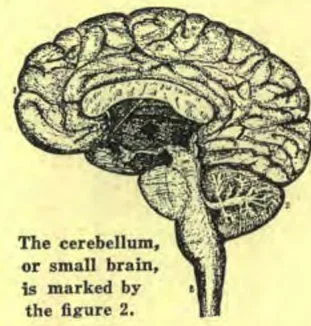
The cerebellum, or small brain, is marked by the figure 2.
In the lower back part of the head is a small brain called the cerebellum, or control brain. This little brain directs the body’s movements, and keeps it balanced when standing or running. When a boy rides a bicycle, he does not continually think about balancing himself. The little brain attends to the balancing for him. For the same reason a cat needs not to think of maintaining her equilibrium as she leaps to catch a mouse. The cerebellum controls the eye movements, seeing that both sight organs move together.
This ability of the eyes to move together is called coördination. It is most interesting to notice them moving synchronously, as quickly sometimes as shuttles, when your fellow passenger on the train is looking at near objects as the train speeds along. Now if any outside force comes into play, or any loss of control comes in to interfere with a free and natural motor control on the part of the cerebellum, the eyes are thrown out of coördination, and as a consequence, two separate images are pictured in the brain, and we see “double.”
An interesting experiment producing a temporary incoördination is made by gently applying pressure with the finger upon one eyeball when both eyes are open and looking at some small object. Owing to the dislocation, a double picture of the object now comes to view. You have produced a local condition identical with that produced by alcohol when used excessively.
When alcohol is freely taken, the control brain is put to sleep, and partial control of the eye muscles is lost, allowing the muscle to pull the balls to one side at different angles from the median line, when, if the incoördinated eyes attempt to see anything, they see it “double.”
So now you see how it is that a man can see two hats when he drinks the whisky for his cold. It is apparent, also, why it is perilous to be on board a ship plying in rock-bound and narrow channels, when the captain is under the influence of liquor. Looking at the needle of his compass, he may see two needles, and may not know which one to trust for guidance, and, while deciding, his ship goes onto the rocks.
Yes, it is a serious thing to see two things when you should see but one; and wise men and boys steer clear of any habit that makes one lose control over the special senses in times of danger.
EDMUND C. JAEGER.
Promotes Wife Beating
ONE morning in an Eastern city four cases of wife beating were considered in the police court. Three of the offenders were fined $200 and costs, while the fourth had to pay $500 and costs. All these cases were due to excessive drinking. At the noon hour the judge who tried them was heard to remark, “Drink is certainly the cause of much trouble.” Every one knows that liquor causes men to beat their wives and children. No one ever casts a vote for the saloon but knows that some patron of that saloon will go home and beat his wife.
Then why should it be regarded a crime for a Montana saloon keeper to advertise his wares as possessing superior power to accomplish this end? His advertisement read: “If you take three drinks of Famo whisky and do not beat your wife, you are a coward.” For this frank statement the liquor dealer was refused his license. Of course this confession looks bad in print, but why should the mere statement of the fact be a cause for closing a saloon, when the fact itself was not questioned nor regarded as cause for closing?
Close the saloon of the man who tells the truth, if you will; but do not allow a man to keep his open just because he is silent about the virtues (?) of the liquor he dispenses.
The Prohibition States
The Prohibition States are, Alabama, Arizona, Arkansas, Colorado, Georgia, Idaho, Iowa, Kansas, Maine, Michigan, Mississippi, Montana, Nebraska, North Carolina, South Carolina, North Dakota, South Dakota, Oklahoma, Oregon, Tennessee, Virginia, West Virginia, Washington; and Utah and Florida have dry governors and legislatures.
Heredity, Health, and the Drunkard's Child
“How much Baby Flo looks like papa, auntie! What makes children look so much like their own people?”
“Why shouldn’t they, Fred? The little oak tree looks like the father oak; the baby fern like the mother fern; and Spotty’s calf just like her. It is a part of our heavenly Father’s plan for all his created beings. The little Eskimo is never like the white baby. It has the characteristics of its parents. The baby vine climbs over the trellis just as did the mother vine. The baby swan sails over the surface of the lake just as gracefully as the parents; but biddy’s chicks show no ability in that line. Why not?—It is all a part of the law of heredity—God’s own handwriting—that the baby shall look and act like its ancestors; that it shall be strong and healthy like its father and mother; or weak and sickly like them.”
Baby Flo
“I should think, auntie, fathers and mothers would be very careful, then, to keep well; for everybody feels sorry for a sick child, like old John’s Bessie, down by the mill.”
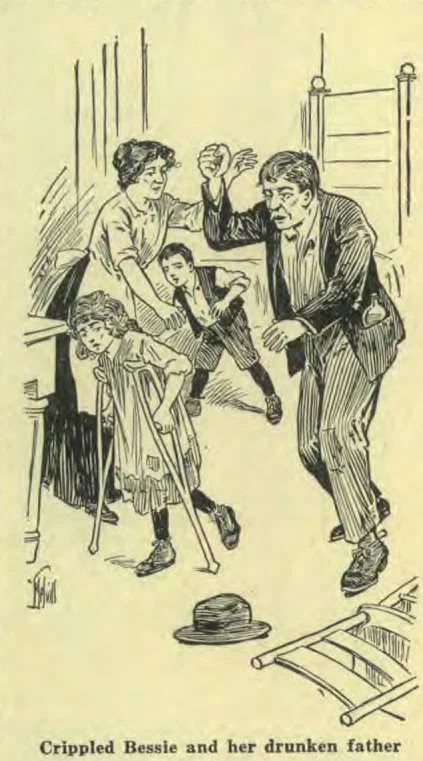
“Yes, I should think so, too. Without doubt little Bessie is sickly and crippled simply because her father is a drunkard. It is a fact, Fred, that the drunkard’s child is more likely than not to be mentally defective, crippled in body, epileptic, tuberculous, or insane. Some of our learned men have proved this to be true.”
“Prof. Charles R. Stockard, of the Cornell University Medical School, New York City, thought that he might learn, from experimenting on guinea pigs, how intemperance on the part of parents would be likely to affect human babies. So he secured sound, healthy pigs, and divided them into two lots. One lot he fed as guinea pigs are usually fed; for the other lot he mixed small quantities of alcohol with the daily food. He did not give them enough to make them drunk. They were never intoxicated, though at times they appeared excited.”
“After a time baby guinea pigs were born to both the temperate and the drinking pigs. Seventeen young were born to the parents that had been fed no alcohol. All these lived and were as chubby, roly-poly pigs as any one would wish for. They were perfectly healthy and normal, just the kind of pigs a self-respecting guinea pig mother would desire.”
“But how about those that had drinking fathers but whose mothers were teetotalers? Of the nineteen baby pigs that came to these, seven were dead when they were born, and seven died soon afterward. The seven that died were epileptic, every one dying in a fit. The five that lived were runts, shy and excitable. Where the mother was fed alcohol and the father was a total abstainer, as every father should be, only two pigs out of sixty-five lived; where both parents had been fed alcohol, only one pig out of fourteen litters lived, and this one died in a fit a week after birth. Since the guinea pig’s general physical nature is much the same as that of man, Professor Stockard’s experiments seem to prove conclusively that parents who drink alcohol are likely to cause great harm to their children.”
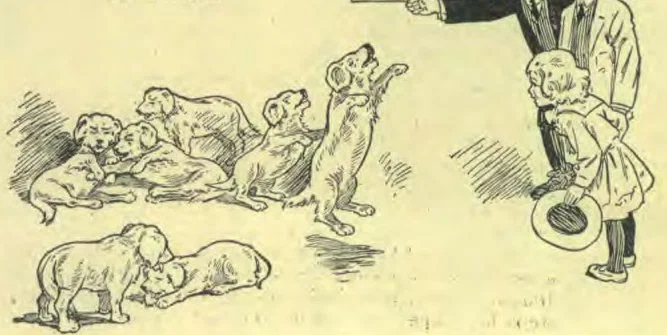
“Another college professor, Dr. Hodge, of Clark University, Worcester, Mass., came to the same conclusion as to the effect of alcohol, from experiments he performed upon seven little black spaniels, the most intelligent breed of dogs to be found in America. Five of the seven, Bum, Tipsy, Frisky, Winnie, and Berry, were given alcoholic drinks with their food. Only Nig and Topsy were total abstainers. Dr. Hodge allowed the school children to come to see his dogs. Nig and Topsy were always ready for a frolic, and would run for hours after balls thrown for them, and were delighted to jump over sticks held several feet from the ground. But Bum and Tipsy were logy, and after a few turns were ready to lie down.”
“From a little machine that Dr. Hodge fastened to the collar of each dog, it was found that the alcoholized dogs did only about half as much running as the temperance dogs, though when first chosen for the alcohol treatment, they were more active than the other dogs. They finally grew to be so ill-natured that the children confined their favors to Nig and Topsy.”
“At one time there was a disease from which many of the dogs in the city suffered. Bum, Tipsy, Frisky, and Winnie came down with it first, and were much sicker than the temperance dogs, which had the disease very mildly. Winnie died of it, and Bum and Tipsy were so sick that for more than two weeks Professor Hodge thought they would not live. For several days both dogs were blind, and they grew exceedingly thin. Tipsy was ever after blind in one eye. Dr. Hodge says that both Bum and Tipsy were as ill as they could possibly be and live, while the dogs that took no alcohol were made simply uncomfortable for a few days. So, naturally, Dr. Hodge concluded that dogs that have alcohol in their food get sick more easily, and stay sick longer, and suffer more, than dogs that do not have it.”
“Bum and Tipsy had several babies born to them; a few of the babies grew up, but never seemed particularly bright. They were not quick to learn tricks, and they made little fuss even when rats ran right over their noses. They were cowards, too. When their master spoke sternly to them, they would howl and yelp so loudly that people passing by thought the poor dogs were being mistreated, although they were always treated most kindly.”
“The other children of Bum and Tipsy were deformed, or for some other reason could not live. In the course of time, when other puppies came, Mrs. Tipsy actually forgot to feed the little creatures when she should, but instead went off by herself where the crying of the hungry babies could not disturb her. Bum, too, was not a very kind parent, for he frequently snapped and snarled when the little fellows begged him to play with them.”
“The temperance family, however, flourished. Nig and Topsy proved excellent parents, and practically all their children were healthy, hearty puppies, which, when they were old enough, were readily sold at good prices.”
Drink Liable to Ruin the Baby
“Men have also studied the history of alcoholic human families sufficiently to feel certain that alcohol affects the human child as unfavorably as it does the progeny of the lower animals. It is claimed that a baby is made up of its ancestry, one half being contributed by the parents and the other half by its grandparents and great-grandparents. Yet if one of these ancestors has a dominant characteristic, that is, is a great musician, artist, or a criminal or drunkard, this leading characteristic may usurp the proportion that belongs to some other, and the child be affected by this dominant characteristic. He may, for instance, inherit the taste for drink, or be a cripple, epileptic, or defective, as the result of a grandfather’s intemperate life. When you look upon a blind, idiotic, or feeble-minded child, you may know that his trouble has more than likely been caused by alcohol drinking on the part of some of his ancestors.”
Crippled Bessie and her drunken father
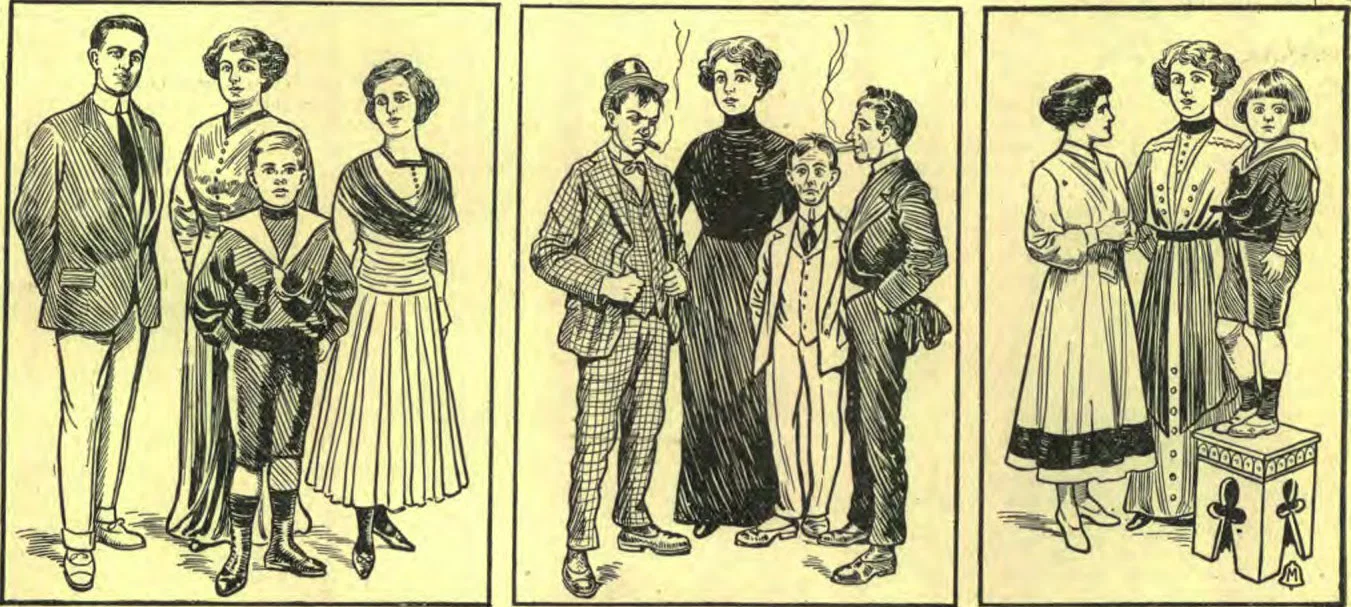
“In Bavaria, the greatest beer-drinking country on earth, three hundred out of every one thousand children are born dead. When Sweden was a great drinking country, two hundred out of every one thousand babies died before two years of age. Now only eighty die. If you will study the illustration on the following page, you will see how seriously alcoholic parentage injures babies.”
“Dr. Norman Kerr cites a family in which were first born a son and a daughter. They were excellent specimens of vigorous humanity. After the birth of the daughter, the father fell to drinking heavily. After this, four more children were born, three of whom were complete idiots and the other was defective.”
Nig and Topsy were always ready for a frolic.
“Another eminent physician, Dr. Sullivan, reports a case in which the older children of a family were ordinary, normal human beings, while the younger ones were neurotic, impulsive, and distinctly degenerate. The mother had become a drunkard before the younger children were born.”},{
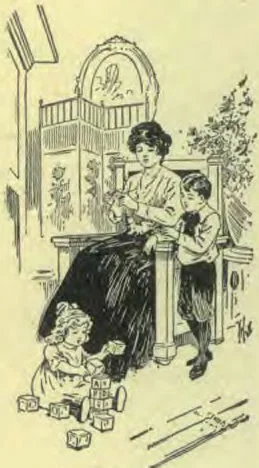
A baby is made up of its ancestry.
Like Father, Like Child
No. 1924’s Arraignment of the Traffic
It was in a great State penitentiary, when four hundred Christian Endeavorers were invited by the warden to conduct a service with as many inmates, that No. 1924, a Negro, gave the address of the day, which Mr. Daniel Poling claims is the best temperance speech he ever heard. Mr. Poling says of the speaker:—
“He was a college graduate, generous and handsome; but, falling into the unsparing hands of alcohol, he became a ready tool of women and men more evil than himself; and now he will be broken and old before the heavy doors of the penitentiary close behind him.”
Lifting himself to his full height, his refined black face alive in every muscle and nerve, the young man having previously referred to various evils that menace society, cried in a voice vibrant with indignation, remorse, and the hurt of a great wrong:—
“What is this thing worse than war, worse than slavery, worse than hate, this peril that has slain its tens of thousands and its millions; that affects chiefly the young, but does not leave the old immune from its evil influence; that robs of youthful vigor, undermines physical and mental powers; that makes those who should be the bulwark of the nation a millstone around the nation’s neck? Need I give you the name of this shadowy peril that hovers over us, this evil that is upon us, this plague that afflicts us? I think not; yet I will. It is the legalized liquor traffic.
“Why should I, an outcast, a human derelict, a member of the gray brotherhood of infamy, a convicted felon, stand and offer my feeble protest against that which the law allows?—Because I have felt its power, because I have seen at first hand the fruits of its business. I have seen our jails, prisons, and asylums crowded with its customers. I have seen homes made destitute and miserable, without coal or food in winter, their broken windows stuffed with dirty rags. Because I have seen husbands, fathers, and brothers incapacitated through the patronage of this business, robbed of their self-respect, broken in body and soul. Because I have seen children cursed into the world, and left hungry and helpless. Because I have seen the blue-eyed Caucasian, with all his nobility of character, forget himself, and the Negro, my people, otherwise honest and industrious, reduced to the level of the savage. And is this the end? If not, what is beyond the shadow? I have a vision of the distant future; I see two pictures; tell me not that they are only dreams.”
“The first is a picture of what may be expected if man’s inhumanity to man continues, if the ‘rule of gold’ continues to supplant the golden rule, if King Alcohol continues to play such an important part in the affairs of the State and nation. It is the picture of another Babylon, of another Alexandria, of another Rome.”
“But there is a fairer picture. There is light beyond the shadow, and in it I see a State and nation where there will be no drunkards staggering down foul-smelling streets to certain doom. I see a land with half its prison cells empty, a land whose cities will have no slums for humanity to decay in, a land where the songs of happy children will mingle in sweetest harmony with the songs of the birds. I see a land without a saloon, a nation without a drunkard.”
“For an instant the orator hesitated. He must have remembered his gray suit and the felon mark that was on him, for the light died out of his eyes; but his voice was still the voice of a prophet as with perfect enunciation and with all the vocal richness that is characteristic of his race, he recited these lines:—
“Unanswered yet! Faith cannot be unanswered;
Her feet are firmly planted on the Rock.
Amid the wildest storms she stands undaunted,
Nor quails beneath the loudest thunder shock.
She knows Omnipotence has heard her prayer,
And cries, ‘It shall be done, sometime, somewhere.’”