The Youth’s Instructor, Vol. 43, No. 2.

NAZARETH

The Youth’s Instructor

Jan 10, 1895

S. D. A. Publishing Association · Battle Creek, Mich. · Jan 10, 1895

NAZARETH
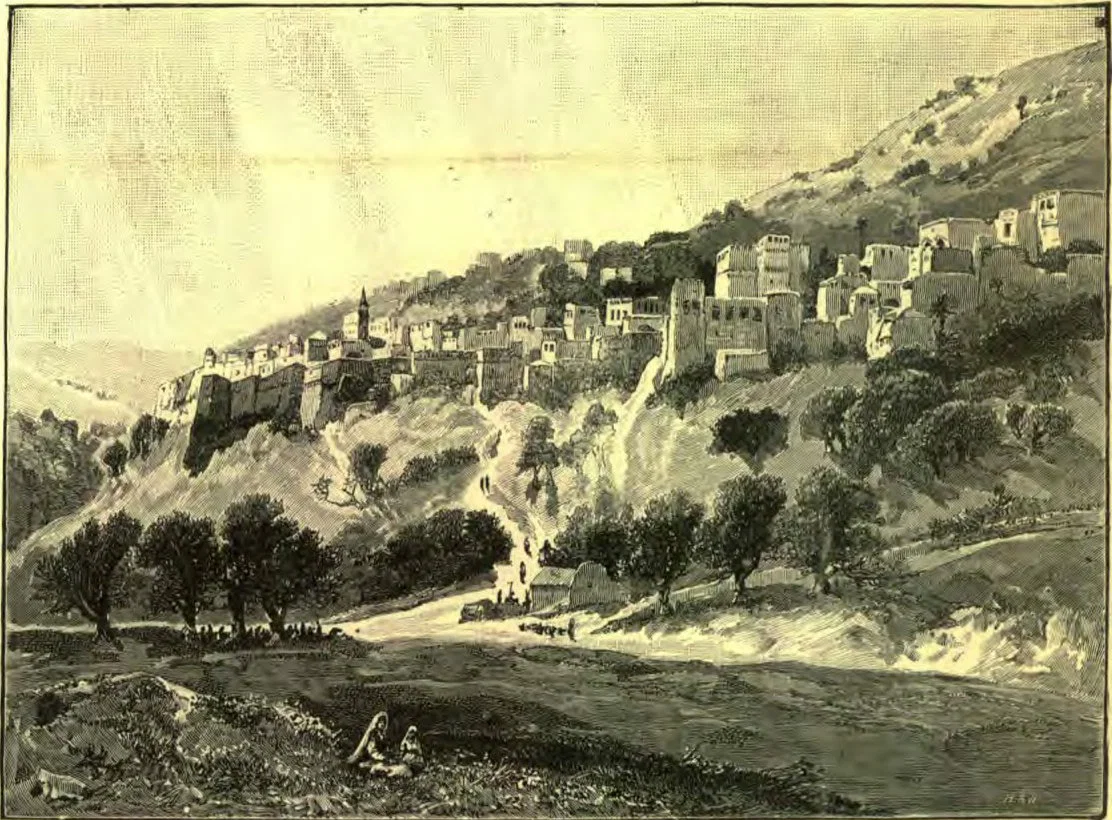
Now the Arabic En-Nasirah is a little country-town of lower Galilee which owes the constant attention given it solely to the circumstance that it was the home of the blessed Saviour, for a number of years. Neither the Old Testament nor the great Jewish historian Josephus makes mention of the place. According to the brief allusions made to it in the New Testament, the people of Nazareth were not susceptible to religious reform, but fanatics who, by reason of their general ignorance and coarseness, were held in contempt among the more cultured Jews. The appellation “Nazarene” was given to the Saviour very likely by his enemies, with evil intent. In Syria the first Christians were likewise derisively named thus after what was then only a Galilean village; and among the Arabs the term “Nasrani” (plural, Nasara) was universally applied to Christians. Quite early in the present dispensation Nazareth became a place of some note, for Jerome, in the fourth century, found already a stately church edifice erected over the spot called Ava Maria; and Arculphus, about 700 A. D., speaks of a second church on the supposed spot of Mary’s home.
NAZARETH.
NAZARETH.
The Crusaders made Nazareth an archbishopric, transferring the see of Bethshean (Scythopolis) to Nazareth. At present the town has probably twelve thousand inhabitants, ten thousand of whom profess Christianity. Among these are found Greek and Roman Catholics (Melchites and Maronites), Protestants, etc.
As to the natural environments of Nazareth, we quote from a learned visitor to the place:—“It lies in a narrow, oblong basin running nearly east and west, about a mile long, and having an average breadth of something less than a quarter of a mile. A girdle of rounded hills encircles it, shutting out all view of the world beyond, and giving that air of quiet, peaceful seclusion which constitutes its chief charm, and its peculiar adaptation to the early history of our Lord. The narrow, rugged glens that branch off in all directions among the hills seem as if made for meditation. The hill on the northwest of the vale overtops all the others, rising to a height of some four hundred feet above the village, and is crowned by a wide-domed tomb. Its side is steep, furrowed by ravines, and broken by ledges of bare rock. On its lower declivities, partly in the ravines, partly on the shelving base, and partly on the sides and tops of the rugged ledges, stand the houses of Nazareth—plain, neat, substantial stone buildings. This is the hill on which the evangelist tells us ‘their city was built’ (Luke 4:29); and there is more than one cliff along its side that might have served the purposes of the fanatical populace when they led him unto a brow of the hill, that they might cast him down headlong. That the brow was in the near vicinity of the village, is plain from the evangelist’s words. Hence appears the absurdity of the monkish legend which places it on the so-called Mount of Precipitation, a hill about two miles southeast of the town, for no better reason, apparently, than that it is a striking object as seen from the plain of Esdraelon. Under the grand altar of the Latin convent is the grotto where, according to the legend, the Virgin Mary once lived and received the salutation of the angel Gabriel. This is the Latin Church of the Annunciation. But the Greeks have their Church of the Annunciation by the side of the one fountain of Nazareth, a short distance east of the village. Legends like these are of no authority. From the crest of the western hill above Nazareth, where stands the Wely—saint’s tomb—of Neby Ismail, is one of the noblest prospects in all Palestine, very similar to that from the top of Tabor.”
There is no place in all the world which has been privileged as highly as Nazareth; for after the return of the child Jesus with his parents from Egypt, he dwelt there, year after year, until he entered upon his public ministry. And yet, in spite of the presence of the Son of God for so long a time among them, the people were ready to stone him upon the very first occasion on which he gave evidence of his divine power and mission. They seemed to be unwilling to accept anything whatever from him; and apparently the only public recognition given him on their account was the stigma “Nazarene,” a synonym for a low and contemptible person. A. K.

ONE MORE YEAR.

One more year; O year Sublime! Dare we trust to future years, Mourning o'er our squandered time, The crisis of this world so near?
Lo! the signs fast passing, strange, Traced by pen of prophets old, Daily teach with sudden change, The soon coming of the Lord!
Hark! the earth quakes, shake the skies; Soon the plagues will be outpoured! Then we'll hear the nations' cries, See the famine for the word:
Now is earth's extremest need, Saving truths the times afford; Who will go and scatter seed For the harvest of the Lord?
Speak the truth, be not afraid; Slight no warning in God's word; Christ as priest though still arrayed, Soon will smite with judgment's sword.
Warn with instant, grace-born sway; Preach the promise deep and broad,— Soon comes, as he went away, Jesus as our King and Lord!
Stand with courage, faith, and trust; Tremble not as others may; Though we mingle with the dust, He will call us in that day!
Herald Jesus, near and far; Cry aloud: Forsake all sin; Christ with clouds through gates ajar Comes his sheaves to garner in.
T. J. ALLEN.

HOW PRINTING-TYPES ARE MADE.

In the earliest days of the art, printers made their own type; but in the fulness of time the type-founder took his place in the ranks of manufacturers. In making type, as in other trades, the first tools and materials were crude and but poorly fitted for the purposes for which they were designed. The type was cast by hand, and one letter at a time, and the processes naturally were slow and tedious.
AN OLD-TIME TYPE-CASTER.
The fac simile engraving shown herewith, the original of which was given by Jost Amman, in the “Book of Trades,” published in Germany in the year 1564, shows an old-time founder at work, with his mold inclosed in a wooden box and held in one hand, while with the other he pours in the melted metal. The modern processes for making type were shown in the last number of the INSTRUCTOR.
The first attempt at casting type in the United States was made at Germantown, Penn., by Christopher Sauer, or Sower, about 1735. He cast the types for a German Bible, which he himself printed. The anvil on which Mr. Sauer forged his matrices is still to be seen at Germantown. The one object of this gentleman seems to have been to cheapen the printing of Bibles, so that his countrymen might have them at a low rate. An unsuccessful attempt was made to establish the business at Boston, about 1768, by a Scotchman named Mitchelson. He made very good type, but his business did not succeed.
One Abel Buell soon after began the business at Killingworth, Conn., and he was granted a loan of money by the Colonial General Assembly to aid him in his designs. Mr. Buell was an ingenious gold- and silversmith, and for a foundry made use of a meeting-house in New Haven.
Doctor Benjamin Franklin, in the year 1775, brought with him from Europe the materials for a complete type foundry, which he fitted up in Philadelphia for the use of his grandson.
At the close of the American Revolution, John Baine, of Edinburgh, Scotland, came to this country, and conducted the business until his death in 1790. At the close of the last century Messrs. Binney and Ronaldson successfully established themselves at Philadelphia, and from that date type-founding has been reckoned among the industries of this country.
At the present time there are about fifty type foundries in the United States, and it is no exaggeration to say that they excel those of every other nation in the extent of their operation and the excellence of their products; for in no other country can there be found so beautiful and so great a variety of printing-types as are made here.
There are very extensive type foundries in New York, Boston, Philadelphia, Buffalo, Cleveland, Cincinnati, Chicago, Milwaukee, St. Louis, and San Francisco, besides those of lesser importance in many other places.
The printer’s profession itself is called the “Art Preservative,” and certainly type-founding is its noble handmaid. G. W. A.

THE SEVEN WONDERS OF THE WORLD.

PART I. — THE TEMPLE OF DIANA.

The ancient city of Ephesus, so well known in Biblical lore, was an Ionic city of Lydia in Asia Minor. It rested on an alluvial plain, and was not far from the mouth of the Caystrus River. Its origin is enshrouded somewhat in the mists of antiquity, but it seems to have been esteemed as a sacred city from an early date. After it came into the possession of the Romans, it was “the greatest place of trade of all the cities of Asia west of the Taurus.” The apostle Paul here took up his residence for three years, and here, according to Acts 19, he encountered the fierce wrath of the pagan world. The Greeks and Romans both worshiped the goddess Diana, and when Christ was presented to the people as the true object of worship, and man-made idols and the whole system of idolatry were denounced by the fearless, brave-hearted apostle, “a certain man . . . which made silver shrines for Diana,” said: “Ye see and hear, that not alone at Ephesus, but almost throughout all Asia, this Paul hath persuaded and turned away much people, saying that they be no gods, which are made with hands: so that not only this our craft is in danger to be set at naught; but also that the temple of the great goddess Diana should be despised, and her magnificence should be destroyed, whom all Asia and the world worshipeth. And when they heard these sayings, they were full of wrath, and cried out, saying, Great is Diana of the Ephesians.”
The Diana of the Romans corresponds to the Artemis of the Greeks. Both nations worshiped her as a goddess capable of destroying and of saving from destruction. Splendid rites accompanied her worship in various places, and even human sacrifices were sometimes offered to her. The Lacedæmonian youth are said to have been scourged publicly before her statue at Sparta.
The famous temple of Diana, known in history as one of the seven wonders of the world, was to the pagans the glory of Ephesus. It arose from successive misfortunes, the Persians, the Macedonians, and the Romans in their order adding to its splendor and magnificence. The chief architect was Chersiphron, who began the work about 600 B. C., which required, according to Pliny, two hundred and twenty years. Its first glory, however, was of short duration; for it was burned by one Herostratus, with no other purpose than the immortalizing of his own name; and so it is said, “The aspiring youth who fired the Ephesian dome, out-lives in fame the pious fool who built it.” His destructive work is said to have been accomplished on the night of Alexander’s birth, 356 B. C. But from its moldering ruins arose a still more magnificent edifice, owing to the enthusiasm of the states of Asia Minor, even the women contributing their ornaments to aid in the enterprise. “Having risen with increasing splendor from seven repeated misfortunes,” it “was finally burnt by the Goths in their third naval invasion.”
Good authorities vary somewhat in their descriptions of this magnificent edifice which “the arts of Greece and the wealth of Asia had conspired to erect.” It was built of white marble, the Ionic style being employed in its architectural design, and was the largest Greek temple ever erected. Its length was about four hundred and twenty-five feet, its breadth two hundred and twenty-five feet, and more than one hundred and twenty-five marble columns supported it, thirty-five of which were carved. These columns were the gifts of devoted kings. They were sixty feet high, and each weighed one hundred and fifty tons. The marble blocks of the architrave were thirty feet long. The building was enriched with many costly statues and pictures executed by the best masters of Grecian art. The famous sculptor Praxiteles displayed his skill in the difficult adornments of the altar, seemingly having selected for his portrayal some of the favorite legends, including “the concealment of Apollo after the slaughter of the Cyclops,” and “the clemency of Bacchus to the vanquished Amazons.”
Were one to visit to-day the site of the ancient city of Ephesus, he would find nothing remaining of her former glory and magnificence. As it has been said of Rome, so it may be said of this city: It “has fallen; ye see it lying heaped in distinguished ruin.” Miserable villages now occupy the place, and over the ruins of the temple of Diana are ruins of other massive buildings which succeeded it.
“The moldering marble lasts its day, Yet falls at length a useless fane; To ruin’s ruthless pangs a prey, The wrecks of pillared pride remain.”
MRS. M. A. LOPER.

Electricity in China.

THE streets are very narrow in Canton, as is the case with all Chinese cities, being from, say six to twelve feet wide, and are filled with hanging wooden signs. Through these signs the wire must twist and turn, because on no account would a Chinaman allow a sign to be moved to make room for the wire, as it would certainly mean bad luck to his business. In many cases the insulation has been strongly reinforced with rubber and tape, to prevent abrasion from the swinging signs.
The streets of Canton are divided into sections of a few blocks each, and each section is shut off from all others by heavy gates, that are closed at nine o’clock in the evening. The populace is so turbulent that for many centuries the authorities have made it a practice to hold all the people of any section responsible for any riot or tumult in that section. The result is that the people have got in the habit of regulating affairs in their section without any reference to the powers that be. The electrician of the Canton plant had occasion to see the effect of this in an instance where a store wanted lights, but the wires could not be run, because one man objected to having a hole cut in his house for securing a pole. The man wanting lights informed his neighbors, and a delegation waited on the individual, and soon induced him to withdraw his objection.
At first there was considerable objection to the plant being put up, but now it has become very popular, and is used in houses and stores; even fruit and nut stands use electricity in the street, the wires being led from the nearest house. The light is now so popular that thousands of lamps could be put in all over the city if the station was large enough to supply them; but its limit is now reached, and difficulty is experienced in building a larger one, as the franchise for the entire Canton province is in the hands of one man, and he wants to make too much out of it.
The Chinese are great people to expect private commissions on everything they have a hand in, and the management of the company, one and all, manage to steal something. One man, who has the handling of the money, will hold back needed supplies and wages; another, less fortunate, will go to the station and steal coal and oil; and if there is any objection, the engineer is told it is none of his affair.
In fact, though the plant is a success from an electrical and mechanical point of view, it is kept running under considerable difficulty. In Canton two attempts were made to steal the street wires soon after the station was started, but, unfortunately for the thieves, the wires were alive, and though no one was killed, no attempts have since been made,—inhabited by a bad Joss, as they are now thought to be.— Electrical World.

ANTIQUITY OF OUR CALENDAR.

Our year, as we now reckon it, is of Egyptian origin. So far as history reaches back into the darkness of the early ages, we are led to believe that the dusky brown people by the banks of the Nile were the first to study the motions of the sun and stars, and make them the measure of time. And some recent discoveries in Egypt, by careful students, seem to show that the early astronomers were enabled to count the days in the solar year. The great temples on the Nile were built with a long entrance of columns leading from the river to the interior shrine—a kind of tunnel; sometimes it was lined with sphinxes, or huge granite figures. Its mouth was turned toward a certain part of the heavens where the light of the setting sun could enter it only once a year. It was either at the summer solstice, when the sun was farthest in the north, or at some other periodic position of sun or star.
We may imagine the Egyptian astronomer watching in the inner shrine for the opening of the new year. The long line of columns served as a telescope by which he could catch the first beam of the setting sun. Suddenly the red light would flash through the tunnel up to the holy of holies; the moment it reached the shrine, the philosopher would mark the hour, and know that another year had begun.
Other nations, and even the Greeks and Romans, used the moon as their guide, and divided the year into lunar months. But it was found, as time passed on, that great irregularities crept in; the months no longer corresponded to the seasons; April became June, and the autumn months winter. The Egyptian sun-year was then generally adopted. But even this was disordered and altered by the ignorance of the Roman priests; and at last Julius Cæsar, who was fond of astronomy, resolved to correct the calendar. It is his year that we now use, and to his friend, the Egyptian Sosigenes, we owe our division of time.—Our Youth’s Friend.

THE GERMAN EMPEROR.

The attitude of the German emperor is one of the interesting features of the present time. That he is animated with a soaring ambition, there is no doubt; and that personal aggrandizement is the prevailing element in that ambition, is equally evident. He is jealous for Germany, very jealous for royalty, and exceedingly jealous for William II. This trait of his character, developed like a pyramid standing on its apex, is not altogether good for the prosperity of his realm or the comfort of his subjects; and it is anomalous to the spirit of our times, when democratic ideas form the all-absorbing sentiment of the people, and democratic principles are the ideal of politics.
That man is truly great who sinks his personality in his devotion to duty. William has a good sense of duty, but a keener sense of his own person; and slights to his dignity seem to constitute the highest possible crime in his eyes. As rulers, men are entitled to the respect and honor that pertain to their position as representatives of the law. But as individuals, one man is as much of a man as another, personal character being equal; for it is character, not money or power, that makes the man.
Socialism in Germany resents these ultra-aristocratic notions of the emperor. At the recent meeting of the Reichstag a few of the Socialistic members remained seated when the rest of the house arose to cheer the emperor’s name. Instead of passing this matter over in the manner that largeness of heart would suggest, the Kaiser demands that these members shall be given over to the courts to be punished for insulting his person. It is the law that this can be done only by the Reichstag itself, and by its own voluntary action, not at the command of the king. Every freeman on earth will be glad to know that by an overwhelming majority the Reichstag refused to do anything of the kind.
His public utterances have always been full of the spirit of autocratic domination, and this has to a great extent been imitated by his sub-princes; and it is no wonder that the liberty-loving people begin to feel somewhat restive under this petty despotism.
In his relations to other powers, William is no more felicitous than with his own subjects. He arrogantly expects England and Russia to attend to his wishes; and when they become more friendly with each other than he desires, he withdraws to pout out his displeasure. Other countries have interests, but it displeases him that they should consider them before his. His commercial policy toward this country in excluding American grain and meat, now threatens to awaken retaliation; and a commercial war is second only to a military war.
In the meantime, if we can read straight from this distance, Germany is not developing the internal strength that France and Russia are developing. It may be questioned whether she is maintaining her high prestige. Her finances show signs of weakening; her people are not united; her leaders entertain mutual jealousies. In view of these things, it would seem to behoove the young man who stands at the head of the German state to think more closely for his people and country, and less of himself. G. C. TENNEY.

THE LAST GREAT DISCOVERY AT MT. SINAI.

The text of one of the very oldest Syriac versions of the Gospels, found two years ago by Mrs. Agnes S. Lewis, an English lady who was permitted to search the manuscripts in the Greek Monastery at Mt. Sinai, has just been issued by the English press. The original is an old palimpsest, on which, under a later text, is found, half effaced, the very ancient Syriac text.
According to the examinations of the most learned experts in that line, the text is a translation of nearly the whole of the four Gospels, in Syriac, made about 150 A. D. In character it is most nearly allied to three of the most ancient and best Greek manuscripts.
In speaking of this version, the New York Independent says:—
“We are sure that this discovery will be hailed as the most important of the century in its line since the discovery of the other famous Vatican manuscript by Tischendorf in the same monastery, and that it will be most carefully studied by students. But its chief value will be found in the fact that it is a new and most important testimony to the existence of the four Gospels in their present form at a time when many critics have declared that they were not yet written, and that they then were accepted as of canonical authority.”

BARON SOLL’S DISCOVERIES.

BARON SOLL’S expedition in 1893 to arctic Siberia and the New Siberian Islands, has proved to be one of the most successful explorations of recent years. The results of the expedition include over three thousand miles of survey, based upon thirty-eight positions astronomically determined, some nine months of meteorological observations in the tundras [steppes], in a series of important measurements of elevation above the sea along the whole route, many interesting photographs, and rich collections of botanical, zoological, and ethnological specimens. In the New Siberian Islands Baron Soll found under the permanent ice a sedimentary deposit containing pieces of bones of mammoths and other post-tertiary mammals, and complete trees fifteen feet long, with leaves and cones.
This is conclusive proof that when the mammoth wandered over Europe and Asia, trees and vegetation reached to the seventy-fourth degree of latitude, thus making its northern limit at least two hundred miles north of its present boundary line. The discoveries include much of interest to geologists concerning the position of Siberian glaciers, and the many varieties of fossils to be found beneath them.
The achievements of this expedition prove that the most desolate regions of ice and snow are fertile fields of study to the intelligent investigator.—Scientific American.

HABITS

Habits, good or bad, cling to us. It was a blustering winter morning when Allen resolutely buttoned his overcoat up to his chin, and drew on his fleecy gloves.
“You’re not going to church such a morning as this, Allen?” said a brother student.
“To be sure I am,” said the other, most decidedly. “I was brought up to attend church, and I should as soon think of going without my breakfast as of staying at home.”
It is one of the best habits a youth can form, and a great safeguard amid the temptations of a city, to attend the house of God.—Selected.

“YET A LITTLE WHILE.”

“Yet a little while is the light with you.”
This was the Saviour’s argument to the Jews, who were resisting all his efforts to reflect upon them the light of the Sun of Righteousness. This is the warning we would give to you who claim to believe the truth! “Yet a little while is the light with you.” We would ask you to consider the shortness of human life, how swiftly time is passing. Golden opportunities and privileges are within our reach. The plenteous, abundant mercy of God is waiting your demand upon its richest treasures. The Saviour is waiting to dispense his blessing freely, and the only question is, Will you accept them? The rich provisions have been made, and light is shining in a variety of ways; but this light will lose its preciousness to those who do not appreciate it, who do not accept and respond to it, or, having received it, do not pass the light along to others.
Your life, your soul, your strength, your capabilities, your powers of mind and body, are to be regarded by you as intrusted capital to be improved for your Lord during the period of your life. You are to stand in your allotted order in God’s great army, to work out his plan in saving your own soul and the souls of others. This you may do by living a consistent Christian life, by putting forth earnest efforts, by learning in the school of Christ his ways, his purposes, and subordinating your will and ways to the will and way of Christ.
Will not all those who claim to be the children of God consider the words of the great Teacher? His words are not mysterious and hard to be understood. When the disciples thought them hard to be understood, they made it evident that they were not united to Christ as the branch is united to the living vine. They did not have true discernment. They misunderstood the words of Christ. That which was plain to those who had true faith, became a stumbling-block to those who lacked spiritual discernment. They were offended because he spoke words to them that the natural heart could not comprehend and receive, and they refused to walk any more with Jesus.
Are there not among the believers some who love the world and whose affections are so absorbed in their relatives and friends who obey not the truth, that they are confused in mind, and through the temptations of Satan take their stand on his side, instead of on the Lord’s side? The love of God for fallen men is without a parallel. Christ declares: “Whoso eateth my flesh, and drinketh my blood, hath eternal life; and I will raise him up at the last day. For my flesh is meat indeed, and my blood is drink indeed. He that eateth my flesh, and drinketh my blood, dwelleth in me, and I in him.” These were the words over which some of the disciples stumbled, but Jesus removed everything that might constitute a stumbling-block, and said to them: “Doth this offend you? What and if ye shall see the Son of man ascend up where he was before? It is the Spirit that quickeneth; the flesh profiteth nothing: the words that I speak unto you, they are spirit, and they are life.” It is the word of God abiding in the heart that will quicken the spiritual faculties.
We wish to impress upon our people who claim to believe the truth for this time that they need to heed the counsel of the True Witness, who represents their state as spiritually fallen, and calls upon them in decided language to repent and to return to their first love. Who is our first love?—The world’s Redeemer is our first love, and must ever remain our first love. The Christian is to live a life distinctly different from that of the worldling. The worldling lives a cheap quality of life. He consents not to spiritual life. It is he who has the love of God that has life; it is he whose hope is centered, not in this world, but in Christ, the great center.
Jesus has loved men, and has made every provision that the blood-bought soul shall have a new birth, a new life derived from his own life, as the branch derives its life from the parent stock. “He that hath the Son hath life; and he that hath not the Son of God hath not life.” Those who believe in Christ derive their motive power and the texture of their characters from him in whom they believe. “Examine yourselves, whether ye be in the faith; prove your own selves. Know ye not your own selves, how that Jesus Christ is in you, except ye be reprobates?” “Know ye not that your bodies are the members of Christ? . . . What? know ye not that your body is the temple of the Holy Ghost which is in you, which ye have of God, and ye are not your own? For ye are bought with a price: therefore glorify God in your body, and in your spirit, which are God’s.”
Our position is plainly marked out. The endowment which we have of God is plainly described, and our accountability and duty are plainly stated. The declaration of Christ is given in language not to be misunderstood: “Except ye eat the flesh of the Son of man, and drink his blood, ye have no life in you.”
MRS. E. G. WHITE.

1895: New Year Consecration Poem

1895.

ONCE more the glass of Time is turned By January's hand, And downward flow the tiny grains Of slowly falling sand.
To ninety-four we've said farewell— May all his good survive!— We've welcomed in the glad New Year Of eighteen ninety-five!
This new year, Lord, thou givest me, I fully consecrate to thee, To walk in all thy ways. My hands fill with thy service blest; Give thou my heart sweet peace and rest; My life fill with thy praise.

I Thought on My Ways: A New Year Reflection

“I THOUGHT on my ways.” Ps. 119: 59.— Any reliable Hebrew scholar could tell us that when we take the root meaning of these words, we find the idea of a weaver working at his loom connected with it. That is the figure which lies deep beneath this word—the figure of a man working skilfully at his web, looking to his garment, that he may not be ashamed whatever side be exposed to view, careful that on both sides his workmanship is faultless.
“I thought on my ways.” Dr. Whyte paraphrases the text thus: “I turned my life upside down, round about, looked at it from all points of view, as a weaver with his web, so as to have no seamy side, but that it might be equally perfect in its workmanship in all its parts. And when I saw I was wrong, I turned my feet unto God’s testimonies.”
How appropriate for every one of us is this text at the beginning of the new year. Let us indeed most thoughtfully consider our ways, and make sure that our way is God’s way, too.

NEW YEAR’S REFLECTIONS.

See the great waves coming,—sweeping up the beach, and then retreating; and yet every dash comes up farther, till at last the great tide is in, covering up miles of sand, and filling up the great rivers with a sparkling flood. As we gaze, we ponder and say, “What is the cause, and where is the beginning of all this?”
We know the beginning is the far-off southern seas; the cause, the gentle moon that rules the night, which silently draws the waters after her, and confers an inestimable boon upon nations and men. Compare the silent beginning with the wondrous end. How different! How marvelous! How full of food for thought for thoughtful minds! God’s holy word gives us examples of such things, for our comfort and encouragement.
It shows us the beginning of the world, and then portrays the lives of men and women like ourselves—people surrounded by temptations, feeble in heart, staggering, yea, even falling; and then it bursts into shouts of triumph, as it shows the glorious end of all who make God their refuge and strength.
God wishes us to see and consider the beginning and the end. People sometimes work themselves into states of enthusiasm, and begin wondrous works; but, forgetting the cost, the patient endurance, the end, they fail; or, forgetful of the end of their actions, they fall into gross sins.
Did Eve consider the awful result of her eating the forbidden fruit? or David, what his sin would end in? or did Sennacherib foresee the end of his pride? or Judas of his treachery? or Herod of his presumption?—the beginning forgotten, the present glossed over, the terrible results, the end, never thought of!
So it is still. Want of forethought ruins men. The drunkard begins, may be, as a boy, with his little tipple, the thief with his small dishonesty in early youth; the blasphemer starts with a careless oath, the murderer with a wicked thought. O that they had remembered that it was only a paraffin oil tin that took fire one night, but the end of it was an American city laid in ashes, and thousands made homeless; and sin is just the same: a little beginning and a gigantic end.
Habits and ways are begun in a mild form, and often at a tender age. The soul shrinks at first, and is shocked; but you need only to go on, and you will soon find that the sensitiveness becomes blunted, and, ere long, unthought-of wickedness can be done, and yet the now-calloused soul may sleep as quietly as an innocent child,—sleep on till the end comes, and then—God have mercy on that day on the awakening soul as it gazes in horror on itself and what it has become.
Consider then your beginnings, and while you do so, pray for God’s guidance, that you may see the end.—Adopted.

Make the Heart Right: The Citadel of Conversion

“THE carnal mind is enmity against God.” Rom. 8: 7.—Make the heart right, and all will be right. France in 1870 was divided into eighty-nine departments; yet when the Germans invaded France, they did not make war upon each of the eighty-nine departments, but struck first at the great military stronghold, and then right at the great center of French life—Paris.
So must the work of genuine conversion begin at the citadel and center of human life—the human heart. Hence the loving invitation of God through his Spirit: “My son [or my daughter], give me thine heart, and let thine eyes observe my ways.” Prov. 23: 26.
Continue reading: LESSON 4.—THE WORLDLY SANCTUARY (CONTINUED); ITS FURNITURE