The Youth’s Instructor, Vol. 33, No. 44.

THE MOTHER'S BLESSING
Earlier text: THE MOTHER'S BLESSING

BEE-HUNTING IN AUSTRALIA.

In Australia, the native adopts a very peculiar plan for discovering wild honey. He knows that bees never wander very far from home, seldom more than two miles; and he also knows that when a bee is laden with honey, it makes, as nearly as possible, a straight line for home. All that is necessary, then, is to find a bee that is well laden, and follow it. But that is more easily said than done. Any boy who has tried to follow the big and gay-colored bumble-bee to its nest knows how great a task it is. But that is a mere trifle to following the sober little honey-bee, which can be lost, like a dream, against a gray-colored hillside.
In order to be followed, the bee must have a distinguishing mark that can be easily seen, and with such a badge the Australian provides it. He gums a small tuft of white cotton to the bee’s back, and thus follows it with comparative ease.
But the question now comes up, how is the cotton to be put upon the bee’s back? The gum is quickly found—it is on almost any tree; the cotton grows right at hand. The bee, too, is found in almost any sweet flower, buried head first in the dusty pollen, drinking in the nectar, and showing quite plainly whether its honey-sac is full or empty. It moves a little in its eager haste to secure the delicious liquid, but perhaps a quick dab will fasten the cotton on its back. Do not try it. As the little boy told his mother, the bee is a very “quick kicker.”
Watch the Australian—and he is a very stupid fellow, too, in most things. He fills his mouth with water, has his snowy tuft of cotton ready gummed, finds his bee, gently drenches it with water spurted from his mouth, picks it up while it is still indignantly shaking itself free from the water which clogs its wings, and with a dextrous touch he affixes in an instant the tell-tale cotton.
Very much out of patience, no doubt, with the sudden and unexpected rain storm, the bee rubs off the tiny drops from its wings, tries them, rubs again, and soon—buzz! buzz! away it goes, unconsciously leading destruction and pillage to its happy home.—St. Nicholas for October.

THE "PONY EXPRESS."

For those of our young people who may have heard of the “Pony Express” and do not know its meaning, we give the benefit of an explanation furnished by a September issue of Golden Days, which is as follows:—
“The ‘Pony Express’ was established in April, 1860, as a part of a mail line between New York and San Francisco, by way of St. Joseph, Mo., and Sacramento. Between these two places the distance was traversed by fleet horsemen, each of whom rode sixty miles, the weight carried not exceeding ten pounds, and the charge being something like five dollars per quarter ounce, paid in gold. The riders received very large salaries, on account of the dangers attendant upon the business. The distance between New York and San Francisco was made in fourteen days. This enterprise lasted two years, being supplanted by the telegraph and railroad.”

SOMETHING ABOUT GUNPOWDER.

“As a matter of fact,” says a manufacturer of powder, “much more powder is burned in time of peace than in time of war. The average daily consumption of powder in the United States is one hundred tons. In a battle in which fifty thousand men fired forty rounds each, less than one quarter of an ordinary day’s quota of powder would be used. In the construction of the Hoosac Tunnel more powder was exploded than in the war of the Rebellion; and a single large coal mine will use almost as much.”—Selected.

A QUAINT USE OF THE LETTER Y.

PYTHAGORAS, the philosopher, used the letter Y as a symbol of human life. “Remember,” he wrote, “that the paths of virtue and vice resembled the letter Y, the foot representing infancy, and the forked top the two paths of vice and virtue, one or the other of which people are to enter upon after attaining the age of discretion.”—Selected.

WASPS

“Uncle George, just come and see what Sam and I have found!” exclaimed little Alfred, rushing into his uncle’s study one bright morning.
Uncle George laid down his pen with a smile.
“What have you found, Alfred?” he asked, as he rose to follow his nephew.
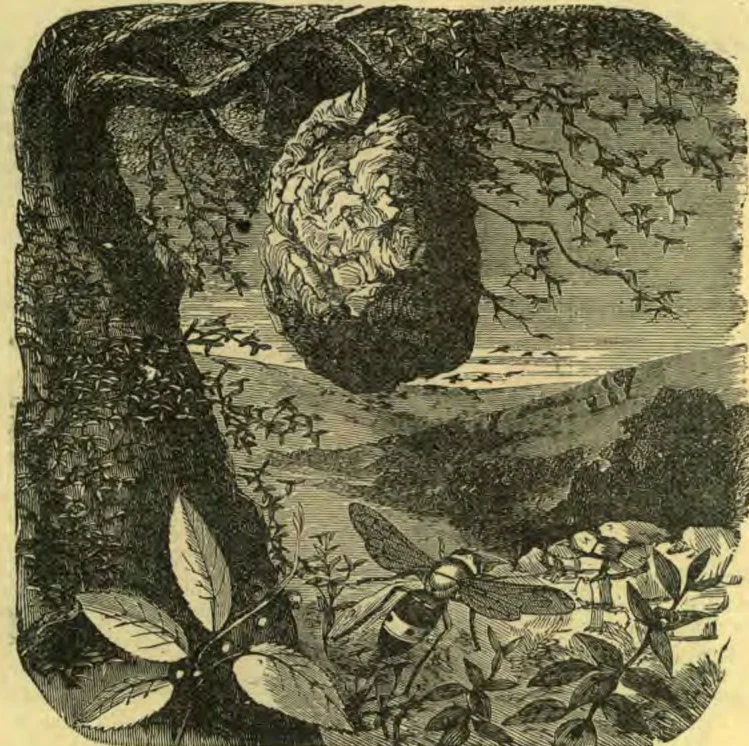
“Well, I don’t know exactly what it is, Uncle George,” answered the little boy, leading his uncle through the garden. “It is a great big gray ball that looks as if it was made of paper, and it is fastened on a branch of the big apple tree down at the end of the orchard. Sam and I were going to throw stones at it, but we saw some wasps crawling over it, and we were afraid to.”
“It is very well that you did not throw any stones at it,” answered his uncle. “It is a wasp’s nest; and if you had made them angry, they might have stung you very badly.”
They soon came to the tree, and Alfred pointed out the object of their curiosity to his uncle. It was an unusually large wasp’s nest, and the insects were swarming in and out, looking terrible enough to stop any one from touching their fortress.
“Didn’t you ever see a wasp’s nest before, Sam?” asked Uncle George of his youngest nephew, who was seated on the fence, viewing the wasps with curiosity mingled with a little fear.
“No, sir,” answered Sam. “Uncle George, where do they get their nest?”
“They make it,” was the answer.
Alfred and Sam looked doubtingly at the nest. It did not seem possible that an insect as small as the wasp could build such a large nest.
“Why, it’s made of paper, isn’t it?” asked Sam, at length.
“They make the paper too,” said Uncle George, smiling at the boys’ surprise.
“Let us sit down here a little while, and I will tell you how they make it. The wasps are furnished with broad, powerful pincers, and with these they tear off small pieces of woody fiber from gate posts, palings, or the bark of trees. This they mix into a soft pulp with their saliva, and with this pulp they build the nest. The inside of the nest is divided into little combs or cells, and the partition that separates these cells is generally thicker and firmer than that on the outside of the nest. As the nest is enlarged, new paper is made for the purpose, the whole nest being inclosed in the last-made covering, and the inner one is taken away to make place for more cells.
“The nests of wasps in tropical countries are sometimes very large, often six feet long, and very large families of wasps live in them.”
“How much paper those big nests must take!” exclaimed Sam, who had been deeply interested in his uncle’s account.
“Yes, paper-making is the principal trade of these little insects,” answered his uncle. “Each one of them has his own share of work to do, and so, little by little, the great nest is built.”
“What do wasps eat?” asked Alfred.
“Wasps will eat a great variety of both animal and vegetable food,” answered Uncle George. “They will eat insects, ripe fruit, sugar, and they often steal the honey from the bees. There is a Brazilian species of wasp that is known to store up honey like bees.”
“Aren’t hornets and wasps very much alike?” asked Sam.
“Yes,” answered Uncle George. “The hornet is the largest species of wasp, and is found in the south of England.—Now, boys, I must go back to my writing. I will leave you here to watch the wasps if you want to, and there is one very useful lesson that I hope you will learn.”
“What is that, Uncle George?” asked the boys together.
“Remember that great things are made up of little ones,” answered Uncle George. “One wasp alone could not build that great nest; but by each one’s doing a little, the work is performed.”—The S. S. Visitor.

Little Things: Learning to Be Contented

Written for the INSTRUCTOR.

LITTLE THINGS.—NO. 5.

I AM going to talk this time about something which I think is very important that you should learn if you hope to be happy; and that is, to be contented with what you have. A good many children make themselves very unhappy, and lose all the enjoyment they might have, because they are discontented. Oh, if they only had this thing or that thing, how happy they would be! But generally when they get it, they care nothing for it.
If you think you do not have some things as nice as you ought to have, and that you have a hard time, you will be sure to be unhappy. There is a way to forget all that, and to be happy with a few things. Just look round you and see how many children are worse off than you are, who have poorer clothes, who live in a poorer house, and who have fewer playthings. This will help you to be satisfied with what you have. Can any of you think of some who are not so well off as you are?
“Oh, yes,” George says; “there is Tom Jones. All he has got is a ball and a jackknife. His father is not able to get him anything else. But I have got a kite, and a little wagon, and a hammer; and I am glad.”
And Mary says, “Susan Brown has to go to school right through the mud without any rubbers, and her shoes are not nearly as good as mine. Besides, her reader is torn, and lots of the leaves are gone; but I have a good one.”
“Do you try to be contented with them?” I ask.
“Oh, yes,” Mary replies, “I would like a rubber cloak; but papa says he is not able to get it, so I do not care. I am glad for what I already have.”
“That is right. Learn to make the best of it.”
“And there is Henry Smith,” adds Herbert; “he has lots of things,—a wagon, a nice jackknife, a watch, and good clothes; but then, he is lame and has to go on a crutch, so he cannot run, and play ball, and do many things that I can do. I would not like to be like him for everything he has.”
If children have good health, just decent clothes, and plain food, they ought to be very thankful for these, even if they have no playthings at all. Try real hard to be happy, and see how much enjoyment you can get out of what you have, if it is nothing more than a jackknife, a ball, or a few marbles. There is a verse in the Bible about being contented; and I will tell it to you, so that you can learn it. It is found in I Timothy 6:6-8: “But godliness with contentment is great gain. For we brought nothing into this world, and it is certain we can carry nothing out. And having food and raiment, let us be therewith content.”
D. M. CANRIGHT.

Bettie's Shoemaking.

It was quite an old shoe that little Bettie Blake had in her hand; we should have called it about worn out. But Bettie hoped that there was wear in it yet, and that it would look real nice when she had sewed a piece of black cloth over the largest hole. She patched, sewed, and sang,—
“Nobody knows but Jesus!” It is music for to-day; And, through the darkest hours, It will chime along the way.
“Nobody knows but Jesus?” Is it not better so, That no one else but Jesus, My own dear Lord, should know?”
Know what little Bettie?
Know that the shoe was going to Sabbath-school the very next day, even if the girls did laugh. Bettie was trying to be Christ's little disciple, and being ignorant, needed to ask her teacher many things as to the way little disciples should live. Of course, she could not go without shoes, nor could her sick father buy her any then; so she became a little cobbler, or shoe-mender, for Jesus' sake. No one knew but Jesus, that she was in her little attic-room, trying to make herself tidy to go to her class on the morrow. She knew that she would feel a little bit bad when Susie Dean would laugh, and point to her shabby clothes; but she would suffer quietly, and try not to be ashamed. She was some like the good apostle Paul,—not a bit ashamed that her love for Jesus sent her to school, if she was clothed in patches.
She got along much better than she expected; for her teacher was kind to her, and the lesson was full of comfort,—so full that she didn't mind anything about her shoes.
When she went home along the leafy road, her father heard her singing, some time before he saw her,—
“Nobody knows but Jesus!” It is music for to-day; And, through the darkest hours, It will chime along the way.”
—Selected.

Letter Budget.

EMMA CHRISTOFFERSON, of Clay Co., D. T., sends seventy-five cents for the INSTRUCTOR, and says: “I have never taken your paper, but I have seen a few copies, and I think it is very nice, so mamma says I may get it a year. I have many times wanted to write for the Budget. We are the only Sabbath-keepers in this place, and it is twenty miles to the nearest Sabbath-school, so I cannot go. I have three brothers and one sister. My father died three years ago. I am fourteen years old.”
The INSTRUCTOR is the Sabbath-school paper; and if it is useful for the Sabbath-school, how much more valuable it would seem to be for those who have not the privileges of a school. We feel sure that you will find the INSTRUCTOR a help, Emma, in many ways. It is well that you have it.
ANOTHER little girl, eleven years old, MINNIE PHELPS, writes from Jefferson Co., Wisconsin. She says: “I live nearest to the church of any one, and go to Sabbath-school every Sabbath. I study my lessons in Book No. 4. I have a little sister Bertha, two years old. This is my second letter to the INSTRUCTOR. I like to read the paper very much. I am trying to be a good girl, so I can meet you all in the new earth.”
If we enter through the gates of the city, which is to come down upon the new earth, we must be washed in the blood of the Lamb from every stain of sin. Are you, Minnie, being thus washed?

“NOTHING TO BE THANKFUL FOR.”

MAMMA can go down stairs; “I shall not say my prayers; For I've nothing to be thankful for!” my willful Robert cried.
“There's all the other boys With multitudes of toys, And books, and dogs, and ponies; but we're poor, and I'm denied.”
“Ask Papa!” And I sought him: With eager steps I brought him. (Myself so shocked and wondering I scarce knew what to do); But still the boy kept saying: “Papa, I'm through with praying; For God gives nothing worth our thanks to me, nor yet to you.”
His father heard with sorrow, But simply said, “To-morrow You'll find his choicest blessings unto both our lives are known. God guard you while you're sleeping; I leave you in his keeping.” Then down the stairs we softly went, and left our boy alone.
But in the early morning, His father without warning Placed bandages across his lips, his ears, and hazel eyes. Deaf, dumb, and blind together, My boy would soon learn whether God had given him any blessings that e'en the poor would prize.
Long ere the morning ended, His grateful thanks ascended, For the blessed gifts of sight and speech; ascended to that One Who gives unstinted measure Of light and sound. With pleasure He meekly said his little prayer that night at set of sun.
—Sophie E. Eastman, in N. Y. Independent.

Keeping Sin Out of the Heart

A LITTLE boy had to be punished for saying bad words. His sister said that mamma was “unlearning” Freddy the bad words. I should think that was a great deal harder than learning them. There is a better way than to “unlearn.” It is the squirrel’s way. When he gets a bad nut he does not fill his mouth with it, and then make a wry face and spit it out. He just throws it away without tasting it. It is easier to keep sin out of the heart than to put it out.

You have reached the end of this edition.

The Youth’s Instructor · Nov 18, 1885