TO THOSE WHO ARE INTERESTED IN THE YOUTH'S INSTRUCTOR.
We are happy to send you the first number of this little paper. For some time we have been impressed that we had a more special work to do for the youth, but have not been able to commence it until the present time. We now cheerfully engage in this work, praying the Lord to help; and we feel sure of success.
The young, at this day, are exposed to many evils and dangers, and they must have right instruction to enable them to know how to shun them. And although the world never was so full of books and papers as at the present time, yet there is but very little written that is calculated to lead the youth to feel the need of the Saviour, and to impress them with the importance of shunning vice, and living a virtuous, sober and holy life.
The young are receiving impressions, and forming characters for Eternal Life or for Death, in an unfortunate age of the world, when spiritual darkness, like the pall of death, is spread over the earth. Pride is fostered; self-will, anger and malice are not timely and faithfully rebuked. Many parents who profess religion have become so worldly and careless, that they do not instruct their children in the way to heaven. In fact, not living devoted and holy lives themselves, they do not set good examples before their children, therefore they are unprepared to instruct them. Thus the light of Heaven is obscured, or entirely shut out from their youthful minds, and they are left to their own thoughts and the temptations of Satan, to move on in the broad way to destruction.
The Apostle, in pointing out some of the sins of the perilous times of the last days, states that children would be disobedient to their parents. Their lamentable condition was to be so much worse than in former times as to constitute a sign of the last days.
And it is a fact that many who profess to be looking for Christ and the judgment, have greatly neglected their duty to their children. Some have thought that because Christ was so soon coming, they need not bestow much labor on their children. This is a grievous error, sufficient to call down the frown of Heaven. We do not say that parents should bestow labor on their children that can be of no real benefit to them, which would only lead them into the spirit of the world; but we do say, that no pains should be spared to impart to them right instruction, calculated to elevate the mind, and guide in the way to the kingdom of God.
As we have seen children growing up at this corrupt age of the world, without an experimental knowledge of the religion of Christ, yet tender, and sometimes seen to weep when brought under a good influence, and then have seen their parents, professing to be looking for Christ, yet careless about their salvation, our heart has yearned over their children.
Parents must feel that they are training souls for heaven or hell, and act their part in giving good instruction to their children, in the fear and strength of God, without delay. And the children must give their hearts to the dear Saviour who died to save them.
We now feel like taking hold of this work in good earnest. And we expect that God will add his blessing, and a good and glorious work will be seen among the youth.
Parents and guardians, in order for this to be accomplished, we must have your help. We do not speak of means to publish the INSTRUCTOR, for we know that if we labor faithfully, in the fear of God, for the salvation of children intrusted to your care, it will be in your heart to sustain us. But you must take hold of this work in love and faith in your own families, and in your closets before God in prayer. The good seed of truth may be planted and watered, but God alone can give the increase. After you have placed good reading in the hands of your children, have taught them their duty, with a heart filled with love—after you have done all in your power—then you can consistently go to God with their case in prayer, and believe without a2doubt, that he will work for them. You should be fervent and persevering in presenting their case to God.
You must keep your children as separate as possible from those children who are suffered to go on in sin. Has God called you out from the world and a fallen church, to secure your vital piety?—If he has, how can your children be pious while associating with wicked children? It is impossible.
We invite you, who are in the habit of writing, to furnish matter for the INSTRUCTOR. Many of you are, or have been, school-teachers. And certainly, if you feel the perishing condition of the young, and your hearts are filled with love to God, and a love for their souls, you can teach them the path of holiness, and the way to heaven. Do not neglect your duty in this respect. We think the paper should be mostly original matter, yet selected matter from good books and other papers, of a sweet, touching character would be very acceptable. Those who can obtain such matter, will please forward it.
We also invite our young friends to write. Do not try to imitate any one; but write, in a simple style, your own views, experience and feelings.
We give four Sabbath Lessons in this number, one for each week, and hope the parents will establish Sabbath Schools, even where there are but two or three children in a place. And we expect the children will read them over many times, so as to be able to answer all the questions.
We design that the INSTRUCTOR shall be filled with sensible matter, not only for the benefit of small children, but for the instruction of the youth from sixteen to twenty years of age.
As we wished to state the condition of many of the youth, and the object of the INSTRUCTOR, in this short address, we shall be excused for saying so much to the parents.
SABBATH SCHOOL LESSONS.
NUMBER I.
THE SABBATH.
The meaning of the word Sabbath is Rest.—When the word is connected with day, it signifies Rest-day.
God created the world, and all things that are in it, in six days, and rested on the seventh day from all his work. After he had rested, he blessed the seventh day, and sanctified it,” and, by so doing, made it a Sabbath for man. Then the Sabbath-day, which God has commanded to be kept holy, is the seventh day, the very day on which the Lord rested after he created all things in six days. Here is the fourth commandment which you should commit to memory:
“Remember the Sabbath-day to keep it holy.—Six days shalt thou labor, and do all thy work; but the seventh day is the Sabbath of the Lord thy God; in it thou shalt not do any work, thou, nor thy son, nor thy daughter, thy man-servant, nor thy maid-servant, nor thy cattle, nor thy stranger that is within thy gates. For in six days the Lord made heaven and earth, the sea and all that in them is, and rested the seventh day; wherefore the Lord blessed the Sabbath-day, and hallowed it.” Ex. xx, 8—11.
There are several things in this commandment which should be carefully noticed.
First, we are commanded to remember the Sabbath-day. This shows that there is danger of forgetting it.
Second, we are told what day of the week the Sabbath is. “The seventh day is the Sabbath,” says the Lord.
Third, we are told how to keep it. That after we have worked six days, we must keep the seventh day of the week holy, by resting upon it. In this, we are to follow the example of the Great Creator, who made all things in six days, then rested on the seventh day.
Fourth, we are told why the Sabbath was instituted, or made for man, in the following words:—“For in six days the Lord made heaven and earth, the sea, and all that in them is, and rested the seventh day.” The Sabbath was made for a weekly memorial, to commemorate, or to call to remembrance, God’s Rest-day, after he had created all things in six days. Then the great object of keeping holy the Lord’s Sabbath-day, by doing no work on that day, is to honor our Great Creator, and that we may keep fresh in the memory the living and true God that created all things, and rested on the seventh day. The great reason why so many have forgotten the true God, and have sinned against him, is because they have not remembered his Rest-day to keep it holy.
Finally, the fourth commandment tells us how the day on which God rested was made a Sabbath for man, in the following words: “Wherefore the Lord blessed the Sabbath-day and hallowed it.”—The account of God’s resting, and then blessing the seventh day is in Genesis ii, 2, 3.
“And on the seventh day God ended his work which he had made; and he rested on the seventh day from all his work which he had made. And God blessed the seventh day, and sanctified it; because that in it he had rested from all his work which God created and made.”
The events in their order are as follows: First, God created all things in six days. Second, he rested on the seventh day. Third, he blessed and sanctified the day on which he had rested, for a Rest-day, or Sabbath-day for mankind. Remember this, that God did not make the Sabbath by resting on the seventh day, but after he had rested3on that day he blessed it and set it apart to be kept by man, whom he had made in his own image.
The fourth commandment states that the Lord made all things in six days, then rested on the seventh day, and then “blessed the Sabbath-day and hallowed it.” Here, the seventh day is called the “Sabbath-day,” at the time the Lord blessed it, the day after he finished creating all things. This shows that the Sabbath began at Creation. God has never blessed the seventh day but once, which was at the end of the first week of time. Then he calls it the “Sabbath day,” which makes it very plain where the Sabbath commenced.
God has never blessed and sanctified but one of the seven days of the week, for a weekly Sabbath. And that day, which he has set apart for this purpose, is the seventh, the very day on which the Great Creator rested, after he made the world.—Then, when we are commanded to keep holy the Sabbath-day, or Rest-day of the Lord, we must observe the very day on which the Creator rested. It will please him if we keep the day on which he rested, which is the seventh day, that he has commanded to be kept holy. But to keep another day of the week for a Sabbath, or to observe no Sabbath, must be displeasing to our kind Creator.
NUMBER II.
THE Lord's Sabbath is called by some “the Jewish Sabbath” and “the Sabbath of the old Jews.” Now it is very wrong to speak in this manner of the Lord's sanctified day. The scriptures call it, the Sabbath of the Lord our God.—Jesus said that the Sabbath was made for man, meaning for all mankind, including Adam, the first man, and all the human family. As Gentiles are men as well as Jews, it is plain that the Sabbath is no more the Sabbath of the Jews, than of the Gentiles.
Some say that the Sabbath was made twenty-five hundred years after the creation of this world, when the Lord gave the law of Moses to the Jews at Mount Sinai, and then when the Jewish religion was abolished, at the crucifixion of Christ, the Sabbath was done away.
This is a mistake, which we will now show you. Read the history of the journey of the children of Israel, found in Exodus, from the fifteenth to the twentieth chapter, and you will learn that they left Egypt on the fifteenth day of the first month. Also, that they came to the wilderness of Sin on the fifteenth day of the second month. Read Ex. xvi, 1. It was there, in the wilderness of Sin, that God gave them manna from heaven. And in giving them manna six days, and giving none on the Sabbath, he showed them plainly what day the seventh was, and that they must keep it holy. Now this was thirty days before the children of Israel saw Mount Sinai where the law of Moses was given. So you see that it is wrong to call the Sabbath the Jewish Sabbath, and to say that it was not given till the law of Moses was given from Mount Sinai. For the children of Israel did not come to Mount Sinai where that law was given until the fifteenth day of the third month, thirty days after the manna was first given. Turn and read it in Ex. xix, 1.
Thirty days before they saw Mount Sinai, where the law of Moses was given, Moses said unto the people: “To-morrow is the rest of the holy Sabbath.” Ex. xvi, 23. Speaking of the manna, he says: “Eat that to-day, for to-day is a Sabbath unto the Lord; to-day ye shall not find it in the field.” Read verses 24, 25. Some were disobedient and went out on the Sabbath to gather manna; but they found none, and the Lord was displeased, and said to Moses: “How long refuse ye to keep my commandments and my laws? See, for that the Lord hath given you the Sabbath.” Read verses 28, 29. All this was said about the Sabbath, one month before the children of Israel came to Mount Sinai where the law of Moses was given. You now see that the Sabbath was kept before that law of Jewish ceremonies was given, and that those ceremonies could be done away at the crucifixion of Christ, and the Sabbath yet remain.
The Lord, by his Prophet, shows how we should love and keep the Sabbath. He says, “If thou turn away thy foot from the Sabbath, from doing thy pleasure on my holy day, and call the Sabbath a delight, the holy of the Lord, honorable, and shalt honor him, not doing thine own ways, nor finding thine own pleasure, nor speaking thine own words; then shalt thou delight thyself in the Lord.” Isa. lviii, 13, 14.
Many tread down the Sabbath by breaking it. Such should turn away their feet from so doing. Many work on that day, and do as they please.—They should not do their own pleasure on God's holy day. The Sabbath should be a delight, and it will be, to all who keep it holy, and love to obey God.
It is the holy of the Lord; for after God created all things in six days and rested on the seventh, he made it holy by blessing and sanctifying it.—Those who call it the “Jewish Sabbath,” and the “Sabbath of the old Jews,” do not realize what they are talking about. It should be spoken of with feelings of great reverence, for it is “the holy of the Lord.”
It is honorable in the sight of God, and his Son Jesus, and the holy angels to keep the Sabbath, although those who do not delight in it may say that it is dishonorable.4
Unless the young are very careful, they will forget the Sabbath, and speak their own words on that holy day. They may speak their own words about worldly things on the six working days; but God has forbidden that they should do so on the Sabbath. They must be careful and not do their own pleasure and speak their own words on the Lord's holy day.
THE LAW OF GOD.
NUMBER III.
The law of God is the ten commandments.—God wonderfully distinguished his law, by speaking the words of the ten commandments, with his own voice, from Mount Sinai. He then wrote them with his own finger, in two tables of stone. Here are some texts of scripture that prove what we have just said:
“And the Lord said unto Moses, come up to me into the Mount, and be there, and I will give thee tables of stone, and a LAW, and commandments which I have written, that thou mayest teach them.” Ex. xxiv, 12.
“And he gave unto Moses, when he had made an end of communing with him upon Mount Sinai, two tables of testimony, tables of stone, written with the finger of God.” Ex. xxxi, 18.
“And he wrote upon the tables the words of the covenant, the TEN COMMANDMENTS.” Ex. xxxiv, 28.
“These words the Lord spake unto all your assembly in the Mount, out of the midst of the fire, of the cloud, and of the thick darkness, with a great voice; and he added no more; and he wrote them in two tables of stone.” Deut. v, 22.
“And Moses turned and went down from the Mount, and the two tables of the testimony were in his hand; the tables were written on both their sides; on the one side and on the other were they written.” Ex. xxii, 15.
When God was about to speak the words of the ten commandments in the hearing of all the people, who had just come out of Egypt, he told Moses to set bounds around Mount Sinai to keep the people back. God descended upon the Mount in great majesty, in flaming fire, and when he spoke his law, the whole Mount trembled, so that the people would have perished if they had come up to the Mount. After he had spoken his law, he wrote it in two tables of stone.
Remember that you read in Ex. xxxii, 15, that the two tables were “written on both their sides; on the one side and on the other were they written.”5We conclude that the first four commandments were written on the first table, and the last six commandments on the second table.
The first four commandments show our duty to God, and it seems proper to have them put by themselves on the first table. And the last six show our duty to our neighbor, and we have no doubt but that God placed them on the second table by themselves. The first table, then, shows us our duty to God, and how we may show our love to him, and the second table shows our duty to each other, how we may show our love to our neighbor.
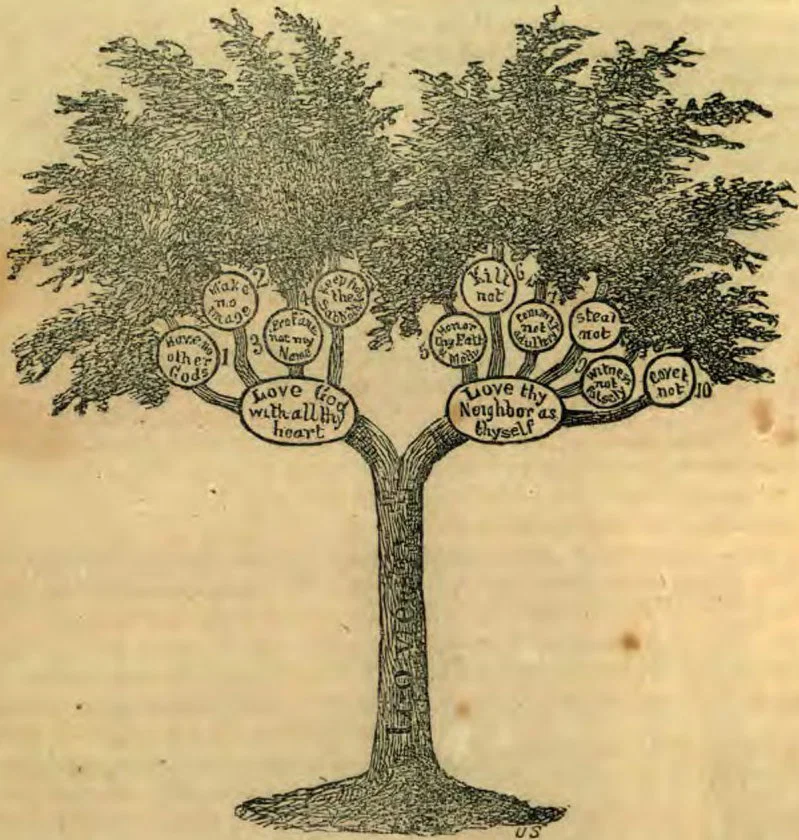
God is love. His law was given in love. And love is the fulfilling of his law, which we will here represent by the tree on the other page.
Let the body of this tree represent his law of love. You see that there are two large branches to this tree. Well, let one of these branches represent love to God, and the other, love to our neighbor.
On the first branch, which is marked, “Love God with all thy heart,” you see four small branches. These four small branches represent the first four commandments, which were written on the first table of stone. By these four commandments in the holy law of God, we may learn how to love God supremely. For if we love him with all the heart, we shall have no desire for other gods; we shall not wish to worship images; nor shall we dare to speak his holy name in vain, or break his Sabbath.
On the second branch marked, “Love thy neighbor as thyself,” you see six small branches. These six small branches represent the last six commandments, which were written on the second table of stone. By these six commandments we may learn our duty to those around us; how to love them as we love ourselves. For those who do really love others as well as themselves, will have no desire to steal, bear false witness, covet, or disobey their parents. Let those children who are tempted to disobey, and dishonor their parents, remember that if they disobey them they break the holy law of God.
THE ARK OF THE TESTIMONY.
NUMBER IV.
The Ark was a chest, two cubits and a half long. This is a little more than four feet and six inches. It was one cubit and a half wide, and also one cubit and a half high. This is a little more than two feet and eight inches. This Ark was made on purpose to contain the two tables of stone, in which God wrote the ten commandments.
It was called the “Ark of the testimony,” because it contained that testimony which God bore to all the people when he spoke the ten commandments from Mount Sinai.
The Ark was overlaid with pure gold within and without in a most beautiful manner, with the Mercy-seat on the top of it. On each end of the Mercy-seat was a cherubim, with their faces turned toward each other, looking down to the Ark. Read Ex. xxv, 10—21.
The place for the Ark, in the Sanctuary, was the holiest of all, a place so holy that no one was allowed to enter it but the high priest, and he only once a year. These facts show us that God's law is very holy, and that we should be very careful to keep all of his holy commandments.
God has placed great honor upon his law which he commanded Moses to put into the Ark. When the children of Israel were about to pass over the river Jordan into the promised land, the officers commanded the people, that when they should see the Ark and the priests bearing it, that they should remove from their place and go after it. Read Joshua iii, 3.
The priests took up the Ark and passed on toward the river Jordan, and the people followed after. And when the priests stepped their feet into the edge of the water, Jordan parted before the Ark of the testimony, and the waters that came down the river, stopped and rolled up and stood still. The priests that carried the Ark, went down into the bed of the river where they stood on dry ground. And there they stood with the Ark till all the children of Israel passed over to the other side of the river. And when the priests that carried the Ark, came up out of the bed of the river, and stood on the bank of Jordan, down came the waters of the river that had stood back in a great heap before the Ark of God, and rolled on as before. Read the third, fourth and fifth chapters of Joshua.
The walls of Jericho fell down before the Ark of the testimony. For six days the children of Israel went around the city with the Ark, and seven priests went before it, blowing trumpets of rams' horns. But on the seventh day they went round Jericho in this manner seven times. And when they had got round the last time, the priests made a long blast with their horns, and Joshua commanded the people to shout, and down came the walls of Jericho flat to the ground. This account you will find in the sixth chapter of Joshua.
When the children of Israel went out to battle, they always prevailed against their enemies, if they had been keeping all ten of the commandments, and had the Ark with them. But once they took the Ark and went out to battle, and thirty thousand of them were killed, and the Ark was taken by the Philistines, because some of them had been breaking some of the commandments. Read the fourth chapter of Samuel.
The Philistines put the Ark into the house of6Dagon, their god, and the next morning they found Dagon fallen on his face, before the Ark of the Lord. They set him in his place, and the next morning they found Dagon on his face again, with his head and hands cut off. Read Samuel v, 1—6.
The Ark was in the country of the Philistines seven months. And during this time they were afflicted with plagues, and many died. And they feared that it was because they had the Ark which belonged to the children of Israel. They finally concluded to make a cart, and put the Ark upon it, and tie two young cows to the cart, and shut up their calves at home. And if the cows left their calves, and went up to Beth-Shemesh, they should know that the plagues came upon them because they had the Ark.
Now, it was natural for these cows to linger at home where their calves were shut up. But no, they left their calves, and “took the straight way to the way of Beth-Shemesh, and went along the highway, lowing as they went” with the Ark, “and turned not aside to the right hand or to the left.”
The men of Beth-Shemesh were curious to see what was in this wonderful chest, and for looking into it, the Lord slew fifty thousand and twenty of them.
The Ark of the Lord was removed to the house of Abinadab, and Eleazer his son was sanctified to keep it. There it remained until David, with thirty thousand chosen men of Israel, went to remove, it into the city of David. Uzzah and Ahio drove the cart on which they placed the Ark, while king David and all the house of Israel followed, playing on psalteries, timbrels, cornets and cymbals. And when they came to Nachon's threshing-floor, the oxen stumbled, and Uzzah put forth his hand to steady the Ark, and God smote him for his error, and he died by the Ark of God. This terrified the king, and he said, “How shall the Ark of the Lord come to me?” So he would not remove it to the city of David, but carried it aside into the house of Obed-edom. But when the king heard that Obed-edom and all his house were blessed because of the Ark of God, which had continued with him three months, he went and brought it into the city of David with gladness. And when they that bore the Ark went six paces, he sacrificed oxen and fatlings, “And David danced before the Lord with all his might.” Read the sixth chapter of second Samuel.
This short sketch of the history of the Ark of the testimony shows that it was the strength and glory of the children of Israel. It should teach us that the commandments are very sacred in the eyes of the Lord, and that they should be kept holy.
COMMUNICATIONS
By Ellen G. White
DEAR YOUNG FRIENDS:—You live in a dark and wicked world, subject to sickness, pain and death. You may see many things that look beautiful; but how soon they fade away. You may have a dear friend that you love; but soon that one may be torn from you by sickness and death, and you will then feel lonesome.
You should have something substantial to fix your minds and affections upon, that can give real satisfaction and joy, and cheer your spirits in this dark world, and cause your sorrows to bring joy in the end.
There is a blight upon everything. The earth feels the curse that God pronounced upon it, because of the disobedience of our first parents. They broke the command of God in eating of the forbidden tree, after he had given them the privilege of eating of all the other trees in the garden. They listened to the tempter, ate of the forbidden tree, and were expelled from the beautiful garden of Eden.
The earth that was then so beautiful, was cursed, and the flaming sword was placed around the tree of life to guard it, lest man in his sin, should approach that tree, and eat of its immortal fruit, and by so doing, live in sin for ever.
The tree of life was designed to perpetuate immortality. Adam and Eve could eat of that tree, and enjoy its rich immortal fruit, until they transgressed the command of God. Death was then pronounced upon them, and all that should ever live upon the earth. There was no way of escape for us; no provision that we might again have access to the tree of life, if we would repent. Whatever evils might befall us, there was then no other way than to bear them without hope of having right to the tree of life, to eat of its leaves and fruit, and be healed. We must ever suffer and groan beneath the curse.
But the Son of God, who was with the Father before the world was, took pity upon us in our lost condition, and offered to step in between us and the wrath of an offended God. Said Jesus, I will7give my life for them. I will take the burden of the sins of the world upon me, and will make a way possible for these transgressors to find pardon, and enjoy thy favor again, that they may repent and keep thy commandments, and again have access to the tree of life. God consented to give his only Son to die for lost man.
The lovely Jesus laid aside his glory, and came into this dark world, and took upon himself our nature, to be wounded for our transgressions, to be bruised for our iniquities. O, what love for us.—He led a self-denying life, and had not where to lay his head. He was a man of sorrow and acquainted with grief, was despised and rejected, and finally was crucified for us.
But you must not think that you have nothing to do, because Christ died for you. You must repent of all of your sins, and give your hearts to God, and then believe that the blood of Christ will cleanse you from all sin. Then, if you keep all the commandments of God, the Sabbath with the rest, you may through the merits of Christ, be brought back to the tree of life. This will be when Jesus comes to raise the righteous dead, and change the living saints. Then you will have right to the tree of life, and eat of the leaves, and immortal fruit of the tree of life and live for ever in perfect happiness.—Read Rev. xxii, 14.
In the next paper I will speak of the beauties of the New Earth. E. G. WHITE.
Rochester, August, 1852.
HEAVEN
By A. R. S.
WHEN darkness gathers round thy way,
As falls the shades of even;
No star, with its mild cheering ray,
To chase the gloom—thy fears allay,
How sweet the light of heaven!
When toiling in the narrow way,
By persecution driven,
Beset with treach’rous snares that lay
To lead thy youthful feet astray,
How sweet the smiles of heaven!
When by earth’s care and grief and woe
Thy anguished heart is riven;
And bitter tears of sorrow flow,
No soothing balm found here below,
How sweet the joy of heaven!
And when our pilgrimage is o’er,
The blessed promise given;
When, borne on angel’s wings, we soar
To meet the Saviour, we adore,
How sweet the home in heaven!
Rochester, N. Y. A. R. S.
SARAH GRIGGS
By Sarah Griggs
DEAR YOUNG FRIENDS:—Do you remember reading in the Bible, about a child at the age of twelve years, that went with his parents to Jerusalem, and when they were returning to Nazareth he tarried behind, that they did not miss him until they had gone a day's journey? They then searched among their company, and not finding him, returned to Jerusalem in pursuit of their son, with sorrowful hearts. “After three days they found him in the temple, sitting in the midst of the doctors, hearing them, and asking questions,” and such was his wisdom, “that all who heard him were astonished at his understanding and answers.” Luke ii, 47.
This was Jesus of Nazareth. He suffered and died on the Cross that you might have your sins forgiven, and be saved from the wrath of God, which will be poured out on all who do not obey his word. He set an example that you must follow if you would please our Father in Heaven and live on the New Earth with holy angels, and those who have been redeemed by his blood out of this wicked world. When Jesus was young, he was the most lovely child that was ever on the earth. He was instructed, and given up by his parents to be holy unto the Lord. He never manifested an unkind look, or spoke a wrong word, or disobeyed his parents. He was always learning something good, for “he increased in wisdom, and in favor with God and man.”
As he advanced in years, he went about doing good, healing the sick, restoring sight to the blind, &c. He kept his father's commandments which you will find in Ex. xx, 3—17; and this is the only way to abide in the love of God by keeping his commandments. John xv, 10.
Jesus loved children, and took them in his arms and blessed them, saying, “of such is the kingdom of heaven.” And now, while he is interceding in the Heavenly Sanctuary, he loves to receive you, and wash away all the stains of sin with his precious blood, when you repent and give your hearts to him. He has promised to help you to overcome temptations and every sin that doth easily beset. If you trust in him, and obey his word, he will prepare you to dwell in that City where there will be “no need of the light of the sun, for the glory of God and the Lamb will be the light thereof.”
This same Jesus is coming again in the clouds of heaven, with power and great glory. And are you preparing to meet him? When he ceases to plead the merits of his blood before the Father, and comes out of the Sanctuary to punish the inhabitants of the earth for their wickedness, it will be too late to obtain pardon.
Come now, dear children, to the Saviour of sinners. Forsake all your wicked thoughts, words and actions, love and obey God, and forsake the company of wicked children. Obey the Apostle in the following text, and the glorious promise therein contained will be yours: “Come out from among them, and be ye separate, and touch not the unclean; and I will receive you; and will be a Father unto you, and ye shall be my sons and daughters, saith the Lord Almighty.” 2 Cor. vi. 17, 18.
SARAH GRIGGS
Avoca, July, 1852.
A Young Believer's Testimony of Conversion and Baptism
By M. J. Patten
MY DEAR YOUNG FRIENDS:—I wish to tell you something of the goodness of God to me, in bringing me out from the world, and causing me to rejoice in the Saviour’s love.
I well remember the time that I first felt that I was a sinner, and in the broad road to destruction. It was in the Winter of 1850, while living away from home. But how to be right I did not know, for I had no one to instruct me. Night after night I wept over my condition, and came to the conclusion that I must be lost; for I could see no source of help for me. I did not know where Jesus was.
But I praise my dear Heavenly Father, that, when I heard the third angel’s message, which touched my heart, (in the month of August, 1851,) it pointed out my Saviour, a merciful High Priest in the Sanctuary above, in the True Tabernacle “which the Lord pitched and not man.” There I looked, by faith, and confessed all my sins, and found peace in believing that I was forgiven.
In the month of October, I was buried with Christ in baptism, and I then felt as I never did before.—It was a beautiful morning, the sun shone out bright, and it seemed as though the angels of the Lord hovered around the water. I then felt that I was dead indeed to sin, and alive unto God. Such peace and love as I then experienced, I cannot describe.
Since that time, I have endeavored to live a self-denying life, and to follow my dear Saviour in the path he has marked out. “I feel that Jesus is mine, and I am his; and that there is nothing on earth that looks lovely to me. My treasure is in heaven, “where neither moth nor rust doth corrupt, and where thieves do not break through nor steal.”—And my heart is there also. My prayer to God is, that I may live humble and holy, so that I may escape the wrath of God, and meet the lovely Jesus in peace, and for ever reign with him in glory.
Rochester, Aug. 1852. M. J. PATTEN.
LESSON IV.
How large was the Ark? What was it made for?—Why was it called the Ark of the testimony? What was it overlaid with? What was on the top of it? What was on each end of the Mercy-seat? What was the place for it in the Sanctuary? Who went into the holiest of all?— How often? What do these facts show? Before what did the river Jordan part? How many days did the children of Israel go round Jericho, once each day, with the Ark? How many times on the seventh day? What fell to the ground before the Ark of the testimony? When the children of Israel went out to battle, what was necessary in order to prevail? Why were thirty thousand of them killed at one time by the Philistines, and the Ark taken? Where did the Philistines put the Ark? Where was Dagon, the next morning? How did they find Dagon the next morning after they set him in his place again? What came upon the Philistines while the Ark was with them? What did they conclude to do? Which way did the cows go with the Ark? How many of the men of Beth-shemesh were slain for looking into the Ark? Where was the Ark removed to? Who went to remove it to the house of David? Who was slain for putting forth his hand to steady the Ark? What whole family was blessed because the Ark was with them three months? What does this sketch of the history of the Ark show? What should it teach you?
QUESTIONS FOR SABBATH SCHOOL LESSONS.
LESSON I.
What does the word Sabbath mean? When connected with day, what does it signify? How long was God creating all things? On what day of the week did he rest? [Repeat the fourth commandment.] What does the command to remember the Sabbath-day show? What day of the week does the commandment tell us to keep? How are we to keep the Sabbath? Whose example do we follow in resting on the seventh day? Why was the Sabbath instituted or made for man? What is the great object of keeping holy the Lord's Sabbath-day? Why have so many forgotten God, and sinned against him? How did the Lord make the Sabbath for man? Where is the account of God's resting, and then blessing the seventh day? [Repeat it.] When was the seventh day called the Sabbath? When did the Sabbath begin? When we are commanded to keep the Sabbath-day, or Rest-day of the Lord, what day must we keep? What will please God? What will displease him?
LESSON II.
What is the Lord's Sabbath called in the scriptures?—Who did Jesus say that it was made for? What does "man" here mean? Where is the history of the journey of the children of Israel found? When did they leave Egypt?—When did they come to the wilderness of Sin? What did God give them there? How many days did he give them manna? What day was it that he gave them none?—What did this plainly show them? How long was this before they saw Mount Sinai, where the law of Moses was given? When did the children of Israel come to Mount Sinai? What did Moses say to the people thirty days before they saw Mount Sinai? What did God say to Moses when some went out to gather manna on the seventh day? What may you learn by this? What does the Lord say about the Sabbath, by the Prophet Isaiah? How do many tread down the Sabbath? What should the Sabbath be to you? Why is it the holy of the Lord? In whose sight is it honorable to keep the Sabbath? What has God forbidden you to speak, and do on his holy day?
LESSON III.
WHAT is the law of God? How has God distinguished it? Where, and how did he write it? [Read carefully the texts quoted.] From what place did God speak the ten commandments? Why did Moses set bounds around the Mount? How many tables of stone did God write his law upon? How were the tables written? Where shall we conclude that the first four commandments were written? Why does it seem proper to have them put by themselves on the first table? Why should the last six be written on the second table? What does the first table show? What does the second table show? What does the body of the tree represent? What do the large branches represent? What do the four small branches of the tree represent?—What may you learn by these four commandments?—What do the six small branches represent? What may you learn by these six commandments?
Youth's Instructor Plans and Subscription Notice
By Editor
THE YOUTH'S INSTRUCTOR will cost about $20 for each No. of 1500 copies. Great care will be taken to make it both instructive and interesting. We design that the Sabbath-School lessons shall, for the future, be upon the faith of Jesus, as well as the commandments of God, and fill only about one half of the paper. This will give room for a variety of other useful matter.
As the INSTRUCTOR will have to be read and studied much, great care will have to be taken, or it will be badly worn. Let each No. be carefully stitched in a thick cover to preserve it.
We send only one copy of this No. to many places where none have been sent for, and where several should be taken. When the friends see the INSTRUCTOR, we expect that all who wish to receive it, will write immediately and send for as many copies as they need in each place. Those children who cannot get the means to pay for it, shall have it free of charge.