The Youth’s Instructor, Vol. 38, No. 46.

ROUND THE WORLD.—35

The Youth’s Instructor

Nov 12, 1890

S. D. A. Publishing Association · Battle Creek, Mich. · Nov 12, 1890

ROUND THE WORLD.—35.

THE INLAND SEA.
Our stay at Hong Kong was very brief, and as we expect to return there again en route for Australia, its description will appear with whatever else there may be to relate concerning China.
On May first, under a lowering sky, the steamship Ancona steamed out of the Hong Kong harbor. It is sheltered in the roadstead, but the sea is lumpy, and the officers prophecy a “blow” outside. The very thought of it makes some of the voyagers turn green, and one by one they steal quietly down the companion stairs, and with heroic resignation stow themselves away in their bunks, with the intention of holding possession till bright skies overarch them, or a haven is reached. Only a few of us remain on deck, the cold, blustering wind cutting through our thin, tropical clothing, and making us think of western blizzards in days of yore; while the mountainous seas lashing each other and the rock-bound coast in their fury, bring visions of cyclones and retreats in storm-caves vividly before our minds. At full speed we stand on toward the open sea; the yards are trimmed to the wind, and the life-boats are turned inboard on their davits, so as to present as little impedimenta as possible to catch the gale and debar progress.
On either side, at the entrance, frown the British forts, with the yawning mouths of their cannon gaping grimly down upon us.
“They would soon knock spots out of a Russian [ship],” said a soldier, whose bronzed and weather-beaten face plainly told he was no novice at his trade. “And more than that, if we miss their boats with the fort guns, there is another little game we can play that will do for them. Beneath the water, from one side of this strait to the other, are dynamite mines, and by the pressure of an electric button, we could disconnect our neighbors somewhat.”
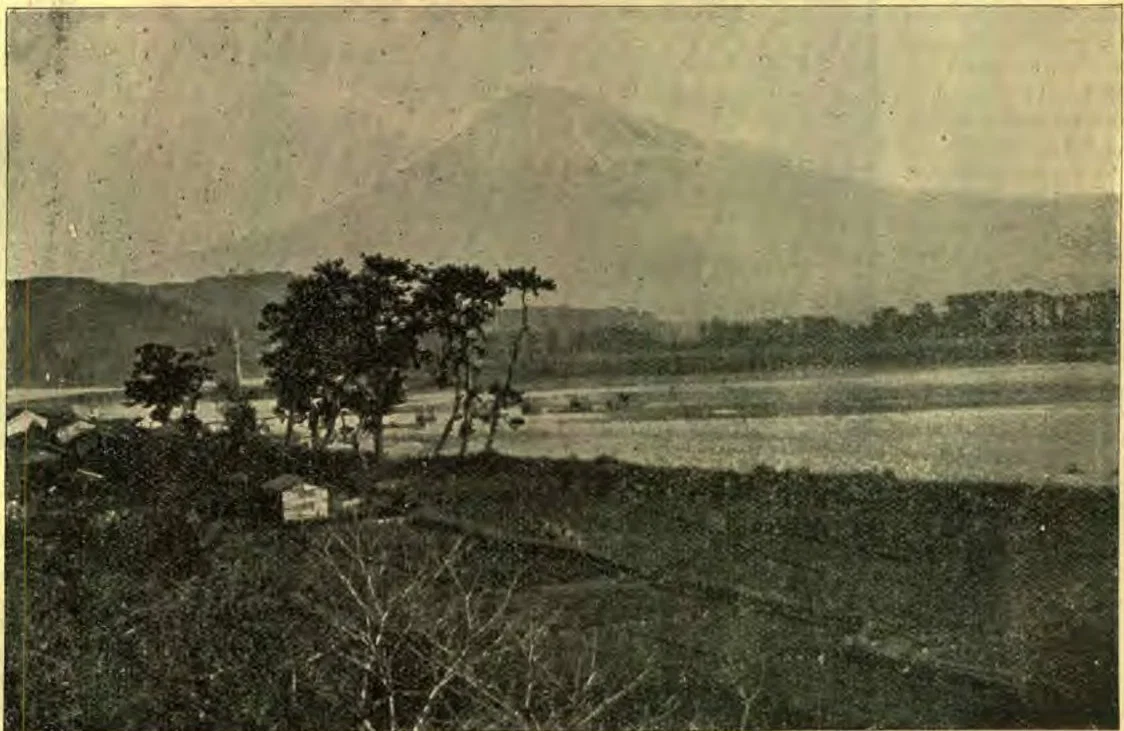
FUGIYAMA, THE “SACRED MOUNTAIN.”
Soon we are through, and congratulate ourselves that no mine went off by accident. Now there is nothing in sight but the barren rocks on the coast; and here and there a white spot higher up on the cliffs, marking the tomb of a Chinaman, and the restless, ever-heaving, tumbling, rolling billows. We are running head to the wind, and so roll but little, but the pitching is frightful.
This state of things continues for two days and nights without interruption, and then on the morning of the third day the gale is at its height. At every pitch, tons of water come over the forecastle head, only, however, to roll off again as she rises on another billow. Every now and then those in the cabins hear a crash, that at first causes great consternation, but it is only another wave coming down with a thud on the main deck. As long as the seas break before they strike the deck, there is but little danger; but if they come unbroken, the houses are sure to go, and the vessel stands a fair chance of being a total wreck. Frequently ropes are stretched fore and aft, fastened to high stanchels, so that the water will be broken by them in its fall. At night the roll of thunder echoes through the chill air, and vivid flashes of lightning cast momentary glares across the angry deep.
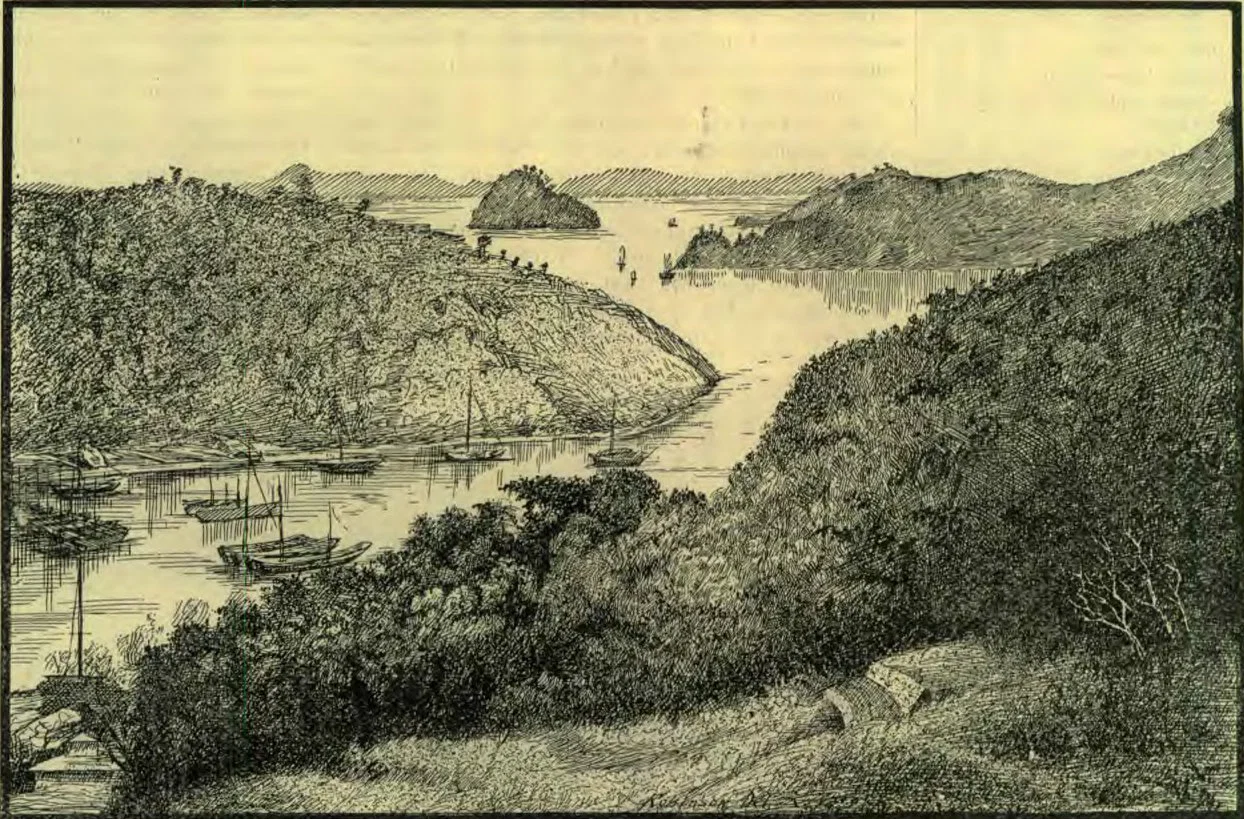
On the morning of the sixth, we wake to find that the ship is running in smoother waters, and, coming on deck, see that we are entering the lovely harbor of Nagasaki. The Japanese think that their country is an ideal fairyland, capable of surpassing in beauty the mind’s brightest vision of Eden itself. As the Ancona draws nearer, the dayspring sifts enough of suggestive light over the land to entice us into a belief that the “land of the rising sun” is one of the fairest on earth,—a belief which a residence of but a few weeks has sufficed to ripen into an article of faith. All welcome the sight of terra firma once more, and are glad that the perilous voyage is overpast. Nothing so impresses the reflecting mind as the thought of the mighty ocean arks of the present day, which by magnet, sun, and stars are safely steered into the desired haven. Without a Noah, without dove or olive leaf, freighted with the merchandise of the world and hundreds of precious souls, over a flood of turbulent or placid waters they float alone, till land is reached.
On either side rise beauteous hills. Some are terraced and others wooded, while upon the flat tables of the former waves golden grain, even at this season drooping its bearded heads all ready for the reaper’s sickle. Athwart the entrance stands a rocky islet, with a steep precipice facing seaward. It bears the name of Pappenberg, and is the Tarpean Rock of Japan; for from its heights, four centuries ago, the Christians were hurled into the eddying waters below. The reason for thus ruthlessly taking their lives was because they refused to trample and spit upon a model of the cross of Calvary.
Nagasaki nestles in a smiling valley,—a neat little town almost purely native. We had only a few hours for a run on shore, but visited the Shinto Temple, where the Japs go to worship departed heroes. Why these places are always built on hills, mortal cannot tell, unless it be to weary the tourists who come to visit them. We climbed flight after flight of stone steps, and at last reached the sacred edifice. There is but little to be seen in it except a large bronze statue of a horse. The building is quaint, although showing no great architectural beauty. Behind, there is a lovely grove of ivy-twined trees, which look as if they had been there for ages. Everything seemed fresh after the rain, and the flowers of spring were just commencing to peep up in the midst of their leaves. Of the people, their habits, and customs we will speak hereafter, but must leave them for the present.
After coaling, we leave again, and darkness soon casts its pall over the Island Empire. Through calm waters we journey on, at break of day to enter the Straits of Shimonoseki, which form the entrance to the Inland Sea.
It is on the glorious splendors of this island-spangled mirror of silvery waters that, since the land and seas of Dai Nippon have been traversed by men and women of cultured lands, poets have versed, artists have painted, and orators have expended eloquence. But, as the white-crested breakers dashing themselves against a rock-bound coast, are foiled in their efforts to move it, and return whence they came, these too must retire to the depths of their study, each one repeating, “The human mind cannot do it justice.”
It is a perfect day. The sun, which, during the earlier part of the voyage, had been hidden behind thick gray clouds, now shines forth in smiling radiance, as if to bid the good ship welcome to the land of which in her rising she is the emblem. Overhead hangs a dome of purest blue, as if vying in beauty with the deeper sapphire of the waters beneath. The soft, dreamy light of the morning hour seems to cast a halo of misty glory over the wooded islands, which rise, each one in independent majesty, and in the gentle eddy of the waters appear like a floating specimen of Queen Nature’s work. Being spring-time, the foliage looks its best. The crisping winds, which at times even in summer chill the bosom of the waters, and change the bright green and freshly-budded leaf to a darker hue, with wiry form and curled edges, have not yet done their work.
Sometimes we cling to a coast, threading our way with its trend so close that with the naked eye can be discerned the little villages in which these islanders dwell, nestling in ravine and dell; while from the mountain above a little rivulet comes laughing gaily down, playing with the pebbles in its bottom, and sending them merrily dancing to the waves beneath. The cottages are built of bamboo, with homelike thatches of brown. They are so tiny, and the construction appears so delicate, that one would almost think they had been erected for children’s dolls instead of for human beings. Japanese junks, with their snowy wings, are wafted to and fro across our course. These sails are peculiar to the craft of the country, and are formed of narrow slips lashed together; and instead of reefing in the ordinary manner to shorten sail, the strips are detached from either side. Others are riding at anchor in cosy bays, all ready to sail when the shades of night shall hush the land in slumber, and warn the fisherman that the hours of his toil have come.
Most of the islands are highly cultivated, and the soil is so rich that it yields two and sometimes three crops a year. The rocks are covered with mosses and ferns, and every once and again a dash of silvery spray covers them with sparkling diamonds.
Were it not that an old brown leaf or a broken straw of wheat occasionally floats past, or, passing close under shore, we see the scattered corolla of a dying flower, we might be tempted to believe that we had reached that land of which a holy man of old proclaimed, “Eye hath not seen, nor ear heard, neither have entered into the heart of man, the things which God has prepared for them that love him.” But there will be no death, nor sorrow, crying, or decay; amaranthine flowers of varied hues will bloom forever ’neath the shade of Eden bowers on the banks of the river of life.
Two huge Russian battle-ships steam proudly by, floating the blue-crossed flag from the staff, as if in their grandeur disputing nature in her reign. Guns bristle from their turrets and from the fighting tops with which their masts are decorated, ready at a moment’s notice to spread devastation on either hand.
Thus passed the day, the Ancona winding her way in and out among the islets, around capes and headlands, and through narrow channels with shelving beaches, till the orb of day began to set in the golden west. It seemed to sink so calmly down to rest, sending up, as it were, for the influence of its journey, wave after wave of golden clouds, which on distant hills cast purple shadows long and deep. And the words of Israel’s royal psalmist, “The heavens declare the glory of God; and the firmament showeth his handiwork. . . . There is neither speech nor language where their voice is not heard,” came forcibly to our minds. At night the pale moon climbed softly up the heavens and lent a sublimity to the scene, which, if it could be, eclipsed the glory that bathed the landscape during the day-time. Everything was so still that the silence of the air remained unbroken, save for a rhythmic whispering from the waters, as if chiding the leviathan for thus ruthlessly cutting her way through them, and separating their embraces.
In the morning we were in the harbor at Kobe, and the work of discharging cargo commenced. The following noon we left again, and, clear of the land, entered the North Pacific. On Friday afternoon land was sighted again, and Yokohama descried in the distance.
The ship moves on, and the panoramic landscape unfolds before us. In the background of undulating plains, under high and close cultivation, and dotted with rural hamlets, rise the crumpled backs of many ranges of mountains. While afar-off, yet brought delusively near by the clear air, sits the queenly mountain in her robes of snow, her summit glowing with the purple hues of evening, and her forehead gilded by the last rays of the setting sun. Above her, in the purple air, glitter the jewel stars, while her own bosom trembles through many changes of color. Far out at sea, long before land is descried, and from a land area of thirteen provinces, the peerless cone is seen and loved. Perhaps no view is so perfect, so impressive for a lifetime, so well fitted to inspire that intense appreciation of nature’s masterpieces, whose glory and freshness we can feel intensely but once, as is the view of Fugiyama, the sacred volcano, from an incoming steamer. From the vast, out-spreading base, through mighty curves, sweeping past snow, and up to her summit, the mountain is visible in queenly solitude and fullness of beauty. As the soft rays gather round the sinking orb as if to wish it farewell, the vast form is bathed in golden glory.
ENTRANCE TO NAGASAKI HARBOR.
But now the engines stop, and the great ship lies motionless at her buoy; and in a sampan we start for the “hatoba.”
All are glad of shore once more; for even this ocean scenery, though like God’s mercies new every morning and fresh every evening, palls on the eye, and loses its glory before the thoughts of a land where comforts cluster, and pleasures bloom. And we cannot help but feel that “east or west, home is best,” and that the waves that cradle the infant sun and pillow his dying splendor, the effulgence of cavernous sunsets, the wonders of spouting whales, flying fish, or phosphorescence at night, would be gladly exchanged for a home, however humble it be, in the land of the “star spangled banner.” F. T. M.

BUILDING

WE are building to-day, building for aye, Building, building, to pass away; Stubble, wood, hay, to die and decay, Or building, building with things of worth A building to last past the passing of earth.
Building, building! One with a jest; One with an earnest thought in the breast; One heaping high the stubble in play; One with jewels, lasting for aye; One with laughter; one with prayer; One with carelessness; one with care; Building, building, each one we see, Building for time or eternity!
Soon, O soon, if earnest or jest, The house we are building must stand the test. The fire of proving will fall at last, The fire of consuming the worthless past, The fire that will banish both stubble and hay, The fire that will brighten what's built for aye.
O listen, my soul! With stubble in hand, What art thou building upon the land? Cast thou aside the things of earth, Reach for the heavenly things of worth. What shall it profit to gain earth's whole, And lose at last thy redeemed soul?
Better be earnest, and leave thy jest, Better build with a solemn breast; Better with tears, better with prayer, Better with suffering, grief, and care Build for heaven, for truth, for duty; So shalt thou build with marvelous beauty; And the fire of testing that burns the hay, Will leave thee a mansion unmarred for aye.
FANNIE BOLTON.

“TAKING INTEREST.”

“Sue,” said the manager of a great retail establishment, pointing out the forewoman of one of the departments, “is the most successful of all the three hundred salespeople in the house. She began behind a small counter where different colored embroidering silks were sold. I observed that customers would ask for her, and if she was engaged, would wait until she was ready to serve them.”
“I wished to find out the reason for this, and offered to bring another saleswoman to a patient customer one day.
“‘No,’ she said. ‘Miss Crale never forgets the kind of silk which I use. She remembers the grade and even the shade which I bought before. And she takes such an interest in it!’”
“These two qualities—her memory of the preferences of her customers, and her interest in them—have made her the best saleswoman that we have ever had.”
A daughter of a prominent senator made his house the most popular resort in Washington a few winters ago.
“There are many women here,” said a friend, “more beautiful and more brilliant than Miss Dash, but she never forgets you, or anything that concerns you. After years of absence, if you go to her house, she will remember that you take three lumps of sugar in your tea, that you dislike the color of yellow, and that your favorite songs are Scotch ballads. It is a trifling quality, but certainly it gives her a wonderful charm.”
No quality will strengthen the influence of a sister, a wife, or a mother so much in her home as this persistent remembrance of the little likes and dislikes of those about her, with a hearty effort to indulge them.
Surely every woman should try to strengthen her influence in the field in which God has set her to work. Some of them may complain that they have no memory for trifles, nor a keen sympathy with the wants or feelings of others. As a rule, this is because they are exclusively occupied with their own wants and feelings.
Put self out of your heart, and you will be surprised to find how large and warm a tenement it is!—Selected.

RIGHT USE OF WORDS.

JERRY would use slang. He said it didn't make any difference what words he used, so people understood what he meant to say.
Jerry was mistaken. It does make a great deal of difference about the words that we use, and the way we speak them. When Peter denied all knowledge of Jesus of Galilee, he was told that his speech betrayed him. Our words reveal ourselves. They tell of our education, habits of thought, our age, and our country.
Daniel Webster, who was a master of language, made a daily study of words, that he might use only clear, strong ones to express his thoughts.
Lord Chesterfield, known as one of the most polished talkers of England, was asked how he had acquired such a command of language. He replied that early in life he had determined not to speak one word in conversation which was not the fittest he could recall. And he charged his son never to deliver the commonest order to a servant but in the best language he could find, and with the best utterance.
It has been said that if a word should be lost from any passage of Shakespeare, you might hunt through the forty thousand words in the language, and not one would fit the vacant place so well as that which the poet put there.
If the masters of the English language thought so much care necessary in the use of words, surely the study of words and the correct use of them ought to be worthy of our closest attention.—Selected.

SELF-SACRIFICE NEEDED.

Miss MARY LYON was the founder of Mount Holyoke Seminary, and for many years an able teacher in the school. She was deeply interested in the cause of missions, and her inspiring influence was widely felt. To the young girls of Holyoke she gave this earnest advice: “My dear girls, when you choose your field of labor, go where no one else is willing to go.”

LIKE A FLOWER.

“Ho! you’re proud. You’re as stuck up as you can be. Any body could see it; you think that blue sash is about the finest thing going.”
Roy said it teasingly, and it is, perhaps, not to be wondered at that Dorry should feel a little annoyed. But there was far more than a little annoyance shown in her reply.
“Roy, you are always saying hateful things. I wish you’d keep away and stay where you’re wanted, if that’s anywhere.”
“Whew, what a tempest! Isn’t the little Daisy afraid she’ll blow herself away?”
Poor Dorry felt as if there was nothing bad enough to say in return for such very provoking words. She had been of late trying very hard to keep in the ugly words that would fly to the tip of her tongue. For one moment she stood, half in search of words which could prick as Roy’s silly one had pricked her, half in really strong desire to conquer her quick temper, then wisely turned and ran away. A most excellent thing for either boy or girl to do under such circumstances.
“Why, what’s the matter, little girlie?” In her haste Dorry almost came full against her Aunt Lucy as she rushed down the garden path. “Has anything gone wrong with you?”
“No; I mean, not much. I was only angry with Roy.”
“Only!”
Dorry walked beside her aunt for a few moments, then spoke again in much quieter but very earnest tones:— “Aunt Lucy, is it wrong to like to look pretty and nice?”
“Wrong?” repeated Aunt Lucy, smiling as she patted the flushed cheek. “Well, no one ever asked me such a question before, so perhaps I ought to take a little time to think before answering it. But I am inclined to say that all the thinking in the world would not lead me to say anything but no. That is, unless the great Lord made a mistake.”
“O auntie!” said Dorry, looking shocked, “God never makes mistakes.”
“So I think. And so when I see a dear little face, with bright eyes and rosy cheeks, and a pair of lips just fitted to make smiles and dimples, I conclude that God has answered your question. It is not wrong to like to look pretty and sweet. He made the flowers, too. I have often wondered if they know how lovely they are—if in some way they have not the happiness of knowing how happy they make us.”
“But,” said Dorry, with an air which showed that her trouble remained, “the flowers never get angry.”
“No,” said her aunt, “that is one way in which they differ from us. And they can never overcome their anger through the help of and for the love of the dear Lord who made them. But has getting angry anything to do with looking sweet?”
“I guess not,” said Dorry, smiling as she shook her head. But the smile went away as she continued: “You don’t know how provoking Roy is. He makes fun of me because he knows I like a white dress and a blue sash.”
“The sash is no brighter than your eyes,” said Aunt Lucy, “and the dress cannot be whiter than little hearts should be.”
“But I don’t—” said Dorry, half crying.
“Not always, poor little girl. When quick temper flashes from the eyes, and the rosy cheeks flush deeper with anger, they are perhaps pleasing in the eyes of the enemy who is permitted to work evil in our poor souls. But we know that the dear Master is stronger than he, and will give us his strength to overcome. Wouldn’t it be wise in you, dear child, to strive to seek the very highest and sweetest beauty for yourself?”
The blue eyes looked inquiringly into Aunt Lucy’s. “I mean,” she went on, laying a caressing hand on the shining curls, “the beauty which the dear Lord intended should belong with the lovely things he has given you. He wants to see the light of a beautiful soul beaming through your eyes. He listens for loving words from your lips. And he is surely looking for the helpful, kindly, graceful things which your hands can do.”
Aunt Lucy went in, while Dorry lingered among the flowers.
“You dear little things!” she said, looking lovingly into the heart of a rose, “I believe you do not know how sweet you are, and how much good it does us to look at you. I never can be as beautiful as you are; no indeed, no matter what Aunt Lucy says. But if I can’t be like you that way, I’m going to try it another way—in never saying ugly things.”—Sydney Dayre.

SUSIE'S TEMPTATION.

“I NEVER can get this example right. I have tried and tried, and it comes just the same every time, and I can't make it any different. I've a great mind to put it down as it is in the answer; for there is only a difference of one figure, and that is the remainder.”
The tone was full of vexation and discouragement, as the little girl looked up for approval at her mother, who was lying on a couch near her.
“No, my dear,” said the mother. “You could not do anything like that, because it would not be honest.”
“But, mamma,” urged Susie, “I was so anxious to be perfect to-morrow in everything.”
“Never mind, darling,” said her mamma; “I am sure you will feel a great deal better to write your answer just as you get it than you would to be marked perfect when you did not deserve it.”
Down went the little brown head, and the fingers flew faster than ever over the slate for about five minutes, when Susie looked up quietly, and said: “Mamma, I think I had better not try that again; for it is getting late, and my spelling lesson is not learned, but I don't like to give it up.”
“I wish I could look it over for you,” said her mamma; “but my head feels so bad.”
“Oh, no!” exclaimed Susie. “I would rather be imperfect than have you troubled with it.” So the slate was laid aside with a sigh, and the speller took its place.
The next afternoon, about half-past four, Susie came rushing into her mamma's room as if she had for once forgotten that mamma was sick, till she saw her lying down, as usual, when she exclaimed, “O mamma, I am sorry I made so much noise, but I have something to tell you. Don't you think, my example was right, after all!”
“I am very glad,” said mamma, quietly. “How did it happen?”
“Why, you see,” said Susie, “it was not a real example from the book, but one the teacher made up and gave us, and more than half the scholars had it just like mine, and the rest had it like the answer she had given us. The teacher looked surprised, and said she would look the example over at noon. Our lesson came in the forenoon, and to-night she said she had made a mistake in working it, and that ours was right.”
“What if you had put down the answer?” asked her mother with a smile.
“O mamma!” went on Susie, earnestly, “wasn't I glad I had you here to caution me! Why, I could not have looked my teacher in the face if I had put that figure down wrong. I did feel so sorry for the others, and I am afraid I should have blamed them more, if I had not come so near doing the same thing.”
“Well,” said her mamma, as she brought the little, excited face down to hers, and kissed it fondly, “I am glad it happened just as it did; but if mamma had not been here, I hardly think her little girl, after thinking a minute, would have been so foolish.”
“I felt the worst for Fanny Barnes,” continued Susie; “for she is such a good little thing, and never tries to cheat in her lessons, and her face was as red as a blaze while the teacher was talking, and she could hardly keep the tears back. As soon as school was closed, she came and told me all about it. When she got home last night, her papa and mamma and little brother were all ready to go to her grandma's, and waiting to take her with them. They did not get back till half-past eight, and Fanny goes to bed at nine o'clock, whether she has her lessons or not. So she went right to bed, and her papa promised to call her at six the next morning; but he overslept, and it was almost seven when she was dressed and ready to go to studying. She had them all done but that last one when breakfast was ready, and she hadn't a minute afterward. The first girl she saw when she got to school was Del Farnsworth, and Fanny began to tell her she hadn't time to do that last example, and Del told her to copy it from her slate. Fanny didn't like to, but Del said: ‘Why, you little goose, you know how to do it, don't you? It's easy enough, and I'd like to know where the harm is for you to copy mine when you can do it so much quicker?’”
“Then Fanny looked at it a minute, and saw just how it was done so; as it was almost time for school to call, she copied it. Del came up while we were talking and saw that Fanny had been crying, and wanted to know what was the matter; so Fanny asked her how she happened to get that example wrong.
“‘O pshaw!’ she says, ‘is that all? Of course, I supposed Miss Pierce gave us the right answer, and so I put it down. I knew that was the right way to do it, and you'll never catch me working an example over a dozen times just for one figure, as Sue Simpson probably did last night. Didn't you, Sue?’”
“‘Yes, I did,’ said I, ‘and I thought of writing it down just as you did, but my mother told me better.’”
“‘I should like to see my mother troubling herself about my lessons. She never thinks of such a thing,’ said Del. Then she turned around to the girls, and said: ‘I presume Sue Simpson will go straight home and tell her mother all about it. I do believe she tells her mother everything that is done in this school. I'd be the last one to tell her anything I didn't want her mother to know.’”
“Mamma, I was so angry to hear her speak so of you that I could hardly keep from crying, but I just told her I didn't think you would care about hearing all the nonsense that was going on in this school, and that I didn't want her or any one else to tell me anything I couldn't tell you if I wanted to, and then she called me a little tattler, and I ran home just as fast as I could, for fear I should say something awful naughty, for I felt just like it.”
Mrs. Simpson smiled at this hurried recital, and said: “I think you were wise for once, my dear, to hurry away from danger. You know how apt you are to say things you are sorry for afterward.”
“Yes, mamma,” said Susie, thoughtfully; “I am glad I thought in time; for it is quite a while now since I have said any of those cross things to the girls, and I guess I am cured of that bad habit.”
“Don't be too sure about your being cured,” said her mother, smilingly.
“I think I am,” said Susie, confidently; “for Del Farnsworth has said ever so many real mean things on purpose to provoke me, and I never said a word. But I must study now till tea-time.” And she was soon busy with her books, while her mamma sat watching her, and thinking how many sad lessons her little daughter would probably have before she learned to control her impetuous temper.—Christian Advocate.

HOME FROM SCHOOL.

The western sun comes softly in Through hall door open wide; Young Rover lies with low-stretched chin Upon the steps outside; The great hall clock ticks sleepily; A hint of clucking hen Comes from the yard uncertainly; Then all is still again.
But hark! A banging of the gate! A clatter up the walk! A tangle of blithe sounds elate In song and laugh and talk! Loud strikes the clock! The chickens flee! Rover's a frantic fool! The very sunshine laughs to see The children home from school! — Wide Awake.
HOME FROM SCHOOL.
HOME FROM SCHOOL.

PREACHING WITH A SHOVEL.

It was a dreary winter evening, and Laura was snuggled up in a corner of the sofa, with her book in her lap, just in the middle of a most delightful story. The boys were playing in the corner, and now and then she caught a scrap of their talk, but she paid very little attention to it. Rob was putting his locomotive together, and Fred was arranging an orphan asylum with his alphabet blocks.
Twenty-seven orphans were ranged about the carpet, some of them in bed, some eating soup out of Laura’s china dishes, one desperate fellow in solitary confinement behind the door, and a long row learning to read from bits of newspaper. The only trouble was that they all had such jolly faces; they would grin all the time; and what can you do with a boy that grins even when you whip him?
So presently the orphan asylum was turned into a gymnasium, where twenty-seven little acrobats stood on their heads, walked on their hands, turned somersaults, and performed all manner of wonderful feats. Then they were all convicts in State prison, and Rob came and preached them a sermon. This was the sermon:—
“My brethren,”—
“People in jail aren’t brethren,” said Laura, looking up from her book.
“O yes they are!” said Rob; “brethren is just a kind of preach word, and means everybody but the minister. My brethren, folks ought to be good, and not steal things, and quarrel, and get angry. When you begin to be bad, you can’t tell how bad you may get to be. The minister knows of a boy that begun by wouldn’t let his brother take his skates when he didn’t need ’em at all himself, and he grew up so’t he set a house afire.”
“Is that true, Robby?” asked Fred, with very big eyes.
“Course not; that’s a ’lustration. Sermons are true, and ’lustrations are just to make you understand ’em. Now, my brethren, you mustn’t steal or do any more bad things, cause you can’t do it any way, and if you try to get out, they’ll shoot you.”
The convicts now marched back to their cells under the sofa. Rob lay upon the carpet, with his arms under his head, and said, very slowly, “When I am a man, I shall be a minister.”
“I thought you were going to be an engineer,” said Laura.
“Well, p’raps I shall. Cars don’t run on Sunday, and I could think up my sermons all the week, and then go and preach ’em.”
“O, you can’t make sermons, just thinking them up on an engine,” said Laura positively; “you have to do ’em in a study, with books and writing.”
“I could,” persisted Rob; “I shall say my sermons like Mr. Challis, and I know lots of texts.”
Laura looked at papa, who was smiling at them over the top of his paper, and asked, doubtfully, “Could he, papa?”
“I suppose he could,” said papa.
“But I thought ministers had to be just ministers, and not part something else.”
“I know of a boy,” said papa, “who preaches first-rate sermons, and he does a great many other things,—goes to school, brings in wood, takes care of a horse.”
“Me, papa?” asked Rob.
Papa laughed and shook his head. “He preaches them to people on the street; he preached one to me to-night.”
“O!” said Laura, and Rob sat straight up and looked at papa.
“He preaches them with a shovel.”
Rob laughed heartily at this, and Laura looked more puzzled than ever. Fred came and leaned his arms on papa’s knee.
“Now papa,” he asked, “how could anybody preach with a shovel?”
“I’ll tell you,” said papa. “All through this month of snowy weather there has been one hundred feet on Beech Street of clear, clean sidewalk. No matter how early I go down town, it is always the same—clean to the very edge of the walk. People pick their way through the slush, or wade through the drifts, or follow the narrow, crooked path the rest of the way; but when they come to this place, they stamp their feet, and stand up straight, and draw a long breath. It makes you feel rested just to look at it. The boy that keeps that sidewalk clean preaches a sermon with his shovel. It is a sermon on doing your work well, and not shirking; a sermon on doing things promptly without delaying; a sermon on sticking to things day after day without wearying; a sermon on doing your own part without waiting for other people to do theirs.”
“May be a man does it,” said Rob.
“No, it is a boy; I have seen him at it. I saw him one day when it was snowing very fast, and I said, ‘Why do you clean your walk now?’ It will soon be as bad as ever.’ ‘Yes, sir,’ said he, ‘but this snow will be out of the way. I can brush it off now easily, but when it is tramped down, it makes hard work.’ I call that a first-rate sermon, and every one who does his work in his very best way, preaches a sermon to all around him.”
The bell rang, and somebody called papa away; but Rob kept thinking of the little crooked, uneven path he had made to the barn and well, and what a stingy little pile of kindlings he had split for the kitchen, and he made up his mind he would try to preach a sermon with the shovel the next day.
Laura saw that her mother had laid aside her own book to show some pictures to little Nell.
“That’s what mamma is always doing,” she thought, “preaching sermons about loving other people better than yourself; I guess I’ll preach one about ‘Do unto others.’ And Laura left her story and amused her little sister until her blue eyes were too sleepy even to smile.”
The next day Rob widened his path, and shoveled it clear down to the firm ground, and then he called Fred to admire it.
“It’s nice,” said Fred; “I guess it’s as nice as that sermon-boy could make. S’pos’n we go and shovel a path for Mrs. Ramsey.”
“Come on,” said Rob; “that’ll be a sermon about—about—I wonder about what?”
“Being kind,” said Fred, “but I don’t know what the text for it is, unless it’s, ‘Love one another.’”
“That’s a pretty good text,” said Rob, “that fits to ’most anything good.”—Emily Huntington Miller.
Continue reading: SKUG AND HIS FRIENDS