Your ShelfYour Projects

Review and Herald, Vol. 66, No. 50.

THE DUTY OF PAYING TITHES AND OFFERINGS
Earlier text: Louis Auger on Roman Catholic Influence in Schools

THE POWER OF THE BIBLE.

The Lord says concerning his word, that it shall not return to him void, but shall accomplish that which he pleases. Isa. 55: 11. The word of God is sent forth as a lamp to the feet, and a light to the path of those who are in nature’s darkness. Ps. 119: 105. Therefore when the Bible is carried to those who have never before heard of its promises, it must, to accomplish its purpose, open to their eyes the power and majesty of Him who sent it.
Yet God did not design that his word should accomplish his will apart from visible means. Indeed, from the nature of his message, that would be next to impossible. It is not the plan of God to coerce men into his service against their will, but to influence them, through association, to yield to his demands. In order to do this, it is necessary to have living witnesses of the power of that word, whose lives shall testify to all that the way it points out is the only road to happiness here and hereafter.
To go and tell the truth once to people who have been reared in the darkness of heathenism, and then leave them, does not accomplish the work God has designed shall be done. For although the story has been a pleasing one, if they are left to other influences almost immediately, the power of the truth is soon overcome, because the example of those who believe and live it are absent. The same effect is seen in a less degree in labor among comparatively enlightened people. Many times, days and weeks of earnest labor have been nearly all lost because those for whom the labor was performed, were left to counteracting influences.
But, on the other hand, when those who have told the story of Christ’s love and the power of his grace, have lived, among those for whom they have labored, in a way to demonstrate the truthfulness of what they have taught, it has often had more effect to lead others to Christ, than all the preaching done. In this lies the secret of success of the truth in any land.
This point is well illustrated by what happened not many years ago at Madanapalle, India. A missionary had, after repeated failures, succeeded in opening a reading-room, where the natives might be induced to come and read, and have the gospel preached to them. The work went on a long time without much apparent fruit, until at the close of a Bible lecture by the missionary, an unconverted Brahmin arose, and asked permission to speak. He was granted liberty to do so, and addressed the large audience substantially as follows:—
Behold that mango-tree on yonder road side! Its fruit is approaching to ripeness. Bears it that fruit for itself, or its own profit? From the moment the first ripe fruits turn their yellow sides toward the morning sun, until the last mango is pelted off, it is assailed by sticks and stones from boys and men and every passer-by, until it stands bereft of leaves, with branches knocked off, bleeding from many a broken twig. Piles of stones underneath, and clubs and sticks lodged in its boughs, are the only trophies of its joyous crop of fruit. Is it discouraged? Does it cease to bear fruit? Does it say, “If I am barren, no one will pelt me, and I shall live in peace”?—Not at all. The next season the budding leaves, the beautiful flowers, the tender fruit again appear. Again it is pelted, and broken, and wounded, but goes on bearing, and children’s children pelt its branches, while enjoying its fruit.
That is a type of these missionaries. I have watched them well, and have seen what they are. Is it for gain that they leave parents, friends, and country to come to this unhealthy climate? Is it for an easy life? See how they work, and then tell me. No; they seek, like the mango-tree, to bear fruit for the benefit of others; and that, too, while receiving only abuse from those they are benefiting.
See this missionary. He left all at home, and came here to do us good. He was met with cold looks, and avoided by all. When he sought to talk with us on matters of importance, we would not listen. But he was not discouraged. We complained if he walked through our streets. But when we were sick, he came to our help, and made us smile in health.
Now, what makes him do all this for us?—It is his Bible. I have looked into it, and it is just the same in all the languages I know. Nothing is like it in our sacred books, for goodness and purity and holiness and love. Where did the English people get their intelligence and power?—It is their Bible that gives it to them. Now they bring it to us, saying, “This is what lifted us up; take it, and raise yourselves also.” They do not force it upon us as the Mohammedans did their Koran, but they translate it into our tongue, and say, “Look at it; read it, and see if it is not good.” Of one thing I am convinced—do what we will, the Christian’s Bible will sometime bring a great change into our land.
What a testimony is this to the power of the Bible! Not only was it seen by the Brahmin that what it contained, elevated the nations that received it, but it had been fully demonstrated before them that the same word could give power to the missionary to endure rebuffs and hardships, in order to its prosperity. It is such living examples of the power of God’s word, that gives it prosperity even in the heart of heathendom, as well as among the enlightened nations of the earth. J. O. O.

ILLINOIS

St. Anne and Kankakee.—It is with gratitude to God that I make this report of labor done among the French Canadian people of this State. I have canvassed for the French “Life of Christ” and for “Bible Readings.” Sold $325 worth of books. I sold Bibles wherever I could. Though often meeting strong opposition on the part of the priests, the Lord enabled me to gain the esteem of the people in general, to the degree that I am invited even by some who have not seen me, to speak about the Bible to them. As the roads are in a very bad condition in the country, I spend my time in visiting our people and interested persons. Space is lacking to give a full account of the many interesting cases I have met, among both the Catholic and the Protestant French population here; but suffice it to say that all goes to show that the time has fully come to work for them, and that we have the strongest reasons to believe that no bounds can be set as to how fast the Lord will do this great work among the French, through those who will consecrate themselves wholly to it.
Our people at Pitwood, St. Anne, and Kankakee are being blessed in a marked manner, as a revival is beginning to be seen among them. I believe the Lord will do much for us during the week of prayer, if we earnestly seek him. The truth is brighter, and more precious, and in the practice of it we find rare blessings. By all who interest themselves in this nationality, we ask to be specially remembered in prayer, as the French work is behind almost all the others. What help may we not expect from God in the closing scenes of the proclamation of the third angel’s message? O for more faith, and more of the Holy Spirit’s power among all our people, and especially among those of us who are behind, that we may at last enter in with the faithful, at the gate of the New Jerusalem!
I would ask an interest in the prayers of all who are in sympathy with the work that is being done to bring the present truth to the blind, and in making ourselves generally useful to them every way. I espoused their cause while in Europe, and the readiness with which they receive the comforting power there is in present truth, so touched me that I have decided to do all the dear Saviour would have me do for them. The name of the contemplated association will be, “The Vigilant Christian Endeavor Association for the Blind;” and although in its infancy, as it were, it has before it a vast field, in which are great possibilities. The beginning is indeed small, but it is supported by many encouragements; and with God to aid us, our anticipations must be realized. Few, indeed, of those who are not so afflicted, realize the full import of the word “blind.” In France alone, there are not less than 40,000 blind persons, and only about one third of them know how to read and write. Others live a life of begging, etc. When we consider our own country, the United States, that each State has an institution full to overflowing, and yet not one-half of the whole number of blind persons is thus sheltered, we get a faint idea of the number there are. It has been seen in almost every case that the blind can do more for the cause in canvassing or Bible work, than many of our good workers; and if we can thus get them to work,—and we can,—will it be lost time?
May God come near to us all in rich blessings to every branch of the work. My address is St. Anne, Kankakee Co., Ill. E. P. AUGER.
Dec. 10.

GEORGIA

ALPHARETTA.—Since my last report, I have been laboring in and about Alpharetta, following up the interest awakened by the tent-meetings. I have been visiting from house to house, holding Bible-readings, and preaching each week in the court-house. The interest to hear is still good, and many are almost persuaded to obey.
Quite a number have embraced the truths of the third angel’s message, among whom are both Methodists and Baptists. The Methodist ministers in charge of the Alpharetta circuit, became very much alarmed, and appointed a committee of three to wait upon those who had accepted the views taught by us as a people, and ascertain, if possible, whether they intended to continue to practice the views they had lately accepted. The committee was told by the parties that they expected to continue until they were convinced they were in error. They were advised to quietly withdraw from the church, and thus save further trouble. Five withdrew, and four demanded a trial. The trial took place Oct. 21. The charge brought against them was “heresy.” They were tried by a jury of six. The minister presided, and defined heresy as that which is against the essential or fundamental principles of Christianity; and in giving his charge to the jury, he stated that the question to settle in this case was not whether these sisters believed the Bible, but whether, believing as they did, it was in harmony with the Methodist doctrine. He said he did not consider them infidels. In harmony with his charge, the jury returned a verdict finding the defendants guilty of heresy; and no one can fail to see that, according to the verdict, they not only branded those four as heretics, but all others, of any denomination, who do not believe in the Methodist doctrine.
On Sunday, Nov. 24, we repaired to the water some two miles distant, where five willing souls, in the presence of a large concourse of people, were buried with the Lord in baptism, and came forth, we trust, to walk in newness of life. Many said they never before had witnessed so solemn a scene, I believe a deep and lasting impression was left upon the minds and hearts of the people. I organized a church of thirteen. Several others who are keeping the Sabbath, will unite with them in the near future. A Sabbath-school, also, was organized, and the friends have fitted up a nice hall in which to hold their Sabbath-school and meetings.
I have labored in Georgia eleven months, and as I survey the past year, I can but praise the Lord when I call to mind the many blessings I have received during my short stay in this field. The Lord has been very good, and has been pleased to bless the efforts put forth; and as a result, fifteen or twenty have embraced the truth. In connection with my labors in Georgia, I have sold some $200 worth of books, pamphlets, and tracts, and obtained nineteen subscribers for the REVIEW AND HERALD, nearly all being for one year; also received nearly $100 in donations. I am persuaded to believe there are many honest souls in the great field of Georgia, who will yet embrace the truth. But I am also persuaded that this work will have to be done mostly by canvassing. Georgia is a good field in which to sell books. Those who are now canvassing, are doing well, and all seem well pleased with the field. I held my last meeting at Alpharetta Sunday night, and as I bade the friends farewell, my prayer went up to God that he might bless and keep them humble, and that we at last might be privileged to meet where parting will be unknown. I leave to-day for Indiana, my former field of labor. I feel to praise the Lord for the privilege of having some part in this grand and glorious work of bringing the light of present truth before those who are in darkness.
Nov. 28. M. G. HUFFMAN.

ORGANIZATION OF THE NEW ZEALAND SABBATH-SCHOOL ASSOCIATION.

(From Bible Echo.)
DURING the sittings of the New Zealand Conference of S. D. Adventists, held in Auckland from May 27 to June 5 of this year, the Sabbath-school work was brought forward for consideration, and a meeting was called for the purpose of organization. M. C. Israel was voted to the chair, and Bro. Clayton was chosen to act as Secretary. After discussing the importance and needs of the work, it was unanimously agreed that the time had come to take advanced steps in the work by organizing the New Zealand Sabbath-school Association.
The usual committees were appointed, and at the two following meetings decided measures were adopted in connection with the organization. The Committee on Nominations presented the following names: For President, R. Hare, Gisborne; Vice-President, E. Cleal, Auckland; Secretary and Treasurer, Mrs. M. H. Tuxford, Napier; Executive Board, J. Glass and Bro. Keymer. The Committee on Constitution reported the adoption of the By-laws recommended by the General Conference in America, with the necessary changes of name, etc. The committee on Resolutions gave in the following report:—
Whereas, We recognize the Sabbath-school work, with its carefully prepared Scripture lessons for old and young, the system of conducting it as recommended by the International Association, as a very important factor in the work of God; therefore,—
Resolved, That we express our thanks to God for the prosperity that has attended this work in New Zealand during the past, and that we will in the future support it by our presence, our prayers, and all ways in which we can promote its prosperity.
Whereas, The sole object of the Sabbath-school should be to lead souls to Christ, and no one can lead others in a way which he knows not; therefore,—
Resolved, That we recognize and emphasize the necessity of having converted teachers in the Sabbath-school.
Whereas, Experience in the Sabbath-school work has shown that its efficiency has been greatly promoted by a systematic correspondence with the officers of the Association; therefore,—
Resolved, That we urge the Secretary of the Association to keep in constant communication with the schools, so that she may know the exact standing of each, and thus be enabled to give the instruction required; and that the secretaries of the schools be thorough and prompt in sending their reports to the Secretary of the Association; also that isolated families of Sabbath-keepers should be looked after, and instructed in conducting family schools and in making their reports.
Resolved, That members of the Sabbath-schools which compose this Association be encouraged to make liberal donations, that a tithe of these be paid to the Association, and that the remainder, after meeting the running expenses, be used as recommended by the International Association.
Resolved, That we recommend that every teacher and officer in the Sabbath-school take the Sabbath School Worker, as it is filled with practical information bearing on the Sabbath-school work.
Resolved, That we cannot too highly appreciate the importance of the teachers’ meeting in connection with every Sabbath-school.
Resolved, That it is also important that there be a teachers’ library in connection with every school, so that teachers may have a good opportunity of being informed on all points concerning the lessons which they are to teach.
Interesting reports were given by Brn. J. Hare of Kaeo, Clayton of Auckland, and Glass of Napier, respecting the work in their districts. Important instructions were given in class work by Mrs. Morrison, and in general school discipline by R. Hare. Thus we start on our work, and look for the blessing of God on our future efforts.
R. HARE, Pres.
MRS. M. H. TUXFORD, Sec.

NOT YET.

The days go by, and earthly suns still set, And the cold stars shine down into our night; That face of faces brightens earth not yet, With a new dawn of never-ending light.
And so the same old ills creation fret, The curse still clinging with relentless hold; The great Joy-Bringer brings his joy not yet, Sickness is on us, and our graves are cold.
Storms are in all our skies, hoarse winds beget, And nature trembles as the floods alarm; The promised calm of ages comes not yet, The dirge is mingled with the holiest psalm.
Men earnest to behold the day of days, Have studied long, and many dates have met; But years move on in their appointed ways, To turn with just rebuke, and say, “Not yet.”
God’s clock is hid that strikes the hour of doom, But omens rise he bids us not forget; And so we watch and cry, “There still is room; Haste to the shelter while he comes not yet.” —J. Albert Libby.

NEBRASKA

REPUBLICAN VALLEY.—Nov. 6-30 I have spent in this section of the State. I spent one Sabbath and Sunday with the canvassing company at Tecumseh, and found the canvassers doing well and of good courage in the work. On the way I made short calls at Beatrice and Hebron, encouraging the “lonely ones,” who seemed to enjoy very much these efforts in their behalf. I spent three days in visiting at Alma, where I spoke twice. Some here are indeed growing, while some seem to be failing. An organization of a church was contemplated at this time, but was postponed till a more favorable time.
At Beaver City and Richmond I spent six days; held twelve services, and baptized two persons. These meetings were very precious indeed. The Lord came near and touched our hearts with the divine anointing.
On my way westward, I held one meeting with the scattered friends near Hendley. During these visits, four recruits have been secured for the canvassing work. My courage in the Lord is good.
Thos. H. GIBBS.

Canvassing in Tuscola County, Michigan.

Through the influence of one brother who felt a deep interest in the work, several from Vassar are now circulating “Bible Readings.” The Lord has greatly assisted in getting the people to subscribe for the work thus far. During the week just ended, nearly sixty orders have been obtained; and if all had worked the full time, the number would, without doubt, have reached eighty. Agents who have been handling worldly books, have considered it necessary to suspend operations on account of hard times, and yet the “Bible Readings” sell. This proves to us that God is willing to work with humble instruments in carrying his glorious truth to those who know it not. We feel to praise him for past blessings, and trust that many will enlist in this important branch of the work.
BYRON HAGLE. WILLIAM HAGLE. C. D. MOTT. A. BOTMER. E. J. SMITH.

THE CENTRAL BIBLE SCHOOL, FOR HOME AND FOREIGN MISSIONARIES.
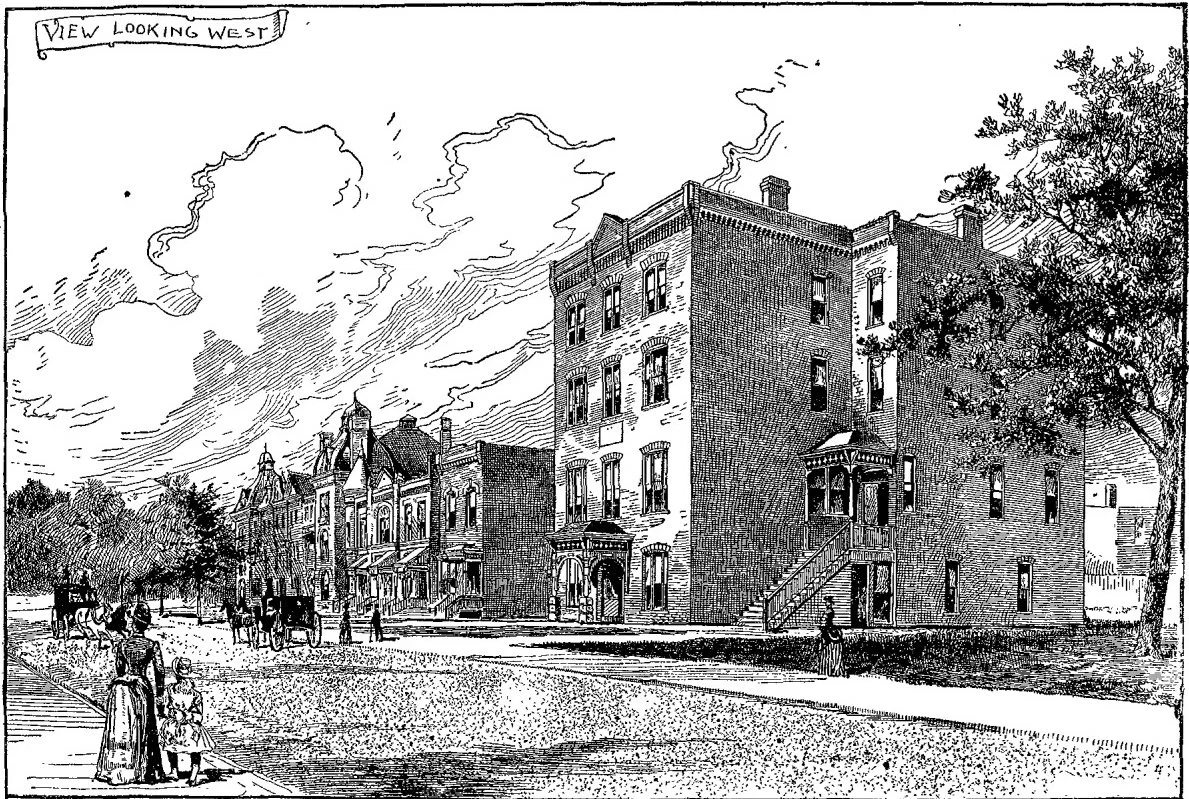
The accompanying illustration shows our new building; numbers 26 and 28 College Place, Chicago, as viewed from the east, just as it appears to one stepping off the cable car on Cottage Grove Avenue, after a thirty-minutes’ ride south from the center of the city. The building is a substantial brick structure, forty-five by sixty feet, with four stories and basement, and contains thirty-eight rooms, including the chapel and two class-rooms, besides bath, toilet, laundry, and store rooms.
The building faces the south, thus giving the sunlight opportunity to enter all parts of the house. It is heated by steam throughout, and furnished with one of the very best passenger elevators. A water purifier distills and purifies the lake water, freeing it from germs, and making it pure and soft. Much care was given in the construction of the house, to provide for the economy of labor and the preservation of health.
The entire cost of the building and grounds was about $28,000. Nearly one half of this sum has been given by friends of the school in Illinois, and two or three thousand dollars by others; and upon the remainder a low rate of interest is paid. The property has been deeded to the General Conference Association, and at the last session of the Illinois State Conference, its free use was offered to the General Conference as a training-school for Bible workers and home and foreign missionaries. This offer was accepted by the General Conference, and a committee was elected for the management of the school. The committee requested that three persons under the employ of the General Conference should be appointed to its management; and George B. Starr (Principal), Miss M. L. Huntley (Assistant), and Mrs. G. B. Starr (Matron), were chosen.
There are now about twenty persons in attendance at the school, maintaining interesting classes in Bible study, Scripture readings, missionary correspondence, etc. A large increase in attendance is expected at the opening of the next term.

SPECIAL SCHOOL FOR LADIES.

Arrangements have recently been made for a thorough course of instruction at the Central Bible School, Chicago, for ladies from the various States, who desire to fit themselves to become Bible workers and corresponding secretaries in the tract and missionary work. The course will begin Wednesday, Jan. 8, 1890, and continue six months. The charge to be made for tuition, room, and board, for the entire time, is to be placed at the very low sum of fifty dollars.
The calls for intelligent persons to engage in these branches of work, are becoming more and more urgent each year as the work advances; and the necessity of seeking out persons of fair education and good address, and encouraging them to fit themselves for these lines of work, is becoming more and more apparent. We are assured that there are many intelligent ladies among our people, between twenty and forty years of age, who could, with proper instruction, fill these places with acceptance. The cause could use a hundred such today, were they in readiness to enter the work. Shall we labor earnestly to avoid being in this same situation next year? Will the officers of the various Conferences begin now to seek out proper persons to enter upon a training this winter? The school is under the direction of the General Conference, and the teachers are persons in its employ.
The following is a brief outline of the course proposed:—
  1. Instruction in home and foreign missionary correspondence, under the direction of Miss M. L. Huntley.
  2. Training in the canvass for Good Health, and other introductory work in cities.
  3. Daily class in Bible study.
  4. Class in Bible work.
  5. Short course in single-entry book-keeping.
  6. To those remaining more than six months, opportunity will be provided for the student to acquire, under competent leaders, an experience in working in new fields. This will occupy the summer months, and it is hoped may be so planned as not to add any expense to the worker, but rather to be a source of income.
Each person will be expected to devote one hour’s time each day to the regular routine work of the house. For further particulars, address, Eld. Geo. B. Starr, or Miss M. L. Huntley, 28 College Place, Chicago, Ill. COMMITTEE OF MANAGEMENT.

Special Notices.

TENNESSEE RIVER CONFERENCE, NOTICE.

There will be a general meeting at Springville, Tenn., from Dec. 25 to Jan. 7, 1890. Let as many of our people come as consistently can, and especially those who wish to canvass, as we wish to engage as many as possible in that work soon after the meeting. At first it was thought best to hold one meeting for the entire Conference, but it was found by correspondence that it was thought that the distance would be so great that but few could attend. So we shall hold two meetings. One will be held somewhere in Central Kentucky, notice of which will be given as soon as we can advise with brethren there as to the best probable place for the meeting.
At these meetings we wish to lay plans for the spring and summer work. Satan is at work here, to harass and destroy our work, and we must redouble our diligence in the spread of the light, or darkness will overtake us. In the recent attempt at conviction of our brethren before the courts, God has given us some victories, but we cannot expect a long respite at this late hour; so let us rise from this opposition stroke, and do valiant battle for truth.
E. E. MARVIN, Pres. Tenn. River Conf.

THE MINNESOTA CONFERENCE SCHOOL.

THE WINTER TERM.

The winter term of the Minnesota Conference School will begin Wednesday, Jan. 1, 1889. The term will last twelve weeks, and will probably be followed by a special course. All who desire to enter, should make application at once, and should be present the first day for classification.

STUDIES AND ADVANTAGES OFFERED.

A full line of classes in the common branches will be open, and in addition classes will be formed to begin a twelve-weeks’ course in the following subjects: physiology, U. S. history, civil government and religion, book-keeping, business arithmetic, physical geography, and present truth. The classes in rhetoric, algebra, general history, and Bible history will be continued, and will be open to all who desire, and are prepared, to enter them. There will be two singing classes, meeting weekly,—one for beginners, the other for pupils more advanced. A course of doctrinal lectures will be in progress Sunday evenings, and missionary, social, and Sabbath-school teachers’ meetings will be held weekly. A health and temperance club will hold monthly meetings. Every Friday afternoon will be devoted to literary work.

EXPENSES.

Tuition: $2.25, $2.50, and $2.75 per month. Board, at dining hall, $1.00 to $1.25 per week. Room, furnished, about $1.50 per month to each student. Books, estimated, $3.00 to $5.00.

WHO ADMITTED.

There is no primary department. Our work begins with the fourth reader and the studies usually accompanying it. Above this grade of work, any person of good moral character will be received. Those who are unknown to the Conference committee or to the teachers, must come well recommended. We are especially anxious that all who desire to fit themselves to labor in any department of the cause, should embrace this opportunity. Even if you are somewhat advanced in years, and your mind has become rusty through disease, do not hesitate on that account. We have a school, we are thankful, where you can “brush up” with the least possible embarrassment, and whose teachers will take a special interest in helping you. We have tried to plan the work of the school so as to do the most good to the greatest number, and we hope that a large number will avail themselves of the opportunity thus provided. The total attendance for the term about closing is sixty-seven. We can accommodate thirty or forty more, and hope to see that number added next term. Students from neighboring States will be welcomed.

MISCELLANEOUS.

1. To reach the school: From the Union Depot, go to the new Post-office Building, which you will easily find by inquiry. At that corner take the electric motor (not the steam motor) to the corner of Fourth Avenue and Lake Street. From the Milwaukee Depot, go south on Fourth Avenue one block, and take the electric motor going south.
2. Address all correspondence concerning the school, and all mail for students, to the Minnesota Conference School, 338 E. Lake St., Minneapolis, Minn.
3. Make application, so that we may know how many are to be provided for.
C. C. LEWIS, for CONF. COM.

COUNCIL MEETING FOR OHIO.

BEGINNING Thursday, Jan. 9, 1890, at 7:30 P. M., and continuing till Tuesday morning, Jan. 14, there will be a council meeting held at Columbus, Ohio, at which will be present the ministers and licentiates, the officers of the tract and missionary society (including directors), the officers of the Sabbath-school association, of the canvassing work, and of the national religious liberty and health and temperance associations. Elds. O. A. Olsen and R. A. Underwood, and other members of the General Conference Committee not yet decided upon, will be present to assist in the meeting. Let there be a full attendance of those included in this notice, as matters of importance pertaining to the work in Ohio will be considered at this meeting.
OHIO CONF. COM.

TENNESSEE RIVER TENT AND CAMP-MEETING FUNDS.

It is known to our people that we purchased some new tents last spring, to be paid for in the fall, and the pledges were taken from our brethren to meet the payment at camp-meeting time; but many of those pledging did not come to camp-meeting, and so quite a sum is still behind, and thus far we have been unable to meet the payment. Now, let all, as far as possible, send in their pledges, or at least a part of each, at once, to J. H. Dortch, Springville, Tenn., specifying what each is for.
There is another matter of which we must speak. The expenses at our last camp-meeting were much greater than ever before, amounting to about seventy-eight dollars above camp-meeting receipts. We had on hand a camp-meeting fund from last year, amounting to $12.60. This would still leave a deficit of about sixty dollars. We had to draw from the Conference fund to pay this, and this, by all means, should be paid back. If each one will do something for this fund, it can and will soon be paid up. Let all who feel disposed to help lift this burden, manifest their purpose by sending donations to J. B. Yates, Cross Plains, Tenn.
E. E. MARVIN, Pres. Tenn. River Conf.

The Sabbath-School.

“The entrance of thy words giveth light.”—Ps. 119:130.

LETTER TO THE HEBREWS.

LESSON 13.—HEBREWS 7:15–26.
(Sabbath, Dec. 28.)

Questions, with Scripture Texts and Notes.

1. To whom was the priesthood given in the law of Moses?
2. How strict was the law on this subject?
3. How, then, could Christ become a priest?
4. How were the first priests said to be made?
“Who is made, not after the law of a carnal commandment, but after the power of an endless life.” Heb. 7:16.
5. What is meant by a carnal commandment? (See notes.)
6. How was Christ made a priest? Id.
7. Why was the former commandment disannulled?
“For there is verily a disannulling of the commandment going before for the weakness and unprofitableness thereof.” Verse 18.
8. Why was it unprofitable?
“For the law made nothing perfect.” Verse 19, first part.
9. What was brought in when that was disannulled?
“For the law made nothing perfect, but the bringing in of a better hope did; by which we draw nigh unto God.” Verse 19.
10. How did the Father declare the priesthood of his Son?
“And inasmuch as not without an oath he was made priest (for those priests were made without an oath; but this with an oath by him that said unto him, The Lord sware and will not repent, Thou art a priest forever after the order of Melchisedec.)” Verses 20, 21.
11. What did this indicate? Ans.—The oath of God, from which he would not turn, indicated the honor and dignity of the priesthood of Christ, to show which is, indeed, the object of this entire chapter.
12. Of what did he become surety?
“By so much was Jesus made a surety of a better testament.” Verse 22.
13. What is meant by his becoming surety of a covenant? (See note.)
14. Why were there many priests under the old covenant?
“And they truly were many priests, because they were not suffered to continue by reason of death.” Verse 23.
15. Why is the priesthood of Christ perpetual?
“But this man, because he continueth ever, hath an unchangeable priesthood.” Verse 24. (Perpetual, not transferred from one to another, gives a better idea of the fact stated than the word unchangeable.)
16. What further assurance does this give to us?
“Wherefore he is able also to save them to the uttermost that come unto God by him, seeing he ever liveth to make intercession for them.” Verse 25.
17. How is it that such a High-priest became us?
“For such a high-priest became us, who is holy, harmless, undefiled, separate from sinners, and made higher than the heavens.” Verse 26. (This means that he is a High-priest in every way suited or fitted to our wants. The Aaronic priests could not meet our necessities—could not take away sin.)
18. What is the character of our High-priest? Id.
19. Did any of the Levitical priests resemble him in this respect? Ans.—The laws concerning the purity, in both person and character, of the high-priests, were very strict. But no man ever bore the character here described.
20. What is meant by his being higher than the heavens?
“The eyes of your understanding being enlightened; that ye may know what is the hope of his calling, and what the riches of the glory of his inheritance in the saints.” “And hath put all things under his feet, and gave him to be the head over all things to the church.” Eph. 1:18, 22.
“Who is gone into heaven, and is on the right hand of God; angels and authorities and powers being made subject unto him.” 1 Pet. 3:22.

NOTES.

Carnal means fleshly; a carnal commandment means a commandment pertaining to the flesh. Carnal does not always nor necessarily mean sinful or evil. The Levitical system was not spiritual; perfection was not by nor in it. The word seems here to have reference to the frailty and mutability of mortal priests. This is rendered quite certain by the contrast. They were made priests by a carnal commandment; he, after the power of an endless life.
Of course the commandment that is disannulled is the same as the law of Heb. 7:12. There was a disannulling of the entire ecclesiastical law of that dispensation, of which the priesthood was the center. Verse 19 is obscured by the common rendering. The first clause should certainly be in parentheses. “For there was verily a disannulling of the preceding commandment, for the weakness and unprofitableness thereof (for the law made nothing perfect), but [there was] the bringing in of a better hope by which we draw nigh unto God.” The actual contrast in the passage is destroyed by the introduction of the word “did” in our version. There was a disannulling of the one, and there was a bringing in of the other. The first made nothing perfect; by the second we draw nigh unto God. The first had to be taken away, that the second might have place. There is a force to the expression “by which we draw nigh unto God,” that is generally overlooked. Thus it is said that Moses drew nigh unto God, while the people stood afar off. Ex. 20:21; 34:1. And so the priests drew nigh unto God in his sanctuary, even into his presence, but it was death to the people to come near. But under the intercession of our High-priest we are all said to draw nigh unto God. (See the same contrast presented in 2 Cor. 3:12–18.) What gracious privileges are conferred through the gospel of Christ?
Becoming the surety of the covenant is a strange expression; such an idea is nowhere else found in the Scriptures. Jesus is not only the mediator of the better covenant, but he becomes surety—he seems to assume the responsibility of seeing that the object of the covenant shall be accomplished. This is an additional assurance to those who place their cases in his hands. But in this word, or in this transaction, there is no room given for presumption. It may not be said, I will do nothing, or, I have nothing to do; Jesus is my surety, and he will do all in my behalf. In any transaction no one would become surety for another who made no effort to be just. The first covenant had no surety; for the priests could not insure perfection, either in obedience, or by virtue of their offerings. How great reason have we to be thankful; for, with such a High-priest as we have, there can be no failure in this covenant, unless it be through our own neglect or willfulness.
Because Christ has unending life and a perpetual priesthood, he is able to save completely—to the uttermost—them that come to him. No case can be forgotten or neglected in the transfer of office from one to another, or by reason of the infirmity and inefficiency of the advocate. Everything connected with his priesthood is calculated to give encouragement and assurance to those who put their trust in him.
Continue reading: News of the Week