The declaration of the apostle Paul has ever been the watchword of the militant church of God, emblazoned upon the escutcheons of her standard-bearers, proclaimed in clarion tones by her heralds:
“I AM NOT ASHAMED OF THE GOSPEL OF CHRIST; FOR IT IS THE POWER OF GOD UNTO SALVATION TO EVERY ONE THAT BELIEVETH; . . . FOR THEREIN IS THE RIGHTEOUSNESS OF GOD REVEALED FROM FAITH TO FAITH; AS IT IS WRITTEN, THE JUST SHALL LIVE BY FAITH.” ROM. 1:16, 17.
That faith was based upon the word of God.
“ALL SCRIPTURE IS GIVEN BY INSPIRATION OF GOD [LITERALLY, GOD-BREATHED], AND IS PROFITABLE FOR DOCTRINE, FOR REPROOF, FOR CORRECTION, FOR INSTRUCTION IN RIGHTEOUSNESS: THAT THE MAN OF GOD MAY BE PERFECT, THOROUGHLY FURNISHED UNTO ALL GOOD WORKS.” 2 Tim. 3:16, 17.
That watchword and battle-cry was heard faint and far and infrequent during the Dark Ages; but the Reformation revived it. The Bible came to its own. Chained tho it often was, it set men free. That Gospel, that Reformation, revolutionized Europe, and changed the face of the world. Thus its historian D’Aubigne speaks:
“The Reformation was accomplished in the name of a spiritual principle. It had proclaimed for its teacher the word of God; for salvation, faith; for king, Jesus Christ; for arms, the Holy Ghost; and had by these very means rejected all worldly elements. Rome had been established by the law of carnal commandment; the Reformation by the power of an endless life.”
“If there is any doctrine that distinguishes Christianity from every other religion, it is spirituality. A heavenly life brought down to man—such is its work.”
“The Gospel of the Reformers had nothing to do with the world or with politics.”—Book XIV, Chap. 1.
Upon the foundation of faith in the word of God was virile, aggressive, winning Protestantism built. Into the soil of that word it stuck its roots and grew and flourished and bore fruit. Millions sought its shade and shelter and sustenance, and found salvation and life and growth.
Not all the truth of God’s Book did Protestantism possess. That was and is evidenced by her numerous branches. The spell of hoary tradition was still strong upon the Reformation. The human creed-power still bound her. The power of the state still had its attractions; but her face was Godward, her principles were sound, and she was on the highway to truth and freedom.
Would God she had broken the spell of tradition. Would God she had left the human shaping of creeds, and remained loyal to the Bible wherever the Old Book led. Creeds would not have multiplied. National churches would not have been formed. Dead formalism would not have cursed her congregations. The union with the state would not have tempted her; for the church of Christ never asked human power to enforce a truly Scriptural teaching.
Intolerance and persecution would never have been known in Protestant ranks. The monopoly of church and state and its fruitage would have been left to Rome. Great power would have remained with Protestantism.
Problems to Solve
Then grave problems faced her. Long downtrodden truths, forever settled by the Bible, confronted her. The full claims of the Decalogue were pushed upon heart and soul. Should she break with the civil power? Should creeds by dead hands be set aside, and defined human standards erected? That word clearly showed errors still to be relinquished. Right here Protestantism made a fatal mistake. In the words of the Right Honorable James Bryce, present British Ambassador to the United States:
“The principles which led the Protestants to sever themselves from the Roman Church should have taught them to bear with the opinion of others, and warned them from the attempt to connect agreement in doctrine or manner of worship with the necessary forms of civil government. Still less ought they to have enforced that agreement with civil penalties, for faith, upon their own showing, had no value save when it was freely given.”
“But whether it was that men only half saw what they had done; or that, finding it hard enough to un-rivet priestly fetters, they welcomed all the aid a temporal prince could give; the result was that religion, or, rather, religious creeds, began to be involved with politics more closely than had ever been the case before. Through the greater part of Christendom, wars of religion raged for a century or more; and down to our own days, feelings of theological antipathy continue to affect the relations of the powers of Europe. In almost every country the form of doctrine which triumphed associated itself with the state, and maintained the despotic system of the Middle Ages, while it forsook the grounds on which that system had been based.
“The will of the sovereign, as in England, or the will of the majority, as in Holland, Scandinavia, and Scotland, imposed upon each country a peculiar form of worship, and kept up the practices of medieval intolerance without their justification.
“Therefore the intolerance of Protestants, if the forms it took were less cruel than those practised by the Roman Catholics, was also far less defensible; for it had seldom anything better to allege on its behalf than motives of political expediency, or more often the mere headstrong passion of a ruler or a faction, to silence the expression of any opinions but their own.”—Holy Roman Empire, Chap. 18.
Out of this condition, Protestantism slowly emerged. The world grew sick of intolerance. It drove from some countries, like France, the best of her citizens. England led in liberty of conscience. America opened her doors to the oppressed of all nations, and set a higher standard of religious liberty than any government of the world had ever known. Under that liberty, religion, and education and all the beneficent practices which flow therefrom flourished.
But great, present truths, lying dormant, demanding resurrection, or ripe for the times, pressed upon the great Protestant denominations. Fulfilling prophecy demanded their attention. A wounded, divided church demanded their application. The power of tradition and denominational pride held the church from her duty. The offense of the cross was too great to bear. The scientific sedatives of geology and evolution came in11to blind the eyes which began to see, to harden the consciences which began to be troubled.
What was the worth of the story of Creation in Genesis in the light of geology, hypothetical tho it was? What was the story of the origin of man worth in the light (?) of the Darwinian theory of evolution and origin of the species? Men began to measure God’s power by themselves, His word by their word. The evil leaven crept into education and leavened the lump. There have been many and strong protests against the higher criticism, against the rejection of the Genesis story of man and his fall. But they have rapidly grown weaker and fewer, till now one is scarcely heard. Heresy is triumphant. With the rejection of Moses goes ultimately the rejection of Christ. In the rejection of Creation and its memorial, the Sabbath, goes the regeneration and restoration of the sinful soul. The awful results of that first step are thus stated by the New York “Independent” of June 24, one of the leading semi-religious journals of America:
“When we found that the world was more than six thousand years old, that there was no universal flood four thousand years ago, that Adam was not made directly from dust, and Eve from his rib, and that the Tower of Babel was not the occasion of the diversification of languages, we had gone too far to stop. The process of criticism had to go on from Genesis to Revelation, with no fear of the curse at the end of the last chapter. It could not stop with Moses and Isaiah; it had to include Matthew and John and Paul. Every one of them had to be sifted; they had already ceased to be taken as unquestioned, final authorities, for plenary inspiration had followed verbal inspiration just as soon as the first chapter of Genesis had ceased to be taken as true history. The miracles of Jesus had to be tested as well as those of Elijah. The date and purpose of the Gospel of John had to be investigated historically as well as that of the prophecy of Isaiah; and the conclusion of historical criticism had to be accepted with no regard to the old theologies. We have just reached this condition, and there is repeated evidence that it makes an epoch, a revolution, in theologic thought. This is what we learn from Chicago and New York, from two such militant denominations as the Baptist and the Presbyterian.
“Consider what it means. In England Professor Forsyth is repeating with emphatic insistence that Christianity centers not in the teachings but in the person of Christ, the Christ of the trinity, miraculously conceived, risen from the dead, ascended up into heaven, and there seated as one of the three persons in the trinity of God. But the current, critical theology, which we read in the current Bible dictionaries, and which is taught in venerable theological seminaries, doubts or denies all this. To this present teaching, which has invaded all our denominations, Jesus is the world’s prime teacher, but it can assert nothing more. There is, it declares, no reasonable proof of His birth from a virgin, no certainty of a physical resurrection; the Gospels must be analyzed, for they contain mythical elements, non-historical miracles, unverified assertions. The synoptic Gospels give us more correctly the oral teachings of Jesus, but the Gospel of John and the epistles of Paul make the person of Jesus central and represent a stratum added to the genuine, simpler teachings of the Master, and must be analyzed and questioned or rejected.
“But this doubt, even this questioning or denial, changes the old, evangelistic theology. It questions or denies the trinity, the Resurrection, the Sacrifice of the Cross, even all miracles, and it undermines all authority of inspiration or even revelation, and sends us back to human reason, with such divine guidance as may be allowed; the authority of the Bible and the authority of the church both to be validated only by human reason. Just how this differs from the old Unitarianism, and what need there is for Unitarianism to maintain itself, are questions that must arise for consideration.”
Of the present and future of this trend of Protestantism we have more to say in future issues.
Some Important Facts
THE “Wall Street Journal” is a daily paper which sells for five cents. Its circulation is small, probably not over fifteen thousand. But those fifteen thousand buyers of the paper are the richest men in the United States. The “Journal’s” regular daily readers have an aggregate wealth greater than that of any other daily paper. It is the trade journal of Wall Street, and it is alone in its premiership. Its contents consist of the New York Stock Exchange quotations, running comment on the day’s events on the Exchange, news of corporation meetings, dividends declared, the trend of the bond market, a mass of financial advertising, and finally, each day a few very able editorials. It is from these editorials during the past few weeks that the following paragraphs are taken. We think they will surprise any one who does not know the “Wall Street Journal” and has read our description of it. First, about the $29,000,000 fine against Standard Oil:
“The Landis decision was the fruit of a popular state of mind brought about by methods of corporation activity of which the life insurance inquiry gave the first illuminating exposition. Corporations in those times were in many cases being conducted with an utter indifference to the laws of God and man. If a corporation were only strong enough, its managers assumed that anything was right which they could bring about without actually incurring prosecution. It was thought in some financial circles proper to own the representatives of the people in state legislatures or in Congress, and, indeed, we had established a condition so rotten as to bring about a violent revulsion of public sentiment.”
This concerning the tariff which the Senate has been making:
“We have only to glance at the tariff discussion in the Senate to see how far we have fallen back, after the moral upheaval of a few years ago. The spectacle there is so base, so utterly without patriotism or principle, so far from the ideals of either party, so crudely self-seeking, and so callously ready to sacrifice the interest of an entire nation for the benefit of a small part of it, the interest of a state for a small influential portion of that state, and even the interest of a Congressional district for a few contributors to a campaign fund, that it points to the establishment of a new tyranny. This moral rot in our commercial system, so indecently displayed in the United States Senate, is one of a number of signs which should cause us to think. The spectacle at present afforded by the United States Senate is an insult to every self-respecting American. It exhibits statesmen supposed to be acting in a national capacity owned in soul and pocket-book by petty local interests, while one corporation after another shows that it can snap its fingers at the promises made by the Republican President and all his party before election, and accepted by the American people.”
Finally, this about commercial and political conditions:
“There is, however, evidence patent enough to any observer that favored interests are trying to establish a return to conditions which were most properly suppressed within the past four years.”
“There is, in fact, a shameless revival of that association of selfish corporate interests with legislation and legislators, such as dared not show its head twelve months ago.”
These quotations suggest many thoughts. Probably it is proper first to express appreciation of a newspaper which, although its clientele consists of men of great wealth exclusively, is yet independent and outspoken. We know of no newspaper, even among those that appeal to the public in general, which is so frank and forceful. . . . Finally, the intrinsic truth of the “Journal’s” words is important. We trust the character of their source will carry conviction where a more radical publication’s utterances might be read with some reservation.—Collier’s Weekly.
Persecuted for Conscience’ Sake
On Copper Ridge, in a country district about twelve miles from Knoxville, are a Seventh-day Adventist church and a school.
Among the members are the wife of a prominent and well-to-do merchant, who lives near the church, and a good and respectable citizen by the name of Davis Cruze. The merchant does not belong to the church, but is in sympathy with the teachings of the Seventh-day Adventist religion. Some of the neighbors do not like it because the merchant attends this church, and they have opened a store in opposition to him. Previous to the erection of this church, it was customary for the neighbors to buy necessary articles on Sundays. The merchant has kept this custom up, and has recently been indicted for selling goods on Sunday.
It is also the custom of the neighborhood for the men to chop wood and do other chores about the farm on Sundays. A short time since, Davis Cruze, early one Sunday morning, chopped a little wood for his wife to get dinner. On the complaint of some of his neighbors, he has since been indicted by the grand jury of Knox County, Tennessee. Many of the neighbors of this vicinity deplore the proceedings that have been taken against these two gentlemen, as they are esteemed to be among the most worthy citizens of the county, which proceedings demonstrate the partial enforcement of Sunday legislation for religious persecution, and for the gratification of personal revenge.
The following is taken from the Knoxville Journal and Tribune, published July 28, 1909:
“Indicted for Chopping Wood on Sunday”
“Davis Cruze, a Seventh-day Adventist, and a respectable citizen, living near Powell Station, was indicted by the grand jury for chopping wood on Sunday. He had been working for a neighbor during the week, and on Sunday morning his wife requested him to chop a little wood so that she could get dinner. He did so, with the above result. Others in his neighborhood, not belonging to his religion, have, it is said, chopped wood on Sundays, on such occasions, without being molested. His case is continued until the next term of the criminal court.”
Forest Facts
In their original condition the forests of the United States exceeded in the quantity and variety of their timber the forests of any other region of similar size on the globe. To the eyes of the pioneers they were an inexhaustible resource. Only within recent years has the fact of their destructibility been emphasized to the public ear.
In pursuit of the crusade for the forests the Department of Agriculture has just issued a pamphlet showing the present state of the trees. That an original forest acreage of 850,000,000 has been reduced to not more than 550,000,000 by cutting, clearing, and fire, is the first impressive statement. These figures show less strikingly what destruction has been wrought, however, than does the declaration that where was once a total stand of 5,200 billion feet of saw timber, there remains a stand of only 2,500 billion feet. The forests have been reduced by thirty-five per cent, the stand by fifty-two per cent.
We are cutting our forests three times as fast as they grow. We take 250 cubic feet of wood per capita annually from our forests, where Germany takes but thirty-seven cubic feet, and France but twenty-five. Germany has learned the lesson of forest renewal, with no better soil or stock than ours.
Even on an acreage reduced another 100,000,000 by the opening of new farms, as much wood as a population much greater than our present one will really need can be maintained by proper forestation. —New York World.
The Turkish Mission
By C. D. AcMoody
By C. D. AcMoody
[One of the good reports made at the recent World's Conference of Seventh-day Adventists at Washington, D. C.]
THE Turkish Mission comprises Turkey in Europe, and that part of Turkey in Asia lying north of the Bay of Alexandretta, the country known as Asia Minor and Armenia.
Past History
In presenting a report of the Turkish Mission for the past four years, it may be well to briefly review the way in which the truth entered the Turkish Empire. It first entered Constantinople about twenty years ago. An Armenian brother who had accepted the message in America, returned to his own country to let his light shine, and to disseminate the principles which he had learned to love. In the course of a few months Elder Z. G. Baharian, who at the time was a student in the Aintab Protestant College, became interested in the principles of the third angel's message through literature sent him from Constantinople. After his graduation he came to Constantinople, and studied the truth with this Armenian brother. He was then sent to Basel, where he remained several months studying the principles of Seventh-day Adventists, returning to Turkey as a worker in 1892. His work was confined for several years to the Asiatic coast in the vicinity of Constantinople, where several companies of Sabbath-keepers were raised up.
Some workers were sent into the central part of Turkey in 1904, and Brother Baharian was exiled from Constantinople to the country of his birth, at Aintab. Many of those who hear this report will remember reading an account of the imprisonment of Elder Baharian which followed his banishment, when, for several months, it was thought that he must face the penalty meted out only to anarchists and traitors, which in Turkey means banishment for life or capital punishment; but God delivered His servant.
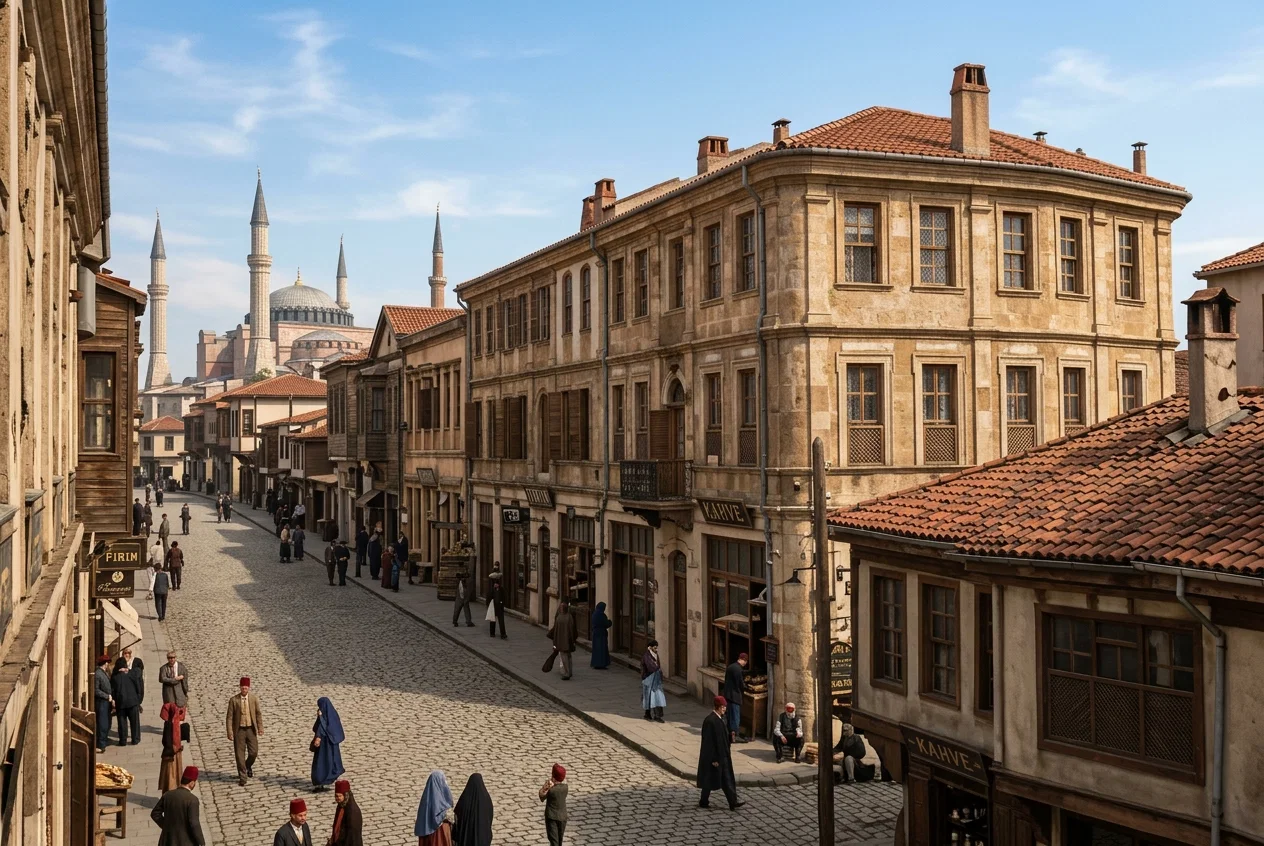
Cathedral of St. Sophia, Constantinople
A street in Monastir, Turkey, where the reform movement broke out
The late Doctor George went to Turkey in 1903, and began immediately to prepare himself for work among the people of Constantinople in medical lines. His task was greater than that of the ordinary foreign missionary, as it was necessary for him first to acquire the French language in order that he might pass the medical examination in Turkey. He was successful in passing his examinations, and then devoted his attention to acquiring the Turkish language. He started treatment-rooms in Constantinople after visiting among the churches, and much patient effort in preparing a suitable location. Having thus started his work, he was afflicted with tuberculosis, and was forced to leave the field in 1906, two weeks before my arrival in Constantinople. He went to Switzerland for his health, and later to Germany, where he died in February, 1907.
Too much could not be said in paying high tribute to the character and work of this missionary, who laid down his life in the interests of the third angel's message in the land of the sultan. Tho I was not privileged to meet him personally, I found that he had left behind him, through his earnest work, that which was lasting, and that which was to stand as an encouragement to those who would follow him. In everything he did, persevering effort and painstaking care were shown. He clung to his work too long for the good of his health. When he left Constantinople, he was confined to his bed. His death was indeed a severe blow to such a weak mission field as Turkey. The burden which rested upon all of us as the result of this experience, seemed heavy indeed. The treatment-rooms had to be closed up, and the furniture stored and finally sold, because no one could be found to take his place. This is an appeal to all who love the message throughout the world, and especially to those assembled at this Conference, to place some one in the Turkish Empire to take up the work of him who fell at his post.
Work During the Past Four Years
The chief matter of interest in the years of 1905-6 relates to the establishment of the treatment-rooms in Constantinople, which has already been referred to. During these years, Elder Baharian was not allowed to travel, and was confined almost entirely to the city of Aintab. Here he has not been able to do as much as has been desired, because of the bitter antagonism of the Protestants against his work. Besides, there have been obstacles to meet in Turkey which are met in other field. These I will speak of later.
I arrived in Constantinople, Dec. 3, 1906. My efforts were expended during the following winter in traveling among the churches and companies in the vicinity of Constantinople, as they had not been visited by any minister, either native or foreign, for some time. The summer of 1907 I spent most of my time in the city of Constantinople, traveling again among the churches in the fall.
In the middle of May, 1908, Elder R. S. Greaves and wife arrived in Smyrna to take up work among the Greeks. Smyrna is the second city in size in the Turkish Empire, and is composed of Greeks, who are Turkish subjects. Brother and Sister Greaves have been diligently working upon the Greek language, and hope so to master it as to be able to work to advantage on the west coast of Asia Minor, and in the islands of the Greek Sea.
Prior to July 25, 1908, and especially since 1903-4, our native workers, wherever located in Turkey, have labored under such tremendous disadvantages as in many cases to render their work quite fruitless, as far as securing converts to the faith is concerned. But since the declaration of the Turkish constitution in July, such liberty has prevailed in the Turkish Empire as has never before been known. Perfect freedom of speech and press was granted, and that for which we had prayed many years, and which we had endeavored to secure by various means for a long time, was granted to us in a single day.
Our First General Meeting
A Levant Union general meeting had been planned for, but it had not been decided where it should be held. We were desirous that some of the native workers attend this meeting. The liberty came in time so that the general meeting could be held in Turkish territory. Accordingly, the workers came together at Beirut, Syria, the last week in September, and three of our native workers from the Turkish Mission were able to attend this meeting. For the first time in the history of our work in Turkey we had liberty, and were free to meet together to sing praises to God, and counsel together regarding His work, knowing that we were not infringing upon the tyrannical laws of the sultan. This meeting was a great help to the whole Levant Union, as workers were gathered together from all the various mission fields. Especially was it a great help to the Turkish Mission.
Following this meeting, Elder Baharian and I made a tour throughout central Turkey, visiting the isolated companies of Sabbath-keepers, some of whom had never seen a Seventh-day Adventist minister. Few can appreciate what this meant to the native constituency.13God's blessing attended us throughout the trip, most of which was made on horseback, as there are very few roads in that part of Turkey. During the trip, we were ten days in the carriage, and eleven days in the saddle. We visited ten churches and companies.
Upon arrival at Constantinople, the middle of December, I found it necessary, on account of my health, to make immediate plans to come to America, and I accordingly left Turkey, Jan. 10, 1909.
Statistics
I will now give a brief statistical statement of the membership, workers, etc., of this field. At the close of 1908, the membership shows 233 members, with five churches and ten companies; number baptized during the year, eighteen; total workers, ten; total money received, $621.30.
And now when you consider that there are many families who live on from fifty to seventy-five dollars a year, and that out of this must come their living expenses, you can readily see that the tithe must be very small.
Of the workers reported for 1908, there are four ordained ministers, two native workers, two licentiates, one nurse, and one Bible worker.
Freedom for Turkey
Prior to the granting of the constitution, the Turkish field was in many respects the most difficult in the world in which to work. Our brethren were not recognized by the government officials, because our church is not an established church according to Turkish law. If a man be not a church-member of some established church which is recognized by the Sublime Porte, he is not a protected subject under Moslem law. It would take a great deal of space to enter into details to show the embarrassing situation under which our work has been conducted. No meetings could legally be held anywhere. None of our people could become legally married without being baptized according to the rites of the Gregorian or Greek Orthodox churches. Neither could our people secure permission to travel. Our native workers were especially watched, and were not able to do any effectual work for weeks at a time. We sought God earnestly for a door to be opened whereby we might be able publicly to spread the Gospel; and just while we were considering some plan by which we might accomplish this, the hand of God, which rules over the affairs of nations, was manifested in causing to come to pass a complete change in the Turkish Empire. This change will be recorded in history as a miracle in the doings of nations, and we praise God that since July we have had a free hand in Turkey. The problem that now presents itself is not, How shall we secure the right to labor? but How shall we fill the great open door that we now face?
Facing the Future
As distinct and separate from each other are the different languages of Turkey, as the English language is separate from any one of them. There are some nineteen or twenty distinct languages spoken in the empire, besides the various dialects of these languages.
The acquiring of one of these languages is practically of no assistance in acquiring a second. We need workers to master these languages, and to enter into the field to reach the various people with the message.
Whether you consider it politically, religiously, or prophetically, there is no country in the world to-day that occupies a position of so unique importance as does the Turkish Empire.
No longer can we maintain the plea that Turkey is so largely a closed field that it will not pay to spend our energies upon it until the door is opened, for now the door is opened. O, how important that we should be ready to enter the regions beyond at these critical moments!
The Song of the Lowly
WHEN I have nothing in my hand
Wherewith to serve my King;
When Thy commandment finds me weak
And wanting everything,
My soul upon Thy greatness cast
Shall rise divinely free;
And I will serve with what Thou hast,
And gird myself with Thee!
— Sel.
The Vegetarian Cook Book
By E. G. Fulton
By E. G. FULTON
THE author has had years of experience in vegetarian cookery and in the management of vegetarian cafes, and cafeterias. With its aid the chef, cook, or housewife is able to prepare appetizing, healthful meals without the use of any flesh food.
This book contains 226 pages, including a handy and well-arranged index of all the recipes given.
Tastily bound in cloth, price, post-paid, 75 cents
Pacific Press Publishing Assn.
Mountain View, California
Portland, Ore. Regina, Sask., Can. Kansas City, Mo.
Take the Chicago and Northwestern Line for all points East.
Through daily and personally conducted tourist cars from San Francisco at 6:40 p. m. Low round-trip tickets on various dates to Eastern points. Apply to Southern Pacific agents, or
R. R. RITCHIE,
General Agent Chicago & Northwestern R. R.
878 Market St. San Francisco
Early Writings.
By Mrs. E. G. White. A new edition of this popular work, rearranged and reprinted from new plates. This book is a compilation of the first published writings of the author, and contains many encouraging words for those who are looking for the soon return of our Lord. Cloth, 75c; limp leather, $1.25. Address this office.
Seventh-day Adventist Hymn and Tune Book
Seventh-day Adventist Hymn and Tune Book. The best selected and arranged hymn and tune book ever issued. Contains 1,413 hymns and 568 of the choicest tunes and sacred songs ever written. 640 large pages. Cloth, plain edges, 75 cents; half leather, marbled edges, $1.50; Russia, marbled edges, $2.00; Turkey morocco, gilt edges, $2.25; Levant, round corners, gilt edges, leather lined, $3.25. Address this office.
Consider It
If one person can by devoting all her time, put into circulation 1,900 copies of the Montly Signs in eight weeks; if another worker places 3,500 in three months, what might be accomplished by a hundred persons who can not give all their time, but some time each month? This is rather hard to answer. The number of small orders is increasing, however. One faithful home worker who has never missed taking her 25 copies each month writes: “I know the Lord will bless these papers, as the time has come for this Message to go to all the world.”
35,000 copies of the August number have been sold—August 3.
Will you not help in putting the remaining stock into circulation quickly?
Note how it gives the Message for to-day
General Alaska-Yukon-Pacific Exposition; Current Topics.
Prophetic “Westward the Course of Empire”—A review of the rise and development of nations, showing the historical and prophetic setting of the last (The United States) with its attending progress and prosperity. By Eld. M. C. Wilcox.
Bible “Needs of the Soul, and How Supplied,” by Eld. Wm. Covert; “I Am the Resurrection and the Life,” by Mrs. E. G. White; “The Law of Faith,” by Eld. S. W. Nellis; “Man’s Station Between the Present and the Future Life,”—Bible Reading—by Eld. J. O. Corliss; “Shall We Recognize Matter, or Spirit Only?”—Dealing with principles of Christian Science—by Eld. R. A. Underwood.
Religious Liberty “Fundamental Principles of Religious Liberty,” by Eld. W. A. Colcord.
Health and Temperance “Dangers in Use of Milk,” by Dr. H. F. Rand; “Prohibition Progress in Canada.”
Twenty-five copies cost $1.00; they sell for $2.50. 100 cost $4.00. You sell them for $10.00. Order of your Tract Society. Ask for the SIGNS WORKER which contains selling points and suggestive canvasses.