Your ShelfYour Projects

Review and Herald, Vol. 93, No. 57.

Christ and the Law
Earlier text: Take Time to Commune With God

Self-Improvement

Now that the long evenings have come, bringing relief from the summer’s heat and the cessation of some of the activities of farm and shop, there is opportunity for most fathers and mothers to take a little time for self-improvement. By this is not meant the spiritual help that should come to each of us in the reading of the Word of God, in meditation, and in prayer. These are primary, and must take the leading place in every successful Christian life. No desire for self-improvement, no social duty, no labor, however pressing, should hinder parents from daily reading the Word and from other spiritual exercises.
It is of another matter that we wish to speak at this time. Often it is a real relief to mind and body, as well as an inspiration and uplift, for fathers and mothers to take a little time for mental improvement. One cannot devote himself wholly to the grind of daily toil without shriveling in soul. Not that any duty in life is humiliating, but the heart of man needs something besides the daily routine, it matters little what that routine may be, to ennoble his life and elevate his ideals.

How Reading Helps

Of all the varied means of self-improvement there is no other so beneficial and at the same time so widely available as reading. One who acquires a taste for reading carries a key of happiness which the world cannot take from him. Sir John Herschel said: “If I were to pray for a taste which would stand by me under every variety of circumstances, and be a source of happiness and cheerfulness to me through life, and a shield against its ills however things might go amiss and the world frown upon me, it would be a taste for reading.”
The gifted statesman and author, Disraeli, declared that “the delight of opening a new pursuit or a new course of reading imparts the vivacity and novelty of youth even to old age.”
“Think what reading, if it is well ordered, can do for us,” says Amos R. Wells. “It introduces us to the best and wisest and strongest of all the past and present, and tells us more about them than their closest friends could know, sometimes more than they knew themselves. It renders us participants in all the stirring scenes of human history, admitting us to the council chambers of kings, the cabinets of presidents, the consultations of great generals. It gives us the inestimable advantages of travel, transports us instantly to the pampas of Brazil, the steppes of Russia, the forests of Alaska, or the Strand of London. It carries us where only the most fortunate and courageous explorers have gone, and gives us in an hour the experience of years. It admits us also to the secrets of nature, and familiarizes us with the high designs of the universe. Carried safely in its paper canoe, we float backward on the stream of time, see antediluvian monsters along the banks, pass amid forests of strange foliage, and watch new continents arising from the deep. Lifted on its paper wings, we fly to other worlds, . . . consort with the comets and the meteors, and grow at home in Orion and the Pleiades.”

We May Choose Our Book Friends

To form a taste for good books is to keep the best company, and have it when we choose. Neither social disadvantages nor lack of wealth can deprive us of this intellectual communion with the great minds of all time; for few are so poor that they cannot have a few choice volumes. “As friends and companions, as teachers and consolers, as recreators and amusers, books are always with us, and always ready to respond to our wants. We can take them with us in our wanderings, or gather them around us at our firesides. In the lonely wilderness and the crowded city, their spirit will be with us, giving a meaning to the seemingly confused movements of humanity, and peopling the desert with their own bright creations.”
Books are among our most precious inheritances, and we should prize them as such. “They are a guide in youth and an entertainment for age. They support us under solitude, and keep us from becoming a burden to ourselves. They help us to forget the crossness of men and things; compose our cares and our passions, and lay our disappointments asleep. When we are weary of the living, we may repair to the dead, who have nothing of peevishness, pride, or design in their conversation.”

Now is the Time

The long evenings of fall and winter afford a favorable opportunity for profitable reading, and parents as well as the younger members of the family should improve this time to the best advantage. It is wonderful what a little application can do in enlarging the vision, and bringing hope and cheer to the performance of life’s daily tasks. Recently a young woman, who is teaching school and doing heavy work, wrote me that she is devoting her spare time to the study of birds. She really enjoys this nature study so much that it gives her even greater satisfaction in the performance of her school duties.
Many fathers and mothers could, by planning a systematic course of reading during the present autumn and winter, widen their acquaintance, enlarge their mental capacity, elevate their standards, add to their happiness, and gain an immeasurable enrichment of mind and heart. Suppose one were to devote an hour a day during the four months from November 20 to March 20 to good reading, that would make one hundred twenty hours—fifteen days of eight hours each, or a little over two working weeks! If one can read ten pages in an hour, he will be able to read during this time about twelve hundred pages. That would be three or more good, substantial books. Many will read more.

Wise Use of Time

Economy of time is essential for success in any undertaking, especially in carrying out a plan for self-improvement; but such economy will pay large dividends. Gladstone said: “Believe me when I tell you that thrift of time will repay you in after-life with a usury of profit beyond your most sanguine dreams, and the waste of it will make you dwindle, alike in intellectual and in moral stature, beyond your darkest reckonings.” Yet in how many homes the precious hours of the long fall and winter evenings are practically wasted! Idle conversation, gossiping about the neighbors, story-telling, foolish games, and other things steal away the golden moments, and self-improvement is neglected. Of all spendthrifts he who squanders time is most to be pitied; for time “is the stuff that life is made of.”
Naturally, the reading hour will have to be planned for, and it will require resolution and self-discipline to keep it free for this purpose. “Allow no exceptions” is a good rule to lay down as a safeguard to the time set aside for self-improvement. Not all who receive the benefit from the reading will need to lose the entire time from other duties. The husband can read aloud while the mother is mending or doing other hand sewing; and often the husband can work at some quiet task while the wife reads.
Not only are the hours spent in this way an inspiration and a source of happiness to the parents, but they are a help to the children. Many young people get the idea that father and mother are behind the times. Often this is because they never hear discussed at home the subjects which are more or less constantly brought before their attention at school. When their parents show themselves familiar with the facts of history, enjoy excursions into the wide field of nature study, and keep up with the trend of present-day events, children are quick to ask father and mother for help on the questions that puzzle them, and to show a proper respect for their opinions.

The Choice of Books

What shall we read? How, among so much that is good, shall we choose the best? Certainly there is a wide field to select from, and one has need of good sense in making the choice. Not all will receive the same help from reading the same books. Emerson says: “The profit of books is according to the sensibility of the reader.” Much depends upon our education and special need.
In general it may be said that books of history, biography, missions, and travel offer a wide field for entertainment and instruction. Books of nature and science, books dealing with the problems of home or farm or school, and books of poetry will be the choice of many. Books on meditation, prayer, and the Bible and its characters, and books relating to special epochs or movements in religious history, will appeal to others.
Two very simple and satisfactory rules to govern the choice of reading have been laid down by D. H. Martin: “(1) Read standard books—those that have stood the test of time; (2) read only elevating books—such books as will stimulate your mental powers, and elevate your morals.”
Shall we not set apart a definite time for daily reading? MRS. I. H. E.

The Rainbow Pledge

WORTHIE HARRIS HOLDEN
The drifted gold of the sunset, The morning's roseate hue, The purple haze in the distance, The high arched dome of blue, Are bits from the scattered rainbow That circles the earth for you.
And yonder the golden city With rainbow foundation stands, And spanning his throne the Almighty A beauteous rainbow commands,— A pledge that continual mercy Is tendered to you from his hands.
Portland, Oregon.

Conducted by Mrs. I. H. Evans, Takoma Park, Washington, D. C

Assisted by Miss Lora E. Clement
Through the columns of this department, hints will be given on all matters pertaining to the home life. Short articles and letters are solicited from home makers, telling of their everyday experiences,—their joys and sorrows, their failures and successes.

The Little Foxes

WORTHIE HARRIS HOLDEN
If we should see a great giant-enemy, Goliath, stalking down the path to the very threshold of our doorway, what should we not do? We should summon all our courage, strength, and wits to protect our own. But the great enemy of your home and mine comes in more insidious ways. It is the little foxes that spoil the vines,—these tender vines of God’s own planting.
Deceit is of Satan. He is the father of it, from the beginning. In these last days especially, deceit permeates every stratum of society.
I see a father and mother who are church members. They are telling their daughter to crouch down so the conductor on the railway coach will not notice her size and age. The act is successful. Later these parents mourn the fact that their girl has given up the faith, and is out in the world. They “tried so hard to bring her up in the way she should go.”
A mother is urging her children to endeavor to pass old street-car transfers. The conductor may not notice. They must have a nickel in reserve, however, in case he refuses to accept.
Father shows the son and daughter how to put large potatoes on the bottom and top layers of the sack, and how to arrange the best berries on the top of the box.
“Mrs. Brown is coming up the walk, mother.”
“Oh, I wish it were any one else!” the mother replies. The children look on in astonishment as Mrs. Brown is greeted, “I am simply delighted to see you!”
Outside a place of forbidden amusement a father hesitates. Assuring himself that there is no one in sight with whom he and his family are acquainted, he enters, followed by his son.
But why make a list of so-called “white lies” and “worldly-wise” deeds?
From the mothers and fathers of the Bible we may learn much. Behold Rebekah, who has taught her favorite son obedience, and inspired in him a longing for divine favor. She is ambitious to have him receive the blessing. God has promised, but Rebekah yearns to see its fulfilment. She does not trust Jehovah and bide his time, but plans to take matters into her own hands. Watch her plot the deception. Jacob has scruples against it, but his mother’s counsel finally prevails. She exults in her triumph, but only for a moment. Both she and her beloved Jacob suffer from self-reproach and condemnation. Rebekah to her old age is deprived of the comfort of her son’s companionship.
We all earnestly desire to stand with the overcomers, of whom it is said, “In their mouth was found no guile [“no lie,” R. V.],” and we want our children there with us.
Recently I heard a brother tell how he was out walking hand in hand with his little boy. “Look, papa!” cried the child, “I am walking in your shadow!” That is the way they usually walk, these children of ours.
Only the Holy Spirit can enlighten our eyes to see the scope of God’s commandments; and if we seek for it with all our hearts, God will give us more abundant grace to keep them in every detail, and finally to be found faultless “before the presence of his glory.”

Renewing the Kitchen

L. A. HANSEN
OUR kitchen was not a room that would make an attractive workshop for the housekeeper. The walls were an ugly dark blue, and were scaling badly. The woodwork was of a cheap yellow-ocher color, and the floor was rough and splintered.
A kitchen may be an object of beauty and pride, so that it may be shown to visitors with as much pleasure as any other part of the house. The woman who spends a considerable part of her time there is more likely to enjoy her work if the surroundings are agreeable.
The walls of this kitchen were first scraped with a broad putty knife; but a better instrument, with a blade about three inches wide, may be obtained at the ten-cent store. Then a coat of lead paint was given to fill the pores, though a coat of glue size or cheap varnish would have answered. Next came two coats of a flat paint, of which there are several good brands on the market. We got white paint and tinted it with chrome green and chrome yellow. The yellow gives life to the shade, and avoids the hard blue appearance of green. The shade is a soft one, very restful.
The woodwork was painted with lead paint, thinned with turpentine for quick drying. Chrome green without yellow made this harmonize with the walls, but gave a little different shade. A little varnish might have been added if some gloss had been desired.
The floor seemed a hopeless job, but turned out fine. First, the cracks were filled with crack filler. We found this should not be allowed to stand more than twenty-four hours before being coated, or it would get brittle and come out. Two coats of brown paint, made by mixing burnt umber and burnt sienna ground in oil, were next given. The second coat had some floor varnish in it. Then we sandpapered. Next came a coat of floor varnish, a waterproof brand, colored with a little umber and sienna to cover spots that appeared after sandpapering. To make the floor still better, we gave it another coat of varnish, not much of the last coat being required to cover.
For want of suitable wall space, a kitchen cabinet could not be used. Wall space that was unused was utilized for cupboards and shelves. A cupboard over the table takes the cookbooks, small kitchen tools, and jars for salt, sugar, and flour. Cup hooks are used for the can opener, mixing spoons, egg beater, and other utensils that will hang up. A set of shelves by the range holds the stove vessels, with hooks under the lower shelf for skillet, frying pan, etc. Another cupboard is for dishes, and a small one in the corner serves for a medicine cabinet. All these are painted white, with enough varnish in the last coat to give what is called an “eggshell” finish, and are smooth enough to permit washing, and yet are not glossy.
A nickeled cup holder at the sink and a towel rack on the door are convenient, and look well. Two or three pictures (yes, why not?) help to make the room cheery. As we have no greasy cooking, we can use a nice rug or two. The old kitchen chair was also given a coat of white, but this has made it so pretty that it is spoiled for standing on. We must get a small chair stepladder. Now it is a delight to work in the kitchen, and a pleasure to keep it neat.

Life Sketch of David Paulson, M. D.

DAVID PAULSON was the third child of Jörgen and Carrie Paulson. His parents were both born in Denmark, and came to the United States in the year 1863. They first settled on a farm at Raymond, Wis., about sixteen miles northwest of Racine. There were six children in the family, five boys and one girl. It was at Raymond that David was born, Oct. 27, 1868. He was forty-seven years, eleven months, and eighteen days old at the time of his death, Oct. 15, 1916.
When he was only six years old, his parents journeyed west to what was then the frontier of civilization. They settled on a farm twenty miles north of the little town of Vermilion, Clay Co., S. Dak., and with them David passed through all the hardships incident to pioneer life.
In 1867, while yet in Wisconsin, Mr. and Mrs. Paulson were converted to the Seventh-day Adventist faith, under the labors of the late Elder John G. Matteson, so it may be said that David was born in the belief of the near advent of the Lord. When but a child of tender years, he was of a deeply religious turn of mind, having a firm belief that the providence of God would provide for all his needs.
At eight years of age, he attended the first camp meeting ever held by the Seventh-day Adventists in Dakota. This was at Sioux Falls, and Elder and Mrs. James White were present. Their earnest labors made a deep impression upon David’s heart, and before the meeting closed, he was baptized.
In 1888 David attended a camp meeting at Mitchell, S. Dak., where he heard Prof. W. W. Prescott, then president of the Battle Creek College, deliver a stirring address upon the subject of Christian education. That sermon filled him with a great desire to attend college. Through the kindness of his brother Nels, the way was opened for him, in the fall of 1888, to leave home and go to Battle Creek, where he entered the Seventh-day Adventist college.
In the summer of 1890, he was graduated from the academic course in the Battle Creek College, and in the autumn of that same year he entered the sanitarium as a medical student. One year was spent in that institution, and in the fall of the next year he entered the College of Medicine of the University of Michigan, at Ann Arbor. His senior year’s work was taken at the Bellevue Medical College, New York, from which he was graduated as a Doctor of Medicine in the year 1894.
Dr. Paulson was united in marriage with Dr. Mary Wild, Dec. 15, 1896. After spending a number of years in earnest work in connection with the Battle Creek Sanitarium, he connected with the work in Chicago, and acted a prominent part in the extensive medical missionary work which was carried on in that city. Here, in the course of changes which took place, he succeeded to the editorship of the Life Boat, of which he continued in charge till the time of his death.
In the month of March, 1904, he became deeply impressed that God would have him found a sanitarium in one of the suburbs of Chicago. The late Mr. C. B. Kimball nobly assisted him in this project by placing a part of what is now the Hinsdale Sanitarium property at his disposal. With his wife and a few faithful helpers, Dr. Paulson began work in a barn on the Hinsdale premises. This barn was altered and rebuilt so that it made a fairly comfortable though very humble home for the first few patients, and in that lowly place was begun the work of the Hinsdale Sanitarium, and here was laid the foundation for the institution as it now is.
DAVID PAULSON, M. D.
The Hinsdale Sanitarium soon became known as a place where not only good scientific medical work was carried on, but where also earnest prayers were offered to God in behalf of the sick. To this many men and women are able to bear testimony. A few weeks before Dr. Paulson died, one noted Chicago surgeon remarked to the writer, “There has many a man and woman been brought to Hinsdale to die whom Dr. Paulson has prayed back to life.” He was ever solicitous for the spiritual welfare not only of the patients, but of the nurses and institutional laborers.
About ten years ago Dr. Paulson became president of the Anti-Cigarette League, aiding Miss Lucy Page Gaston in her noble work. He traveled extensively, lecturing upon the cigarette evil and on other health and temperance topics.
Dr. Paulson was never strong or robust. His entire life was a battle against a naturally frail constitution. He always knew and thoroughly understood that Providence had not endowed him with any great degree of physical strength or endurance. His life battle was fought in the face of physical infirmities.
February 14 of this year he was taken very ill with a raging fever and a profound toxemia. He did not make the recovery that his friends hoped he might, and even after the acute condition had subsided, other symptoms began to develop. He was loath to quit his post, but finally agreed to spend a while resting with some of his friends in the sunny Southland, at Madison, Tenn. He improved slightly and returned home, and in the month of June went to Boulder, Colo. The salubrious climate of Colorado was beneficial to some extent, but the altitude affected his heart, and he desired to return to the scene of his love and labors at the Hinsdale Sanitarium.
After this he rapidly grew worse, and on September 24, accompanied by his wife and his brother Julius, he went to Asheville, N. C., where it was hoped that the mild climate might be of material benefit to him. For a while he seemed to rally, but then a change came, and he sank into the final and fatal decline.
Even these days in the valley of the shadow were not without their rays of comfort and of hope. Many earnest seasons of prayer were held for the doctor by his friends, all of which brought peace and blessing to his heart. Old friends, some from among the noted of earth, journeyed hundreds of miles to visit the sufferer in his humble cottage.
On the afternoon of Sunday, October 15, he quietly yielded his life into the hand of the kindly God whom he had so faithfully served, and to whose fold he had been the instrument of leading so many souls.
A great life has passed away, and while now we see through a glass darkly and cannot fully understand the providences of the One who keepeth Israel and numbers the very hairs of our heads, our hearts blend together in the words of one of the greatest of Bible characters, “The Lord gave, and the Lord hath taken away; blessed be the name of the Lord.”
P. T. MAGAN, M. D.

Little Rock Camp Meeting (Colored)

THE camp meeting at Little Rock, Ark., has been a record-breaking one for this people and State. Several tents were pitched in an ideal location, and all of them were occupied, and more were needed. The attendance was larger than at previous camp meetings, while those not of our faith paid great attention and made more earnest inquiries relating to present truth than ever in the past. One who camped on the ground with us, accepted present truth, before leaving.
No one could begin to estimate the blessings gained from the presence of the Lord through his Holy Spirit. Testimony from the Spirit of prophecy bearing directly on the color line, which has worried so many minds, was read. This vital question needed some attention at this time, since Satan has overturned the faith of some and was undermining others through the influence of those whom he has already caused to look with favor on his way of securing freedom. It was a time of refreshing. Hearts, touched under the influence of the Spirit, renewed their consecration to the Lord and his cause, and vowed to stay on the advent platform till the work shall triumph.
We did not have all the help we had expected, but with Elder Thomas Murphy, of Texas; Elder W. E. Baxton, president of the conference; Brother M. G. Haynes, secretary and treasurer of the conference; the State canvassing agent; and the writer, our work had a fair representation in this part of the State. As a result of the good work, six were added to the faith by baptism, and four others decided to keep the Sabbath. At the close of the camp meeting, the writer was left in charge of the work, to develop the interest.
In tone, spirit, pledges, and attendance of both our own people and those not of our faith, this exceeded all camp meetings of the past. For this we lift our hearts in gratitude to God. With one voice all agreed this had been the best camp meeting ever held in the State.
METHUSELAH JONES.

Southeastern California Conference and Camp Meeting

The Southeastern California camp meeting was held in San Diego, Cal., from August 3 to 13. This was preceded by the conference session, which began the evening of August 1. San Diego is the largest city in this conference. The Panama-California exposition was in progress during the meeting, and it was feared at first that it might interfere with the attendance at the meeting; but from all that could be seen, it had no effect whatever upon either the attendance or the interest at the camp. There were about two hundred tents pitched on the ground, and the number of our people in attendance ranged from twelve hundred to fourteen hundred. This was the first conference session held since the organization of the Southeastern California Conference.
From the first, the Holy Spirit was present, and a remarkable unity was manifested among the delegates and people assembled, so that the larger part of the business was out of the way before the camp meeting began. Not many changes were made; most of the officers and committeemen were re-elected. Aside from the choosing of the officers, the most important item of business transacted was the organization of a tract society for the conference, and the preliminary steps to the formation of a legal corporation.
The report of the conference showed a healthy growth for the first year. During 1915 two hundred and seventy-eight persons had been baptized. The amount of tithe paid during the year was $36,928.40, a per capita tithe of $20.18. Fifteen church schools have been conducted the past year.
At the camp meeting, the following workers were present: I. H. Evans, from the North American Division; E. E. Andross, E. W. Farnsworth, G. W. Reaser, J. O. Corliss, M. E. Cady, Ernest Lloyd, F. A. Coffin, C. W. Irwin, A. O. Tait, and F. E. Painter, from the Pacific Union. In addition to these, Drs. Newton Evans and P. T. Magan, with other medical workers, represented Loma Linda. During the camp meeting, the Pacific Union Conference held its session on the ground, and we were favored with the presence of the brethren of the committee. These, with the home workers, constituted a strong corps of helpers for the meeting.
The campers on the ground, and those who attended from the outside, manifested a deep interest, and it was evident that they came for the purpose of seeking the Lord. At the early morning meetings, both in the pavilion and in the young people's tent, large crowds would assemble, and were ready to pray and bear their testimonies. The meetings throughout the day were also well attended, and a deep interest was manifested in the word preached. The evening services were largely devoted to a consideration of the different phases of the message. Elder I. H. Evans occupied the eleven o'clock hour. His valuable instruction was gratefully received, and had a strong molding influence on the hearts of the people.
It was a common remark on the camp ground by those who have been a long time in the message, that this was the best camp meeting they had ever attended. This should be so. As we near the end, the Lord is ready to pour out his Holy Spirit upon his people to fit them for speedily finishing his work in the earth. Twenty-five were baptized at the close of the meeting. These have united with the various churches from which they came. A deep interest was also shown by the people who live in the neighborhood of the camp meeting.
Although the expenses of the meeting were very heavy, they were largely met by donations and pledges. The people left the ground much encouraged, and it is evident that the meeting was a great uplift to the work in this field. We feel glad for the manifest tokens of the Lord's blessing with us, and we consecrate ourselves anew to his work.
W. F. MARTIN.

The Growing Church of Kingston, Jamaica
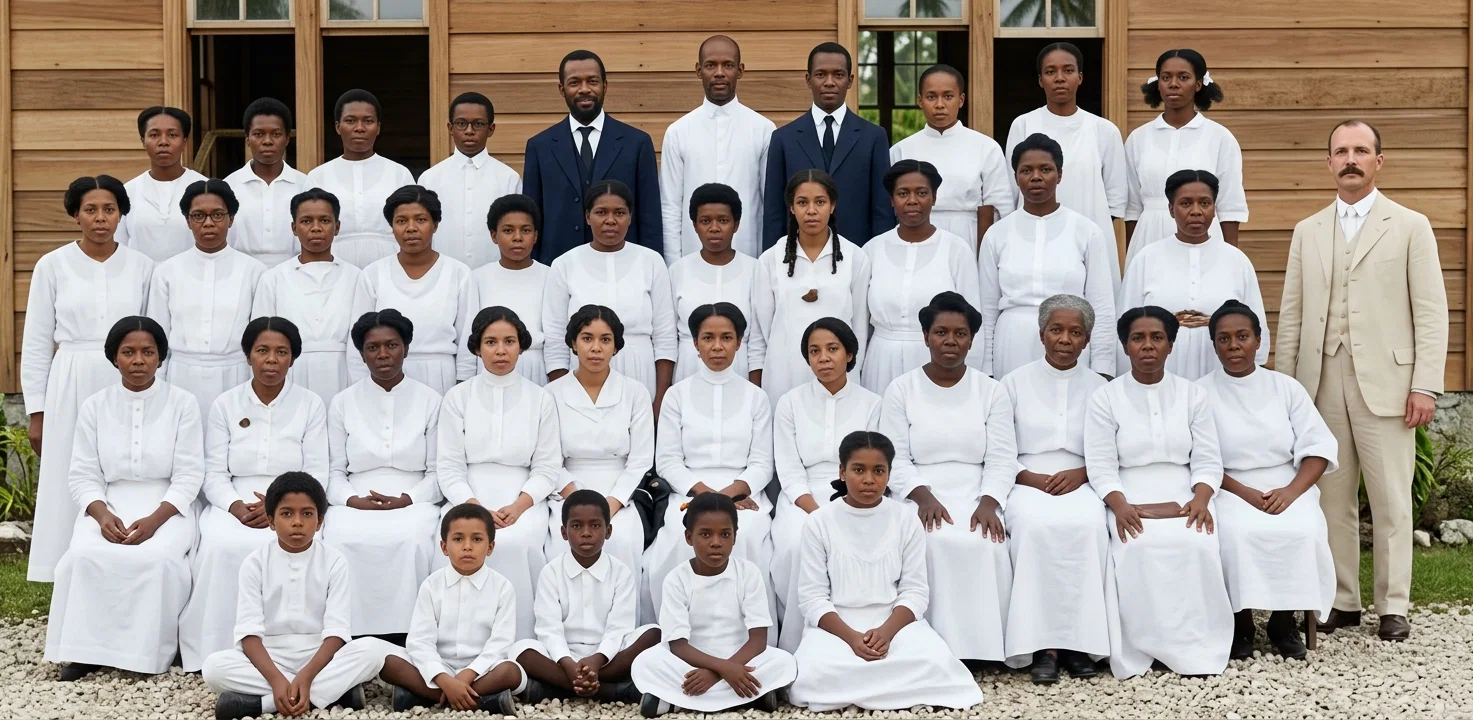
WE show herewith a picture of some of the people recently baptized by Elder G. A. Roberts, pastor of the Kingston (Jamaica) church. There were forty-three candidates in all. The occasion was given a special write-up in one of the city newspapers.
This was the third large baptism of the present year, making a total of ninety-six baptized. Another baptismal class of seventy-five members is now receiving instruction. The present membership of the church is about five hundred.
G. A. ROBERTS AND BELIEVERS, JAMAICA
These candidates are thoroughly instructed in all points of our faith before baptism. A number of persons of strong influence are being reached. The revival spirit has reclaimed many back-sliders. The church has well-laid plans for uniting all the members in missionary work.
As Brother Roberts is a trained nurse, he is prepared to do medical missionary work, and to instruct the church members how to give treatments. This kind of work is doing its part in reaching the people. Brother Roberts has been in Jamaica only since the first of the present year, but he has had several interesting experiences in connection with his medical work. L. A. HANSEN.

The Colored Work in Chesapeake Conference

It has been so long since a report of the colored work in this conference has been sent in, that perhaps the readers of the REVIEW have wondered what was being done in this field. We have been very busy. June 26 we went to Wilmington, Del., to revive the work there with a tent effort. Four weeks were spent in that city. This was not really long enough to do justice to the effort, but we were able to create an excellent interest to be developed by the local worker. Several signed the covenant to keep the Sabbath, and some additions to the church have been reported.
We next pitched the tent at Cheswold, Del., about forty miles below Wilmington, where we have had a church for at least fifteen years. This church needed to be awakened. The tent was pitched in a beautiful grove, and from the first we had an excellent attendance of interested people. The second Sunday of the meetings the choir from our Baltimore church visited the tent. The people in Cheswold surely enjoyed the singing, and the choir did much to advertise the services. We spent five weeks there, and have baptized five as a result of the tent meetings. There is a splendid interest, and I go to Cheswold as often as I can leave Baltimore. Brother Mosley is doing splendid work in Cheswold in his effort to prepare candidates for baptism.
Baltimore was not neglected while the two efforts were being conducted in Delaware. Every Sabbath I returned to that city, and as a result of my labors and that of Brother Cox, our faithful Bible worker, thirty-three earnest believers in the coming of the Lord were baptized September 17.
Our church in Baltimore is growing fast. The days are too short for us to get in the amount of work necessary to keep up with the progress of the church. For the month of September $97.85, our offerings to missions, was sent to the conference treasurer, besides nearly $200 in tithe. Our offerings for the support of the local work are good, and the Sunday night attendance is fine. The church is too small, the seating capacity of three hundred being taxed to its limit.
We have in the church splendid schoolrooms nicely equipped for teaching the industrial branches, as well as for class studies in grades from one to eight. Next year we hope to add grades 9 and 10 to the regular course of studies. We have several students from neighboring States, and others are writing for admission to the school. The first day forty-four students enrolled, and as soon as the quarantine is lifted prohibiting younger pupils from entering any school, we expect to see at least seventy-five take up studies in the above-mentioned grades. We are more than encouraged with the beginning; and with experienced teachers in charge, we are sure that it will be the aim of this school to turn out creditable workers for the cause.
For information regarding the school address the writer, at 1714 Druid Hill Ave., Baltimore, Md.
GUSTAVUS P. RODGERS.

Minnesota

BLACKDUCK.—Seventh-day Adventists are quite generally commented upon for their zeal. As a people we feel, however, that we are not doing all that we might do. We know that we have not accomplished all that we might have accomplished in the past. What is worst of all is the fact that we have failed to save many of our own children and young people. We have been forced to witness the heart-rending spectacle of Adventist young people dropping off the narrow path to the world below. Why this terrible loss, and what is the remedy? One reason for the loss is this: We spend too much precious time sowing the seed, and not enough time reaping the ripened grain. Too often by far we spend our time marching up and down the Lord's great harvest field sowing the precious seed into soil that is already supporting a bounteous crop of matured wheat, white for the harvest; and from timidity, embarrassment, lack of time, or from some other insufficient reason, we do not make any effort to induce a soul to take a definite stand at a definite time, and thus fail to bring a golden sheaf into the Lord's great glorious storehouse.
As the leaders of our young people's societies have been calling our attention to these important facts, we decided to hold a special consecration and reconsecration service here at Blackduck, a few Sabbaths ago. Among us were several children who had just come to the age of accountability, and a few considerably older, who as yet had never taken a definite public stand for the Saviour. The older church members all felt the urgent need of reconsecration in the service of the Master. Accordingly the leader set the day for the service, and conferred with several members of the church as to ways and means of making the proposed service a success. As a preparatory step, the children were carefully instructed in regard to the importance of the soon-coming time of special consecration. They were even informed of the exact purpose of the meeting, and an effort was made to impress them with their personal need and responsibility and the importance of making an early choice.
At the appointed time the officers met to invoke the power of the Holy Spirit in this time of need. They then opened the service, trembling betwixt hope and fear. The leader gave a short exhortation on the text, 'Suffer little children to come unto me.' After a few words of counsel by other members, an opportunity was given for all who would to take their first public stand for the Saviour. Imagine the unspeakable joy of those parents present at seeing every child of accountable age rise to his feet.
Who will be the next to try the special consecration service and receive the Lord's richest blessing, the conversion of the children in Israel?
B. H. PALMER.
Continue reading: Our Literature Doing Good Work Among the Jews