Your ShelfYour Projects

Signs of the Times, Vol. 30, No. 24.

BUSINESS
Earlier text: THE SUNDAY-LAW MOVEMENT

SOFT ANSWERS.

BY MRS. L. D. AVERY-STUTTLE.
“A soft answer turneth away wrath.”
THERE must of necessity be two parties to every quarrel. It matters not how ill-tempered or quarrelsome a person may be, he can not indulge his ill-temper to the extent of a quarrel, unless he finds some one foolish enough to take the opposite side of the argument.
It is the same with nations as with individuals. There need never be another war waged,—no belching cannon or screaming shell would carry death and destruction in their courses in all the years to come, and nations would not learn war any more,—if only the soft answers which turn away wrath, were persistently given by the rulers of this world. O what a beating of swords into plowshares there would be then!
As I write, the eyes of the world are turned toward the far East. Two nations,—brothers; for “of one blood hath He made all nations”—are met in deadly conflict. Human life is accounted a very cheap commodity, when laid in the balance with human greed and a few acres of common ground. How must the horrible carnage and the rivers of crimson blood glut the eyes of him who was a murderer from the beginning!
But our pen is feeble, and our words of little worth, to influence the conduct of the nations, who are filling up the cup of their iniquity, and preparing for the last great conflict—the Armageddon of the world. Only as we can influence individuals, can we hope to do any good.
The text above quoted was written by the son of a great king and mighty warrior. Solomon himself had come into his kingdom peaceably. The throne of his realm was not established by conquest; and undoubtedly he knew by experience the blessed results of giving soft answers. But perhaps it was after listening to the story of that tactful and wonderful woman, Abigail, from the lips of his father, that Solomon seized his pen and wrote that far-famed proverb about the efficacy of soft answers.
In imagination I can see the fair face of the woman Abigail. One of the young men has just told her of the unjust and wicked reply made by Nabal to the messenger of David. There is a shade of sadness in the beautiful eyes, but the full red lips are compressed firmly. Quickly the order is given, and she is on her journey to meet David, carrying a present such as befitted one in her station. See, she is coming down yonder hill, with her train of servants carrying provisions for the man who has received so great a provocation from her lord, Nabal. Look! from whence is this array of armed men who meet her? Determination and vengeance is written on each countenance.
What shall be able to turn away such wrath as this?—Ah, a soft answer will do it. The beautiful woman has fallen on her face before the stern warrior from the wilderness:—“Upon me, my lord, upon me let this iniquity be.” What unselfishness to bear the guilt of a churlish man like Nabal! The journey was successful; and the blessing pronounced upon the peacemaker rested upon the fair head of this wonderful diplomat. Ah, if only the diplomats of the nations to-day were like the fair Abigail!
Again! Yonder is a band of men among the rocks of the wild goats of En-gedi. Their leader is fleeing for his life from a mighty king. The anointing oil of the prophet of Jehovah is upon his own head also, yet he guards with conscientious zeal the anointed of the Lord, altho he be an avowed enemy who is hunting him like a wild beast, with an army of three thousand chosen men. Look! in yonder cave reposes the king. Who is this young man carrying a keen-edged sword, who stealthily approaches the sleeping monarch?—It is his enemy—his hated rival.
Will the sword of the young man seek vengeance? See! he has drawn it forth! Ah, he is only severing a fold from the mantle of the sleeping king.
Finally the pursuer awakes and continues his search for the enemy for whose blood he is thirsting. Probably he has not yet missed the severed fold from his ample robe. Hark! a familiar voice is calling from behind him:—“My lord the king! . . . Some bade me kill thee; but mine eye spared thee. . . . Moreover, my father, see, yea, see the skirt of thy robe in my hand; for in that I cut off the skirt of thy robe and killed thee not, know thou and see that there is neither evil nor transgression in my hand, and I have not sinned against thee.”
Note the magical effect of this pacific argument—this soft answer. The misguided monarch lifted up his voice and wept, declaring in tearful tones: “Thou art more righteous than I; for thou hast rewarded me good, whereas I have rewarded thee evil.”
What wonder that the son of such a man as David should have written that wonderful—that deathless proverb—about the soft answers? And the saying holds as good to-day as in the days of David and Abigail and Saul. If a soft answer would produce such grand results then, it will do no less for you and me to-day.
Not only should the words of our tongue be guarded, but no less should we watch to cultivate a pleasing tone of voice. I know a young woman whose face is sweet and whose smile is kind and winning, but whose voice is so unlovely and harsh that even tho her words be gentle one has to think twice before being sure of it.
A soft answer given in a harsh and unpleasant voice, is like a beautiful picture in an ugly frame. Then let us believe that it is pleasing to the Lord to cultivate soft and gentle tones. Even a little babe who has not yet learned a syllable of any spoken language, detects instinctively the voice of anger or reproof, and cries in genuine distress if spoken to in an ungentle voice.
It would be hard to imagine any other than soft and silvery tones issuing from the lips of the great Teacher as He pronounced those precious beatitudes, which seem as beautiful to-day as when they fell like pearls from the guileless tongue of the Man of Galilee: “Blessed are the merciful; for they shall obtain mercy.” “Blessed are the peacemakers; for they shall be called the children of God.”
Then, my sister, when the good man of the house returns from his work irritable and moody, and speaks to you harshly, try the efficacy of a soft answer. And, my brother, when the good wife is hurried and nervous, speak gently to her whom you have sworn to love and protect.
Ah, as I write to-night, there are many desolate homes, caused by sudden calamity. The fire fiend has kissed, with his burning tongue, the fair cheek of beauty, and the noble brow of manhood and youth, and breathed her scorching breath in the innocent face of childhood. Ah, methinks, could these desolate homes be filled again with the forms of loved ones, soft words and gentle voices would alone prevail; but now, alas! the moan of sorrow and the cry of the bereaved are heard.
Sometime, God alone knows how soon, but sometime we may stretch out our arms for our beloved, and embrace only shadows. Sometime we may strain our ears in vain for the tones of love, while our eyes become weary, watching for the forms that never come.
“Then, O may the tones of anger Be never, never heard, But may we give to our best beloved The tender and gentle word.”

ARMORED

Youth upon Life's threshold standing, Hand upon His open door, Footstep eager on the landing, Heart a-leap with hope before; O, the tremor! And the glamor! Day doth dawn! Behold the morning! Not a cloud in all the sky; Dost thou know there's need of warning? Danger lurketh by-and-by.
Watch the way, O son of promise; Guard thy going day and night; Foes would foil each holy purpose, Snares are set thy bloom to blight. O, be watchful! And be prayerful; Keep thyself in Christ, thy Saviour; If thou wouldst the comfort win, Battle bravely, falter never, Know no compromise with sin.
Gird thyself with Truth's own armor— Shield of Faith and Gospel sword; Smite with might and thou shalt conquer, Strong in spirit through the Word. Men may cavil, Fear no evil; Take the helmet of salvation, Let the feet be sandal shod; So shalt thou o'ercome temptation, Walk in paths of peace with God.
—Selected.

NEVER SWEAR.

1. It is mean. A boy of high moral standing would almost as soon steal a sheep as swear.
2. It is vulgar—altogether too low for a decent boy.
3. It is cowardly—implying a fear of not being believed or obeyed.
4. It is ungentlemanly. A gentleman, according to Webster, is a genteel man—well-bred, refined. Such a one will no more swear than go into the street to throw mud with a chimney-sweep.
5. It is indecent—offensive to delicacy, and extremely unfit for human ears.
6. It is foolish. “Want of decency is want of sense.”
7. It is abusive—to the mind which conceives the oath, to the tongue which utters it, and to the person at whom it is aimed.
8. It is venomous—showing a boy’s heart to be a nest of vipers; and every time he swears one of them thrusts itself out from his head.
9. It is contemptible—forfeiting the respect of all the wise and good.
10. It is wicked—violating the divine law, and provoking the displeasure of Him who will not hold him guiltless who takes His name in vain.—Selected.

A Way Through the Waters

“SOME will complain of the mud when a way is opened through the waters.”

A GLIMPSE OF DARJEELING.

BY L. F. HANSEN.
Darjeeling is the headquarters of a large district in the lower ranges of the Himalaya mountains. A ride from Calcutta through beautiful country by rail, by water, across plains, and over mountain roads, reaches Darjeeling in twenty-two hours. This city, situated fifty miles from the plains, at an altitude of seven thousand feet, is the seat of the Bengal Government during the summer months. Here is also a resort and recuperating station for many a worn missionary, merchant, and official from the plains. The high altitude insures a cool, delightful climate. Located on hill slopes, amid ever-blooming flowers, the place is most charming. To the praise of the government, great sums of money have been spent to make pleasant walks, with occasional resting-places, elaborate water ducts, and everything convenient and pleasing to the eye.
For the care of the sick who need medical attendance, here is the Eden Sanitarium for Europeans, the Jubilee Sanitarium for the natives, and this summer there has been added a hospital with free dispensary for all classes.
In clear weather the snow of the Himalayas can be seen from many places, and the view is marvelous beyond description. Altho the snows are forty miles distant, they seem much closer. From the valleys below, up terrace upon terrace of mountain ranges, there is a height of fifteen thousand feet before the snow is reached. Then the snow covers another ten thousand feet.
But aside from these natural and incidental attractions, Darjeeling is an important missionary station to the “regions beyond.” The district of Darjeeling is wedged in among what is known in missionary language as “the three closed countries.” On the right is Bhutan, on the left is Nepal, and right ahead is Tibet. Thus far these countries have staunchly and successfully resisted all efforts of the missionary to gain access. It is not this class alone who are denied access; for no white man is admitted. Just at the present time there is much apprehension of invasion, as the boundary lines are not well defined, and Russia is making rapid inroads from the east. A war is, however, not necessary to prepare the way for the Gospel. For a long time God has had agencies at work for the people. Years ago the Germans translated and issued the New Testament in the Tibetan language. And the Scotch Church has done much among the Nepalese, and has made many converts. And among the Bhutias there are several energetic missionaries who are beginning to see some fruit of their toil. This has been accomplished even when they refuse to admit the white man to their countries. During the busy season at Darjeeling, these hill people send many of their young people to work or trade among the visitors. And as a result, altho the Gospel is most carefully excluded, yet the good news of salvation in Christ has reached to the interior of even Tibet. The lamas (priests) are amazed. Let people come in contact with the missionaries, and the Gospel will affect them; but let them come in contact with the Word, and they will be converted.
So far we have been able to do but little in this place. In Elder Robinson’s days some pioneering was done, and some accepted the truth. These have all moved away, with the exception of one family. During the past three years very little has been done here. But this year one after another of our workers went to Darjeeling for a little relief from the heat of Calcutta. Thus both Bible work and meetings have been conducted for several months, and God sent some precious souls to hear and accept the truth. The field is ripe for the harvest, and the three closed countries will open sooner than we think. What India needs just now is some earnest young men to go to the people. There is a rich fruitage awaiting the faithful reapers.

ORPHANAGE WORK IN PORTO RICO.

BY MRS. IDA M. FISCHER.
At 6:30 in the morning I boarded the train, on what is known as the French Railroad, for the town of Bayamon. This town, only six miles from the capital, San Juan, appears much larger than it really is. At 7:30 the train steamed alongside of the little station, about half a mile from the town.
Several little boys, some of them boot-blacks, with bright, black, shining faces, came eagerly forward, offering to carry my grips, and to show me to a good hotel. In about twenty minutes we reached the hotel.
This town of 2,500 inhabitants was founded in 1772, and, unlike many of the small towns of Porto Rico, has several good streets, town hall, jail and barracks. From all appearances one would judge that at one time it was a wealthy place.
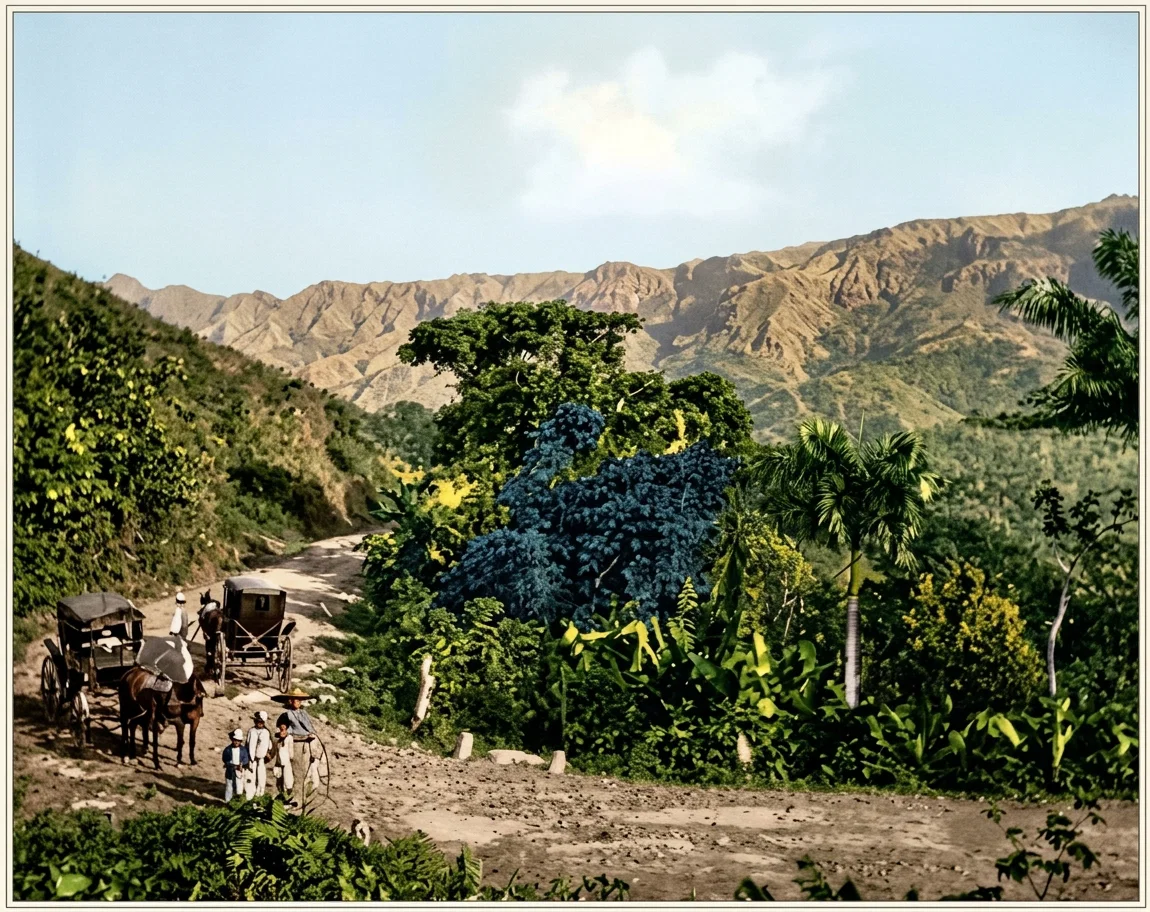
A Glimpse of Porto Rico.
Having a few hours to spare, before beginning my canvassing work, I decided to visit the Orphanage, which is under the auspices of the Christian denomination. At the earnest solicitation of the matron, I spent my spare time at the Home. During the afternoon I had the privilege of seeing the children work. This Home, which is now caring for fifty girls, has brought happiness to many lonely little ones. Most of the girls have been taken from the lowest and poorest of homes and families. They have been cared for and educated, and many of them have been placed in good homes, where they are giving good satisfaction to those who have employed them.
These girls, from five years old, are taken into the kitchen and taught all kinds of housework. As I watched them going back and forth to and from their work, with their joyful faces, and merry voices singing Gospel hymns, I could not but believe that the Spirit of God was co-operating with the work of the teachers.
After the kitchen work was done, many of the little ones gathered upon the balcony in small groups for their lesson in sewing. Each group was in charge of one of the older girls. The lesson for that afternoon was one in darning, and each girl darned her own stockings.
Just as the sun was sinking, we drove out a few miles into the country to see the farm which they have purchased for their Boy’s Industrial Home. The beautiful winding road, with the mountains in the distance, covered with lovely foliage, and the quiet of night settling upon nature, re-awakened within our hearts the desire to labor for this poor people as we have never done before.
As I listened to the experiences of my hostess, in which she told me of her work with her girls, and what the power of God was doing for some of them in changing their lives, I realized, as never before, “that God is no respecter of persons; but in every nation he that feareth Him, and worketh righteousness, is accepted with Him.”
She told of a bright girl of twelve, whose godparents had put her in the Home. Naturally lively and self-willed, the matron knew much wisdom would be needed in dealing with her. Time after time the Christian woman presented the girl to her heavenly Father. At times she feared her efforts were being wasted, but one evening, she was surprised to see the girl leave her playing companions and come to her side. Seeing a serious look on the child’s face, she inquired the reason, and, to her surprise, the child replied, “Teacher, I want to be a Christian, I want to follow Jesus.”
After questioning her closely, the matron was convinced that she had weighed the subject carefully and understood the step which she was about to take. Her godparents, who are devout Catholics, had warned her repeatedly to have nothing to do with the Protestant religion; they had even threatened that if she did they would cast her off forever. Nevertheless, the next Sunday she followed her Lord in baptism.
At eight o’clock in the evening the babies, as the little ones are called, were put to bed, and the older girls gathered in the school room for their Bible work. I wish you could have seen their happy faces, and the interest they took in the study of God’s Word. As their teacher reviewed them on the lives of the kings of Israel, I plainly saw that not only the historical facts were imbedded in their memories, but practical lessons had been drawn from Israel’s experiences, and had left a lasting impression upon their young minds.
The Spirit of God is working with souls in Porto Rico; God has His jewels even here, hidden, within the homes of the rich and educated, and within the homes of vice, ignorance, and filth. The time is fast hastening on when these jewels will be gathered with the rest of the faithful ones. “After this I beheld, and, lo, a great multitude, which no man could number, of all nations, and kindreds, and people, and tongues, stood before the throne, and before the Lamb, clothed with white robes, and palms in their hands.”

NEVER ALONE.

BY M. WELDEN.
“Lo, I am with you alway.” Matt. 28:20.
Close to my side in the morning bright; Close in the noontide’s golden light; Close when the deepening shadows fall, And the quiet night enfoldeth all;
Close when the angry storm-winds beat, And the thorns are sharp to the pilgrim’s feet; Close when the laugh of joy is heard; Close when my eyes with tears are blurred.
In His guiding hand my hand is pressed, Weary, I lean on His loving breast. I am never alone, ah no; And my heart is filled with joy as I go.
Gurney, Kansas.

Honesty and Policy

“HONESTY is the best policy,—but the man who views it as policy will bear a reasonable amount of watching.”

PROTESTANTISM IN BRAZIL.

[Horace M. Lane, M.D., Sao Paulo, Brazil, President of Mackenzie College.]
THERE are more points of difference than resemblance between Brazil and her sister republics. The Brazilians are descendants of that plucky, hard-headed, industrious, superstitious race of people who conquered India, and made a stir in the world in the sixteenth century—the Portuguese. The flower of the Portuguese nobility emigrated to Brazil in the early days of colonization—the Albuquerques, the Cavalcantis, the de Barros, the Barretos, etc., whose descendants form to-day the best elements of Brazilian society. It differs also in the enormous extent of its fertile lands, its unrivaled river system, and the exceptional value of its great staples—coffee and rubber. Again, it differs, and very widely, in appreciation of liberty and of what constitutes a republic, and also in its tolerance and hospitality. It has adopted our Constitution, and is putting its principles into practice; it has also begun to elevate the masses through education. The Brazilians have an intense pride of country, and guard, with perhaps too much jealousy, their vast possessions, yielding not a foot to anybody; this may be seen in their successful contention with England for the disputed island of Trinidad, with France for the Tunc- boundary, with the Argentines for the Misiones territory, and as will certainly be seen in the vexed Acre question.
There the spirit of tolerance prevails everywhere, and the missions established forty years ago (those of an earlier date had disappeared altogether) have had a phenomenal growth; so that to-day Protestant Christianity is an important element in society which no political party dare ignore. The Presbyterians, Methodists, Episcopalians, Baptists, and Lutherans all have numerous, self-supporting churches, ministered to by talented native pastors; some have their theological seminaries, and are growing in numbers and strength, becoming rapidly independent of the boards. The Roman Catholic Church has no advantage under the law, but still holds sway, through tradition and inherited devotion, over the masses of the great interior, tho in most places it has little power to suppress the growth of Protestant Christianity.
In Brazil these two influences go hand in hand. The people and government accept and adopt as fast and as far as possible what is known as American education. Now, American education really means Protestant education—not in the sense of having for its chief object the teaching of Protestant doctrine, but in being based upon principles of Protestant origin. It promulgates the broad principle of personal liberty, devotion to and pursuit of truth for truth’s sake; it puts character before erudition, and inculcates personal independence and personal responsibility. These are distinctly the attributes of Protestant Christianity as distinguished from that system founded by Loyola, which has had undisturbed control of the education of the people of Latin America for centuries, and which is responsible for their present condition—a system which is based upon blind obedience to authority, which places duty to church above duty to self, country, or God, which educates pupils to defend opinions rather than to seek the truth, and which strangles freedom of thought and action.
Primarily an essentially military society, formed to meet a crisis in the life of the church, the Jesuit Society has developed into the most wonderful organization known to human history—more far-reaching, more powerful, more dangerous to human liberty and free government than anything ever before known. It has come down to us across the centuries unchanged in principle and with power unimpaired, and to-day constitutes a peril to free institutions and a menace to liberty. The diabolical principle which underlies its organization—that the end justifies the means—has done more to destroy the moral sense of the Latins than any overt acts on the part of the Jesuits. Claiming to be the servant of the church, it became its master, and more than once the church has tried to free itself from its tyranny.
The evils of Jesuit education, the false processes of thought which it inculcates, the wrong motives of action which it originates, have become so crystallized in the Latin races as to be almost hereditary. The only weapon that can be used successfully against it is that which has been used in our own country—the enlightenment and uplifting of the people . In Brazil the upper classes have broken away from it to some extent, but in the reaction have unfortunately fallen into the various forms of unbelief; the masses, however, are still under its baneful influence, and it will require education of more than one generation on true principles to eradicate the evils planted during three or four centuries.
The foreign evangelistic missionary is sent out to do a specific work with the expectation of one day completing it. He goes to deliver a message, and procure its acceptance. The results of his work ought to be self-propagating, but history shows they are not, and that the work of the preacher must be supplemented by the teacher. This is the plan which we aim to follow in Brazil. The work of the educational missionary is never finished, and must be perpetuated by institutions which he must establish, and which his successors must carry on indefinitely.
The most notable feature of modern missions is the recognition of this truth, and the organization of permanent institutions of learning as the natural sequence of evangelistic work. Not only theological seminaries and mission training-schools to preserve the form of faith of the respective denominations are necessary, but schools and colleges for secular education on Christian principles must be established. To secure permanent results the lives of men must be touched, not merely their beliefs. The demand for the new education comes from the converts themselves, who see the danger of the old methods.
Brazil, tho she may not welcome with great effusion the greedy speculator, who seeks only personal gain, with no purpose of benefiting the country or identifying himself with it, is still the only “wide-open” door in South America—open alike for the missionary, the educator, the laborer, and the capitalist. It is a wonder that North Americans, so keen and quick-sighted, have not yet perceived the great importance and deep significance of Brazil in the life of Greater America. After our own country, it is the most important factor in the problems of the near future, and as such must be considered.—Missionary Review.

CARROL HOUSE, TAKOMA PARK. D. C.,

FROM WASHINGTON.

CARROL HOUSE, TAKOMA PARK. D. C.,

May 10, 1904.
Dear Fellow Workers,—
With gratitude I acknowledge the tender care of my heavenly Father for the blessings that He has bestowed upon me since we left St. Helena. The journey across the continent which I dreaded so much, was pleasant, and I rested all the way. And since I reached Washington, my health has been better than for many months before.
We are pleasantly settled in Tacoma Park. Within fifteen minutes’ walk are the homes of Brethren Daniels, Prescott, Washburn, Spicer, Curtis, Bristol, Rogers, Needham, Cady, and others connected with our work.
The way is opening rapidly for the beginning of our work. For this I am very thankful. As I look at the situation and the prospects here, I am filled with hope and courage. We shall endeavor to respond to the favoring providences that attend us by pressing forward with the work as speedily as possible.
The location that has been secured for our school and sanitarium is all that could be desired. The land resembles representations that have been shown me by the Lord. It is well adapted for the purpose for which it is to be used. There is on it ample room for a school and sanitarium, without crowding either institution. The atmosphere is pure and the water is pure. A beautiful stream runs right through our land from north to south. This stream is a treasure more valuable than gold or silver. The building sites are upon fine elevations, with excellent drainage.
One day we took a long drive through various parts of Takoma Park. A large part of the township is a natural forest. The houses are not small and crowded closely together, but are roomy and comfortable. They are surrounded by thrifty, second-growth pines, oaks, maples, and other beautiful trees.
The owners of these homes are mostly business men, many of them clerks in the government offices in Washington. They go to the city daily, returning in the evening to their quiet homes.
A good location for the printing-office has been chosen, within easy distance of the post-office, and a site for a meeting-house, also, has been found. It seems as if Takoma Park has been specially prepared for us, and that it has been waiting to be occupied by our institutions and their workers.
My hopes for this place are high. The country for miles and miles around Washington is to be worked from here. I am so thankful that our work is to be established in this place. Were Christ here upon the ground, He would say, “Lift up your eyes, and look on the fields; for they are white already to harvest.” We have a work to do in leading precious souls onward step by step. Many will have to be taught line upon line, precept upon precept. The truth of God will be applied, by the Spirit’s power, to the heart and conscience. We must present the truth in love and faith and hope and courage.
ELLEN G. WHITE.

POWER OF THE SPOKEN WORD.

God’s ministers and teachers must never despair of the influence of their words. Let them remember that the word which George Herbert spoke to those who went to sacred places to worship is just as true for those who go to such places to witness: “God is more there than thou.” The nourishing grass of human wisdom may wither, the beautiful flowers of human culture may fade, but “the word of our God shall stand forever.” We know how a catching harmony lingers in our ears; we can not get it out; it keeps ringing there; that is the way we are made. And there is no march, or dirge, or choral of them all, that so lingers with men as do the deep-sounding, eternal notes of the Word of God. Nothing can silence them—that, too, is the way we are made. All lips or lives which repeat a true word of God will be heard. They can not be stilled. The whole high heaven is their sounding-board enforcing them; the whole wide world is their whispering gallery, through which their faintest tone echoes and re-echoes, and will not be lost. When such come unto men or unto children, there is a voice that comes with them as unto the seer long ago, saying, “These are true words of God.”—Sunday School Times.

OUR WORK AND WORKERS.

At the last quarterly meeting of the church at Baraboo, Wis., two members were added.
In the Southwestern Union Record Brother E. L. Neff reports the baptism of four candidates at San Antonio, Texas.
As a result of meetings held at Gentry, Ark., by Brother V. B. Watts, eleven members were added to the church May 14.
On the 8th ult. eight candidates were baptized by Brother E. L. Fortner, at Fayetteville, Ark., and three others were awaiting a later opportunity.
The brethren of Indianapolis, Ind., are erecting a new house of worship on Twenty-third Street, near Central Avenue. They expect to occupy it the first of October. The East Side brethren have also purchased a lot, and will erect a building at Rural and Thirteenth Streets.
Reporting to the Southwestern Union Record, Brother A. E. Field notes six converts at Muskogee, I. T. Also the addition of six members to the church at Greenleaf, by baptism. Two other candidates were unable to be present on that occasion. He also notes the addition of one of the company at Texmo, and four to the company at Okmulgee.

WANTED FOR MISSIONARY WORK.

(Always prepay postage.)
CLEAN copies of any of our denominational papers. Address George Rice, Dawson, Yukon Territory.

ANNUAL MEETING OF THE STOCKHOLDERS OF HEALDSBURG COLLEGE.

NOTICE is hereby given that the twenty-third annual meeting of the stockholders of Healdsburg College will be held on Monday, June 20, 1904, at 10 o'clock A. M., in the South College building, Healdsburg, Cal., for the purpose of electing a board of seven directors, and of transacting any other business that shall lawfully come before the stockholders. By order of the trustees, M. E. CADY, President, H. G. LUCAS, Secretary.
Continue reading: LESSON 13.—JUNE 26.—QUARTERLY REVIEW