We are here every day with the Indians, but I will relate the experience of two special days. The mission has ordered a boat from the States to use in our work among the Indians around Lake Titicaca, which, if you will look on the map, you will find is not a very small body of water. Having a boat necessitates our having a place in which to keep it. So we asked the brethren if they would not like to donate a day's labor carrying stone from the mountains. About nine in the morning, Brother Stahl, Brother Achenbach, and I went over to the site, and found about two hundred men and women carrying rocks. Some of the men were dragging the larger rocks with their ox teams, some of the women were driving burros loaded with stones, while others were carrying large loads on their backs.
As there had been a little trouble earlier in the morning, between some of our brethren and those not of our faith, about some rock, Brother Stahl thought best to go to the owners of the mountain and ask permission to carry the stones away. There are so many rocks that if I owned the place I should be very glad to have them removed, but the Indian is very much like his white cousin, and likes to be asked for things. We went to the owners, who seemed very glad to give the permission. One man was so anxious to help that he gave us permission to take down his stone fence, saying that he could replace it later. In all I think we had about enough stone offered us to build a good church building instead of a little boathouse. As the brethren had been so willing to help in every way possible, we thought it well to show our appreciation in a way we knew they would like very much. They have never had much opportunity to play and enjoy themselves, so we invited them to come to the mission, Thursday, December 9, for a day of recreation. In this country such a gathering is called a “feast,” but it very much resembled a Sabbath school picnic in the States.
At nine o'clock they began to gather. At first we were a little afraid we were not going to have a very large company, but by noon there were about three hundred present. As the Indian is very fond of music, we invited some of the brethren to come prepared to play. They have very good native bands. At 10:45 we could hear the music in the distance, and at eleven o'clock they marched into the yard, playing, and I must say it equaled any music I ever heard anywhere. They played for about an hour. Their instruments consisted of a large bass drum, two snare drums, and eight instruments, each made of eight tubes of different lengths, very simple, and yet making very pretty music.
Shortly after twelve, we brought out the food to be served. It was a little different from that in the States. We had two large clothes boilers full of soup, with potatoes, onions, and other native foods; two large butter bowls full of toasted barley; three hundred and sixty biscuits; large jars of kemwa, a native dish; and about seven gallons of sirup made from the native sweets. When there was nothing more to be served, we all went to the yard for some games.
CHAPEL AT CHIOH-BE
Formerly the Catholics had feasts that some who are now our brethren attended. They made a specialty of selling alcohol and the coca leaf, and the Indians would get very drunk. The Indian very much prefers the “sober feast,” as the others invariably left a “bad taste in his mouth” and an empty pocket. One man was present yesterday from a tribe some little distance from here. He said his people were anxiously waiting for a mission. There are many such places.
The New Mission Chapel in the City of Chioh-Be
By W. C. Hankins
W. C. HANKINS
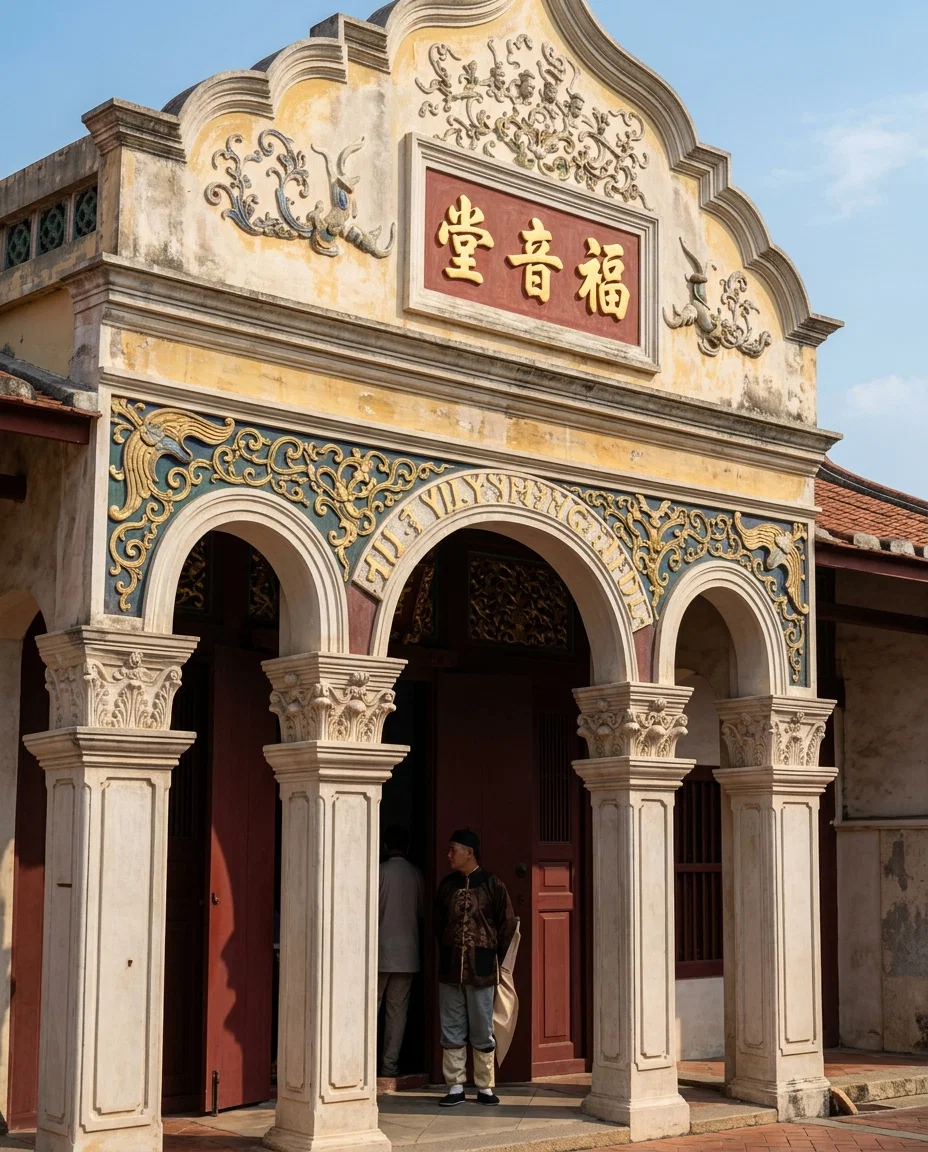
I AM inclosing a picture of the first chapel owned by our mission in the province of Fukien. It was dedicated Sept. 11, 1915. This chapel is not one that we have built ourselves, but an old building that we have bought and remodeled. A few months ago the brethren in Chioh-be came to us with the information that they had the chance to buy a good house very cheap. The mission was greatly in need of a suitable chapel there, as the one we had was not in a sanitary location, neither was it large enough to meet the needs of our growing work in this important place. Rents were very high, and even then it seemed almost impossible to find the right kind of place for a chapel; so when the brethren came to us with the news that we could buy a house for the same amount of money that we would have to expend on rent inside of three years, we decided to investigate.
We found that the building in question was being used as a shop for the manufacture of paper money. This is imitation money which the Chinese use in their worship of the spirits of the dead. The house was long and narrow, consisting of three sections aggregating over a hundred feet in length, but only about fifteen feet wide. There were upstairs rooms at the back where the evangelist could live. The place was very dirty.12and we knew we would have to spend something in repairing it, but we felt that even then it would be a cheaper investment for the mission than renting. So we bought it, and set the contractors at work on the needed repairs. Windows and doors were cut, partitions torn out, and floors renewed, the dirty walls patched and whitewashed, and then the front of the building remodeled to look like a chapel. By the time the work was completed the old house was utterly transformed. The entire cost, including purchase price, was only about three hundred dollars gold, over a fourth of which was donated by the Chinese brethren.
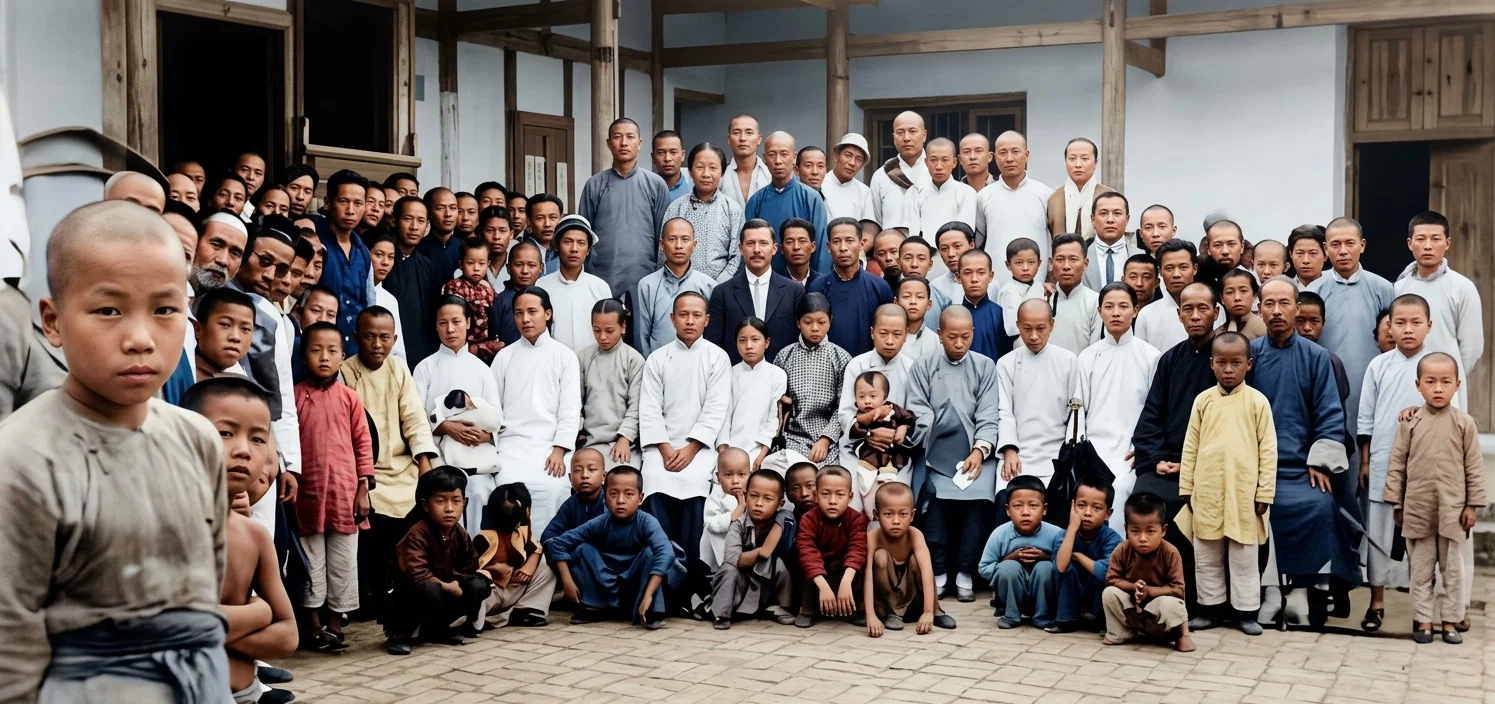
Sabbath, September 11, was finally decided upon as the day when the chapel should be dedicated. Word was sent out to all the Chinese brethren in that immediate vicinity, that there would be a five days' meeting at Chioh-be, and all were invited to attend. Friday morning Elder B. L. Anderson and the writer left for Chioh-be. When we arrived, we found every one busy trying to get the chapel in shape for the next day's services. We had not seen the place since it was finished, and were very much pleased with the transformation. We found that the chapel proper was about seventy feet long and would seat about two hundred people. Everything was neat, clean, and inviting. The upstairs living rooms were comparatively cool and airy.
CONGREGATION AT CHIOH-BE
Sabbath morning a good congregation of our own people came together, and we held our first service in the new building. After an interesting Sabbath school, conducted by the Chinese evangelist, Elder Anderson preached the dedicatory sermon. Meetings were also held in the afternoon and evening. Mrs. B. L. Anderson and Mrs. Hankins came to the meeting to take special charge of the women's services. The Sabbath meetings were followed by a four days' meeting, with subjects prepared especially for the heathen. Such subjects as God, Christ, the Son of God, the second coming of Christ, the inspiration of the Bible, the law of God, the saints' inheritance, and other kindred subjects were dwelt upon. These regular services were attended by men and women alike, but some special services were held by the sisters for women only, in which practical lessons on home life, child training, importance of knowing and obeying the will of God, and kindred subjects were discussed.
The outside attendance during the day was fairly good, but at night the attendance from among the heathen was very good, and increased each night during the meetings. A lively interest was awakened, and the meetings soon became the talk of the city. The last two nights, when we asked all those who would like to join a Bible class to sign their names to cards which were passed around, we received fifty-six names, most of the signers being heathen.
Elder Keh Hok-siu, a young man who has just recently been ordained to the ministry, has been left there to follow up this interest. A night school has been opened and regular Bible classes organized, and we hope that a good harvest of souls will be the result of the work done there. A similar work should be done in many places throughout this province. The whole western part of the province is still unentered, except by our colporteurs who are traversing these mountainous regions in all directions. They report a few large cities and many large towns and villages scattered over the mountains and plains. These are waiting for the last warning message to be given them.
We are praying that the Lord of the harvest may send forth reapers into this needy part of his vineyard, that when the Saviour gathers his jewels, these, too, with the rest of those "from the land of Sinim," may be numbered among the redeemed. May God help our dear people in the homeland to remember this waiting field in their prayers and by their gifts.
Kulangsu, Amoy, China.
Mission Notes
ACCORDING to the latest report of Cato Sells, Commissioner of Indian Affairs, 245,948 of the 331,250 Indians in the United States (exclusive of Alaska) have never professed the Christian faith under any denomination. A very large percentage of those who have professed Christianity are pagans still, as even Catholic priests admit. It is also stated that some of the Indians reported as “provided for” have no local missionary, but are visited once or twice each year by a Catholic priest. Here is a missionary field of many thousands of Indians at our very doors, who need the last gospel message now going to all the world.
OUR first church building in Fukien, China, was dedicated to the worship of God a few months ago.
NEAR the close of the year Brother E. L. Maxwell, writing of the work in Peru, said that during the past month and a little more he had baptized sixty-three believers into the message, and all these were outside the Puno mission up in the Lake Titicaca region. This is certainly a very encouraging growth in the northwest Inca mission field of South America.
As a result of the first pitching of the gospel tent in Durban, South Africa, Brother Geo. R. E. McNay, who went out from Iowa early last summer to labor as an English evangelist, is able to report eight new Sabbath keepers. The offerings met the expenses of the effort, and one shilling over. The tent has now been removed to another section of the city for a second effort.
“IN OUR WORSHIP MORNING AND EVENING, and at every meeting,” writes Brother D. C. Babcock, from Nigeria, West Africa, “we use only the Yoruba language. At the beginning and close of the Sabbath from fifty to seventy-five are present, and Adventist melodies are sung by many of them.” Brother and Sister Babcock are located several miles from white people, alone in the midst of Mohammedans.
It’ll be of interest to our brethren and sisters to know that fruit is appearing of the visit made by Brother Davis back into the interior of British Guiana. A Brother Duncan gives the following experience of how he and his wife came to know the message of truth for this time:—
“We were Anglicans. One day, after reading about the Sabbath, we both became troubled, and went to our pastor, showing him what was said about the Sabbath. He said that since the resurrection, one can take any day and keep it holy unto the Lord. I was then satisfied to know I had nothing more to do. Then this pastor was removed, and another came.
“When we asked him about the Sabbath, he replied that he would preach about it. He said he had to go to another district just then, but on his return he would explain about it.
“He returned, but did not preach. As he took the cup to administer the Lord’s Supper, and started to say, ‘All ye who truly repent of your sins,’ etc., he fainted and fell into the altar. He was taken home, but died the next Sunday.
“We still remained Anglicans until Brother Davis came and lectured. After hearing him, we searched the Scriptures he referred to upon the subjects of the Sabbath and baptism. We are now happy to know Jesus has called us from darkness to light. We are doing all we can to enlighten others. Pray for us.”
A Heathen Home in Western China
By Eva Allum
MRS. EVA ALLUM
How would some of our busy housewives enjoy housekeeping in a home where there were no washing days, ironing days, or baking days; no carpets to beat or floors to wax or oil; no windows to clean, or curtains to wash and hang; no silverware or glass to polish? Wouldn’t housekeeping be easy with all these eliminated?
On the other hand, how would you enjoy simply having two coarse, dark-blue dresses, one to wear while the other is being washed; rice three times a day, every day in the week; beaten earth floors entirely bare of carpets, linoleum, or even boards; no windows, except tiny openings in the wall, with a few bars to keep out intruders; chopsticks and bowls in place of silverware and china; no decorations on the wall except festoons of soot-laden cobwebs; no magazines or books; without God and without hope?
This is as it is in thousands, yes, millions, of Chinese family homes. Directly opposite us in this city is an ordinary Chinese family, living in two rooms with mud walls and mud floors. This is a family of four,—the grandfather, his son, his daughter-in-law, and a little grandson. The front room serves as a shop, and at daylight the shutters, which are the upper half of the front wall, are taken down and placed across some benches to form tables or stalls. On these are exhibited for sale, peanuts arranged in handfuls (you get thirty handfuls for one cent gold), lengths of sugar cane, pomelos, matches, dried tobacco leaves, cigarettes, grass shoes, straw hats, string, eggs, pipe lighters, and various other odds and ends. The old man and his son attend to any early customers, while the daughter-in-law prepares the breakfast of rice and a bowl or two of relish. After breakfast the morning’s housework is soon finished. There are only six bowls and four pair of chopsticks to wash; then the large rice cooker is scrubbed with a brush made of split bamboo, the earth floor is swept in the center, and the chairs are wiped off. If the weather is fine, she may do any washing that is waiting. As the few pieces are mostly coarse blue cloth, they need no boiling or bluing, and water strained from the rice is used to stiffen any that need starching. The washing must be strung on bamboo poles across the front of the shop, as this home, like the majority of homes in this city, has no courtyard, and the only outlet is on the street. Her household duties attended to, she then helps in the shop, arranging peanuts in handfuls, peeling and quartering pomelos, weaving grass shoes, or braiding straw hats. The small boy also has to be cared for. Any spare minutes are used in sewing and embroidery, for she must make shoes, stockings, and hats for the family, as well as cut and make their garments, and pad comforters for the winter. Not many idle moments are hers, although many of her less industrious neighbors visit and gossip over their needlework.
The old man attends to the sprinkling of the tobacco leaves on the stand by filling his mouth with water and ejecting it over the leaves; then he neatly piles the boxes of cigarettes and matches, his shaking hands finding it no small task to get the boxes just where he wants them. He then sits down to his string-making stand, which is about four feet high, with six bamboo pins around the top, and one reel of cotton suspended from each pin. He throws one reel across another, and keeps crossing the reels in turn, the finished string being similar to the tubular cord we used to make in our younger days by knitting on four pins in a spool. He makes three or four yards of this in a day, and it sells for about one cent gold a yard. But he is happy doing his share toward the support of the family. His son earns about ten cents a day as a sedan chair bearer.
Because of their diligence and economy, this family are able to “go over the days” without actual want. They are a poor family, but there are thousands of poorer ones in this city. This family is hardly representative of those around; for in the surrounding homes gambling, wine drinking, and quarreling are part of the daily life, while the women spend a large part of their time gossiping with their neighbors.
We find the inhabitants of Szechuan are most superstitious, and have a deep-rooted faith in their idol worship. If Paul had come to this field, he might well have said, “I perceive that in all things ye are very superstitious.” Their worship for the most part is for mundane purposes, and seldom for moral or spiritual development. Once a month the family described above light several candles and small sticks of incense, and place them in the cracks of their stand, fire off a string or two of firecrackers, and burn some sheets of paper,—and consider their duty toward the gods as done for that month. There is no communion with God in prayer, no yearning to partake of his moral and spiritual nature and share in his holiness, no looking for the blessed hope which is ours. How thankful we are that the Light has shone into several homes, and is giving the “knowledge of the glory of God,” and of his soon coming.
Pray for the work in this field, that special power from on high may attend the message, and many homes may be brightened with the glorious hope of our Lord’s soon coming.
Chung-king, Szechuan.
Look Out for the Grippe Germ
By Lora E. Clement
LORA E. CLEMENT
THE grippe has gripped the country. One hears sneezes to right and sneezes to left; there are coughs and snuffles and weeping eyes on every side. It is estimated that more than two hundred thousand persons living in New York City are suffering from the epidemic, and residents of other cities from east to west, and from north to south, are sneezing and coughing in due proportion.
The grippe is contagious. Of this there can be no question. According to Dr. Charles F. Bolduan, of the New York Health Education Bureau, unsmothered sneezes and coughs are more dangerous carriers of grippe and cold germs than expectoration. Thousands of cards bearing the wise admonition, “Cover up each cough and sneeze; if14you don’t, you’ll spread disease,” and, “If you’d keep away disease, dodge the dangerous cough and sneeze,” are being distributed in large Eastern cities where the epidemic is rampant.
This elusive disease is a puzzle to the doctors, for no one can tell just how it starts or what causes the epidemic to cease. One thing is certain, while it stays, its victims are its devoted slaves. Work and pleasure are alike swallowed up in valiant efforts to dislodge the uninvited destroyer of the peace. Grippe may be “caught” in street cars, stores, or any crowded place. It may be carried into homes and there distributed. It is particularly easy to “take,” since the germs attack the membranes of the nose and throat, and every inhalation may bring into these passages microbes which will lodge and multiply.
“Fresh air will not cause the grippe, even if it is cold air. Indeed, fresh air is the grippe germ’s worst enemy. If you catch cold in a draft and develop the grippe, it is because the germ had already found lodgment in the respiratory passages. Not every grippe germ develops. Sometimes the individual’s system is strong enough to destroy it. But with the digestion upset by indiscreet eating, with the general tone of the system lowered by fatigue, the soil for the grippe germ to propagate in is excellent, and trouble follows.
“To keep well means to keep the lungs supplied with fresh air and to keep the stomach in proper order. The grippe germ may get you with all your precautions, but it has much less chance if you will follow these two general rules, and keep yourself in the best possible shape to resist it.”
Numerous cures have been suggested for the grippe. One physician recommends that the victim take vigorous treatment, including a sweat, go to bed and stay there until he is well. But if the grippe “grips” you, and your work will not wait until you take this rest cure, you can at least indulge in copious drafts of good fresh air and “cover up each cough and sneeze,” remembering that “if you don’t, you’ll spread disease.”
A Birthday Thought
By Mrs. I. H. Evans
MRS. I. H. EVANS
(Written to a friend on his fiftieth birthday)
TIME was (ah, well indeed we all remember!)
When Fifty seemed
The period, the last day of December,
To all we’d dreamed.
But as we’ve neared that dreaded day,
Or reached it,
Our point of view
By some surprising mental transformation
Is all made new.
“Fifty — the end?” we cry. “O, never,
never!
We’ve just begun!
A thousand tasks await our eager doing
Ere set of sun.”
. . . . .
So, friend, we wish for all of life before you,
Faith, hope, and praise,
And that in every trial the “strength sufficient”
May bless your days.
Conducted by Mrs. I. H. Evans, Takoma Park, Washington D. C
By Mrs. I. H. Evans; Miss Lora E. Clement
Assisted by Miss Lora E. Clement
Through the columns of this department, hints will be given on all matters pertaining to the home life. Short articles and letters are solicited from home makers, telling of their everyday experiences,—their joys and sorrows, their failures and successes.
A Message to Wives
By Martha E. Warner
MARTHA E. WARNER
YEARS ago, there lived in a Western State a mother in Israel. To her one day came a woman in trouble. Here is her story:—
“A few years ago a Bible worker came to my home. I enjoyed her visits, took notes on her studies, and soon became so familiar with them that I could give readings to others. Then I began to long to work for the Lord. I had a good home, a kind husband (though he was not in the truth), and three children. But I fretted because my husband would not attend church with me, or consent to family prayers, say grace at the table, etc. I brooded over these things until my imagination created a dark cloud around me. My desire to do something for the Master was so great and, that I sought and found a position where I could take a course of institutional training, and work for the board of myself and children.”
“Secretly I made my plans to leave, and one day took the children and came here. I have been here over a year now. The children are separated from me, and I cannot earn enough to pay our expenses. I am tired, tired. What shall I do?” Here her voice broke, and the tears came.
Soon she heard the quiet voice of the older woman saying: “And to work for your Saviour you ran away from home, left your husband to shift for himself, or find some one to take your place, and gave the training of your children to others. My dear, you will never receive the approval of the Master until you try to rebuild the home you have so blindly broken up. Write to your husband, asking God to guide your pen, and confess that you failed in your duty. Then pray. When the answer to the letter comes, do as God leads you.”
Two weeks later the woman called to say that her husband had written asking her to return at once. As she said good-by, her last words were: “Tell other mothers my experience, that they may be saved from a similar mistake. My first mistake was in marrying an unbeliever, but oh, I made a greater one in not being satisfied to live the truth before my husband, and to train my children for the Master. It is so plain now. The duty of a wife and mother is in the home, and it is her privilege to make that home a little heaven.”
Today God is calling upon us as never before to take an active part in proclaiming this gospel message, but not all are to have a place in the heat of the battle. Our homes must not be neglected. “God has assigned woman her mission; and if she in her humble way, to the best of her ability, makes a heaven of her home, faithfully and lovingly performing her duties to her husband and children, continually seeking to let a holy light shine from her useful, pure, and virtuous life to brighten all around her, she is doing the work left her by the Master, and will hear from his lips the words, ‘Well done, thou good and faithful servant; . . . enter thou into the joy of thy Lord.’”
The Wholesome Oatmeal
By Marion Harris Neil
As winter advances, the morning dish of oatmeal becomes a very acceptable thing. It gives a staying power attainable by no other food. It imparts warmth to the body, a feeling of general well-being, a sensation of all-round fitness for work.
The quality of oatmeal is judged by its weight and color. The color depends upon the harvest weather. If dried quickly in sunshine while on the field, the color is light, and consequently the flavor fresh and good. If the oats have to be exposed in damp weather for some time, the color darkens and the flavor deteriorates.
Oatmeal forms wholesome and firm flesh, for it has a rich percentage of nitrogenous substance, no less than fifteen per cent. This substance makes the red and white corpuscles of the blood, builds every muscle and nerve cell, is the active agent in forming new tissue when wounds are received, and yields the blood the great bulk of its own food.
The rest of the food that the blood takes up consists of minerals and salts. These, too, oatmeal supplies.
Oatmeal feeds the nerves. Those who use it regularly will not fear neuralgia—often a sign of starved nerves. It contains all the elements that are in meat, eggs, or milk, and that in greater abundance.
Oatmeal contains enough fat to provide its eater with working energy. It is a carbon, akin in nature to coal. There is seven per cent of vegetable fat in oatmeal, a little less than half of its flesh-making percentage, but it is enough, considering that bread has only two parts per hundred and rice but one. Even beans, so rich in all materials for the making of the human body, have only two and one-half parts of fat per hundred.
Porridge made with water alone is a sufficiently wholesome and good food, as will be seen from its high percentages of flesh and fat attributes. Made with cream, it becomes one of the richest of all possible diets, as the bland richness of the little oil globules that make up cream is added to its own wealth of body-forming material.
Oatmeal makes bone. It has two per cent of mineral matter, which is more than either rice or bread contains. It has more than beef, or sugar, or potatoes, but is equaled by beans and cheese. There is a very large amount of starch, too, in this notable cereal, in union with some amount of sugar.
Oatmeal Soup
Boil one cupful of oatmeal in one quart of water, add one tablespoonful of butter, one teaspoonful of sugar, the grated rind of one lemon, one slice of onion, one bay leaf, one blade of mace. Salt to taste, and boil gently for twenty minutes. Press the whole through a sieve, return to the saucepan, add one cupful of milk, and when hot serve with toast sippets. After heating, the beaten yolks of two eggs mixed with one cupful of cream may be added if desired.
Oatmeal Porridge
Put three cupfuls of water on to boil, add one teaspoonful of salt. When boiling point is reached, dredge in one cupful of fine oatmeal, stirring all the time with a wooden spoon. Allow the porridge to simmer slowly for one hour, stirring it frequently. After this it may be turned into a double boiler to save stirring, as it is impossible for it to burn, but it will require at least one hour’s additional cooking.—Marion Harris Neil, in The Mother’s Magazine.
Make Today Better
: “WHILE we look for a better day to come, let us see how good we can make today”
Review and Herald Constituency Meeting
The fourteenth annual meeting of the constituency of the Review and Herald Publishing Association was held in the Seventh-day Adventist church at South Lancaster, Mass. The first meeting was held at 7 P. M., January 8, and the closing meeting at 10 A. M., January 10. There were present the officers of the association and the presidents of the Columbia and Lake Union Conferences, besides members of the General and North American Divisions; the Atlantic Union Conference Committee, the tract society secretaries, and the field missionary secretaries of the Atlantic Union Conference. Thirty-nine delegates responded to the roll call.
President’s Address
In the address of welcome given by the chairman, he spoke of the early history of our work and of the pleasure it was to the association to hold its annual meeting within the territory where our publishing work was born, and where it was nourished through the period of its early infancy. He said in part:—
“As New England proved to be the cradle of Western civilization, so it proved to be the cradle of this world-wide gospel movement with which we are connected. We owe much to the earnest servants of God who have gone out from this Eastern field as pioneers in this work. . . .”
“We have no evil report to bring of the last year’s experiences. Abundant blessings have attended the work of the association. Many and wide doors have been opened for the reception of the printed page. The events which are taking place in the world are making significant appeal to the hearts of men, and as never before in the history of our denominational work there is a spirit of inquiry as to the portent and meaning of the conditions which surround us.”
“Well may we be thankful that God has provided us the facilities and the means whereby these anxious inquiries may be answered. In the splendid denominational literature which has been created through the years, we are supplied with munitions for the great spiritual warfare in which we are now engaged.”
Manager’s Report
The manager, E. R. Palmer, made a very encouraging report of the work of the association during the year, showing an encouraging growth in every department of the institutional work.
A Pioneer Evangelizing Agency
“The publishing work of this cause is as old as the movement itself, the very first efforts for the extension of this message having been exerted in the publication of literature. “Publishing gospel literature is both a pioneer work and a permanent evangelizing agency. Elder O. A. Olsen, a former president of the General Conference, and a man whose knowledge of our work extended over many years and over many countries, left on record the statement that, so far as he knew, every foreign mission work established by this people has been started by the influence of our literature.
“In every department of our work, literature is becoming more and more a mighty agency in winning souls to the truth. This fact is being strongly emphasized in reports of progress from the great mission fields of the Far East. It is affirmed by those who have made a close study of this question, that literature is doing more to win souls to Christ in China and in other countries of the Asiatic Division than all other agencies combined.”
A Return to the East
“All who love this message feel a deep interest in the work in this populous section of our field. For a number of years the work was not so prosperous in this territory as in the West. The tide of emigration and wealth and enterprise was flowing westward. The unsettled frontier territories proved more fruitful than the East. But years ago the servant of the Lord said that the message would return to the East with power. For years God’s people have been looking with anticipation for that experience. They are longing and praying for the time when God’s name will be greatly glorified, and his cause advanced with power in the very places where the message began to be published in such a humble way.”
The Day is at Hand
“And now it seems that the time for the fulfillment of the promise has really come. During the recent past there have appeared omens that the work in the East is taking on new strength. Wonderful victories are being gained, our publishing work is advancing as never before in this territory, souls are being won for the kingdom, and the courage of all is being revived. These blessed experiences you are enjoying in the Atlantic Union, and these historic places where our publishing work was cradled in its infancy, form an interesting and proper setting for this report of the most successful year in the history of this association.”
Seventy Years of Progress
“Without a reminder we may hardly realize how great is the progress of this department of our work. Sixty-five years ago this movement was represented by only one little printing house, the total investment in which was less than one thousand dollars. We now have thirty-eight publishing houses, printing literature in ninety-one different languages; and the sale of literature by the denomination in one year (now amounting to over two million dollars) is more than four times as great as it was during the first forty years of our history. In fact, the literature circulated by the Review and Herald office during the past year more than equals the total distribution by the denomination during those first forty years.”},{