The Youth’s Instructor, Vol. 65, No. 1.

Wedding Gifts in Japan Versus America

The Youth’s Instructor

Jan 2, 1917

Review and Herald Publishing Assn. · Takoma Park Station, Washington, D. C. · Jan 2, 1917

Wedding Gifts in Japan Versus America

The question of wedding gifts is much simpler in Japan than in America. Instead of being showered with presents, the bride and groom present gifts to their guests.
If Jupiter were cut up into one thousand three hundred pieces, each would be larger than the earth. All the planets together do not weigh half as much as Jupiter. Only the sun surpasses Jupiter in size.
The United States government has placed a ban on liquor-advertising calendars in federal buildings. Attorney-General Gregory has caused the substitution of a neat calendar prepared by the government itself.
A gleaner eighty years old went over the wheat fields of Pawnee County, Kansas, after the rich farmers had finished their harvest, and swept up with shovel and brush nine hundred bushels of wheat in forty days.
Every morning, when Mr. Rockefeller’s alarm clock goes off, he has $378,353 more than he had the day before. That is thirty-five times as much as poor King George finds in his stocking. Imagine the entire population of New York City standing in line for a street car, add Chicago’s 2,500,000, San Francisco’s 417,000, Washington’s 331,000,—each one with a nickel in his or her hand,—and you have a composite picture of the magnitude of Rockefeller’s daily income.
A Lowell, Massachusetts, lad of fourteen years entered Harvard University at the beginning of the present year. He did not break the record, however, for Herbert William James Sidis entered Harvard at eleven years of age, and John Trumbull, poet and patriot, passed successfully the entrance examination to Yale College at the age of seven years. Of course this was in 1757 when the requirements were not so heavy as at the present time. Edward Everett Hale was ready for the famous Boston Latin school at the age of nine years.
Modern medical science has proved that the tonsils are the cause of many grave disorders. When diseased, they may cause not only bad breath, sore throat, and deafness, but many serious affections commonly known as rheumatism, neuralgia, pleurisy, infection of the lungs, tuberculosis, appendicitis, ulcer of the stomach, heart disease, kidney affections. These throat glands are the frequent open doors to germ invasions whose poisons may produce hardening of the arteries. Better slaughter a hundred innocent-looking tonsils than run the risk of sickness and premature death by harboring one that is guilty.
The American Bible Society, which has distributed 115,000,000 Bibles since its organization a century ago, is not alone in its field of work. Great Britain has a Bible society that is one hundred and twelve years old, and a recent report says that in the past year it has issued the unprecedented number of 11,059,617 copies of the Bible. Of that number, it sent nearly 9,000,000 abroad. More than 1,000,000 Bibles found their way into the kits of British soldiers at the front. It is of special interest that the British society’s depots in Berlin, Vienna, Budapest, Warsaw, and Constantinople have been permitted to do business as in times of peace.
Hai-tan is a Chinese island about twenty-five miles long, with a population of 70,000. About thirty-seven years ago, it is reported, one of the inhabitants, being on the mainland, heard of Jesus, from a fellow traveler at a Chinese inn. He accepted the truth, returned to Hai-tan, and did not rest until he had carried the gospel to every one of the villages on the island. When the missionaries entered, about ten years ago, they found a prepared people. There are now preaching stations in thirty villages. Some of these poor village Christians give one fourth of their income for the spread of the gospel.
The governor of Wisconsin, according to the Expositor, has recently signed a bill providing a penalty of a heavy fine or imprisonment for gossipers. The act provides that any one who, in the presence or hearing of another, other than the person slandered, whether he be present or not, shall maliciously speak of or concerning any person in such a manner as shall impair his or her reputation for virtue or chastity, or expose him or her to hatred, contempt, or ridicule, shall be deemed guilty and be punished by a fine of not more than $500 or imprisonment for a term not exceeding one year.
One of the most remarkable exhibitions of plant force I ever saw was in a Western city, where I observed a wild sunflower forcing its way up through the asphalt pavement; the folded and compressed leaves of the plant, like a man’s fist, had pushed against the hard but flexible concrete until it bulged up and split, and let the irrepressible plant through. The force exerted must have been many pounds. I think it doubtful if the strongest man could have pushed his fist through such a resisting medium.
The General Federation of Women’s Clubs, at its thirteenth biennial convention in New York City, took action of nation-wide interest when it passed a resolution recommending that the American laurel (Kalmia latifolia) be adopted as the national flower of the United States of America.

The Colporteur’s Mission

THERE is no class of men whose work I value more than the colporteurs’. If I were not a preacher I should be a colporteur. Indeed, if I have been of any use at all to my generation, it has been more as a kind of colporteur than as a preacher. And such is the great need and such is the great opportunity in that direction in our day, that there will always be abundant room for both the clerical and the lay colporteur, both working into one another’s hands.”—Rev. Principal Alexander Whyte, D. D.

Facing Weakness: Why Not Fight It Now

You cannot run away from a weakness; you must sometime fight it out or perish; and, if that be so, why not now, and where you stand?—Robert Louis Stevenson.

New Year’s Thoughts

LET us walk softly, friend; For strange paths lie before us all untrod; The new year, spotless from the hand of God, Is thine and mine, O friend!
Let us walk straightly, friend; Forget the crooked paths behind us now, Press on with steadier purpose on our brow, To better deeds, O friend!
Let us walk gladly, friend; Perchance some greater good than we have known Is waiting for us, or some fair hope flown Shall yet return, O friend!
Let us walk humbly, friend; Slight not the heartsease blooming round our feet; The laurel blossoms are not half so sweet, Or lightly gathered, friend.
Let us walk kindly, friend; We cannot tell how long this life shall last, How soon these precious years be overpast; Let love walk with us, friend.
Let us walk quickly, friend; Work with our might while lasts our little stay, And help some halting comrade on the way; And may God guide us, friend! — Lillian Gray.

The Land of the Lapps

W. S. CHAPMAN
LAPLAND is peculiarly situated, geographically, and from an examination of an atlas map of Russia in Europe, it is puzzling to trace its actual boundaries. However, this article is not concerned so much regarding the boundary lines of this country as it is in describing the people, their homes, customs, and industries.
Suffice it, therefore, to say that, technically, Lapland has its four divisions: Russian Lapland, with an area of about 13,000 square miles; Swedish Lapland, with 10,500; Finnish, with 6,000; and Norwegian, with 3,500; in all, about 33,000 square miles.
In length, Lapland begins at the head of the Gulf of Bothnia, and extends far north to the Arctic Ocean, terminating in the extremity of land called the North Cape. In Norway and Sweden the Lapps are found as far south as 62°, but are few in number, the great bulk of the people being located above 65° and upward to Vardo situated on the Arctic Ocean.
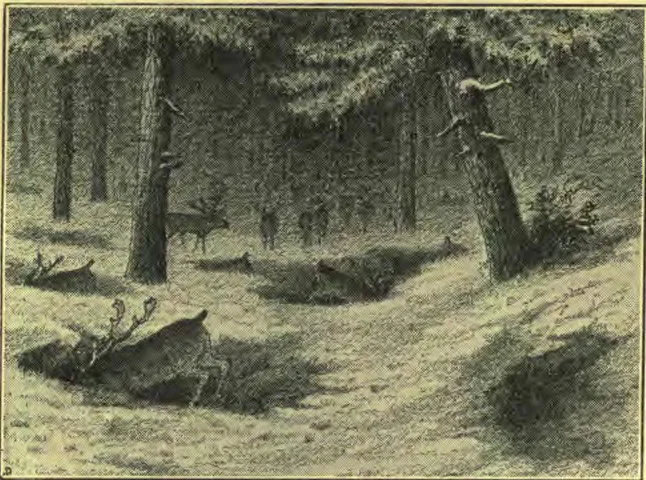
REINDEER DIGGING IN THE SNOW
Spread over such a territory, extending almost from the temperate zone even into the arctic circle, it is natural to expect to find marked differences in the appearances, lives, and occupations of the Lapps peopling so widely separated regions. For instance, the Russian-Arctic Lapp met with in Vardo,—where the sole occupation is fishing, and where everything and everybody smells of fish, and even the cows are fed on fish,—is a whaler and a deep-sea fisherman. He differs, however, from the lake fisherman of the interior, upon whom the traveler will come camped beside a beauty-lake of which the country boasts its hundreds. The only outward resemblance between the Arctic and woodland fishermen lies in the matter of dirt, filth seeming to be prominent features in both the people and their homes.
Then there are the Mountain Lapps, roaming the forests of northern Norway and Sweden, men who will come under no law, wanderers and pilferers, who pester the Scandinavian farmers, shooting their deer, milking their cows, and occasionally raiding their homes, carrying off a rifle or other property which attracts them. Process by law being impracticable, as the lawless ones move rapidly, here today and gone tomorrow, their trail growing green with grass behind them, the matter is generally compromised by the organization of a pursuing party of hunters. A few rifle shots put some of the trespassers, at least, where they will cease to trouble further.
But these characters do not represent the Lapp proper. No finer people live anywhere than the true Lapp, who is upright, honest, and lovable in character. The Swedish and Norwegian Lapps are Lutherans, with a deep reverence for God and everything connected with religion; hospitable to a fault; a people who would rather die than knowingly commit wrong. Such is the Lapp when not corrupted by Western civilization.
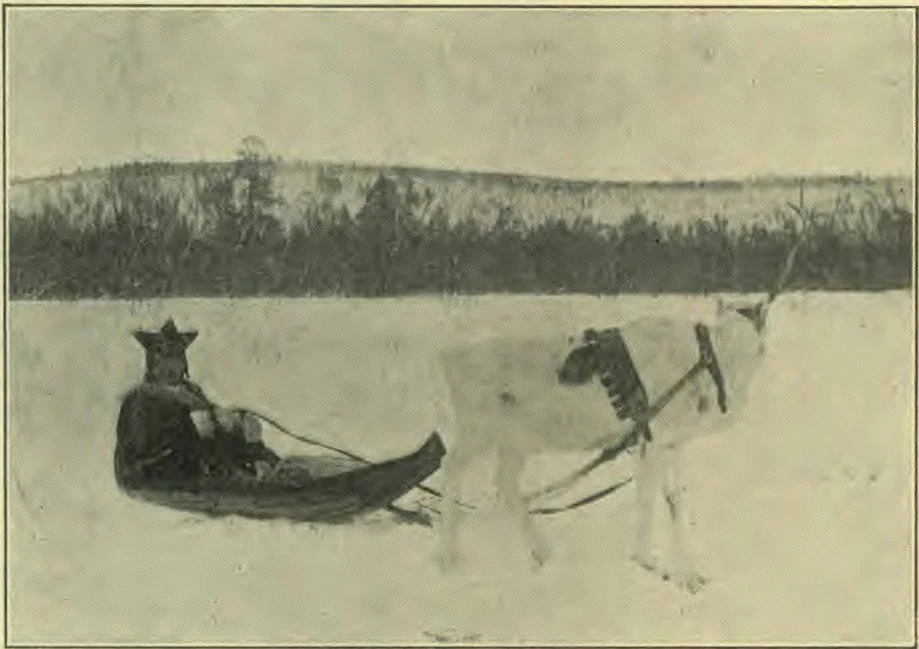
A LAPLAND TRAVELER
A LAPLAND TRAVELER
The Lapps have never been united into a nation. The Norwegians and the Swedes formerly held them in bondage as serfs, and even today, though under Russia’s fostering care they have increased numerically, they are still looked upon by the government much as we regard our Indians or native Alaskans.
One great cause of this lack of unity has been the migratory life of the people. As a body they are wanderers, not from choice, but necessity. They have always been herders and hunters, living on their deer. These are generally kept in small herds because of the difficulty of obtaining feed, and so the people always live in small camp communities. Their legends reach back far beyond the rise of the Roman Empire; but as they have no written history, no books, no monuments, no kings or royalty, they do not understand what patriotism means, or comprehend the necessity for wars, so have always been easily subjugated. They are a people of small stature, the average height of the men being from four feet five inches to five feet.
However, all Laplanders belong to “parishes” established by the government, where they pay taxes and tithe, and where they report annually for registration and assessment; but the greater portion of the people, being herders, spend their entire life caring for their reindeer. These deer feed on a peculiar moss called yellow moss, on which they must be allowed to browse, as they will not eat gathered and dried moss unless trained to do so. This is a difficult task, and not practicable except for a few deer in a bunch.
This moss is a very sensitive plant, and once browsed over, even for only three weeks, it must then be given years of rest—from five to ten—before the deer can be permitted to feed upon it again, or it will die and not reappear for a generation at the least. So the herder is forced to change his location each year, often wandering far for new pasture. For his own sustenance his beasts must live, and to find food for them compels the herder often to wander over miles of desolate territory. He is compelled also to seek territory where in winter the snow does not fall too heavily, as the deer must dig down into it to find the moss which is their food. It is a strange sight, the feeding of hundreds of these animals, often almost completely hidden from sight under the snow.
Lapland is largely made up of lakes, marshes, and swamps. In summer there is no other possible way of traveling through the greater portion of the country except on foot. In a few districts reindeer can be used as pack animals, but usually supplies must be transported on the backs of men. In winter, however, when all is frozen and covered with thick ice, traveling is done by sleighs, and regular routes are established by the government, where relays of deer can always be had, and in some places horses may be obtained. A few short lines of railroad reach into the interior from the borders connecting with navigable streams, but in general, the methods of travel in Arctic Lapland remain about as they have been for generations.
To the other many disadvantages and discomforts of summer traveling in Lapland, must be added the terrible plagues of mosquitoes, dragon flies, great bluebottle flies, and horseflies. These are present in millions, and it is not possible to protect the person from their attacks, clothing being but a small defense, especially against the bluebottle flies.

The Old Woman Who was Blind

In the railway station of the little town of —, the other morning, everybody seemed to be hurrying to see who could get a ticket first. The ticket agent was doing his best, but it was nearing train time, and though he tried to appear calm and deliberate, he was growing decidedly nervous. An old woman who had just purchased her ticket, not seeming to notice the crowd of people waiting, lingered at the ticket window to inquire what time it was. “There’s the clock right behind me,” was the curt reply of the agent, and the woman quickly gave place to another. But she did not look up at the clock. A young woman who was standing near by noticed this, and cheerfully told her the time of day.
No doubt that agent felt justified in suggesting that the old woman should not take his valuable time. He was overworked, and she evidently had plenty of time; the clock was in plain sight, placed there purposely; and of course he did not know she was blind. But somehow I believe the agent would have sold just as many tickets if he had taken time to glance at the clock and give the old lady a quick, courteous reply; for there is a sort of impetus given by a kind act. Anyway it was pitiful to think of the old woman starting to grope her way back to her seat, not knowing how long she must wait for her train. I am glad the young woman noticed.
It is bad enough to be blind, but there are sometimes other defects which are even worse than those which are physical. These are not always seen by those who are passing through life in a hurry. All about us are people who, though seemingly self-sufficient, are needing help the very worst way; for this is a helpless old world at best, and none of us can well get along without the occasional help of a fellow traveler. So when you and I get too busy to help others, too overworked to be kind, and we feel we are justified in not doing one thing more for anybody, let us take time to stop and look about us in a kind, unhurried way, and remember the old woman who was blind.
VIDA V. YOUNG.

Cooking Near the Kongo Border

As we all eat one, two, or three meals a day no matter where we may be, it may be interesting to know how we in this far-away land cook and bake without a stove. When we first came, we cooked over a bonfire by placing a piece of tin over the burning wood. Sometimes the boy would use large clods of clay from the ant heap when he could not get bricks or stones on which to place the pots. Many times the fire was built beside a stump or a live tree.
The cost of a stove just now is very great, and the cost of getting it here is still greater, so we have improvised a stove. We built a large standard of brick and filled the center with dirt. This saves stooping. Then we ran the brick shell about two or three layers above the standard, and this makes the fire box; over the bricks is placed a piece of sheet iron.
It is better to use iron or copper cooking kettles, as the enamel pots chip quickly and then begin to leak, and aluminum pots are too expensive.
By placing this brick stove so the wind will blow away the smoke, it will answer the purpose quite well till we can get a proper stove.
The baking is done by putting the bread into tins and placing the tins in large iron pots which have iron lids. Hot coals are then placed all around the pot and on the lid, and the bread bakes beautifully. Even pies and puddings can be baked and kept very clean of ashes by this method. Several times I have made gems by heating the irons and the pot before placing the batter in the gem irons.
At Matandani I cooked for a while over a fire in the fireplace and then used a Dutch oven. This oven was built of brick, but had no proper door. We placed hot coals inside the oven and left them there till the oven was hot; then scraped out the coals and hastily put in the bread, using a piece of sheet iron for a door. The iron bake pot is easier to use, and the food can be kept much cleaner.
Some of the pioneers place the bread right in the pot, and I saw one who used an ordinary enameled pan; but with this, one has to watch or the food will be burned.
One must be very careful about the quantity of ashes or coals used; for if too many coals are used, the crust will be burned before the center of the loaf is baked.
Today I made breaded tomatoes, roasts of different kinds, johnnycake, and gingerbread, and had good success.
It is most important to all missionaries to know how to make yeast as well as to know how to make good bread. Since flour costs nearly $15 a sack of one hundred pounds, one cannot afford to waste any by bad batches of bread. RUTH KONIGMACHER.

Overcoming Laziness to Begin Work

The hardest part of any work, is in rousing oneself to begin it. Let that initial scrimmage with the devil of laziness be over with, then, as soon as possible.—Albert J. Lyman.

A Young Mother's Regret

A young girl was attending a good school in the Southwestern Union Conference. She was doing acceptable work in the seventh grade, and had high ideals for the future; but not having been taught the danger and sin of flirting, she had spent the previous summer indulging in dress and gayety, or having fun, as she called it. Unable to break away from the company of one young man without offending his parents, as the two families were intimate friends, she left school about Christmas, and the two were married, rather to please their parents than themselves. The groom was only eighteen and the bride seventeen years of age. As neither one had been taught to work or to be in any way independent of their people, they found it very hard to begin home-making.
In about a year an unwanted baby girl came to them, which died in a few days. In another year a baby boy was born, and both parents, though living in poverty, welcomed him. The father quite often said, “I didn't marry you because I loved you;” or, “I didn't miss you.” after she had been on a visit to her mother's. Why did not he miss her? Ah! he spent his time with the boys,—the boys that smoke and chew and drink a little just to make themselves think they are men. They laugh and tell rude jokes, and think it funny if one gets “a little tipsy.”
The young girl's heart was sad, though she tried to hide the fact. She wore a pleasant smile when callers came, and tried to excuse anything she couldn't conceal.
At last their home was broken up. Their little boy, only two and a half years old, cried to go with his papa the morning he told them good-by without any kiss, and said he would come back in two weeks to get them. But he never came back, and the young mother, who works at anything honorable to make a living for herself and child, sincerely wishes she had finished her education before she married, and that her husband had been a Christian instead of just a good worldly boy, who her blinded parents felt sure would be an Adventist some day.
Girls, be careful in your choosing. Do not be too easily influenced to marry, especially before you get an education, or have weighed the matter from every side to see if the new relation will be a help and not a hindrance to a sincere Christian life. Never flirt, nor keep steady company with one you would not wish to marry if you should learn to think enough of each other. “Satan is constantly busy to hurry inexperienced youth into a marriage alliance. But the less we glory in the marriages which are now taking place, the better.”—“Testimonies for the Church,” Vol. II. p. 252.
ETHEL KING.

Lessons from the Dandelion

O DANDELIONS, brave and gay, that greet us in the spring,— And even on some winter’s day,—I would your praises sing. The green fields are all thickly strewn with coins of gleaming gold, And little children, loving you, pluck all their hands can hold
As day by day the parent plant brings forth her children gay. There’s honey for the humming bee, and common flowers for play. You look the sun straight in the face, be skies all gray or blue. Like common honest folk who hide no shame in hearts so true
When bloom is past, the stalks are crowned with spheres of gauzy sheen, Like constellations pure and white, the clumps of grass between He who the lilies viewed with love, would have us note with care All growing things that he has made, in earth and sea and air.
I think he’d say, “The hoary head’s a glory-crown indeed When found in paths of righteousness. Behold this flower’s seed!”
And, when the seeds go sailing off on all the winds that blow, I think I hear our Master say, “Learn, sower, how to sow; Speak wingèd words; do worthy deeds; be quick to catch the breeze Of opportunity, and all fair chances seize.
How difficult it is to rid the lawn of this gay weed, Because there is a gauzy wing attached to each small seed And when the mower cuts it down, before he is aware The plant has donned a fresh new gown, and doth winged seeds prepare.
Awake, my soul, and learn of her, this little common flower, And scatter thou the wingèd truth ’mongst men from hour to hour!
KATHERINE L. PECK.

A Daily Rule to Make One Person Happier

MAKE it a rule, and pray God to help you keep it, never, if possible, to lie down at night, without being able to say, “I have made one human being, at least, a little wiser, a little happier, or a little better this day.” — Charles Kingsley.

MRS. W. B. WHITE

Mattie

MRS. W. B. WHITE

Mattie is a strong, erect, well-developed Matabele girl, apparently fifteen or sixteen years of age. Born in the wilds of central Rhodesia, her only dress during her first half-dozen years a string of beads or a grass bracelet, she was reared in filth, and, like thousands of her sisters, was treated as the slave of the village. The African girl is the property of the father or brother, and is valued by him only for the work she can do during the first twelve or fourteen years of her life, and for the lobola she will bring when he sells her. Old men with two or three wives near their own age often wish a strong young wife to do the heavy drudgery of the kraal, and will pay more cattle for one than young men are able to give. As a rule the girl has no voice in the choice of a husband, but is sold to the highest bidder. Abused from infancy, the dog and slave of the kraal, knowing the life that awaits her, is it any wonder that the African girl is often stubborn and unreliable, and less susceptible to Christianizing and civilizing influences than the boys?
But God has his jewels among the dark-skinned daughters of this dark land, and many of them are finding their way to our missions, where they are decently housed and clothed, and taught not only to read and write, to sew and mend, and to keep themselves and their surroundings clean, but to love and serve the living God.
While many of the parents are anxious that their sons receive some education because of the financial advantage it may prove to them, they are as a rule very much opposed to their daughters’ attending school. They know that as the girls become enlightened they often refuse to be the wives of the men chosen by the parents, and may even make their own choice of husbands, who may not be able to pay so much as others could. It becomes a case of a girl’s heart against parental authority, and tribal customs grown hoary with age; and, alas! the latter usually wins. No matter how deeply the missionaries sympathize with the girl, there is little they can do to help her. While the tribal laws forbid a man to compel his daughter to marry against her will, few girls know this, and fewer still dare face the consequences of such rebellion.
Mattie’s father is dead, and her brother is the head of the kraal. As the girl became of marriageable age, perhaps fourteen, he engaged her to an old man who was able to pay the requisite number of cows and sheep. But a year or two before this the Somabula Mission had sent a teacher into that neighborhood, and his work had begun to take effect. Many of the boys had attended his school, some who had been converted went to the main station twenty-five miles away for further instruction and baptism, and his preaching and Bible reading in the kraals awoke new desires and aspirations in the minds of the young people. Naturally this was not pleasing to most of the older people. Mapone was one of the most prominent young converts, and he had made such good progress in his studies that he was able to assist Philip in his work.
Mattie had not been allowed to attend school, but Mapone wished to make her his wife, and his affection was returned. When she learned that she had been sold to an old man, she flatly refused to marry him. This did not worry her brother, for few girls can withstand authority long when enforced by the cruel sjambok but Mattie watched her opportunity and ran away from home, found her way to the mission, and told her story. She was taken in and kindly treated, while watch was kept for her brother, who was sure to follow.
On the second day he was seen approaching with another man, both armed with heavy sjamboks. Had Mattie fallen into their hands at that time, their cruelty would doubtless have compelled her to yield, but she escaped into the bush before they saw her. Brother de Beer, superintendent of the station, told them she had been there, and tried to reason with them, but to no avail. As they could not find the girl, they returned home, but with no intention of giving her up.
There was but one thing for Mattie to do, and that is something that few native girls have courage to undertake. She went to the native commissioner in Gwelo, twenty-five miles away, and laid her case before him. Mr. Jackson is a just man, and gave her a letter to her head chief, ordering him to see that justice was done her.
On receipt of the letter, the chief summoned her brother and lover, also the old man who had bargained for her. After hearing their stories, he asked Mattie which man she wanted to marry, and she walked to the side of Mapone and said she would have no one but him. The chief told her she could marry the man of her choice, but must go home with her brother until Mapone had cows enough to pay the lobola for her. He told her brother to treat her kindly, and if he thrashed her, she had permission to return to the mission and stay till her marriage.
For a month or two all seemed to go well, but the brother did not give up his purpose to sell his sister to the highest bidder. So after he thought those who had interested themselves in the case had forgotten about it, he informed Mattie that the old man was soon coming to take her to his kraal. When the girl told him she would never go with the old man, he beat her most inhumanly with the sjambok, inflicting wounds the scars of which she may carry through life, and made threats of further torture. But Mattie’s spirit was not to be broken, and she succeeded in eluding the vigilance of her relations. It needed no words to inform the chief that her brother had not obeyed him, and she was sent to the mission with permission to remain there until Mapone is able to secure the necessary number of cattle for lobola.
Mattie has now been at the mission three months, and is learning fast. She has mastered the Zulu primer, and is beginning to learn the Zulu Bible. She has renounced the ways of heathenism, and given her heart to God. In the mission kitchen she is being taught the rudiments of housework, to keep herself and her surroundings clean, and she will be taught to sew. She is shy and modest, but she goes about her work with a song on her lips. Last evening, before our service in the church, Mr. White asked her and Monkey, another mission girl, to sing to us in Sindebele. At first they were timid, but a reassuring word from Sister de Beer encouraged them, and sitting on the floor before the fire, without embarrassment they sang, “Shall We Gather at the River?” and “Bright Jewels.” Mattie’s courage and determination have served her well, and we expect her to develop into a strong Christian character.
Continue reading: Carrying the Gospel to the World