INTRODUCTION.—Between the events recorded in this and the preceding lessons, a wide gap intervenes, variously estimated at from eighteen to thirty-seven years, which the sacred historian passes over in silence. The second entrance of the Israelites into the desert of Zin occurred in the first month of the fortieth year after their departure from Egypt, as appears from a comparison of Num. 20:28 with 33:38.
Questions, with Scripture Texts, and Notes.
1.When the Israelites came to Kadesh, in the wilderness of Zin, what took place?
“Then came the children of Israel, even the whole congregation, into the desert of Zin in the first month; and the people abode in Kadesh; and Miriam died there, and was buried there.” Num. 20:1.
Miriam at the time of her death is supposed to have been one hundred and thirty years of age. This event occurred four months before the death of Aaron, and eleven months before that of Moses.
2.From what did the people suffer?
“And there was no water for the congregation: and they gathered themselves together against Moses and against Aaron.” Verse 3.
3.What did they do and say?
“And the people chode with Moses, and spake, saying, Would God that we had died when our brethren died before the Lord.” Verse 3.
In this act of murmuring, the younger generation of the Israelites proved themselves to be no better than their fathers, who had murmured at the same place and for the same reason thirty-eight years before.
4.What did they charge Moses with doing?
“And why have ye brought up the congregation of the Lord into this wilderness, that we and our cattle should die there?” Verse 4.
5.What did they say of the place where they then were?
“And wherefore have ye made us to come up out of Egypt, to bring us in unto this evil place? it is no place of seed, or of figs, or of vines, or of pomegranates; neither is there any water to drink.” Verse 5.
6.Whom did they blame for bringing them out of Egypt?
“And the people chode with Moses, and spake, saying, Would God that we had died when our brethren died before the Lord. And why have ye brought up the congregation of the Lord into this wilderness, that we and our cattle should die there? And wherefore have ye made us to come up out of Egypt, to bring us in unto this evil place? it is no place of seed, or of figs, or of vines, or of pomegranates; neither is there any water to drink.” Verses 3–5.
7.Who had really brought them from Egypt?
“And God spake all these words, saying, I am the Lord thy God, which have brought thee out of the land of Egypt, out of the house of bondage.” Ex. 20:1, 2.
8.Then to what was their murmuring equivalent?
Ans.—To a denial that God had anything to do with their wonderful deliverance.
9.What does the psalmist say of them?
“They forgat God their saviour, which had done great things in Egypt: wondrous works in the land of Ham, and terrible things by the Red Sea.” Ps. 106:21, 22.
10.While the sin of the Israelites was exceedingly great, is it an uncommon one?
11.What did Moses and Aaron do in this extremity?
“And Moses and Aaron went from the presence of the assembly unto the door of the tabernacle of the congregation, and they fell upon their faces: and the glory of the Lord appeared unto them.” Num. 20:6.
12.What directions did the Lord give them?
“And the Lord spake unto Moses, saying, Take the rod, and gather thou the assembly together, thou, and Aaron thy brother,350and speak ye unto the rock before their eyes: and it shall give forth his water, and thou shalt bring forth to them water out of the rock; so thou shalt give the congregation and their beasts drink.” Verses 7, 8.
13.When the people were gathered before the rock, what did Moses say?
“And Moses and Aaron gathered the congregation together before the rock, and he said unto them, Hear now, ye rebels; must we fetch you water out of this rock?” Verse 10.
14.What does the psalmist say of this occurrence?
“They angered him also at the waters of strife, so that it went ill with Moses for their sakes; because they provoked his spirit, so that he spake unadvisedly with his lips.” Ps. 106:32, 33.
15.How did it go ill with Moses?
“And the Lord spake unto Moses and Aaron, Because ye believed me not, to sanctify me in the eyes of the children of Israel, therefore ye shall not bring this congregation into the land which I have given them.” Num. 20:12.
16.In what particular did Moses and Aaron trespass against the Lord?
“Because ye trespassed against me among the children of Israel at the waters of Meribah-Kadesh, in the wilderness of Zin; because ye sanctified me not in the midst of the children of Israel.” Deut. 32:51.
Moses was not commanded to smite the rock, but only to speak to it; and the language which he used—“must we bring you water out of this rock?”—directly tended to justify the representation of the murmurers that it was only Moses, and not God, who had led them in their wanderings through the wilderness.
17.When Moses allowed the Israelites by their rebellious words to provoke his spirit, what position toward God did he also assume?
“Aaron shall be gathered unto his people: for he shall not enter into the land which I have given unto the children of Israel, because ye rebelled against my word at the water of Meribah.” Num. 20:24.
“For ye rebelled against my commandment in the desert of Zin, in the strife of the congregation to sanctify me at the water before their eyes: that is the water of Meribah in Kadesh in the wilderness of Zin.” Chap. 27:14.
18.Do we have any intimation that the Lord in any degree excused his sin because he labored under great provocation?
19.In this giving way to anger, of what grace did Moses show a lack?
“Charity suffereth long, and is kind; charity envieth not; charity vaunteth not itself, is not puffed up, doth not behave itself unseemly, seeketh not her own, is not easily provoked, thinketh no evil.” 1 Cor. 13:4, 5.
20.What evidence have we that, although Moses was prohibited from entering the promised land, he repented of his sin, and was fully forgiven?
“So Moses the servant of the Lord died there in the land of Moab, according to the word of the Lord. And he buried him in a valley in the land of Moab, over against Beth-peor: but no man knoweth of his sepulchre unto this day.” Deut. 34:5, 6.
“Yet Michael the archangel, when contending with the Devil he disputed about the body of Moses, durst not bring against him a railing accusation, but said, The Lord rebuke thee.” Jude 9.
“And after six days Jesus taketh Peter, James, and John his brother, and bringeth them up into a high mountain apart, and was transfigured before them: and his face did shine as the sun, and his raiment was white as the light. And behold, there appeared unto them Moses and Elias talking with him.” Matt. 17:1–3.
The sin of Moses was a great one, even greater than that of the people; for he had all the light that they had, and more. It is true that the people were the cause of his fall, yet that did not in the least relieve him from responsibility. The real cause, after all, was in his own heart, otherwise nothing that the people could have done would have moved him. The Lord cannot tolerate sin, no matter in whom it appears, yet he is “the Lord God, merciful and gracious, long-suffering, and abundant in goodness and truth; keeping mercy for thousands, forgiving iniquity and transgression and sin.” Ex. 34:6, 7. That Moses repented, and was abundantly pardoned, is shown by the fact that after his death he was raised and taken to heaven, and was commissioned to come on a message of love to Christ. From this we are warranted in concluding that if it had not been for this one sin, he would not only have been permitted to enter the land of Canaan, but would, like Elijah, have been translated without seeing death.
21.Then what must even the best of men say to the Lord?
“If thou, Lord, shouldest mark iniquities, O Lord, who shall stand? But there is forgiveness with thee, that thou mayest be feared.” Ps. 130:3, 4.
We are often prone to excuse some sin in ourselves, on the ground that it is the only time we ever committed it; or that we but seldom fall into it, and only under the greatest provocation. Many seem to think that if a person has great provocation, he can commit a sin with impunity. But that reasoning would have made it right for the Saviour to yield to Satan’s temptations in the wilderness; for no man ever suffered so fierce temptation. The truth is, there is no excuse for sin, and anger is not admissible under any circumstances. When the translators of our common version of the Bible wrote that charity “is not easily provoked,” they were evidently moved by some consideration for the weakness of the flesh. They seem to have the idea that a man might have charity, and still be provoked to anger, providing he was not very easily provoked. But they did great injustice to the truth; for the words as Paul wrote them are simply, “is not provoked.” True charity does not get provoked under any circumstances.
NOTICE TO STATE CONFERENCE COMMITTEES.
LET the various State Conference committees attend to the matter of ordering their large posters and Camp-meeting Journal for their camp-meetings in time, being particular to give location and description of grounds, railroad and street-car facilities, daily programme, etc., as they desire them to appear on these advertising sheets, if they wish us to furnish them.
VIRGINIA, NOTICE!
By R. D. Hottel
Our brethren who were in attendance at our late State meeting know, and those who will read the resolutions adopted will learn, that we desire to create a canvassers' fund for the purpose of assisting any who may not be able to join a company and pay board, etc., in advance. We believe that Virginia is just as promising a field for the canvassing work as any other State. Especially do we believe this to be true at the present time, and until the holidays, at least, a fine prospect is before us. Crops of all kinds are promising. New interests are being created at different points by Northern capitalists. We have talent in our Conference, if consecrated to the work, that can be the means of getting before the million and a half of inhabitants of this State, the precious truth of God. We believe that this can be done largely in the canvassing work.
We expect to have several companies in the field before the summer is over. Brethren and sisters could unite with these companies, be surrounded by home influences, have the benefit of instruction and encouragement each day, and we believe make a success of the work. What a noble work we would all be engaged in,—working with Christ to spread the last warning message to the world,—and there are many who would gladly enter this work if they had a small amount of means until they could make one or two deliveries. It is for this purpose that we design to see created in our State a canvassers' fund that can be used for that purpose. When the canvasser has made his delivery, the means can be returned, and used to assist others, and thus be doing a good work all the time. Who will donate liberally to it, and who will respond first? We ought to have several hundred dollars for this purpose. The interest that will accrue to the donor will be in seeing seeds of truth sown, and souls saved in the kingdom of God. Let us hear from the brethren in Virginia and others who are interested in the work in this State. Send the money to our State treasurer, Chas. D. Zirkle, New Market, Va., stating the purpose for which it is sent. May God's rich blessing rest on all whose hearts are in the work. R. D. HOTTEL, State Agent.
NOTICE TO DAKOTA CHURCH CLERKS.
By Geo. H. Smith
Those who have not sent in their credentials to the Dakota Conference should do so at once. We also desire a report from every church, unorganized company, and Sabbath-school, without an exception, at the Madison camp-meeting. I will send you the blanks in time so that you can report as soon as June 18. My address is Madison, Dak., Box 444.
Geo. H. Smith, Sec.
News of the Week.
FOR WEEK ENDING MAY 25.
DOMESTIC.
—Washington Irving Bishop, the noted mind reader, died suddenly in New York last week during an exhibition of his powers before the Lamb’s Club.
—Fire at Pearlington, Miss., Monday afternoon destroyed the plant of the Port Evant and Favre Lumber Company, causing a loss of $150,000, on which there was $75,000 insurance.
—At Baltimore, Md., Monday, the passenger steamer “Johns Hopkins,” of the Merchants and Miners’ Transportation Company, was totally destroyed by fire. The vessel was worth $200,000, and was insured for $145,000.
—Trouble has begun in Guthrie, Oklahoma, over the forcible eviction from a town lot of an old man named Diemer, whose claim to the land had not been sustained by the Board of Arbitration. An angry mob gathered to prevent the eviction, and a collision with the militia and city authorities resulted, but without bloodshed. A large number of other residents are said to be lacking the sanction of the same Board for the validity of their claims to real estate in Guthrie, and other evictions are likely to follow, in which case it is feared there will be trouble.
—Great excitement has prevailed in Chicago since last Thursday over the discovery of the remains of the late missing Dr. Cronin, of that city, the evidences pointing conclusively to murder, back of which it is thought there exists a great conspiracy. The doctor had been prominent in connection with the affairs of the Irish land league, and had threatened, it is said, to make exposure of the misappropriation of funds by certain of its members. The body when found was entirely divested of clothing, but around the neck was left suspended an Agnus Dei, a Catholic charm which guards the wearer from accidents, and which the devout Catholics who committed the deed had reverently refrained from touching.
FOREIGN.
—Ten Irish members of the House of Commons are in prison for offenses under the Crimes Act.
—The British House of Lords has rejected the bill allowing a man to marry his deceased wife’s sister.
—The Shah of Persia, who is now journeying from Teheran to St. Petersburg, is meeting with a grand reception in Russia.
—The daily attendance at the Paris Exposition averages 71,000 persons. The Eiffel tower is capable of holding in its different landings 10,000 persons.
—In the St. Lawrence River, opposite Point Trembles, early Wednesday morning the Allan line steamer “Polynesian” was in collision with and sunk the steamer “Cynthia,” eight of the crew of the latter vessel being drowned.
—The great strike of the German coal-miners is about over. Emperor William’s calm, but determined words to mine-owners and workmen produced immediate effect. A compromise favorable to the men was arranged, and they are everywhere returning to work.
—The French Socialists have secretly invited their German brethren to take part in a congress of socialists which it is proposed to hold on July 14. It is reported that the French Government will prohibit the holding of the congress, or, at any rate, that it will expel all foreigners who may come to attend the congress, even Deputies of the German Reichstag.
—According to the Nineteenth Century, the Senatorial Court of France finds difficulty in framing a specific charge against Gen. Boulanger. Some senators propose that a nolle prosequi be entered in his case, others that he be tried at the assizes, and still others that he be court-martialed. It is believed, the paper says, that the proceedings against Gen. Boulanger will fail, and that the prosecution of M. Rochefort will be abandoned.
—A dispatch from the city of Mexico says: “News has been received here of a discovery of great archaeological importance in the State of Chiapas, near the ruins of Palenque, being nothing less than a large city hidden in the depths of the forests. Some buildings are five stories high and in a good state of preservation. There is a well-paved road, several miles in length, still perceivable in the midst of a tropical forest. Very few particulars have reached here, but the report comes from good sources. Palenque is said to be a mere village in comparison with lost city of prehistoric times.”
—The Samoan conference is nearing a successful close. Dispatches seem to indicate that the American Commissioners have succeeded in carrying every important point they set out to obtain. Indeed, so prevalent is this feeling in Berlin that the press and other influential papers in Germany complain of the success of the Berlin Americans. It is thought that the restoration of Malietoa to power is assured, and that the plan for a tripartite government in Samoa will be put into effect. It is also more than likely that the Commission has decided in favor of the absolute independence of Samoa as soon as the people there demonstrate their ability to go alone.
RELIGIOUS.
—The total number of the Waldenses is given at 16,500.
—The total number of Italian communicants in the evangelical churches of Italy is 22,000.
—It is stated at Cettinje, the capital of Montenegro, that Christians are being massacred by Turks on the Montenegrin frontier.
—A General Conference of United Brethren has been in session at York, Pa. It adjourned Tuesday night until the third Thursday in May, 1893.
—Richmond, Va., is experiencing a great revival among the negroes. Many hundreds have been baptized in the James River, and many more are waiting their turn.
—At Boston, Mass., Monday, the American Baptist Publication Society began its sixty-fifth annual meeting. The report of the Board of Managers shows the society to be flourishing.
—The oldest church structure still standing in North America is believed to be the original First Church erected in Salem, Mass., in 1634, now carefully protected, and still standing in the rear of Plummer Hall, in that city. The dimensions, interior, architecture, and the material of this church all fully conform to the ancient records, and prove it to be the original church of the Fathers.
—A New York journal prints an item to the effect that the two factions of the Reformed Presbyterian Church, known as the Synod and the General Synod, will probably soon be united, after a separation of fifty-six years. The seceding body, or Covenanters, left the church in 1835, the question in dispute being whether members could consistently vote in political elections while God is not recognized in the Constitution of the United States.
—A split has occurred in the religious body known as the United Brethren in Christ. At the General Conference held in York, Pa., last week, resolutions were adopted declaring that Bishop Milton Wright and several delegates who were named have irregularly withdrawn from the body, and are no longer members of the Church of the United Brethren in Christ. The question in dispute is regarding the recognition of secret societies. The seceding faction is opposed to allowing church members to belong to such societies.
Appointments for Sabbath-School and Health Association Meetings
Appointments.
“And he said unto them, Go ye into all the world, and preach the gospel to every creature.”—Mark 16:15.
The next annual session of the Wisconsin Sabbath-school Association will be held in connection with the camp-meeting at Mauston, June 18-25. W. W. SHARP, Pres.
The next annual meeting of the Minnesota Health and Temperance Association will be held in connection with the camp-meeting, June 11-18, 1889. ALLEN MOON, Pres.
The next annual session of the Wisconsin Health and Temperance Association will be held at Mauston, Wis., June 18-25, in connection with the camp-meeting. W. W. SHARP, Pres.
There will be a general meeting at Taopi, Dak., beginning Friday evening, June 7, and continuing over Sabbath and Sunday. The meeting will be held in the new church, and the brethren at Madison and Grand Meadow are specially invited to be present. W. B. WHITE.
There will be a Sabbath-school held in connection with the general meeting, June 8, at Canaan, Me. The lesson for the occasion will be the regular lesson for June 8. Hope all will come prepared to take part in the exercises, and to make a good liberal donation to the association. The schools have done well in this respect in the past, and at this meeting we do not want to fall behind what we have done before. S. J. HERSUM, Pres. Me. S. S. Ass’n.
Obituary Notices.
“Blessed are the dead which die in the Lord from henceforth.”—Rev. 14:13.
LAWTON.—Died in Winfield, N. Y., May 4, 1889, Wm. Lawton, in the eighty-fourth year of his age. He suffered a year and a half from that dread disease paralysis. He embraced the Advent faith thirty-five years ago, and remained a firm believer to his death. The funeral services were conducted by the Rev. Wm. Williams, of the M. E. Church.
A. P. LAWTON.
BRONNEN.—Died of consumption, in Houlton, Maine, May 6, 1889, Lucy N., wife of Elias Bronnen, aged thirty-three years. She embraced the truth about three years ago, and continued in the faith until death relieved her from suffering. She rests in hope of a crown of glory that fadeth not away when Jesus comes. Remarks by the writer from 2 Tim. 4:7, 8. May God bless this afflicted family.
J. B. GOODRICH.
SPEECHER.—Died of pneumonia at the home of her parents in Burke, Wis., May 12, 1889, Amelia C., daughter of E. C. and E. F. Speecher, aged 22 years, 4 months, and 8 days. Amelia had kept the Sabbath with her mother for several years, but had not fully given herself to the Lord’s service, yet in her last sickness she gave her friends cause to hope that all is well. Words of comfort were spoken by the writer.
W. W. SHARP.
JOHNSON.—Sister Ruama L. Johnson, wife of Garland Johnson, and daughter of Bro. B. W. Stilson, lately deceased, died at her home in Montezuma, Iowa, April 22, 1889. Her disease was consumption, terminating in dropsy. Sister Johnson was born at Owego, N. Y., Dec. 16, 1846. She was converted at the age of thirteen, and united with the Baptist Church. She accepted the present truth in 1881. Her husband, son, and two daughters survive. Services at the Christian church by Rev. John F. Rouse (Methodist).
T. F. CRANE.
DOLLARHIDE.—Died of flux, at Denison, Tex., May 7, 1889, our darling boy, in the ninth year of his age. Warren was such a promising boy, and everybody loved him. We feel that the hand of the Lord is indeed heavy, for it is only two months since we buried our little girl; but we know that our children are better off. We look to that meeting beyond the grave, where there is no more sickness and death, and where parting and sorrow never come. “The Lord gave, and the Lord hath taken away; blessed be the name of the Lord.”
MR. AND MRS. J. R. DOLLARHIDE.
WILBUR.—Died at the residence of her brother in the township of Ogden, Mich., May 14, 1889, sister Eunice A. Wilbur, in the forty-eighth year of her age. She had been called to attend a case of sickness at the home of her brother, when she was attacked by a fit of apoplexy, and died without an attendant. Sister Wilbur embraced the truths of the third angel’s message about six years ago, and united with the church at Ogden Centre a few years after, from which her loss will be severely felt. She leaves a husband and one daughter to mourn her loss. Words of comfort and consolation were spoken by the resident M. E. pastor on the occasion of her funeral.
EUGENE LELAND.
FARBER.—Died at her home in Lodi, Wis., May 15, 1889, Mrs. Elizabeth Farber, in the forty-third year of her age. In early years sister Farber embraced the Christian’s hope, and became a member of the Presbyterian Church. About ten years ago she became convinced of the truths of the third angel’s message, and united with the Seventh-day Adventist Church, of which she continued a devoted member. Three orphan children are left to mourn their loss, but they have learned to know and trust their Saviour, and hope to meet their mother at the first resurrection. The consolation of the gospel of Christ was presented by the writer, to a large assemblage of sympathizing friends.
W. W. SHARP.
LESLIE.—Died April 28, 1889, near Wauseon, O., E. B. Leslie, aged 42 years, 4 months, and 3 days. He accepted the truths for this age some seven or eight years ago at Dunkirk, O., of which church he was a member at the time of his death. He had been a great sufferer for nearly three years, but his last days were quiet, and he fell asleep without a struggle. He had hope of recovery most of the time till the last, and said he wanted to live to care for his children, but he was resigned if it was not God’s will that he should live. We had a very joyful season of prayer the morning before he died. He took part in praising the Lord. We hope to meet him in the first resurrection. He leaves a wife and two children. Funeral services were conducted by W. E. Collett (Methodist). Text, Eccl. 9:5, first clause.
MRS. CLARA LESLIE.
THE MINNESOTA CAMP-MEETING.
We are pleased to be able to say that we have succeeded in securing reduced fare over all the railroads in Minnesota, and also in North Dakota, to the camp-meeting at Minneapolis, on the following terms: A certificate must be obtained at the office where you buy your ticket to come to the meeting, stating that you have paid full fare to Minneapolis on that date. This certificate, or receipt, you must bring with you to the ground; and at the close of the meeting, it must be presented to Bro. D. P. Curtis, to be filled out and signed by him. On presentation of this certificate at the ticket office in Minneapolis, you will be entitled to return for one-third fare.
TAKE NOTICE.
1. Those who fail to secure and preserve certificates must pay full fare returning, as the roads are very strict in this matter.
2. Those who are compelled to come over more than one road should buy tickets as far as they come over each road, and obtain certificates from each agent.
3. All who live on the Chicago and Northwestern Road, and who will come to the meeting by way of Kasota, can buy through tickets to Minneapolis.
4. Those coming on the Wells Branch of the Milwaukee and St. Paul Road must buy tickets to Mankato, and at Mankato purchase tickets to Minneapolis by either the Omaha or the St. Louis Roads. Secure certificates both at your home station and at Mankato, and the agent of the Wells Branch at Mankato will be instructed to honor them when you return.
5. We still hope to secure reduced fare on the Burlington Road from points in Wisconsin between Minneapolis and La Crosse.
HOW TO REACH THE GROUNDS.
Arriving at Minneapolis, you should take the motor train at Washington Ave. and First Ave. south to Thirty-first St. Junction. Here you will change cars, taking the train on the Washburn Park line to Forty-fourth St., which is but a short distance from the grounds. All trains stop at this point. There will be a camp-meeting agent at the depots on the 11th and 12th of June, to whom all baggage checks should be delivered. Only hand baggage can be carried on the motor line. Provision has been made for carrying baggage to and from the grounds, with no danger of loss, at an expense of ten cents per trunk each way. As usual, there will be an ample store of provisions on the grounds, for sale at reasonable prices; also hay and grain for horses.
We desire to call attention once more to the matter of ordering tents. Those desiring them should order at once of C. M. Everest, Box 1058, Minneapolis, giving size of tent wanted. The sizes we have are 10 x 12, 12 x 14, 12 x 16, 12 x 12, and 14 x 14 ft.
MINN. CONF. COM.
Travelers' Guide.
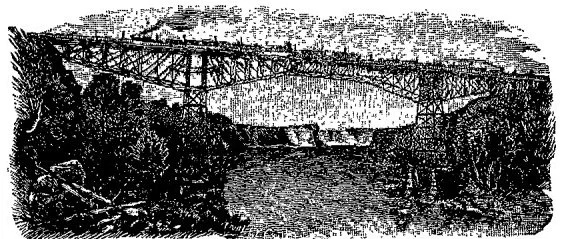
MICHIGAN CENTRAL NEW CANTILEVER BRIDGE, NIAGARA FALLS.—
O. W. RUGGLES,
General Pass. & Ticket Agent, Chicago.
O. E. JONES,
Ticket Agent, Battle Creek.
DIRECTIONS FOR THOSE ATTENDING THE NEW YORK CAMP-MEETING.
By M. H. Brown
1. Those living near the N. Y. Central Railroad should purchase tickets over it, and not over the West Shore, as the last-named railroad does not pass through Rome. Those living in Monroe, Orleans, and Niagara counties, should take the N. Y. Central instead of the R. W. & O. R. R., as the route will be cheaper and more convenient. Those living where they can take the Syracuse Northern branch of the R. W. & O., should do so in preference to taking the N. Y. Ont. and W., on account of saving transfer at Oneida. Those living near the “Phœnix line” of the R. W. and O., should buy their tickets at Phœnix, Fulton, or Oswego, provided they can obtain certificates, and so save transfer in Syracuse. If certificates cannot be obtained at those stations on the Phœnix line, they can be secured at the Fulton and Oswego offices of the D. L. & W. R. R. Due notice will be given.
2. Those living in Warren County can buy round-trip tickets to Saratoga from North Creek for $3.15; from Riverside for $2.75. At Saratoga, tickets can be purchased for Rome, and certificates obtained to secure reduction of fare on return.
3. Those coming from north of Richland over the R. W. & O. R. R., should not take the train leaving Canton and Dekalb Junction about noon and Watertown at 2:55 P. M., for it runs to Oswego and not to Rome. The trains leaving Canton and Dekalb Junction about 8 A. M. and 5 P. M., and Watertown at 10 A. M. and 7:15 P. M., both run to Rome, the first one reaching there at 12:50, and the latter at 9:43 P. M.
4. When you reach Rome, take the horse cars marked James and Madison Sts., to the corner of Madison and Thomas, and then walk two blocks west on Thomas St. to the camp. It is about one mile north from the depot.
5. Do not deliver up your checks to any one at the depot, unless to one of our brethren, but report your baggage to one of the camp-meeting committee on the ground.
6. Please remember to purchase your tickets and get your certificates between June 2–9, so as to be sure of the reduced rate on returning home. You can come to the meeting any day you choose up to June 15, and your ticket will be good, or you can start from home and obtain a stop-over ticket of the conductor at any station you choose between your station and Rome; but on returning you cannot stop off, as the return tickets are limited.
7. There will be an ample supply of tents on the ground, so no one need stay away because he has not ordered one.
8. All should provide themselves with bedding, as bedding is always scarce to obtain at a camp-meeting.
9. There will be a grocery and boarding tent on the ground. Board can be obtained at reasonable rates.
M. H. Brown.
THE INTERMEDIATE STATE.
AN EIGHT-PAGE TRACT,
Containing Bible arguments in proof that the doctrine of eternal torment is groundless, and showing the condition of both the righteous and the wicked after death. Price, 1 cent.
Address, REVIEW & HERALD, Battle Creek, Mich.; 26 and 28 College Place, Chicago, Ill.; or Toronto, Ontario.
HISTORY OF THE DOCTRINE OF THE SOUL
Among all races and peoples, ancient and modern, including theologians, philosophers, scientists, and untutored aborigines, carefully brought down to the present time. 186 pages, 75 cents.
Address, REVIEW & HERALD, Battle Creek, Mich.; 26 and 28 College Place, Chicago, Ill.; or Toronto, Ontario.
PARABLE OF THE TEN VIRGINS.
A NEW TRACT, BY URIAH SMITH,
Designed to give a better understanding of this parable, showing its past and present application, and defining the “shut door.” 24 pp. Price, 3 cents.
Address, REVIEW & HERALD, Battle Creek, Mich.; 26 and 28 College Place, Chicago, Ill.; or Toronto, Ontario.