Reader, have you ever reflected that you are not keeping the day which Christ, his apostles, and the primitive Christians observed? There is no evidence that the first day, or Sunday, was observed even as a festival, until some time in the second century. The first law for Sunday was that of Constantine, in A. D. 321; from that time forward ecclesiastical and state influences were used with rigor to turn the people from the observance of the Sabbath, and oblige them to keep Sunday. Christians generally continued to keep the Sabbath until the fifth century, as is evident from the oldest authorities on the subject, of whom are Morer and Geisler. To this effect Dr. Twisse quotes Baronius, Gomaris, and Rivet. The same testimony is given by Dr. Lyman Coleman of Philadelphia, in his Ancient Christianity, chap. xxvi. sec. 2: "The last day of the week was strictly kept for a long time after the overthrow of the temple and its worship. Down even to the fifth century the observance of the Jewish Sabbath was continued in the Christian church. During the early ages it was entitled 'the Sabbath,' this word being confined to the seventh day of the week, which, as we have already said, continued to be observed for several centuries by the converts to Christianity. No law or precept appears to have been given by Christ, or the apostles, either for the abrogation of the Jewish Sabbath, or the institution of the Lord's day, or the substitution of the first for the seventh day of the week."
The Abyssinians have always observed the Sabbath. Traces of Sabbath-keeping in Europe are found from the sixth century to the sixteenth. In the year 600 there was a class of Sabbath-keepers in Rome who were denounced by the pope. Erasmus speaks of Sabbatarians in Bohemia. Many of the Waldenses were called Sabbatatti, because, as Benedict says, "they met for worship on the seventh day, and did not regard the first-day Sabbath." From references by old authors, it appears that in the beginning of the sixteenth century there were Christian Sabbath-keepers in Germany, Holland, and England. The Sabbath controversy in England waxed great from 1585 to 1685. It has been continued in England and America ever since, but at no period has it assumed such proportions as within the past forty years. The present number of Christian Sabbath-keepers in Western Europe and America is supposed to be about 40,000, with an increase of more than a thousand annually. This does not include the Russian Sabbath-keepers, who are reported to number more than a million. Thus, from the time of the apostles until the present day, there have existed Gentile Christians who have faithfully adhered to and observed the seventh day,—the true Sabbath of the fourth commandment.—Sabbath Memorial.
SYNOPSIS OF THE PRESENT TRUTH.
By Uriah Smith
NUMBER FIVE.
We pause again to look at the symbols by which God had foreshown these events. In the great image, there was, succeeding the breast and arms of silver, the belly and sides of brass; corresponding to which the Prophet told king Nebuchadnezzar that after a second kingdom had arisen inferior to him, there should arise another third kingdom of brass, which should bear rule over all the earth. The kingdom of Alexander was more extensive than any that had preceded it.
In the second series of Dan. 7, after the Prophet had seen the bear pass away, he beheld an extraordinary leopard rise in its stead. This leopard had four wings of a fowl, and four heads. Verse 6. On this verse, Scott has the following note: "This was the emblem of the Grecian or Macedonian empire, which for the time was the most renowned in the world. It was erected by Alexander the great on the ruins of the Persian monarchy, and it continued in four divisions under his successors. The leopard being exceedingly fierce and swift, represented the kingdom, and especially Alexander its founder; but the swiftness of the quadruped was not an adequate emblem of the rapidity with which he made his conquests, as he subdued nations more speedily than others could march their armies through them. The leopard had therefore four wings of a fowl upon his back. When Alexander died, his kingdom was after many contests among his captains, divided into four parts, Egypt, Syria, Macedonia and Thrace, with some regions of Asia Minor. These were the four heads of this third beast, and under them dominion was given to it, until it was gradually reduced by the next beast."
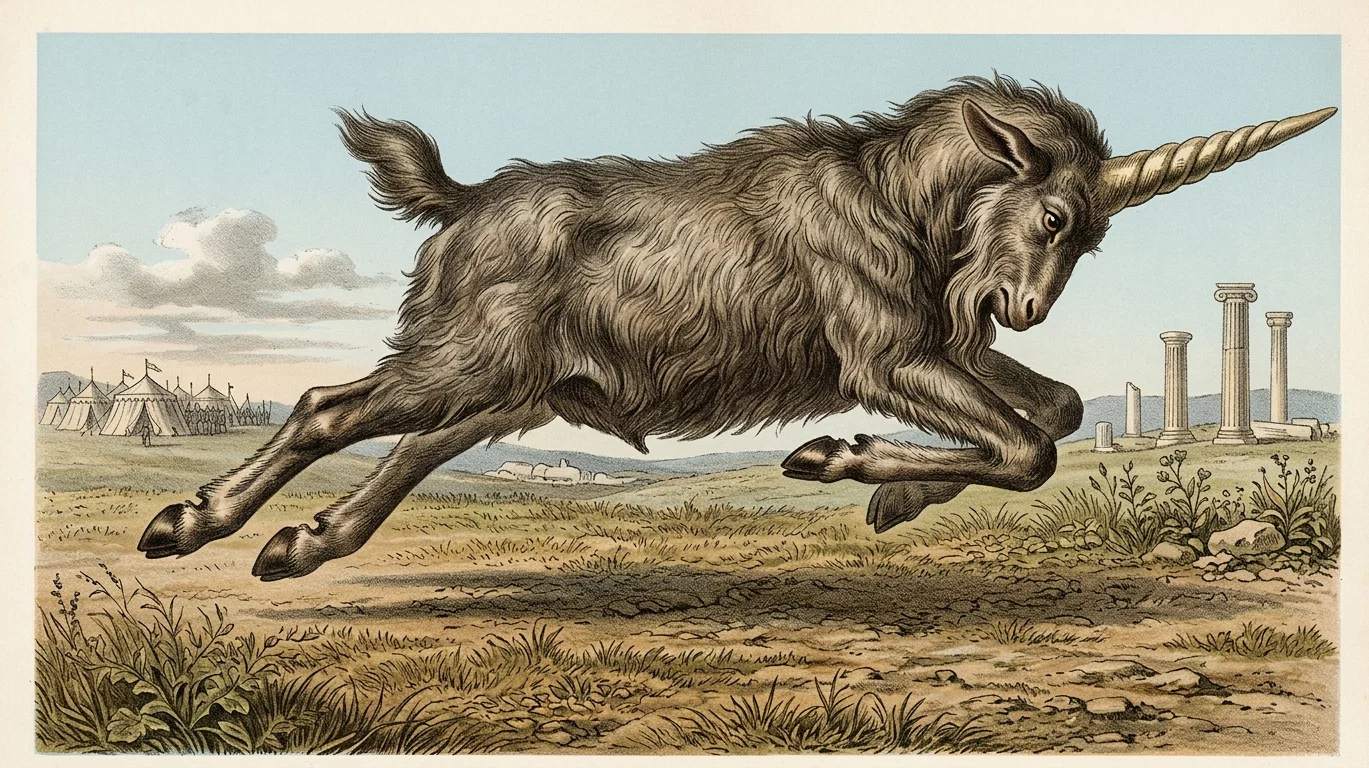
Again, in the third series of symbols, [chap. 8,] as Daniel was considering the ram, he saw a he-goat come from the west on the face of the whole earth, with that swiftness that he touched not the ground; and he had a notable horn between his eyes. He ran into the ram in the fury of his power, smote him, cast him down and stamped upon him. He waxed great, his horn was broken, and in its stead came up four notable ones towards the four winds of heaven. This goat is explained in verse 21, to be Grecia, and the great horn, the first king, or Alexander. And whereas, that being broken, four stood up in its place, as shown the Prophet, in fulfillment hereof, that division took place in the kingdom on the death of Alexander, which has been already noticed.
With the following extracts from Prideaux, we take our leave of this he-goat of the west:—
"Alexander was not stayed by the death of Darius from still pursuing after the traitor Bessus; but finding at length that he was gotten too far before him to be overtaken, he returned again into Parthia; and there having regulated his affairs in the army, as well as in the province, he marched into Hyrcania, and received that country under his subjection. After that he subdued the Mardans, Arians, Drangians, Aracausians, and several other nations, over which he flew with victory swifter than others can travel, often with his horse pursuing his enemies upon the spur whole days and nights, and sometimes making long marches for several days one after the other, as once he did in the pursuit of Darius, of near forty miles a day, for eleven days together. So that, by the speed of his marches, he came upon his enemy before they were aware of him, and conquered them before they could be in a posture to resist him; which exactly agreeth with the description given of him in the prophecies of Daniel some ages before; he being in them set forth under the similitude of a panther, or leopard, with four wings; for he was impetuous and fierce in his warlike expeditions, as a panther after his prey, and came on upon his enemies with that speed as if he flew with a double pair of wings. And to this purpose he is, in another place of those prophecies, compared to a he-goat, coming from the west with that swiftness upon the king of Media and Persia, that he seemed as if his feet did not touch the ground. And his actions, as well in this comparison as the former, fully verify the prophecy."
Again he says, "Never had any man a greater run of success than he had for twelve years and a half together; (for so long he reigned from the death of his father;) in that time he subjected to him all the nations and countries that lay from the Adriatic sea to the Ganges, the greater part of the then known habitable world. And although most of his actions were carried on with a furious and extravagant rashness, yet none of them failed of success. His first attempt upon the Persians in passing the Granicus with only thirty-five thousand men against an army above five times as many guarding the banks of the river on the other side, was what no man else that was well in his wits would have run upon, and yet he succeeded in it; and this success creating a panic fear of him through all the Persian empire, made way for all the other victories which he afterwards obtained; for no army after that, though twenty times the number of his (as was that of Arbela), would take courage enough to stand before him. He was a man of some virtues, but these were obscured by much greater vices. Vain glory was his predominant folly, and that which chiefly steered him through all his actions."
In reference to his death, M. Bossuet, Bishop of Meaux, thus speaks: "At thirty-three years of age, in the midst of the grandest designs that ever man formed, and flushed with the surest hopes of success, he died, before he had leisure to settle his affairs on a solid foundation; leaving behind him a weak brother, and children very young, all incapable of supporting the weight of such a power. But the circumstance which proved most fatal to his family and empire, was his having taught the generals who survived him to breathe nothing but ambition and war. He foresaw the prodigious lengths they would go after his death. To curb their ambitious views, and for fear of mistaking in his conjectures, he did not dare to name his successor, or the guardian of his children. He only foretold that his friends would solemnize his obsequies with bloody battles; and he expired in the flower of his age, full of the sad images of the confusion which would follow his death."
Thus fell this haughty monarch who rose up like a colossus and bestrode the world. And here we leave him till we shall behold him in the resurrection of the unjust.
The history of Alexander's successors, till the reduction of the empire by another power, would involve an extended commentary on a great portion of the eleventh of Daniel, for which we have not space. We therefore pass on to the fourth and last of this world's great empires.
And here we would leave with the reader a few suggestions. Daniel as we have seen lived two hundred years and over, previous to the events last mentioned. How did he know that a kingdom would succeed the Babylonian composed of two divisions, and that the more powerful of these divisions would come up last? How did he know that this kingdom would in turn be overthrown by another from the west? How did he know that the conquests of this third kingdom would be accomplished with such speed? It is usual for kings to provide carefully for a successor; that the crown may be safely preserved to their own posterity; how did Daniel know that this king would die without a successor? And how did he know that the empire would thereon be divided into just four parts? Answer: he had his knowledge from that God who rules in the kingdoms of men, and appointeth over them whomsoever he will. Dan. 5:21. From the same source and upon the same authority he has set forth some facts, and uttered some prophecies, which have their application in our own day, and concern our own selves, as we shall by and by see. Omniscience alone could have foreseen and inspired the Prophet thus accurately to write of the events of the future; Omniscience alone did it; and let us remember continually, while tracing out the fulfillments of his word, that with no less certainty, and no less accuracy, will those things in which we personally and the whole world have now an interest, be brought to their fulfillment. Every accomplished prophecy is like a record graven in eternal rock, that the Lord Omnipotent reigneth. And no word or purpose of his shall ever fail.
U. S.
BOOKS, PAMPHLETS AND TRACTS,
By Editor
ISSUED BY THE SEVENTH-DAY ADVENTIST PUBLISHING ASSOCIATION, AND FOR SALE AT THIS OFFICE.
The Sanctuary and the 2300 Days of Daniel 8:14. By Elder U. Smith. This question has developed the people known as Seventh-day Adventists, and is the pivotal doctrine upon which their applications of prophecy largely depend. 352 pages. $1.00
Thoughts on Daniel, critical and practical. By Elder U. Smith. An exposition of the book of Daniel, verse by verse. 384 pp. 1.00
Thoughts on Revelation. By Elder U. Smith. With notes or remarks on every verse in the book of Revelation. 352 pp. 1.00
Life of Wm. Miller, with portrait. Interesting sketches of the life and public labors of this pioneer in the Advent movement in this country. 416 pp. 1.00
The Biblical Institute. A synopsis of the lectures given at the Institute held at Oakland, Cal., April, 1877, covering the main points of our faith. 352 pp. 1.00
History of the Sabbath and First Day of the Week, for the period of 6,000 years. By Elder J. N. Andrews. This is a work of unusual interest, prepared with great care, and is full of historical and Scriptural facts. 528 pp. 1.00
The Nature and Destiny of Man. By Elder U. Smith. This work treats on the conditions of man in death, and his final destiny. 356 pp. 1.00
The Constitutional Amendment. A Discussion between Elder W. H. Littlejohn and the editor of the Christian Statesman, on the Sabbath. 1.00
The Spirit of Prophecy; or the great controversy between Christ and his angels and Satan and his angels, in four volumes. By Mrs E. G. White. These volumes cover the time from the fall of Satan to the destruction of sin and sinners at the close of the one thousand years of Revelation 20. Each 400 pp.—
Vol. I. Old Testament facts to Christ.
Vol. II. Life and Ministry of Christ.
Vol. III. The Death, Resurrection and Ascension of Christ, with the Lives of His Apostles.
Vol. IV. (In preparation). Each, 1.00
Life of Elder Joseph Bates, with portrait. 352 pp. 1.00
The Bible from Heaven. By Elder D. M. Canright. An argument to show that the Bible is not the work of men, but is of God. 300 pp. 80 cts. Revised edition (in preparation). 1.00
Spiritual Songs. A choice collection of hymns and tunes. 416 pp. 1.00
The United States in the Light of Prophecy. An exposition of Revelation 13: 11-17. By Elder U. Smith. Applying to our own land and time, this prophecy possesses surpassing interest for every American reader. 200 pp. 40 cts. Paper covers, 20 cts
Thoughts on Baptism. By Elder J. H. Waggoner. A careful examination of the subject of Christian Baptism in the light of history and the Bible. It presents strong arguments against the notion of trine immersion. 186 pp. Bound in flexible cloth, 35 cts
Paper covers, 25 cts
Song Anchor, for Sabbath-school and Praise Service. By J. E. White. A new book, with excellent new words and music. 164 pp. Per hundred, $30.00. Single copies, 35 cts
The Atonement. By Elder J. H. Waggoner. An examination of a remedial system in the light of nature and revelation. 168 pp. 20 cts
The Ministration of Angels, and the Origin, History and Destiny of Satan. By Elder D. M. Canright. 144 pp. 20 cts
The Nature and Tendency of Modern Spiritualism. By Elder J. H. Waggoner. A thorough exposure of Spiritualism; application of the Scriptures, and copious extracts from a library of Spiritualist publications. 184 pp. 20 cts
Our Faith and Hope. Sermons on the Coming and Kingdom of Christ. By Elder James White. 182 pp. 20 cts
The Spirit of God, its Gifts and Manifestations to the end of the Christian age. By Elder J. H. Waggoner. 144 pp. 15 cts
The Three Messages of Revelation 14 : 6-12; particularly the third angel's message and the two-horned beast. By Elder J. N. Andrews. 144 pp. 15 cts
The Two Laws, as set forth in both Testaments. By Elder D. M. Canright. 104 pp. 15 cts
BATTLE CREEK SANITARIUM.
By John Harvey Kellogg
INSTITUTION FOUNDED, . . . . . . 1866.
4000 Patients Successfully Treated.
THIS INSTITUTION, for completeness of appointment, and extent of facilities, is unrivalled in this country. Its splendid arrangements for HEATING AND VENTILATION, together with special appliances for regulating the humidity of the atmosphere, makes this Institution UNEQUALED AS A WINTER RESORT FOR CHRONIC INVALIDS.
Even persons suffering with pulmonary difficulties do much better here than in Florida.
All known useful remedies for disease are employed, including Turkish, Russian, Vapor, Electro-Thermal, Electro-Vapor, all kinds of Water Baths, Sun Baths, Swedish Movements, Electricity, etc., etc.
Terms very reasonable. J. H. KELLOGG, M. D., Medical Superintendent.
Address for Circulars:—SANITARIUM, Battle Creek, Mich.
GOOD HEALTH.
By Editor
For 1880.
THIS POPULAR JOURNAL enters upon its fifteenth volume with the most flattering prospects not only of a continuance of the prosperity which has attended it in the past, but also of a great increase of patronage, although it already enjoys
THE LARGEST CIRCULATION OF ANY HEALTH JOURNAL IN AMERICA.
The interest of the journal for 1880 will be greatly increased by a series of practical articles from the well-known pens of
ELDER AND MRS. WHITE.
Whose contributions in the past have done so much to increase the popularity and the usefulness of the journal.
A SPLENDID PREMIUM BOOK
Is offered to new subscribers. Address, for specimen copy :—
GOOD HEALTH PUBLISHING CO.,
Battle Creek, Mich.
Or:—SIGNS OF THE TIMES,
Oakland, Cal.