Your ShelfYour Projects

Signs of the Times, Vol. 23, No. 28.

Himself He Can Not Save

Signs of the Times

Jul 22, 1897

Pacific Press Publishing Company · Oakland, California · Jul 22, 1897

Himself He Can Not Save

Editorial
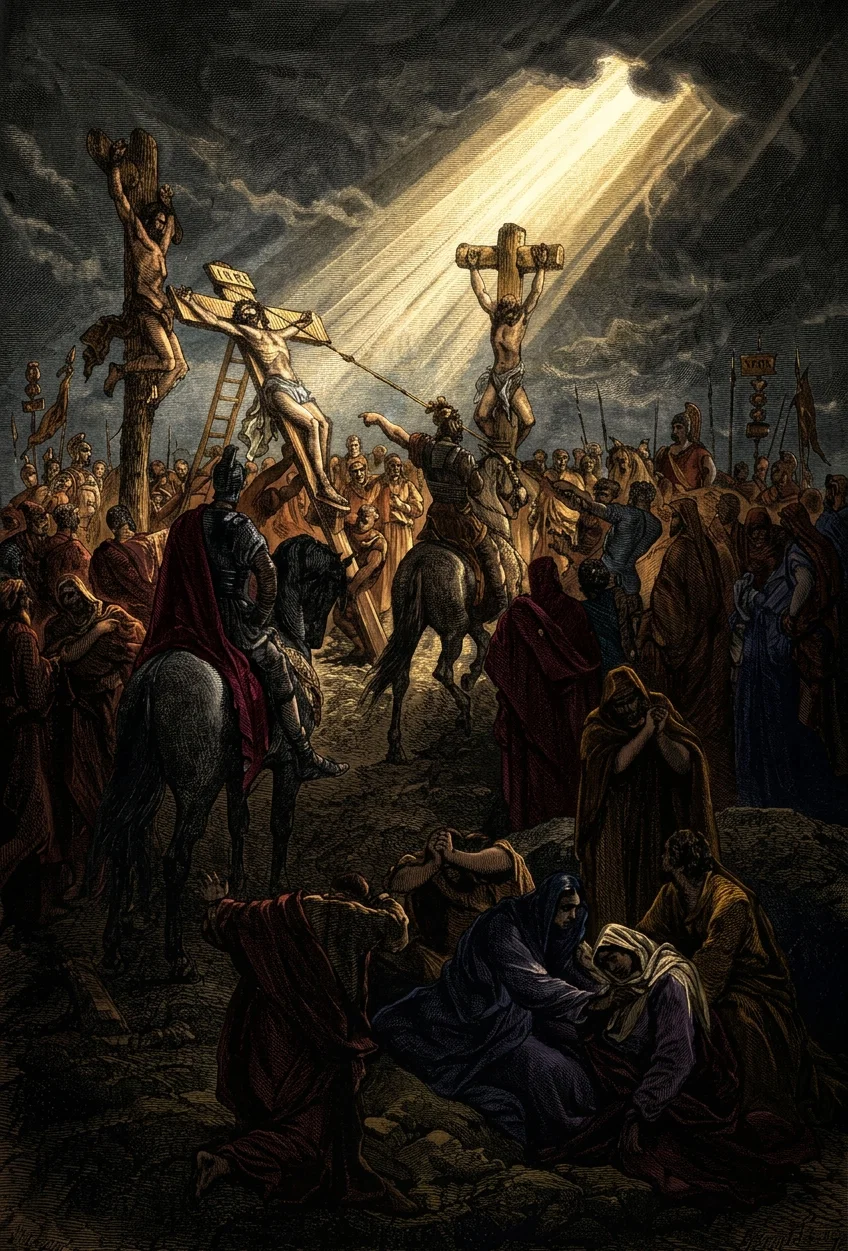
“Himself He Can Not Save.”—When Jesus hung upon the cross, the priests and scribes and elders said in mocking contempt, “He saved others; himself he can not save.” Matt. 27:42. In these words there was a truth far beyond what the Jews had any thought of,—a truth that even the followers of Jesus do not appreciate. Whoever grasps the full meaning of the statement, “He saved others; himself he can not save;” and whoever allows it to apply to himself, has salvation, for it contains the whole of the Gospel.
“He Saved Others.”—The Jews acknowledged this, yet they crucified him. He whose only offense was that “he went about doing good,” was hanged as a malefactor, and he lifted no hand in self-defense, nor uttered a word of reproach against his persecutors. “He was oppressed, and he was afflicted, yet he opened not his mouth; he is brought as a lamb to the slaughter, and as a sheep before her shearers is dumb, so he openeth not his mouth.” Isa. 53:7. He saved others, and, even while hanging on the cross, “a reproach of men, and despised of the people,” he showed his power to save, in the case of the penitent thief; but himself he could not save.
The Secret of His Power.—This was the secret of his power to save others. It was not simply that he would not save himself,—not alone that he unselfishly forgot himself,—but he could not save himself. To have saved himself would have been the destruction of all others; for if he had planned to save himself, he would have stayed in heaven, and never exposed himself to reproach and cruelty. But such a thing was impossible. He could not thus save himself, for such a saving of self would have been selfishness, and there was no selfishness in him. He absolutely could not remain in heaven and leave man to perish. But he could not save men while keeping himself in safety apart from them and their troubles. So he “gave himself for us.” Titus 2:14.
The Gospel and Giving.—Thus we see that the Gospel has its origin and perfection in giving. “God so loved the world, that he gave his only-begotten Son.” John 3:16. “The Son of man came not to be ministered unto, but to minister,”—not to be served, but to serve,—“and to give His life a ransom for many.” Matt. 20:28. “For ye know the grace of our Lord Jesus Christ, that, tho he was rich, yet for your sakes he became poor, that ye through his poverty might be rich.”2 Cor. 8:9. He had everything, and we had nothing; so he gave up everything, and kept nothing, in order that we might have everything.
Emptied Himself.—Most clearly is this set forth in Phil. 2:7, in the rendering of the Revised Version, where we are told that when Jesus had everything, he did not count it a thing to be desired to hold it, “but emptied himself.” The Greek word from which this is translated has the sense of “to drain out.” In a sense he annihilated himself, threw himself away, in order that he might save those who were lost and in danger of annihilation. He took no thought for himself; he did not defend himself against attacks that were made upon him; utterly regardless, reckless of self, he was lost in solicitude for others.
The Purpose of Love.—This neglect of self was not a momentary enthusiasm, as when one under a strong impulse saves another from impending death at the expense of his own life. On the contrary, it was a deliberate, settled purpose. Calmly and deliberately, looking over the whole situation, and counting the cost, he laid down his life, that is, he placed it from him, gave it up to the service of others; and when that was done, the moment of death was but an incident in a long career of the same giving. His life was just as truly laid down for the sheep before he came to earth, and while he walked and talked and suffered in Judea and Galilee, as when with his expiring breath he cried, “Father, into thy hands I commit my Spirit.”
A Lesson to Us.—In all this history of self-sacrifice there is a lesson for us. We are not simply to admire the example of devotion, but to follow it. In it alone is there salvation. Jesus seemingly threw himself away, yea, that is what he actually did, for he “poured out his soul unto death” (Isa. 53:12), “emptied himself,” drained the last drop; “wherefore God also hath highly exalted him, and given him a name which is above every name.” Phil. 2:9. His humiliation was his exaltation; his casting away of self was his salvation. And that was the only possible way of salvation; for, as before stated, to have sought to save himself would have been to deny himself, that is, to prove false to his nature. Since God is love, unselfishness, the only way that he can preserve his own existence is to give himself away.
The Mind of Christ.—“Hereby perceive we the love of God, because he laid down his life for us; and we ought to lay down our lives for the brethren.” 1 John 3:16. “The brethren” for whom we are to give ourselves are the sons of Adam, for all who are children of Adam must be brethren. Of course those who give themselves for their brethren in Adam, will without question give themselves for their brethren in Christ, who himself counts even those who do not know the name of God as his brethren, saying, “I will declare thy name unto my brethren.” Heb. 2:12. “We ought to lay down our lives for the brethren.” Let no one say or think, “My life is so commonplace and uneventful that I have no occasion to lay down my life for anybody; no great opportunities come to me.” It is not in dying on some great occasion that laying down one’s life consists; the laying down of life consists in not counting it our own, reckoning ourselves as dead, deliberately putting our life from us, and forgetting all about it in thoughts of others. “Let this mind be in you, which was also in Christ Jesus.”
Not by Our Effort.—The lesson, in short, is that nobody can be saved by trying to be saved. Salvation is too great a thing to be accomplished by human efforts. Strange as it may seem, we can be saved only as we cease all efforts to save ourselves, and lose all thought of self in efforts to save others. Only so do we enter into full sympathy with Christ, and become laborers together with God. But that casting away of self is our salvation, for while we are concerning ourselves for others, Christ, who is also concerning himself for others, is as a matter of course caring for us. God “turned the captivity of Job, when he prayed for his friends.” Job 42:10.
Rest and Peace.—Freedom from anxiety is thus assured to us. How easy to cast all our care upon him, when we know he cares for us! And when we know that he cares for us, what need have we to care for ourselves? Thus we experience the truth that the Lord’s yoke is easy, and his burden light.
Debtors to All.—One thing more. Paul said, “I am debtor both to the Greeks, and to the Barbarians; both to the wise, and to the unwise.” Rom. 1:14. That which was true of Paul, is equally true of us. Why was he debtor?—The answer is plain, when we once stop to think; it is simply this, that Paul had received the whole of that which was given for the world. Christ gave his life for the world. He “tasted death for every man.” But Christ is not divided; every soul gets the whole of him. “Unto every one of us is given grace according to the measure of the gift of Christ.” Eph. 4:7. His life is light, and the light that shines for me, shines equally bright for all. He is the “Sun of Righteousness,” but the sun shines for all; each one gets all the benefit of the sun, and no one could get any more, even if he were the only person on earth. So each person gets the whole of the life of Christ, which is given to the world. Now it is very evident that if I get the whole of something that is given to all the world, then I am debtor to the world; and the same is true of every soul. The only difference between the most of us and the apostle Paul is that he realized that to him was the fulness of Christ given, and he accepted and appropriated the gift, while we are too often content with but a little of the divine life. We selfishly think to take just enough for our own use, and put a part away from us, not realizing that we must have the whole; and so we fail to realize that we are debtors. May God grant that we all may have the eyes of our understanding enlightened by the Holy Spirit, so that we may know the riches of the glory of his inheritance in the saints, and may not reject that portion of the life of Christ which to the natural man seems disagreeable, but may allow his perfectly unselfish life to abide in us, so that we, not alone with our lips, but by the glad offering of ourselves for others, may truly render thanks unto God for his unspeakable gift. E. J. W.

“TAKE MY YOKE UPON YOU.”

“Come unto Me, all ye that labor and are heavy-laden, and I will give you rest. Take My yoke upon you, and learn of Me; for I am meek and lowly in heart; and ye shall find rest unto your souls. For My yoke is easy, and My burden is light.”
There is a condition to the rest and peace here offered us by Christ. It is that of yoking up with him. All who will accept the condition will find that the yoke of Christ will help them to bear every burden needful for them to carry. Without Christ at our side to bear the heaviest part of the load, we must indeed say that it is heavy. But yoked with him to the car of duty, the burdens of life may all be lightly carried. And just as a man acts in willing obedience to the requirements of God, will come his peace of mind. He will give evidence of clear judgment and a steadfastness of character in coöperating with God to redeem himself through faith in Christ.

Submission of Faith in Christ.

Meekness and humility will characterize all who are obedient to the law of God, all who will wear the yoke of Christ with submission. And these graces will bring the desirable result of peace in the service of Christ. In learning Christ’s meekness and lowliness, we shall submit the entire being to his control. Then the transforming grace of Christ will work upon heart and character, making human beings, fallen in sin, complete in him.
Christ would teach this lesson to all who will follow him. As our Substitute and Surety, standing at the head of humanity, he is our example. He was obedient to all the requirements of God. He, the Majesty of heaven, the King of glory, laid aside his royalty, his position as Commander in the heavenly courts, came to our world as a man, and became subject to the law. And all this that man might become like his Master, obedient, not to the enemy of God, but obedient to his Father in heaven, that he might engage in the service that God requires of each of his obedient children.
This constitutes the condition of salvation. And God enjoins this condition upon every human being just as verily as he enjoined it upon Adam and Eve in the Garden of Eden. Our first parents fell because, when tempted by Satan, they disobeyed God. With few exceptionsthe human family has since been in service to Satan, doing his work, wearing his yoke, and bearing his burdens. But they have found his yoke uncomfortable and galling, his burdens heavy and grievous to be borne.
But Christ pledged his own life in order that the transgressor might be spared, that man might have another trial. He would himself stand in man’s place; he would clothe himself in the garb of humanity, and live the life of man from the very beginning. He would pass through the stages of infancy, childhood, youth, and manhood, that he might show man how to live, how to employ his hours of probation.

Obedience of Faith in Christ.

Christ acknowledged himself subject to the law. If this were not so, he could not be our Saviour. And God designs that man shall live up to every specification of the law, that he may reveal a character after the pattern given him by Christ. He desires that while in the world, his followers shall not be of the world. Their experience may find expression in the words, “I am crucified with Christ; nevertheless I live; yet not I, but Christ liveth in me; and the life which I now live in the flesh I live by the faith of the Son of God, who loved me, and gave himself for me.”
In his Son, God has placed before man the life he is to live. It is not for him to be constantly branching out in lines of his own choosing, and placing his will in opposition to the will of God. Yet many are expending their powers in hopeless pursuit of things they can never attain. How different are the lives of such when compared with that of their Example, the Son of God, who for their sake pledged himself to a life of self-denial, of poverty, and of suffering, unappreciated, unacknowledged, despised, and rejected! He was “a man of sorrows, and acquainted with grief; and we hid as it were our faces from him; he was despised, and we esteemed him not. . . . He was wounded for our transgressions, he was bruised for our iniquities; the chastisement of our peace was upon him; and with his stripes we are healed. . . . He was oppressed, and he was afflicted, yet he opened not his mouth; he is brought as a lamb to the slaughter, and as a sheep before her shearers is dumb, so he openeth not his mouth.” Christ was often weary and hungry and filled with sorrow in the consciousness of unrequited love. The nation whom he came to save and bless did not realize his mission. They had departed from God, and were constantly misunderstanding and misinterpreting him. “He came unto his own, and his own received him not.”

Willing Obedience in Christ.

In view of the abundant evidence God has given of his love, his sympathy, and his benevolence, he requires our willing obedience. His love will prove a safeguard to every soul. It will bar the path to sin and selfish indulgence. In looking unto Jesus, the author and finisher of our faith, in studying his life of self-denial and self-sacrifice, we are armed with the same mind to do the same service. “Whosoever will come after me,” says Christ, “let him deny himself, and take up his cross, and follow me.” To the true follower of Christ there is a pleasure in doing the things that Christ has done in his behalf. He does not regard the Lord’s requirement as an arbitrary exaction, but a clear specification of his only safety from the advances of the wily foe, who is ever seeking to entangle his feet and make his path difficult. God knows that if we were left to follow our own inclinations, to go just where our will would lead us, we should fall into Satan’s ranks and become possessors of his attributes. Therefore the law of God confines us to his will, which is high and noble and elevating. He desires that we shall patiently and wisely take up the duties of service. It is for our present and eternal good to work the works of God. If his will is cheerfully and gratefully accepted, the results will be seen in the service rendered and in the character developed.

Result of Sullen Submission.

A sullen submission to the will of the Father will develop the character of a rebel. By such a one service is looked upon as drudgery. It is not rendered cheerfully, and in the love of God. It is a mere mechanical performance. If he dared, such a one would disobey. His rebellion is smothered, ready to break out at any time in bitter murmurings and complaints. Such service brings no peace or quietude to the soul.
Christ assumed humanity, with all its humiliation and service, that he might set men free from the bondage of Satan. He knew that the service of Satan can bring only wretchedness and misery in its train. The sinner is a stranger to repose. He says, “I want my freedom.” He hopes to get rid of all restraint by casting aside the law of God. But it is this desire that has made the world what it is to-day, corrupt as in the days of Noah, and polluted as the cities of Sodom and Gomorrah.
Law and service are a part of every true life. Idleness is sin. Money is supposed to carry its possessor above service. Because a man has money, he is allowed to spend his time in idleness. But Satan engages all such in the meanest kind of work. It is the Lord who has a right to our service. The more an individual lives to himself, and the less for the good of others, the less noble and pure will be his life. His moral power degenerates while he is living for himself. Compare the idle life with that of one who looks his responsibilities in the face, and takes up his life service for God and for his fellow-men.

The Work of Faith with Christ.

All who have a sense of their duty to their fellow-men will accept the invitation to work in co-partnership with Jesus Christ, by a life of obedience and service. In this way alone can they give the divine credentials to the world. These will entertain a high conception of life. It is not to them a round of worldly pleasure and amusement. This can never satisfy the hungry soul. The truth is noble, elevating, and sacred, and the wisdom and knowledge given us in it are as a tree of life to all who will accept them.
In the fifty-eighth chapter of Isaiah God has placed before us the work he would have us do for him and for our fellow-men. He says: “Is not this the fast that I have chosen? to loose the bands of wickedness, to undo the heavy burdens, and to let the oppressed go free, and that ye break every yoke? Is it not to deal thy bread to the hungry, and that thou bring the poor that are cast out to thy house? when thou seest the naked, that thou cover him; and that thou hide not thyself from thine own flesh? Then shall thy light break forth as the morning, and thine health shall spring forth speedily; and thy righteousness shall go before thee; the glory of the Lord shall be thy rereward. Then shalt thou call, and the Lord shall answer; thou shalt cry, and he shall say, Here I am. If thou take away from the midst of thee the yoke, the putting forth of the finger, and speaking vanity; and if thou draw out thy soul to the hungry, and satisfy the afflicted soul; then shall thy light rise in obscurity, and thy darkness be as the noonday; and the Lord shall guide thee continually, and satisfy thy soul in drought, and make fat thy bones; and thou shalt be like a watered garden, and like a spring of water, whose waters fail not.”
Then why not try this kind of service? The Lord calls his yoke easy, and his burden light. Yet that yoke will not give us a life of ease and freedom and selfish indulgence. The life of Christ was one of self-sacrifice and self-denial at every step; and with consistent, Christlike tenderness and love, his true follower will walk in the footsteps of the Master; and as he advances in this life, he will become more and more inspired with the Spirit and life of Christ.
MRS. E. G. WHITE.

NONE BUT THEE.

I CHALLENGED once to prove There's none but Thee. In earth or heaven above To solace me.
But bitter years of pain, Long days of wo, Have made the passage plain I doubted so.
No, none in heaven can feel My spirit's grief, Save He whose love can heal And give relief.
And none on earth can know The path I've trod, Save He who bore my wo, The Son of God.
So whom have I on earth To say forgiven? And who to fill my dearth But Thee in heaven?
Hope Onslow.

THE EVERLASTING GOSPEL AND THE UNCHANGEABLE SABBATH.

The Sabbath and Holiness.

It is the good-pleasure of God that his own character should be revealed in his children. “Wherefore girding up the loins of your mind, be sober and set your hope perfectly on the grace that is being brought unto you at [in] the revelation of Jesus Christ; as children of obedience, not fashioning yourselves according to your former lusts in the time of your ignorance; but like the Holy One which called you, be ye yourselves also holy in all manner of living; because it is written, Ye shall be holy; for I am holy.” 1 Peter 1:13-17, R. V., margin. The assurance that we may be holy is found in the fact that he is holy. This experience of holiness is necessary to our salvation, for we are instructed to “follow peace with all men, and holiness, without which no man shall see the Lord.” Heb. 12:14. But we have no holiness of our own, and can not make ourselves holy, neither are we required to do this, since God has made provision that we “might be partakers of his holiness.” It is then of the utmost importance that we should understand how this holiness is brought within our reach.

Revelations of God’s Holiness.

Language, time, and flesh have been used as the channels through which God has made a threefold revelation of his holiness to man. Because God has put forth a revelation of himself as the Holy One in human speech, the sacred writings expressing this speech are called “the Holy Scriptures.” Because he has by the blessing of his presence made a similar revelation of himself in time, the seventh day is called “My Holy Day” and “Thy Holy Sabbath.” And so when God was revealed in the flesh in the person of his Son, he was designated as “Thy Holy Child Jesus.” Neither of these three channels of holiness to man have been shown to be such by any particular outward marks of distinction which compelled an acknowledgment from men. The language of the Bible is the ordinary language, of men; there is nothing in the seventh day to distinguish it outwardly from the other days of the week; and the flesh which Jesus bore was the same flesh which we have, yet God was revealing his own presence through each one of these channels of blessing and holiness to men.

How to Be Blessed by Them.

Now the measure of benefit which we receive through these channels of holiness is determined by the way in which we treat them. If we receive them for what they really are, we may obtain through them the blessing which God designed to convey through them. This will be plainly seen by reading the Scriptures. First,as to “the Holy Scriptures:” “For this cause also thank we God without ceasing, because, when ye received the Word of God which ye heard of us, ye received it not as the word of men, but as it is in truth, the Word of God, which effectually worketh also in you that believe.” 1 Thess. 2:13. Whether the Word of God is to us the blessing which God intends that it shall be, depends upon whether we receive it as the Word of God or as the word of man. It remains the Word of God just the same if we do not regard it as such, but it works effectually in those only who believe.
Secondly, as to the “holy Sabbath:” “If thou turn away thy foot from the Sabbath, from doing thy pleasure on my holy day; and call the Sabbath a delight, the holy of the Lord, honorable; and shalt honor him, not doing thine own ways, nor finding thine own pleasure, nor speaking thine own words; then shalt thou delight thyself in the Lord.” Isa. 58:13, 14. The Lord speaks of the Sabbath as his “holy day,” and through the holiness of his own presence which he has put in the day, it may be a channel of holiness to us; but the blessing is for those only who regard the day as the Lord Jehovah’s Sabbath, and “every one that keepeth the Sabbath from polluting it, and taketh hold of my covenant: even them will I bring to my holy mountain, and make them joyful in my house of prayer.” Isa. 56:6, 7.
Thirdly, as to the “Holy Child Jesus:” “He came unto his own, and his own received him not. But as many as received him, to them gave he power to become the sons of God, even to them that believe on his name.” John 1:11, 12. In speaking of the mission of Jesus to this world, Peter said, “Unto you first God, having raised up his Son Jesus, sent him to bless you, in turning away every one of you from his iniquities.” Acts 3:26. But only those shared in this blessing who received him as “the Holy One of God.” Some said: “Is not this the carpenter, the son of Mary, the brother of James, and Joses, and of Juda, and Simon? and are not his sisters here with us? And they were offended at him. . . . And he could there do no mighty work, save that he laid his hands upon a few sick folk, and healed them.” Mark 6:3-5. They did not receive the blessing which was for them, because they treated the Son of God as a man altogether like themselves.

The Sabbath a Blessing.

In the beginning “God blessed the seventh day, and sanctified it,” and thus made it a blessing and a channel of sanctification or holiness to man. He then taught man to “remember the Sabbath day, to keep it holy,” or to sanctify it. God made the day holy, and he instructed man to treat it as holy, that he might thus receive the blessing of holiness through it; but when man treats the day as common time, he fails to receive the Sabbath blessing through God’s appointed channel. It is not in the power of man to make a day holy, neither can we receive the blessing of holiness through a day which the Lord has not made holy, even tho we should outwardly treat it as tho it were holy. So when we turn away from the day which the Lord has made holy, and accept any other day in its stead, we are thus turning away from the Lord’s own channel of holiness for us. This is the great loss with which we meet in following the traditions of men, instead of obeying the Word of God.
So intimately related is the “Holy Sabbath” to the “Holy Scriptures,” and to the “Holy Child Jesus,” that it can not be consistently disregarded by those who profess to receive the other two for what they really are, and it is worth noting that the power which professes to have changed the Sabbath has practically put itself above the Bible and Christ. So long as the Bible is received as the Word of God, and the example and instruction of Jesus are followed, so long the seventh-day Sabbath will be observed; and when the seventh-day Sabbath is knowingly disregarded, the logic of this act really demands that the Bible and the example of Jesus should be set aside. The Roman Catholic Church in its teaching openly states that the Bible commands the observance of the seventh day and no other, and that there is not a word in the Bible authorizing a change of the day; and it just as openly teaches that the church changed the Sabbath from the seventh to the first day of the week, and that there is no other authority for the change. It is only consistent, therefore, for it to treat the Bible as of secondary importance as compared with its own traditions, and to make the intercession of the Virgin Mary of more value than the intercession of Christ. In all this the Roman Catholic Church puts itself above God, but it is consistent in the way in which it does it. So long as one receives the Bible as the Word of God, and acknowledges its authority as supreme, so long will he see that the seventh day is the Sabbath, and that the intercession of Jesus is all that is needed for man, or that can avail anything for man; and when one rejects the Lord’s Sabbath, the logical result will be to reject the authority of the Word of God, and to receive the word of man in its place, and to accept a supposed human helper as of more value than is the help of Him who alone is able to save. But this is not a question simply of cold logic. In thus turning from God’s appointed blessings and channels of blessing, man meets with an irreparable loss. If we receive the salvation of God at all, we must receive it through the channels which he himself has established; and the blessing of holiness should be so highly prized that we should be glad to receive it in any way which the Lord may appoint.
The original Sabbath still remains as a sign and a pledge of God’s power to make holy, and the true keeping of the Sabbath, the entering into his rest, is the experience of His presence who only can make and keep us holy. God’s purpose in the Gospel has always been the same, that we should be “created in righteousness and holiness of truth,” and his means of accomplishing this result have always been the same in making us “partakers of the divine nature,” and so the Sabbath remains unchanged and unchangeable, a channel for this blessing of holiness to man. W. W. P.

The Way to Misery

If you want to spoil all that God gives you, if you want to be miserable yourself, and a maker of misery to others, the way is easy enough. Only be selfish, and it is done at once. Think about yourself, what respect people ought to pay you, what people think of you, and then nothing to you will be pure.—Charles Kingsley.

Riding Our Pet Hobbies to Death

LET us be careful not to ride our pet “hobbies” to death. Come to think about it, that is not just what we mean. Perhaps, after all, it would be as well to ride them to death, the sooner the better, and have them out of the way.—College View Enterprise.

Goodness, the Crowning Virtue

“Few people are able to be brilliant, but all people can be good, and goodness is the crowning virtue.”

REVERSING THINGS.

TO GET “the cart before the horse” is a proverbial English idiomatic expression, denoting that an effect has been taken for a cause, or that in some way the true order of things has been reversed. An illustration of this reversing process may be seen in a statement made in the Christian Statesman of June 12. The author of the Sunday-school lesson notes, commenting on Rom. 14:21, and indirectly referring to verses 5 and 6, says:—
The holy days of the old dispensation were likewise in dispute. No doubt all agreed that the Sabbath was a permanent institution. The observance of the first day of the week was universal, but there were some who, in addition to this, still observed the seventh day. The dispute was not whether there was still a Sabbath, but whether there were now two sabbaths.
According to this statement, all Christians kept the first day of the week, or Sunday, but some “added” Sabbath-keeping to Sunday-keeping. But there is not a particle of evidence to prove that Sunday was kept at all, or regarded as a sabbath in the days of the apostles. Furthermore, the universal testimony of all church history proves, not that Sabbath-keeping was added to Sunday-keeping, as Sabbath-keeping was first, but that Sunday-keeping was added to Sabbath-keeping; that it was done at a much later time than the apostolic age; and that it never, in the earliest ages or its very slight observance, was regarded as the Sabbath, or was considered as deriving any sanctity whatever from the fourth commandment. To make Sunday out to be the universal Sabbath, when it never had any Sabbatic character, and to have the Sabbath of thousands of years’ standing, and which is everywhere called the Sabbath in all the sacred writings, but a secondary and added Sabbath, is surely getting things wofully misplaced. A cart before a horse would but illustrate the incongruity of it.
Again, there was no discussion as to whether there were two sabbaths or not. No hint of such a discussion can be found in the New Testament. If this were the question at issue, Paul gave a very remarkable answer. Said he, “Let every man be fully persuaded in his own mind.” And that would make every man’s mind a criterion of judgment as to whether there was one or two sabbaths a week. Further, among the things permissible to believe is that all days are alike. Verse 5. This would make every day a sabbath, or no day the Sabbath. Can any one in his sober senses believe that the apostle Paul would give an answer in relation to the Sabbath as incoherent, unsatisfactory, and contradictory as the answer of a heathen oracle?—No, indeed.
There is just one way to straighten this thing out, and get things into their proper places. The days of celebration referred to by Paul in Rom. 14:5, 6 do not include the weekly Sabbath. In fact, the weekly Sabbath is not once named in the whole letter.
One statement of the Statesman is true: “The dispute was not whether there was still a Sabbath, or whether the first day of the week was the Sabbath.” Sure enough. There was a sabbath. The fourth commandment is proof of it; and since, at that time, and for centuries later, no one thought of calling the first day of the week the Sabbath, there could therefore have been no dispute in reference to it. An observation of these facts would save some people a great deal of trouble and prevent them from making statements involving themselves in endless absurdities and contradictions.
M. E. K.
Continue reading: Its Strategic Value