NOTE.—We wish those who ask questions to take particular notice: (1) Only such questions will be answered here as we believe to be of general interest and information. (2) We can not undertake to explain from four to a dozen scriptures, as in one sentence we are often requested to do. (3) Do not ask to “explain” a certain text or passage. State clearly the point in question. (4) Give full name and address, not for publication unless desired, but as evidence of good faith, and to give us the privilege of replying by letter if deemed best. (5) Unsigned communications of any kind find the quickest way to the waste-basket. (6) It is always well to inclose stamp. (7) “Foolish and unlearned questions avoid,” also those that minister to mere curiosity. (8) Study the Scriptures yourselves.
The texts are one: “It is easier for a camel to go through the eye of a needle, than for a rich man to enter into the kingdom of God.” There is a slight verbal difference in Luke, but the meaning is the same. Our Lord’s words were a proverbial expression implying an utter impossibility. It was just as impossible for a rich man to enter the kingdom of God as for a camel to pass through the eye of a needle; if desired, make it a fine cambric needle. It is said by some that “needle’s eye” referred to a small gate in the wall of Jerusalem, through which a loaded camel could not pass. His load had to be removed, and even then he could only get through by shuffling through on his knees. Even if this were true, which we much doubt, it would show that the rich man could be saved only by yielding up his riches. And that is true not only of the rich, but of him whose heart is set on obtaining riches. And that takes in about all naturally. Who, then, can be saved?—No one by man’s help. God’s grace, however, if admitted into the heart and life, will remove the love for riches, and enable the soul to give them all up for Christ’s sake, to become poor for Christ’s sake, but rich in the abundant riches of his grace. God will never take a man from where his heart is. If man wants deliverance, God will grant it.
No. 603. A Sabbath-Day’s Journey.
WILL you please tell us what is a “Sabbath-day’s journey,” as in Acts 1:12? Inquiring Sister.
This was not a law laid down by the Lord, but was a well-known Jewish measure of about six furlongs or three-fourths of a mile. It is supposed to be the same distance as between the ark and the people (Joshua 3:4) when Israel were marching in the wilderness. The place reckoned from was not a man’s own house, but the wall of the city in which he lived. But if a man would the day before go to the end of the first Sabbath journey, there eat some food, bury the remainder, and thank God for the boundary line, he could the next day take a Sabbath day’s journey beyond. It was used as indicating a distance well understood, but not as something to be observed.
No. 604. Acts of the Roman Catholic Church.
PLEASE inform me through your “Question Corner” when the acts of the Roman Catholic Church would be rightfully considered as hers only, say between the years 300 and 700; that is to say, acts that she alone could be held responsible for, supposing the affairs of the early church to have been regulated by councils and all subject to same. E. R.
The question itself is not clear. What does our questioner mean by “acts”? Does he mean deeds, good or bad, or decrees, decisions, etc., by councils or bishops? The Roman Catholic Church as an ecclesiastical body may be said to date from the Council of Nice, 325. As a general thing the councils of the west were controlled by the Roman Church after that date, and she could rightfully be held responsible for what was done under the sanction of those councils and of her authorized pontiffs and bishops. This is but a general answer, and if it does not meet the question, our querist must be more specific.
Living in a Grand and Awful Time
We are living, we are dwelling,
In a grand and awful time,
In an age on ages telling—
To be living is sublime.
MRS. PICKETT’S MISSIONARY BOX.
By Alice M. Eddy
Benefits at a Cent Apiece.
BY ALICE M. EDDY.
“THAT there missionary box,” said Mrs. Pickett, surveying it with her head on one side, as it stood in state on the best parlor mantel, “that there missionary box is worth its weight in gold two or three times over to me. You’d never believe it, Mis’ Malcolm, the things I’ve been a learnin’ of, ever sence Mary Pickett she brought it home, or rather the mate to it, an’ sot it out on the dinin’-room shelf, an’ told me she’d brought me a present from meetin’.”
“Do tell me about it,” said the new minister’s wife, with girlish pleasure at the prospect of a story.
“I’ve half a notion to,” replied her hostess. “You’ve got a real drawin’ out way with you, Mis’ Malcolm. Some way you make me think of Mary Pickett herself, that was the beginnin’ of it all, she that’s a missionary to Turkey now—my niece, you know. You’ve got jest her colored hair and you’re light-completed like her, and you laugh something like her, too. Mary Pickett always was a master hand for laughin’. I remember how she laughed that afternoon when she came in with them two boxes an’ sot mine on the shelf out there. She knowed I warn’t the missionary kind. I do’ no but she done it jest for a joke. It was five years ago, you know, an’ I was scrapin’ along with my boarders, an’ rents was high, an’ livin’ higher, an’ I had hard enough times to make both ends meet, I can tell you, tho it warn’t half as hard times as I thought it was. I was that down-hearted that everything looked criss-cross to me, an’ I’d got to have hard feelings against every one! looked ’s if they got along easier ’n me, an’ I most gave up goin’ to church at all, for all I was a professor, an’ I won’t say but what I had murmurings against providence—fact is, I know I had—if you be a minister’s wife. An’ so it was work, work, from one week’s end to another, an’ I never thought of nothin’ else. Then Mary Pickett she come home from school, where she’d ben ever sence she was fifteen, for she took all the money her pa left her, to get an education, so’s to teach; an’ she got a place in the grammar school an’ come to board with me, an’ she’d heard about missions to that school till she was full of ’em, an’ the very fust meetin’ day after she come, she walked out in the kitchen, an’ says she:— “Aunty, a’nt you comin’ to missionary meetin’, down to the church?” says she. “I’ll meet you there after school,” says she. “An’ if you’ll believe me, Mis’ Malcolm, I was that riled that I could have shook her. I says:— “Pretty doin’s ’twould be for me to go10traipsin’ off to meetin’ and leave the ir’nin’ an’ the cookin’ and set alongside o’ Lawyer Stapleton’s wife, hearin’ about—the land knows what! Folks had better stay to home and see to their work,’ says I. But, law! nothin’ ever made Mary Pickett answer back. She jest laughed and said, ‘Good-by,’ an’ I staid an’ puttered over the kitchen work till I was hot as fire, inside an’ out; an’ long about five o’clock back she came with them two boxes.”
“I’ve brought you a present, Aunt Mirandy,” says she, settin’ of it down, an’ when I see what it was, I jest stood an’ stared. ’T warn’t that one there, ’twas one jest like it, an’ it had a motto written on to one end: ‘What shall I render unto the Lord for all his benefits to me?’
“Well, you’re smart!” says I, an’ Mary she jest dropped into a chair an’ laughed till I couldn’t help laughin’ too. “Great benefits I have,” says I, standin’ with my arms akimbo an’ lookin’ that box all over. “Guess the heathen won’t git much out o’ me at that rate.”
“I s’pose that depends on how much you render,” says Mary; says she: “You might try at a cent apiece awhile, jest for the fun of it. Nobody knows who’s got this motto, you know, an’ even a few cents would be some help,” says she.
“’Bout’s many as grapes off bean vines, I’d get,” says I, for I was more than usual low-spirited that night, an’ I jest made up my mind I would keep count, jest to show myself how little I did have. “Them few cents won’t break me,” I thought, an’ I really seemed to kinder enjoy thinkin’ over the hard times I had, while I was settin’ the table, with Mary helpin’, an’ I kep’ sayin’ little mean things, about how I s’posed she wanted me to put in a cent for the smoky stove, an’ for the bread that warn’t light, so’t I knew all the boarders would be grumblin’ at supper, an’ plenty more in that line, that she never took no notice of. Mis’ Stapleton said once that Mary was a girl of great tact, an’ I guess I know it better’n any one else.
“Well, the box sot there all that week, an’ I used to say it must be kinder lonesome with nothin’ in it, for not a cent went in till next missionary meetin’ day. I was settin’ on the back steps gettin’ a breath of fresh air, when Mary came home, an’ I called out to her to know what them geese talked about to-day. That was the livin’ word I called ’em—‘them geese.’ Well, she come and set down along o’ me, an’ begun to tell me about the meetin’, an’ it was all about Injy an’ the widders there, poor creturs, an’ they bein’ abused an’ starved an’ not let to think for themselves—you know all about it better’n I do—an’ before I thought I up an’ said:— “Well, if I be a widder, I’m thankful I’m where I kin earn my own livin’, an’ no thanks to nobody an’ no one to interfere.”
“Then Mary she laughed an’ said there was my fust benefit. Well, that sorter tickled me, for I thought a woman must be pretty hard up for benefits when she had to go clear off to Injy to find ’em, an’ I dropped in one cent, an’ it rattled round a few days without any company. I used to shake it every time I passed by the shelf, an’ the thought of them poor things in Injy kep’ a comin’ up before me, an’ I really was glad when I got a new boarder for my best room, an’ felt as if I’d oughter put in another. An’ next meetin’ Mary she told me about Japan, an’ I thought about that till I put in another, because I warn’t a Jap. An’ all the while I felt kinder proud of how little there was in that box. Then one day when I got a chance to turn a little penny sellin’ eggs, which I warn’t in the habit of, Mary brought the box in where I was countin’ of my money, an’ says:— “A penny for your benefit, Aunt Mirandy,” an’ I says:— “This a’n’t the Lord’s benefit”; an’ she answered:— “If ’ta’n’t his, whose is it?” an’ she begun to hum over something out of one of the poetry books that she was always a readin’ of:— ‘God’s grace is the only grace, And all grace is the grace of God.’”
“Well, I dropped in the penny, an’ them words kep’ ringin’ in my ears, till I couldn’t help puttin’ more to it, on account of some other things I never thought of callin’ the Lord’s benefits before. An’ by that time, what with Mary’s tellin’ me about them meetin’s an’ me most always findin’ somethin’ to put in a penny for, to be thankful that I warn’t it, an’ what with gettin’ interested about it all, an’ sorter searchin’ round a little, now an’ then, to think of something or other to put in a cent for, there really came to be quite a few pennies in the box, an’ it didn’t rattle near so much when I shook it. An’ then one day Mary she brought me a little purplish pamphlet, an’ she says:— “Aunty, here’s a missionary magazine I’ve subscribed to for you, bein’ you’re so interested in missions.”
“Me interested in missions! But when I come to think it over, I didn’t see but what I was, in a way, an’ I said it over to myself, kinder curious, to see how it sounded. It was jest what they said about Mis’ Stapleton, she’t was the president of the missionary society. An’ that night our new boarder he picked up the magazine, and said:— “Why, what’s this?” An’ I said, quite pleased, before I thought:— “That’s a magazine that my niece, Mary Pickett, she’s subscribed to for me, bein’ I’m so interested in missions.”
“‘My mother used to take it,’ says he. He was a young man, not much more’n a boy, an’ homesick, I guess. ‘I’d like to look it over, if you don’t mind,’ he says. ‘It looks like home.’ So I was so pleased to hear him say that, for the boarders they don’t most generally say much, except to find fault, that when I went out in the dinin’-room, I jest put another cent in, for the magazine itself, part for what he’d said, an’ part for what I’d ben readin’ out of it that afternoon; an’ while I was a droppin’ of it in, Mary she come up behind me an’ give me a big hug.
“‘You dear old inconsistent thing!’ she says, an’ then I knew she’d heard what I’d said in the parlor.
“Well, it went on that way for quite a while, an’ it come to be a regular thing that a cent would get in there every time I heard about the meetin’. I thought Mary would a’ died laughin’ the time I put one in because I warn’t born a cannibal—an’ one day—I’ll never forget that day, Mis’ Malcolm—she was tellin’ me about Turkey, an’ she told how some missionaries heard a little girl sayin’ how the smallest thing in all the world wa’n't any smaller than the joy of her father when she was born. Them words went right through me. I was standin’ over the ir’nin’-board, an’ Mary was opposite to me, but all of a sudden, instead of her, I seemed to see my Liakim’s face, that had ben dead ten year, an’ him a leanin’ down over our little baby, that only lived two weeks, the only one I ever had. Seemed to me I couldn’t get over it, when that baby died. An’ I seemed to see Liakim smilin’ down at it, an’ it lyin’ there, all soft an’ white—she was a white little baby—such a pretty baby—an’ before I knew it, I was droppin’ tears all over the starched clothes, an’ I turned round an’ went an’ put another cent in that box, for the look on Liakim’s face when he held her that time. An’ Mary she see somethin’ was the matter, I guess, for she walked off an’ never asked me no questions. But all the rest of the day I kep’ seein’ that little face before me, an’ thinkin’ how I’d had her for my own—an’ before I went to bed I went out in the dinin’-room, an’ I put in a little bright five-cent piece for my baby, because I couldn’t bear to count her jest like everythin’ else, an’ I found myself cryin’ because I hadn’t money enough jest then to spare anythin’ bigger. I suppose it was from thinkin’ about her so much that that night I dreamed about mother. I could see her as plain, an’ father with her, an’ we was back on the old farm, an’ while I was kissin’ of ’em both, I heard some one sayin’, ‘As one whom his mother comforteth.’ An’ I woke up, an’ I was sayin’, ‘O Lord, I am a wicked, ungrateful woman!’”
“Mis’ Malcolm, I don’t suppose you could understand—you that’s a minister’s wife, an’ thankful to the Lord, in course—what I thought that night. I laid awake, thinkin’ an’ cryin’, an’ yet not all sorry, for half the night. I kep’ thinkin’ of all the things the Lord had ever done for me, an’ the more I thought of mother an’ the old home, the softer my heart seemed to grow, an’ I jest prayed with all my might an’ main, an’ that there box weighed on my mind like lead. ‘A cent apiece!’ I kep’ sayin’, ‘A cent apiece for all His benefits!’ Why, they come over me that night, while I laid there prayin’, till they was like crowds an’ crowds of angels all round me. In the mornin’ I went up to the box feelin’ meaner than dirt, an’ I put in a cent for mother, an’ a cent for father, an’ one for the old farm, an’ the rose-bush in front of my window, an’ for my little pet lamb, that made me so happy when I was a girl, an’ for heaps of other things that I’d ben forgettin’ in them hard times. An’ when I couldn’t spare no more, I went to work, an’ do believe I was a different woman after that. For there was the verses in the Bible, that I used to get up early to read them mornin’s, an’ there was the love of God, that I’d never rightly understood, an’ there was church, that I couldn’t bear to miss now, an’ there was the daily bread, that I’d never thought of bein’ thankful for till after that night, when I found out how much I’d had in my life, an’ begun to look about me for what I had now. An’ so it went on, till the box grew heavier an’ heavier, an’ before the day come for it to be opened, three months from the time I’d had it, it was all full, an’ I stuck in one cent into the slit at the top, an’ said:— “That’s for you, Mary Pickett, for if ever I had a benefit from the Lord, you’re one.” An’ Mary she cried when I said it.
“So, when the day come, I said I was goin’ too, an’ I left the ir’nin’ an’ we went off together, an’ there was singin’ an’ everythin’, jest as there always is, only it was all new to me, an’ every one seemed as glad to see me as if I’d ben as rich as any of ’em, an’ at last it come time to open our boxes. An’ I brought mine an’ I says:— “Mis’ Stapleton,” I says, “if ever there was a mean-feelin’ woman come to missionary meetin’ I’m the one; for I’ve ben a keepin’ count of my mercies at a cent apiece,” I says. “It’s all cents in there, ’cept one five-cent piece, that means somethin’ special to me. An’ I wouldn’t let myself put in more,” I says, beginnin’ to cry, “for when I begun to find out what I had to be thankful for, I says to myself, ‘Mean you’d oughter feel, an’ mean you shall feel. You’ll jest finish up this here box the way you begun.’ An’ here ’tis,” I says, “an’ every cent is one of the Lord’s mercies.”
“So I set down cryin’ like a baby, an’ Mis’ Stapleton she begun to count, with the tears a runnin’ down her own cheeks, an’ before she got through we was all cryin’ together, for there was three hundred and fifty blessed cents in that box, not countin’ the little five-cent piece, that nobody knew what it meant.
“An’ now,” says I, “give me another box, but, for mercy’s sake, don’t let it have that motto on it, for I believe it’ll break my heart!”
“So they give me this one, with, ‘The love of Christ constraineth us,’ on it, an’ Mis’ Barnes, that was the minister’s wife then, she prayed for us all, about havin’ thankful hearts, an’ lovin’ the Lord for what he’s done for us, an’ I went home with the new box that’s standin’ there on the shelf, an’ life’s ben a different thing to me sence that day, Mis’ Malcolm, my dear, an’ that’s why that missionary box is worth its weight in gold.”—A Little Tract.
WANING OF PROTESTANT FAITH.
A WRITER, Prof. L. Kayser, LL.D., in the Catholic Mirror of June 26, writes on “Protestantism and Catholicism,” taking for his text a discussion of this subject by Francis de Pressense, son of the well-known Protestant writer, the late E. de Pressense. The contention of Professor Kayser is that the two pillars of Protestantism,—Holy Scripture authority to each individual, and justification by faith,—are becoming things of the past. He thus quotes M. de Pressense:—
“In old times a Protestant would take his Bible, and, reading it, or simply turning over its leaves, every word shone before his eyes as a divine word. To-day, when he opens the Sacred Book, he must begin by asking himself: ‘This part, is it really authentical? Is that word so? Was it said by our Lord himself, or is it merely the conception of John that I read? Is it from an eye-witness, or is it not more likely a statement to be looked on as a compromise opinion between Hebrews and Christians of that remote period? And, again: Modern Theology gives us a Bible of which the disintegrated parts would require, indeed, to be printed in various colors—according to the various times and different writers—and a Bible that savants alone, after innumerable efforts, will be able to read with discernment.”
“And now what about justification by faith . . . in Jesus Christ—no doubt—Son of God, born of the Virgin Mary and risen from the dead? Says again M. de Pressense: ‘Modern Theology gives us a Christ impalpable, intangible, something like a crepuscular phantom, with neither divinity nor humanity, without historical reality in the past, without heavenly divinity in the present, without supernatural divinity in the sacraments.’ In fact, higher criticism has already treated very badly the person of our Lord Jesus Christ. When its work will be finished, it will be interesting to see how justification by faith can—for Protestants—be consistent with the notion of a purely human Christ, however unequaled their high criticism may make him.”
And in conclusion this Protestant writer feels that it were better to cast away the cup which this unbelieving Protestantism offers, and, if nothing else be found, “cling to the fringes of his cloak,” or perhaps “stick to the footsteps of his disciples, were it only for the sake of being touched by the shade of Peter, that cured the sick of Jerusalem!”
The reference to the shade of Peter is to the Roman faith.
In the above arraignment of much that is called Protestantism there is much truth; but that kind of Protestantism, tho it may bear the name, is false to every principle of the original. The vital principles of original Protestantism are the principles of Christianity. They are an open Bible, the living Word of God to every man, personal faith in a personal Saviour, no interference on the part of a church by a creed or a state by law. These exist, tho all who may be called Protestants fail. All the so-called great Protestant bodies may abjure faith and mutilate the Word of God, yet there will arise witnesses for Jesus Christ who will testify to the saving power of personal faith, to the divine life received by the Word. As of old they may be persecuted by “Orthodox” Pharisees or “Higher Critic” Sadducees; nevertheless, they bear witness for God, and are his church in the earth—the children of Abraham, not by human succession, but by faith, and divine regeneration.
“TOO MUCH LIBERTY.”
A Baptist minister in Stockton, Cal., in course of a Fourth of July sermon, remarked that “the trouble with this country is that there is too much liberty.” He didn’t tell his congregation how much of his liberty should be taken away from him. Presumably this omission was owing to the fact that, like all men who talk in that strain, he had reference to the liberty of other people. His argument was based upon the increase of crime, and the idea advanced was that when men’s opinions lead them to commit crime, their opinions should be restrained. Such argument carried to its logical conclusion is tyranny and the Inquisition. God himself never has sought to restrain opinion, no matter how erroneous; he seeks to correct opinion and restrain wrong action by the power of his Word and Spirit. He has not delegated to man the authority to restrain opinion. Civil government was ordained to restrain uncivil action, to enforce a recognition of the rights of all classes of people. Because fiends commit horrible crimes, it does not follow that the people have too much liberty.
The assumption that crime is the result of liberty is decidedly erroneous. “Where the Spirit of the Lord is, there is liberty.” Crime is the abuse of liberty nominally guaranteed by law. In what way should such abuse of liberty be restrained? It can only be legitimately restrained by proper law properly executed. Men forfeit their liberty by the commission of crime; but how can we say that there is too much liberty because some men abuse the liberty designed for all? We might as well argue that there is too much life in the world because some men act improperly and legally forfeit their lives by uncivil or vicious acts. Shall we take away or curtail the lives of the masses because some prove to be unworthy of life? We can not rightly conclude that there is too much liberty in the country because some have forfeited their right to the enjoyment of that liberty. There could be no greater incentive to crime than the curtailing of the liberty of the people.
Transmigration of Soul in America
It is told as a fact that Mrs. Henry K. Gilette, of Vestal Center, N. Y., believes that the soul of her sister who is dead has taken up its abode in a maltese cat. The cat is given a bedroom and double bed, as good as in the house, all to herself, has a chair and plate at table, and is considered as much as a cat could be a member of the family. Mrs. Gilette is a well-educated woman of thirty-five. Before her sister died, three years ago, she told Mrs. Gilette she would enter the cat, so as to be near her. Since then the disposition of the kitten completely changed, being much more quiet and intelligent. This is theosophy. The Word of God is, “The dead know not anything.” “His breath goeth forth, he returneth to his earth; in that very day his thoughts perish.” “His sons come to honor, and he knoweth it not.” “Neither have they a portion forever in anything that is done under the sun.” He who believes God’s Word can never believe in a human cat or a feline woman. Such are Satan’s deceptions to deceive the world, and to degrade God in the minds of men. How much better is the hope of life through Jesus and the resurrection!
A King Who Reigns in Righteousness
THE social condition of this poor world is much like its surface, greatly broken up and uneven. It is said that a cool $100,000,000 were spent on the queen’s jubilee festivities, and one writer says that at one of the receptions not less than $10,000,000 blazed in costly diamonds. At the same time thousands of “her most gracious majesty’s” subjects were dying of famine in India. How such things make one long for the time when the “King shall reign in righteousness, and princes shall rule in judgment. And a Man [“the Man” Christ Jesus] shall be as an hiding-place from the wind, and a covert from the tempest; as rivers of water in a dry place, as the shadow of a great rock in a weary land.” Welcome, glad day!
ALL-SUFFICIENT
LEAVE God to order all Thy ways,
And hope in Him whate'er betide;
Thou'lt find Him in the evil days
Thy all-sufficient strength and guide;
Who trusts in God's unchanging love
Builds on the rock that naught can move.
Only thy restless heart keep still,
And wait in cheerful hope, content
To take whate'er His gracious will,
His all-discerning love, hath sent.
Doubt not our inmost wants are known
To Him who chose us for His own.
Sing, pray, and swerve not from His ways,
But do Thine own part faithfully;
Trust His rich promises of grace,
So shall they be fulfilled in Thee;
God never yet forsook at need
The soul that trusted Him indeed.
—Selected.
How Many Days Do You Expect?
My friend, you make very free with your days; pray, how many do you expect to have?—De Quincey.
The Call to Christendom.
I. NINETEEN centuries have passed since Christ uttered the “Go ye” of the great commission, and it is still true that the majority of mankind are unsaved. Almost a thousand millions of our lost race perish in the life of each generation without the Gospel. Does not that commission throw the responsibility for all this upon the church of Christ, and especially upon its leaders, the ministry?
2. We have evidently reached a great crisis in the history of our race, when nothing but the universal spread and triumph of the Gospel can save the church and the world from dire disaster. The Gospel has wrapped up in it the solution of all the industrial, financial, political, social, and12moral problems of the age with which the philosophers and statesmen and philanthropists are hopelessly struggling. Is not the call a clear one to those who have the Gospel, and understand its regenerating and transforming power, to apply it speedily in making over mankind and transforming human institutions by this divine agency?
3. Christ requires that we should give the Gospel to the world immediately. His command is, “Go ye into all the world, and preach the Gospel to every creature.” That is the plainest of commands. It means us personally. It means now, for it is in the present tense, and God has now unquestionably, for the first time in the centuries, removed out of the way every obstacle to the immediate evangelization of the world, and given to the church everything needed for the completion of the work of preaching the Gospel to the world. The whole world is open and accessible, physically, geographically, politically, to the Gospel messengers, and waiting for them.
The church has the means, the messengers, and the promise of the Spirit at her command, and seems dangerously near to suffering eclipse of faith and blight of life because of her failure to avail herself of them in fulfilling her great and pressing mission. Christ is waiting for her to move in obedience to his command. Who among her leaders will risk the responsibility of holding back or of hindering the onward movement he demands?—Homiletic Review.
SOUTHWESTERN ASIA.
Southwestern Asia includes Persia and Turkey. Persia has a population of 9,000,000. There are 9,000 Parsees, 20,000 Jews, 23,000 Nestorians, 43,000 Armenians, 800,000 Kurds, and the others are Mohammedans, chiefly of the Shiah faith.
The reigning ruler is Shah Muzafer ed-Din, who was born in 1853, and ascended the throne in 1896. He is the absolute ruler over, and master of, the lives and goods of all his subjects. The laws are based on the precepts of the Koran.
The Persians are a social and polite people. The women are kept in seclusion. They are nearly all Mohammedans.
The mullahs are the ministers of their religion. They are leaders in worship, interpreters of the sacred law and its traditions, and teachers of the schools.
The sayids are a semi-religious order, direct descendants of Mohammed. They are exempted from taxation, and are supported by the alms of the people.
The dervishes are religious mendicants. They stroll from place to place, telling stories and collecting money.
The religious rites of the Mohammedans are the repetition of their creed, prayer, giving alms, pilgrimages, and fasting. The creed is, “There is no God but God; Mohammed is the apostle of God; Ali is the vicegerent of God.” Prayer is appointed for five times a day. Friday is the Mohammedan sabbath. There is a widespread belief in signs, lucky and unlucky omens, etc.
The missionary, Henry Martyn, said of the Persians, “They are clever and intelligent, and more calculated to become great and powerful than any of the other nations of the east.” Rev. S. G. Wilson, for fifteen years a missionary in Persia, has lately written: “The Persians have alert, active minds. They are untrained and unscientific, but naturally intelligent, subtle in argument, sharp in business, skilful in imitation, artistic in execution, socially entertaining, fond of humor, delighting in poetry and music, and remarkably well informed for their limited opportunities. Persian art and civilization gave birth to Arab culture in Bagdad and Spain, with its philosophy, mathematics, and architecture. Persian poets have sung in immortal verse.”
Protestant missions are permitted among those who are not Mohammedans. There are about 3,000 Protestant converts, chiefly in the missions of the American Presbyterian Church. There are also missions of the Church of England and of the Lutherans.
In Turkey in Asia is embraced Asia Minor, Syria, Palestine, Arabia, Mesopotamia, Armenia, and Kurdistan. Asiatic Turkey has a population of 21,608,055. There are found in Asia Minor, 9,123,432; in Armenia and Kurdistan, 2,457,400; in Mesopotamia, 1,350,280; in Syria and Palestine, 2,676,943; in Arabia, 6,000,000.
The ruler is Sultan Abdul-Hamid II., born in 1842, and ascended the throne in 1876. The sultan is an absolute monarch, and reigns in accordance with the teachings of the Koran.
There are about 5,000,000 Arabs, of whom 2,000,000 are Bedouins, sheltered only in tents, dwelling chiefly in the desert, and moving from place to place with their camels, horses, and sheep. There are 1,000,000 Kurds, 3,000,000 Armenians, 100,000 Nestorians, 250,000 Maronites, 350,000 Roman Catholics, 100,000 Jews, and 75,000 Druses. The others are Turks. The Arabs, Turks, and Kurds are of the Mohammedan faith; the others claim to be Christians.
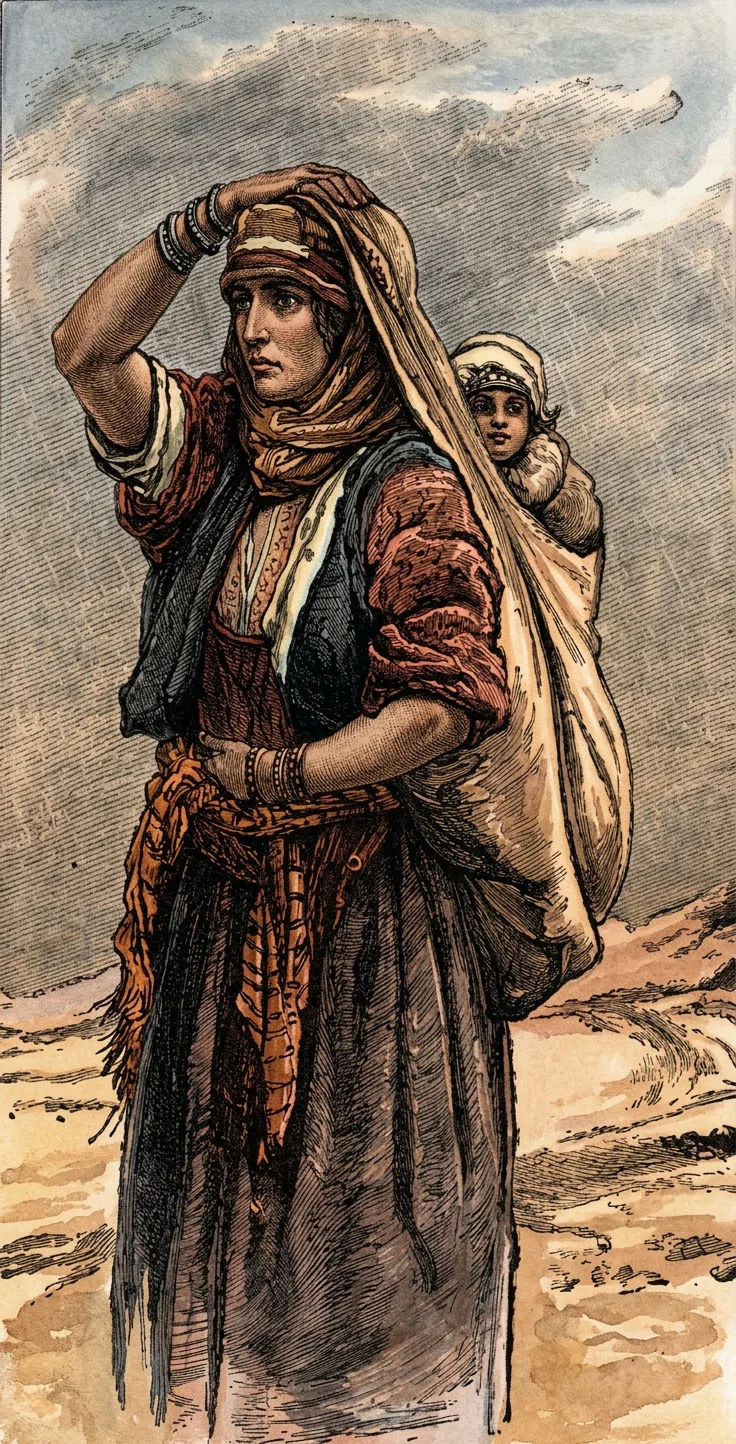
ARABIAN WOMAN AND CHILD.
Protestant missions are carried on in Asia Minor and Armenia chiefly among the Armenians by the American Board of Foreign Missions.
In Arabia are some small Protestant missions. At Aden is the mission of the Scotch Presbyterian Church; at Kerak and Muscat, the missions of the English Church Missionary Society; at Busrah, Bahrein, and Muscat, the missions of the American Dutch Reformed Church.
In Syria and Palestine are missions of the English Church Missionary Society, Free Church of Scotland, Friends, American Presbyterian Church, American Reformed Presbyterian Church.
A missionary in Arabia writes that in Arabia there are less difficulties in the way in reaching the Mohammedans than elsewhere. He also says: “Arabia is the home of the Mohammedan religion. While there are nearly 200,000,000 Mohammedans scattered over the world, they all turn their faces in prayer toward Mecca, and hope to make at least one pilgrimage thither. This shows what a strategic point Arabia is for missionary work. The fall of Mohammedanism in Arabia means the fall of Mohammedanism in the world. Once convert a Mohammedan, and he is likely to prove a good missionary of Christ, as he has been of Mohammed. He is naturally religious, naturally generous, and naturally a wanderer—three great missionary qualities.”—Gospel in All Lands.
RESPONSIVE
“Consecrate yourselves to-day to the Lord.” Ex. 32:29.
Lo, A harvest vast and white
Waving in the dawning light!
Reapers few and faint I see;
“Here am I, send me, send me.”
Waiting millions sadly stand,
Asking, with outstretching hand,
News of mercy rich and free;
“Here am I, send me, send me.”
Earthly gain I count as loss,
Fame a shadow, gold as dross;
Sweet were toil or death for Thee;
“Here am I, send me, send me.”
Father, in Thy boundless grace,
Choose for me, Thy child, the place
Where I most may honor Thee;
Father, here am I, send me.
Saviour, kindly let me share
Blessed work beyond compare,
Winning wandering souls to Thee;
Saviour, here am I, send me.
Pants my heart. Forbid my stay,
May Thine angels guard my way,
Guide and speed o’er land or sea;
Here, O, here am I, send me!
—Christian and Missionary Alliance.
PRACTICAL MISSIONARY THOUGHTS.
By E. E. Hoss
The Christian who comes to realize in a vital way that all men are his brothers, to whom he is bound by the most sacred ties of duty and obligation, is made thereby not only a better Christian, but a better citizen. The man who gives a dollar to save the soul of some foreign heathen may possibly have reason to believe that it has failed to accomplish that result; but it has done something else, perhaps quite as important. It has strengthened and deepened the spirit of brotherhood in the heart of the giver, and taught him to realize more perfectly than he ever did before the interdependence of all men upon each other. In fact, modern civilization is making the term foreign mission a misnomer. Innumerable tendons, social, industrial, political, and commercial, are making the whole world one. There are to-day no foreign nations in the old meaning of the word; for in a large but real sense we are all becoming citizens of the world, so that if we try to elevate and enlighten some one in the most remote corner of the earth, we may lift up to a higher plane of living a man who may have a profound influence, either direct or indirect, on our own lives. It was the apostle to the Gentiles who said, “None of us liveth to himself.” In carrying out the spirit of these words we are all apostles to the Gentiles to-day; for not only Christianity, but modern civilization, must acknowledge them as fundamentally true.
The success of our missions depends not only upon the money that we give to support them, but also on the prayers that we offer in their behalf. This is not considered as much as it ought to be. Our age is materialistic. We have come to measure everything in dollars and cents. Let us come back to the true position, that more things are wrought by prayer than men dream of. Praying without giving would do little good, and so would giving without praying. Let us give and pray. Who among us regularly remembers the lonely workers of the far-off fields in his private devotions? At how many family altars are the names of our foreign missionaries included in petition and supplication? Nothing would so cheer the hearts of the brave men who, few and scattered, are holding up the torch of truth in the midst of heathen darkness, as the certainty that they are not forgotten by believers at home. O, for more prayer, and more earnest prayer! Shall our lips be dumb and our hearts cold, when interests of such magnitude are at stake? The needs of the world should drive us to the throne of the heavenly grace.—E. E. Hoss, D.D.