The Youth’s Instructor, Vol. 38, No. 38.

I WILL BE WORTHY OF IT

The Youth’s Instructor

Sep 17, 1890

S. D. A. Publishing Association · Battle Creek, Mich. · Sep 17, 1890

I WILL BE WORTHY OF IT.

I MAY not reach the heights I seek, My untried strength may fail me; Or, half way up the mountain-peak, Fierce tempests may assail me. But though that place I never gain, Herein lies comfort for my pain, I will be worthy of it.
I may not triumph in success, Despite my earnest labor; I may not grasp results that bless The efforts of my neighbor. But though my goal I never see, This thought shall always dwell with me, I will be worthy of it.
The golden glory of love's light May never fall upon my way; My path may always lead through night, Like some deserted by-way; But though life's dearest joy I miss, There lies a nameless joy in this, I will be worthy of it. —Selected.

ROUND THE WORLD.—27.

THE INDIAN MUTINY.
On the Oudh and Rohilcund Railway we journeyed to Lucknow, a city famed in part for the buildings erected there by the Mohammedans, but more especially as having been the scene of one of the most terrible sieges recorded in history. This took place in the year of our Lord 1857, when from the second of July to the twenty-fifth of September the Christians were besieged, and a harassing fire constantly poured upon them by the hands of the mutineered native troops.
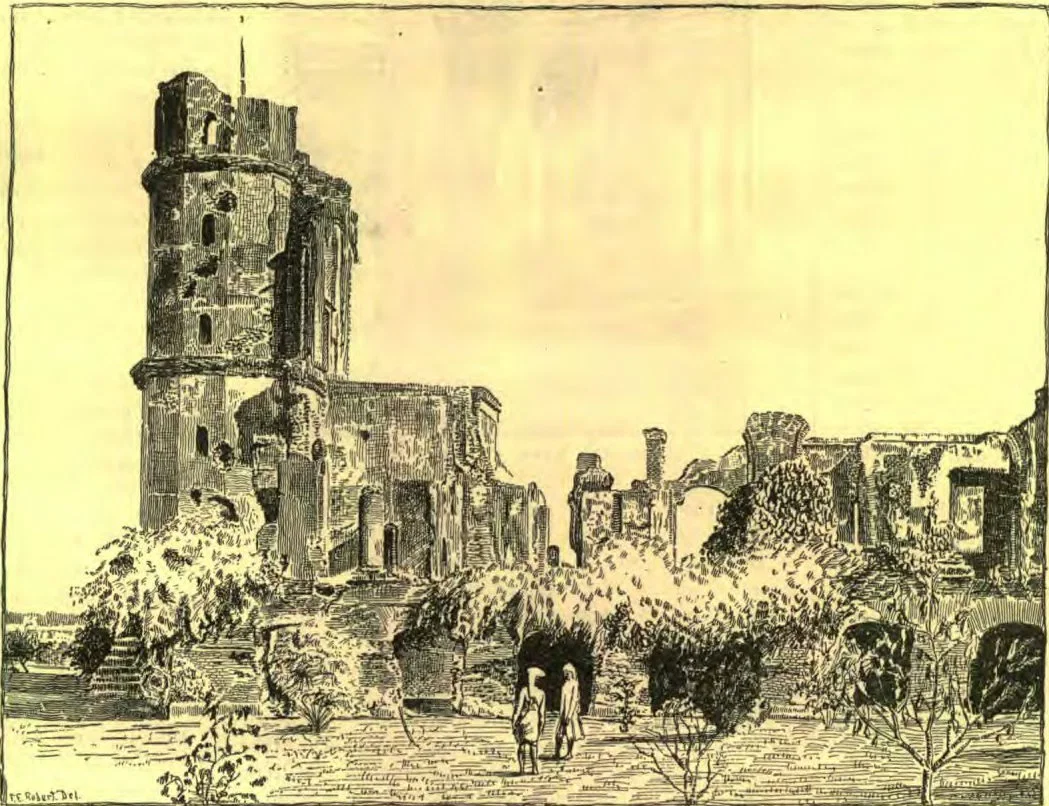
RUINS OF THE LUCKNOW RESIDENCY.
In this year, 1857, arrived the Hindoo “Sumbut,”—the hundredth year after the battle of Plassy, a battle in which the British arms had gained a decided victory over the natives. Hindoo astrologers had declared that the “raj,” or reign, of the British power was to continue for one hundred years, and then be no more. It is impossible to overrate the effect of this strange prediction upon a people who are credulous and superstitious to a degree, who will not marry, make a bargain, set out upon a journey, or even have their nails pared, without a favorable conjunction of the planets.
The British had carried civilization forward to a comparatively high state of perfection, but the religion of the country had not been interfered with in any way. For a while the mutiny smoldered, but was soon kindled to a flame by the following spark:—
A rumor ran through the native army in British employ that the cartridges served out to the regiments had been greased with—the Hindoos said the fat of cows, the sacred animal, and the Mohammedans said the fat of pigs, the quadruped that they detest so much. No sooner had this source of dissatisfaction spread over the country, than the troops revolted, and open hostilities commenced.
The Lucknow Residency, and the compound, or inclosure surrounding it, and the other buildings connected with it, form a spot which nature has spared no pains to adorn, and the arm of mutiny no steps to devastate. The buildings are on slightly rising ground, now covered with beautiful trees and shrubs, with a soft, mossy carpet of grass beneath. Round the gray old walls the dark green ivy has entwined her loving tendrils, as if to soothe with loving embrace the wounds made by the rebel bullets. In many places there is hardly a square inch not dotted over with the marks of the bullets from the murderous rifles, and huge gaps still remain where cannon balls tore away the masonry, causing pain and death to those within. We walked in the dungeons where the women and children were placed for safety, and where they remained during all the siege, without a change of clothes and with scant provisions. We could but think of the early Christians in the catacombs, and we wondered how many fervent prayers had ascended to our Father’s throne during that fearful time. In one room upstairs is a huge hole torn by a relentless shell, and the place is shown where it struck the floor and exploded, killing a young girl who was in the act of crossing the room to go to her father.
Near by is the old well which supplied the garrison with water. Over it are the remains of stone arches covered with pretty creepers, and bright syringas gently and softly wave their graceful stems and comely leaves in the pacific zephyrs which are wafted across the Indian plains, as if bewailing in low and mystic music the fate of those gallant defenders whose noble hands had often drawn cooling draughts from the pure, quiet spring beneath, to quench the burning thirst of brothers wounded in the fray. So calm, so secluded is the well, that it almost seems to say to the hearts of those who gaze upon it, “My own praises I never tell; but many a thirsty soul I have refreshed, and the Master knoweth all.” The heart was filled with so many sad memories of relatives who had perished here, that we turned with sorrow from the spot to spend a quiet moment in the little church-yard, where truly the words of the poet are verified,— > “And every turf beneath his feet, > Shall be a soldier’s sepulcher.”
There is a striking contrast in the cold, dismal-looking gray slabs erected in honor of the departed heroes, and the soft, gently undulating grass and the flowers of varied hue, which, fostered by Heaven’s tender care, turn their petals to the skies, as if in the act of rendering joyful praise to their Maker. Seemingly they are oft repeating to the mourner, “God gave; he hath taken; he will restore; he doeth all things well.” Yes, faith and faithful works, crowned by a martyr’s death, will lead to that immortal garden where bloom the flowers of amaranthine shade, and where death’s sting will never again be known.
On the twenty-fifth of September, Havelock and Outram arrived with relief, but their force was itself beset by a fresh swarm of rebels, and it was not till November that Sir Colin Campbell cut his way to Lucknow, and on the sixteenth of that month finally delivered the garrison.
From Lucknow we passed to Cawnpore, where occurred one of the most cold-blooded, heartless massacres that the sunlight or stars of heaven have looked down upon. As Taylor, in his admirable history of India, expresses it: “More deliberately treacherous than the catastrophe of the ‘Black Hole,’ a hundred years before, more intensified and prolonged, the fate of those who perished there forms a tragedy so full of terrible misery, of heroic endurance, and the deepest pathos that it will ever be read with a shuddering tribute of tears, to the latest Christian generation.”
There were about a thousand whites in the town, and on the sixth of June they took refuge in a miserable and hastily-prepared entrenchment. For eighteen days they fought, under a blazing, scorching sun, until all the medicines for the sick, and well-nigh all the provisions, were exhausted. Their ammunition was also running very low. One of the best buildings was burned, and the rest were riddled with shot, many of the bravest defenders killed, and the remainder greatly debilitated. There were the little band praying for succor, which indeed came, but, alas! too late. At this critical point, Nana, the rebel leader, sent an emissary bearing the white flag of truce. His offer was to transmit the defenders in safety to the city of Allahabad, provided their goods and chattels, and whatever else of value the intrenchment contained, were surrendered to him. Had the men been alone, and not encumbered with helpless women and children, they would have preferred to cut their way through the Sepoy army; but under the existing circumstances that was impossible, and fearing no treachery, they accepted Nana’s offer.
Forever will his name be handed down to infamy. On the twenty-seventh, the survivors, now reduced in numbers to four hundred and fifty, were marched down to the boats prepared for them on the Jumna River. No sooner had they embarked than a murderous fire was opened on them from the bank. Many perished, others escaped for the time being, and were again captured. Some of them were instantly shot, but one hundred and twenty-two were reserved for awhile. Of the whole army who left the entrenchment on June twenty-seventh, only four escaped and survived. When news reached Cawnpore that General Havelock and the relieving force were coming up, Nana decided to slay the rest of his victims. Women and children were tossed in the air, and as their bodies descended, they were caught on the rebel bayonet, and dead and dying were hurled into a well near by.
When the relieving force arrived, was it marvelous that the mournful, blood-stained relics, the little shoes and scraps of clothing, and the deep well filled with fresh dead, caused every British soldier to make a vow of revenge, which to the last was sternly fulfilled? It is said that in one building, known as the “Slaughter Ghat,” the mutineers had plastered the scalps of the women and children all over the walls, and when the British entered, they stood ankle-deep in blood. Each Britisher took a scalp, and vowed that, for every hair on it, his sword should drink Sepoy blood. At first there was some resistance, but when the order, “Fix bayonets and charge!” was given, the mutineers threw down their arms, and cried for quarter. But it was too late; at the foe went the Highlanders, vengeance stamped on every brow, and like nine-pins the Sepoys went over before their terrible charge. Their rage and passion knew no bounds, and the revolting massacre was punished with a frightful retribution.
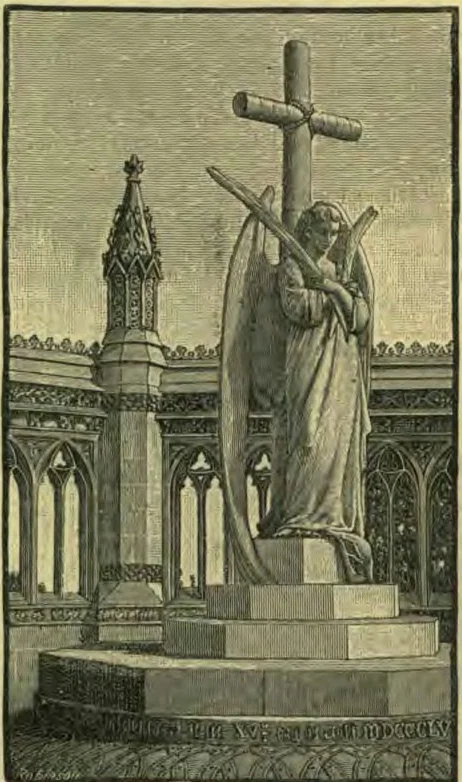
Over that well, now inclosed by a rich Gothic screen, stands an angel in marble, with folded wings and crossed hands, bearing two palms of victory, emblematic of the dead who sleep beneath, awaiting “the coming of their Lord. P. T. M.

A WONDERFUL VISITOR.

For a year or more there has been a “stranger within our gates,” whose story of life in her native land is so fascinating and wonderful that had she dropped from some cold, starry planet in the northern skies, her presence would be hardly more marvelous.
Olof Krarer, a young Eskimo woman now visiting this country, is probably the only educated Eskimo lady in the world. There have been one or two women who have accompanied Arctic voyagers upon their return to this country, but they were the wives of hunters, women who knew little more than the strange dogs which were their companions. All except Olof Krarer have been natives of West Greenland, a region of which we have read and learned much in the last two decades. It has been left to this one little Eskimo lady from the far distant, almost unknown region of the East Coast, to tell to us the pathetic and curious tale of home life and child-life in the frozen north.
Of this little explored portion of the globe, Captain Holm, the Danish explorer, who recently returned from the Arctic seas to Copenhagen, says: “I found the east coast of Greenland to be the coldest and most dismal region of all the Arctic lands I ever visited, and here, isolated from the whole world, is a race of people who have never known of the great civilized nations of the earth! They differ entirely in language and physical character from the Eskimos of West Greenland. From the meager traditions they have, it is to be supposed that they are descendants of the early Icelandic Norsemen, who, centuries ago, were wrecked off that perilous coast, and, unable to return to their native land, became the founders of this strange people who to-day inhabit this little-known portion of the land. They have been cut off from communication with the outer world, by reason of the great masses of ice, sometimes hundreds of miles wide, perpetually piled up against the shore, which have kept explorers from the east coast of Greenland long after all other Arctic lands were fairly well known. Within the past two centuries, ten or twelve expeditions have been sent out in search of the lost Norsemen, who, it is supposed, settled here, but only one ship has ever been known to reach the coast. The people in this country live in little hamlets, or settlements; and, aside from their ignorance and the suffering caused by the intense cold, they seem to be a happy, contented, honest people.”
In this dreary land, some thirty years ago, was born the little woman who to-day tells us her wonderful story. Her first recollections are of the snow hut which was her home, and the bitter cold and frequent hunger from which every one about her suffered. Fuel there was none, there being no vegetable life in that latitude; and to make the feeble fires which served to keep them only half warm, the dried flesh of the reindeer, with the bones of the walrus and of fish, were ignited by means of a piece of flint. Flints are rare in Eskimo-land, and sometimes there is only one in a community of several families. The flint-owner is the rich man of the place. He does not hoard his treasure, however, for the flint is freely borrowed and generously offered at all times.
MEMORIAL WELL AT CAWNPORE.
There appears to be little true affection in the care which an Eskimo mother gives her babies; she never fondles or pets them, and when they are peevish and ill, she neglects them, not unlike some of the lowest brutes.
As soon as they are able to sit alone, they are put upon the fur-covered floor to take care of themselves; and there they sit, muffled in their little seal-skin jackets—the fur side turned inward—with their little arms folded about their bodies to keep warm. The girls grow deformed by being constantly in this constrained position. The boys, who are more active and go out-of-doors, escape such deformity; but all Eskimo women have the upper arm short and crippled from disuse.
An Eskimo girl has an indolent time of it. There is no housework to do; there are no household utensils of any kind; no brooms with which to sweep; even no water for washing. The blubber of the whale, the flesh of the polar bear, and fish—their only articles of food—are eaten frozen and raw. Only the very sick or old, or infants, ever taste heated meat. As for washing, an Eskimo does not understand the term.
They have no register or notation of time, nor routine of daily life, as we understand it. They eat when they are hungry, and sleep when they are sleepy.
There is no outdoor occupation or amusement for the women. Occasionally a man will take his mother or wife out in a sledge for an airing; and if a little one goes too, it is carried inside the large fur hood of the woman’s coat, and dangles down her back.
There is no mode of government, as we understand it, in these communities: no laws; no written language; no one man holds a higher place than any other—the man who owns the flint is, perhaps, the millionaire of the hamlet, but he shares his riches with the rest. All are equal, and meet on common ground.
Custom is the highest law of their bare, rude lives; and their customs are prompted and regulated mainly by the first great instinct of self-preservation.—St. Nicholas for August.

LINCOLN'S SCHOOL-DAYS.

LITTLE Abe was first sent to school when he was about seven years of age. His father had never reached any “book learnin’,” as education was termed among such people, and it was with difficulty that he could write his own name. One day, about four weeks after Abe had been sent to school, his father asked the teacher, “How’s Abe getting along?”
The teacher replied that he was doing well; he wouldn’t ask to have a better boy. He had only one lesson book, an old spelling-book. During the school hours he was attentive to his task, and at night he would study over the lesson he had been engaged upon during the day; the highest ambition of his life at this time was to learn to read. He believed if he could only read as well as his mother, who read the Bible aloud to the family every day, the whole world of knowledge would be opened to him, and in this conjecture he was about right. As the old Baptist minister said to him one day, “When you can read, you’ve got something that nobody can get away from you!”
In the Kentucky home there were but three books in the family—the Bible, a catechism, and the spelling-book which Abe Lincoln studied. He had not been long in Indiana before he had read the Pilgrim’s Progress, his father borrowing it from a friend who lived twenty miles away. He was very fond of reading Æsop’s Fables, a copy of which came in his way. A young man taught him to write. As writing-paper of any kind was very scarce and expensive, Abe used to practice his writing exercises with bits of chalk or a burnt stick on slabs and trunks of trees. Sometimes he would trace out his name with a sharp stick on the bare ground. When, finally, he was able to write letters, he was called to do the correspondence of his neighbors; for very few grown persons in that district could write even a simple letter.
As Abe Lincoln grew older, he became a great reader, and read all the books he could borrow. Once he borrowed of his school-teacher a Life of Washington. His mother happened to put it on a certain shelf, and, the rain coming through the roof, the book was badly damaged. Abe took it back to the school-master, and arranged to purchase it of him, paying for it by three days’ hard work in the cornfield, and he was entirely satisfied with the bargain at that. At the age of eighteen his library consisted of the Life of Franklin, Plutarch’s Lives, the Bible, the spelling-book, Æsop’s Fables, Pilgrim’s Progress, and the lives of Washington and Henry Clay. A boy might have a much larger private library than this, but he could scarcely find an equal number of books better calculated to impart wholesome lessons as to correct living and right thinking. —Harper’s Young People.

SOMETHING BETTER.

The “little virtues” are in no way remarkable, but somehow we never get tired of praising them—especially when they are found among strangers. The Christian Register relates this pleasant incident of a Southern journey—one of the small happenings which help to make places memorable and life itself delightful.
The fields of Arkansas were white with the bursting balls of cotton, and wherever one traveled, the cotton plantation followed the road. An Eaton lady was very desirous of getting a sprig of the plant, with a bunch of cotton on it; but though the train often stopped provokingly near, it was never quite near enough. In vain she looked for a small boy to gather a spray. When the small boy was there, the cotton was gone, and when the cotton was almost within reach, there was no boy to be seen.
At last her fellow-travelers became interested in her success, and always looked up inquiringly, or in words asked how she fared in her quest.
Just before dusk, the train halted opposite a vast field, tufted with snow-white dots all over its wide expanse; and here was a boy—yes, three of them. Stepping to the front of the car, she said, “A nickle to the boy who brings me a sprig from the cotton plant,” and threw down a five-cent piece.
The three black faces grinned at so unusual a request. The boy who caught the money gave a bound, cleared the ditch, and was almost over the fence into the cotton patch, when the warning bell of the engine began to ring. He was doubtful for a moment, then jumped back, and began to follow the train, which was already moving pretty fast.
The lady had not gone in. She was still looking longingly at the coveted plants, and had quite forgotten the trifle she had given in vain, when a black hand caught hold of the stair-railing, and a hurried pair of feet kept pace with the train, while a panting voice exclaimed, “Lady—here’s—yer—nickle!” and the shining bit was laid on the car-step as the boy fell back.
The lady kicked it off with her toe so quickly that it must have fallen within his sight; for a loud “Thank yer, lady,” followed after the now swiftly moving car.
She returned to her seat, only sorry that she had not ventured more for such a pleasant return. The passengers, seeing her satisfied look, asked eagerly, “Oh, did you find some?” to which she quickly replied,—
“No, but I found something better; I found an honest boy.”—Selected.

THE STORY OF THE LITTLE LAD.

WHAT is this that my darling is saying? You think that your gift is so small, Though it's all that you had to offer, It can surely do no good at all?
You forget, then, that sweet Bible story Meant for little ones, yes, even you, Of the dear little lad who brought gladly His gifts, though so small and so few.
Five loaves and the two little fishes Were all that the little lad brought. What were they among hungering thousands That thronged where the Master had taught?
Yet he brought them, not doubting or fearing But that Jesus the offering would own; And lo! when the Master had blessed it, To abundance the small gift had grown!
So to-day you may take to the Saviour Your childish gift without fear But that he will own and receive it. Since you bring to him what you hold dear.
And his blessing will add what it lacketh, Till perchance it may do great good. And carry the news of the gospel To a hungering multitude. —Minnie E. Kenney.

GOLDEN STILTS.

“WISH we could think of some new game,” said Allen. “We can’t play marbles, for the street is all wet with rain, nor roll hoops; and anyway I’m tired of those games; for we’ve played them all summer.”
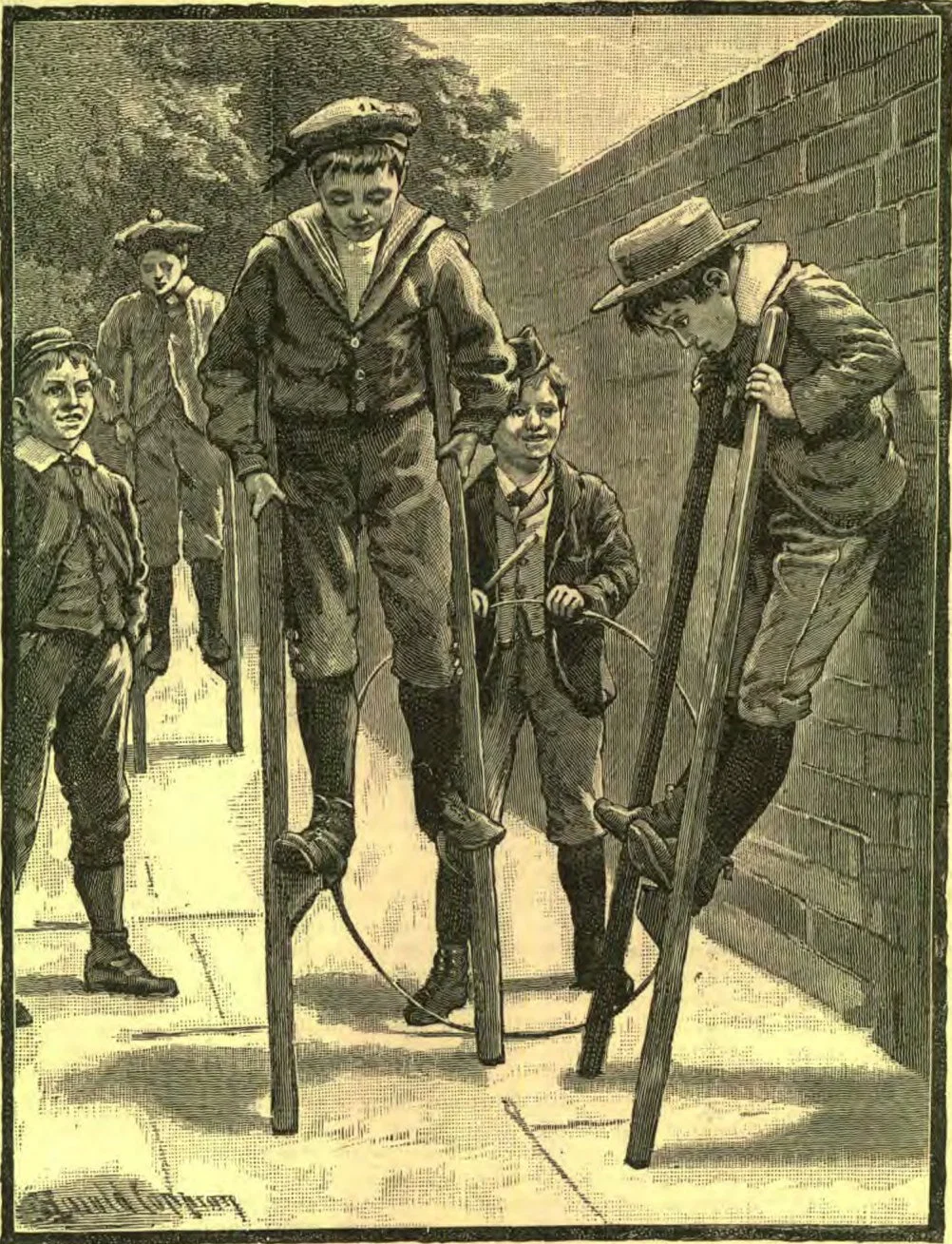
“I tell you what,” said John excitedly, “let’s make some stilts. I saw a boy down town this morning walking round above all the fellows, as though he owned the whole world.”
“Hurrah!” shouted Edgar and Allen, springing to their feet. “That’s capital! But where can we get the timber to do it?”
“Over at the saw-mill.”
Away the boys started, to make known their request to the foreman.
“So you want to get up in the world,” said the foreman, laughing. “Well, human nature is about the same all round. But when you do get up, boys, be sure not to look down on others.”
“How can we help it, I’d like to know,” said Allen. “If we’re above them, we’ll have to look down, won’t we?”
“Well, I’ll tell you how to help it,” said the foreman. “Whenever you find yourself looking down on anybody, and feeling yourself above him, just step down yourself, and try to help up the one you despise. Now, for instance, if you are on stilts,—and stilts are mighty uncertain things, and sometimes land you into very humble positions,—and you see a poor boy without stilts, suppose you say, ‘Here, do you want to try my stilts awhile?’ Just step down and help some one else up, and you’ll be pretty sure steppers after awhile. It’s wonderful how tall it makes folks grow to be always helping someone else up; and it’s wonderful, too, how small people do grow who are always looking down on others, and trying to keep them down. They turn into dwarfs, and I tell you it takes pretty high and dangerous stilts to keep them walking with their heads above their fellow-men. The only way to grow tall and large and be well-developed boys, is to do unto others as you would have them do unto you. That golden rule is the best pair of stilts I ever saw. Yes, boys, go along, you are welcome to all the timber you want. Here are some hammers and nails, and I’ll show you how to make the best kind of steppers, as it isn’t quite one o’clock yet.”
When the boys started off from the mill, you may be sure they felt happy. There was a warm glow round their hearts, and they thanked the kind foreman for all his help, though they didn’t realize what help he had given them.
He stood in the doorway as the one o’clock bell rang, and called after them, “Don’t forget the Golden Rule stilts, boys. I want to see you about the biggest men in the country.”
“What a queer man he is,” said Allen. “But he is nice, though.”
Wasn’t it fun to stride over the ditches and mud-puddles, and splash through the ruts in the road? By and by the boys of the neighborhood came running to see the stilt-walkers. Marbles and hoops and balls and everything lost all attractions in contrast with this novelty.
It was hard for the boys not to feel a little big as they strode around, head and shoulders above the other boys, and it was not long before the boys found it out. There is something strange about that, but it is true, that we cannot keep our real feelings from showing out. They are something like an odor or an influence. Little children and even animals find out about us. Haven’t you seen how cats and dogs know their friends, and how children, even babies, seem to tell at once those who really love them?
Well, I’ll tell you how the boys found out that Allen and Edgar and John felt big and selfish.
One little boy came up to John, and said,—
“Say, where did you get your stilts?”
“None of your business,” said John, striding up the road.
“Say, Smartie, I wish you’d tumble down and break your stuck-up bones,” cried the little fellow revengefully.
Then another boy walked up to Allen, and asked him to let him see how he cut the steppers; but Allen said,—
“O, get out of my way! Wait till I get through walking, and then you can see them.”
The boys gave very black looks at John and Allen; for the spirit of selfishness communicates itself to others; and they said among themselves, “Let’s trip up the stuck-up things.”
When Allen and John marched round the corner, the boys began to dig holes in the road, and to cover them with sticks and straws, so that no one would suspect holes were there.
“There, that will serve them just right. ‘Pride goes before a fall,’ you know. We’ve seen the pride, now I hope we’ll see the fall.”
Edgar had stopped walking on his stilts as soon as he heard John say, “None of your business!” and ever since, he had been leaning up against the fence, thinking.
“It’s kind of hard to give up my stilts now; but I am sure it’s about time to use the other pair.”
Allen and John were marching round the corner when Edgar came to this conclusion.
“Say, boys,” he said, “don’t you think we’d better use the Golden Rule stilts awhile?”
“What do you mean? Give up our stilts to these rude fellows? Not by a long ways. Just see them grinning and making faces at us.”
“Well, if you won’t, I will,” said Edgar.
So Edgar called out, “Say, boys, I’ve got another pair of stilts, and if any of you want to try this pair, all right, come on.”
There were several who did want to try them, and Edgar found that as he stepped down to let another step up, he did feel a kind of tallness that he had never felt before. It was real fun to see the boys look so happy.
Edgar was the hero of the day. One boy gave him a beautiful glass agate, and another gave him a hoop, though Edgar did not expect anything, and felt a little ashamed to take these presents.
“But say, where’s your other pair of stilts?” asked one big boy, who thought perhaps he could borrow them for a race with Allen.
“O, my other pair are golden ones,” said Edgar.
“Golden!” exclaimed the boys; “why, I never heard of stilts like that. Can’t you show them to us?”
“Easy enough,” said Edgar. “They are made of the Golden Rule, ‘Do unto others as you would that others should do unto you.’”
“Humph!” said the big boy, and the others looked at him as though they thought him rather queer.
But the little boy exclaimed, “That’s a boss pair! I’ll have some of them right off.”
“Say, Allen,” he continued, “don’t go over to that side of the road, for I made some holes there to trip you up in.”
“Thanks,” said Allen. “Long as you told me before I fell into them, I’ll let you take my stilts.”
Well, it was strange what a fine time those boys had that afternoon, and yet it wasn’t strange either; for before night every one had taken a step up on the Golden Rule stilts.
When the others had gone to bed, Edgar stood beside his mother. “Mother, do you think a fellow grows any faster for being kind to others?”
“Why, yes,” said his mother, “in one way he does, and I might say in every way. A kind, genial disposition is a promoter of health and happiness, so that physically one is apt to be better and bigger for this trait; but I think that it benefits the spirit, the character, more even than the body, and makes a boy manly and Christlike, helping to the beautiful, noble stature that God calls manly.”
Edgar kissed his mother good night, and left her somewhat puzzled, but greatly pleased, by saying, “Then I think I’ll always keep a pair of the Golden Rule stilts to walk on.”
Won’t you all keep a pair of them, boys and girls?
FANNIE BOLTON.

Improving Spare Moments Against Temptation

SPARE moments are the gold-dust of time. We should see that they are well improved. They are often the most fruitful of evil; for they are gaps through which temptations find the easiest way to the garden of the soul.

QUEER WOOL.

STRANGE as it may seem, there comes from the iron furnaces of Pittsburg a substance so white and light, so fluffy and flaky, that it looks and feels like picked wool. It is called “slag wool,” and a correspondent tells us how it is made and for what it is used. Slag is a waste substance which issues from iron melting furnaces. It is formed by the separation of the earthy matter from the ore, and looks like coarse, dark glass if allowed to cool as it comes from the furnaces. Formerly it was thrown away as valueless, but since a process for converting it into “wool” has been discovered, it is utilized for many purposes.
This mineral wool is formed by causing a jet of steam to play upon the stream of molten slag as it issues from the furnace. This has the effect of breaking up the melted mass into countless small, bead-like particles, so light that they fly in every direction. Each of these tiny beads carries behind it a delicate thread of finely-spun slag, so that one is reminded of a comet with its tail.
To collect these threads, and to separate the fibers from the beads, or heavier portions of the slag, the steam jet is arranged at the mouth of an open cylinder of sheet-iron, in which a strong air current is induced by additional jets of steam.
The tube, or shaft, is furnished with a shield, or striking plate, which detains the heavier particles, while the lighter slag wool is carried by the draught into a large chamber resembling a gigantic meat-safe, its walls being formed of wire netting with about sixteen meshes to the square inch. Here the steam condenses and escapes, leaving the slag wool, which now has the appearance of snowflakes, deposited on the floor of the chamber, or clinging to its wire walls.
The filaments, or flakes, are then broken up and felted together, when they look and feel like wool.
This mineral wool is extremely light and absolutely fire-proof—properties which make it useful for a large variety of purposes. It is a marvelous non-conductor of heat and sound, which renders it valuable for packing between the floors of rooms and in the spaces between partitions. It serves as an excellent covering for boilers, heating pipes, and such things.
It can be woven into cloth, and as such makes fire-proof curtains for theaters, and it might not be a bad plan to make clothes out of it for children who persist in playing near the fire. It is so porous that it will absorb and retain large quantities of water, like a sponge, and it is also an antiseptic, that is, a substance which resists or corrects putrefaction. It is useful, therefore, as a dressing for wounds, as well as for other medical purposes.—Selected.

POWER OF PLANT GROWTH.

ORDINARILY the immense power exerted by plants during growth passes unnoticed, because of the gradual and unobtrusive way in which the results are attained. When, however, some unusual obstacle has to be overcome, the manifestation of power is often strikingly exhibited.
At one of the grain elevators in Buffalo, a few years ago, there was noticed in the asphalt floor a curious bulge, which, when first seen, covered about a square foot. The flooring was known to consist of two layers, and under one of tar and gravel six inches thick, and upon this seven inches of asphalt which had been laid hot and rolled down four years previous.
“In six hours,” so runs the account, “the floor was burst open, and a perfectly formed toadstool, with the stem two inches through, and a very wide cap, made its appearance. Elsewhere the floor was smooth and unbroken.”
Such a soft-textured plant as a toadstool is surely the last that would be expected to do such a piece of work; still, not a few similar cases are on record. In one instance reported, a toadstool raised through a distance of several inches a stone weighing over three hundred and fifty pounds.
Cases such as these suggested to the President of the Massachusetts Agricultural College the idea of trying to measure the expansive force of a squash during the process of ripening. When about half grown, the fruit, still connected with the vine, was placed in a wooden cradle, and to the upper surface was fitted a basket-like frame-work of iron bands riveted together.
As the squash enlarged, the frame-work was pushed against a stout beam, arranged as a lever and weighted at regular distances. In spite of all this harnessing, the squash steadily enlarged from August 21st to October 31st, raising with perfect ease the weights which were added from day to day.
From sixty pounds on the first day, the burden was gradually increased to over two tons, and the squash continued to grow. Under a pressure of five thousand pounds, the iron frame-work broke, and so brought the experiment to an end—leaving it in doubt whether with a stronger harness still greater power might not have been displayed.
In woody plants the expansive power is generally less conspicuously exhibited, because of the slower growth, and for the same reason the force exerted is more difficult to measure. Tree roots which have penetrated into the crevice of a rock, sometimes afford, however, quite impressive examples of what such a plant can do, if occasion requires. A sugar-maple in South Hadley, Mass., having insinuated one of its roots between the horizontal layers of a sandstone ledge, was found to have raised a slab measuring more than twenty-four cubic feet, and weighing, therefore, over two tons.
In Norwalk, Connecticut, the writer found what appeared to be an apple-tree growing between the separated halves of a good-sized boulder. It was evident that a seed had lodged in some crevice opened by the frost, and from this seed had grown the tree whose trunk had wedged the rock asunder.
Visitors to Marion Cemetery, in Hanover, Germany, are shown a strongly-built tomb, the stones of which have been similarly displaced through the growth of a tree. By a singular coincidence the tomb bears the following inscription: “This sepulcher, bought for all eternity, let no man open.”
Although the above examples of plant power are truly extraordinary, they are no more wonderful than the exhibitions of growth-force which we may see all around us. It is surely surprising to see through what a thickness of overlaying earth a slender seed-sprout will force its way. The wonder increases as we follow the boring of its roots through the soil, and if our seedling grow into a stately tree, how immense is the force which carries high up into the air tons of branches and foliage!—Youth’s Companion.
Continue reading: ARTIFICIAL FLOWERS