The Youth’s Instructor, Vol. 27, No. 50.

ARCHERY

The Youth’s Instructor

Dec 18, 1879

S. D. A. Publishing Association · Battle Creek, Mich. · Dec 18, 1879

ARCHERY
ALTHOUGH archery in civilized countries ranks only as a sport, yet there are some parts of the world where many a small boy will have to shoot at, and hit, his breakfast to-morrow morning with an arrow, before his father will let him eat it. With such a necessity before us, most of us would probably be pretty good archers.
A bow and arrow rightly used will train the eye, strengthen the arm, steady the nerves, and furnish a recreation more useful and no less entertaining than some other sports that by bad associations have become objectionable. But a young lady who one day heard the whiz and felt the thud of a boy’s arrow in her hair did not think that arrow had been rightly used. No one has a right to be careless about anything, and, as to archery, even a common bow and arrow can be used so as to produce death in an instant, to say nothing of putting out eyes and giving bruises by careless shots. There has been more than one game, harmless in itself, turned into a funeral by carelessness.
Nor do we think an arrow rightly used when turned toward an innocent bird, or shot at any living thing simply for amusement or to improve one’s skill. That may do for savages, but not for Christian boys and girls. Unerring skill in shooting will not pay for a heart cruelly hardened to suffering.
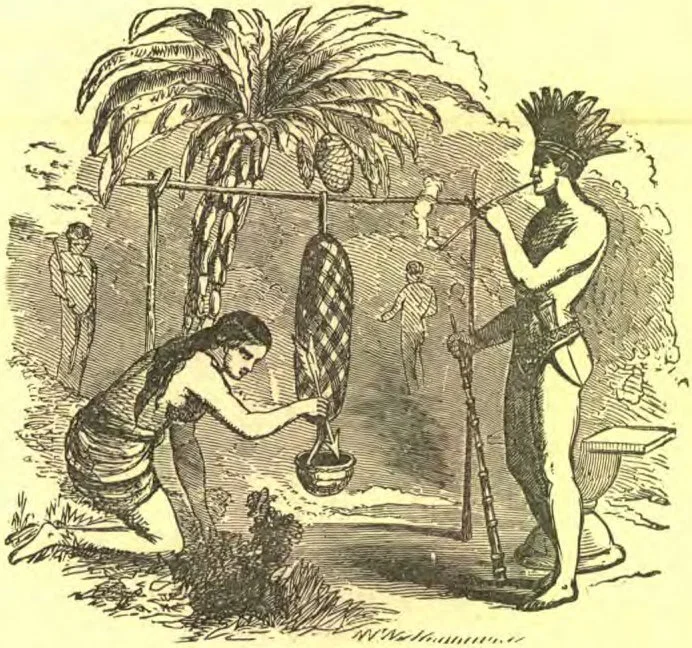
You have all heard of “poisoned arrows.” The process of poisoning is illustrated in the accompanying picture. The Indian gathers deadly herbs and steeps them. He then dips the points of his arrows into the mixture, and sets them carefully aside for future use. It does not take a deep wound then, nor a large arrow, nor a sure aim at a vital part, to do the work. All that is needed is a mere scratch, and the victim often dies within an hour from the time he was hit.
There is another kind of “poisoned arrows.” They are the shafts of envy, or the “arrows of suspicion.” A single word from an envious lip, and some one’s happiness is destroyed, never to be brought back. A single suggestion, something that you “don’t know to be true,” “but if it isn’t so what else can it be?” and the sharp barbed arrow of suspicion has sped to its mark—a character is ruined, a reputation is destroyed, perhaps forever.
Do you ever shoot such arrows? Something is missed from the house, or from the desk at school. It is hunted for. It does not appear. “Well,” says some one, “that was certainly here, and just as certainly it is gone! Somebody must have stolen it, and who has done it unless”—Stop! it may still be found. You may have mislaid it, a rat may have taken it to his nest—but no matter how—did you see the person steal it? “No?” then you have NO RIGHT to carelessly turn toward him a “word” arrow touched with so deadly poison as suspicion. You did not say that he did it. No, but you said enough, fully enough, to poison his reputation.
Then, too, there are boys and girls who seem to think they can say what they will if it is “only in fun.” Hear what the wise man says about this:— “As a mad man who casteth fire-brands, arrows, and death, so is the man that deceiveth his neighbor, and saith, Am not I in sport?”
An arrow wrongly used is a terrible thing, but the most cruel of all is the “poisoned arrows!” No wonder that David prayed: “Hear my voice, O God, in my prayer; . . . hide me from the secret counsel of the wicked, . . . who whet their tongue like a sword, and bend their bows to shoot their arrows, even bitter words; that they may shoot in secret at the perfect; suddenly do they shoot at him and fear not.”
Be careful of your arrows. Do not point them where you have no business to, and never use “poisoned arrows,” bitter words, deceitful words, and unkind looks, that pierce the hearts and embitter the lives of those around you.—Sel.

The Careless Word.

It was but a word, a careless word— As thistle-down it seemed as light; It paused a moment on the air, And onward then it winged its flight.
Another lip caught up the word, And breathed it with a haughty sneer; It gathered weight as on it sped, That careless word, in its career.
Then rumor caught the flying word, And busy gossip gave it weight, Until that little word became A vehicle of angry hate.
And then that word was winged with fire; Its mission was a thing of pain; For soon it fell like lava-drops Upon a wildly tortured brain.
And then another page of life With burning, scalding tears was blurred; A load of care was heavier made, Its added weight, a careless word.
How wildly throbbed that aching heart! Deep agony its fountain stirred; It calmed, but bitter ashes mark The pathway of that careless word.

THE TIME TO OBTAIN RELIGION.

DEAR CHILDREN: Perhaps you have often said, “Oh, religion is a good thing, and I mean to be a Christian sometime; but I am not old enough yet to trouble myself about it.” Let me ask, How old are you? Perhaps you are six, eight, ten, or fourteen years of age, and possibly you may be older. You can read and understand common conversation, and I am sure that you are old enough to learn about God.
I want to show you that youth is the most favorable time to seek the Lord. Religion appeals to the heart, and demands love. Your hearts are now tender, your habits unformed, and your affections fresh and ready to twine around every lovable object. If you live a few years in sin, your hearts will become hardened, your habits fixed, and your affections blunted. For this reason it is much easier to become a Christian in the morning of life than in after-years.
The little rill can be easily directed into a new channel, but it requires much hard labor to change the course of a mighty river. A small shoot will bend easier than a lofty tree, and a tiny slip will root quicker than a large branch; so the tender heart of the little child is more susceptible to divine influences than the care-worn soul of the grown-up man.
I wish to tell you something about life. You are now young, and future days look bright; but, my dear young friends, trials await you, and you will need more than mortal strength in the conflict of life. Your flashing eyes will soon grow dim with tears, and your dimpled cheeks become furrowed with care. Your nature is now warm, quick, and impulsive, and your heart bounding with hope; but the stern discipline of coming years will dampen your ardor, disappoint your hopes, and change the golden hue of fancy into a dull, cold gray. The gliding sands of life will lose their brightness, and the heart become corroded with care, unless daily refreshed by cool flowing waters from hidden springs.
Daily communion with God will banish discontent and gloom, and keep every avenue of the heart clear and undefiled. My dear young friends, plant your feet firmly on the “Rock of Ages,” and you will escape the darkness of despair, and realize the “fullness of joy” that ever comes to those that seek Him early. The time to obtain religion is now. “Now is the accepted time, and now is the day of salvation.” ELIZA H. MORTON.

IT ISN'T MINE.

“Hallo, I've found something!” exclaimed Joe Fellows, as he stooped to pick up a bit of paper from the path. “Twenty-five cents, as sure as anything.”
“It takes you to find things!” said Harry Hale. “I never saw such a boy for four-leaved clovers, and mushrooms, and shells. Is it really a quarter?”
“Look for yourselves! A nice new quarter.”
“So much the better! You know you promised to treat us at Madam Bates', and she has some famous peanut candy, and corn-balls, now.”
“I know I promised, and I am going to do it when I have some cash of my own; and that will be next Friday. But just now I haven't any.”
“I don't see why that isn't yours,” said another boy. “You found it.”
“Suppose you had lost it. Would you think my finding it made it mine?”
“That's different,” said Richard Hale. “Then you would know the owner of the money. Now you don't know whose it is.”
“May be not; but I know whose it isn't, and you'll have to wait, Dick; this isn't mine.”
“Oh! you are too particular. Just see, now, what nice things the old woman has in the window. As likely as not, they will all be gone by Friday.”
But Joe was firm, and the party passed Madam Bates' little shop, a good deal to the disappointment of the old woman. Presently they met an old, lame, colored man, whom they all knew and liked.
“How goes it, Uncle Jacob?” asked Joe.
“Well, so so! I's met with a loss. You haven't seen a twenty-five-cent bill anywhere, have you?”
“I've seen just the very thing,” replied Joe. “Have you lost one?”
“Yes, I have; 'bout half an hour ago. I was coming up from the field, and somehow I must a dropped it, for I can't find it, and it's all de money I've got. I don't know what we shall do for dinner.”
“Here's the twenty-five cents all right, uncle!” said Joe, producing it; “and father says you are to come up to our house and get a leg of mutton. He has saved a nice one for you.”
“There, you fellows!” said Joe, as the old man went on rejoicing. “Suppose we had spent that quarter at Madam Bates'! Shouldn't we have felt mean when we met the old man?”
“You might have paid him back.”
“Yes, if I had the money; but suppose I hadn't, which happens to be the case. I tell you it's always the best way to keep on the safe side, when you are dealing with other folks' money.”
Joe was right. How much misery and disgrace might be saved by keeping on the safe side, in dealing with other folks' money.—Missionary Echo.

THE LORD KNOWETH THEM THAT ARE HIS.

MANUFACTURERS, in order to distinguish goods of their own make from those made by others, place upon them some peculiar mark called a “trade-mark.” Of these marks there is a great variety. Sometimes they consist of a name, sometimes of the initials of a name ingeniously combined, sometimes of a picture, and often of a simple cross-mark. These you will see illustrated on spools of thread, packages of yeast, bars of soap, rolls of cotton cloth, etc., etc. Very similar to the trade-mark is the marking put on cattle and horses to show who owns them.
For many years the United States law has allowed manufacturers the privilege of registering their trade-marks, and has given each a right to the exclusive use of the mark he has chosen. It even subjects to fine, or imprisonment, or both, any person who imitates trade-marks, or who places genuine ones upon other goods than those made by the real owner of the mark.
All this is done to protect both manufacturers and purchasers from fraud in dealing in common articles of merchandise; but there are two marks spoken of in the Bible to which we would call your attention. Although they cannot perhaps be called “trade-marks,” yet they do a very similar work.
The first one, which is mentioned in Ezek. 9 : 4, is placed by our Creator upon the foreheads of all who are counted worthy to be called his children; and the second will be placed upon the foreheads of as many as Satan can induce to follow his example in rebelling against the laws of Heaven.
Which of these marks we will have placed upon our foreheads remains for us, dear readers, to decide. When tempted to say what is not strictly true, or to take what is not yours, when tempted to disobey your parents, or to be unkind to your schoolmates, remember that the Lord knoweth them that are his, and that he will never place his mark upon us unless we have done that which is right in his sight. Oh, that all the INSTRUCTOR family, in the day of final reckoning so soon to come upon us, might be counted as property of the heavenly King, and heirs of eternal glory. M. K. W.

“A QUARTER OF AN HOUR BEFORE TIME.”

It has been well said that industry is of little avail unless it be seconded by punctuality,—a habit which may be acquired with but slight perseverance by every one. Perhaps these combined qualities were never so well exemplified in the career of a public man as in that of the Duke of Wellington. It is said that when on one occasion he was making an appointment to meet a famous engineer early on the morning of the following day, the latter remarked, “I will take care to be punctual at five.” To this Wellington replied, with a quiet smile, “Say a quarter to five. I owe all I have achieved to being ready a quarter of an hour before it seemed necessary to be so; and I learned that lesson when I was a boy.”

BIBLE LESSONS FOR YOUTH.

LESSON LXXVI.—AHAZIAH, JEHORAM, AND THE PROPHET ELISHA.

  1. Who took Ahab’s place on the throne of Israel? 1 Kings 22:40.
  2. What course did he take? Verses 51–53.
  3. How could such a course affect the people?
  4. With what accident did he meet? 2 Kings 1:2.
  5. To whom did he send messengers?
  6. Whom did the angel of God send to meet the messengers?
  7. What did he say to them?
  8. What did the king say when he heard this message?
  9. How did he try to bring the prophet under his power?
  10. How did the first captain address Elijah?
  11. How did the prophet answer him? Verse 10.
  12. How did it turn out with the second captain and his fifty?
  13. How did the third escape the same fate?
  14. How long did Ahaziah reign?
  15. Who succeeded him?
  16. What good thing did Jehoram do? 2 Kings 3:2.
  17. What species of idolatry did he still continue?
  18. What prophet played a very prominent part during the reign of Jehoram?
  19. In what respect were his miracles like those of Christ?
  20. Enumerate the most prominent of his miracles.
  21. Tell where each is recorded.
  22. What did Elisha do with the Syrian army that was sent to take his life? 2 Kings 6:13–23.
  23. When he had brought them completely under the power of the king of Israel, what did he say must be done with them?
  24. Describe the famine that came upon the land. Verses 24–29.
  25. What added to the distress of the Samaritans?
  26. What did the king do in this extremity? Verses 30–33.
  27. What did Elisha predict? 2 Kings 7:1, 2.
  28. How was this seeming impossibility brought about?
  29. What judgments were pronounced against Ahab when he took Naboth’s vineyard? 1 Kings 21:17–24.
  30. How was the first of these predictions fulfilled? 1 Kings 22:37, 38.
  31. How long did Jehoram reign? 2 Kings 3:1.
  32. How was his reign suddenly brought to a close? 2 Kings 9:14–24.
  33. What other decisive measures did Jehu take? 2 Kings 9:27–37; 10:1–11.
  34. How did he put down the worship of Baal? 2 Kings 10:18–28.
  35. What was the fate of Jezebel?

SYNOPSIS.

After the death of Ahab, Ahaziah his son reigned in his stead. He followed all the evil ways of his father, thus continually leading the people away from God, and confirming them in the worship of Baal.
Having received a serious injury by falling through a lattice, Ahaziah sent men to the god of Ekron to inquire whether he would recover. Elijah met the messengers, reproved them for seeking counsel of a false god, and sent them back to tell the king that he would surely die.
Then Ahaziah sent a captain with fifty men to take Elijah; but the captain spoke roughly to the prophet, and the Lord sent fire from heaven and destroyed both him and his men. A second captain and his fifty, sent out by the king, met the same fate; but the third captain kneeled before Elijah, and begged that his life might be spared; so the man of God went with him to the king.
But Ahaziah died, as Elijah had predicted, having reigned less than two years; and Jehoram, his brother, reigned in his stead. Jehoram put away the image of Baal, but continued the worship of the golden calves, set up by Jeroboam.
During the reign of this king, the prophet Elisha played a very prominent part, as did Elijah during the reign of Ahab and Ahaziah. He had seen Elijah ascend, and had received his mantle, in token that a double portion of Elijah’s spirit should rest on him.
Many wonderful miracles were wrought by this gentle prophet, among which were, the healing of the waters of Jericho; causing the borrowed ax to float upon the water; multiplying the widow’s oil, that she might meet the demands of her exacting creditors; restoring to life the son of the good Shunamite, who had so often entertained him; healing the poisonous pottage, to save the life of the young prophets; curing Naaman, the proud Syrian, of his loathsome leprosy; furnishing water to the perishing armies of Jehoram and Jehoshaphat; striking with blindness the Syrian host that had come to take his life; and after his death, the reviving of the dead man that was let down into his sepulcher.
The miracles of Elisha, like those of Christ, were wrought, not to destroy men, but to restore them to life, or to relieve them from distress; not to strike with terror, but to touch the heart by manifestations of the love and compassion of the Almighty.
When Elisha lead the sightless Syrian army into Samaria, he gave command, not that they should be slain, but that they should be fed and sent home.
At one time there was a famine in the land so severe that women ate their own children in Samaria. To add to the distresses of the Samaritans, the Syrians came up with a vast army and besieged their city. In this extremity the king sent for Elisha, who, when he had come, said that by the next day food should be plenty. Impossible as this seemed, it came to pass; for that very night, the Syrians, seized with an unaccountable panic, fled precipitately, leaving their tents and provisions behind them.
When Ahab took Naboth’s vineyard, the Lord, by the mouth of Elijah, told him that dogs should lick his blood where they did the blood of Naboth; that dogs should eat Jezebel by the wall of Jezreel; and that his family should be utterly destroyed. Although Ahab was killed in battle far away, the chariot in which he died was washed in the pool of Samaria, and there the dogs licked his blood. When Jehoram had reigned twelve years, Jehu, a captain in his army, coming suddenly upon him, slew him and all the rest of the house of Ahab. Jehu also destroyed the temple of Baal, slew all the priests of Baal, and burned all his images. Jezebel, putting out her head to reprove Jehu, was pitched out of the window, and dogs ate her flesh. Thus all the predictions of Elijah were fulfilled.

SABBATH-SCHOOL RECORD BOOKS.

As we near the close of the year, all S. S. officers should be planning their work for 1880. If you have not blackboards, maps, and song books, set on foot some plan to secure them. If you have no Record Books, get them at once; instruct your teachers and Secretary how to use them, and start in with the new year right.
Every successful teacher and Sabbath-school worker knows the advantages of keeping proper records. The teacher should have a record of the attendance and scholarship of each member of the class, and the Secretary of the school should keep a record of the names of all the members of the school, a summary of the class records, and the minutes of each school. To aid in the taking and preservation of such records, we have prepared the following books:—

THE S. S. TEACHER'S CLASS RECORD.

This is neatly ruled and printed, bound in press-sheet covers, and will hold the record of a class for two years. Each book contains full directions for keeping the record, and a sample page showing the record of a class for a quarter. Price, 15 cents.

THE COMPLETE S. S. RECORD AND REGISTER,

for the use of Superintendents and Secretaries, contains ruled and printed blanks in which to keep, 1. An Officers' Register; 2. Teachers' Register; 3. Scholar's Register; 4. The Minutes of School; 5. Weekly Record of total membership and attendance of each class; 6. Quarterly and Yearly Record of the average membership and attendance of scholars; 7. Cash Account.
These books are of several sizes, suited to various schools.
Record B contains 175 pages (half Russia binding), and is suitable for a school of from eighty to two hundred members for two years. Price, $1.20.
Record C. Same size as Record B (half bound, that is, leather back and corners, with paper sides). Price, $1.00.
Record D contains 110 pages (half bound), and is suitable for a school of less than eighty members for two years. Price, 75 cents.
Record F has 56 pages, bound in press-sheet covers like the Class Record, and is suitable for a school of less than thirty members for one year. Price, 35 cents.

LESSONS FOR CHILDREN.

LESSON L.—SOLOMON'S WISDOM AND GREATNESS.

There came two women to Solomon, bringing a child with them. Each of the women claimed the child as her own, but one of them said that the other had stolen the child from her when she was asleep. She said, “This woman's child having died in the night, she came and put it in my bed, and took my child to bed with her.” But the woman who was accused, said that she had done no such thing. Then Solomon ordered that the child should be cut in two, and half of it given to each woman. The woman who had told the falsehood was willing to have the child divided, but the other said, “O my lord, give her the living child, and in no wise slay it.” Then Solomon knew that the one who loved the child was its real mother. And all the people feared the king, for they saw that the wisdom of God was in him.
And “Judah and Israel were many, as the sand which is by the sea in multitude. . . . And Solomon reigned over all kingdoms from the river unto the land of the Philistines, and unto the border of Egypt.” He kept a great many people about him. The provision required to furnish his table for one day was thirty measures of fine flour, threescore measures of meal, ten fat oxen, twenty oxen out of the pastures, and a hundred sheep, besides harts, roebucks, fallow-deer, and fatted fowl.
“And Solomon had forty thousand stalls of horses for his chariots, and twelve thousand horsemen. . . . And God gave Solomon wisdom and understanding exceeding much, and largeness of heart, even as the sand that is on the sea-shore. . . . He was wiser than all men, . . . and his fame was in all nations round about. And he spake three thousand proverbs; and his songs were a thousand and five. And he spake of trees, from the cedar-tree that is in Lebanon even unto the hyssop that springeth out of the wall: he spake also of beasts, and of fowl, and of creeping things and of fishes. And there came of all people to hear the wisdom of Solomon, from all kings of the earth, which had heard of his wisdom.”

QUESTIONS.

  1. Who came to Solomon to have a difficult case decided? 1 Kings 3:16.
  2. Of what did one woman accuse the other?
  3. How did she say this happened?
  4. What did the other woman claim?
  5. What did Solomon say must be done with the child?
  6. Which woman was willing to have the child divided?
  7. What did the other woman say?
  8. How could Solomon tell by this who was the mother of the child?
  9. After this incident, how did the people regard the king?
  10. How numerous were the people of Israel and Judah at this time? Chap. 4:20.
  11. How far did Solomon's kingdom extend? Verse 21.
  12. How much provision was required to furnish Solomon's table for one day?
  13. How many horses and horsemen had Solomon?
  14. How great was his wisdom?
  15. How many proverbs did he speak?
  16. How many songs did he write?
  17. How well did he understand botany?
  18. What did he know of the natural history of animals?
  19. How did people show their confidence in the wisdom of Solomon?

MAKE THE SABBATH PLEASANT.
“Oh, dear,” said Robbie, on Sabbath afternoon; “what shall I do? I can’t go up to mamma’s room, and I suppose papa and Aunt Annie will stay there till night. I do wish mamma was well!”
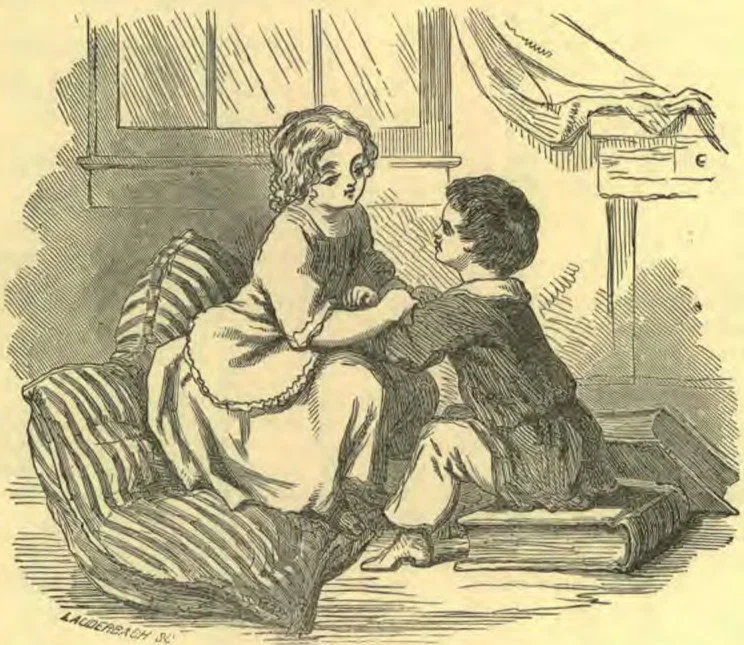
Edna was curled up on a cushion by the window, reading a very interesting book. It was all about “doing for Jesus,” and Edna wished she could do something for the dear Saviour, like the little girl in the story. Just then she heard her little brother’s voice. “I might keep Robbie still,” she thought. “He doesn’t know what to do with himself, now mamma is sick.” So, closing her book, Edna said, pleasantly,
“Come here, Robbie, and I’ll help you learn the Sabbath-school lesson, and then tell stories, just as mamma does.”
Robbie was delighted with the promise of a story, so he sat down right in front of his sister, put his little hands in her lap, and fixed his blue eyes on her face, while she taught him the lesson for the next Sabbath.
When this was learned, they looked at the pictures in the large Bible, while Edna repeated the sweet Bible stories, and then they sung the songs they had learned at Sabbath-school.
By and by, when papa came down stairs, Robbie told him what a pleasant afternoon they had spent, and how Edna’s stories were “almost as good as mamma’s.”
Papa smiled, and said, gently,
“I am glad my little daughter is learning to give up her own pleasure for the sake of others. You have made us all happier to-day by your care for your little brother, and best of all, you have pleased your heavenly Father.”
Will not all our little readers who have younger brothers or sisters follow Edna’s example? The Sabbath sometimes seems long to little ones who cannot read for themselves, and you can make it pleasanter for them, and thus help to give them a love for God’s holy day.

LETTER BUDGE

CLAYTON, CAL.
DEAR EDITORS: I have taken your paper two or three years, and although I am now sixteen years of age I still enjoy reading it.
My mother died last February, in Oakland. I live with my step-father and a half-brother and half-sister. The boy is four, the girl six, years old. I keep house and tend store.
None of our family, except myself, keep the Sabbath. Indeed, I am the only Sabbath-keeper within ten or twelve miles of this place. I was baptized three years ago, in Oakland, by Eld. Waggoner.
ALICE INGRAM.
SYRACUSE, IND.
DEAR READERS OF THE INSTRUCTOR: With you I hail with joy the visits of our precious little paper. There are no Sabbath-keepers near our home, and we do not often have the privilege of attending meetings, but I am trying to be an overcomer.
Young friends, do we realize and appreciate the interest which our parents, teachers, and friends take in our eternal welfare? How careful we should be to heed all their kind admonitions.
Although we cannot see and talk with one another, yet we may receive encouragement and help by corresponding through our little paper. I always enjoy reading the letters in the INSTRUCTOR, especially those from the little ones. Above all else, let us remember that we have the same heavenly Father, to whom we may pray for each other. I desire an interest in your prayers, that I may prove faithful.
MARY OGDEN.

THE FAMILY.

The family is a little book, The children are the leaves; The parents are the covers that Protective beauty gives.
At first the pages of the book Are blank and purely fair; But time soon writeth memories And painteth pictures there.
Love is the little golden clasp That bindeth up the trust; O break it not, lest all the leaves Shall scatter and be lost.

COLTON’S SABBATH-SCHOOL MAPS.

No. 1. Eight-Sheet Map of Palestine.—With topographical plan of the city of Jerusalem, and a plan of the vicinity of Jerusalem. Size, 116x81 inches. This beautiful wall map is printed in such a large, clear, and distinct style, that everything upon it is clearly distinguishable from every part of a large school-room. Price, printed on cloth, $12.50.
No. 2. Map Illustrating the Travels of St. Paul.—Eight sheets. Size, 116x81 inches. This is the largest map of these countries ever published. The routes of St. Paul are distinctly shown by strong lines of different colors; the names of places visited in his various missionary tours are lettered very boldly to distinguish them from other ancient names; and the few modern names that are introduced to make the identification with places of present interest more easy, are in a still lighter style of lettering. Price, on cloth, $12.50.
No. 5. Map of the Peninsula of Mount Sinai.—Illustrating the wanderings of the Israelites in their journey from Egypt to Canaan, with a plan, on a large scale, of the vicinity of Mount Sinai, 72x52 inches. This map exhibits the results of the researches of the English and American expeditions for the exploration of this interesting region. Its large scale, bold lettering, and skillful execution have combined to produce a map which fully meets the want long felt by those who have attempted to teach the narrative of the Exodus. Price, on cloth, $5.00.
No. 6. Old Testament Map of Palestine.—Size, 58x41 inches. Price, on cloth, $3.00.
No. 8. New Testament Map of Palestine.—Size, 58x41 inches. Price, on cloth, $3.00.
No. 7. Old Testament Map of Palestine.—Size, 41x28 inches. Price, on cloth, $1.50.
No. 9. New Testament Map of Palestine.—Size, 41x28 inches. Price, on cloth, $1.50.

HOW TO PROCURE MAPS.

LAST week in our list of prizes we offered the choice of maps numbers 7 or 9 to any person or school that would send us twenty new subscribers, the choice of maps numbers 6 or 8 for thirty new subscribers, and map number 5 for fifty subscribers.
We now make in addition the following MAGNIFICENT OFFER.
To the Sabbath-school which sends us the largest number of new, full paying subscribers before the first day of March, we will give the choice of the eight-sheet map of Palestine, the eight-sheet map illustrating the travels of St. Paul, or a ten dollar library selected and put up by us for small schools.
W. C. W.

You have reached the end of this edition.

The Youth’s Instructor · Dec 18, 1879