As to the religious belief of the Wapares, we have found no idols whatever. They tell us that their ancestors had a god, but as a famine came and they implored his help in vain, they cast him off. While they thus lost their god, they still retained the belief in one great Creator, who is to them an “Unknown God.” They all seem desirous of hearing and being instructed. They have not the written law, and still we can see every evidence that in their hearts there is something left of the law once inscribed there. While there are not many civilized countries in the world, especially in the Orient, where one dares to turn his eyes away from his property even for a moment, yet here we could leave everything open in our tents, and no one would ever touch a thing.
Their present religious system centers in their witch doctors, who supply them with remedies against disease, charms against dangers, and protection against wild beasts, etc. I have several charms with me such as the natives wear on lead chains around their neck. Even the bodies of the children are covered with gashes and cuts, which the parents inflict for disobedience or other naughtiness on the part of the little ones. One of the most unsightly things that a visitor notices in this country is the manner in which the natives, especially the women, adorn their ears; as they bore large holes in them, and insert pieces of wood or paper or cloth, until the holes become so extended that the lobe of the ear reaches almost to the top of the shoulder. Nearly all shave their heads, but they leave a small spot of long hair on some part of the head, so that the appearance is very unique indeed, as one looks over a crowd of natives sitting or standing together. With the Suaheli women the case is just the opposite, for their hair is done up in the most fantastic manner, and they will sit for hours and hours trying to arrange their head-gear in the “latest fashion.”
One of the worst customs they have is their native dance—especially popular by moonlight—when you can hear the dancing-call beat on their small drum calling the people together. The dance lasts all night. While many youth are anxious to secure an education from our missionaries, yet the majority of these forsake the mission station as soon as they learn that they must give up these heathenish dances.
As far as the government is concerned, the natives are under local chiefs, and then the German government chooses a head chief, whose duty it is to gather in the poll-tax, amounting to thirty-five cents per hut, each quarter. If these natives do not earn that amount of money, then they must work on the roads, for their head chief must see that the poll-tax is discharged either in money or in work, building bridges, grading and keeping in repair the roads, etc., etc.
If we except the Leipsic Mission, eighteen miles to the north of us, there is no other European any nearer to us than Momba. This place is our future railroad terminus, and Wilhelmstal our post-office and trading city. Momba is over fifty miles from us, and Wilhelmstal is sixty-five.
ERECTING OUR MISSION HUTS
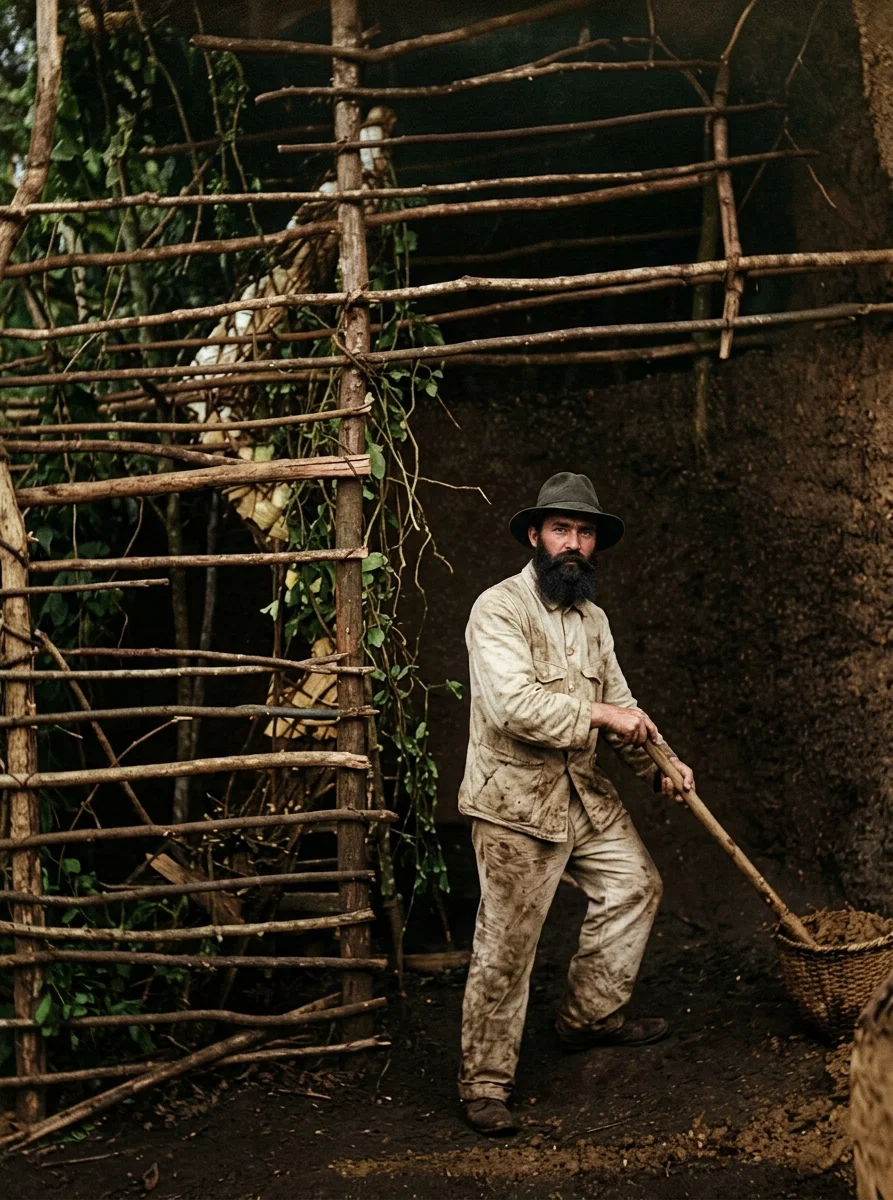
As our brethren arrived late, they could provide only temporary buildings for us, erecting these of light timber covered with banana leaves. One such hut served as kitchen and dining-room, a small adobe hut served as sleeping-room for two brethren, and we had two tents pitched and converted into sleeping apartments, and there was a small stable for the cattle.
After studying over the situation carefully, and visiting other missions, we came to the same conclusion our brethren have reached in Matabeleland—not to build up one large station, but to have a number of smaller stations. Thus far we have finished a good adobe stable, and one building intended for our blacksmith and carpenter shop. A temporary dwelling for the brethren is nearly finished. We expect to build a dwelling of four rooms surrounded with a veranda, from sun-dried bricks, upon a stone foundation. The roof of this house will be of banana leaves. Further up the hill we hope to erect a school and meeting-house. Our chief expense connected with the erection of our buildings is the transportation and preparation of the material, for the material itself costs nothing. The mission station is over eleven hundred meters above the level of the sea, we have no mosquitoes, and, therefore, no fever, so far as the station itself is concerned.
While with the brethren, we made a three days’ journey to the south of us, ascending as high as seven thousand feet above the sea, and from here we had a most beautiful view away into British East Africa, and over the Massai plains of German East Africa, to another mountain chain. After this trip, we thought that it would be best for us to plan to open up a school in Kihuiro itself. The chief treated us very kindly, promising us a nice building place in the valley, free of charge, and he not only promised help in erecting the building, but also said that the youth would come to school. While we expect to put up our school building at this place, yet we thought that during the time in which the erection of the structure was going on, we would have our brethren encamp further up the mountainside, to ascertain what would be the most healthful location for the dwelling-house, which the teacher would have. It is quite possible that half or three quarters of an hour up the hill, the fever would not be so bad, and walking to and from home would only be beneficial to the health of the teacher. I think that two thousand dollars will erect all the buildings we would need in German East Africa at present.
Before starting this East African Mission, we were very careful to prevent giving any occasion for complaint on the part of any other missionary societies that were operating in those fields. I visited the headquarters of the Moravian Mission in Herrnhut, and also called upon the officials of the Lutheran German Missions in Leipsic and Berlin. Besides that, we called on the government to ascertain what it had to say, and, indeed, it was the colonial government which actually pointed out to us the Pare Mountains as a good prospective mission field. But, lo, our workers had been there only a few months when some missionaries came down from the north, stating that they had come there to open up a mission, and that they were surprised to find us in that district. They claimed that, as they had a mission about fifty13miles north of us, in the North Pare Mountains, they were therefore entitled to occupy the whole range. Shortly afterward we received a letter from the mission superintendent in Kilimanjaro requesting us to move out. Our brethren kindly replied that this was impossible, that we had carefully considered the matter, and that when we arrived, there was no station in the district.
For this reason, I went up to that station and talked with the missionaries. The missionary himself was very kind to us, and said that he personally was satisfied, as their station was eighteen miles from ours, to divide the territory between us, but he did not know what their officials in Germany would say. While I was in Africa, a gentleman of the society called upon our office in Hamburg, and asked us to retire, but as their director had never been there to visit their station, and I have been there and have seen their own missionaries, and know the lay of the land, and as we have the government permission, and have bought our land, we feel that the protest of the society ought not to give us the least disturbance.
We all realize that pioneer work is the hardest kind of work, and as we are in a new country, and have not yet learned the language, and are without buildings, we know there will be difficulties and hardships. It is very hard to get one’s goods, where everything has to be transported on the heads of the natives for a hundred miles. Because of the building of the new railway, carriers were harder to get than usual, and we waited a whole month for our baggage and tools, etc., and of course were more exposed to the dampness than we would have been in the dry season; for we arrived in Africa during the rainy season.
When we started the mission, Brother Ehlers had an attack of fever lasting three weeks. Our company of seven reached their destination without sickness, and I left them all in good health. But Brother Ehlers, who accompanied me down to the coast, must have become infected from the mosquito bites at the same time that I did, as I learn from a letter just at hand that he took sick of the fever at the same time that I did. He had been ill for three weeks, and Brother Enns also had suffered several weeks, but they were better the last we heard from them. Upon leaving Dar-es-Salaam I had fever for three days on the boat, but checked it with quinine. We had a very pleasant sea voyage, and the fever did not return, and I thought that it had left me; but when I reached Rome, the fever reattacked me, and not until I was able to spend over a week at our sanitarium in Friedensau, under skilful treatment, with quinine as one of the remedies, did the malaria leave me.
While I was with our missionaries, we had no special trouble on account of the wild beasts, although there are enough prowling around in the desert below. Once some hyenas came, and took some carcasses; but since I came away, several leopards have visited our neighborhood, even entering our stable and tents.
Upon returning to the coast, I visited, with Brother Ehlers, the officials in Wilhelmstal. They received us very kindly, and not only were we given a written permission to have a school at Kihuiro, but they also promised us help in every right way. Our present mission property has been secured for forty-five dollars. It contains thirty acres, most all under cultivation in maize. Up the hillside, where we plan to have our buildings, there will yet need to be a little clearing done to put the place in proper condition.
GOVERNOR'S RESIDENCE, DAR-ES-SALAAM
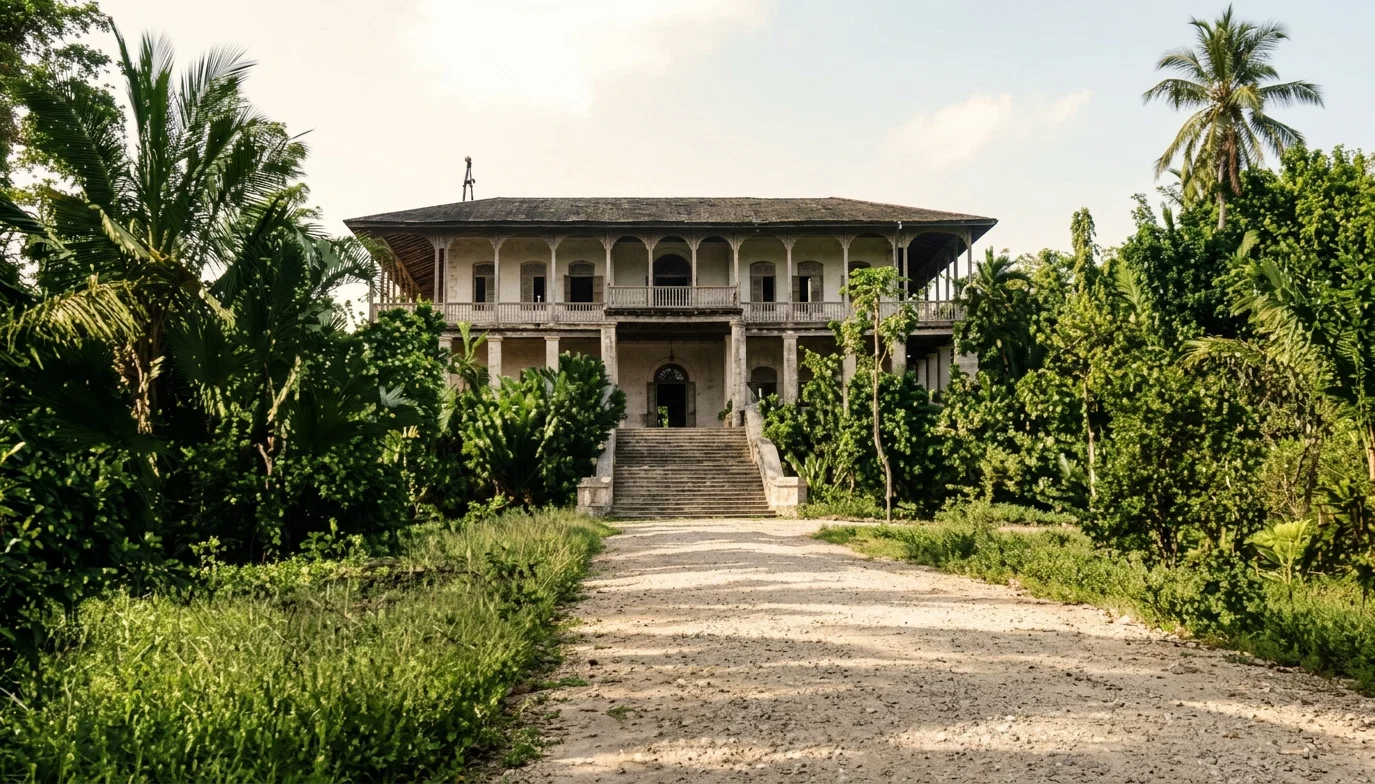
From Tanga, I went to Dar-es-Salaam, where is the beautiful palace of the governor. Here is one of the nicest harbors I ever saw. En route, I stopped at Zanzibar, a city of sixty thousand, in English territory; it would also offer us a good mission field.
The governor received me very kindly, and gave me an interview of over an hour, and he said he only wished we would extend our missionary operations. Through a letter he gave me, I was able to visit the government agricultural school. I found that the superintendent of the latter was an old friend of Elder Erzenberger, who had attended school with him in Switzerland, and that he was acquainted with our work. He had been a missionary in Abyssinia and in Egypt, and had married an Abyssinian woman, and he had spent quite a while in missionary work in German East Africa, and he was pensioned by his society, and afterward entered the government service. I had several very interesting visits with him. As he is a total abstinence man, he gave me some very nice fruit juices and fruits.
To my surprise, the adjutant of the governor called on me, and gave me a written invitation to dine with the governor at his residence. I hoped there would be only his family present; but, when I came, I found quite a number of higher officials had also been invited. His wife was formerly a resident of Washington, D. C., and was naturally very much interested in what I told her of the work we were doing in that city. She was acquainted with Takoma Park, and its surroundings.
As the governor knew of my temperance principles, he had kindly provided me with a glass of soda-water, and when the governor drank to my health, I was able to return the compliment with the soda-water he had given me. After the dinner, his wife took me aside, and she and some other ladies questioned me until eleven o’clock about our faith, and I felt very thankful that God had given me the privilege of witnessing for him in the palace of the governor. The officials also gave quite a little attention to the conversation. The opening for us is very favorable; indeed, I do not think any of our missions have opened any more favorably, but it depends upon the course which our missionaries themselves take, and the blessing of God, to give us the success we ought to have.
I felt indeed thankful to the Lord for the privilege of being personally acquainted with the work among the heathen. I shall be pleased when the missionary work extends to take in other places. While the malaria is not the most pleasant disease, yet the Lord is the great Healer. I am thankful that in a short time I was able to recover, and can now again be about my work. The missionary work among the heathen of Africa is deepening the interest our German brethren feel in scattering the truth throughout the whole world. I hope that our friends in America will also feel a genuine interest in this new enterprise, and follow it with their prayers, and with gifts, as God may lead them, that they, too, may have a part in the labors of our brethren at the front.
The German Swiss Conference
By J. T. Boettcher
J. T. BOETTCHER
The fourth annual session of the German-Swiss Conference was held in Sissach, Canton Baseland (about twenty kilometers south of Basel), June 29 to July 5. This village has about twenty-five hundred inhabitants. It is located in a beautiful basin, and is surrounded on all sides by mountains, whose green sides are covered with forests of oak, pine, birch, and beech. In the surrounding farms are many orchards, the cherry-tree, the apple-tree, and the pear-tree predominating. At the time of the meeting, cherries were two cents a pound.
We never had a better attendance, either from the outside or of our own brethren. The churches in Zurich, Basel, St. Gall, Winterthur, and Aarau were represented by about thirty delegates, and on Sabbath, there were one hundred and eighty of our people present. The people from the village and the surrounding country were very orderly, and gave14good attention to the truths presented by the ministering brethren. Brethren Conradi, Schuberth, and Weber aided the conference workers in giving the message God has for the people to-day. The weather was favorable throughout. The three hundred or more outsiders on Sunday gave sixty-seven francs toward defraying our expenses. Our people generally expressed themselves as having received the richest spiritual blessings they ever experienced.
The work of the conference moved off harmoniously. The reports from the workers showed that God had blessed their labors. The last of December, 1902, we had 290 members; and for the quarter ending March 31, 1904, the membership was 333. The treasurer’s report showed a surplus of three thousand francs. In view of the financial blessing God has given us, we felt it a privilege to join the other German Conferences in voting a second tithe to the union, for missionary purposes, during 1904.
During the past year, the hand of God has been seen in many different ways. In the canton of Zurich, where a brother had been doing Bible and colporteur work, and then left for America, one of our workers followed up the interest. The hall in which the meetings had been held did not have the very best reputation, so we desired to change, but we did not know where we could go. We laid the matter in the hands of the Lord, and were directed to a temperance restaurant. Looking over the papers, and thinking that some place might be provided, we asked the family in charge of this restaurant, if they did not know where we might find a suitable meeting-hall. Upon our making this request, they offered us their own house. The tables were set to one side, and the chairs were used to seat the people who came to hear. Our rent was only seventy-five centimes a night, and the lady herself paid twenty-five centimes of that each time the collection plate was passed around, so that we easily covered our expenses. The whole family attended. Shortly the mother and daughter accepted the message, and the father will be baptized this week. He is a machinist in one of the largest silk factories in Switzerland. Upon making up his mind to take his stand, he wrote a letter to the director of the factory, stating his convictions. The director visited him personally, while at the Basel Sanitarium where he was taking treatment, and told him that he could have the Sabbath free. We know that God directed us to the house of this brother.
In other localities we have also seen how the Lord has opened the way for people to obey the fourth commandment. Another instance: A young lady was working in an envelope factory in Zurich. She began to obey the Lord’s commandments, and her employer discharged her, but as she had taken her stand for God, she really believed the Lord would open the way for her in some manner. The very day she had to leave the first place, another gentleman engaged in the same sort of work asked her to accept a position with him, and she contracted for three years’ service, with the Sabbath free, at a better salary than she had received before.
One thing which would be of interest to our people, we might relate. A brother who has a large family was sentenced to thirty-five days’ imprisonment because he did not send his children to the state school on the Sabbath. But while in jail, he had an opportunity to testify to the truth; for, when the first Sabbath-day came, he was asked to go out to work, as on other days. Of course he could not do this, and he gave them plainly to understand that this was the reason why he was in prison. However, the jail-keeper did not let him off. He had on his morning slippers, and was asked to put on his working shoes. This he did not do. The jailor tried to put the shoes on his feet, but the shoes were rather small, so his attempt was a failure. Then he said, “I will go and get a larger pair, and I will get them on you.” The shoes were brought and forcibly put on his feet. And then he was kicked down the stairway and beaten with the fist, as he went along. Of course he would work under no consideration. Then he was put in a dark room, with no bedding, save a little straw on the cold stone floor. He was obliged to remain there over Sabbath and Sunday. He received only bread and water for his food. This was repeated the following Sabbath. I visited the chief of police of the confederation, who plainly told me that nothing could be done for the man, that the school law as he interpreted it was a part of the civil law which must be complied with. But I went to see the jailor, and had a talk with him about our faith. He of course thought the man an extremist, and wished me to influence him to pay the fine and go home; but this I could not do. The brother was called in before the keeper of the jail, and was reprimanded by the jailer for being in prison when he might be at home with his family, where it would be much better for him. The brother replied that he did not look for ease; with him it was a question of right and wrong, and as the Lord plainly commands to keep the Sabbath day, he must obey God first, and suffer the consequences. The visit, however, had a good impression upon the mind of the jailer. The following Sabbath, our brother was permitted to stay in a room, and was given good food. The remaining time during which he served, he was given the easiest place to work on the farm, and that was to herd the cattle. When he arrived home after having served his time, he found a new sentence pending, amounting to one hundred and thirty francs, or another twenty-six days’ imprisonment.
The town clerk and the president wrote him that if he would not send his children to school on the Sabbath, they would take them away from him by force, and put them into orphan asylums or poorhouses. They wrote him that they would inflict upon him the severest penalty of the law, for disobeying the government officers. We know not what the outcome will be, but we pray that in some way the Lord will help this brother and advance his own work in the earth. The school and military laws are great questions with which we have to contend in this country.
Our friends who are acquainted with God’s faithful servant, Elder Erzenberger, will be interested to learn that the long years of service which he has seen in the third angel’s message having made his testimony in behalf of our faith of great value, the brethren have called him to labor entirely under the direction of the German Union. The German-Swiss Conference heartily expressed its thanks for the faithful labors of Elder Erzenberger during the past, and asked that the union, in consideration of his being called into the more general work, would at least provide in some measure for his loss by sending a young Bible worker or licentiate, and several experienced canvassers to labor in German Switzerland.
The brethren here were very free to express their thanks also for the volume of Testimonies which has been recently received from our Hamburg press, and recommended that all the German-Swiss brethren be encouraged to provide themselves with this book.
The report of the nominating committee, which was adopted, reads as follows: President, J. T. Boettcher; Secretary, W. Kury; Treasurer, Hamburg Branch of International Tract Society in Basel; Sabbath-school Department, Mrs. L. Sebald; Conference Committee, J. T. Boettcher, J. Erzenberger, W. Kury, L. Aufranc, A. Weidmann: and these, with four lay-members, form the auditing committee.
For the coming year, credentials were granted to one minister, licenses to two licentiates, and missionary credentials to three Bible workers. We have seven colporteurs.
The collections of the Sabbath-school on Sabbath amounted to one hundred and thirty-four francs; on Sunday the First-day offerings were taken up, and some comments made about being faithful in these gifts, as they are to go to the support of the East African Mission. The collection on First-day amounted to ninety francs. A collection of four hundred francs for the tent fund was also received on the ground.
We begin the new year with hope and courage, and we ask that our friends will remember us in their prayers, that all our workers may be more thoroughly in earnest in their efforts to save souls and hasten the coming of the Lord, through their faithfulness in giving the warning message for this generation. Especially would we ask to be remembered in the continuation of the tent effort at Sissach, as we plan to remain here for a time to follow up the interest.
Pennsylvania Tent Mission in Williamsport
By W. H. Smith; Nellie B. Underwood; Albert Sholder
Pennsylvania
WILLIAMSPORT.—God has wondrously blessed us, multiplying the seed sown and increasing the fruits of righteousness at every step of the way. At the very beginning of the work, when selecting a site for the tent, we realized that God had a chosen people in Williamsport who were to be called out of Babylon; for the enemy was so persistent in withholding from us the use of desirable locations. Then the guiding hand of God was seen as he located us on a pretty grass plot in a strong Catholic community near the St. Boniface church and school. Although the pitching of the tent was ignored by both children and adults, on the evening of June 28 we opened the song service in hope and courage, knowing that God had thus far led, and that he would be with us to the end. The Lord sent out the people to hear the word, and while our congregations were not large, except Sunday nights, they were composed of honest souls seeking truth. Two or three families were so eager to hear that they came a distance of four miles almost every night in the week; among these was the family of eight mentioned later. The Lord wonderfully blessed in the presentation of his word, giving liberty to the speaker, and some who came out of curiosity were won by the truth. As the testing truths were presented, the congregations steadily increased, and even the Catholics would assemble outside the tent and listen with interest. Much of their prejudice was removed, as was evinced by their offers to help us in any way they could at time of storms. Three afternoons of each week children's meetings were held, which were quite largely attended by Catholic children, and we trust that the seed sown in their hearts will bring forth fruit to the glory of God.
The last service in the tent was held August 28, when the largest congregation we had at any time was present to hear the plain testimony of God's Word respecting the New Testament Sabbath. Since that time we have been holding services in the chapel, and carrying on the work in the homes of the people. As the seed has been sown, God has not failed to give the increase, and we now have twenty-eight Sabbath-keepers, including one family of eight. Eight of this number are men, and one of these brethren has been driven from his home because of his loyalty to God. Four souls who had long known the truth and grieved the Spirit of God by their resistance, have ceased the struggle, entering into a covenant with God, and are now living in the light of his countenance. We also have three colored sisters, one being the matron of the home for aged colored ladies. These sisters are an honor to the cause of truth, and will be instrumental in spreading the truth among their own people. Twenty-six have been baptized, of which number six were re-baptisms. Still others will be buried with their Lord next Sabbath. Fifteen have already united with the church, and others will do so later. Since the tent was taken down, several have become interested in the truth, and are now in the valley of decision. We feel confident that they will stand on the Lord's side ere many days pass. Almost daily we are finding precious souls who are seeking truth, and it is our purpose to continue the work, making the winter season one of earnest labor and victory. It is God who has given the victory, and knowing that he is “the same yesterday, to-day, and forever,” we ask you to join with us in the prayer that he will more fully magnify and make honorable his law in this city.
W. H. SMITH,
NELLIE B. UNDERWOOD,
ALBERT SHOLDER.
S. A. FARNSWORTH
By S. A. Farnsworth
Canada
THE Canadian Union Conference held its second biennial session in connection with the annual camp-meeting of the Quebec Conference, at Knowlton, Quebec, September 1-11. Delegates were present from all parts of the field. Owing to the vast extent of territory covered by the Canadian Union Conference, it is difficult to reach all parts of the field. Yet as the delegates came together, all were ready to sound the note of courage, and it was the unanimous voice of all that greater efforts should be put forth to carry forward the work in this rapidly developing country.
Elders A. G. Daniels and W. C. White were with us part of the time, and their words of counsel and instruction were appreciated by all, and we also trust that as these General Conference men saw the field as it is, its needs will be more fully realized than ever before.
The Ontario and Maritime Conferences are working hard to establish industrial schools, and are meeting with good success. The Quebec Conference is bending its energies to establish a sanitarium. This is a large undertaking for a conference so small in numbers; yet they have gone forward, trusting in the Lord, and the first year's report shows that he has wonderfully blessed the efforts put forth.
Elder W. H. Thurston was re-elected president, and S. D. Hartwell secretary and treasurer. The delegates return feeling anew the responsibilities resting upon them to carry the message to the world, and finish the work committed to them in this generation.
S. A. FARNSWORTH
Virginia Camp-Meeting
By H. W. Cottrell
The twenty-first annual session of the Virginia Conference was held in connection with the camp-meeting at Stanleyton, August 5-14. The camp was situated in a convenient grove in the Luray Valley, which is adjacent to the historic Shenandoah Valley. The picturesque view afforded by the Blue Ridge Mountains made the location especially enjoyable to those who were not accustomed to such a variety of natural scenery.16The famous Luray Caverns were within a few miles of the camp. Their beautiful limestone formations far surpass the works of art, and are beyond human description.
The conference was well attended by our people from all parts of the State. Besides the workers in the conference, there were present, either all or a portion of the time, Elders A. G. Daniels and S. G. Huntington; Prof. F. Griggs; Miss Dickerson, editor of the Youth's Instructor, who labored especially for the young people; Brother F. E. Painter; and the writer.
As Elder Daniels could remain only the first few days, he was urged to occupy the time of as many of the public services during these days as his strength would permit. The labors of each of the workers were much appreciated by the people.
Although the camp was located in a country place, the outside attendance was excellent, the people coming from miles around. On the last Sunday there were at least one thousand persons in attendance, who gave close attention to the presentation of the testing truths of the message, and a deep impression was made on the minds of many.
Nine young people gave their hearts to the Lord and were baptized during the meeting. Our own people were much encouraged and strengthened. They are loyal to the truths of God's Word that make us a separate people.
The conference and the Tract Society Department are out of debt, which is a great encouragement to the brethren and sisters, who have for many years been struggling to get free from this monster, and they are now ready to engage in aggressive work in new fields.
Elder H. J. Farman, of the Vermont Conference, will soon begin work in Virginia, and will be quite an addition to their working force. If each worker keeps in close touch with the Source of all wisdom and strength, marked progress will be seen in the advancement of the truth during the present year.
Elder R. D. Hottel was re-elected president of the conference, and A. M. Neff, secretary. The other officers also remain about the same as before.
The conference employed a good canvassing agent, and they intend to do a stirring business in distributing the printed pages, thus adding another agency to their present methods of spreading the light of truth. All the people are of good courage.
H. W. COTTRELL.
E. L. SANFORD
By E. L. Sanford
Kentucky
WINCHESTER.—Sabbath, September 10; it was my privilege to organize a church at this place, consisting of ten members. Brother J. A. Samson was chosen elder; Brother W. H. Shoemaker, deacon; Miss Sallie More, clerk and treasurer. The organization is the result of work done here by Brother John Wm. Stein, last fall and this summer; Sister Maud Dortch, last summer; Dr. O. C. Godsmark and his wife, this summer; and my wife and I last summer and also this summer. Three or four are keeping the Sabbath who were not ready to join the church, and we believe that others will soon take their stand with us.
We have now pitched the tent in another part of the city, and so far are having a good attendance. Dr. Godsmark and his wife had to go home, so my wife and I are alone now. We are of good courage, and ask an interest in the prayers of the brethren and sisters.
E. L. SANFORD
Missionary Visit Among Colored People in Mississippi
By W. H. Sebastian; M. C. Strachan
Mississippi
HUNTLO.—Acting upon an invitation extended to us by the pastor of the M. E. church at Huntlo, we visited that neighborhood, and spent seven days laboring with the colored people who were scattered over the plantations in that vicinity.
The people were truly glad to have some one talk with them in their homes and in the fields, and instruct them and help them to a higher plane of Christian living. We had the privilege of bowing in prayer with some by the roadside and at the plow handle, thus presenting them to the Saviour of all mankind.
While our visit was enjoyed by the people, yet many were rather suspicious of the “new doctrine” we brought, and they told us that the white people would have to lead out in the matter before they dared take a step.
It was sad to see the condition of the people in those out-of-the-way places of the swamp. Many of them live in an atmosphere of modified slavery; that is, their liberties and privileges appear to be bound up in the hands of the overseers (or riders, as they are commonly called) and the plantation owners; and all their movements must be countenanced by their white superiors. We were told that we were in danger of being driven from these parts if it were known that we were teaching the negroes to quit their work on Saturdays, while they were in their busiest season with the crops.
After distributing some papers, tracts, and cheap books, we left the dear souls in the hands of God. We have since received a letter from one family who have become thoroughly convinced of the Sabbath truth, and they ask us to pray that they may be given courage to obey. Let those who read these lines join us in this prayer.
W. H. SEBASTIAN,
M. C. STRACHAN.
Southern Illinois Camp-Meeting
By J. M. Rees
THE Southern Illinois camp-meeting was held August 17-28. About forty tents were pitched, and about two hundred camped on the ground. Elders S. N. Haskell, Allen Moon, and E. A. Curtis, and Brother J. B. Blosser were with us. All our home laborers were present, and did efficient work. Elder Haskell was with us from the beginning of the meeting till almost the close. The Lord greatly blessed his servant, and the studies given by him were greatly appreciated, not only by our own people, but by others as well. Sister Haskell gave some very interesting studies on the subject of the sanctuary. Brother Blosser did all he could for the canvassing work and for the canvassers. Quite a number of new ones will enter the field.
From the first, the deep moving of the Spirit of the Master was seen. The business sessions of the conference passed off very pleasantly. The following officers were elected: President, J. M. Rees; Vice-President, Chas. Thompson; Secretary and Corresponding Secretary, Nettie Eaton; Treasurer, Southern Illinois Tract Society; Recording Secretary, Pearl L. Rees; Auditor, W. H. Edwards; Executive Committee, J. M. Rees, P. G. Stanley, Chas. Thompson, C. L. Taggart, and P. Rothrock. Two new churches were received into the conference,—the Farmington and Second Springfield churches, one with a membership of twenty, and the other with twenty-five.
The Lord has greatly blessed the work in the Southern Illinois Conference the past summer. The work of all the laborers has borne fruit. Two new churches will soon be organized from the past summer’s tent efforts.
We passed through two very severe storms, one of which blew some of our older tents to pieces, leaving the inmates at the mercy of the wind and rain. Yet not a word of complaint was heard, neither did any one go home on account of the storm. Just after the storm, we met, and had no trouble in raising four hundred and sixty dollars to put into new tents for our next camp-meeting.
Near the close of the meeting, the campers repaired to the water, where twenty souls were buried with their Lord in baptism. Wherever we have gone since the meeting, we have found our people greatly strengthened, and rejoicing over victories gained.