The Youth’s Instructor, Vol. L, No. 6

SOME INTERESTING SPARROWS

The Youth’s Instructor

February 6, 1902

Review and Herald Publishing Company · Battle Creek, Mich. · February 6, 1902

SOME INTERESTING SPARROWS

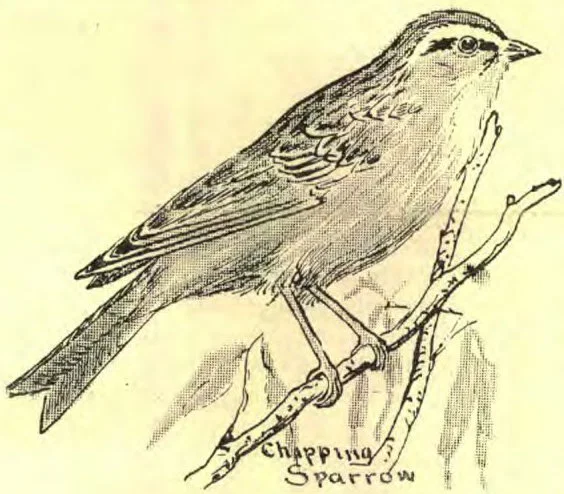
Chipping Sparrow

EVERY bird has its good qualities. Some have nothing but good characteristics, while others have some not so desirable. Bradford Torrey says that if he could have his way, the Chipping Sparrow should be known as the “door-step sparrow.” It is a very tame bird when kindly treated, and many pleasing anecdotes are related showing this characteristic. Here is one, told by Robert B. Lawrence, and quoted in “Birds of Village and Field,” which I can not refrain from giving you.
“For years at our place in Flushing, L. I., my father has fed some half-dozen of these Chipping Sparrows, and the young birds have taken bread or seed from his hand when it was held near the ground, but the old birds would never allow any such familiarity. One of the adult birds, however, seemed more inclined to do so than his companions; and at last, in the summer of 1879, mustered courage enough to follow the example of the young birds, and finding no ill effects, jumped onto my father’s finger, and, sitting there, ate his breakfast. The ice once broken, ‘Dick,’ as we christened him, seemed to lose all fear; and from that time always ate his breakfast from my father’s hand. . . . This continued all the summer; but when the fall came, with the first cold blasts Dick took his departure for the summer regions of the South. The next April, however, he returned, and without any hesitation came one morning at my father’s call, and in his old, accustomed way ate his breakfast from my father’s hand. Dick and his mate built their nest in the vines which clambered over our piazza, and spent the summer with us. . . . This year he has gone further, as he has several times, while sitting on my father’s hand, ceased eating, and poured forth his song of thanks. . . . It has long been known that birds would return to the same locality year after year, but that a wild bird should remember a person’s voice, and come back after his long wandering as tame and confiding as when he went away, is, I think, very remarkable.”
The Chipping Sparrow is one of the first birds to return to us in the spring, and several seasons about the first of April, I have heard his chirping trill, monotonous, high, and wiry, at times somewhat like an insect, but a sure reminder to us that he has just arrived from the South. At such times he was always hidden in the trees, and it was with difficulty that I could get sight of him.
The Chipping Sparrow destroys the seeds of some injurious weeds, such as the foxtail and crab-grass of our lawns, sometimes adding to his diet pigweed, chickweed, and knotweed. Among insects, he is not backward about eating cabbageworms, tent-caterpillars, cankerworms, and other pests. He winters in the Gulf States and Mexico, getting back home again between the first and the tenth of April.
Description.—Top of head, reddish-brown; under parts, plain gray; back, brown, streaked with black; bill, black. Length about five and one-fourth inches.

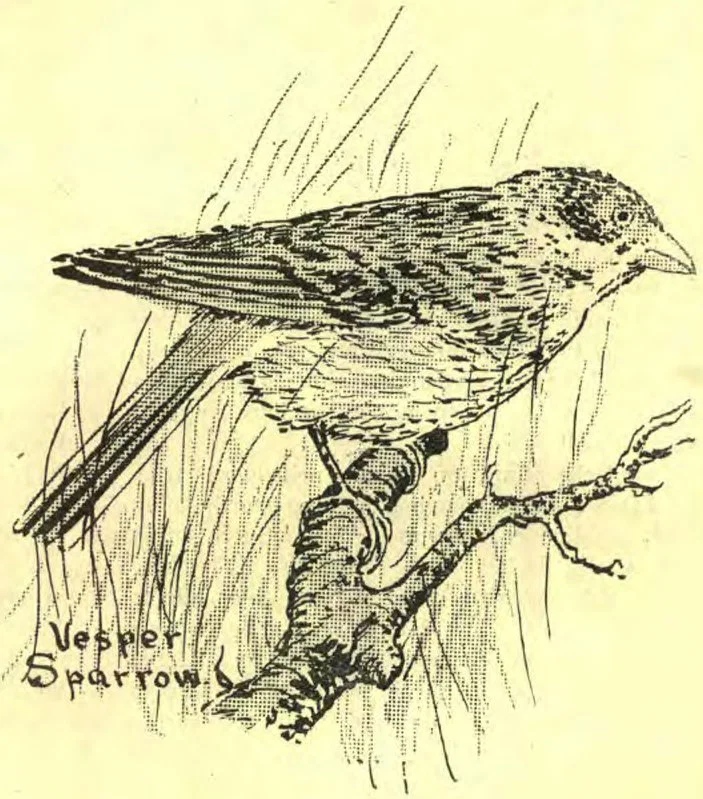
Vesper Sparrow

The Vesper Sparrow is quite a singer. His notes remind one somewhat of those of the Song Sparrow; but the song is, on the whole, sweeter and more plaintive. When singing, he usually selects an elevated perch, and works at nothing else.
You will often find him on the ground; and if you do not chase after him too closely, he will run ahead of you for some distance. If you overtake him, he will fly, swinging off on bounding wing, showing the white feathers on either side of his tail. These two white feathers are very good marks by which to identify him.
The bird is called Vesper Sparrow on account of his vesper, or evening, song. Florence A. Merriam tells of an interesting experience in connection with the “vespers” of this bird. They were first greeted by the voice of one of these sparrows. “He was perched on a stake in the meadow beside the lane; and as we stopped to listen, he poured out his beautiful vesper hymn. It had scarcely ceased when it was taken up by another of the rich-voiced choristers, and soon was being sung by glad, sweet voices scattered far through the meadows. In the stillness of the hour, with the level fields reaching to the golden horizon, the peaceful evening-song seemed full of new beauty; and we listened in silence to its calm, melodious notes till the sunset afterglow faded from the sky, and the twilight shadows gathered around us.”
Description.—Brownish-gray, streaked; patch on wings, reddish-brown; outer tail-feathers showing white in flight. Length, about six inches.
L. A. REED.

A BIRD INCIDENT

A COMMON bird with us is the pheasant, and one of the most interesting incidents of my life was in connection with a family of pheasants.
Crossing a woodland one summer evening, making the dead leaves rustle beneath my feet, I looked down, I hardly know why, but it must have been in order to save the little innocents. For the brown leaves seemed to me to be alive, very much alive, indeed.
I stopped, dropped to a sitting posture, and reached forth my hand; and to my surprise they never tried to get away, but cuddled up in a little frightened flock right at my feet. I gathered them all into my dress, twelve of them, cunning little midgets, not larger than the end of a man's thumb, and awaited developments.
The parent birds were near, and soon the mother began crying with a pitiful call. I couldn't imitate it in any way, but it expressed tenderness, concern, and fear. Soon an angry, frightened bird whirred over my head, again and again, each time nearer, until she almost knocked off my hat; she passed, and getting just in front of me, made feint of a broken wing, and lay apparently helpless a little ahead. I never saw anything more expressive of anxiety than the actions of this bird. I could not bear to tease her, so, setting the birdlings on the ground, I withdrew to a position where I could see the united family, and watched the mother-love as it went out to the helpless brood. The words of the Master, “O Jerusalem, Jerusalem, . . . how often would I have gathered thy children together, even as a hen gathereth her chickens under her wings, and ye would not!” never before came to me with such force. Truly the maternal instinct, next to love of the divine, is the most sacred thing in the world.—Mary Noland, in Birds and All Nature.

SELF-IMPROVEMENT

“I WENT by the field of the slothful, and by the vineyard of the man void of understanding; and, lo, it was all grown over with thorns, and nettles had covered the face thereof, and the stone wall thereof was broken down. Then I saw, and considered it well: I looked upon it, and received instruction. Yet a little sleep, a little slumber, a little folding of the hands to sleep: so shall thy poverty come as one that traveleth; and thy want as an armed man.” Prov. 24: 30-34.
These are the words of Solomon, the wise man. As he passed by the field of a certain slothful man, he noticed that it was all covered with thorns and weeds, and the stone wall surrounding it was broken down, allowing free access to man or beast.
Everything this man had planted, if, indeed, he had been sufficiently industrious to attend to the plowing of the soil and the sowing of the seed, was being choked with the thorns and nettles, and the soil was being robbed of its strength. His vineyard and fruit-trees were in the same neglected condition.
On the other hand, his neighbors’ fields were covered with ripening grain, their vineyards bore rich clusters of grapes, and their fruit-trees were bowed beneath the weight of luscious fruit.
What was the reason for this difference? Solomon says he considered it well. He looked upon it, and received instruction. His good judgment could assign no other cause for this sad condition of things than that this man was not industrious. He loved to fold his hands in idleness, to live a life of ease, and to spend the precious hours of day in needless sleep.
In all the affairs of life this principle is true,—that we can accomplish nothing worth doing without diligence and perseverance. Success does not come of itself.
To each one of us the Lord has given talents which he expects us to improve to the best of our ability. Our minds may be likened to a fertile piece of ground, in which something is sure to grow. If properly cultivated, they will, like a well-kept garden, bring forth flowers and fruit; but if left to themselves, they will be filled with thorns and thistles and weeds.
A sound mind is the best natural gift that has been given to man, and we owe a duty to ourselves, to our fellow men, and to our Creator, so to cultivate it that we shall be able to do the best work that it is possible for human beings to do. It is the trained and disciplined intellect that rules the world in literature, the sciences, and the arts. It is this which opens up to us the treasures of the universe, and gives us power over nature. It is mental training which largely forms the distinction between savage and civilized peoples. It is the proper development of the mental faculties that raises men and women from the humblest walks of life to the highest positions of influence and responsibility.
But we should remember that mental training does not consist alone in storing up a large number of facts in the mind. We must learn how to think, how to form correct judgment, and to put into practical use the knowledge which we have gained. We must learn to have control over our appetites and passions, and to bring every act of our lives into subjection to the will.
It has been truthfully said that thought is to the brain what gastric juice is to the stomach,—a solvent to reduce that which is received to a condition in which all that is wholesome and nutritious may be appropriated. Without proper thought and reflection, our learning, however much we may have, will be of little use to us.
In all our striving after knowledge, we should bear in mind that there is an education to be received which the colleges and universities can not give. There is a higher training to be obtained from communion with the Great Teacher, not only through the thoughtful and prayerful study of the Book of books, but through reading the thoughts of the Infinite One in his created works.
The object of education is not only to prepare for the duties of this life, but to form characters for eternity. This life is short at best. In childhood the days go slowly by. A year seems long, and a lifetime almost an endless age. As we grow older, time goes more rapidly, until in old age life seems but a flitting shadow.
While our days are passing so swiftly by, we should ask ourselves the question, Is the education that I am receiving such as will fit me for eternity?
Every day we are adding to our education, either consciously or unconsciously. Every thought, every feeling, leaves its impress upon the mind, and we owe a duty to ourselves and to others so to direct our thoughts and feelings that they shall educate us in the right direction. We must cultivate our moral nature, and grow in all that is manly or womanly in life, until we shall have come to the full stature of men and women in Christ, and the Master shall be able to say of us, “Well done.”
B. E. CRAWFORD.

WHAT SHALL I DO WITH JESUS?

It is a wonderful testimonial to the greatness of human life that we are able to ask the question. Who are we, that we should have the deciding of his fate? Yet for one life, and for all that that one life counts, which is much, the responsibility is ours. We can not evade the responsibility; we can not plan our lives as if he had never lived; we must reckon with his life and our relations to him. What shall we do with Jesus?
It does not greatly help us to say that we think well of him; the question is not of thinking, but of committal. It is possible for us to substitute some thought about him for vital faith in him. It is possible to make a sacrament, a creed, a form of worship, an unthinking assent to the conventional demands which are supposed to represent his cause, a substitute for a confidence in him that transforms our lives. Let us not ask, simply, “What think ye of Christ?” but also, “What shall I do with Jesus?”
It is a solemn thought that some who lived nearest to him rejected him. His star and birth made Bethlehem glorious with the light of heaven, but Bethlehem settled back into the dark, and knew not, or, if it knew, forgot, that he was born there. He showed the world that a good thing could come out of Nazareth, and therein glorified the rich possibilities of that and many another obscure village; but Nazareth dragged him to the summit of its hill, and would have cast him over, and did cast him out. Capernaum was saved from oblivion by his dwelling there; but Capernaum, thus exalted to heaven, cast itself down to immortal shame by its unbelief in him. Jerusalem, the home of his royal ancestors, he invested with a more than regal glory; but Jerusalem, which received him with palms, sent him out tottering under the cross.
We can not escape responsibility commensurate with our privilege. Sodom would have repented if it had known what we know; but Sodom is judged by its light, and we can not place ourselves in the ignorance of Sodom. We must accept the light of to-day, and be judged accordingly. One man attempted to waive the responsibility of judging Christ; and the world has singled out his name from the four magistrates before whom Christ appeared in his trial, and preserved it to everlasting infamy.
There is no Herod to whom we can send him; there is no one on whom we can load responsibility while we wash our hands; we must choose. Every one of us is a court of last resort. What shall I do with Jesus? Let me answer the question honestly, for no one can answer it for me.—Wm. E. Barton.

THE MARRED PICTURE

THERE is a story of a woman whose little child had died, leaving emptiness and great loneliness in the home. The mother had skill in art, and to fill her hands, also in order to preserve the image of the child’s lovely features, she devoted herself for many days to touching up with her brush a photograph she had. As she wrought upon the picture, the dear face seemed to live again, every charm of expression coming out under her skilled fingers. When the work was finished, she carefully laid the photograph away.
After some days she brought it out again, and was grieved to see blotches here and there on the face. She could not understand it; but she set to work once more with loving patience, and restored the marred beauty. In a few days, however, the blotches had reappeared. Then she understood that in the fabric of the paper on which the picture had been taken, there were certain elements which, when chemically acted upon by the paints, had produced the blotches.
So in even the best human nature, however deeply imbued and thoroughly cleansed by divine grace, there still lurk elements of the old sinful life; and evermore these evil qualities work up to the surface, and mar and spot the loveliest character. We should never cease to pray for cleansing and sanctifying, that God may search us and try us, casting out anything that is evil, until the last trace of corruption is gone.—Well Spring.

Obedience as the Keyword of Scripture

THE Bible rings with one long demand for obedience. The keyword of the book of Deuteronomy is, “Observe and do.” The burden of our Lord’s farewell discourse is, “If ye love me, keep my commandments.” We must not question nor reply nor excuse ourselves. We must not pick and choose our way. We must not think that obedience in one direction will compensate for disobedience in some other particular. God gives one command at a time; if we obey this, he will flood our souls with blessing, and lead us forward into new paths and pastures. But if we refuse, we shall remain stagnant and waterlogged, make no progress in Christian experience, and lack both power and joy.—F. B. Meyer.

AFTERWARD

What if thy house on earth be poor and small, Or if thou hast no house on earth at all? Thou hast a Mansion waiting in the sky; That Mansion fair thy wants will satisfy.
What if thy garments here be coarse and few, And let the rain and frost, unhindered, through? Thou hast a Garment white in yonder sky; That Bridal Robe thy need will satisfy.
What if thy table scant be spread below, And thou dost eat in bitterness and woe? There waits for thee a bounteous Feast on high; That Bridal Feast thy soul will satisfy.
What if thy years in sorrow here be spent, Thy spirit ’neath afflictions sore be bent? There waits a Song of triumph in the sky, That glad New Song thy heart will satisfy.
What if thy friends be false, and thee betray, Companionless and lone thine earthly way? Thine Elder Brother still to thee is nigh; That Friend thine every want will satisfy.
ELIZABETH ROSSER.

TALKS TO OUR BOYS

III

The idea has gone abroad (I don’t know where it originated) that in order to be a man, one must be gruff and hard-hearted. Some people seem to think such a manner shows manly strength,—that it is excusable on the same ground that one overlooks the rough, prickly covering that protects the toothsome nut. Boys generally hold the opinion that a kind heart and a sympathetic nature are sure indications of weakness. Many a boy who, yielding to the promptings of that “better nature” which is really God’s nature, does little kindnesses on the sly, would feel that he had lowered himself in the eyes of his companions if they were to find out what he had done. That whole idea is a humbug. Let us learn a lesson from the oak tree, which is proverbially known as the strongest tree of the forest. Examine its wood, and see how much closer-grained and finer it is than the weak wood of the basswood or the willow. Instead of the finer qualities of the human heart making a man weak, they only make him strong. Strength comes from the development of the finer sensibilities of the heart.
A kind heart is one of the surest indications of manliness. One thing we all admire in Abraham Lincoln, and that which places him first in the list in our estimation of great men, is his kind heart; then there is that other Man, of all who have lived on the earth the most lovely, who by his very gentleness was made great.
Cultivate gentleness, therefore: it is a priceless trait of character. It may sometimes cause you to be laughed at by unthinking persons; but what of that? A man can conquer scorn. Resolve never, for the sake of creating a laugh, to say anything that may cause pain or mortification to another. You may gain a reputation for being witty and bright by so doing; but you will just as surely lower yourself in the estimation of all right-thinking people. We may enjoy doing these things at the time; but when we are by ourselves, that voice from which we can never get away will say: “You have been a scamp; I am ashamed of you.”
And if you cultivate true gentleness toward your fellow men, it will naturally follow that you will be kind to the lower animals. It takes so little effort to be kind, and thoughtful consideration of our dumb friends means so much. They have hardships enough without man’s adding to them. Remember that life to them is sweet; and make it a rule not only never needlessly to kill or cause them pain, but to do all you can for their comfort.
Many boys and even grown-up men are afraid to express a love for the beautiful. How often we hear the expression about flowers, “Of what use are they?” Yet God has made all things beautiful, and he desires that we shall enjoy them. A lady who was something of an artist once said to me that she had seldom seen men who appreciated art, outside of those who themselves follow it as a profession. I said: “No; they appreciate it well enough, but are ashamed to say so.”
Cultivate courtesy,—not set forms taken from a book, but that truer politeness that comes from a tender heart; that chivalry that is always kind and obliging to others, not for form’s sake, but from sympathy. That man is of most use in the world, though his name may not be known outside his own county, who comes into closest touch with the most people, and can talk with them heart to heart, and leave them the better for the association. It takes a positive character to do this, but by perseverance one who really desires thus to win love and confidence can win them. Thus we are brought back to the same old starting-place,—“grit” and “stick-to-itiveness;” and it is here that true grit is shown—not in some brawl or fight for our so-called “rights.” It takes real bravery to have a purpose and to stick to it day after day, always keeping our eyes on the future,—on what we may become instead of what we can enjoy to-day. Glue is neither beautiful, fragrant, nor palatable; yet we would find it hard to do without it, for it sticks. Remember that it is not distinguished ability that accomplishes great things one half so much as “keeping everlastingly at it.”
FLOYD BRAULIAK.

TALENTS—LESSON I

(February 9-15)
PLACE the general heads on the blackboard, and fill in the outline as the study proceeds.
Read carefully the parable of the talents, as found in Matt. 25:13-30.
Find and read two other passages of scripture that teach the same lessons.
From these parables we learn,—
1. That God has given each of his servants a particular work to do.
2. That this work is according to their individual ability.
3. That the work will be required at the hands of those to whom it is given.
4. That the faithful ones are rewarded.
5. That the reward is in proportion to the faithfulness with which the work is done, and not the amount of the result. Effort is God’s standard. Result is man’s.
In studying the parable of the talents, no one can help being impressed with the personal responsibility which our Lord has laid upon each of us. It is the object of these studies to find out the best way to enlarge and improve our talents, that we may do our work in the best possible way.
NOTE.—In filling out the lesson outline, it will be well to insert after each of the five heads the single text which is the foundation for it.

Selected Thoughts on the Topic

1. “To his servants Christ commits ‘his goods,’—something to be put to use for him. He gives ‘to every man his work.’ Each has his place in the eternal plan of heaven. Each is to work in co-operation with Christ for the salvation of souls. Not more surely is the place prepared for us in the heavenly mansions than is the special place designated on earth where we are to work for God.”—“Christ’s Object Lessons, pages 326, 327.”
2. “All men do not receive the same gifts, but to every servant of the Master some gift of the Spirit is promised.”—Id., 327.
3. “To every man God has given ‘according to his several ability.’ The talents are not apportioned capriciously. He who has ability to use five talents receives five. He who can improve but two, receives two. He who can wisely use only one, receives one. None need lament that they have not received larger gifts; for he who has apportioned to every man, is equally honored by the improvement of each trust, whether it be great or small. The one to whom five talents have been committed is to render the improvement of five; he who has but one, the improvement of one. God expects returns ‘according to that a man hath, and not according to that he hath not.’ 2 Cor. 8: 12.”—Id., 328.
4. “The talents, however few, are to be put to use. The question that most concerns us is not, How much have I received? but, What am I doing with that which I have? The development of all our powers is the first duty we owe to God and to our fellow men. No one who is not growing daily in capability and usefulness is fulfilling the purpose of life. In making a profession of faith in Christ, we pledge ourselves to become all that it is possible for us to be as workers for the Master, and we should cultivate every faculty to the highest degree of perfection, that we may do the greatest amount of good of which we are capable.”—Id., 329, 330.

“NUMBER ONE”

“He is a Number One boy,” said grandmother, proudly. “A great boy for his books. Indeed, he would rather read than play, and that is saying a good deal for a boy of ten.”
“It is certainly,” returned Uncle John; “but what a pity it is that he is blind!”
“Blind!” exclaimed grandmother. And the Number One boy looked up, too, in wonder.
“Yes, blind, and a little deaf, also, I fear,” answered Uncle John.
“Why, John, what put that into your head?” asked grandmother, looking perplexed.
“Why the Number One boy himself,” said Uncle John. “He has been occupying the one easy-chair in the room all the forenoon, never seeing you, nor his mother when she came in for a few minutes’ rest. Then, when your glasses were mislaid, and you had to climb up-stairs to look for them, he neither saw nor heard anything that was going on.”
“Oh, he is so busy reading!” apologized grandmother.
“That is not a very good excuse, mother,” replied Uncle John, smiling. “If Number One is not blind nor deaf, he must be very selfish, indeed, to occupy the best seat in the room, and let older people run up- and down-stairs while he takes his ease.”
“Nobody asked me to give up my seat nor to run on errands,” said Number One.
“That should not have been necessary,” urged Uncle John. “What are a boy’s eyes and ears for, if not to keep him posted on what is going on around him? I am glad to see you fond of books; but, if a pretty story makes you forget all things except amusing Number One, better run out and play with other boys, and let grandmother enjoy the comfort of her rocker in quiet.”— Church Progress.

The Way to High Things

“THE way to high things is through low things.”

FAITHFULNESS IN SERVICE

In his infinite mercy and love God has given us light from his word, and Christ says to us, “Freely ye have received, freely give.” Let the light God has given you shine forth to those in darkness. As you do this, heavenly angels will be beside you, helping you win souls for Christ. The Master is saying to us: “Come to me. Right counsel and sound judgment belong to me. I have understanding and strength for you.”
Dear young friends, remember that it is not necessary to be an ordained minister in order to serve the Lord. There are many ways of working for Christ. Human hands may never have been laid on you in ordination, but God can give you fitness for his service. He can work through you to the saving of souls. If, having learned in the school of Christ, you are meek and lowly in heart, he will give you words to speak for him. Ask, and receive the Holy Spirit. But remember that the Spirit is given only to those who are consecrated, who deny self, lifting the cross and following their Lord.
Do all in your power to gain perfection; but do not think that because you make mistakes, you are excluded from God’s service. The Lord knows our frame; he remembers that we are dust. As you use faithfully the talents God has given you, you will gain knowledge that will make you dissatisfied with self. You will see the need of sifting away harmful habits, lest by a wrong example you injure others.
Work diligently, giving to others the truth so precious to you. Then when there are vacancies to be filled, you will hear the words, “Come up higher.” You may be reluctant to respond; but move forward in faith, bringing into God’s work a fresh, honest zeal.
The secret of winning souls can be learned only from the great Teacher. As the dew and the still showers fall gently on the withering plant, so our words are to fall gently and lovingly on the souls we are seeking to win. We are not to wait till opportunities come to us; we are to seek for them, keeping the heart uplifted in prayer that God may help us to speak the right word at the right time. When an opportunity presents itself, let no excuse lead you to neglect it; for its improvement may mean the salvation of a soul from death.
MRS. E. G. WHITE.

INTERCESSION

LORD, when before thy mercy-seat I bow To pray thee for the friends thy love has given, I ask that love to save them here and now, Not only at the last and in thy heaven.
Keep thou their feet, not only when their way Draws near that sea which waits before us all. Walk thou beside them, Christ of God, this day. Take thou their hands, and hold them, lest they fall.
Not only in the darkness of the grave I pray thy light across their eyes may dawn; Through all life's darkness let it shine, and save Beyond the shadow leading up and on.
Not only in the terror of that day When death and hell before thy face shall stand,— Have mercy on them now, great Judge, I pray; Keep them among the sheep at thy right hand.
Not only in that morning let them rise Washed clear of stain at last, redeemed and free. O keep them holy in thy holy eyes This day, triumphant over sin, in thee!
— Mabel Earle, in Christian Endeavor World.

CHITWOOD YOUNG PEOPLE'S SOCIETY

About three months ago the young people of this church organized into a working company. We have regular meetings on Sunday evenings, using the outline lessons in the INSTRUCTOR.
Our company is in a mountain district in western Oregon; and considering that this is a thinly settled country, the attendance has been good from the outside. Last Sunday evening we elected officers for the next three months, afterward conducting a Bible study on the second coming of Christ.
Our membership is about fifteen. Our courage is good, and we believe a good work will be done here. When we first undertook this work, the outlook was not promising, but it is growing brighter.
Let other little companies report, as well as the larger ones; and by our speaking “often one to another,” we shall all be encouraged in the work of carrying the “advent message to all the world in this generation.” FRANK L. CHITWOOD.

THE TWO DEMONIACS AT GADARA

(Continued.)

STUDY OF THE MIRACLE

Immediately There Met Him a Man out of the Tombs.— Perhaps the reason that but one of the gospel records mentions the two demoniacs, is that either before or after the healing, only one of them acquired any special prominence. This beautiful morning shortly after sunrise, as the disciples of Christ landed, they saw the two men issuing from the tombs; but instead of recognizing in this occurrence an opportunity for the working of a great miracle by their Master, they became frightened. A lesson is to be found here for every Christian worker. We are often in danger of fleeing from the openings of divine Providence, regarding them as dangers, rather than recognizing their possibilities for good. The disciples seemed to forget that he who could still the sea could quiet the tempest of sin.
It was probably the need of these two men that called Christ, through storm and tempest, across the lake. What a remarkable illustration of the value that he places upon the souls held captive by sin! The evening before the working of this remarkable miracle, Christ had shown himself to be Lord of nature, the great Pacifier of its tumults. On this beautiful morning, he is to show himself Master of man, and the Pacifier of storms of vice and passion that rage within.
Man with an Unclean Spirit.— The healing of these demoniacs, perhaps as no other similar miracle performed by the Saviour brings up for consideration the question of demoniacal possession. Undoubtedly the Jews had come to attribute many cases of physical disease to the possession of demons; but notwithstanding this error on their part, it can not be presumed that all cases of demoniacal possession were circumstances of mere physical derangement. No doubt many persons whom to-day we call epileptic, lunatic, and melancholic, would at that time have been considered possessed with a devil.
Cutting Himself with Stones.— These deluded and possessed men had cut themselves with stones. How often we find degraded men and women day after day inflicting further injury on themselves by the use of drugs and in other ways, in the vain hope of thus relieving their condition. The demoniacs, it would seem, still possessed sufficient reasoning power to seek to drive the demon out of themselves.
The tombs, or ancient burial-places, were often large excavations supported by columns, sometimes being hewn out of a rock, and were seldom visited. Thus they proved a suitable place for the abode of men who sought to avoid the association of their fellows.
He Ran and Worshiped Him.— These poor men, notwithstanding their terrible condition of mind and body, could see something in Jesus that even his disciples failed to recognize. They ran to him, and worshiped him. They may have been insane; but their insanity was not such as to render them unable to recognize Christ. They besought Christ that he torment them not. It is a foolish notion, entertained by many a sin-burdened soul, that Christ comes to torment; that the life of the Christian is one of discouragement and despair; and yet Satan has gained such control over the human mind that he is able to lead many men and women thus to look upon the Saviour of the world. W. S. SADLER.

MARY A. WADSWORTH

FROM PAWTUCKET, R. I.

I KNOW you will be glad to hear how our Young People’s Society is getting along. I am glad to report that it has grown from six to fourteen members since it started, a year ago. As the direct result of its work, one girl seventeen years old has begun to keep the Lord’s Sabbath, and another, who is greatly interested, is attending the meetings.
We learn a portion of the Bible every week, and all are working hard. Last quarter one hundred and thirty-five copies of the Signs of the Times were distributed, besides sixty Sentinels and a number of copies of the YOUTH’S INSTRUCTOR, Little Friend, tracts, etc. We are going to have a regular club of the INSTRUCTOR now. Ten missionary letters were written, and eleven missionary visits made. The members also raised money for the mission offering, and to buy clothing for one who was in need.

MARY A. WADSWORTH

Continue reading: CHILDISH THINGS