IT is interesting to note to what an extent the heathen nations and weak religious systems cling to ideas that are distinctively characteristic of childhood.
The average street-boy is a modern Esau; his active but disorganized brain responds to no systematic plan or principle; but if twenty-five-cent military caps are put on the heads of several hundred of these boys, and rude wooden guns are placed in their hands, then, like the dry bones in Ezekiel’s valley, each falls readily into line; and an organized army is the result, ready to keep perfect step with almost any leader.
One evidence of growth and maturity of the mind is its ability to rally around certain principles instead of requiring a visible representation of them. But as we note the vast number of votaries of badges, class-pins, buttons, and “colors,” we are forced to the conclusion that either great rallying truths are becoming scarce in this world, or else there is a growing tendency on the part of the rising generation to cling to childish methods. This tendency is by no means confined to ordinary worldly societies; but is invading the ranks of those who are supposed to be particularly delivered, not only from childish things, but also from worldly ways.
Sometimes a graduating class composed of professed missionaries, will actually consume more time in the weeks prior to commencement day, in trying to determine what shall constitute their class-pin, color, or badge, as the case may be, than they actually expend in earnest prayer and study, or a consideration of their future field, and how they may enter it most successfully. Frequently a corps of Christian young people who have organized themselves for active service, are content to employ more time discussing, and occasionally even in wrangling over, the problem of what shall constitute a constitution and set of by-laws, or over the adoption of some distinctive button, than they spend in studying and absorbing gospel methods sufficiently ever to accomplish anything.
The workers in the early church needed no set of by-laws to regulate their conduct, and no outward sign in order to impress others with the fact “that they had been with Jesus;” and just to the degree that we receive our inspiration to work from similar association, just to that extent shall we attach less and less importance to these outward things.
DAVID PAULSON, M. D.
MRS. JESSIE L. ADAMS
By Jessie L. Adams
WINNIPEG, MANITOBA.—One morning a company of our young people went to a poor house, or shanty, where the father had a broken arm, and the mother was dead. There were four children, the eldest nine years old. We took some food, cleaned the house, sawed wood, and washed the children. We all came away feeling more thankful than ever for all the blessings we enjoyed. I was glad the young people could do such work. Another morning I took five little girls, and we went to a poor portion of the city, and distributed about eighty papers. We all enjoyed it, and the people seemed glad of the visits. We hope to do much of this work in our Young People’s Society.
MRS. JESSIE L. ADAMS
A WARM DAY IN WINTER.
By Minnie Rosilla Stevens
The Southland has turned her fair visage this way,
And blown her warm breath for our pleasure to-day;
The air is all misty and moisty and sweet,—
Too cool to burn faces, too warm to nip feet.
The snow disappears where the leaves rustled brown;
A gray cloud dips softly and scatters more down;
While snow-water pools by the wayside appear,
And icicles, fading, drop tear after tear.
The sparrows are chirping loud under the sill,
The snowbirds all twitter with happy good will;
We dream that the robin is near with his song,
And fancy he’s bringing the springtime along.
Winds blow that seem laden with promises kind
Of May-bloom beyond, days of frost far behind;
While at their soft touch a numb violet starts,
And sap slightly stirs in a thousand green hearts.
Each moment the children enjoy the mild day,
Forgetting the sting of the frost in their play,
And then, like the flowers, tucked snugly in bed,
They dream of the springtime that seems just ahead.
But, lo! ere a hint of the dawning of day,
A blast from the north drives the southwind away;
A moan in the gables, a drift at the door,
And swift in a blizzard comes winter once more.
MINNIE ROSILLA STEVENS.
FUNNY BROWN BABIES
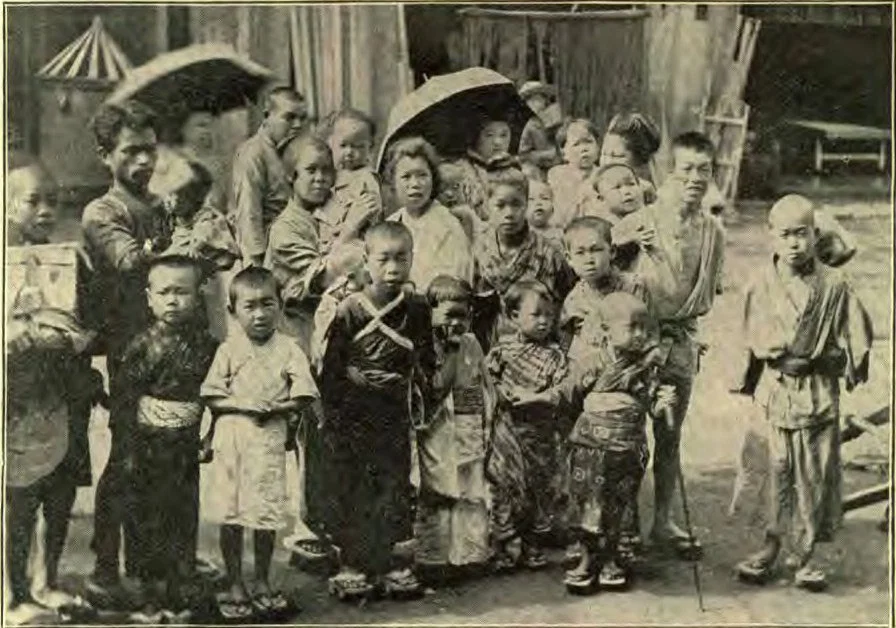
THE Japanese baby is a funny, brown creature, with snapping black eyes, and a full crop of stiff, black hair. That is, he would have a full crop if his mother did not shave his head, sometimes as bare as a croquet-ball, but oftener into all sorts of fancy patterns. A favorite fashion is to leave two little tufts at the sides, and a larger one about the size of a saucer on the top of his head.
He is seldom carried in his mother's arms, as an English baby is; but as soon as he is two or three months old, he begins his travels in the world “picka-back,” on the shoulders of an elder brother or sister.
Japanese children, as well as the grown people, all wear a loose garment called a “kimono,” open in front, with wide sleeves, very much like a dressing-gown, which, as it has no buttons, is tied on by means of a long sash wound several times around the waist.
The kimono is so loose that the baby can be tucked inside, and tied on with the sash; and thus he is carried around, peeping curiously with his bright black eyes over his sister’s shoulder at the great new world. Asleep, his poor little shaven head bobs helplessly around, and the glare of the sun beats on his upturned face.
His little body is entirely covered with the kimono; and the children, when they are carrying their small brothers and sisters, look as if they were two-headed. But they play tag and ball and prisoner’s base, and fly kites, just the same, whether they carry the baby or not.
And he seems to enjoy it, too, for he hardly ever cries; but when the game is especially lively, he will laugh and crow as if he understood it all. As soon as he is able to walk, he takes his turn in bringing up the baby next younger than himself. So you see that being a child in Japan is much like an everlasting game of leap-frog, for while the baby at first can ride on the backs of the elder children, as soon as he lands on his own feet, he must take his turn as baby-tender, and lend his shoulders to the one next in line.—Selected.
HOW ROY MADE MAMA HAPPY
By M. C. W.
I WONDER how many would like to hear a real, true story. Of course you all would; so I will tell you one about a little boy I know.
One rainy morning not many weeks ago, as the little boy’s mother was sweeping, a team was heard on the driveway, and pretty soon a man came in with two bushels of peaches—“from grandma,” he said.
That meant that the morning must be spent in canning the fruit; so as soon as mama was through sweeping, she began peeling peaches.
Pretty soon Roy—for that was the little boy’s name—said, “Now, mama, my work is all finished. May I help you peel the peaches?”
JAPANESE CHILDREN
Of course mama was very glad of help. She cut the fruit in halves, and Roy would peel it quickly and carefully; he was pleased to be called “mama’s little helper.”
They worked steadily, and by eleven o’clock the last peach was peeled, and Roy ran out to play.
Papa did not come home to dinner that day; so mama and Roy ate alone. After the work was done up, mama asked him if he would like to go to see Mrs. Austin, who was an invalid.
Indeed he would; for he and Mrs. Austin were great friends. So they put on their rainy-day suits and started. How it did rain! But Roy enjoyed that, and said, “O mama! isn’t this fun?” Just as he spoke, a team turned in at the gate, and they had to go back to the house. Papa had sent home two bushels of peaches! Mama knew that that meant no visiting for her that afternoon.
As she took off her rubbers, the little boy, with a look of surprise on his face, said, “Why, mama! what are you going to do?”
“I am going to can peaches.”
“But you are too tired, mama; besides papa wants you to be outdoors all you can.”
“Yes, but papa did not know that grandma sent the peaches this morning, and we must not let these spoil. They must be attended to.”
“Now! this afternoon?”
“Yes.”
“But I want to go to Mrs. Austin’s. Can’t papa can the peaches this evening?”
“Yes, he could; but I wouldn’t want to go visiting, and leave them for papa to do after he has worked hard all day.”
“Couldn’t you do them after you came home? I could stay up and help you.”
“No; I think you would better go to bed at your regular time. Mama can not go to Mrs. Austin’s to-day.”
“Mama, I want to go to-day!” The little boy’s foot came down decidedly. Mama was surprised; for it was an unusual thing for her little boy to tease. He generally said, “All right, mama.” This time he didn’t. Mama thought for a minute, and then said, “Well, you may go. Tell Mrs. Austin that mama wanted to come, but could not. Good by, dear. I hope you will have a pleasant time.”
Then mama went to work. She wondered if her little boy would be lonely; for it was quite a long way to Mrs. Austin’s, and this was the first time he had ever gone without her. They always played together, read together, and visited together.
Pretty soon she heard footsteps, and looking up, saw Roy. He was taking off his coat.
“Why, Roy, aren’t you going to Mrs. Austin’s?”
“No, mama; I can’t leave you all alone. What shall I do this afternoon? Shall I help you?”
“You may do just as you like, Roy. You worked so long this morning I think you ought to play now. I am sorry our little visit was spoiled; but if you will bring your playthings out here, mama will play with you the best she can while she works.”
“It almost seems like I ought not to play and let you work. Tell me just what to do.”
“You must settle the question for yourself, Roy. If you can not decide, I think Jesus will help you, if you ask him.”
Then Roy went upstairs. Not many minutes had passed before mama heard some one come softly down the stairs, and tiptoe around in the dining-room. Knowing who it was, she began to guess what Roy had brought down to play with. Was it his cars, his top, his ball, his blocks?—No. So she gave up guessing, and waited to see.
All at once some one said, “Mama!” She looked around, and what do you think she saw?—Why, there stood Roy, with his apron on, and a pan and a knife in his hand.
Seeing the surprised look on mama’s face, he began to dance around, saying, “I’ve come to help you, mama; I’ve come to help you.”
Then he sat down and went to work, and such a happy afternoon as he and mama had. They sang, they said the commandments, they repeated psalms; then Roy played he was the teacher, and heard mama’s Sabbath-school lesson.
After that mama asked him if he did ask Jesus if he should help her.46
He said, “Yes, mama, I did. And when I got up from my knees, I just had to come and help you. I am so glad I did. And, mama, I am sorry that I was so naughty about going to Mrs. Austin’s.”
Do you not think that Roy gained a victory?—I do. If he had cried and whined all the afternoon, how miserable he would have been. Instead of being a bother, he was a real help. Best of all, he made mama happy, and was happy himself. M. C. W.
PETER’S STRANGE DINNER
By John K. Hastings
Have you read about Peter’s queer dinner? Never such an one had he seen before. It was served, not in a comfortable dining-room, but on a house-top; and not on a table at all, but in a great sheet, caught up at the corners, and let down from the skies. It seemed to be a “meat dinner,” made up of such things as toads and crickets, snails and eels, creeping things and leaping things, calves and cats and dogs and chickens, wild beasts of the forest, and birds of all sorts. Peter’s dinner was not cooked, but “all alive,” and hopping, flying, growling, snarling, and acting, I suppose, as such creatures naturally would act when tumbled up together.
Now Peter was hungry. It was dinner-time. Here was something to eat, and a mysterious Voice called upon him to arise and help himself. But, as hungry as he was, Peter could not make up his mind even to take a taste. How could he? Many of the squirming things in that sheet the Jews despised, and were positively forbidden by their laws to touch. In fact, law or no law, it did not increase Peter’s appetite to look at them. Again the Voice invited him to arise and eat. Peter objected, and said that he had always been a law-abiding Israelite, and had never eaten anything that was common or unclean. But the Voice again bade him “Eat,” and said, “What God hath cleansed that call not thou common.” And then up went the great sheet into the sky, and Peter’s strange dinner was gone.
I will tell you more about that dinner by and by, but first let us visit the very place where Peter saw it. It was in Joppa, one of the oldest cities in the world, on the Mediterranean Sea, about thirty-nine miles northwest from Jerusalem. We can not sail right up to the town, as the Romans could two thousand years ago. Since then the little harbor has been nearly filled up with sand brought all the way from the River Nile in Egypt by the hidden currents of the Mediterranean Sea. So our steamer tosses outside a dark half-circle of rocks, that shut in the harbor from the sea, and shut out our ship from Joppa.
But boats are coming out for us from the town. They dart between the rocks, and out into the open sea, filled with a hundred shouting Arabs. The men climb over our vessel’s sides. They snatch our satchels from our hands, and go to fighting for them, until we have to take a hand in the battle ourselves. To our surprise, we ourselves are snatched up and held over the water, until suddenly we are dropped, and down we go. Strong arms of the boatmen receive us, and off we start for Joppa,—yes, the very town from which Jonah once set out on a sea voyage to Spain, to run away from the Lord. Now we are close to its single-storied white stone houses coming down to the water’s edge. They have flat roofs, and, as they are built on a steep hillside, these roofs serve as a terrace for the people who live in the next row of houses above to walk on. The boat runs aground. A boatman takes hold of us, lifts us high and dry, jumps into the water, and wades with us to land, and we are in Joppa.
Here are long bazaars and narrow streets, shaded overhead with cloth or matting, with little shops on either side. There are shoemakers, cutting out yellow morocco slippers, or red leather boots. Here are tailors marking out graceful patterns for gold embroidery. In another part are the silks of Aleppo and Damascus, with veils from Constantinople, and English cottons from Manchester. The shopkeepers are gravely smoking and reclining at ease among their gay wares. We see few ladies here. Men and boys mostly do the shopping in this country. Neither do we see coaches nor cabs, nor horse-cars, nor trains, nor anything else on wheels; but there are little donkeys with big, lazy men upon them, which like to rub up against you and knock you over. There are also great hump-backed camels, and mules, and horses, to ride upon.
Now let us go outside the city gates. It is a market day in April. Here we find a crowd of busy townsfolk, country people, and foreign pilgrims, mixed up with camels and horses and braying donkeys. You thought Joppa was very beautiful from the sea, and so it was. But it is not altogether pleasant close at hand. This crowd is boisterous, quarrelsome, ragged, and filthy. Many are blind, or have sore eyes, and all are so ragged and dirty that we think of Dorcas. Do you not remember Dorcas? She was a Joppa lady, and made coats and garments for the poor; and when she died, they were very sad. Peter was at Lydda near Joppa. They sent for him, and Dorcas was brought back to life. One can not help wishing, as he sees these beggars, that she might rise again from the dead; for a dozen Dorcases, yes, whole societies of them, seem to be needed by many of the ragged Joppa people this very minute.
But let us go into the Joppa gardens, where they raise the finest oranges in Syria. In March and April these gardens are enchanting. The air is loaded with the perfume of oranges, lemons, apples, apricots, plum, and china-trees. Here the wealthier people sit down on mats under the palm-trees, sip coffee, smoke, sing, talk, or sleep until evening, when they go back to their homes in the city. Instead of fences and stone walls between these gardens there are tall hedges of prickly giant cactus plants, higher than a man, or two or three men, and covered with flowers and beautiful vines and creepers.
Originally, Joppa was a Phoenician colony. When the Israelites took Canaan, Joppa was given to the tribe of Dan. Joshua 19:46. Under Solomon, about a thousand years before Christ, it became the port of Jerusalem, where ships were loaded, and to which they came with the precious things of all nations, to sell to the people who lived in the City of the Great King. When Solomon wanted to build his Temple, Hiram, the king of Tyre, sent his own men far up on the sides of Mount Lebanon, in the north, to chop down the great cedar-trees, and drag them to the rivers, and float them to the seaside. There they were made into rafts, and men in boats pulled them along the coast down to this very town, where hundreds of men dragged them out of the water, and carried them over the hills to Jerusalem, to build the splendid temple.
Joppa is in what is now called “Asiatic Turkey,” in the “Province of Syria,” and is also known as Jaffa, or Yâfa. During the crusades, it was a landing-place of the so-called “Christian armies,” who went to butcher the Turks under the pretense of worshiping God in Jerusalem.
Here by the seaside they show you the place where they suppose stood the house of Simon the tanner,—the place in which Peter was stopping when he saw that dinner let down so strangely to him from the sky. And about that dinner,—what do you suppose it meant? Those were the days when one nation called all other nations barbarians. Until Christ came, men knew little and thought little of God as the Father of all men, and of all men as brethren to each other. Christ came to put away these divisions, to teach men to be brotherly to one another, and to love the one Father who is over all. The Jews were remarkably strict in these matters. They would not even eat food cooked in a dish that had been used by a Gentile. Many animals which the Gentiles ate, the Jews were forbidden to touch, so as to keep them quite separate from other people. Peter, although he had begun to serve Christ, had not yet come to understand the full meaning of Christ’s gospel to dying men. Up to this time he had preached to Jews only. Now God wished to show him that the gospel was intended for all the world, and not for one little nation only. So he sent this vision to Peter one day when he was hungrily waiting for his dinner upon the house-top of Simon the tanner, by the seaside in Joppa. In the great sheet were the very animals Jews were not to eat, but which Gentiles did eat.
But that great sheet was not let down to show Peter what he himself must eat, for he was not required to eat unhealthy food, but to show him that wherever there was an opportunity to preach Christ, it was right to go there and preach. And while Peter was thinking over his dream, and wondering what it meant, there came a messenger from a Roman officer in Cesarea, calling for Peter, to tell him and his family of the way of life.
If Peter had not seen the vision of the strange dinner, he would not have gone; but now he was ready to go. The Roman officer heard the glad news of salvation, believed, and was baptized. From that day Christianity began to be carried to all the nations of the earth; and men like Paul preached that there was neither Jew nor Greek, bond nor free, but that all were one in Christ Jesus.
There are doubtless many places in the world more beautiful than Joppa, and many that are larger and grander; but Joppa is one of the most interesting of them all, because here was spread Peter’s dinner,—a feast of deeper meaning than all the banquets ever given by the mightiest kings of earth.—John K. Hastings.
PARABLE OF THE TWO SONS
(February 15)
MEMORY VERSE: “If ye know these things, happy are ye if ye do them.”
23. And when he was come into the temple, the chief priests and the elders of the people came unto him as he was teaching, and said, By what authority doest thou these things? and who gave thee this authority?
24. And Jesus answered and said unto them, I also will ask you one thing, which if ye tell me, I in like wise will tell you by what authority I do these things.
25. The baptism of John, whence was it? from heaven, or of men? And they reasoned with themselves, saying, If we shall say, From heaven; he will say unto us, Why did ye not then believe him?
26. But if we shall say, Of men; we fear the people; for all hold John as a prophet.
27. And they answered Jesus, and said, We can not tell. And he said unto them, Neither tell I you by what authority I do these things.
28. But what think ye? A certain man had two sons; and he came to the first, and said, Son, go work to-day in my vineyard.
29. He answered and said, I will not; but afterward he repented, and went.
30. And he came to the second, and said likewise.47And he answered and said, I go, sir; and went not.
31. Whether of them twain did the will of his father? They say unto him, The first. Jesus saith unto them, Verily I say unto you, That the publicans and the harlots go into the kingdom of God before you.
32. For John came unto you in the way of righteousness, and ye believed him not; but the publicans and the harlots believed him: and ye, when ye had seen it, repented not afterward, that ye might believe him.
Synopsis
It was Tuesday morning of the last week of Christ’s life upon earth. The Saviour was teaching in the temple. The day before he had driven out the money-changers, and them that bought and sold; now, as he was feeding the people the word of life, the chief priests and elders came up with great pomp and show, and said, “By what authority doest thou these things?” that is, who gave you the right to cast out the money-changers, upset our arrangements, and come in here and teach? “The baptism of John,” said Jesus, “whence was it? from heaven, or of men?” The elders would not say; they lied,—“We can not tell.” But Jesus told, and thereby gave the reason why they could not enter the kingdom of heaven.
Questions
1. In what place was the Saviour teaching at this time?
2. Who came to him questioning his authority?
3. How did he reply?
4. What question did Christ then put to them?
5. What is the true answer? Why would they not give it?
6. Why would they not say “of men”?
7. What did they finally say?
8. What answer did Christ then give them? (These chief priests told a lie,—they refused to tell the truth when they knew what it was. Notice now how the Saviour’s parable so completely absorbs their attention that they not only give a true answer to his question, but they also condemn themselves in so doing.)
9. What did a certain man ask one of his sons to do?
10. What did the son say? What did he afterward do?
11. Who else was given the same opportunity?
12. How did he treat it?
13. Which one of these sons did the will of his father?
14. What answer did the chief priests make to this question?
15. Who therefore would go into the kingdom of God before them?
16. Why could the chief priests and elders not go?
17. Just a few minutes before, what had these men done in order to prevent Christ from saying these very words?
Questions from the Lesson Help
1. Christ does not say to any man, What say ye more than others? but, “What do ye more than others?” Full of meaning are his words, “If ye know these things, happy are ye if ye do them.” Words are of no value unless they are accompanied with appropriate deeds. This is the lesson taught in the parable of the two sons.
2. “We can not tell.” This answer was a falsehood. But the priests saw the position they were in, and falsified in order to screen themselves. Remembering how John had repeated the prophecies concerning the Messiah, remembering the scene at the baptism of Jesus, the priests and rulers dared not say that John’s baptism was from heaven. If they acknowledged John to be a prophet, as they believed him to be, how could they deny his testimony that Jesus of Nazareth was the Son of God? And they could not say that John’s baptism was of men, because of the people, who believed John to be a prophet. So they said, “We can not tell.”
3. In the company before Christ there were scribes and Pharisees, priests and rulers, and after giving the parable of the two sons, Christ addressed to his hearers the question, “Whether of them twain did the will of his father?” Forgetting themselves, the Pharisees answered, “The first.” This they said without realizing that they were pronouncing sentence against themselves. Then there fell from Christ’s lips the denunciation, “Verily I say unto you, That the publicans and the harlots go into the kingdom of God before you. For John came unto you in the way of righteousness, and ye believed him not; but the publicans and the harlots believed him: and ye, when ye had seen it, repented not afterward, that ye might believe him.”
Wrens Nest in a Bird-House
Irma, Wis.
Dear Instructor: We live five miles from any post-office, in a log house. Up under the eaves is an auger hole, bored into a log, and a pair of wrens made a nest in it. Soon afterward another pair wanted to build in the same place, so mama made a little bird-house, and papa nailed it up. It was not half an hour before the happy birds were making a nest in it.
Bion Whitehouse (aged 7 years).
St. Clair, Nev.
Dear Instructor: I read the Youth’s Instructor, and like it very much. Three or four years ago, a swarm of bees got into the attic of our house. They increased so fast that last summer ten swarms came out. They became quite a nuisance, even getting into the bedrooms. Last fall papa and Brother F. took one hundred pounds of honey from between two walls. They left the boards down, and at the coming of cold weather, the bees all perished.
Madge Cushman (aged 11 years).
Padang, Sumatra.
Dear Editor: I am sending you the handwriting of a little Chinese schoolboy. He is twelve years old, and supports a family of six persons by selling Chinese cakes, which he puts on a round tray, and carries on his head. If he is sick, his mother has to pawn her gold hairpins to get money, and she comes to our house and begs us to give him water-treatments. He is in the third grade in English, and always gets his lessons. We are surrounded with cocoanut trees, and from our back veranda we have a beautiful view of the mountains. The girls all speak Dutch here, and I am learning to speak it a little, too.
Miriam Munson (age 13 years).
Baldwin, Mich.
Dear Instructor: I thought perhaps you would like to hear about a pet I once had. One day in spring, when we were driving in the country, we heard a fluttering in the bushes near the road, and saw a mourning-dove. As it did not seem to fly, papa got out of the buggy to see if it was hurt. We found that it had only one wing. It looked as if the other wing had been shot off, and the wound had healed, leaving no feathers. When it was frightened, it would try to fly, and so bruise its side. At first we kept it in a large wooden cage; but in the summer we nearly always put it in a chicken park in the daytime. One day we were all gone away from home; and when we returned in the evening, the dove was gone. We never knew what became of our pet.
Ethel Voorhees.
Dacca, Bengal, India, Dec. 14, 1901.
Dear Youth’s Instructor: I like the Youth’s Instructor very much, especially the articles on natural history, in which I am greatly interested. I am a member of the Agassiz Association, which is devoted to natural science.
There is no church building in Calcutta. The services are held in a large room, which was formerly the billiard-room of the Anglo-Indian Club. The meeting on Sabbath morning is divided into small classes, both of children and grown people. The smaller children receive Our Little Friend, and the older ones the Youth’s Instructor, at the door when the meeting is over. We study our lessons from them, and read them Sabbath afternoons.
On Sabbath evening, testimony and prayer-meetings are held. Dr. Ingersoll gives a health lecture on the evening of the first Sabbath of the month. Lectures are given on Sunday evenings. Bible study is given Friday evenings. When we lived in Calcutta, I went to Sabbath class without missing any. Once a quarter the church-members take the Lord’s Supper. We also have Dorcas meetings once a week. There are families scattered here and there who are Seventh-day Adventists. These all help in spreading the truth everywhere.
Canvassers go all over India, the Straits Settlements, etc., selling our publications, and getting subscribers for The Oriental Watchman. The health foods are also sold by them. The children at the Karmatar orphanage are taught to wash clothes, cook, and do other household work, besides farming and the ordinary school lessons.
We have a missionary society to write letters and give away the Oriental Watchman. Tracts are given away also. I am nine years old. I do not go to school. My mother teaches me. I give away tracts and papers. I have also sold things for our tract society.
Your little friend,
John S. Belchambers.
SHORTHAND BY MAIL
YOUR spare time can be well improved by studying shorthand, and this can be done at small expense to you by taking a mail course at your home. We are using “The Rogers Compendium of the Graham System of Shorthand,” a method arranged especially for home study, and giving an epitome of a system of shorthand acknowledged to be the best, the briefest, and the most complete. The only presentation of Standard Phonography in which all shorthand outlines are written as first learned, thus greatly abbreviating the work on the part of the student. A complete course in thirty lessons, illustrated by facsimile notes, with key. The correction of all students’ papers given special attention by experts. Reasonable tuition rates. If interested, write for full particulars. Practicing stenographers wishing to prepare for rapid reporting work should secure the last twenty lessons.
FIRESIDE CORRESPONDENCE SCHOOL,
Battle Creek, Mich.
GRAND TRUNK R'Y SYSTEM.
By W. C. Cunliffe
Taking Effect June 2, 1901.
Trains leave Battle Creek.
WEST-BOUND.
No. 9, Mail and Express, to Chicago — 12.15 P. M.
No. 7, Limited Express, to Chicago — 7.10 A. M.
No. 3, Lehigh Valley Express, to Chicago — 3.50 P. M.
No. 5, International Express — 2.17 A. M.
No. 75, Mixed, to South Bend — 7.30 A. M.
Nos. 9 and 75, daily, except Sunday.
Nos. 3, 5, and 7, daily.
EAST-BOUND.
No. 10, Mail and Express, East and Detroit — 3.45 P. M.
No. 8, Limited Express, East and Detroit — 4.14 P. M.
No. 4, Lehigh Express, East and Canada — 8.22 P. M.
No. 6, Atlantic Express, East and Detroit — 2.10 A. M.
No. 2, Express, East and Detroit — 7.00 A. M.
No. 74, Mixed (starts from Nichols yard) — 7.15 A. M.
Nos. 10 and 74, daily, except Sunday.
Nos. 4, 6, 8, and 2, daily.
W. C. CUNLIFFE, Agent,
BATTLE CREEK.
WHAT IS GOING ON IN THE WORLD.
A German Measure.—In a recent edict Emperor William required the Poles in Germany to use the German language in their schools, their church services, and on the streets. Naturally the subject people resent this curtailing of their rights, realizing that their language is about the last thing left them. Much sympathy is expressed for them.
A French School in Chicago.—A French millionaire, M. Lebaudy, has recently given one million dollars to found a French industrial college in connection with the University of Chicago. Every year two hundred graduates from French colleges will come to this new school to complete their education by a practical study of American business methods.
The United States Representation at the Coronation.—Whitelaw Reid, General James H. Wilson, and Captain Charles E. Clark have been appointed to represent the United States at the coronation of King Edward next June. Mr. Reid has served as ambassador to France, and also acted as special ambassador at the time of the jubilee of Queen Victoria. General Wilson served in the Civil War; and Captain Clark won distinction by bringing the “Oregon” around Cape Horn in time to be of service in the destruction of the Spanish fleet in the late war with Spain.
Prince Henry’s Visit.—Since the announcement that the Emperor of Germany would send his brother, Prince Henry, of Prussia, to be present at the christening of the new imperial yacht, now building on Staten Island, preparations have gone forward to give him a royal reception. Through the German ambassador, and also through our representative at Berlin, the president has received an invitation for his daughter, Miss Alice, to christen the yacht; and this invitation, with the visit of Prince Henry, are interpreted as indicating a friendly feeling on the part of Germany toward this country.
Cuba’s First President.—Thomas Estrada Palma, who was elected to the presidency of Cuba on December 31, has lived for seventeen years in Central Valley, N. Y. As the son of a rich Cuban planter, he was educated for the bar; but became involved in one of Cuba’s wars, was captured, and sent to Spain in 1876. After his liberation he came to this country. In 1885 he founded a school for Spanish-American boys and girls, he and his wife keeping the school open till the beginning of the late war. During all these years he has lived in a simple way; but he has kept in close touch with the needs of his country, and his selection as its first president is looked upon as a fortunate one.
Modern Improvements in Havana.—A gigantic contract for sewering and paving the entire city of Havana has recently been let to an American firm. The consideration is to be ten million six hundred and forty-nine thousand dollars; and the contractors have deposited a bond for five hundred thousand dollars. The terms of the contract provide that the work shall be finished within four years, and that it is to be begun within thirty days after the contractors receive notice to begin. If such notification is not received within sixty days from the date of depositing the bond, the city is to pay three per cent on it. There is some delay, owing to the fact that the city has not devised means to raise the necessary money to carry on the work.
A New State.—The suggestion that Oklahoma and Indian Territories be united under the name of “Jefferson,” is meeting with some favor. The Atlanta Constitution thinks that the name of this statesman, next to that of Washington, “deserves to be thus visibly, audibly, and permanently associated with the Union,” and says: “The approaching celebration of the centenary of the Louisiana purchase by Jefferson, makes opportune the creation of a new State bearing his historic name; and as the territories occupied by Oklahoma and the Indian five tribes are a part of that purchase, and now have quite sufficient population and resources to make Statehood for them desirable and practicable, Congress might very properly grant the necessary enabling legislation to that end.”
Strawberry Leaves and Silver Balls.—The Round World thus rather humorously describes the new coronets which are a-making for the coming coronation: “The differences of rank, as indicated by the headgear, are a matter of strawberry leaves and silver balls. The ducal privileges are indicated by eight strawberry leaves on the coronet; a marquis is designated by six strawberry leaves; an earl has the same number of leaves to his credit, and besides may boast of eight silver balls in his highly ornamented cap. The leaves ran out before the viscount was reached, but he was given eighteen silver knobs on the rim of his crown. This act of generosity evidently broke the treasury; for of strawberry leaves and silver knobs the baron got none. His is a simple crown, but its brilliant red color outshines the more bedecked coronets.”
Bible Astronomy Article Delayed to Next Issue
By Editor
OUR “Bible Astronomy” article came too late this week for publication in this number. We hope to keep the series unbroken hereafter.
Sowing Days: The Harvest of Youth
THE days of youth are “sowing days,”—and sowing days are always followed by a harvest. Remember, in choosing your seed, that the sower not only reaps what he sows, but more than he sows.