THOSE who observe the Sabbath of the Bible, are able to present as its foundation, a divine institution. "God blessed the seventh day, and sanctified it." Gen. ii, 3. To sanctify is "to separate, set apart, or appoint to a holy, sacred, or religious use." Webster. It was by this act of the great Creator, that the Sabbath was made for man. Ex. xx, 11; Mark ii, 27. As God has never taken this blessing from the seventh day, and has never given to secular purposes the day which he here "set apart to a holy use," the original institution still exists. As he has never sanctified another day as a weekly Sabbath, the Sabbath of the Lord is the only Sabbatic institution. Ex. xx, 10.
As God made the Sabbath in paradise, when the morning stars sang together and all the sons of God shouted for joy, it follows that it is not Jewish, not a carnal ordinance, not a yoke of bondage, but a sacred institution made for the well-being of the human family, while yet upright. The great Creator rested first on the seventh day and was refreshed. Ex. xxxi, 17. The Son of God who kept his Father's commandments, followed this example, [John xv, 10; Ex. xx, 8-11,] and thus, also, did the entire church so far as inspiration gives us the facts.
After giving the institution of the Sabbath, the book of Genesis, in its brief record of 2370 years, does not again mention it. This has been urged as ample proof that those holy men, who during this period were perfect and walked with God in the observance of his commandments, statutes and laws, [Gen. v, 24; vi, 9; xxvi, 5,] all lived in open profanation of that day which God had blessed and set apart to a holy use. But the book of Genesis also omits any distinct reference to the doctrine of future punishment, the resurrection of the body, the revelation of the Lord in flaming fire, and the judgment of the great day. Does this silence prove that the patriarchs did not believe these great doctrines? Does it make them any the less sacred?
But the Sabbath is not mentioned from Moses to David, a period of five hundred years during which it was enforced by the penalty of death. Does this prove that it was not observed during this period? The jubilee occupied a very prominent place in the typical system, yet in the whole Bible a single instance of its observance is not recorded. What is still more remarkable, there is not on record a single instance of the observance of the great day of atonement, notwithstanding the work in the holies on that day was the most important service connected with the worldly Sanctuary. And yet the observance of the other and less important festivals of the seventh month, which are so intimately connected with the day of atonement, the one preceding it by ten days, the other following it in five, is repeatedly and particularly recorded. Ezra iii, 1-6; Neh. viii, 2, 9-12, 14-18; 1 Kings viii, 2, 65; 2 Chron. v, 3; vii, 8, 9; John vii, 2-14, 37. It would be sophistry to say that this silence respecting the day of atonement, when there were so many instances for it to be mentioned, proves that that day was never observed; and yet it is actually a better argument than the similar one urged against the Sabbath from the book of Genesis.
The reckoning of time by weeks was established in Gen. i; ii. This period of time is marked only by the recurrence of the sanctified Rest-day of the Creator. That the patriarchs reckoned time by weeks and by sevens of days, is evident from several texts. Gen. xxix, 27, 28; viii, 10, 12; vii, 4, 10; i, 10; Job ii, 13. That the reckoning of the week was rightly kept appears evident from the fact that in Ex. xvi, Moses on the sixth day declares that "tomorrow is the rest of the holy Sabbath unto the Lord." Verses 22, 23.
But if the opponents of the Sabbath, claim that a knowledge of the true seventh day was lost in the patriarchal age, we will now show that before God gave the ten commandments he pointed out the true seventh day in a manner which could not be mistaken. First. By a direct miracle, God caused the fall of a certain quantity of manna each day of the week to the sixth day when there was a double quantity. Ex. xvi, 4, 5, 29. Second. On the seventh day, which Moses calls the Sabbath, there was none. Verses 25-27. Third. That which was gathered on the sixth day kept good over the seventh, whereas it would corrupt in the same length of time on other days. Compare verses 23, 24, with verses 19, 20. This three-fold weekly miracle continued the space of forty years. Verse 35; Joshua v, 12. The fact is settled, then, beyond all controversy that the Sabbath of the Lord which was made in Paradise, was here directly pointed out by God himself. And to this important testimony we add the declaration of Nehemiah, ix, 13, 14, that God made known to Israel his holy Sabbath.
No one pretends that the true seventh day was lost by the Jewish church after this. And it is certain that as late as our Lord's crucifixion they observed the true seventh day. They rested upon the day enjoined in the fourth commandment; namely, the day which the Lord rested upon and hallowed at creation. Luke xxiii, 55, 56; Ex. xx, 8-11; Gen. ii, 3.
Since the record of inspiration closed, the Jews and the Christians, each scattered in every land under heaven, have carefully kept the reckoning of the week. If a mistake in this reckoning had been made a discrepancy would at once manifest this. For it is certain that every Jew and every Christian under heaven could not at the same time make the same mistake. The fact that there is no such discrepancy is decisive testimony that such mistake has not been made. Consequently we have the true seventh day from creation.
When God gave his law in person, in the hearing of the people, by the fourth precept of that law he solemnly enforced the observance of the holy Sabbath. Ex. xx, 8-11. In explicit language the great Law-giver states the reason why he made the Sabbath and the time when this act was performed. "For in six days the Lord made heaven and earth, the sea and all that in them is, and rested the seventh day; wherefore [i. e., for this reason] the Lord blessed the Sabbath day and hallowed it." This is the reason why God made the Sabbath. It is the same reason that is stated in Gen. ii, 3.
The act by which God made the Sabbath is here stated with distinctness. It was his act of blessing and hallowing his Rest-day. The time when this act was performed is here given as in Gen. ii, 2, 3; namely, the close of the creation week. And it is worthy of note that in thus giving the fourth commandment, God calls the seventh day the Sabbath at the time when he thus placed his blessing upon it. This most effectually shuts the mouths of those who deny the institution of the Sabbath at creation.
The great design of the Sabbath was that there might be a standing memorial of God's act of creation. Its observance would have saved the world from atheism and idolatry; for it has ever pointed back to God, the great first cause; and it has ever pointed out the true God, the great Creator in distinction from "the gods that have not made the heavens and the earth."
We have now considered three important facts in the history of the Sabbath. First, its institution at creation; second, the fact that the true seventh day was pointed out to Israel; and third, the grand law of the Sabbath, the fourth commandment. As we proceed in this investigation we notice three different Sabbaths. First, the weekly Sabbath of the Lord, the seventh day. Ex. xx, 10. Second, the annual sabbaths of the Jews, the first, tenth, fifteenth and twenty-third days of the seventh month. Lev. xxiii, 24, 27-32, 39. And third, the septennial sabbath of the land, the seventh year. Lev. xxv, 1-7.
The Sabbath of the Lord was instituted at creation, and at Sinai was embodied in the royal law, every precept of which according to James ii, 8-12, is still binding upon us. But the sabbaths of the Jews and the sabbath of the land were instituted in the wilderness, and embodied in the hand-writing of ordinances with the feasts, new-moons and ceremonies of the Jewish church. That hand-writing of ordinances, which was a shadow of good things to come, was nailed to the cross by our Lord, thus taking all these festivals out of the way.
The most precious blessings are promised to those who observe the Sabbath of the Lord. Isa. lvi; lviii, 13, 14. And it is worthy of notice that this prophecy pertains to a period of time when the salvation of the Lord is near to be revealed. Heb. ix, 28; Isa. lvi, 1. The blessing is promised to the sons of the stranger, the Gentiles, [Ex. xii, 48, 49; Isa. lvi, 1; Eph. ii, 12,] as well as to the people of Israel. If they will keep the Sabbath holy unto the Lord while dispersed in the four quarters of the earth, God will bring them again to his holy mountain. The promises here made by the prophet shall be verified when the outcasts of Israel and the sons of the stranger shall come from the east and from the west and shall sit down with Abraham, Isaac and Jacob in the kingdom of God. Matt. viii, 11.
Notice the distinction between the Sabbath of the Lord and the sabbaths of the Jews as presented in the prophets. Of the perpetuity of the former let us judge after reading Isa. lxvi, 22, 23, where we are informed of its observance in the New Earth. But the Lord assures us by the prophet that the latter shall cease. Hos. ii, 11. The fulfillment of this prophecy may be read in Col. ii, 14-17. The weekly Sabbath is styled "the Sabbath of the Lord," "my Sabbath," &c. Ex. xx, 10; Isa. lvi, 4; Eze. xx, 12-24; xxii, 8, 26. The annual and septennial sabbaths are styled "her sabbaths" and "your sabbaths." Hos. ii, 11; Lev. xxiii, 32; xxvi, 34, 35, 43; 2 Chron. xxxvi, 21; Lam. i, 7.
Though the Scriptures nowhere teach or authorize the change of the Sabbath, yet they plainly point out the power that should do this. Let the reader compare Dan. vii, 25, with the history of the Papal power, and carefully mark its acts of changing and mutilating the divine constitution, the ten commandments.
We have seen the grand law of the Sabbath embodied in the decalogue. We come now to the New Testament. That our Lord did not destroy that law, or lessen our obligation to obey it, he clearly teaches in Matt. v, 17-19. And we may with the utmost safety affirm "that the apostles did not disturb what their Lord left untouched." Rom. iii, 31; James ii, 8-12. We say therefore that the New Testament teaches the perpetuity of God's law, and for that reason does not re-enact it.
Our Lord came to "magnify the law and make it honorable." Isa. xlii, 21. He kept his Father's commandments, and solemnly enjoined obedience to them, pointedly rebuking those who made them void that they might keep the traditions of the elders. John xv, 10; Matt. xix, 16-19; xv, 3-9. "The Sabbath was made for man," says the Saviour, "and not man for the Sabbath." Mark ii, 27. If the Sabbath was made for man, then it belongs alike to Jews and Christians, and to all our race. The statement carries the mind back to the creation of our race and evinces that the Sabbath was made in immediate connection with that event. On the one hand our Lord rebukes the Pharisaic observance of the Sabbath;93on the other, he rebukes with equal force that class of modern teachers who affirm that the Sabbath of the Lord which Infinite Wisdom made for man before the fall, was one of those sabbaths which were against him, contrary to him and taken out of the way at the death of Christ. Col. ii.
The fact that those, who had been with Jesus during his ministry, "rested the Sabbath-day according to the commandment," after his crucifixion, and resumed labor on the first day of the week [Luke xxiii, 55, 56; xxiv, 1] shows clearly that they knew nothing of the supposed change of the Sabbath. Yet Jesus testifies that all things which he had heard of his Father he had made known unto them. John xv, 15. The fact that God has never sanctified the first day of the week shows plainly that it is not sacred time, and not a divinely instituted Sabbath. The fact that God has never required us to rest on that day shows that its observance in the place of the Sabbath of the Lord, is a clear instance of making void the commandments of God to keep the traditions of men. Mark vii, 6-13; Prov. xxx, 6.
That sanctified time exists in the gospel dispensation, or in other words, that there is a day which belongs to God, is clear from Rev. i, 10. That "the Lord's day," is the Sabbath-day is plain from Isa. lviii, 13. As the Sabbath was made for man, we find it under all dispensations, and in every part of the Bible. Those therefore who profane the Sabbath sin against God and wound their own souls.
We most solemnly believe that God designed that his word should be understood; but not without searching the Scriptures, comparing one portion with another, and earnest prayer for that Spirit to guide into truth, which at first inspired holy men to write. In order to come to the knowledge of the truth, we must possess a child-like, teachable spirit, then pray much for divine aid. The blessed Jesus said, "I thank thee, O Father, Lord of heaven and earth, because thou hast hid these things from the wise and prudent, and hast revealed them unto babes. Even so, Father, for so it seemed good in thy sight." Matt. xi, 25, 26.
We do not agree with some who say that the prophecies cannot be understood. Revelation is something made known, and, of course, to be understood. A man may say in truth that he does not understand the prophecies; but to assert that they cannot be understood, is quite another thing; and he who says it, must be infidel in his principles. Not that he rejects the whole of revelation; but he virtually denies that a part of the Bible is a revelation. Some men who denounce infidelity with an unsparing hand, tell us that we cannot understand the prophecies. What is this but infidelity?
We should humbly, and in faith, seek for the aid of the Holy Spirit to give us understanding, and in that light search the Scriptures to know what was the mind of the Spirit that inspired them, and we shall not search in vain. We will now examine the second chapter of Daniel, and for the sake of brevity begin with verse 31.
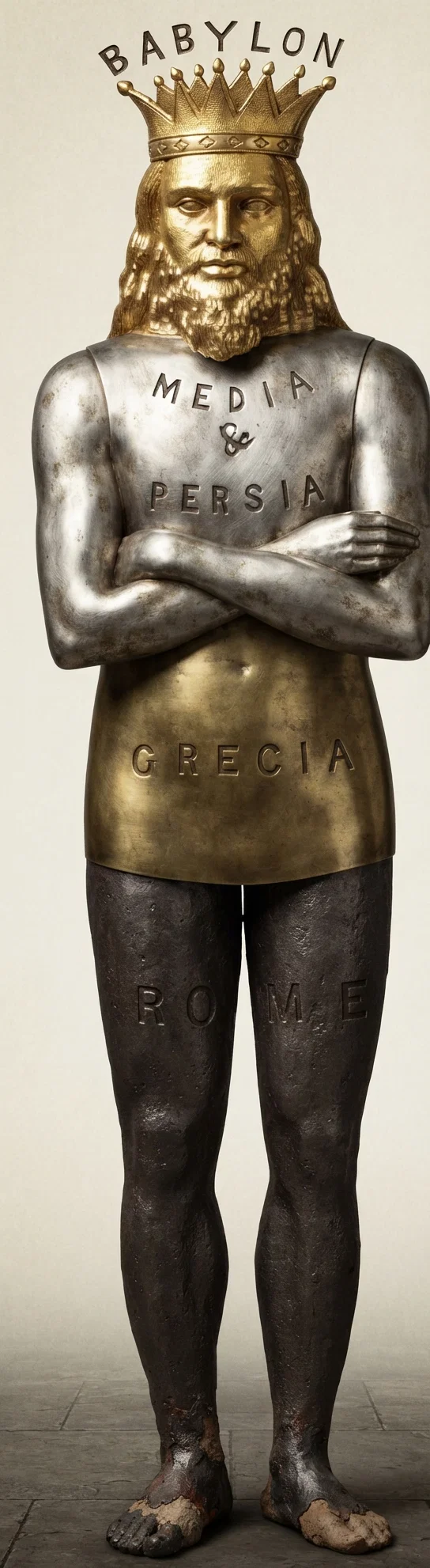
Verses 31-36. "Thou O king, sawest, and behold, a great image. This great image, whose brightness was excellent, stood before thee, and the form thereof was terrible. This image's head was of fine gold, his breast and arms of silver, his belly and his thighs of brass, his legs of iron, his feet part of iron and part of clay. Thou sawest till that a stone was cut out, without hands, which smote the image upon his feet that were of iron, and clay, and brake them to pieces: then was the iron, the clay, the brass, the silver, and the gold, broken to pieces together, and became like the chaff of the summer threshing-floors, and the wind carried them away, that no place was found for them: and the stone that smote the image, became a great mountain, and filled the whole earth. This is the dream; and we will tell the interpretation thereof before the king."
We wish here to inquire, Where did the stone strike the image? Answer, "upon his feet." We shall have occasion to refer to this fact again.
"Thou, O king, art a king of kings: for the God of heaven hath given thee a kingdom, power, and strength, and glory. And wheresoever the children of men dwell, the beasts of the field and the fowls of the heaven hath he given into thine hand, and hath made thee ruler over them all. Thou art this head of gold."
"And after thee shall arise another kingdom inferior to thee."
"And another third kingdom of brass, which shall bear rule over all the earth."
"And the fourth kingdom shall be strong as iron:" "And whereas thou sawest the feet and toes, part of potters' clay, and part of iron, the kingdom shall be divided."
"And as the toes of the feet were part of iron, and part of clay, so the kingdom shall be partly strong, and partly broken. And whereas thou sawest iron mixed with miry clay, they shall mingle themselves with the seed of men; but they shall not cleave one to another, even as iron is not mixed with clay. And in the days of these kings shall the God of heaven set up a kingdom, which shall never be destroyed."
Verses 37, 38. "Thou, O king, art a king of kings: for the God of heaven hath given thee a kingdom, power, and strength, and glory. And wheresoever the children of men dwell, the beasts of the field, and the fowls of the heaven, hath he given into thine hand, and hath made thee ruler over them all. Thou art [or, thy kingdom is] this head of gold."
Babylon was the first kingdom of universal empire. It was founded by Nimrod, the great grandson of Noah. See Gen. x, 8-10. It lasted near seventeen hundred years, though under different names; sometimes called Babylon, sometimes Assyria, and sometimes Chaldea. It extended from Nimrod to Belshazzar, who was its last king.
Verse 39. [First part.] "And after thee shall rise another kingdom, inferior to thee."
What kingdom succeeded Babylon? See Chap. v, 28. "Thy kingdom [Babylon] is divided, and given to the Medes and Persians." Then the Medo-Persian kingdom was the second universal kingdom, and is represented by the breast and arms of silver.
Verse 39. [Last part.] "And another third kingdom of brass shall arise, which shall bear rule over all the earth."
What kingdom was this? See Chap. viii, 5-7, 21. Here we learn that Grecia conquered the Medo-Persian kingdom and became a kingdom of universal empire. This took place under Alexander. Here, then, we have the third kingdom, which is represented by the brass of the image.
Verse 40. "And the fourth kingdom shall be strong as iron: forasmuch as iron breaketh in pieces and subdueth all things; and as iron that breaketh all these, shall it break in pieces and bruise."
What kingdom is this? It is generally admitted to be the Roman kingdom. It is a universal kingdom, that is to break in pieces all that went before it. Rome alone answers the description. That did have universal empire. See Luke ii, 1. "And it came to pass in those days, that there went out a decree from Caesar Augustus, that all the world should be taxed." Who was Caesar Augustus? A Roman Emperor. Here, then, we have the fourth kingdom, represented by the legs of iron.
Verse 41. [First part.] "And whereas thou sawest the feet and toes, part of potters' clay and part of iron, the kingdom shall be divided."
What kingdom shall be divided? Answer. The fourth kingdom. The Western empire of Rome, between the years A. D. 356 and 483, was divided into ten divisions, or kingdoms. 1. The Huns, in Hungary, A. D. 356. 2. The Ostrogoths, in Mysia, 377. 3. The Visigoths, in Pannonia, 378. 4. The Franks, in France, 407. 5. The Vandals, in Africa, 407. 6. The Sueves and Alans, in Gascoigne and Spain, 407. 7. The Burgundians, in Burgundy, 407. 8. The Heruli and Rugii, in Italy, 476. 9. The Saxons and Angles, in Britain, 476. 10. The Lombards, in Germany, 483. Thus the kingdom was divided as designated by the ten toes.
Verse 41. [Last part.] "But there shall be in it the strength of iron, forasmuch as thou sawest the iron mixed with the miry clay."
The Roman or iron power, through the influence and authority of Papacy, or Papal Rome, stretched itself among the clay so as to be mixed with it, and thereby kept up the strength of iron.
Verses 42, 43. "And as the toes of the feet were part of iron and part of clay; so the kingdom [Roman kingdom] shall be partly strong and partly broken. And whereas thou sawest iron mixed with miry clay, they [Romanists] shall mingle themselves [Rome Papal] with the seed of men; but they shall not cleave one to another, even as iron is not mixed with clay."
How exactly has all this been fulfilled. Romanism, or the Roman Church, while it has mingled with all nations, has not mixed with them, but has kept up its authority over its subjects, under whatever government they may have been located; so that the authority of Rome has been felt by all the nations where her subjects have been "mingled with the seed of men." The fourth, or Roman kingdom is thus perpetuated, though divided.
Verse 44. "And in the days of these kings shall the God of heaven set up a kingdom which shall never be destroyed: and the kingdom shall not be left to other people, but it shall break in pieces and consume all these kingdoms, and it shall stand forever."
We shall do well to notice with care (1) what kings, or kingdoms are here referred too. Most certainly they are the ten kings of the divided fourth kingdom; for they are the subject of discourse. And (2) the kingdom set up. It is the fifth universal kingdom, and is never to be destroyed and left to other people. It is, therefore, the immortal kingdom. The subjects will not pass from one set of rulers to another, as has been the case with the four previous kingdoms.
In regard to the fifth kingdom, set up by the God of heaven, there are at least two general views.
One is, that it is the kingdom of grace, which was to increase till it filled the whole earth; "for" say they who hold this view, the stone was to roll and grow till it became a great mountain, and filled the whole earth. Unfortunately for this view, however, there is not a word of Bible testimony to sustain it.
The other is the Bible view as follows: "Thou sawest till that a stone was cut out without hands, which smote the image upon his feet that were of iron and clay, and brake them to pieces. Then was the iron, the clay, the brass, the silver, and the gold, broken to pieces together, and became like the chaff of the summer threshing-floors; and the wind carried them away, that no place was found for them: and the stone that smote the image became a great mountain, and filled the whole earth." Chap. ii, 34, 35. Mark well the events here stated. The stone breaks the image, and it becomes like the chaff of the summer threshing-floors, and the wind carries it away so that no place is found for it—all earthly kingdoms are broken and cease to exist—then the stone becomes a great mountain and fills the whole earth. This view of the subject is in perfect harmony with the testimony of the Old and New Testaments.
But we would inquire of those who teach that the kingdom of grace was set up by our Lord Jesus Christ 1800 years since, Had God no "kingdom of grace" before the first advent of Christ? If not, then Enoch, Noah, Lot, Abraham, Isaac, Jacob, Moses and the Prophets have perished without hope, for certainly no man can be saved without grace.
But let us look at this subject a little further. Where did the stone strike the image when it smote it? Not on the head—Babylon; nor on the breast and arms—Media and Persia; nor on the belly and94thighs—Grecia; nor yet on the legs—Rome Pagan, as it should have done, if the kingdom was set up at Christ's first advent. Where, then, did the stone smite the image? Answer. "Upon his feet." Now it could not smite the feet before they were in being; and they did not exist till several hundred years after Christ's crucifixion, till the fourth, or Roman kingdom was divided; which we have seen did not take place till between the years A. D. 356 and 483.
But that the kingdom was not set up at certain periods spoken of in the New Testament, will appear from the examination of a few passages. It was not set up when our Lord taught his followers to pray, "Thy kingdom come;" it must have been future then. Again. The mother of Zebedee's children understood it to be future when she desired our Lord to grant that her two sons might sit, "the one on the right hand, and the other on the left, in thy kingdom." It was still future when our Lord ate the last passover. See Luke xxii, 18: "I say unto you, I will not drink of the fruit of the vine, until the kingdom of God shall come." So, it had not then come. Let us see if it had come when Christ hung on the cross. See Luke xxiii, 42. "Lord, remember me when thou comest into thy kingdom." Thus, to his death, it seems, his kingdom had not been set up.
But did he not set it up before his ascension to heaven? See Acts i, 6. "Lord, wilt thou at this time restore again the kingdom to Israel?" Not done yet. Now see 1 Cor. xv, 50. "Now this I say, brethren, that flesh and blood cannot inherit the kingdom of God." This settles the question that the kingdom of God is not set up till the saints put on immortality, or not till they enter the immortal state, which Paul tells us, [verse 52,] is "at the last trump," and the Apostle tells us, [2 Tim. iv, 1,] that "the Lord Jesus Christ shall judge the quick and the dead at his appearing and kingdom." And again he tells us, [Acts xiv, 22,] that "we must through much tribulation enter into the kingdom of God;" and this address was made to those who were already Christians, and shows that the kingdom of God was still future, in the Apostle's estimation.
The kingdom is a matter of promise. "Hearken, my beloved brethren, hath not God chosen the poor of this world, rich in faith, and heirs of the kingdom which he hath promised to them that love him?" James ii, 5. It is yet to come. "Fear not little flock, for it is your Father's good pleasure to give you the kingdom."
But when will the kingdom of God be set up? See Matt. xxv, 31-34. "When the Son of man shall come in his glory, and all the holy angels with him, then shall he sit upon the throne of his glory. Then shall the King say unto them on his right hand, Come ye blessed of my Father, inherit the kingdom prepared for you from the foundation of the world." Then, and not till then, will the kingdom of God be set up, "for flesh and blood cannot inherit the kingdom of God."
The miniature exhibition of the kingdom of God at the transfiguration [Matt. xvi, 27, 28; xvii, 1-5] is designed to show the nature of the kingdom, and when it will be set up. "For the Son of man shall come in the glory of his Father, with his angels; and then he shall reward every man according to his works. Verily I say unto you, There be some standing here, which shall not taste of death, till they see the Son of man coming in his kingdom." ["Till they see the kingdom of God." Luke ix, 27.]
This promise was shortly fulfilled on the mount. "And after six days, Jesus taketh Peter, James, and John his brother, and bringeth them up into an high mountain apart, and was transfigured before them: and his face did shine as the sun, and his raiment was white as the light. And behold, there appeared unto them Moses and Elias talking with him. Then answered Peter, and said unto Jesus, Lord, it is good for us to be here: if thou wilt, let us make here three tabernacles: one for thee, and one for Moses, and one for Elias. While he yet spake, behold, a bright cloud overshadowed them; and behold, a voice out of the cloud, which said, This is my beloved Son, in whom I am well pleased: hear ye him."
Jesus Christ appeared there in his own personal glory. His countenance shone like the sun, and his raiment was white as the light.
The glory of the Father was there. It was a "bright cloud" of the divine glory, out of which came the Father's voice.
Moses and Elias appeared; the one, the representative of those saints who shall be raised at Christ's coming, and clothed with glory; the other, Elias, the representative of those who will be alive and be changed at the appearing of Christ.
The use the apostles made of the scene. The apostle, Peter was one of the witnesses; and in view of the importance of the kingdom of Christ, he, in his second epistle, has given the church of all coming ages instruction how they may ensure an abundant entrance "into the everlasting kingdom of our Lord Jesus Christ." "For we have not followed cunningly devised fables when we made known to you the power and coming of our Lord Jesus Christ, but were eye-witnesses of his majesty." This he says was "when we were with him in the holy mount." 2 Pet. i, 16-18. This scene was a demonstration of Christ's second, personal and glorious coming, and shows that the kingdom will be immortal when set up, and that it will be set up at the period of the second advent and resurrection of the just.
But it is urged as an objection to the view here presented, that our Lord said, "the kingdom of God is within you." But notice the party addressed. "And when he was demanded of the Pharisees, when the kingdom of God should come, he answered them and said, The kingdom of God cometh not with observation. [Margin, outward show.] Neither shall they say, Lo here! or, Lo there! for behold the kingdom of God is within you." [Margin, among you.] Luke xvii, 20, 21. Did our Lord mean to say that the kingdom of God was within the Pharisees? Certainly not. He says of them, [Matt. xxiii, 13,] "Ye shut up the kingdom of heaven against men: for ye neither go in, neither suffer ye them that are entering to go in."
But did our Lord intend to teach that the kingdom was then among them? If so, why did he speak a parable in Chap. xix, 11, and onward, to disabuse the minds of the people, "because they thought that the kingdom of God should immediately appear?" He clearly teaches in that parable, that they were not to expect the kingdom of God till he should return from heaven, at which time he would reward his faithful servants, but would say, at the same time, "Those mine enemies, which would not that I should reign over them, bring hither and slay them before me." We understand our Saviour to teach [Luke xvii] that his coming and kingdom will not be with outward show to the unbelieving world, and that while those who hold the spiritual views of the subject shall be saying, "See here, or see there," the first they know it is upon them. The whole heavens blaze with his glory, and the earth trembles at his presence. "And they shall say to you, See here! or, See there! go not after them, nor follow them. For as the lightning that lighteneth out of the one part under heaven, shineth unto the other part under heaven; so shall also the Son of man be in his day." Verses 23, 24.
We admit that the phrase "kingdom of heaven" does not always refer to the future, immortal kingdom; but in such cases it should be understood so as to harmonize with the plain declarations of Christ, Daniel, Paul and Peter already presented. "Then shall the kingdom of heaven be likened unto ten virgins," &c. Matt. xxv, 1. This parable applies to the history of those who hear the gospel of the kingdom, and who may become the subjects of the kingdom. "For the kingdom of heaven is as a man traveling into a far country." Chap. xxv, 14. This refers to Christ who is to be king of the future kingdom. The parable of the "mustard seed" and "leaven" represents the grace of God in men, which makes the preparation necessary to constitute them subjects of the kingdom, so it is called the "kingdom of heaven" in regard to the result. We would say the same of Rom. xiv, 17.
Christ preached the kingdom of heaven at hand. Matt. iv, 17; Mark i, 15. But "at hand" in these passages is from the Greek word eggiken, which signifies, "has approached; drawn near." It was then at hand in the sense of being next to come. What kingdom was at hand when Babylon was in power? Answer. The Medo-Persian. Why? Because it was next to come. What kingdom was at hand when the Medo-Persian was in power? Answer. The Grecian, because it was next to succeed it. What kingdom was at hand when Grecia was in power? Rome, because next to come, as a kingdom of universal empire. What kingdom is at hand when Rome is in power? God's everlasting kingdom. Why? Because that is the next kingdom of universal empire.
Paul taught his brethren [2 Thess. ii, 2] that the day of Christ was not at hand; but the Greek word translated "at hand" in this case is enesteken, "to place in, or upon; to stand near; impend." In this case Paul would not have his brethren believe that the day of Christ was impending, or immediately to come in their day; while in the other case the kingdom of heaven had drawn near, as the next universal empire.
The distinct offices of our Lord Jesus Christ are Prophet, Priest and King. No two are filled at the same time, but they succeed each other. Those who have all three fulfilled at the same time make perfect confusion of plain Scripture testimony. In Christ's life and ministry on earth he was a Prophet, or teacher. Said Moses, "The Lord thy God will raise up unto thee a Prophet from the midst of thee, of thy brethren, like unto me; unto him ye shall hearken." Deut. xviii, 15. And Peter, speaking of Christ, testifies that "Moses truly said." Christ ascended up to heaven to be a priest. "We have such an high priest," says Paul, "who is set on the right hand of the throne of the Majesty in the heavens, a minister of the Sanctuary," &c. Heb. viii, 1, 2. That he was not a Priest while on earth, is positively declared in verse 4. "For if he were on earth, he would not be a Priest." The book of Hebrews places Christ's priesthood in the heavenly Sanctuary. And when his priestly office shall be fulfilled, he will lay off his meek, priestly attire, and, put on his kingly robes and crown, to ride forth to the destruction of his enemies, and the salvation of his people. Then there will be "on his vesture and on his thigh a name written, KING OF KINGS AND LORD OF LORDS."
Christ is the rightful heir to David's throne. Read the angel's testimony to Mary. Luke i, 32, 33. "He shall be great, and shall be called the Son of the Highest; and the Lord God shall give unto him the throne of his father David. And he shall reign over the house of Jacob for ever; and of his kingdom there shall be no end." When speaking of the throne of Israel, the Prophet says:—"I will overturn, overturn, overturn it; and it shall be no more, until he come whose right it is; and I will give it him." Eze. xxi, 27. When Pilate asked Jesus if he was king, he replied, "To this end was I born."
The earth restored will be the territory of his kingdom. Paul, in speaking of the promise of the land made to Abraham, says, "Now to Abraham and his seed were the promises made. He saith not, and to seeds, as of many; but as of one, and to thy seed which is Christ." Gal. iii, 16. Abraham had no inheritance in the land, and Christ had not where to lay his head. But the promise will be fulfilled gloriously in the immortal kingdom. Christ will say, "Come, ye blessed of my Father, inherit the kingdom prepared for you from the foundation of the world." This world was originally made for man; but the first Adam having lost it, together with his life, the Second Adam came to purchase both the one and the other. At his second coming, he will redeem the purchased possession. He will raise the sleeping saints, and change the living righteous. He will remove the curse and the effects from the earth, and restore it to the Eden glory. This will be the territory of his kingdom. Then Abraham and Christ will share the promise and all who are of faith will be "blessed with faithful Abraham." Then "the kingdom and dominion, and the greatness of the kingdom under the whole heaven, shall be given to the people of the saints of the Most High, whose kingdom is an everlasting kingdom. The 'saints of the Most High shall take the kingdom, and possess the kingdom for ever, even95for ever and ever." Dan. vii, 18, 26. The immortal saints will be the subjects of God's everlasting kingdom. The New Jerusalem "that is above, and is free," will come down from God out of heaven and be the metropolis of the immortal kingdom. Abraham looked for this same City which hath twelve foundations. And the holy law of God which is to be kept here, as the moral condition of entering the City, to enjoy a right to the tree of life, will doubtless be the eternal law of the kingdom. "Blessed are they that do his commandments, that they may have right to the tree of life, and may enter in through the gates into the City."
Now comes the inquiry, "Watchman, what of the night?" In what period of prophecy are we now? Are we in the kingdom of Babylon, under the "head of gold?" No. That has passed long ago. Are we in the Medo-Persian empire? Long since that kingdom was numbered with things passed. Are we in Grecia? That, too, was numbered and finished more than two thousand years since. Are we in Rome in its undivided state, or in the "legs of iron?" No. Long since that empire fell. Where are we, then? Answer. Down among the feet and toes. How long since those divisions came up, which constitute the feet and toes? Nearly fourteen hundred years. Almost fourteen hundred years we have traveled down in the divided state of the Roman empire. Where does the stone strike the image? "Upon his feet." Where are we now? In the feet. What takes place when the stone smites the image? It is all broken to pieces, and becomes like the chaff of the summer threshing-floors, and the wind carries it away that no place shall be found for it. Then will the everlasting kingdom of God be set up which shall never be destroyed.