The Youth’s Instructor, Vol. 47, No. 42.

THREE TREES

The Youth’s Instructor

Oct 26, 1899

Review and Herald Publishing Company · Battle Creek, Mich. · Oct 26, 1899

THREE TREES

The pine-tree grew in the wood, Tapering, straight, and high; Stately and proud, it stood Black-green against the sky. Crowded so close, it sought the blue, And ever upward it reached and grew.
The oak-tree stood in the field, Beneath it dozed the herds; It gave to the mower a shield, It gave a home to the birds; Sturdy and broad, it guarded the farms With its brawny trunk and knotted arms.
The apple-tree grew by the wall, Ugly and crooked and black; But it knew the gardener’s call, And the children rode on its back. It scattered its blossoms upon the air, It covered the ground with fruitage fair.
“Now, hey,” said the pine, “for the wood! Come, live with the forest band. Our comrades will do you good, And tall and straight you will stand.” And he swung his boughs to a witching sound, And flung his cones like coins aro’d.
“Oho!” laughed the sturdy oak; “The life of the field for me. I weather the lightning stroke; My branches are broad and free. Grow straight and slim in the wood if you will; Give me the sun and the wind-swept hill.”
And the apple-tree murmured low: “I am neither straight nor strong; Crooked my back doth grow With bearing my burdens long.” And it dropped its fruit as it dropped a tear, And reddened the ground with fragrant cheer.
And the Lord of the harvest heard, And he said: “I have use for all,— For the bough that shelters a bird, For the beam that pillars a hall,— And grow they tall, or grow they ill, They grow but to wait their Master’s will.”
So a ship of the oak was sent Far over the ocean blue, And the pine was the mast that bent As over the waves it flew; And the ruddy fruit of the apple-tree Was borne to a starving isle of the sea.
Now the farmer grows like the oak, And the townsman is proud and tall; The city and field are full of folk, But the Lord has need of all.
— Selected.

HER MAJESTY'S COLONIES

Concluded
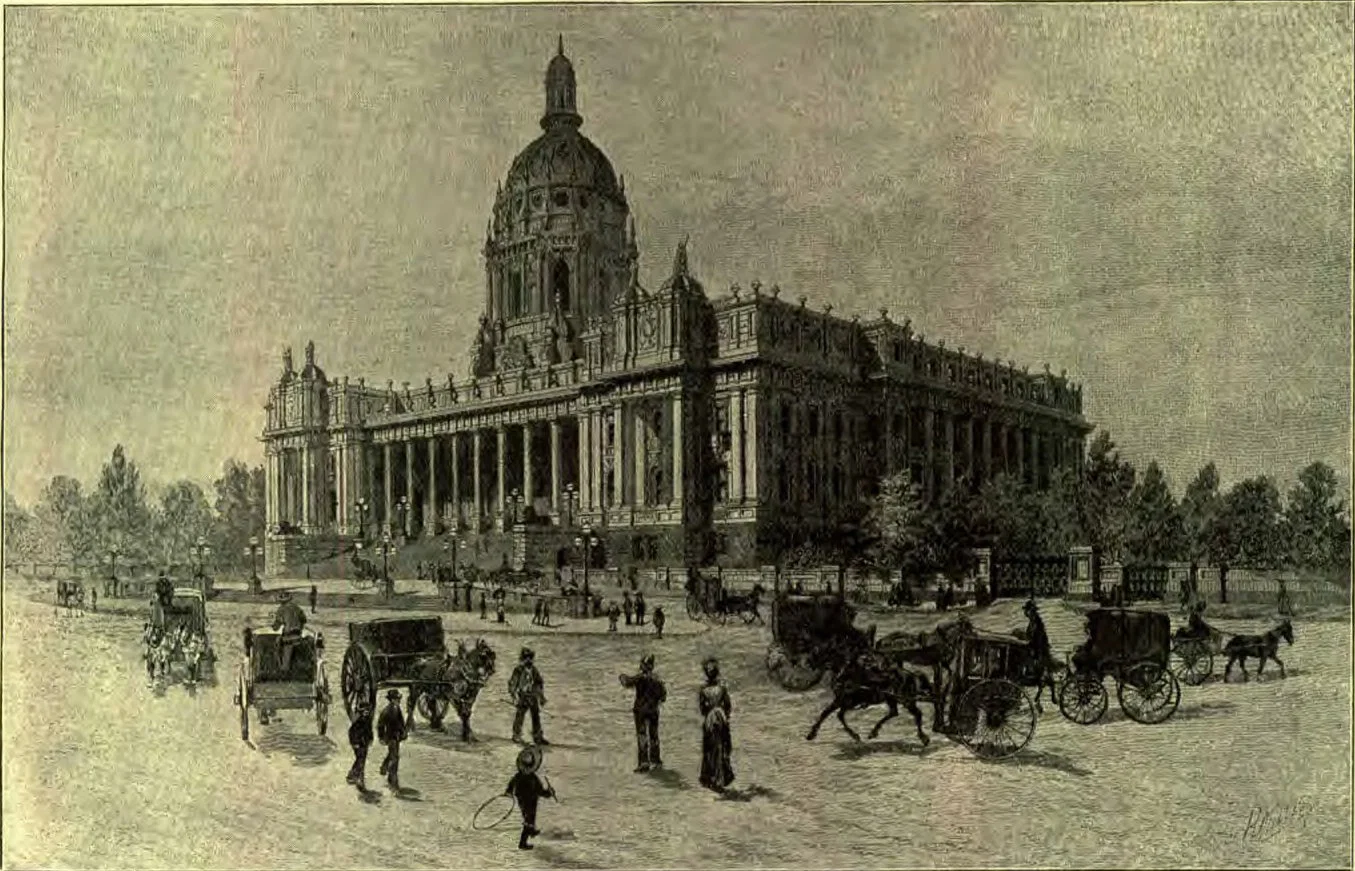
PARLIAMENT HOUSE, MELBOURNE.
Melbourne is the most American of the colonial cities. According to the census of 1891, its population numbers about five hundred thousand, though during the last few years, through bank failures and high tariffs, it has lost somewhat,—a loss by which Sydney and the new gold-fields have gained. It is now, however, steadily improving. Its wide, clean, well-paved streets; its beautiful buildings; the river running through its center, spanned by the fine Princess Bridge; its comfortable and noiseless cable tram-lines,—all combine to impress the American visitor that he is in a new Chicago. The residence portion is much handsomer than that of Sydney, except in Sydney's newest suburbs. The houses and cottages are of varied pattern, with large lawns, and present a general air of room and comfort; and the business blocks are tasty and up-to-date. Prices are higher than in Sydney, but the quality is generally better. In its system of sanitation, Melbourne has been far behind Sydney, its open sewage being both dangerous and disagreeable. Epidemics of typhoid fever and diphtheria occur every year, with a high death-rate. Thousands of pounds are annually expended in the drainage of the river to accommodate steamers, and thousands more are squandered in a futile attempt at drainage. At the present time a plan for forced drainage is on foot, which it is hoped will prove successful, but which will be very expensive.
The journey from Sidney to Brisbane, Queensland, is over some beautiful country. We get many a peep at real Australian “bush” and farm life. The trip past the Hawksbury River is rarely surpassed in railway travel, the view constantly changing as we wind in and out among its many curves, and are treated to views of what appear to be beautiful lakes, where the river widens into great basins between mountains and hills.
In Queensland we are delighted with the scenery on the Darling Downs Range, an ideal farm district lying two thousand feet above sea-level, and covered with luxuriant crops of grain and fruit. Oranges, grapes, peaches, pears, apricots, plums, passion-fruit, almonds,—almost everything, in fact, but good apples,—grow here in abundance. Some apples are raised, but the climate is too warm for a really fine apple, such as is grown in the States. Toowoomba, the principal city on the Darling Downs Range, is in the midst of this fruit district. It has a fine climate, and is a favorite summer resort for the city of Brisbane as well as the colony generally.
The colony of Queensland has a coast-line of two thousand two hundred and fifty miles, an estimated area of over six hundred and fifty thousand square miles, and a population of about five hundred thousand. Brisbane, the capital of the colony, is a fine city on the Brisbane River, fourteen miles from Moreton Bay. The river is navigable by ocean-going vessels. Moreton Bay is the home of the “Moreton Bay Fig-tree,” an evergreen of surpassing beauty, with wide, overspreading branches, covered with large leaves, which afford the finest imaginable shade. In this respect it is in marked contrast with the gum and eucalyptus, whose slender leaves seem to have a fashion, as an American expressed it, “of making a successful effort at turning themselves slantwise at the sun, so as to let its bright rays right down on you.” This tree sheds its bark annually instead of its leaves.
Queensland has about twenty towns of importance, varying in population from one to thirteen thousand inhabitants, and many villages. The colony has abundant resources in its agricultural, cattle, sheep- and wool-raising and fruit-growing districts, besides its productive gold-mines. Around Brisbane the pineapple is grown in large quantities, supplying not only the home market, but also Sydney and Melbourne. In the far north, the mango, guava, and banana are grown. The climate south of the tropic of capricorn is generally a delightful one, but in the far north it is too warm for comfort.
THE COUNCIL CHAMBER.
An article on Australasia would be incomplete without a reference to its “southern skies,” which must be seen to be appreciated. In its clear atmosphere, the heavens seem to be brought startlingly near. The casual observer remarks it, and the lover of astronomy is delighted beyond expression. He visits the large telescopes of the various colonial astronomical societies, and never tires of viewing through them the fine nebula, “The Jewel Casket,” near the “Southern Cross,” as well as the nebula of “Orion,” and other familiar constellations of the northern hemisphere. We invite the reader to come and see it all for himself.
G. B. STARR.

GOSSAMER THREADS

Often in late summer the bushes are covered with threads that are attached by one end, and blow out in the wind. These are especially numerous in autumn. Everybody knows that they are threads spun by spiders, but all do not know how or why. Small spiders, and especially the young of the Lycosa family (the running spiders), are very fond now of flying, apparently “just for fun.” They will crawl to some exposed point at the top of a bush or fence; place all their feet in a bunch, with the head held down and the hinder part of the body up, and then exude from the spinning apparatus at the tip of the abdomen a thread, or sometimes a brush-like cluster of threads, which is caught by the breeze, and floats out as it lengthens, until finally it has buoyancy enough to carry the spider away aloft out of sight, or drift him off across the country until he strikes some foothold and stops. Then he may simply rest, and soon fly on again; or he may cut loose, and let his thread go on wherever the wind will carry it.
This is the explanation of the gossamer threads that in autumn cling to our clothes and faces and shimmer in the sunlight. Mr. Emerton, the author of an excellent little book on American spiders, also says that it is a common habit with some spiders, especially in October, to draw out a thread behind them as they walk along, and that this accounts for the attached threads commonly seen lacing together the pickets of a fence, or covering a field of grass, or clinging to the side of a barn. Another common habit with spiders is to let themselves down by threads from the branches of trees to the ground; and these hanging cables are blown about to add to the tenuous, silvery gossamer that is one of the exquisite ornaments of this most delightful of months.—Well-Spring.

THE LITTLE THINGS

A CERTAIN weaver became so poor that he could no longer buy wool or silk with which to weave. Then he carefully collected the odds and ends that he had thrown aside in more prosperous days, and culled from the waste material short threads heretofore regarded as wholly useless. So skilfully did he weave the tiny bits together, that when the tapestry made therefrom was completed, it was pronounced the most beautiful pattern ever woven, and the curtain was purchased by a king for a large sum of money.
It is the little things, so often looked upon as trifles, which, when woven and interwoven in the great loom of life, come out the finished fabric—character. True character is not revealed by one heroic act, nor by occasional good deeds or misdeeds, but by the tendency of the habitual words and acts. A holy life is made up of a number of little things,—little bits of true service done in the name of Jesus. The overcoming of little evils, little sins, little indulgences of the flesh, constitutes our greatest victory. In the years to come, we shall find that the smallest deed done for Christ, the feeblest and most broken words spoken in his name, have not been in vain.
We should all remember, however, that with the most valuable “odds and ends” we have—our fragments of time—we can not do as the weaver did. The minutes must be used as they come to us, or the opportunity is past. To each one comes the time when he would gladly gather up the stray moments carelessly wasted; and could he do so, days and weeks of extra time would be his; but the moments are gone forever. “Time creeps toward us with folded wings; but when ’t is past us, its wings seem to flap with speed.” He is wise who remembers always that the present moment alone is his.
MRS. L. FLORA PLUMMER.

NEVER MIND

Toddling Nell, the darling of the house, suddenly caught a fall in her race across the parlor.
“Never mind,” said mama; “get up and try it over again.”
One sat by who had caught a fall in the life race. The sweet words, so full of courage, fell on her ears like an authoritative command: “Never mind. Get up and try it over again.”
Our losses, our falls, can have no power over us if we will not yield to them. If the baby should persist in remaining where she fell, too discouraged to make any further effort, there her career would end; but if she will put forth her will, and use such ability as she possesses, she will gain strength for the difficulties in the way.
This is the word for every discouraged man and woman: “Get up and try it over again.” The energy may seem to be all gone; but that which is really used up is the will to take hold of the stores of energy always ready for human use. The energy is never used up, any more than the sun is used up by shining. The power is yours, O despairing one! because it is God’s. Believe in it, use it.
Every moment spent in discouragement is a greater waste than if you should throw away gold-dust. After every fall, one must at some time get up and go on. The power to rise lessens as the effort is postponed. Unused abilities rust and corrode. Especially does an unused will rapidly lose grip. It is better not to fall. But once down, “never mind. Get up and try it over again.”—Christian Endeavor World.

Don't Be Cheap: Mrs. Abbott on Girls' Conduct

THE unpleasant phrase “cheap girls” has arrested my attention more than once, and I have wondered what sort of girls they are, writes Mrs. Lyman Abbott. Are they those whose loud laughter and talking draw to them the attention of every one in the car? Are they those whose voices call us to the window as they pass? Do they wear skirts so narrow, shoes so tight, waist so small, that their gait is an amusement or a marvel? Do they piece their skirts down from the top, in order that they may sweep the streets? I wonder are they the girls who place themselves in the way of young men? who “make errands” which will carry them into business streets, and call frequently on girls who have brothers? How easily their flimsy device is seen through, and what sneers it occasions! Dear girls, don’t be cheap. Don’t make a “bargain counter” of your church vestibule, and offer your smiles and vivacious talk to the young man whose person and manners have pleased your fancy.

Unbroken Sunshine and Perpetual Heat

“UNBROKEN sunshine and perpetual heat / Make deserts only.”

THE LITTLE DOG'S VICTORY

A LITTLE dog barked at the big, round moon, Which smiled in the evening sky; And the neighbors smote him with rocks and shoon, But still he continued his rageful tune, And barked till his throat was dry.
The little dog bounced like a rubber ball, For his anger quite drove him wild; And he said, "I'm a terror although I am small, And I dare you, you impudent fellow, to fall!" But the moon only smiled and smiled.
Then the little dog barked at a terrible rate; But he challenged the moon in vain; For as calmly and slow as the workings of fate, The moon moved along in a manner sedate, And smiled at the dog in disdain.
But soon, 'neath a hill that obstructed the west, The moon sank away out of sight; And it smiled as it slowly dropped under the crest; But the little dog said, as he lay down to rest, "Well! I scared it away, all right!"

AGAINST PRINCIPALITIES AND POWERS

God has need of workers who, as they labor with him, will comprehend the sacredness of the work, and the conflicts they must meet in order to carry it forward successfully,—workers who will not grow despondent as they see the arduous task before them. The Lord does not try to conceal from his people the stern conflicts they will meet in these last days. Instead, he shows the plan of battle; he points out the hazardous work to be done; he lifts his voice in warning, bidding men count the cost of their discipleship: but he encourages all to take up the weapons of their warfare; for the heavenly host will stand with them in the defense of truth and righteousness.
On every side God’s people will meet the specious temptations of Satan. The enemy knows how desirable a place heaven is to every human being. He has a keen sense of what he has lost; and when he was cast out of heaven, he determined to use all the knowledge and power he possessed in warring against God, and taking from him the beings he had created. He knows that the work which Christ has purposed will be accomplished; he knows that the Scriptures will be fulfilled, and that a host that no man can number will encircle the throne where he so often stood as chorister, to sing songs of praise and adoration to God and the Lamb. And in accordance with his purpose, he is working to make of no effect the labors of Christ’s followers.
Christ presents before his people their source of power and efficiency to meet the wiles of Satan, and his words of admonition are full of encouragement. “Be strong in the Lord,” he says, “and in the power of his might. Put on the whole armor of God, that ye may be able to stand against the wiles of the devil. For we wrestle not against flesh and blood, but against principalities, against powers, against the rulers of the darkness of this world, against spiritual wickedness in high places. Wherefore take unto you the whole armor of God, that ye may be able to withstand in the evil day, and having done all, to stand. Stand therefore, having your loins girt about with truth, and having on the breastplate of righteousness; and your feet shod with the preparation of the gospel of peace; above all, taking the shield of faith, wherewith ye shall be able to quench all the fiery darts of the wicked. And take the helmet of salvation, and the sword of the Spirit, which is the word of God: praying always with all prayer and supplication in the Spirit, and watching thereunto with all perseverance and supplication for all saints.”
Those who unshrinkingingly stand in the forefront of the battle will feel the special attacks of the enemy; and realizing their need of help from God, they will flee to the stronghold for refuge. Perseverance, faith, and a perfect trust in God will insure success. In every stern conflict, feeble man will have strength to do the deeds of Omnipotence.
The mighty general of armies leads the hosts of heaven in defense of his people as verily as he led the armies of Israel at the taking of Jericho. Not one soul in all the hosts of Israel could boast of his strength to throw down the walls of that city. It was the Captain of the Lord’s host who planned that battle, and his name alone could receive the glory. So the servants of Christ labor in the strength of their Master; and every victory they gain leads them, not to exalt self, but to lean more securely on the arm of God. Deep and fervent gratitude is awakened in their hearts, and they rejoice in tribulation. These willing servants are gaining experiences and forming characters that will do honor to the cause of God.
Writing to the church in Rome, Paul says: “We have peace with God through our Lord Jesus Christ: by whom also we have access by faith into this grace wherein we stand, and rejoice in hope of the glory of God. And not only so, but we glory in tribulations also, knowing that tribulation worketh patience; and patience, experience; and experience, hope: and hope maketh not ashamed; because the love of God is shed abroad in our hearts by the Holy Ghost which is given unto us.” In Christ are hid all the treasures of wisdom and knowledge, and we are without excuse if we fail to avail ourselves of the provision made. Christ sacrificed everything in order to make it possible for man to gain heaven. Now it is for man to show what he will sacrifice for Christ’s sake. Those who have any just sense of the magnitude of the plan of salvation, and of its cost, will never murmur that their sowing must be in tears, and that conflict and self-denial must be the Christian’s portion. Why should we be unwilling to endure, to suffer, and to sacrifice, in order to secure an imperishable treasure,—a life that runs parallel with the life of God,—a crown of immortal glory, that fadeth not away!
When the follower of Christ meets with trial and perplexity, he is not to become discouraged. He is not to cast away his confidence if he does not realize all his expectations. When buffeted by the enemy, he should remember the Saviour’s life of trial and discouragement. Heavenly beings ministered to Christ in his need, yet this did not make the Saviour’s life one of freedom from conflict and temptation. He was in all points tempted like as we are, yet without sin. If his people will follow this example, they will be imbued with his Spirit, and heavenly angels will minister to them.
The temptations to which Christ was subjected were a terrible reality. As a free agent, he was placed on probation, with liberty to yield to Satan’s temptations and work at cross-purposes with God. If this were not so, if it had not been possible for him to fall, he could not have been tempted in all points as the human family is tempted. The temptations of Christ, and his sufferings under them, were proportionate to his exalted, sinless character. But in every time of distress, Christ turned to his Father. He “resisted unto blood” in that hour when the fear of moral failure was as the fear of death. As he bowed in Gethsemane, in his soul agony, drops of blood fell from his pores, and moistened the sods of the earth. He prayed with strong crying and tears, and he was heard in that he feared. God strengthened him, as he will strengthen all who will humble themselves, and throw themselves, soul, body, and spirit, into the hands of a covenant-keeping God.
Upon the cross Christ knew, as no other can know, the awful power of Satan’s temptations: and his heart was poured out in pity and forgiveness for the dying thief, who had been ensnared by the enemy.
“We wrestle not against flesh and blood, but against principalities, against powers, against the rulers of the darkness of this world, against spiritual wickedness in high places.” But Christ has promised us “all power” for the conflict. “Lo, I am with you alway,” he says, “even unto the end of the world.” And the promise is “unto you, and to your children, and to all that are afar off, even as many as the Lord our God shall call.” As we see the stubborn unbelief of men, and understand the risks that must be taken in the work, we must learn to listen to the voice of Jesus, “Be of good cheer; I have overcome the world.” Yes, Christ is conqueror, and we can advance with him to victory. Because he lives, we shall live also.
MRS. E. G. WHITE.
Continue reading: Chapter XIX