Mr. Goss had not yet become indifferent to memories of this past. He lived in a continual hungry regret for the old-time companionship which he had so strangely lost. Sometimes his heart felt sore, as if he were mourning the dead; and he would have given anything but the self-surrender that would secure it, if he could have felt that he had his darling back again.
There came one day when this bitter longing had made him more exacting than ever. The day had been very hard for them all; and to make matters worse, Shirley had lost her temper. The provocation had not at first been so great as on some other occasions, and her father might reasonably have reproved her; but he seemed so to sense the calamity that had befallen her in thus actually sinning that he did not even attempt to improve the occasion, but left her alone with the terrible consciousness that she had failed to be a Christian just when failure was most deplorable.
It took her all day to get herself straightened out so that she could even attempt to apologize to her father. He had been so hard; she felt that she had not given him one half the disrespect he deserved, and that he had no right to expect her to confess. But she could not get back her peace of soul while she harbored such thoughts; so as he was passing through the wood-shed just before supper-time, she ran out to him, and, although he gave her small opportunity, poured out her confession. He seemed to harden under every word; and before she had finished, turned angrily away, with a contemptuous exclamation, which caused her to cry out as if it had been a blow. Her heart was more nearly broken than it had ever been before; and going up to her room, she threw herself on her face before the Lord, and agonized in prayer and confession and weeping until her strength was well-nigh exhausted.
At last a thought flashed into her mind; and springing up, she sat down at her writing-desk. She searched until she found some sheets and envelopes of a peculiar style; rapidly wrote page after page; folded, addressed, and sealed them; and stealing down, as if afraid of being discovered, she hastened to the old post-office. The lamp was in its place, only needing to be filled and lighted to shine out its little signal, just as it had done in the care-free days before she could have even dreamed of the bitterness of repentance.
She knew that her father must pass near enough to see the light on his way to the barn, which he always visited the last thing at night;520and she wondered what he would do. Would it bring any memories out of the past that would move him? She could not think of going back to her work, or of retiring, until she knew the fate of her messenger; so, withdrawing to a point from which she could observe without being discovered, she waited and watched, her heart beating with a strange, painful longing for power such as she had never known,—a power to be and do something that would lead her father out of himself into the love of the truth.
She had not waited long before she saw her father coming. His head was bent low, so his beard swept his breast; but the night was dark, and the little twinkling light caught his careful eye, alert as it always was for anything that needed to be looked into about the premises. He made a few quick steps toward it, then suddenly stopped, put his hand to his head, looked about, made as if to go on, but again paused; then, as if drawn irresistibly, he went toward the office. Shirley could not see his face, but she saw him take out the letter, extinguish the light, and go on to the barn. She waited until she knew he could not see her, and then ran to the house, and was busy at her belated work when she heard his step as he came in at the side-door, and went up to the room that was both his private office and emergency bedroom.
After that she could not work. Her strength left her limbs. It was with difficulty that she crept into her mother's room for her good-night kiss, and then up to her own.
Her father did not look at her all the next morning, so far as she knew, at least, nor did he speak to her; and she was so weary in both brain and spirit that she did not feel equal to forcing any further attention upon him. If he would not accept the appeal that had torn itself out of her heart the night before, the case seemed hopeless, and she was well-nigh in despair.
But Benjamin Goss was not having an easy time that morning, by any means. He had sat well on into the night with that letter before him. It read, beginning as her childish epistles had done:—
MY DEAR, DEAR DADDY: I think you must be sorry that you ever had a girl like me, and I wish you had a better one. I have been a very naughty, irresponsible, capricious child. I have never, until lately, thought at all about what a child owed her father and mother, and what it would be to be left alone in the world without them. Of course I don't half know now; but I do know enough to be thankful that I don't have to find out yet what being all alone means. I wish I could make you happy, father. I wish I could make you realize how sorry I am for all the naughty things I have done, and how I have repented, and how God has forgiven me, and how I have learned from the love of my Heavenly Father how to love you, dear, dear daddy, as I never did you or anybody in my life before. I know you have cause to be angry with me; but oh, can't you forget it, and forgive your poor, lonesome little Shirley, and let us be dear, good friends again? I want you so. Don't you ever want me, daddy? Don't you ever think how nice it would be for us to go together, and let the bars down for Shep to bring the cows home; and to sit down on the back steps again, as we used to every pleasant night after the chores were all done, and watch the stars come out, and count them, and you tell me about them, as you used to, you know? Father, will you not forgive me, and take me home again?—for the house and farm, as dearly as I love them, can not make home without my father; neither can my mother, all alone. I want you, daddy, and I know just as well as can be that you want me. What is it that keeps us apart? Tell me; and if I can possibly do it, I will get it out of the way, no matter what it is. I pray for you, daddy. I love you dearly, and wait for you to take me home.
Your own little girl,
SHIRLEY.
It took him a long time to read it; for his eyes would become so dim that he could not see. His heart seemed fairly numb with pain when he had finished. He had a good mind to answer it right out of his heart; but he dare not, for to do that, was to do much more than he was not yet ready to do. So at last he folded the letter, slipped it into its envelope, and put it away in a little drawer, with many other relics of the old post-office. The lamp, which he had for the first time taken from its place, he had in a closet on the top shelf. He would not risk having it shine out of that little old window again.
And the shadows deepen about the feet of Shirley Goss. Woe to her if she depends on any external source of light; for she is like a craft over which the most impenetrable fogs are wrapped, fold on fold; and in her soul the alarm-bell seems to toll a constant warning: “Be not overcome. Be not overcome. Be not overcome of evil, but overcome evil with good.”
The work accumulated, the burdens grew, and it seemed as if the girl's strength was being taxed beyond all reason. Aunt Nell took it upon herself to remonstrate with her brother-in-law; but she soon found that the change which had taken place in Benjamin Goss was almost in inverse ratio to that which appeared in Shirley. He gave her the roughest answer she had ever heard from his lips, and from that time she gave up. She was almost ready to advise the wife and daughter to leave him utterly; but her husband said: “Be careful, Nell, how you break into any place where God has shut himself in to have it out with a man. You better just keep still, or at least make all your ‘helloes’ through the telephone that leads up to the throne.” And she concluded to take his advice.
She went over almost daily to help Shirley with the work; and sometime during the day they went together into Shirley's room, and knelt to pray for the man whose salvation they so desired.
Will, Seth, McFarlan, and the police matron had one dreadful day in Chicago, blindly searching for some clue to the missing girl; although Will, after those few moments of prayer, had insisted that no harm would come to her. But the next morning he bethought him that the home folks might have something to communicate, and would probably send it to Seth's address. This proved to be the case,—a telegram from Aunt Nell, giving the glad tidings that “the lost was found,”—and they came home on the next train.
Seth was not slow to recognize the change in Shirley,—a change which filled him with alarm, while it inspired the profoundest reverence. “I shall have to do something for Seth Adams,” he confided to Aunt Nell, “or let the Good Spirit have a chance with him,—that is settled. I shall never dare think of her again until I am a better man.”
But he also saw the change for the worse in Benjamin Goss, and felt keenly all that he could observe of what Shirley had to endure. One hot day in haying-time, as he came to the well for a pail of water to take back to the field for the “hands,” and caught sight of her at the kitchen stove, her face pale, and her eyes red, as if with weeping, he could not forbear the word which, if she would only receive it, would make it possible for him to set her free from every burden. So, leaving his pail at the pump, he came in; and in a simple, straightforward way began to tell her just what was in his mind.
Shirley listened long enough to catch the drift of his words, and answered: “No, no, Seth. I can not listen to you or to any one. Nothing must take me away from my home, especially now. My father needs me, and what would my mother do?”
“As for your mother,” began Seth.
“My father and mother and I must live together just as long as God permits. Don't say any more, Seth; nothing can change my purpose unless it should be something that would make me unworthy of any friend. And that—I pray every hour to be kept from that.”
She had turned her face full upon him, and was looking him in the eyes, and he knew that she had spoken the truth. After a moment of solemn pause, he said, “Then, Shirley, I would not say one word to move you, if I could. I am not that sort. I want you to be what you are, even if I never speak to you again.”
“Thank you, Seth;” and Shirley's head dropped low over her work.
“And, Shirley, will you pray that I may be made over, and kept, too, from every sort of selfishness?”
“I do pray for you, Seth; and you must pray for me; for I need it! I have something to do, Seth, and I must not fail in it.”
“Well, then,” he said, “I will tell you what nobody else, even my mother, knows. I do pray for you. I am not supposed to be a praying man; but I am, and I want to be more. I want to be a whole, all-round man; and that, I take it, means a good deal. I respect your decision, and will never make you think of me in any especial or hindering way; and I will try to learn how to pray the effectual prayer of the righteous.”
At this Shirley looked up with her face glowing again, and said, “Well, then, all there is to do is just to give up every way and will of your own: just stop thinking about what you would like to do and be, and think about what Jesus is. At least that is the way I found it, and that way it is not hard to be a Christian. And I want father and—and—and all—everybody, to be one, too. That is my work, you see, in my home. You do see, don't you?”
“I do; and I have faith in it. Well, I must get that water. But I am glad we have had this understanding, Shirley.”
“Yes, so am I; and you will pray for him, too?”
Seth stopped and stood still a moment, shook his head dubiously, then answered, “Yes, I will. Every time I pray for myself, I will pray for Benjamin Goss.”
This had been a specially hard day for Shirley. She had given way to such tears as she seldom shed. The talk with Seth had been a relief; but other things came on,—little, vexing things, which she could not help, the lack of necessary supplies being the most annoying,—until it seemed as if she could no longer endure it. Aunt Nell came late that day, and found her in a state of mind that caused her to take her at once to the upper room.
“Now, child,” she said, “something has to be done. I don't know what, but something must break this yoke. If something would just happen to your father,—to the business, I mean,—the barn burn, maybe the house; if he would only lose his property or get sick, not sick enough to die, of course,—but—oh, dear! I have thought a hundred times of things that might bring him to his senses.”
“Yes,” said Shirley, “so have I; but I know he is in God's hands. I only want strength to endure to the end, and I am trusting for that. Now I am going to make a request of you. Do you know we have done almost nothing but talk and pray as if we were in great distress? I don't think that is good for any of us. I'm going to stop it. I just thought this afternoon that instead of counting up the things that father does not do that I ask of him, I am going to begin to count up what he does do, that I never think of. Now this morning he brought me the graham flour that I wanted a week ago (I have thought all the time that I could not get along without it, but I have), and a bag of whole-wheat flour, that I had not asked for; and I'm just going to thank God for the fact that I've got a father, and stop crying and praying as if I wished I could change him off for another. Every little while he surprises me with something nice, and I am going to think on these things. How does that strike you, Aunt Nell?”
“As very sensible indeed,” and there were tears in Aunt Nell's voice. “Shirley, you make me ashamed. I don't believe I have been any help to you at all.”
“Oh, but you have, though! But another thing,—you know we've been coming up to my room to pray together, because our praying was so heavy and burdened and heart-breaking that we felt mother couldn't endure it. You needn't look shocked. You know it's so.”
“Did I look shocked? Well, I am. I never thought of it just that way; but it is so. Well, we will reform our praying at once.”
And after that the three women met once a day in Mrs. Goss's room, and returned thanks to God for his mercies, and tried to help one another see signs of the soon coming of the Lord into the life of Benjamin Goss.
MRS. S. M. I. HENRY.
(To be continued.)
KEEP WATCH
By Edith Gilling Cherry
Keep watch for the Master:
The day draweth near;
Soon, soon, in his glory
My Lord will appear.
Soon, soon, shall we hear him
All lovingly say,
“Rise up, my beloved,
And come thou away.”
Keep watch for the Master:
Glad, glad, will it be—
That day when he cometh
And calleth for thee!
Joy, joy, to be ready,
Found doing his will,—
Found watching and waiting,
And serving him still.
Keep watch for the Master,
Keep watch for the King;
Tasks many and varied
Thy swift days may bring.
Sweet, sweet, is his service;
But ’mid its delight,
Keep watch for his coming,
By day and by night.
Keep watch for the Master
While treading his ways,
Live but for his glory,
Seek naught but his praise.
Care only to hasten
His kingdom of grace,
Until, the veil lifted,
Thou seest his face.
— Edith Gilling Cherry.
THE CHILDREN
By Elizabeth Rosser
There are little black children on Africa’s sand, And yellow-skinned babes in the Flowery Land, And brown in the isles of the sea, And white ones and red in this land we call ours; But they all love the birds, and the trees, and the flowers, And play the same games as do we.
When Jesus, the Saviour, was here upon earth, He blessed little children, and taught their true worth,— How precious these little souls be! “Suffer the children,” the dear Saviour said,— And he didn’t say yellow, white, black, brown, or red, But the children,— “to come unto me.”
In the streets of the City of cities so fair, Where sorrow and sin never taint the pure air, The children will play, large and small. They’ll come from the yellow, red, brown, black, and white, For they all are alike in his heart-searching sight, And he equally loveth them all.
ELIZABETH ROSSER.
SAVING FOUR HUNDRED LIVES
It is a beautiful story told by Lafcadio Hearn of an old man whose great deed belongs to Japanese history. He was Hamaguchi, and his farmhouse stood on the verge of a small plateau, overlooking the bay. The plateau, mostly devoted to rice-culture, was hemmed in on three sides by thickly wooded summits; and from the outer verge, the land sloped down to the sea. Below were ninety thatched dwellings and a temple; these composed the village.
One autumn evening, Hamaguchi Gohei was looking down from his balcony on the preparations for some merry-making in the hamlet below. All the villagers were out, and he would have gone with them, had he not been feeling less strong than usual.
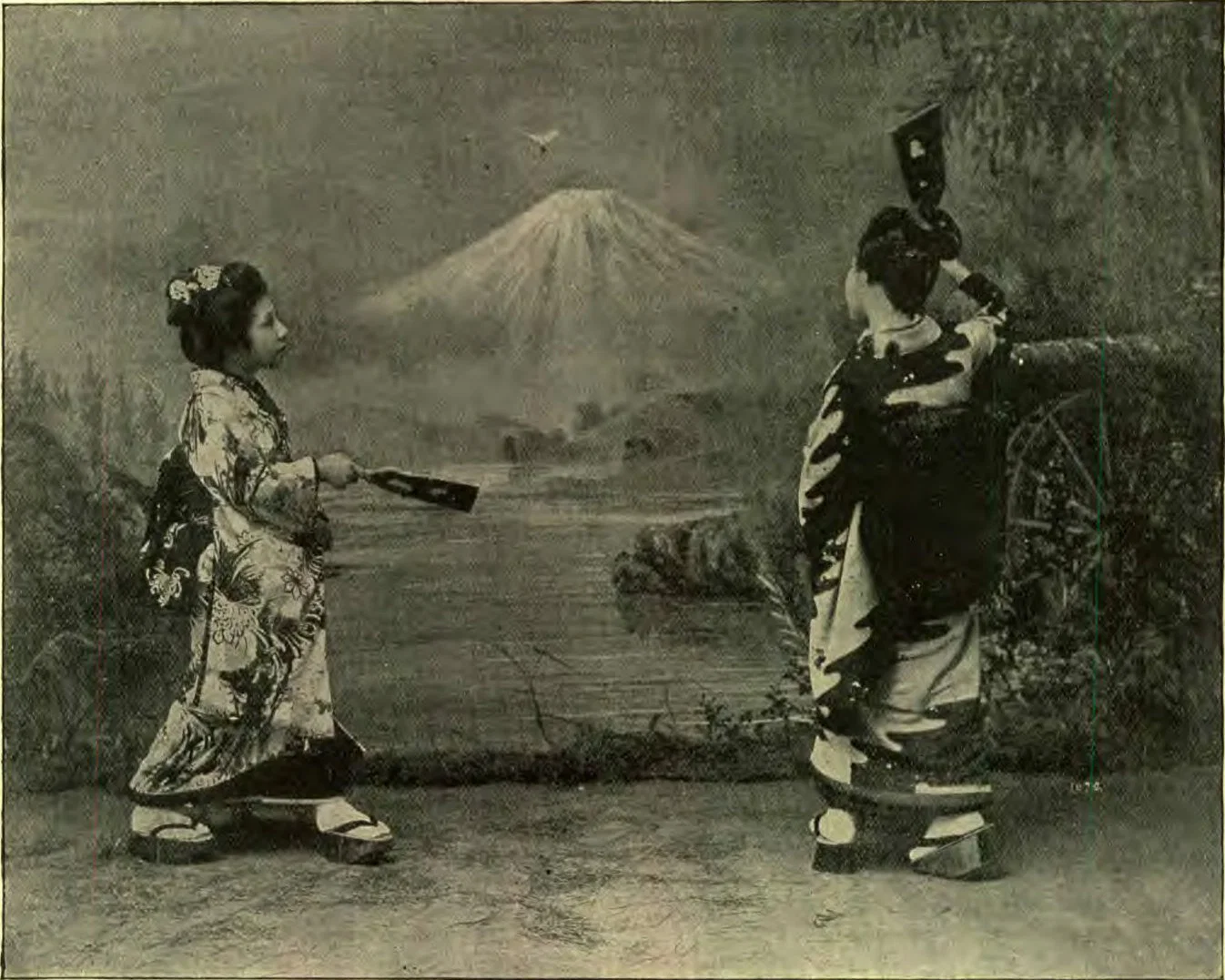
JAPANESE GIRLS PLAYING BATTLEDORE AND SHUTTLECOCK.
Suddenly there came an earthquake shock. It was not a very strong one; but Hamaguchi, who had felt many before this, thought there was something odd in its long, spongy motion. As the quaking ceased, he chanced to look toward the sea, and there he saw the strangest possible sight—it seemed to be running away from the land.
Apparently the whole village had noticed it, for the people stood still in wonderment; but only Hamaguchi drew any conclusions from the phenomenon, and guessed what the sea would do next. He called his little grandson, a lad of ten, the only one of the family left with him.
“Tada! Quick! Light me a torch!”
The child kindled a pine torch, and the old man hurried with it to the fields, where hundreds of rice-stacks stood ready for transportation. One by one he lighted them in haste, and they caught like tinder, sending skyward masses of smoke that met and mingled in one cloudy whirl. Tada, astonished and terrified, ran after his grandfather, weeping and calling, “Why? why? why?”
Hamaguchi did not answer; he thought only of four hundred lives in peril. He watched for the people, and in a moment they came swarming up from the village like ants.
And still the sea was fleeing toward the horizon. The first party of succour arrived,—a score of agile young peasants, who wanted to attack the fire at once; but Hamaguchi, stretching out both his arms, stopped them.
“Let it burn, lads!” he commanded; “let it burn. I want the whole village here.”
The whole village came, mothers and children last of all, drawn by concern and curiosity.
“Grandfather is mad. I am afraid of him,” sobbed little Tada. “He set fire to the rice on purpose. I saw him do it.”
“As for the rice,” said Hamaguchi, “the child tells the truth. I set fire to it. Are all the people here?”
“All are here,” was the answer; “but we can not understand this thing.”
“See!” cried the old man, at the top of his voice, pointing to the open. “Say if I be mad!”
It was the returning sea, towering like a cliff, and coursing swifter than the kite. There was a shock, heavier than thunder, as the colossal swell smote the shore, with a foam-burst like a blaze of sheet-lightning.
Then a white horror of sea raved over the village itself. It drew back, roaring, and tearing out the land as it went. Twice, thrice, five times, it struck and ebbed, each time with lesser surges; and then it returned to its ancient bed, and stayed there, although still raging. Of all the homes about the bay, nothing remained but two straw roofs, tossing madly in the offing. All lips were dumb until Hamaguchi observed, gently, “That is why I set fire to the rice.”
He was now as poor as the poorest in all the village; but he had saved four hundred lives. — Youth’s Companion.
A CANARY’S TROUBLE
I HAVE only one fault to find with my little mistress. I have plenty of fresh, bright seeds, put in for me new every day, or I should soon lose my appetite, and now and then a bit of apple or lettuce. She cleans my cage every day,—I am so thankful for that; for dirt makes a dainty bird like myself very unhappy,—and puts in fresh water and gravel for me. She always sets me in a warm place to bathe, too; and better than all these, she loves me, and often turns her bright face up to praise me for my song.
But there is one thing I long to tell her about,—how I wish I could speak in her language!—and that is the air. All the heat and foul air in the room come crowding up here where I hang, and it is terrible! The other evening, mistress had a number of boy and girl friends in to spend the evening. There were so many of them that the air was suffocating. I gasped and grew dizzy, and had hard work to keep from falling from my perch. If you will believe me, when the last guest had departed, she shut the door, and left me in that terrible atmosphere to suffer all night long! My little mate, who used to hang and sing just over yonder, was dead next morning at the bottom of her cage. How I managed to live through the night and until my cage was taken down the next morning, I never knew; but I suffered enough to break my mistress’s kind little heart, had she known anything about it. As it was, I could not sing, and felt weak and faint for many a weary day. If some one would only tell her to cover my cage a moment, so that I should not feel the draft too much, and open some doors and windows, so that the bad air would be driven out, just before she leaves me for the night! Her Aunt Katy did that once; and when she took the cloth from my cage, after the doors were shut, oh! how the fresh air revived me! and what a sweet sleep I had that night!
Perhaps some day my bright little mistress will think of this. I hope she will. I would tell her if I could speak her language.— Primary Education.
Two Little Eyes to Look to God
“TWO LITTLE eyes to look to God,
Two little ears to hear his word,
Two little feet to walk in his ways,
Two hands to work for him all my days,
One little tongue to speak his truth,
One little heart for him now in my youth;
Take them, Lord Jesus, and let them be
Always obedient and true to thee.”
Selfishness Always Overreaches
Selfishness always overreaches.
HE GIVETH HIS BELOVED SLEEP
By Minnie Stevens
The sun had set in far-away Judea;
The towers of David's city dimly shone;
The doves stopped cooing; in the olive branches
The wild birds faintly chirped, in drowsy tone.
From wandering far, over a waste of waters,
A tiny sparrow, breathless, fluttered down
Upon a lofty house-top; while the sunset
Deepened to twilight o'er the silent town.
No other of its kind was near; unsheltered
Behind the parapet, forlorn, alone,
The tiny thing shook out its plumes, and nestled
Its tender breast against the cold gray stone.
A royal singer, in a noble palace,
Knelt praying; in his tender voice a tear;
Baring his aching heart to God in music,
And pouring forth his sorrow in his ear.
“I watch,” he sadly sang, “and as a sparrow
Alone upon the house-top, so am I!”
And bitter tears dropped fast upon the harp-strings
Vibrating to his grief, in harmony.
'T was midnight! Comforted, the king slept calmly;
Slept, too, the tiny bird, with folded wing:
Both safe! the Father's care and love unbounded
Guarding alike a sparrow and a king.
MINNIE STEVENS.
(November 4, 1899)
SABBATH-SCHOOL LESSON—NO. 5
(November 4, 1899)
MARRIAGE OF THE KING'S SON; SUBTLE QUESTIONS ASKED
Time: A. D. 31. Place: Jerusalem. Persons: Jesus, Pharisees, Herodians.
QUESTIONS
1. In what form did Jesus continue his instruction in the temple? Matt. 22:1. To what did he liken the kingdom of heaven? V. 2. To whom did the king send his servants? With what result? V. 3.
2. What urgent message did he then send to them? V. 4. How was the message treated? Vs. 5, 6. As a result, what did the king do? V. 7; note .
3. What did the king then say to the servants? V. 8. Where and to whom were they now commanded to go? V. 9. What classes were gathered to the marriage? V. 10.
4. When all had come, what did the king do? What did he find? V. 11. What question did he then ask? What was the effect of the question? V. 12. What decree was then made concerning the man? V. 13; note .
5. In the final punishment, what will be the feelings of the wicked? V. 13. Why? V. 14; note .
6. What did the Pharisees now plan to do? V. 15. What special object had they at this time in purposing to entrap him? Luke 20:20. In order to succeed, whom did they send to Jesus? Matt. 22:16; note .
7. With what flattering words did these agents approach Jesus? V. 16. What question did they then ask? V. 17. What scathing reply did they receive? Vs. 18, 19.
8. When they had brought the money, what pointed question was asked them by Christ? V. 20. What only could they reply? V. 21. From their own answer, what unavoidable conclusion did Jesus draw? V. 21; note . How were his enemies affected by his wisdom? Luke 20:26.
NOTES
SOLOMON'S WISDOM
By H. L. Carlisle
“THERE was none like thee before thee, neither after thee shall arise any like unto thee,” was the word of the Lord to Solomon, the wisest man the world has ever seen. This excellent talent was a direct gift from the God of all wisdom.
After Solomon had been placed upon the throne of his father David, God appeared to him in a dream, and said: “Ask what I shall give thee.” The young king rehearsed the mercies and kindness of God in placing him on the throne; and as a sense of his youth and inexperience, and the great work he had to do, came upon him, he said: “I am but a little child. I know not how to go out or come in. . . . Give therefore thy servant an understanding heart to judge thy people, that I may discern between good and bad: for who is able to judge this thy so great a people?”
It pleased the Lord that Solomon should ask wisdom instead of riches, long life, or the gratification of any selfish ambition; and he was given a “wise and understanding heart,” with both riches and honor. The promise of long life was also made, on condition that he would walk in the way of the Lord. It was not long before Solomon’s judgment was tested, by the two women who claimed the same child. He decided this case so wisely that “all Israel” saw and acknowledged that “the judgment of God was in him.”
There is a difference between wisdom and knowledge: God gave Solomon wisdom and an understanding heart, and he “searched out” knowledge. He was not immediately filled with knowledge, without any effort on his part. We find that he was a great student of botany: “And he spake of trees, from the cedar-tree that is in Lebanon even unto the hyssop that springeth out of the wall.” He was familiar with the animal kingdom; for he “spake also of beasts, and of fowl, and of creeping things, and of fishes.” He was a keen observer: “Go to the ant, thou sluggard.” He was a literary man: “He spake three thousand proverbs.” He was a musician: “His songs were a thousand and five.” “He was wiser than all men; than Ethan the Ezrahite, and Heman, and Chalcol, and Darda, the sons of Mahol: and his fame was in all nations round about.” If we should put this in the language of to-day, it would read: He523was wiser than all men; than Edison, and Shakespeare, and Herschel, and Sir Isaac Newton, and Mozart; and his fame is all over the world.
“If any of you lack wisdom, . . . ask of God, that giveth to all men liberally, and upbraideth not.” H. L. CARLISLE.
Wishing for Power to Do Good
Said one unto himself: I would
That I might wield some power for good;
That I some wondrous tongue could learn,
To speak the thoughts and words that burn;
That I could marvelous colors mix,
Wherewith on sacred walls to fix
The glimpse of heaven, the holy dream,
That should from sin men's thoughts redeem;
And O that some rare gem were mine
Whereon to carve the face divine!
Another took the selfsame words
We use each day,—
The words wherewith we chide or bless,
We curse or pray,—
And with them sang a song that through
The wide world rings;
And slumbering souls that hear it, wake
To nobler things.
— Selected.
MISSIONARY MONEY
Have you ever brought your pennies to the missionary box,—
The pennies that you might have spent like other little folks?
And, when they fell among the rest, have you ever heard a ring
Like a pleasant sound of welcome that the other pennies sing?
This is missionary music, and it has a pleasant sound;
For pennies make a shilling, and shillings make a pound,
And many pounds together the gospel news will send
To tell the distant heathen that the Saviour is their friend.
And oh! what joyous music is the missionary song,
When it comes from every loving heart, and sounds from every tongue;
When happy Christian little ones all sing with one accord
Of the time when realms of darkness shall be kingdoms of the Lord!
But sweeter far than all that Jesus loves to hear
Are children's voices when they breathe a missionary prayer;
And many a one from distant lands will reach his heavenly home
In answer to the children's prayer, “O Lord! thy kingdom come.”
Then, missionary children, let this music never cease;
Work on, work on, in earnest for the Lord, the Prince of Peace.
There is praying work and paying work for every heart and hand,
Till the missionary chorus shall go forth through all the land.
— Selected.
MISSIONARY CORRESPONDENCE
By Mrs. W. C. Sisley
I
There is probably no one feature of our work that has been considered so thoroughly as that of missionary correspondence. Paul, in writing to the Philippian brethren, said, “To write the same things to you, to me indeed is not grievous, but for you it is safe.” One writer on this text says: “If from a dread of saying what we have said before, we try to go off to something less familiar, what follows, but that we put the less important truth in the place of the more important?” So in treating this subject that has been written upon so often, I shall of necessity have to write many of the “same things” to you; but I trust that, though it be an old theme, it may stir your hearts anew with the great possibilities for good that are centered therein.
There is danger that while other methods of labor, such as canvassing, colportage, and Bible work, receive much attention, the subject now under consideration may be looked upon by some as a “back number,” to be laid on the shelf. While much is said and written in regard to these newer modes of labor, we doubt if any would intentionally detract in the least from the value of missionary correspondence in connection with the distribution of reading-matter through the mails. In fact, canvassing and colportage prepare the way for more effectual work by correspondence. We may well rejoice that there are so many avenues for work open before us; but while few, comparatively, can leave their homes to canvass or do Bible work, many can engage in the circulation of our literature through correspondence.
To the disciples, Christ said, “Go ye into all the world, and preach the gospel to every creature.” Was this language restricted to the eleven? In “Testimonies for the Church,” Vol. I, we read: “The signs of Christ’s coming are too plain to be doubted; and in view of these things, every one who professes the truth should be a living preacher;” not necessarily by word of mouth, but by whatever agency he may best employ. But to whom shall we preach? How reads the great commission?—To every creature, and in all the world. In this we see manifested the depth of God’s love—redemption offered to all, though all may not accept it. That none might excuse themselves, saying that the commission, “Go ye,” was not to them, there is written, “Let him that heareth say, Come.” Yes, we have heard; it remains for us to re-echo the invitation.
We have various helps at our command,—papers suited to all ages, and treating upon themes of vital worth; leaflets and books shedding precious light upon the word; and the word itself. Only a little over a hundred years ago the Bible was so expensive that but few could own a copy; and the first religious newspaper was published in 1804. When the disciples were commissioned to “go” and “preach,” they had not the helps that we have. While we have the whole Bible in plenteous numbers, they had a few copies of the Old Testament, written by scribes on heavy parchment; where we have the swift transit and efficient postal service, they had nothing but a staff. In view of all our available means, we are without excuse if we neglect to help preach the gospel.
“Men and women are dying unenlightened, without hope in God; and who are accountable? If all would realize the necessity of doing to the utmost of their ability in the work of God, having a deep love for souls, feeling the burden of the work upon them, we should see hundreds engaged as active workers who have hitherto been dull and uninterested, accomplishing nothing. They have felt that there was nothing of importance in this tract and missionary work, nothing worthy of their especial interest. Yet it is a fact that the circulation of our literature is doing an even greater work than the living preacher can do. All can do something. Some can do more than others, but all should become intelligent as to how they can work most successfully and methodically in spreading the light of truth by scattering our publications. The lack of men to go from place to place, and preach the word may be in a measure supplied by tracts and papers and by intelligent correspondence.”
Acknowledging all this to be true, it behooves each one of us to do efficiently our part in this important work. O that we might lose sight of the duty in the privilege! While opportunity still remains for us to scatter the seeds of life, let us “thank God, and take courage,” praying that, whether with voice or pen, we may be sanctified for the Master’s use.
MRS. W. C. SISLEY.
Self-Pronouncing S. S. Teachers' Reference Bible.
CONTAINS the celebrated Teachers' Helps, comprising nearly 400 pages. Also a complete series of fifteen new maps.
Description. — Imperial Seal Binding, Tuck Edges, known as “Divinity Circuit,” Rounded Corners, Full Red under Gilt Edges.
We offer this Bible, post-paid, for only SIX NEW YEARLY SUBSCRIPTIONS at 75 cents; or TWELVE NEW SIX MONTHS' SUBSCRIPTIONS at 40 cents.
We will also send it, post-paid, with the INSTRUCTOR one year for $2.25. For 20 cents extra we will stamp your name in gold upon the cover.