Your ShelfYour Projects

Review and Herald, Vol. 87, No. 21.

SUNRISE
Earlier text: SUNRISE

The New Santa Catharina (South America) Conference

CHAS. F. KNOTT
After the general meeting held in Curityba, Parana, where it had been decided that it would be for the best to divide the Santa Catharina-Parana Conference, forming a new conference of the state of Parana, Brethren J. W. Westphal, F. W. Spies, John Lipke, and I left Curityba for the conference, which was to be held in Blumenau, Santa Catharina. The first part of our journey was on one of the most beautiful stretches of railway in the world. After a ride of six hours, we arrived in Paranagua, where we had to wait one day for a steamer which took us to Itajahy, whence we had a seven hours' ride on a river steamer to Blumenau.
FLORIANOPOLIS, THE CAPITAL OF SANTA CATHARINA
The conference was held in a hall, January 21-26. The attendance was good from the very first, not only of our people, many of whom had come from a distance requiring from five to six days' journey on muleback, but of the citizens and colonists, who manifested a great interest in the meetings.
The brethren all felt grateful to God, who had so abundantly blessed the effort here that it was now possible to divide the conference, which was organized only four years ago. It is interesting to see how the Spirit of God goes before us, and prepares the hearts of men for the reception of this message.
The session had already closed, and the greater number of the people had left, when four men came to the home of one of the brethren for information as to where the services were being held. They had come from a distance, had never seen any of our ministers, and were, with their families, keeping the Sabbath. One of them, a Brazilian, had already observed the Sabbath a year. Fourteen years ago a Bible was given him, and from that time he was convinced that it is right to keep the seventh day of the week as the Sabbath. A year ago he asked his priest whether he would have to bring four sponsors or only two, for his two children, whom he desired baptized. He was informed that two sufficed. As the mother came to bring the second child, the priest told her that what he had done for one of them was enough for both. This opened the eyes of the father, and he took his wife and children home, and kept his first Sabbath. The priest came, and asked him what he was doing. He replied, “My Bible teaches me to keep the Sabbath.” “My Bible says Sunday is the Sabbath,” was the answer; “come over and see it.” So the next day he went to see the Bible. He was told he would find the text in Acts. “But where in Acts?” “Well, you go home, and read the whole of it, and you will find it.” So he went home, reading with his wife the whole of the book of Acts. This only confirmed him in his belief. He has kept the Sabbath ever since, and has gained three of his neighbors, who came with him.
From several places comes the cry, “Come over, . . . and help us.” May the Lord help us in learning the language, so we may bring the light to these dear souls.
We are now employing three laborers among the Portuguese-speaking people in our conference. The first has already been out a few months with books, in Florianopolis, and the other two will begin immediately. We believe this year will mark great advancement in our work here.
The business of the conference passed off harmoniously. The Spirit of God moved on all hearts, and helped us to see things clearly. The brethren present from outside the conference were Elders Westphal, Spies, and Lipke. Officers were elected as follows: President, Chas. F. Knott; secretary, August Anniess; treasurer, C. F. Knott. Executive committee: C. F. Knott, August Anniess, Adolph Hort, Franz Pechan, and Ernest Bergold.
We hope that the coming year may witness glorious results in the efforts put forth in this field, and we ask you to pray that this may be so.
Curityba, Brazil.

Lord, I Believe

MARY VALLIANT NOWLIN
LORD, I believe; help thou mine unbelief, And teach me thy sweet law in joy or grief. O may I just be still, in doubt or fear, And listen till thy Spirit's voice I hear!
Lord, I believe; bear me to higher faith, That I may do whate'er my Master saith, And, though thy hand I may not always see, May know thy sendings, Lord, are best for me.
Lord, I believe. Help me to calmly wait, And, though the longed-for vision cometh late, O may I look, be it through tears, above, And see the rainbow, shining, of thy love!
Lord, I believe that thou dost care for me; I know thy love's in all that comes from thee; Help me the blessing ever to discern, Thy grace to feel, and every lesson learn.
Lord, I believe that thou forever art, And art omnipotent, with all my heart; With all my heart believe thy Word is sure, And when the mountains fail, it will endure.
And now I plead, O Father! make me whole, Every whit whole, in body, spirit, soul; Wherever sin's polluting power has been, O make me clean, my Saviour, make me clean!
Lord, I believe; help thou mine unbelief. Then I will ever sing, in joy or grief; And, should the fiercest storms around me come, I'll bless the gale that sends me swiftest home.
Takoma Park, D. C.

The Risen Life

“A FATHER was unwilling to let his ten-year-old daughter unite with the church, although to her pastor she gave every evidence of having entered on her inheritance; he told the father he was sure she had made the risen life her own. The father doubted until a day when he saw a playmate slap her in the face. For a moment the little girl's face flamed; her hand was raised as if to return the blow. Then, suddenly, the hand dropped to her side, while a look of peace came to her face. ‘I doubt no longer,’ the happy father said a little later to his pastor. His daughter had proved that she was trying to do the will of her risen Saviour.”

Love and Understanding

If we do not understand our fellow creatures, we shall never love them. And it is equally true that if we do not love them, we shall never understand them. Want of love, want of sympathy, want of good feeling and fellow-feeling—what does it and what can it breed but endless mistakes and ignorance, both of man's character and man's circumstances? — Charles Kingsley.

The Grahamstown Camp-Meeting

H. J. EDMED
FOLLOWING closely the rich experiences enjoyed at the Johannesburg camp-meeting, another gathering took place at what is commonly known as “the City of the Saints,” and the scene of historic and thrilling incidents recounted by the settlers in Cape Colony early in the last century. Grahamstown, the stronghold of Wesleyan Methodism in South Africa, is a pretty town, quiet and religious: the place is sprinkled with church spires, and the sounds of “sacred” bells lend hourly music to the echoes that pass from hill to hill around the entire city. It has a cathedral, by which it may be known that Wesleyans do not hold that fort alone. Other denominations have gained a footing there, and the many colleges and schools mark the place as a seat of learning.
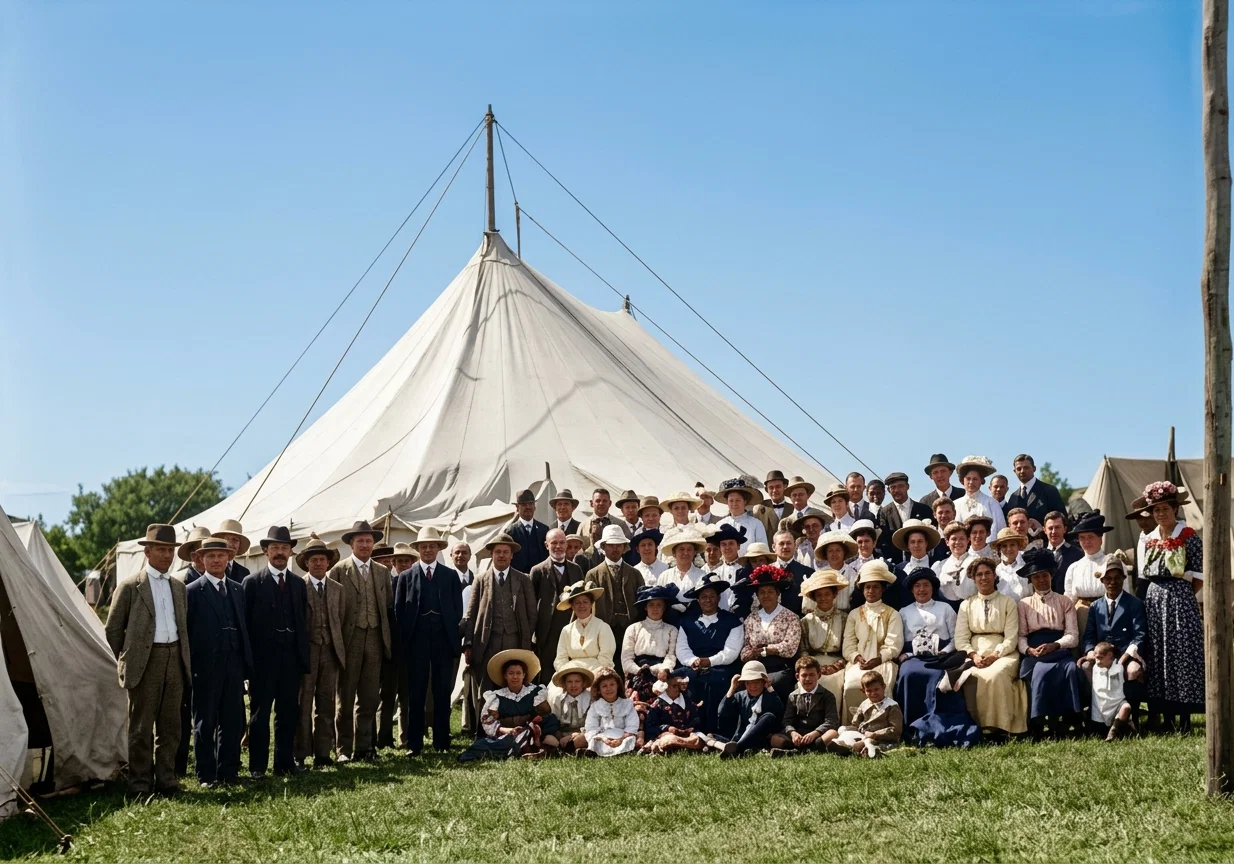
BELIEVERS ATTENDING THE GRAHAMSTOWN CAMP-MEETING
It was in Grahamstown that Elder I. J. Hankins began to preach the truth some twenty years ago, going thence to a farm about twenty-five miles from the city, and gathering into a church organization several families who had accepted the truth, and who have ever since been known as the Rokeby Seventh-day Adventist church. Five years later, Elder D. F. Tarr and the writer conducted meetings at the same place, with the result that quite a number were baptized. About two thousand persons attended that baptismal service, which was held in the public baths.
Near the cathedral, in the very heart of the city, the brethren secured a fine site for the camp-meeting. About twenty-five tents were pitched, with a fifty-by-seventy-five-foot meeting-tent and a commodious dining-tent. Besides almost all the families from the Rokeby district, many others came from a distance, and a meeting of the South African Union Conference committee was called at the same time. Thus the gathering was a very representative one. From the first it was evident that the blessing of God would be with us. The citizens were wonderfully interested in the meetings, which, as they continued, drew larger and larger numbers from the city, who took part freely in the social exercises. Day after day, every meeting seemed to lift a step higher. At the evening services the attendance reached from eight hundred to one thousand, and when we went up-town, it was with difficulty that we were able to return to the camp, owing to the interested conversations into which the people of the city would draw us. Never before have we seen such an interest in South Africa. Truly it was good! Several requests came for prayers from persons outside, and these were graciously answered. Victories were gained that were marvelous.
The response to the calls for financial help were ready and liberal; $750 was cheerfully donated for the city work of the conference, the citizens also generously giving $100 toward the expense of this excellent camp-meeting.
One of the events of the meeting was field-day, inaugurated for the campers, who in a few hours sold nearly four hundred magazines. On returning, every one reported a rich experience, and it was a matter for general regret that the city was too small to allow of more work being done.
The reports from the conference show that while the financial depression now visiting South Africa has somewhat decreased the income, the work has gone forward steadily, and good progress has been made. During the past year over seventy persons have been added to the churches by baptism, and plans have been laid for a more thorough, aggressive work in the field. The resolutions passed expressed courage and hope, and there was a spirit of harmony throughout all deliberations. Elder E. R. Williams was re-elected to the presidency, with J. V. Willson as secretary. Three new churches were added to the conference, and it was decided to continue a course of tent-meetings in Grahamstown immediately following this meeting.
Elder R. C. Porter and Mrs. Porter, Elder W. S. Hyatt and family, and the Union College faculty were present to help with their counsel. We have every reason to believe that this meeting, with all its precious experiences, will mark a new era in the work of our message in South Africa.
Pietermaritzburg, South Africa.

Turkey

ROBERT S. GREAVES
At our last general meeting it was thought best that I should leave Smyrna for a time, and make another trip to Albania, which place I have just reached, holding our first service at the town of Vostina. Our brother here has just started a small store, and has left me an up-stairs room for meetings. I have fixed it up the best I could, using a number of empty petroleum barrels for seats, covering a desk and a few special seats with our traveling blankets, and hanging our charts on the wall. Altogether, it makes a very respectable appearance.
We have a good attendance, and I must now hunt up more boxes, for all our seats were occupied last night. A Turkish policeman stayed all this evening, and another Mohammedan came in toward the close of the meeting. The rest were Jews and Greeks. My earnest prayer is for wisdom and grace, that each may hear the gospel in the way that will most appeal to him. I earnestly desire your prayers, that God's work may not be marred at my hands, but that it may appear in all its beauty to these souls who live in darkness. Much uphill work must be done, and great barriers torn down, but a comforting thought is that the gospel is the power of God. Rom. 1:16 comes to my mind over and over, and strengthens me for my work.
There is in all this country only one family of Sabbath-keepers who believe the message. But I have confidence that our work will spread rapidly, if we but trust in the Lord and go forward.
On my way here, I called at Greece, and met a new Sabbath-keeper, with whom I had been corresponding. His name had been sent to me by friends in America, who were also corresponding with him, and felt anxious that he should accept the truth. After a short time he took his stand firmly for it. He lives just outside Athens, and I believe will be a great help to us. He speaks English, has a bright mind, and, better than all else, has a consecrated heart. The prayers and good letters of his American relatives have not been without influence; as he showed me some of these letters, I felt that the Lord would bless the dear ones who had written in such a spirit of true love and Christianity. I would that all our brethren in America, who have friends in other countries, would write such letters; then our missionaries would find many open doors awaiting them.
This brother agrees with us on every point of truth, and as he wished baptism, we walked a few miles to the foot of the mountains. Near the ruins of an old monastery, we found a large stone cistern, about nine feet square, into which a pure stream of water was running, and escaping through a hole in the bottom. Formerly this cistern had been used as a reservoir by the monks. By stopping up the hole, we soon had an abundance of fresh, pure water. Here our first baptism in Greece took place, as our brother was buried with his Lord in the watery grave. A new-born creature arose, one who was filled with happiness and praise to God. This brother stands alone in Greece as a representative of the truth. Were it not that our Father carries the burden, I do not know what we could do. When in the future we see mighty things accomplished, we shall all the more willingly ascribe the praise to him whose power wins our battles and victories.
I expect to be away from home for some months, and my wife will remain in Smyrna to help our little company during my absence. We are all of good courage, for we believe the Lord has wonderful things in store for us.
Vostina, Albania.

European General Conference Committee Meetings

L. R. CONRADI
THIS meeting was held in Friedensau, March 23–25, and then from Friday till Monday (the Easter holidays) in Berlin, in connection with the first East German Union District meeting. The six union conference presidents, with W. C. Sisley and other leading workers, were all present. Besides these we had invited our medical men to hold a council with us; and Dr. A. B. Olsen from England, Dr. J. C. Ottosen and Brother Juhl from Skodsborg, and Dr. P. A. DeForest from Gland, met with the General Conference Committee and the physicians and managers of the Friedensau Sanitarium.
In one day the auditing was finished for the African missions and the Levant field. We were grateful that our tithe and offerings had increased to such an extent in Europe, and our people had responded so freely to the call for annual offerings, that we were able to meet all the extra expenses on this side of the waters. A carefully prepared report of the growth of each union and mission field in Europe for the last eight years showed the last to be our best year so far. Not fewer than 20,000 members had been added from 1902 to 1909, while the membership has increased from 8,274 to 19,626. Our gospel workers have increased from 187 to 499; our tithe from $59,000 to $194,500; Sabbath-school offerings from $4,000 to $15,000; First-day offerings from $800 to $7,800; annual offerings from $2,500 to $13,000; and sales from $103,000 to $304,000. Every union conference showed a decided increase, except the Levant Union Mission field. Our African missions, which have developed during the last few years, now have twenty workers, and during the past three years thirty-two persons have been baptized, and their tithe and offerings have increased to $1,000. All the union conference presidents desired these figures printed for the use of themselves and their fellow workers, as they plainly reveal the strong and the weak points in each field.
According to suggestions made in the recent union committee meetings, a number of resolutions were unanimously passed. Some of these are: That steps be taken to organize a new union conference soon in Russia; that the French-Belgian field be transferred to the West German Union; that the Hamburg Publishing House be encouraged to secure a building for its branch office in Riga; that the two German unions invite the General Conference Committee to hold its biennial session in Friedensau in July, 1911, and that we then make a grand rally for the great European field; that Europe raise a supplementary $10,000 to the $300,000 Fund to strengthen its educational work in the Levant, Russian, and Latin union conferences; and that the number of our workers in the African fields be increased as fast as possible.
Special attention was given to considering the needs of the mission fields under the charge of the General Conference in Europe, such as the Levant and African missions. Good, strong general meetings were planned for both the Turkish and the Syrian-Egyptian field this coming fall. Some new missionaries were selected for Africa, and it was advised to increase the number of our stations in Victoria Nyanza and among the Abyssinians. It was also decided to begin the work in Persia by sending several workers this fall to Baku, where there seems to be a favorable opening from the Russian border all along the Persian line.
While the doctors had a number of profitable meetings among themselves, the General Conference Committee also considered some important propositions with them, especially the education of our nurses and their preparation for mission fields. In the evening, large meetings were held for the two hundred students and the many nurses and other employees. Then our committee proceeded to Berlin, where a large hall had been secured in the very heart of that city; and the first night more than one thousand persons were present.
As Berlin alone had over six hundred members, and the union district of Friedensau over nine hundred, and a number also came from other conferences, there was a large company of our people at this meeting. As far as possible, we accommodated the audience in our large hall. Sunday and Monday there were no fewer than eight meetings in different parts of Berlin, various brethren filling the appointments. All the members of the European General Conference Committee appreciated these large and attentive audiences, consisting of both our own people and strangers in the very heart of this great capital.
Sabbath we had an excellent day, and one of our promising young men was ordained to the ministry. We are truly grateful to the Lord for his blessing throughout the great European Division, for the harmony which prevails in all our councils, and for the bright prospect before us; and we ask our people in the United States and throughout the world still to remember us in their prayers, and to help us in our great responsibility to give this gospel to the more than five hundred twenty-eight million people in the European Division.
Hamburg.

A Story in Real Life

THE story is of a girl, a sweet Christian girl, who lived in an Eastern village. Her father was a plain, upright, honest citizen, a deacon in the church and owner of a grocery store. In this store, like many other grocery stores, was kept a stock of tobacco.
One day the daughter was helping her father in a general rearrangement of the store, and she suggested that along with the general cleaning up it would be a good time to dispose of the tobacco stock. Her father listened kindly to the suggestion, but was afraid he would lose so much trade that he could hardly afford to make the change.
That night, in the quiet of the evening hour, he chanced to overhear Elizabeth, in her evening devotions, praying that her father might come to see more clearly the wrong he was in.
What chance step may have led him by her door at that hour, I do not know, but the answer to the prayer came swift and sure, for the first thing the next morning the whole stock of tobacco was buried in a deep pit at the back of the lot.
To-day this same man is the most prosperous business man in the town. His business has branched out into several departments, and many of his customers who “use the weed” go elsewhere to buy it, but return to his store for the remainder of their purchases, and assure him that they admire the stand that he has taken.—The Advance.

The Third Angel’s Message in Siam

So far as we know, we have no representative of the third angel’s message in Siam. Other missionaries are at work there, and doing well. There is a press in operation at Bangkok, under the direction of the Presbyterian Mission Board, where Siamese Bibles are printed. As early as 1819 a little catechism was printed in Burma, translated by Mrs. Ann Hasseltine Judson, who became interested in some Siamese captives brought to Burma as prisoners of war. There Buddhism holds sway, as that is the state religion of Siam. The Siamese are said to be a reading people, and inasmuch as the Bible is being circulated in their own language, the time is ripe for the introduction of the third angel’s message into this heathen stronghold.

The Sure Foundation

HE who introduced offense into heaven set up a foundation which God could not permit to endure. It was not composed of enduring material. Falsehood entered into every fiber, and only error could build upon it. “Every plant, which my Heavenly Father hath not planted, shall be rooted up.” “Affliction shall not rise up the second time.”
In view of the unalterable purpose of God to uproot and cast out of his universe all that partakes of the nature of that which brought offense into the universe, how important that we know his truth, and come into harmony with his purpose. Says Jesus: “Ye shall know the truth, and the truth shall make you free.” Every error clung to breeds in us other errors, and binds us by just so much to the kingdom of darkness, which is built on error.
There is spreading through the world insidiously a doctrine, expressed in various forms, but based directly on that falsehood of Satan uttered in Eden, “Ye shall not surely die: . . . ye shall be as gods.” That false doctrine teaches that we are truly a part of God — not merely his workmanship, but a very part of his essential being. Journals are printed to propagate the teaching; myriads of books are published to expound the mysteries of the new faith; it is touching a responsive chord in the hearts of many, and building up a large following. “The divinity of humanity” has come to be a favorite phrase for the tongue of many a public speaker. But the philosophy for which that and kindred phrases stand, is the philosophy with which Satan overthrew man in Eden; and through that philosophy he proposes to continue the work of overthrowing humanity. Its remarkable revival at this time in so many different quarters of the earth is a sign of the times. It is one of Satan’s last strenuous efforts to blind the eyes of the race.
In a journal called the Sun Worshipper, — not printed in India, Persia, Egypt, or the islands of the South Seas, but in the center of the United States of America, — that satanic philosophy is expounded. It teaches that man is his own savior; that in order to become free, he must learn to liberate himself; that he must find in himself the power to cure himself of sickness and sin; that everything has within itself the power of creation; and that “man is the highest expression of God.”
“Ye shall be as gods,” said Satan. Ye ‘are “the highest expression of God,” says this philosophy. In this not only is God’s Word utterly discredited; but the plan of redemption, all that God has done for man, is flatly denied, cast aside, trampled underfoot; and man is put in the place of God, to do for man that which God alone can do. This is man’s attempt to do in the earth what Satan attempted to do in heaven — exalt self. Satan said, “I will exalt my throne above the stars of God. . . . I will be like the Most High.” And man is allowing himself to be actuated by the same terrible ambition.
It is right to worship God; it is our duty so to do. But if God be inherently in us, if any part of us be God, then it would be right to worship ourselves; for in so doing we would be worshiping God. That false doctrine teaches, first, that God is in us inherently; that we are part divine, and therefore immortal. Then how logical to reason that in exalting and worshiping self, we are exalting and worshiping God. By that subtle falsehood — the divinity of humanity, God inherently in us — the worship of self takes the place of the true worship of God, and all that false and fatal system comes trailing after, overthrowing (in the minds of those blinded by it) the whole divine plan, making Christ’s life and sacrifice for us superfluous, and the Word of God “of none effect.”
That one subtle purpose has run through the work of Satan from the day he conspired against his Maker even to this present day, and will so continue until his last victim has been ensnared. His power over the minds of those who have not the mind of Christ will increase from day to day. The subtlety of his sophistry will continue to grow keener to the end. The rapid increase in the teachings of the philosophies of heathenism now proves that this is so. There has been an awakening among those false systems in the lands of their origin, and they have been rapidly spreading in lands that had not known them hitherto. They are winning their disastrous way wherever the power of God has not come in to dominate the life. The harvest of this world is rapidly getting ready for the sickle — the weeds as well as the wheat.
How gratifying it is to know that there is a defense set for the people of God; that there is a foundation on which we can rest down with the most comforting assurance. “The foundation of God standeth sure, having this seal, The Lord knoweth them that are his.” 2 Tim. 2: 19. It is time to seek God, to “watch unto prayer,” that the overspreading delusions of these last days may not reckon us among their victims. C. M. S.

Editorial

“ALL power is given unto me in heaven and in earth. Go ye therefore, and teach all nations.” No one in close touch with the Master discounts foreign missions or home missions.
First Foreign Funds. — The first appeal to us for a foreign mission fund was launched by James White in the REVIEW, Nov. 30, 1869. He called for two thousand dollars with which to aid the forty or fifty believers in Europe, mostly in Switzerland, of whom word had been brought through the coming of James Erzenberger, sent as a delegate to America to look us up.
How the Seed Was Carried. — It was by a wandering and uncertain brother, named Czechowski, that the seeds of this truth were lodged among the rocks of Switzerland, to bring forth the first fruitage of the message in Europe. After working with our people for a time in America, he joined the First-day Adventists, who sent him to Europe, where he preached the Sabbath along with the advent doctrines. And still that early planting is bearing fruit, even though later the human agent again forsook the Sabbath.
Call of Providence.— The appeal for this first foreign mission fund emphasized the special providence leading us abroad; and how often since has the way into new fields been pointed out by special providences that called us to hasten on. Elder James White wrote: —
Those who recognize the present as the period for the spread in all Christian lands of the great truths connected with the third message of Revelation 14, can hardly fail to see the providences of God in the raising up of this people in Europe. And what makes the work appear still more remarkable and providential, is that it has been accomplished independent of our agency and help. It has even been carried forward by those who take the greatest pains to oppose Seventh-day Adventists. While they were doing this, our people had not the least idea that they were raising up a body of Seventh-day Adventists. And while we acknowledge the hand of God in this, we feel humbled in view of the probabilities in the case; namely, that in consequence of our fears to trust money with Brother Czechowski, and our lack of care to patiently counsel him as to its proper use, God used our most decided opponents to carry forward the work. And while we acknowledge the hand of God in this work, in which we took no part, and feel that we have cause for humility on account of our past unfaithfulness, let us see to it that we come fully up to present duty.
IN the list of those who gave for the making up of this first foreign mission fund appear the names of many early believers who were always giving and lifting, as the calls came, until the day of their death. And some who gave then, are still giving. Did they ever regret their investments, through all the years, in the cause of God? — Nay, verily. It was a “laying up in store for themselves a good foundation against the time to come,” that they might “lay hold on eternal life.” The sacrifices made, the money given, the lives laid down in service, are all written in the books of heaven; and now to us comes the finishing of the work.

Richard Boardman’s Deliverance

AN English minister, Richard Boardman, long years ago related an experience of providential deliverance, which was printed in the REVIEW of Feb. 12, 1861:—
I preached one evening at Mould, in Flintshire, and next morning set out for Parkgate. After riding some miles, I asked a man if I was on the road to that place. He answered, “Yes, but you will have some sands to go over, and unless you ride fast, you will be in danger of being enclosed by the tide.” It then began to snow to such a degree that I could scarcely see a step of my way. I got to the sands, and pursued my journey over them for some time as rapidly as I could; but the tide came in, and surrounded me on every side, so that I could neither proceed nor turn back, and to ascend the perpendicular rocks was impossible. In this situation I commended myself to God, not having the least expectation of escaping death. In a little time I perceived two men running down the hill on the other side of the water, and by some means they got a boat, and came to my relief just as the sea had reached my knees as I sat on my saddle. They took me into the boat, the mare swimming by our side till we reached the land.
While we were in the boat, one of the men said, “Surely, sir, God is with you.” I answered, “I trust he is.” The man replied, “I know he is,” and then related the following circumstance:—
“Last night I dreamed that I must go to the top of such a hill. When I awoke, the dream made such an impression on my mind that I could not rest. I therefore went and called upon this man to accompany me. When we came to the place, we saw nothing more than usual. However, I begged him to go with me to another hill at a small distance, and there we saw your distressed situation.”
When we got ashore, I went with my two friends to a public house not far distant from where we landed; and as we were relating the wonderful providence, the landlady said: “This day month we saw a gentleman just in your situation; but before we could hasten to his relief, he plunged into the sea, supposing, as we concluded, that his horse would swim to the shore; but they both sank, and were drowned together.”
I gave my deliverers all the money I had, which I think was about eighteen pence, and tarried all night at the hotel. Next morning I was not a little embarrassed how to pay my reckoning for the want of cash, and begged my landlord would keep a pair of silver spurs until I should redeem them; but he answered, “The Lord bless you, sir, I would not take a farthing from you for the world.” After some serious conversation with the friendly people, I bade them farewell, and recommenced my journey, rejoicing in the Lord, and praising him for his great salvation. W. A. S.

Every Shoulder to the Wheel

THIS is the way to move the heavy load. In this work there come crises when every member of the church should take hold and do his utmost to help lift the burden. At various times in the past our people have nobly responded to the demand for general denominational aid to various enterprises. Some years ago the integrity of our publishing house in Norway was threatened. As one man, our people rallied to its support. It was carried through the time of crisis, and the work in Scandinavia since that time has taken on increased power. Later a call was made to assist our educational institutions, and the means whereby this could be done was provided in the sale of “Christ’s Object Lessons.” Again our people showed their loyalty to this movement. Thousands of dollars were raised for the support of our schools. They were placed on vantage-ground, and ever since have been doing a truly noble work in educating young men and women as workers in this cause.
And now there comes another call,—a call to assist our sanitariums,—and a way has likewise been provided whereby this may be done without large expense to the denomination, by the sale of “Ministry of Healing” and Life and Health. Thousands of dollars may be raised for this worthy feature of our work. By this effort, threefold good will be accomplished:—
1. By the direct help rendered to our sanitarium work, placing these institutions in a position where they can more acceptably bear their part in connection with this closing message, and do the work which God would have them accomplish.
2. By the dissemination of gospel principles in the homes of the people by the sale of these publications. This of itself will be excellent missionary work, as high an order of missionary labor as can be performed in the sale of any of our publications.
3. By the experience gained by the individual worker,—an experience in being a laborer together with God, a gleaner in the great spiritual harvest-field.
Let all respond to the rallying call in behalf of our health institutions. Let every member of the church, man, woman, and child, have a part. This call appeals to every one as a duty, as a matter of loyalty to the work of the Lord, and it appeals also as a splendid opportunity for labor for the One we love, and for the souls of our fellow men. The campaign for the relief of our sanitariums has in it a wonderful blessing to those who will take part in pushing it forward. May every reader of the REVIEW share in this blessing.
F. M. W.
Continue reading: The Responsibility of Pew and Pulpit