The Youth’s Instructor, Vol. 48, No. 42.

WORDS TO THE YOUTH

The Youth’s Instructor

Oct 25, 1900

Review and Herald Publishing Company · Battle Creek, Mich. · Oct 25, 1900

WORDS TO THE YOUTH
“Remember now thy Creator in the days of thy youth, while the evil days come not, nor the years draw nigh, when thou shalt say, I have no pleasure in them.”
Early piety insures to its possessor the full enjoyment of all that makes life happy, and will give him a right to the future, immortal life. Those who seek God early have the assurance that they shall find him. Those who wait until the span of life is almost ended before they seek God, lose a life of pure, elevated happiness,—happiness that never comes in the pursuit of the pleasures that this life affords. Those who have been long acquainted with God, who from their youth have drawn their happiness from the pure fountain of heaven, are prepared to enter the family of God.
Good and evil are set before the youth of to-day. They are left free to choose which they will. In yielding to Satan, they give up eternal happiness for pleasures which are vain and fleeting. That which he promises them they never obtain; for the path of sin is a path of sorrow.
The youth who fear God will make a conscientious use of their time. They will have firm reliance upon God, and will look to him for help when exposed to temptations which would lead them away from moral rectitude. Divine aid must combine with human effort, in order that the wily foe may be resisted. The youth who desire to become qualified for a life of usefulness must be able to resist temptation and battle against wrong. They must cultivate the mind, so that when they leave school, their time will not be spent in idleness. The heavens may be to them a study-book, from which they may learn lessons of intense interest. The moon and the stars may be their companions, speaking to them in the most eloquent language of the love of God.
God expects us to build characters in accordance with the pattern set before us. We are to lay brick by brick, adding grace to grace, finding our weak points, and correcting them in accordance with the directions given. When a crack is seen in the walls of a mansion, we know that something about the building is wrong. In our character-building, cracks are often seen. Unless these defects are remedied, the house will fall when the tempest of trial beats upon it.
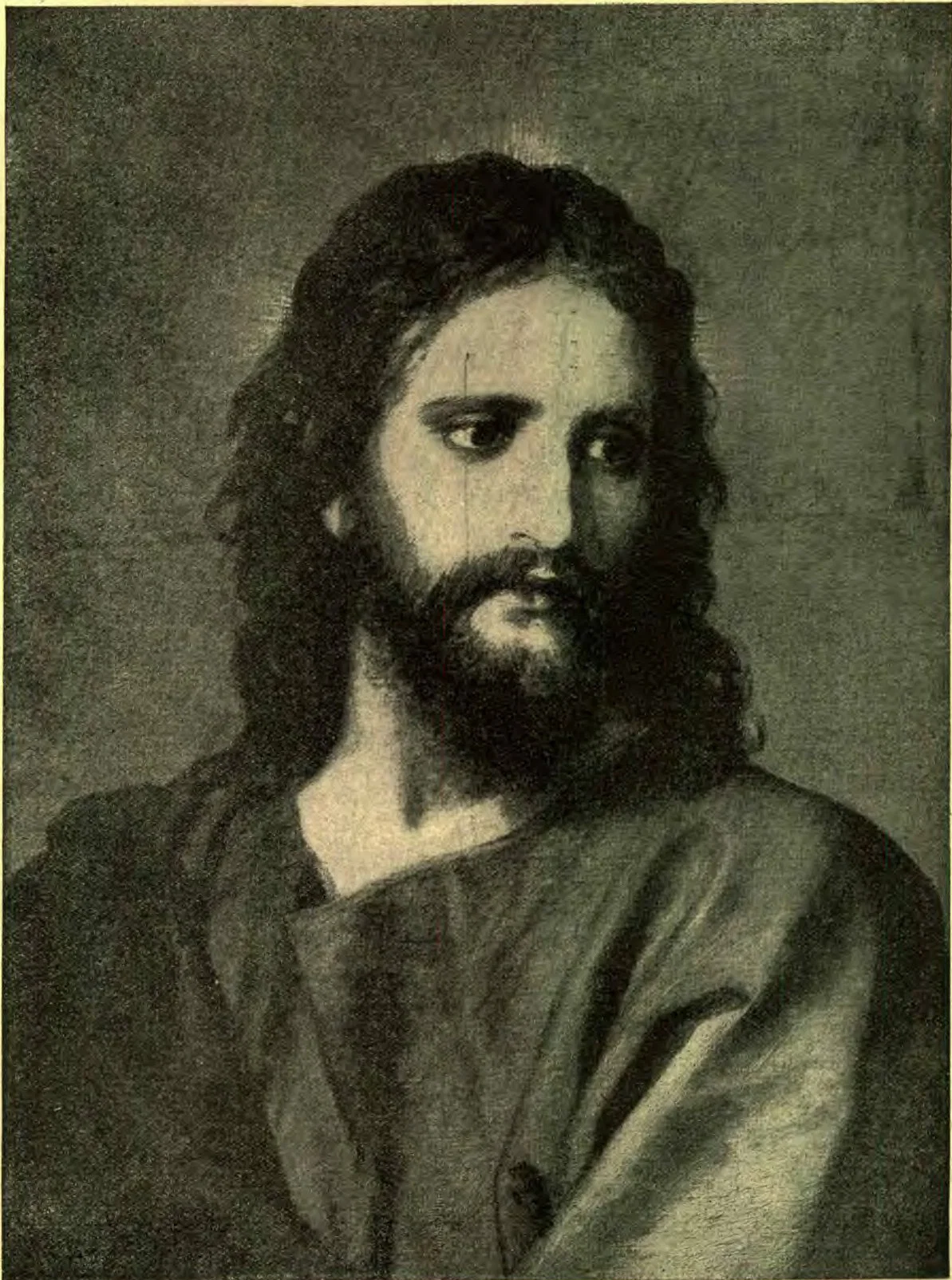
“COME UNTO ME, . . . AND I WILL GIVE YOU REST”
In the work of character-building we need the help of the Holy Spirit. Then the building will grow in symmetrical proportions. “Ye are God’s husbandry, ye are God’s building.” Keep looking to Jesus. Never seek for praise or self-glorification. Strive, by watchfulness and prayer, to build up a Christian character, perfect in all its parts. Remember that you are building for eternity. Be careful how you build. Day by day we need to realize the necessity of being converted. Do not stand on the line of demarcation, trying to balance between Christ and the world. Keep in the path cast up for the ransomed of the Lord. By beholding Jesus, you will become changed into his likeness. Your views will be enlarged. You will see the excellence of the truth as it is in Jesus. Your conceptions will be clearer. You will be imbued with the Spirit of God. You will not seek praise from men; you will exalt Christ, saying, “He must increase, but I must decrease.”
We can not afford to lose eternal life because we are not willing to separate from the world. Self must be hidden in Christ. Our sight must be filled with a view of his perfection. We must stand wholly on the Lord’s side, remembering the word, “We are laborers together with God.” God desires us to learn in the school of Christ to be meek and lowly in heart. Self is to be crucified, with the affections and lusts. There is no second probation for fallen man. Heaven is not the place for overcoming defects in the character. God says to us now: “Work out your own salvation with fear and trembling. For it is God which worketh in you both to will and to do of his good pleasure.”
But let no one think that in his own strength he can leave off sinful practices and accustomed indulgences; and then, after he has made himself good, come to Jesus. Christ says, “Without me ye can do nothing.” No man can, in his own strength, repent of and forsake his sin. It is God who leads him to repentance. All outward manifestations of repentance are vain unless God first works within. Then it is that man becomes a partaker of the divine nature. God and Christ work unitedly for the restoration of the divine image in man, furnishing him with power to distinguish between right and wrong.
Acting as our high priest and intercessor, Christ prepared and presented to God the sacrifice which paid the ransom for sin. It is Christ who draws the sinner to God, who constrains him to acknowledge the Father’s goodness and love. To those who represent the Father as a frowning Judge, whose work it is to condemn and destroy, he says: “Ye know not what manner of spirit ye are of. For the Son of man is not come to destroy men’s lives, but to save them.”
Christ has manifested himself as the way, the truth, and the life. Earnestly and untiringly he seeks to save those who are lost. No one can return to the fold without the drawing of the Holy Spirit. Christ supplies all the opportunities and privileges; and unless the sinner responds to his overtures of mercy, laying hold of the promises, he can not be saved. With every power given him, he must respond to God’s working. He must accept all the help offered. He must believe and obey. He must make the most of every opportunity, working diligently and conscientiously. As he works thus, he becomes a partner in the heavenly firm. Daily he grows in grace and in the knowledge of Christ.
Our success in perfecting Christian characters will be proportionate to the zeal and earnestness with which we seek for godliness. Every soul who enters the gates of the city of God will be like Jesus. Being good and doing good are indispensable to the perfection of character. No man lives to himself. All who gain the precious boon of immortality will follow the example of Christ, who went about doing good, who cheerfully gave up his life to ransom those ready to perish.
MRS. E. G. WHITE.

THE MAN BORN BLIND

He stood before the Sanhedrim, The scowling rabbis gazed at him; He recked not of their praise or blame: There was no fear, there was no shame, For one upon whose dazzled eyes The whole world poured its vast surprise; The open heaven was far too near, His first day's light too sweet and clear, To let him waste his new-gained ken On the hate-clouded face of men.
But still they questioned: “Who art thou? What hast thou been? What art thou now? Thou art not he who yesterday Sat here and begged beside the way; For he was blind.” “And I am he; For I was blind, but now I see.”
He told the story o’er and o’er, It was his full heart’s only lore: A Prophet on the Sabbath day Had touched his sightless eyes with clay, And made him see, who had been blind. Their words passed by him like the wind Which raves and howls, but can not shock The hundred-fathom-rooted rock. Their threats and fury all went wide; They could not touch his Hebrew pride; Their sneers at Jesus and his band, Nameless and homeless in the land, Their boasts of Moses and his Lord,— All could not change him by one word.
“I know not what this man may be, Sinner or saint; but as for me, One thing I know, that I am he That once was blind, but now I see.”
They were all doctors of renown, The great men of a famous town, With deep brows, wrinkled, broad, and wise, Beneath their long phylacteries; The wisdom of the East was theirs, And honor crowned their silver hairs. The man they jeered and laughed to scorn Was unlearned, poor, and humbly born; But he knew better far than they What came to him that Sabbath day; And what the Christ had done for him He knew, and not the Sanhedrim.
— Hon. John Hay.

THE GIRL FOR HER GUEST

To every girl who counts as hers the inestimable blessing of a home, there comes at times the joy of being hostess in it. It is a high and gracious privilege, this of taking a friend for a few days, or even a few hours, into the home—a privilege which will, if rightly and delicately used, make both lives richer. Yet how often it happens that in the rush of preparation and entertainment the finer and more delicate things are lost, and the friend who came to your door eager and expectant goes away at last unsatisfied.
Do you remember the picture of the little household at Bethany when the Master was its guest? The sisters both loved him—they both longed to do him honor. So Martha hurried about with anxious steps preparing a feast that should worthily show her love; she never thought that her nervous haste and querulous words were destroying the sweet serenity of the home, and robbing the Friend of the rest and peace for which he had come. It was Mary who, with finer instinct, let material things go, and rejecting all lesser tribute, gave the Master the gentle welcome of “a heart at leisure from itself,” ready to meet her Guest in the way of his own choosing.
It is natural and beautiful to want to do the most for our friends, and set forth our best in their honor,—to make the guest room fragrant with blossoms and loving thought, and give the flavor of a feast to the common meals. Everything that crowns friendship is richly worth the doing, though it cost much in time and thought. The danger is that, engrossed in these happy tasks, we forget to give the greatest thing,—ourself, fresh and free and unwearied.
Which shine out most golden in your memory,—the visits crowded with calls and drives and luncheons, or the sweet, sun-filled mornings out-of-doors, when you and the friend did not talk much, perhaps, but through a silence rich in revelations grew into deeper love for each other, and for all God’s wonderful world? Long, real, “deep-down” talks over some book before a winter fire, when the rain beat against the windows, and the world was shut out,—are not these the things that your love holds closest and dearest? As you think it over, you see that it is because in these illumined hours the friend gave you herself, undisturbed by careful thoughts; it is souls, not things, that count. Anything that will give your friend joy and freedom and rest, is truest hospitality; anything that takes from these, no matter what form of outward honoring it may assume, is never more than second-best.
After all, the root of true hospitality, as of every other high and beautiful thing, is unselfishness. It is “well-born souls,” as Madame Mohl says, that make friends; and surely the secret of the well-born soul is that it chooses always the real things,—the high and rare and lasting ones,—and wastes no time regretting the others.
Do for your friend what your time and money and strength will allow without strain, and no more. Could you enjoy it if you thought that any one you loved was getting tired and overwrought trying to entertain you; or that the foregoing of some real necessity paid the price of the entertainment in your honor? Take your friend into your natural home life; let her help with the dusting and mending if she wishes to. What if there are big patches on the stockings, and the dusting reveals some shabby places in the furniture? Will she love you any the less for these things? Will she not rather honor you more for counting trifles as trifles, and not worth excuse or apology? She may have beautiful clothes and rich furniture at home, but she has not you. Yourself, sweet and merry and earnest and loving, is the gift you can make her that no other can. Give her that, and you need not be ashamed, though your hands are empty, and your house is poor.—Mabel Nelson Thurston, in Well-Spring.

A GREAT CALL TO A SMALL WORK

We need not necessarily conclude, because we have been given a high calling by God, that he therefore at once puts into our hands what will appear to human eyes to be a great work.
Elijah, the great prophet, cast his mantle upon Elisha (1 Kings 19:19), thereby signifying that Elisha had received a call for a similar position. But the work that was given Elisha was to go around, and pour water upon Elijah’s hands whenever the occasion demanded. 2 Kings 3:11. Certainly, from a human point of view, this was a much smaller business than plowing with twelve yoke of oxen.
Many of the young people whom God has called into our institutions, or to engage in his work in other capacities, become very much disappointed at the apparently insignificant work that is given them to do. But neither the devil himself nor any of his agents can confine a man to an experience in life a moment after it has worked out God’s purpose upon his character. Joseph certainly was a good boy; but it was necessary for his body to be laid in iron, in order for the word of God to “purify” out of his life something that was still lurking there. Ps. 105:18, 19, Jewish translation. And when that had been accomplished, the king sent and loosed him. The proud Egyptian monarch did not possess sufficient power to keep God’s servant in bondage one moment after the prison experience had accomplished its purpose in Joseph’s life. He was to be situated where he would have the privilege of binding princes at his own pleasure—not a safe opportunity for the majority of men, unless they have first passed through the experience of being bound themselves.
Do you seem to be hedged in and bound about, with none to pity or appreciate your situation? Perhaps God is getting you ready to know how you ought to deal with others when they are similarly situated; at any rate, the experience ought absolutely to cure you of the disposition to take delight in binding others.
DAVID PAULSON, M. D.

True Heroism

There are many persons in the world, who, by some worthy and heroic deed, performed at a critical moment, are designated heroes and heroines. They are held in high esteem, honored, and courted. As we read of these illustrious men and women, a desire to do some worthy act, whereby our names may become known and honored, is aroused within us: for it is a characteristic of sinful nature to desire the praise of men.
But he who carefully studies God’s holy word learns therefrom that it is not so much deeds as motives that make men great, and for this very reason we should not exalt men. “Man looketh on the outward appearance, but the Lord looketh on the heart;” therefore only he can judge the motives. Some of earth’s greatest heroes are those of whom the world knows little. They need not necessarily be men and women; children and youth may manifest that sweet spirit of unselfishness, that determination and perseverance, which characterize a true hero. It does not take so much courage to lay down one’s life amid the excitement and inspiration of battle as to fight, daily and hourly, the relentless foe within,—constantly to crucify the uprising of self. No one but God will ever know the inward struggles of those who stand up boldly for the right, in the face of sneers and scorn.
In the battles of earth the victor is one who by physical force triumphs over his foes. He is crowned with laurels, and honors and glory follow in his wake. Not so with the Christian warrior. His greatest victories are sometimes marked by apparent outward defeat. By a quiet self-surrender, unknown to any but God, he conquers. Daily he finds opportunity for this same quiet work to go on; and although he may not win fame, glory, and honor from men, he is continually receiving the approval of Him who will crown him with everlasting honor and glory when the warfare is ended.
K. Blossom Wilcox.

A HYMN TO THE CONQUERED

I sing the hymn of the Conquered, who fell in the battle of life,— The hymn of the wounded, the beaten, who died overwhelmed in the strife; Not the jubilant song of the victors, for whom the resounding acclaim Of nations was lifted in chorus, whose brows wore the chaplet of fame; But the hymn of the low and the humble, the weary, the broken in heart, Who strove, and who failed, acting bravely a silent and desperate part; Whose youth bore no fruit on its branches, whose hopes burned in ashes away; From whose hands slipped the prize they had grasped at; who stood at the dying of day With the work of their life all around them, unpitied, unheeded, alone, With death swooping down o'er their failure, and all but their faith overthrown.
While the voice of the world shouts its chorus, its paean for those who have won,— While the trumpet is sounding triumphant, and high to the breeze and the sun Gay banners are waving, hands clapping, and hurrying feet Thronging after the laurel-crowned victors,—I stand on the field of defeat, In the shadow, ’mong those who are fallen, and wounded, and dying; and there Chant a requiem low, place my hand on their pain-knotted brows, breathe a prayer, Hold the hand that is helpless, and whisper: “They only the victory win, Who have fought the good fight, and have vanquished the demon that tempts us within; Who have held to their faith unseduced by the prize that the world holds on high; Who have dared for a high cause to suffer, resist, fight,—if need be, to die.”
Speak, History! who are life's victors? Unroll thy long annals, and say: Are they whom the world called its victors—who won the success of a day? The Martyrs, or Nero? The Spartans who fell at Thermopylae's tryst, Or the Persians and Xerxes? His judges, or Socrates? Pilate, or Christ?
— W. W. Story.

A WEARY TRAMP

The Spanish village of Lemoncito is situated about seven miles from the Carib town of Lemon. For a week we had been anchored off the coast, and contrary winds prevented our sailing on the night we had planned; so one of the men proposed that we visit the Spanish town, and see if we could buy oranges to complete the cargo. Any change that takes one on land is acceptable after being on board a small boat for a few days, so I gladly volunteered to accompany him.
Learning that the roads were muddy, we put on our oldest clothes; and taking each a native machete,—a long, heavy knife used by the natives,—we started along the beach. After passing the Carib town, we soon came to a pool of fresh water, where the women were washing. They assured us that we could wade through, which we did, the water coming up to our waists. The path was fairly good for a mile or two, but grew rapidly worse as we neared the river flats. Some of the natives had been down to the coast that same morning, and we followed their footprints in the soft mud till the trail was lost in the bog.
My companion was a large man; and being born in these parts, splashed along good-naturedly, having removed his moccasins when they became filled with mud. Tempted by the apparent ease with which he progressed, I followed his example. While my bare feet pulled out of the mud much easier than before, the ragged roots, hidden knee-deep in the soft ooze, cut my feet badly. However, there was no choice but to push on or be left behind.
Half an hour later we came to a swollen stream, red from the up-country clay. A single log, slippery with the floods that could not flow under it, spanned the stream. My companion advanced cautiously, the bridge swaying under his weight; but its hold at either end was better than it appeared, and we hastened on, walking where the mud was up to our ankles only.
We could see, by the light that came through the heavy foliage, that the sun was getting low. A splash now and then told of the movements of some disturbed alligator, but we saw none; the shadows were too deep. Parrots could be heard in the branches far above us, but they said nothing that we could understand.
Reaching higher ground, we found a plantation of plantain and bananas; also a casa, or native house. A sow and pigs were wallowing in mud at the door; and in spite of their chorus of grunts, we were made to understand, by the frizzle-headed, dried-up woman inside, that Lemoncito was only a short distance away.
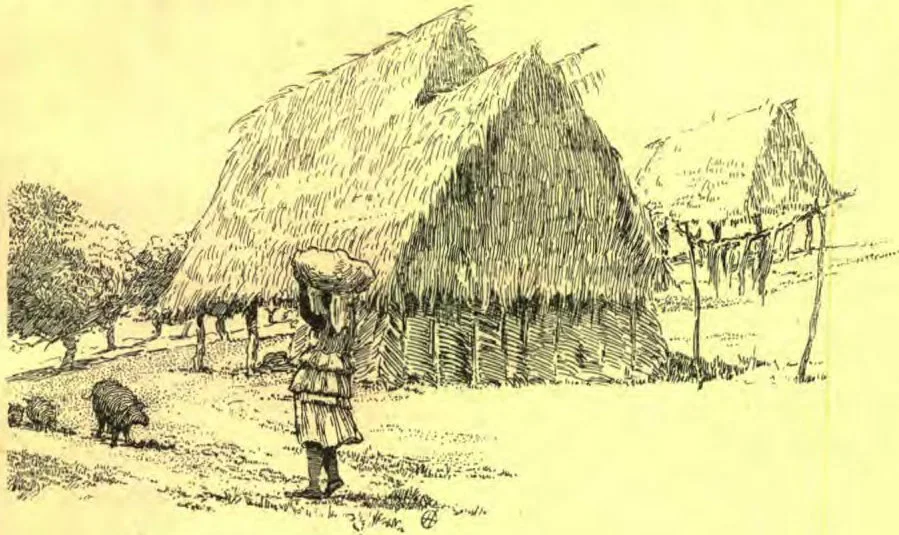
The trail led over hillocks of debris piled up by recent floods, over fallen trees, and across the stream, which was here much more swollen and swift than at the lower crossing. About sunset we came to Lemoncito. We had climbed a steep bank from the river flats, crossed a narrow ravine on a log, hewed flat on top, and now stood in an orange grove. At the right, and thirty feet below, was the stream we had just forded. The village consisted of five houses, and we approached the best one. It was a mud-walled structure, with a thatched roof. At some remote period the walls had been tinted cream-color, and must have looked very dainty; but now only the most sheltered spots preserved the hint of better days. The thatch was black with smoke and time. In the doorway stood a woman, who made us welcome. There was only one room in the house, lighted by two tiny windows and as many doors. At the left, as we entered, flickered a fire of sticks in a broken-down clay fireplace, the smoke finding its way out as best it could.
Learning that we were hungry, the village was ransacked for food, but the only thing available was green bananas. These were peeled, and put in an earthen pot with water from the muddy stream: a bit of salt was added, and, notwithstanding our protests, which were understood by the good woman as the result of reticence on our part to accept so many good things, she poured in a tablespoonful of manteka, or lard, from a soiled bottle. The oranges had only sharpened our appetites; and when, armed with an iron spoon apiece, we sat down on a low bench, with the pot between us, we ate the evening meal gratefully.
A NATIVE HOME
A NATIVE HOME
The fire was brightened after supper by adding pieces of pitch pine. In its flaring light, the villagers chatted, sang, and danced as only Hondurasians can. We sang some of the gospel songs so full of hope to them as well as us, and how my heart went out to those poor creatures! One of the younger women asked us to visit her mother, who was sick. We found her sitting on the bare ground in a wretched hut of thatch and poles, with her arms folded over her knees, to which her chin appeared to be glued. She had not straightened out her body for four years. We could give her little encouragement of a radical change in this life; but we asked the young people to clothe her warmly, also to make a bit of floor of hewn planks under her, and to inclose the hut, that she might be out of the reach of the winter storms. These things they promised to do, and the next morning they were at work on the needed improvements.
How many aching hearts, and aching bodies, too, all over the world, are waiting a word from you and me! Let us go or send help to every needy soul we can reach. H. A. OWEN.

An Unconscious Possession

UNCONSCIOUSLY we are building character. Every day, hour, and moment of our lives the structure is going up, whether we will or no, and into it are going the thoughts, feelings, and purposes that are uppermost in our minds and central in our experiences. Likewise, the possession of character is unconscious to the possessor. Many persons foolishly mistake knowledge, skill, or artistic ability, for character, and pride themselves on the thought that they possess great characters. The man who possesses the greatest character will be the least impressed with his invaluable possession; while, on the other hand, those who pride themselves on the possession of knowledge, art, culture, literature, etc., but who possess very dwarfed characters, will ever be conscious of the mistaken thought of their own greatness. The character that is truly great will not so impress its possessor, but the world will stand in awe of the attributes which have been woven into it by the unselfish life and faithful practices of its possessor. On the other hand, the one who feels so conscious of the possession of a great character will be little appreciated by the world at large, and will go through life feeling that his talents and abilities are greatly underestimated by his associates.
W. S. SADLER.

Sunshine Is Like Love

“SUNSHINE is like love: it makes everything shine with its own beauty.”

STORIES OF GREAT SONGS

The world's greatest songs are songs of duty, comfort, and trust. Those who wrote them were men and women of fervent piety and deep religious experience. Perhaps the story of how a few of these songs were written, and of the hearts they have lightened, will be new and interesting to our readers.
“Jesus, Lover of My Soul,” was written by the English scholar and theologian, Charles Wesley. One day as he sat at his desk by the open window, a little bird, pursued by a hawk, flew in, nestled in his bosom, and thus was safe. Inspired by the incident, Wesley took up his pen, and in a few minutes wrote a hymn that has stirred the hearts of millions.
With this hymn is associated a strange story. Some passengers were singing songs in the cabin of an Atlantic steamship. They had just sung, “Jesus, Lover of My Soul,” when one of them said: “This hymn has recalled to my mind a curious incident. I was a Confederate soldier. One night I was posted on sentry duty near the edge of a wood. It was dark, and very cold; and I was somewhat frightened, because the enemy were supposed to be near. At last, near midnight, miserable, homesick, and weary, I sang these lines:—
“All my trust on Thee is stayed, All my help from thee I bring; Cover my defenceless head With the shadow of thy wing.”
“After singing these words, a strange peace came down upon me; and through the long night I felt no more fear.”
“Now,” said one of the singers, “listen to my story: I was a Union soldier, and was in the wood that night with a party of scouts. I saw you standing, although I did not see your face. My men had their rifles trained upon you, waiting the word to fire, but when you sang,—
“Cover my defenceless head With the shadow of Thy wing,”
I said, ‘Boys, lower your rifles; we will go home.’”
“Rock of Ages, Cleft for Me,” was written by Augustus Toplady, an Englishman, who gave to the world some of its grandest hymns.
The story is told of a Chinese woman, who, to escape reincarnation into a dog, or pig, or perhaps a rat, sought to perform some great labor. With her own hands she dug a well fifteen feet across and twenty-five feet deep. Afterward she heard of Christ, and became a missionary. Seen in her eightieth year, after telling her story, she stretched out her poor, crippled hands, and sang,—
“Nothing in my hands I bring; Simply to Thy cross I cling.”
Among missionary songs there is, perhaps, none better known than “From Greenland’s Icy Mountains.” This was composed in 1819 by Reginald Heber, of Wales. A meeting had been announced in the Wrexham church, to aid in the spread of the gospel. New music was needed for the occasion, and Mr. Heber was asked to write it. It was late Saturday afternoon, and the meeting was to be held the following day—surely there was no time to write a poem! But as Mr. Heber sat by the vicarage window, engaged in deep thought, the whole song shaped itself in his mind, and his pen traced the words. That night it was printed, and the next day was sung by a delighted congregation.
Some years ago a number of sailors were gathered on deck of the United States frigate “North Carolina.” They were speaking of their homes, and there were found to be among them men from ten nations. The last man to speak said his home was Greenland. As he said the word “Greenland,” instantly a dozen voices, then all, joined in singing “From Greenland’s Icy Mountains.” This shows how universally the song is known.
“Nearer, My God, to Thee” was written by Sarah F. Adams, an Englishwoman. A lover of sacred music herself, this woman wrote for the world many hymns, and is said to have died while singing one of her favorites. There has been much disapproval expressed of this hymn because it fails to mention Christ. Many attempts have been made to remodel it, but with poor success.
When the battle of Fort Donelson had been fought, a drummer boy lay dying on the field, his arm shot off by a cannon ball. Around him groans and curses told of other suffering, perhaps worse than his. The boy loved to inspire men with courage. So now his clear, young voice rang out in the words of “Nearer, My God, to Thee.” The groans and curses were hushed, and wounded and dying humbled their hearts in prayer.
“For God did send his songs to earth, That they might touch the hearts of men; Teach their sad souls the world’s small worth, And win them back to him again.”
EDISON J. DRIVER.

WHOM GOD LOVES

“Blessed is the man that walketh not in the counsel of the ungodly, nor standeth in the way of sinners, nor sitteth in the seat of the scornful. But his delight is in the law of the Lord; and in his law doth he meditate day and night. And he shall be like a tree planted by the rivers of water.” Ps. 1:1-3.
Whatever the Bible says, it says to us. For no one who ever lived was the Bible any more especially written, than for the one who is reading this article. It would be just as true to read the word “boy” or “girl” into the place of “man.” “Happy is the boy that walketh not in the counsel of the ungodly.” What does this beautiful language really mean?—Well, in the first place, let us remember that it means me. I shall be blessed or happy if I do not do what is pointed out. One passage of Scripture tells us, “Blessed [happy] are they that do his commandments.” But here is happiness as the result of not doing certain things that are very contrary to the law of the Lord.
If you wish to be truly happy, do not walk in the counsel of the ungodly. Practically, that comes straight home to every boy and girl. With whom do you take counsel? To whom do you confide your plans and troubles? Whose plans and ways are you following? Are you influenced by chums and companions? If so, you are not blessed or happy.
Do not stand in the way of sinners. Do not spend your evenings on the street or your time in rude company. Do not go where sinful people love to go,—to the theater, to the card party, to the dance. Do not go where God is not honored. If you do these things, you can not be truly happy.
Do not sit in the seat of the scornful. That is frequently the back seat at church. Boys and girls who attend sacred services, and spend the time whispering, giggling, trading, writing notes, or in any other way slighting God’s word, are scorning the service of God, and insulting him. To sit with such is to be reckoned with them. No one can do so, and be blessed or happy. It is a good thing for boys and girls to sit with their parents in church.
Our associations generally determine our character. If one takes counsel with ungodly companions, stands or goes with sinful persons, or sits with those who do not reverence God, he is sure to become a godless, sinful scorner.
G. C. TENNEY.

HIS FEARS WERE QUIETED

An interesting story is told of a young man, a bank clerk in Virginia, who was intrusted with a package of bank notes to the value of one hundred thousand dollars, to carry into the adjoining State of Kentucky.
He went on horseback, and there were a number of lonely and dangerous localities through which he had to travel. He had planned to pass through these by daylight, but by some mistake he took a wrong road, and so reached the first of these dangerous regions a little after nightfall. His fears were at once aroused, and he began to look anxiously for some human habitation where he might spend the hours of darkness. A small light shining from the window of a rough mountain cabin was a welcome sight, and he drew rein, and asked the woman who appeared in answer to his call if he might remain there over night. She told him he might, saying that her husband was not then at home, but would be back later.
As the young man sat before the fireplace in the cabin, it occurred to him that perhaps the husband was one of those rough characters that infested the region, and that even then he might be engaged in some act of lawlessness.
Some time later the master of the cabin came in. His appearance was not reassuring, for he was a rough backwoodsman. The clerk’s fears grew greater and greater. He felt that his only safety lay in keeping constantly on his guard, and for that reason he declined the man’s urgent suggestion that he go to bed.
“Well, stranger,” the man said, at last, “if you won’t go to bed, I will. But we have a custom in this cabin that we never break.” Without another word, he took down from a shelf a shabby brown Bible, and prepared to read aloud a chapter from it.
The young man, who sat at the other side of the fireplace, and who had been watching his host’s every movement, was the leader of a club of young men who were proud to call themselves infidels, and who met frequently to cast scorn upon the things that others held sacred. He himself had made many a bitter attack upon the Bible, and had reviled it and those who placed their trust in its teachings. But as he saw the rough mountaineer take down the well-thumbed book, a sudden revulsion of feeling came over him. His fears fled in an instant.
“I need not be afraid of him,” he said to himself. “He will not harm me.” And when the reading and the prayer were over, he lay down quietly upon the bed which his host had assigned to him, and slept peacefully all night.
He accomplished his journey in safety, and returned to his own town. But he gave up the leadership of the club to which he had belonged, and from that time on ceased to revile the Bible.
— Young People’s Weekly.

"GARLAND" STOVES AND RANGES

were awarded highest prize at Paris Exposition, 1900.

THE FELLOWSHIP OF TOIL

I have to toil, but so did He, The lowly Nazarene, Who trod the shores of Galilee, Unruffled and serene.
I may not sit, as some men do, Behind rich palace gates, Unmindful of the beggar who Beside the pillar waits.
Each day that dawns but brings to me The same old toilsome round, The same old struggle to be free,— And night still finds me bound.
I may not have the joys I crave; The dawn but lights me to My narrow pathway to the grave, And work that I must do!
I have to toil—but so did He Who bore his cross to Calvary!
— Selected.

OUR BOY RUSSELL.

HIS CAPITAL

Two small hands ever busy; two small feet seldom still; A tongue he finds so useful it rests but while he sleeps; Two bright eyes opened widely, gathering in their fill; A sturdy little body, that daily upward creeps; Two little keen ears listening to laughter, song, and sighs: And, in his inmost temple, linger the Sisters three— Faith, with a clasp firm, steady; Hope, with the clear, bright eyes; And she of the years eternal—tenderest Charity.

HIS POSITION

Safe in the dear home-cloister, under love’s sheltering wing, Tenderly watched and guarded, taught at a mother’s knee, Nothing knows he of life’s tempest, naught of its pain or sting, Pride and joy of the household, and heir of the kingdom, he; “For unless,” said the loving Master, in that day so long ago, His tender hand in blessing on the dark curls’ clustering grace, “Ye shall become as children, trusting, and pure as snow, In my Father’s heavenly kingdom ye shall not find a place.”

HIS PEDIGREE

Pedigree? Well, what matter? We tread one common soil; Alike we shrink from darkness, and joy in the light of day; And when this life is over, kings and the sons of toil, Treading one after another, we go the common way.
Still, here is his Elder Brother’s,—His who once vanquished death,— And this little lad’s is like it, Prince of the Royal blood; For as the Scripture readeth: “Which was the son of Seth, Which was the son of Adam, which was the son of God.”
ELIZABETH ROSSER.
Continue reading: WHICH GOT AHEAD?