The bell had rung twice, very loudly; and Mrs. Stimson, who happened to be up in the garret looking over rags, hurried down to the door, thinking it must be something very important. For a moment she did not see any one at all, and she looked about in surprise. Then a voice spoke close beside her, and Mrs. Stimson jumped.
“Would you like to have all the weeds pulled out of your lawn?” the voice said, and another sweeter voice added, “It will cost but ten cents.”
There were really two persons at Mrs. Stimson’s door, but they were so small that at first she had looked right over their heads. Mrs. Stimson smiled, and glanced at her lawn, where the weeds had got a good start. Then she looked at the boys.
“It needs weeding badly enough,” she said, “but it’s quite a good deal of work. Don’t you think you’ll get tired before it’s done?”
“No’m,” said both voices at once, and the boys set to work without delay. Mrs. Stimson watched them smilingly a moment before she went back to her rags. George had often pulled weeds before. Willy never had. He fluttered from one to another like a big butterfly. When he hurt his hands, he looked at the red marks on the soft palms, and said, “Ow!” But in spite of this he was enjoying himself. His face was bright with smiles, and the little curls on his head bobbed about as if they liked it too. For several weeks Willy had been saving his money for something that was a secret. George would have liked to know what that was, but he was too proud to ask any questions.
A strange feeling was creeping into George’s heart as he worked. He said to himself that he was very foolish to ask Willy to come along. “I can work twice as fast as he can,” thought George, which was quite true. “I might have done it all myself, and got ten cents instead of five.” George was saving his money to buy a hat and ball. There was no secret about that.
“Aren’t you tired, Willy?” he said, by and by. “Because you’d better not work any more if it’s too hard.”
“I like to get tired,” said Willy, raising his flushed little face, and smiling bravely.
“AND THIS LITTLE LAD’S IS LIKE IT — PRINCE OF THE ROYAL BLOOD”
“Five cents isn’t much, anyway. You’ve got such a lot of money in your bank I shouldn’t think you’d care for any more,” said George, who had not learned that the more money people have, the more they want, as a general thing.
“I want five cents more,” and Willy smiled happily, “and then I am going to buy something. But it’s a secret.”
George looked cross. He was getting tired of Willy’s secrets and of Willy himself. And then such a mean, unmanly thought whispered to his heart that he would not have listened if he had stopped to think. But as other people do sometimes, he spoke without thinking.
“Say, Willy, if we had a rake, we could work a lot faster.”
“I could get our rake, but it’s an awful long way to my house. Maybe the lady that lives here has got one.”
“I don’t believe she has,” answered George, quickly. “You’d better go home for yours. You needn’t hurry, you know, ’cause it’s so hot.”
After Willy had gone, George worked very fast. His face grew flushed, from stooping, and he breathed fast, as if he had been running. Altogether he felt very uncomfortable, and he said to himself that it was because he was hot and tired.
When he rang the bell again, Mrs. Stimson brought her pocketbook to the door. “Oh, the other boy went home, did he?” she said.
“Yes’m,” answered George. His voice dropped down into a whisper.
“I thought he’d get tired and give up,” said Mrs. Stimson. “He’s such a little fellow.” Then she dropped a shining dime into George’s hand, and he hurried away, almost forgetting to say, “Thank you.”
People usually can find excuses for their own wrong-doing. George found a great many for what he had done. He told himself that Willy had worked only a little while, and that very likely he got to playing when he went for the rake, and never came back at all. Mrs. Stimson must have thought he deserved all the money, or why had she given him a dime? But after he went to bed, he found himself thinking of Willy’s happy face as he pulled up the weeds, and of his smile as he started away to get the rake. What could he think except that his friend was a cheat?
George’s father and mother had gone to a lecture that evening; and when they returned, about ten o’clock, they were surprised to find George sitting on the stairs, dressed and waiting for them.
“I want to go over to Willy’s,” he said, and his voice sounded as if he had been crying.
“To Willy’s! at this time of night!” his mother exclaimed, and his father asked, gravely, “What is the trouble, my boy?”
George explained, though it was not easy to tell the story; and before he had finished, his father had taken up his hat again. “You are right, George,” he said. “This should be settled to-night. You must not wait even till morning.”
Willy’s father and mother had gone to the lecture, too, and they had barely reached home when George and his father came. Willy’s mother seemed to understand George’s errand almost before he spoke it.
“Oh, yes, that five cents,” she said. “I told Willy you would bring it over either to-night or to-morrow morning. Thank you very much.” And George’s cheeks burned over her thanks.
It was still worse next day when Willy made his appearance with a long, queerly shaped package in his arms.
“It’s for you,” he explained, joyfully. “Because I didn’t have any money when it was your birthday.”
It was the longed-for hat and ball. George gasped as if some one had struck him. Then he pushed the gift away, and looked at Willy.
“I never meant to bring you that five cents yesterday,” he said. “And I sent you away on purpose. I was trying to get ahead of you. I meant to cheat.” There was a choke in his voice. He felt as if he hated himself.
“But I want you to have it,” pleaded Willy, in distress. “I’ve been saving my money for so long. And you won’t ever try to cheat anybody again.”
“Well, I guess not,” George answered. “I’ve had enough of that.” And he meant every word. That was the last time he ever tried to get the better of people by unfair means. But more and more, as the years go by, he practices the way Willy taught him,—the way of kindness and love.—Selected.
BEREAN LIBRARY STUDY
Revelation 3: “Thoughts on Revelation,” pages 363-383
NOTES ON LESSON 3
(October 28 to November 3)
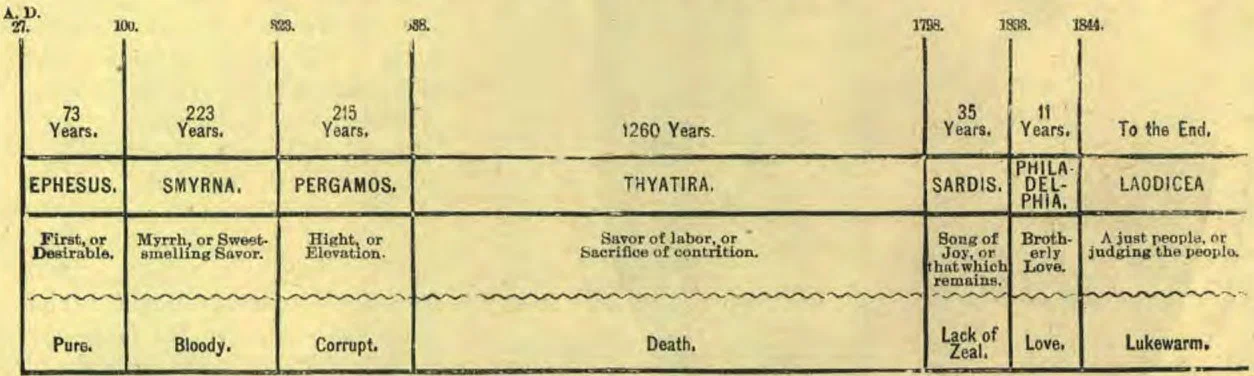
We hope all our young people will carefully study the accompanying diagram of the seven churches, until the definition of their names, and the period of time covered by each, are indelibly stamped upon the mind.
Sardis.—This church came out of the long, dark night of papal persecution with a song of rejoicing; but found that the furnace of affliction was more conducive to spiritual growth than ease and prosperity.
Book of Life.—The overcomer will have his name retained in the book of life. “We should be careful as to what kind of record passes up to heaven concerning our daily lives; for God is no respecter of persons, but will render to every man according to his works. The Judge of all the earth will try every man’s case. . . . He who has offered salvation to the sinner will one day judge the thoughts and deeds of all who stand before him. . . . Gold and silver will not be a sufficient ransom in that day; nothing but the merits of the blood of Christ will suffice to wash out the guilty stains from the hearts of men.”
An Open Door.—The preaching of the first angel’s message during the Philadelphian period of the church carried God’s people down to the time when Christ entered the most holy place of the heavenly sanctuary. Christ entered, as our forerunner; and he calls to his people on earth, struggling amid trials and temptations: “Behold I have set before thee an open door, and no man can shut it.” No matter how many may tempt and entice us to sin, it is beyond human power to shut the door. No man can cheat us out of eternal life: Christ holds the door open, and bids us to enter, and by faith daily walk in the light of the sanctuary. It is our privilege to keep our souls anchored within the veil. Whenever we see an open door, it should remind us of that heavenly door beyond the power of man to close, through whose open portal the Saviour calls to us, “Be of good cheer; I have overcome the world.” “Look, oh, look to the open door, which God hath opened, and no man can shut!”
The Heavenly Merchantman.—The voice of the True Witness calls to his chosen people: “As many as I love, I rebuke and chasten: be zealous therefore, and repent. Behold, I stand at the door, and knock: if any man hear my voice, and open the door, I will come in to him, and will sup with him, and he with me. To him that overcometh will I grant to sit with me in my throne, even as I also overcame, and am set down with my Father in his throne. He that hath an ear, let him hear what the Spirit saith unto the churches.” We have tried to arouse our brethren to the fact that the Lord has rich blessings to bestow upon us as a people. The people of God have lost much by not maintaining the simplicity of the truth as it is in Jesus. This simplicity has been crowded out; and forms, ceremonies, and a round of busy activities in mechanical work have taken its place. Pride and lukewarmness have made the professed people of God an offense in his sight. Boastful self-sufficiency and complacent self-righteousness have masked and concealed the beggary and nakedness of the soul; but with God all things are naked and manifest. Yet Jesus is going from door to door, standing in front of every soul-temple, proclaiming, “I stand at the door, and knock.” As a heavenly merchantman, he opens his treasures, and cries, “Buy of me gold tried in the fire, that thou mayest be rich; and white raiment, that thou mayest be clothed, and that the shame of thy nakedness do not appear.” The gold he offers is without alloy, more precious than that of Ophir; for it is faith and love. The white raiment he invites the soul to wear is his own robes of righteousness, and the oil for anointing is the oil of his grace, which will give spiritual eyesight to the soul in blindness and darkness, that he may distinguish between the workings of the Spirit of God and those of the spirit of the enemy. Open your doors, says the great Merchantman, the possessor of spiritual riches, and transact your business with me. It is I, your Redeemer, who counsels you to buy of me.—Review and Herald, Aug. 7, 1894.
BULBS FOR WINTER WINDOWS
By W. S. Chapman
WHAT shall you purchase? You have the following list to select from: Freesias; tritilias; chionodoxies; sparaxis; oxalis; Roman, grape, and Dutch hyacinths; alliums; narcissus; tulips; crocus; and callas. Do not try to have too many varieties, unless you have had experience in growing bulbs, but there will be no harm in having enough of a few varieties so that you can have a succession of bloom all winter and in the spring.
Hyacinths, tulips, and crocuses will stand the heat of living-rooms, but narcissuses and freesias require a cool and moist atmosphere. Dry heat is death to bulb blooms. Have water evaporating on the stove continually after the buds and blooms appear. Use small pots of five or six inches, and soil that is one part sand and two parts rich earth. Put in good drainage and several lumps of charcoal. Plant only solid, well-developed bulbs, and press well into the soil. Scaly bulbs, such as hyacinths, plant so that the tips protrude above the soil. All solid bulbs, like tulips, plant deeply, at least two or three inches below the surface. After planting, soak the pots thoroughly in a tub of water, then store away in absolute darkness for not less than six or eight weeks, that the pots may fill with roots before the stem starts to grow; otherwise your whole effort will be a failure. You will gain time, and insure success, by patiently waiting. James 5:7.
The storing-place must be free from too much dampness, and be warm—a closet or a frost-proof cellar. The best way to plant tulips is in a grape-basket, first lining with moss. Try this method; you will be pleased. In fact, all bulbs may be planted in this way if you prefer. In this shape they are easy to handle, can be placed in positions where a pot could not be permitted, and will have a very pleasing appearance. Do not allow the top soil to become dry while the pots are stored away; also avoid allowing the earth to become “sloppy,” as this will produce rot. A good plan is to keep damp moss or a piece of wet flannel over the top of the pot.
Bulbs planted in the garden are making roots all winter. This action is imitated by keeping pots of bulbs in a dark place, and there they can remain for several months without injury, if kept moistened. Bring a pot occasionally to the light, after it has been in the dark for six or eight weeks, thus insuring a succession of blooms all winter and in the spring. Bulbs planted in October can be blooming toward the last of December; and from that time on, by judicious management, blooms can be obtained regularly.
When the pots are brought out, do not set them at once in a strong light. Place on the floor under a window, or at a north window for a week, and bring gradually into the clear light. As buds and blooms come, protect the plants from the sun, and be sure to turn the pots frequently, so that an even growth may be assured.
Hyacinths, when brought out of the dark, must be forced to grow a tall stem, or they will be a failure. For this reason make a cone of paper, and put over the pot; better still, invert an empty pot over the one holding the bulbs, so that the only light comes through the hole in the bottom of the inverted pot; let it remain on the pot until the buds begin to form, then give full light. If the buds open unequally, expose to strong artificial light. W. S. CHAPMAN.
DON’T BE TOO TENDER
Don’t be too swift to take offense. Many times the shot is not aimed at you. Don’t cry before you are hit. But if you are hurt, bear the pain in silence. Don’t tell it. Don’t parade it before others. Suffer in silence, and wait God’s time to right the matter. Learn to suffer for Christ’s sake. You can get the victory over the devil by not talking about your injured feelings. He likes you to speak of them often; for your so doing adds fuel to the fire. “For Christ’s sake” lightens many burdens, and makes it much easier to suffer.—Selected.
THE SPIRIT OF PRAYER
By R. C. Trench
If we with earnest effort could succeed
To make our life one long, connected prayer,
As lives of some, perhaps, have been and are;
If, never leaving Thee, we had no need
Our wandering spirits back again to lead
Into thy presence, but continued there,
Like angels standing on the highest stair
Of thy great throne,—this were to pray indeed:
But if distractions manifold prevail,
And if in this we must confess we fail,
Grant us to keep at last a prompt desire,—
Continual readiness for prayer and praise,—
An altar heaped, and ready to take fire
With the least spark, and leap into a blaze.
—R. C. Trench.
The relation of the law to the promises is still the subject in this lesson; so we can profitably review nearly the whole of last week’s lesson. Do not neglect to read the chapter several times during the week. Such review work will serve to impress more deeply the lessons already learned, and also give a connected idea of the subject as a whole.
QUESTIONS
1. By what does the inheritance not come? How did God give it to Abraham? V. 18.
2. What purpose did the law serve? V. 19. What has the law to do with transgression? Rom. 3: 20. By whom was it ordained? In the hand of whom? Gal. 3: 19. What does this show? Note 1.
3. What question is asked concerning the law and the promises? What is the answer? V. 21, first part; note 2.
4. In what case only could righteousness have been by the law? V. 21, last part. To whom alone can the law give life? Lev. 18: 5. Why can not the law give life to men? Rom. 3: 23; 6: 23; note 3.
5. What has the Scripture done? Gal. 3: 22. What portion of the Scripture points out sin? Rom. 3: 20. Why does the law shut men up under sin? Gal. 3: 22, last part; note 4.
6. What was our condition before faith came? Unto what were we shut up? V. 23. What, then, is the object of the law? Note 5.
7. To what is the law compared? To whom does it bring us? For what purpose? V. 24; note 6.
8. After faith is come, what is our condition? V. 25. Whose children, then, are we? How do we become children of God? V. 26. Are we therefore released from obedience to the law? Note 7.
NOTES
1. “From his right hand went a fiery law for them. Yea, he loved the people.” Deut. 33: 2, 3. Though the law was given amid thunders and devouring fire, it was not intended to oppose the promises of God. Rather, it was given that it might reveal the sins that would separate souls from God unless removed. And when the heart is cleansed from sin, the law witnesses to the righteousness of the life of faith.
2. “Is the law then against the promises of God? God forbid.” This is the reading of our common version; but the answer, “God forbid,” is not an exact translation of the original. It might be translated, “It is not.” In form, it is an emphatic denial.
3. The commandment was ordained to life. Rom. 7: 10. But life is found only in the way of righteousness. Prov. 12: 28. Since man has sinned, the law can condemn him only as long as he seeks righteousness by the law.
4. The Revised Version of this verse reads, “Howbeit the Scripture hath shut up all things under sin,” etc. This expresses the idea more forcibly. Men are shut up by the law, like criminals who are confined in jail. But the law shuts men up under sin, not that they may be kept there; but “that the promise by faith of Jesus Christ might be given to them that believe.”
5. Again the reading of the Revised Version adds force to the thought. But before faith came, we were kept in ward under the law, “shut up unto the faith which should afterward be revealed.” The law holds men in its firm grasp, that they may be led to seek deliverance from its condemnation. This deliverance Christ freely offers to all who will receive him by faith.
6. The word translated “schoolmaster” means rather a guardian, who had the charge of a boy, and conducted him to school, to see that he did not run away. So the law leads us to Christ, “that we might be justified by faith.”
7. The pedagogues, or guardians, had charge of boys before the boys became of age. Grown men had no such guardians over them. So when we come to Christ, we become free men in him. “Being justified by faith, we have peace with God.” The law no longer condemns us. We walk at liberty because we are brought into harmony with the law.
THE STILL HOUR
By Mabel Earle
The hills are hushed with holy dawn,
The light grows fair beyond the sea;
Here unto peace and prayer withdrawn,
O Saviour! let me come to thee.
The silence of this hour must cease
In crowded street and busy mart;
Yet keep thou all this day thy peace
Pure, in the temple of my heart.
Clouds shall be dark in yonder sky,
Yet keep my life bright with thy grace;
Though sun be hidden by and by,
Yet hide thou not from me thy face.
The glory grows beyond the sea,
The sunrise opens, clear and wide.
O Light of light unknown! in thee,
From dawn to even, let me bide!
—Mabel Earle.
CHICAGO & GRAND TRUNK R'Y
E. W. Meddaugh and Henry B. Joy, Receivers.
CHICAGO & GRAND TRUNK R'Y.
Trains leave Battle Creek.
WEST-BOUND FROM BATTLE CREEK.
No. 9, Mail and Express, to Chicago — 12.15 P. M.
No. 1, Chicago Express, to Chicago — 8.30 A. M.
No. 3, Lehigh Valley Express, to Chicago — 3.50 P. M.
No. 5, International Express — 2.15 A. M.
No. 75, Mixed, to South Bend — 8.30 A. M.
Nos. 9 and 75, daily, except Sunday.
Nos. 1, 3, and 5, daily.
EAST-BOUND FROM BATTLE CREEK.
No. 8, Mail and Express, East and Detroit — 3.45 P. M.
No. 4, Lehigh Express, East and Canada — 8.27 P. M.
No. 6, Atlantic Express, East and Detroit — 2.25 A. M.
No. 2, Express, East and Detroit — 6.50 A. M.
No. 74, Mixed (starts from Nichols) — 7.15 A. M.
Nos. 8 and 74, daily, except Sunday.
Nos. 4, 6, and 2, daily.
G. W. VAUX,
G. P. A., CHICAGO.
W. C. CUNLIFFE, Agent,
BATTLE CREEK.
Subscription Renewal Notice for November 1900
By Editor
NOVEMBER, 1900
If the yellow address-label on first page of this paper, or on the wrapper, bears this month and year (John Brown 1/3, 1900), it indicates that the following blank should be filled out by you now, and mailed to Review and Herald, Battle Creek, Mich., before the end of this month:—
Inclosed find $........ (money-order, express order, registered letter, or bank draft), for which please send ...... copies of the YOUTH’S INSTRUCTOR ...... months to above address.
P. S.—If you object to clipping this out of your paper, or wish to forward other subscriptions, please write names and full addresses on a separate sheet, stating amount inclosed for that purpose.
Our Premium Testament
By Editor
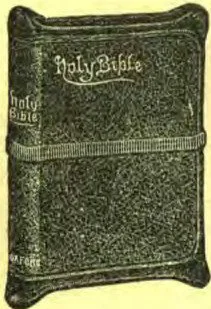
As an aid to daily Bible study, and to memorizing the Scriptures, there is nothing better than a pocket-edition. We have secured a beautiful Vest-pocket New Testament, size 4 x 2¾ in., that we offer, postpaid, with the INSTRUCTOR one year, for only $1.00. Well printed, in ruby type, as shown: Flexible Covers, Round Corners, Red under Gold Edges,—a splendid little book.
St. Matthew, 13.
42 The queen of the south shall rise up in the judgment with this generation, and shall condemn it: for she came from the uttermost parts of the earth to hear the wisdom of Solomon; and, behold, a greater than Solomon is here. 43 When the unclean spirit is gone out of a man, he walketh through dry places, seeking rest, and findeth none. 44 Then he saith, I will return into my house from whence I came out; and when he is come, he findeth it empty, swept, and garnished. 45 Then goeth he, and tak-
50 For whosoever shall do the will of my Father which is in heaven, the same is my brother, and sister, and mother.
CHAPTER 13
3 The parable of the sower, and the seed: 18 the exposition. 24 The parable of the tares, 31 of the mustard seed, 33 of the leaven, 44 of the hidden treasure, 45 of the pearl, 47 of the dragnet. 53 Christ is contemned of his own countrymen.
THE same day went Jesus out of the house, and sat by the sea side. 2 And great multitudes were gathered together unto him, so that he went into a ship, and sat; and the whole multitude stood on the shore.
This offer is made to both renewals and new subscribers. Address—
THE YOUTH'S INSTRUCTOR,
BATTLE CREEK, MICH.
The MODERN WEBSTER'S
Pronouncing and Defining Dictionary of the English Language.
SIZE, 5¼ x 4¼ INCHES
THIS dictionary includes English words in common use, collection of classical and modern words and phrases and maxims, and instruction in proofreading.
In its compact form it has a thoroughness and clearness of its own, and is especially adapted to the use of students, and in the library, office, and home.
We will send the YOUTH'S INSTRUCTOR one year with this dictionary bound in stiff silk cloth, indexed, postpaid, for $1.10; or, we will send the INSTRUCTOR one year, with same book, limp cover, not indexed, for $1.00. This offer applies to both new subscriptions and renewals. Address—
THE YOUTH'S INSTRUCTOR,
Battle Creek, Mich.
SELF-PRONOUNCING S. S. TEACHERS’ REFERENCE BIBLE
By Editor
CONTAINS the celebrated _Teachers’ Helps_, comprising nearly 400 pages. Also a complete series of fifteen new maps.
_Description._—Imperial Seal Binding, Tuck Edges, known as “Divinity Circuit,” Rounded Corners, Full Red under Gilt Edges.
We offer this Bible, postpaid, for only _six new yearly subscriptions_ at 75 cents; or _twelve new six months’ subscriptions_ at 40 cents.
We will also send it, postpaid, with the INSTRUCTOR one year for $2.25. For 20 cents extra we will stamp your name in gold upon the cover.
Address—
THE YOUTH’S INSTRUCTOR, Battle Creek, Mich.
JUDGE NOT
EVERY one has read, in some form, the story of the two travelers, who, coming from opposite directions, drew up at an inn, and fell into a dispute over the sign hanging out in front. One declared it was gilded; the other maintained that it was silver; tempers were lost, hard names called; and the war of words was about to end in a personal struggle when a third man appeared, and called the travelers' notice to the fact that on one side the sign was silver, and gold on the other. So, feeling very foolish, no doubt, the men put up their swords, and went inside. But perhaps they had learned not to be so hasty in judgment; if so, they had acquired a lesson that other travelers along life's highway will be wise to make their own.
We are so liable to judge of a matter when seeing only one side of it; and, trusting in the evidence of the senses, to declare that it is thus and so because we have “seen it with our own eyes,” “heard it with our own ears,”—in short, we “know.” The fact is that nothing in the world is more common than to err in judgment, even concerning things that can be seen. How much easier, then, to misjudge the motives of others, even those we know most intimately; and when the matter concerns those whom we know but slightly, or only by hearsay, the liability to mistaken judgment is greatly increased. It has often been observed that of a number of persons hearing the same sermon, or lecture, or story, each will go away and give a different version of it. No two persons, in reading a description of some beautiful scene, will be likely to receive the same mental picture; and it is doubtful if either sees what the writer was trying to describe: each brings to his understanding the influence of his own environment and association and education. So in reading an article, a poem, a letter, in thinking of the words and acts of those about us, let us not be swift to criticize, or blame, or take offense: it is so natural to read our own feelings into another's words, to attribute to him the motives which might have been ours, had we been in his place, but which, perhaps, he never dreamed of.
Some of the most solemn and terrible warnings in the Bible are spoken on this very matter. How slow we should be to assume a position and work that the Son of God himself refused—that of judge! “I judge no man,” he said; “for I came not to judge the world, but to save the world.” One can not be at the same time an advocate and a judge, and he is our “Advocate with the Father.” How much more fitting for his professed disciples to follow his example, and “judge not at all.”
WHAT THEY SAY OF THE INSTRUCTOR
FRANK WALCOTT HUTT, in The Editor: “A very bright and progressive paper.”
When sending her subscription for the INSTRUCTOR, Effie M. Thompson, Traver, Cal., writes: “I can not be without it longer. I enjoy it very much.”
Rosa Hewitt, Mineral, Ohio, renews a club of five copies, and says: “Our children as well as the older members of the family enjoy reading the paper. May God bless it in its work.”
Sister Kate L. Macey, former secretary of the Michigan Sabbath-school Association, says: “It seems to me that the paper is continually improving; and I pray God may ever supply wisdom and courage to those in charge of it, that it may continue to be what he desires in these days when pure literature is so rare, and other kinds so plentiful.”
Brother Pedro Lemos, of Oakland, Cal., says: “I feel that the INSTRUCTOR is doing a grand work. It only needs comparison with other religious weeklies and magazines, which are filling their columns with fiction and nonsense, to prove its superior quality.”
Notes and Comments
By A. J. Bourdeau
An Expensive Voyage.—A few days ago Andrew Carnegie, the steel magnate, secured passage on the Atlantic steamship “Deutschland,” paying the large sum of eight thousand dollars for his passage and that of his party. This is believed to be the largest amount ever paid by a family party for passage on an Atlantic steamship. The “Deutschland” is said to be crowded most of the time.
Another Submarine Cable.—A new cable, the fifth, is soon to be laid between England and Germany. It is said that “a comprehensive idea of the increase in the cable traffic between the two countries may be gathered from the fact that whereas, in 1896, when the fourth cable was laid, the annual number of cablegrams was 1,867,868 a year, no fewer than 2,465,613 cablegrams are now annually transmitted.”
Excellent Advice.—The following suggestions, from the pen of a well-known physician, are worth heeding: “If you get angry, take a bath, and go to bed and to sleep; if the world abuses you, take extra sleep; if you are dyspeptic and discontented, take a long, sound sleep, and, waking, you will find that all the world is smiling. Nothing so tends to insanity, and nothing so deranges and harms the brain-cells, as lack of sleep.”
A Kite Suggestion.—“How great is the effect of wind pressure on a kite sailing in a stiff breeze,” says the Scientific American, “every boy knows who has ever felt the strong and steady tug on a flying line. But wind-pressure, besides exerting a great strain upon the line, also prevents the kite from attaining a position directly overhead. In meteorological work, it has therefore been necessary, as a rule, to use lines of great length, in order that the kites, with their freight of recording instruments, could reach the height desired. At most of the observatories, however, a device is used to lessen the strain on the lines and to permit the kite to assume a position more nearly at right angles to the horizontal. This device is so simple that any boy can make and apply it to his own kite. In the lower part of the bridle of the kite, a strong, elastic band is inserted, provided with a retarding string, to prevent the expansion of the band beyond the breaking point.” The effect of this rubber band is to absorb much of the strain, and thus allow the kite to fly directly overhead. The dimensions of the Malay kite, thus bridled, are as follows: length of long frame-stick, seventy-seven inches; length of cross frame-stick, sixty inches; distance from head, or peak, of kite to point of crossing of crosspiece of frame, eleven inches, or sixty inches from lower peak, or end, of kite. The bridle is attached to the kite at the place of crossing of frame-sticks, eleven inches down on the seventy-seven-inch frame-stick, and the other end of the bridle is, of course, attached to the lowest extremity, or peak of the kite, where the tail is usually attached on other kites. The flying line is attached to the bridle at a distance of fifty-one inches from the bottom of the kite, and at a distance of thirty inches from the upper point of attachment of the bridle to kite, thus making the upper leg of the bridle thirty inches long, and the lower leg, or the one leading from the flying line to bottom of kite, fifty-one inches long. The rubber band is inserted in the part of the bridle going from the lower end of kite to the flying line, about twelve inches from bottom of kite. For a fuller description of the Malay kite, consult your encyclopedia. A. J. BOURDEAU.
FOR EVERY DAY OF THE WEEK
Sunday:
“Open the heart to the divine will, and it will be filled with the divine peace.”
Monday:
How easily the praises come
When prayers are answered as we would!
But oh, how faltering the strain
That claims Thee “Father,” hails thee “good,”
When our heart’s wish returns again
Void, and thy loving lips are dumb!
—G. H. Bottome.
Tuesday:
Duty looks at life as a debt to be paid; love sees life as a debt to be collected. Duty is constantly paying assessments; love is constantly counting its premiums.—Selected.
Wednesday:
In the hour of trial,
Jesus, plead for me,
Lest by base denial
I depart from thee;
When thou seest me waver,
With a look recall,
Nor for fear nor favor,
Suffer me to fall.
—J. Montgomery.
Thursday:
The only real growth is inner growth. It is vain to rise in the sight of men if we are not growing before the eye of God.—Forward.
Friday:
The trivial round, the common task,
Would furnish all we ought to ask—
Room to deny ourselves; a road
To bring us daily nearer God.
Oh, could we learn the sacrifice,
What lights would all around us rise!
How would our hearts with wisdom talk
Along life’s dullest, dreariest walk!
—John Keble.
Sabbath:
“Him that overcometh will I make a pillar in the temple of my God, and he shall go no more out: and I will write upon him the name of my God.” Rev. 3:12.