The Youth’s Instructor, Vol. 54, No. 43.

The Haystack Centennial

The Youth’s Instructor

Oct 23, 1906

Review and Herald Publishing Assn. · Takoma Park Station, Washington, D. C. · Oct 23, 1906

The Haystack Centennial
THE summer just passed marks the centennial anniversary of the founding of foreign missions at Williamstown, Massachusetts, and the event was celebrated by the American Board of Foreign Missions. The annual meeting of the Board was held in North Adams, October 9-12, inclusive, and the second day was devoted to special services at Williamstown in commemoration of the famous “haystack” prayer-meeting.
In a beautiful grove called Mission Park, not far from Williams College, on the spot where an old haystack stood in 1806, a handsome monument has been erected. Its marble shaft is surmounted by a large globe, under which are the words, “The Field Is the World.”
It is a time-honored custom each year, in connection with the commencement exercises of the college, for the president to lead to this spot a procession composed of the faculty, students, and alumni. Gathering around the monument, a service is held, in which special prayer is offered that the spirit of missions may never die out in old Williams, and that many of her sons may preach the gospel in the regions beyond.
But how came American foreign missions to be born under a haystack? The story is full of interest. On April 21, 1783, there came into the world a little child—Samuel J. Mills by name—who was chosen of God for a great work. Like Samuel of old, he was given by his mother to God. One day he overheard her saying to a neighbor, “I have consecrated this child to the service of God as a missionary,” and henceforth the desire to carry the gospel to the heathen became the ruling passion of his life.
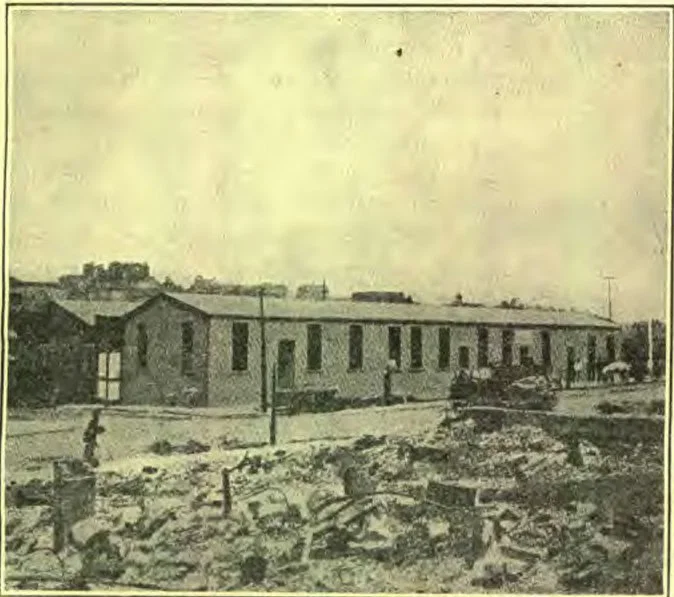
PRESENT HEADQUARTERS OF THE BOARD OF EDUCATION AND SUPERINTENDENT OF SCHOOLS, SAN FRANCISCO
In 1806, soon after entering Williams College, Mills and four other students—James Richards, Francis L. Robbins, Harvey Loomis, and Byram Green—met to hold a prayer-meeting in a grove near the college. A sudden thunder-shower coming up, they sought shelter under a large stack of hay. Here they continued their meeting, and for the first time Mills told them of his life purpose. To his joyful surprise he learned that they, too, had felt the same impulse to go to the heathen. Then and there they covenanted together, solemnly pledging themselves to the cause of foreign missions.
Organizing themselves into a band, the object of which was “to effect in the persons of its members a mission, or missions, to the heathen,” they became the first foreign missionary society in America. During two seasons they continued to meet, praying and planning how best to promote the cause they loved.
In 1809 Mills and others of the band entered Andover to study theology. Re-enforced by Nott, Newell, Judson, and others, they formed a second organization similar to the original one at Williams. Though meeting with many rebuffs, they succeeded in arousing a small degree of interest in foreign mission work.
On June 27, 1810, after consulting the seminary faculty, they held a conference with a few prominent ministers, who advised them to address the General Association of Massachusetts, which was about to convene.
In accordance with this advice, a petition was drawn up in which, among other things, they respectfully asked “whether they may expect patronage and support from a missionary society in this country, or must commit themselves to the direction of a European society.” It originally bore six signatures—Adoniram Judson, Jr., Samuel Nott, Jr., Samuel J. Mills, Samuel Newell, James Richards, and Luther Rice—names destined to become famous in missionary history; but “for fear of alarming the association with too large a number,” the last two were taken off.
This petition was referred to a special committee which reported in favor of giving the young men the assistance they were seeking. The result was the formation of the American Board of Commissioners for Foreign Missions, the first organization of its kind on this side of the Atlantic. Known familiarly as the A. B. C. F. M. of the Congregational Churches, it still lives, having been in existence a full century, with a noble record of which it may be justly proud.—The Wellspring.

A Problem Worth Studying

A COLLEGE student, distinguished for his mathematical attainments, was fond of challenging his fellow students to a trial of skill in solving difficult problems. One day a classmate came into his study, and, laying a folded paper before him, said, “There is a problem I wish you would help me to solve,” and immediately left the room.
PRESENT SCHOOL FACILITIES IN SAN FRANCISCO
The paper was eagerly unfolded, and there, instead of a question in mathematics, were traced the lines, “What shall it profit a man, if he gain the whole world, and lose his own soul; or what shall a man give in exchange for his soul?”
With a gesture of impatience he tore the paper up, and turned to his books again. But he tried in vain to shake off the impression of the solemn words he had read. The Holy Spirit pressed home his conviction of guilt and danger, so that he could find no peace until he found it in believing in Jesus. He subsequently became a minister of the gospel he had once despised, and his first sermon was from the words that had been so blessed to his own good: “What shall it profit a man, if he gain the whole world, and lose his own soul?” — St. Augustine.

Unwise Persons

THOSE persons are foolish who carry no reserve. Some people live on the edge. They save nothing from their salary. They keep no margin between themselves and the border lines. There is no balance of rectitude and honesty. They do not pay down full measure running over. They do not lay up surplus strength and character against the time of testing. Accordingly when any surprise comes, when exceptional strain is put upon them, they are unprepared and break in disaster.
It is folly not to be ready to seize opportunity. Seizing opportunity is not a simple matter of grasping it when it comes. Most opportunity comes to those who have got ready for it. They have known where it was likely to be found. Thither they have gone, and there they have waited; and when it came, they were prepared to use it.
And persons who never look ahead are foolish. Organizing ability is simply the ability to look ahead and plan in advance for things as one would wish he had planned when the conditions actually arise and close in upon him. The most successful man is the one who can see most accurately farthest ahead, and has the faith to act upon his foresight.
The foolish presume that of course things will be all right. After all, they say, things will turn out comfortably. Not for the foolish. God does not conduct an immoral universe. Sin meets its inevitable punishment, and judgment follows upon folly. The cross of Christ was not meant to erase the lines of eternal distinction between sin and righteousness, impurity and faith. The wise realize that God is holy and just, and that he will not allow men to play with sin or think lightly of his judgment.—Sunday School Times.

The Noblest Lesson: Self-Control

“THE noblest lesson taught by life To every great, heroic soul, Who seeks to conquer in the strife, Is self-control.”

The Trees of the Lord

(Concluded)
Of all kinds of forest vegetation, the pine tribe is the most widely diffused, and the most generally useful. Some species or other may be found from the snows of Lapland to the hottest regions of the Indian Archipelago, and from the level of the sea to the highest limit of trees on the great mountain ranges. Figuratively it is said of the cedar that its branches shall cover the earth; literally we find its range of distribution coextensive with the surface of the globe. But though thus mingling with the box tree and the myrtle tree in their chosen haunts, and there beautifying the place of God's sanctuary, and making the place of his feet glorious, there are special regions where the pine forms the sole arboreal vegetation. As the palm is the symbol of the tropics, so the pine is the symbol of the north temperate zone. The palm flourishes in the summer of the world; the pine tree in the winter. Beauty and fruitfulness are represented in the one; strength and patient endurance in the other. The pine is eminently typical of a bleak and inhospitable climate. It is associated entirely in our minds with the gray skies and the rude winds of the North. It forms an essential element in the grandest mountain scenery, and enters into the composition of some of the most magnificent scenic pictures which the great Artist has painted on the canvas of this world, for the admiration of his creatures. In it we have the highest moral ideal of trees, which is dependent upon their right fulfilment of their appointed functions amid the greatest difficulties. Not in rich soil, and amid soft breezes and warm sunbeams, and with the blue smile of unchanging skies resting upon it day after day, does it grow up in pampered and luxurious selfishness; but on the bare steep sides of rocks, where the soil is of the scantiest, amid the rack of gloomy, homeless clouds, and the howling of bitter winds, poverty-stricken, hunger-pinched, and tempest-tortured, it maintains its proud dignity, grows strong by endurance, and symmetrical by patient struggle. It seems intended and created by God for the covering of those wild and lonely spots where no other tree could live.
To the offices which, in such bleak and elevated situations, the pine performs, may be traced much of the beauty and fertility of the earth, and much even of the happiness of man. Standing on the mountain tops, its fringed forests catch and condense the passing clouds, which distil from their branches into the shaded soil, and, percolating through moss and grass into the heart of the rocks, flow down by an appointed channel—a rejoicing stream into the valleys. The pine is, therefore, the earth's divining rod, that discovers water in the thirsty desert,—the rod of Moses, that smites the barren rock, and causes the living fountain to gush forth. When the pine forests on the mountain heights are cut down, the springs and rivulets of the low grounds are exhausted, and the climate is rendered hotter and drier. The destruction of the grand pine woods that once clothed the Apennines, has rendered the Papal States a region of poverty, disease, and wretchedness. In Greece the traveler looks in vain for the old legendary fountains, rivers, and lakes, with which the classic poets had made him familiar. Palestine has become a parched and sterile land on account of the disforesting of its mountains and hills. Not more poetically than truthfully, then, did the old Chinese philosophers say that “the mightiest rivers are cradled in the leaves of the pine.” On the mountain heights, too, in the united strength of its serried phalanxes, the pine is a natural fascine or fortification against the ravages of the elements. The ban forests of Switzerland stay the progress of glaciers, and arrest the headlong fall of the avalanche, protecting the inhabitants of the valley from the fearful ice bolts of the mountain. On the Norwegian hills, the pine forests wage successful war with the bitter winds of the pole; and in their sheltered rear the fruits of a milder climate ripen, and the toils of a happier land are carried on. Against the fierce storms of the Bay of Biscay, the pines of the Landes offer an effectual barrier; and meadows and pastures, forming the support of an industrious peasantry, now appear where sand-dunes once filled the air with their choking clouds, and spread desolation over the far horizon. The pine is, therefore, necessary to the equilibrium of nature. If ignorantly and wantonly removed from the situations where God has so wisely and graciously placed it, his beneficent arrangements for the good of man would be frustrated.
And most admirably has God endowed the pine with strength and capacities of endurance unequalled. Every part of its organization bears testimony to the favor with which he regards it. The peculiarities which attach to the tribe, in their manifest intention and actual result, plainly bespeak a plan or purpose in the mind of the Creator. The whole framework of each species is molded to suit the unfavorable conditions amid which it grows. Its roots adapt themselves to the shallowness of the soil, which usually rests on very hard rocks; for, instead of going down vertically, like the roots of other trees, they extend more in a horizontal direction, under and over the ground, which they clasp with an intricate network of extremely strong, knotted fibers, composed of threadlike cells. They thus make up for want of depth in the soil by the extent of it which they embrace; and by this contrivance the trees are securely rooted, and capable of growing even in the bleakest situations—on the ledges of precipices, and on the most barren mountain heights. The trunk is protected from the keen cold to which it is exposed, by the thickness and roughness of its bark, and by the resinous substances, richly productive of caloric, with which all its parts are strongly impregnated. And it is a remarkable circumstance that the bark is always thicker and rougher in the direction of the prevailing storms. On their northern sides the trees are also covered—on the same principle as arctic animals are furnished with warm furs—with a thick coating of gray lichens; and a knowledge of this curious provision of nature has often been taken advantage of, as a compass to guide the lost wanderer through the pathless primeval forests.
The pyramidal form of the pine is also admirably adapted to its exposed and stormy haunts, as it gives less resistance to the force of the wind than the round, cushioned shapes of trees growing in sheltered places. It is besides designed to catch the falling snow, and by thus investing itself with an ermine robe during the severe and long-protracted frost, to prevent the very rapid loss of heat which its dark verdure would otherwise occasion. It has, moreover, an esthetic significance, reminding us of order in the midst of disorder, and formality in the midst of the rudest chaos. Its regular conical growth affords a pleasing contrast to the wildness and irregularity of the scenery in which it abounds, and introduces an element of education and precision into those outer regions of nature, that seem to have got beyond, or overgrown, her orderly control. Rising tall and straight, “in serene resistance, self-contained,” from the rifts of inaccessible peaks; marshaled in stern and serried ranks on the ledges of perpendicular precipices; standing lonely and unawed—like the Wettertannen of the Swiss Alps—in the midst of fearful horizons of snow mountain and glacier, over the far-off edges of which, where the sunshine lingers behind on the green uplands, the oak and chestnut timidly peer, as if afraid to venture farther,—in such circumstances it speaks of law where all seems lawlessness, and of a conserving power where everything seems to yield to disintegration and ruin.
Especially is the traveler struck with the formal, educated look of the tree in the Araucarias that cover the wild slopes of the Chilean Andes, and in the Norfolk pines, whose branches, all of the same length, grow thickly out all around the trunk from the root to the top, appearing like stately columns resting on rifted rocks, perpetually dashed by the fierce spray of the Southern Ocean.
The leaves of plants which grow entirely under water are cut into long linear segments, in order that the flow of the stream may pass through them without injuring them; so in like manner the leaves of the pine tribe are exceedingly tough and narrow, in order that the wind may blow freely among them without separating them from the tree, or tearing them in pieces. In aerial as well as in aquatic currents, we find the same modification of form and structure in the organisms that grow in them. Though the leaves of the pine are thus smaller and narrower than those of any other kind of tree, they are compensated for this by their immense number and persistent nature. They cling to the tree through summer's sun and winter's frost; and thus each branch bears upon it always the accumulated foliage of five or six summers. By this immense and continuous multiplication of leaf-surfaces, working day and night, summer and winter, those subtle processes by which, through the agency of the leaf, air, dew, and sunshine become changed into solid wood are carried on more rapidly in the pine than in trees whose individual leaves are broader, but less numerous, and liable to the interruption of winter's desolation. No tree, for the reason above assigned, grows more rapidly than the pine; and, liable as it is to continual accidents, such a provision is necessary to make up for its losses, and to keep its ranks always unbroken in the guardian battlements and watch-towers of the world. Such modifications are strikingly expressive of ideas in the Creator's mind, embodiments of his thoughts and purposes. By these wonderful modifications of form and structure, then, have the pine trees been planned to flourish on the barest soil, in the coldest atmosphere, on the stormiest heights. Noble Gothic spires, they tower up in arborescent music to heaven, and carry up the religion of the landscape in unfading verdure, and unceasing fragrance, and untiring patience, to the throne of Him before whom the mountains and the hills break forth into singing, and all the trees of the field clap their hands.—Hugh MacMillan, in “Bible Teaching in Nature.”

Work with Sharp Tools

Some excellent lessons may be learned by contact with the practical every-day toil of common labor. Many a person can remember his first experience of mowing grass with a scythe.
The improved mowing machinery of recent years has so crowded out the general use of the scythe that it is called into service only to mow around the fences, in the orchard, or when a small amount of mowing is required. When a boy of our day is asked to mow with a scythe, he usually finds it rusty and dull.
I know a boy who experienced the chagrin of attempting to mow with a dull scythe. To make the matter worse, an old friend, who was an expert with a scythe, came along and asked why he made such hard work of it, and why he did not stand erect. He related experiences of former days when he and his companions would each mow from three to five acres a day with the scythe or cradle. He then passed on, leaving the young man to his own meditations of the extremely hard work they must have endured if it mowed in those days as it does now. This young man then tried to practise standing more nearly erect, with the hope that that would make the grass cut better. He soon found that although he wielded the scythe vigorously, it would still slip over the grass and leave the haggled meadow behind as an evidence of unskilled workmanship.
At last he asked one of these skilled instructors to take the scythe and teach him the art of mowing. After a few labored swings of the scythe which gave evidence of skill, yet left too much grass uncut, he said, “The scythe is too dull.” This reminded him of the scripture, “If the iron be blunt, and he do not whet the edge, then must he put to more strength.” He refused to waste any further energy with a dull scythe.
The young man knew no more about grinding a scythe than he did about mowing with it, so after an unsuccessful attempt to grind it, he toiled on until one day he chanced to be thrown into company with an old gentleman who came to mow some grass at his home. He saw the ease with which he performed his task and the evenness of the stubble behind the scythe, and he asked him to let him examine his scythe. He found the edge almost as keen as a razor, and this gave the boy the secret of successful work with a scythe. After that he secured some one who understood the business to help him grind his scythe. When he resumed his work, the scythe cut so easily and did the work so well that he worked a half day without even touching the edge with the scythe-stone, lest he should spoil it. He enjoyed mowing so well with a sharp scythe that he could scarcely be induced to stop when wanted for other work.
He soon learned to grind the scythe himself, and he has never since been content to work with dull tools.
He learned the use of the scythe-stone, and the value of sharpening the scythe with the stone while resting. The same principle applies in the case of all other tools.
I am sure, from the instruction the Master always gave in thoroughness, that his carpenter tools were kept sharp and oiled, so that he could always turn out the most skilled work with the least exertion.
There is character in the care of tools. A boy who keeps the tools sharp and oiled will keep the fences in repair, the weeds out of the garden, the grape vines on the trellis, the orchard pruned, and the lawn mowed.
This lesson is applicable also in spiritual work. Laborers in the cause of God often work with dull or rusty tools, greatly to the disadvantage of the work and their own discouragement. They toil hard, but they do haggled work. I often think of the dull scythe and the hard labor and haggled grass, and I find myself thinking they would better grind the scythe.
Then when they stop to rest after a period of hard work, I think, as I see no books in their hands from which to fill their minds with fresh, keen points of truth, how much better work they could do, and how much more they could accomplish, if, while they rest, they would use the scythe-stone and sharpen the scythe.
Canvassers who succeed use sharp tools. They keep sharpening them whenever they stop to rest. Nurses and physicians who are successful among us, keep “brushing up” while they rest. They keep their minds keen for their work, and the rust of indifference never gathers on their well-oiled and brightly burnished instruments. Teachers and editors who succeed keep grinding their scythes and using the scythe-stone while they rest in the intervals interspersed throughout their weekly toil.
The Bible workers and ministers who succeed in this message must give themselves “to reading” and “study” to show themselves approved unto God, “a workman that needeth not to be ashamed.” In fact, we must all break with the commercial spirit of the time and the love of ease and pleasure so common about us, and give ourselves wholly to the Master’s work. To have all training in education and oratory so that one can speak with the tongues of men and angels, avails nothing if it is not oiled by the love of Christ; it is as sounding brass and tinkling cymbals.
It is highly important to keep the tools oiled as well as sharp.
R. C. PORTER.

Chats on Letter-Writing: Writing Naturally and Originally

Chats on Letter-Writing—No. 3

WHILE many books are published which profess to give assistance and guidance in letter-writing, most of them are limited in their usefulness. They may not be altogether devoid of helpfulness, but it is not a wise policy to model one's letters after those found in any such book. Those given in these volumes often are extremely artificial, shallow, lacking entirely in the spirit of whole-heartedness that is a characteristic of every true and sincere communication. Slavish imitation of printed effusions is to be studiously avoided; merely copying what others have written, with a few alterations according to the circumstances, will never accomplish the training and aid in corresponding which is to be derived from personal effort at original writing. Hints are useful to a certain extent; suggestions will do much; but to rely on models when writing a letter is most unwise and highly unprofitable, if not actually injurious.
If you have decided what you wish to say, sit down and proceed to place your thoughts and ideas on paper, with perfect freedom, and as far as possible, write as you would talk. That is, be easy, familiar; be open, plain, frank, whole-hearted. Imagine you are looking at the one to whom you write. Then write out what is in your mind and on your heart. By so doing you will necessarily steer clear of the suggestion of artificiality which is inseparable from the letter written in close imitation of a model in a “Handy Letter-Writer” or similar publication. Of course, while being free and frank, open and honest, you will take care to be discreet as well as candid, and wise as well as confidential.
Do not attempt long sentences nor long words. Short ones are infinitely better, as well as easier. Make your thoughts clear, write so that the reader will catch your meaning the first time, and not have to go over it again to learn what you meant.
Try to give your real self expression. Sincerity is of priceless value in letters. Say what you mean, and write what you honestly feel. Tell the truth, but never forget to do so with a spirit of kindness. Make your sentences definite, clear-cut, and to the point. Don't use four or six words when three would do as well or a great deal better. In brief, know what you want to say, say it, then leave off, and begin about something else.
Writers seldom err in being too condensed in their expression of thoughts. Strange though it may seem, it is nevertheless true that it takes more thought and care to make ten words convey an idea than to express yourself in thirty words. Make every word count, and your sentences will be short but pithy. A good rule is, trim down wherever possible.
Be simple, rather than elaborate. Never try to write in a pompous style. Better be direct, straight-forward, and clear, than try to reach a high standard of literary skill which is beyond you. HENRY W. ROSE.

God’s Plans or Ours

WHEN Ethel Day was twenty, her mother became an invalid, and Ethel left college to go home and be with her.
“Of course it is a disappointment to give it up,” she said, lightly, “but it doesn’t compare with being away from mother for two years longer when she is shut in.”
At first it was not so hard; mother and daughter were the closest of friends, and Ethel went to the city for music and joined the Twentieth Century Club, and had little outings, to which her mother urged her; but as the years passed, she began to go out less and less. “Mother misses me so if I am away,” was her excuse, or, “Mother worries if I am out late.”
Finally Ethel’s friends became indignant. “She is losing not only all her girlhood, but all her opportunities,” they declared; “and Ethel had so much talent. It isn’t fair. Nobody has any right to rob another of her own life. We have just made up our minds that it must be stopped some way.”
The one to whom they were talking—an older woman—asked simply, “Do you dare?”
“Dare?” the girls cried; “wouldn’t we do anything for Ethel?”
“But suppose that God wants to give Ethel something better than ‘her own life’? Are you wise enough to know? Would it not be safer to leave it to Ethel—and God?”
The girls looked at each other in silence. Did they dare, after all?—Selected.

A Spelling-Bee

“I AM going to have a spelling-bee to-night,” said Uncle John, “and I’ll give a pair of skates to the boy who can spell ‘man’ best.”
The children turned and stared into one another’s eyes.
“Spell ‘man’ best, Uncle John? Why, there’s only one way!” they cried.
“There are all sorts of ways,” replied Uncle John. “I’ll leave you to think of it a while;” and he buttoned up his coat and went away.
“What does he mean?” asked Bob.
“I think it’s a joke,” said Harry, thoughtfully, “and when Uncle John asks me, I’m going to say, why, m-a-n, of course.”
“It’s a conundrum, I know,” said Joe, and he leaned his head on his hand and settled down to think.
Time went slowly to the puzzled boys, for all their fun that day. It seemed as if “after supper time” would never come, but it came at last, and Uncle John came, too, with a shiny skate runner peeping out of his coat pocket.
Uncle John did not delay; he sat down and looked straight into Harry’s eyes.
“Been a good boy to-day, Hal?”
“Yes—n-o,” said Harry, flushing. “I did something Aunt May told me not to do, because Ned Barnes dared me to. I can’t bear a boy to dare me. What’s that got to do with spelling ‘man’?” he added, half to himself.
But Uncle John had turned to Bob.
“Had a good day, my boy?”
“Haven’t had fun enough,” answered Bob, stoutly. “It’s all Joe’s fault, too. We boys wanted the pond to ourselves for one day, and we made up our minds that when the girls came, we’d clear them off. But Joe, he—”
“I think this is Joe’s to tell,” interrupted Uncle John. “How was it, boy?”
“Why,” said Joe, “I thought the girls had as much right on the pond as the boys, so I spoke to one or two of the bigger boys, and they thought so, too, and we stopped it all. I thought it was mean to treat the girls that way.”
There came a flash from Uncle John’s pocket; the next minute the skates were on Joe’s knees.
“The spelling-match is over,” said Uncle John, “and Joe has won the prize.”
Three bewildered faces mutely questioned him.
“Boys,” he answered, gravely, “we’ve been spelling ‘man,’ not in letters, but in acts. I told you there were different ways, and we’ve proved it here to-night. Think it over, boys, and see.”
—S. S. Evangelist.

Worshiping a Scarecrow

RECENTLY I stopped in a barber shop in Temuco, a city in Chile, and a boy about sixteen years old served me. I asked him the question, Do you know Christ, the Saviour? He responded that he did, but after a little conversation he said that he knew him only as he had seen him represented by an image.
That is really all that many of the inhabitants of this country know of Christ. The great majority here know nothing of him as a personal friend and a loving Saviour, and yet they want to be saved, and are looking for help and salvation by means of images. The following incident is said to have actually occurred here in Chile:—
A rich woman made a stuffed man and put him in her garden to scare the birds away from her vegetables and fruits; and in order that he might not disfigure the garden too much by his appearance, she clothed him very neatly. After a few days a heavy rain swept him away, and another woman found him on the bank of a river. She took him to her house, thinking that she had found a saint.
Her neighbors soon heard of her discovery, and came to worship the saint, and great cures were reported to have been produced by faith in the image. The images in the church were all put in the shade by this new one, and the priests became jealous; so they visited the widow who found the image, and told her that it was not right to keep a saint in a profane house, but advised that he be put in a holy place, in the church.
They took the image and put it in the church, and its fame as a mighty miracle-worker spread more and more, until the woman who made the image heard of its great healing power. She was very feeble at the time, and with her servant traveled a long distance to worship the idol, in the hope of recovering her health.
After she had given a large offering, she began the repetition of her prayers to the new image. She repeated her prayer several times, when her servant discovered that the image was the bird scare that she had put in her garden, and which had by some means gotten into the church.
The servant said, “Madam, this image is your bird scare that disappeared during the heavy rains.” The sick woman would not believe it, but continued her prayers. After a few minutes the servant repeated that it was the bird scare, and pointed to some of the garments as evidence. The woman examined the matter, and found it so. Ashamed and disappointed, she returned to her home.
Many thousands who worship images do not discover their mistake so easily, but continue in such worship until their eyes close in death.
While time is passing so rapidly, and millions are dying, we should use every moment of the time in trying to save souls from this great darkness. May the true missionary spirit fill the hearts of all the true and loyal, and may the sound of the third angel’s message soon reach all the dark corners of the earth.
F. H. WESTPHAL.

Jack’s Apple Core

It lay unnoticed and despised in a corner of the porch, where Jack had thrown it when he finished eating his apple. He knew better than to do it, but it was an easy way to dispose of the core, so he did it. He knew somebody would have to pick it up after him; therefore he should have been more thoughtful. Let the apple core do some thinking for Jack:—
“Pretty soon the sun will strike around the corner and beat down upon me, and its heat will cause me to turn sour and smell very offensive. Some one will come and sit down in this hammock, and turn up his nose and say: ‘Whew! There must be a rotten apple around here.’
“And there’s the pig squealing over yonder, hungry for his dinner. If Jack had only carried me to the slop-pail, as he should have done, I might have accomplished some good in the world by helping to feed that hungry pig.
“Or if he had only thrown me out in the garden, where I would have been out of sight, my seeds would have dropped down into the soil, and by and by, perhaps next year, four or five tiny apple-trees would have sprung up, which might have been transplanted to some other place, and grown up to bear fruit for coming generations.”—Selected.

The Accuracy of the Bible

MANY evidences are being found to-day which prove the authenticity of the Old Testament. Some are seemingly of small importance, yet they demonstrate that the Word of God is correct even in minor detail.
For instance, in Gen. 41:42, we find this information: “And Pharaoh . . . arrayed him [Joseph] in vestures of fine linen.” The margin says “silk linen,” which would seem to indicate cloth of very fine texture. Fragments of Egyptian cloth have been discovered that were woven with one hundred and forty threads to the inch.
Investigations of late years have proved that at the time of the building of the great pyramids the Egyptians were masters of the arts of masonry, sculpture, metal working, carpentry, pottery, weaving, and dyeing. It is said they had saws made of copper with which they could cut the hardest stone. This seems more wonderful when we remember that the tempering of copper is not known even to-day. It is one of the lost arts.
It is said that the mastery of mechanical detail which was manifested in the quarrying of the vast blocks of granite, and the sculpturing into obelisks and columns of such noble proportion, astonishes the engineers of the present day.
Some of the statues found were carved out of hard diorite, one of the most difficult of materials to work, yet they are equal to anything made in that material at a later period.
Thus we see that the land of the Pharaohs in the days of its glory was one of the greatest kingdoms in the world, and harmonizes readily with the Bible description of Egypt in the days of Moses. This is a strong argument against the popular idea of the evolution of man intellectually. How much better it is to believe God’s Word in preference to men’s word before it is actually demonstrated to be true, than to believe only what we have to because of proof from which we can not escape. C. E. HOLMES.

The Harvest Is Past, the Summer Ended

The harvest is past, the summer is ended, and we are not saved. Jer. 8:20.

Helping Those Who Help Themselves

“‘Help the fellow who tries to help himself.’ When this is done, hunt up some other fellow who is not trying to help himself, and help him to try to help himself.”
Continue reading: Had Moses Failed to Go