"This coming again of Christ is not at the death of the believer. (a) He does not come again at death
with a shout,
etc. (b) Those who are alive and remain are not caught up, etc., at the death of individual believers. (John 14:3, and 1 Thess. 4:16, 17, manifestly refer to the same event. They are exactly parallel in the three facts stated: (1) The 'I will come again' of Jesus, equals 'The Lord Himself shall descend from heaven' of Paul. (2) The 'Receive you unto Myself' of Jesus, equals the 'Shall be caught up in the clouds to meet the Lord' of Paul. (3) The 'That where I am, there ye may be also' of Jesus, equals the 'So shall we ever be with the Lord' of Paul. Paul's words are manifestly an inspired commentary on those of Jesus, and the reference of the words of Jesus to His coming at death is thus made impossible.) (c) John 21:22—'Jesus saith unto him, If I will that he tarry till I come, what is that to thee? Follow thou Me'—shows how utterly impossible it is to make Christ's coming refer to death. 'If I will that he tarry,' evidently means, If I will that he remain alive. Now put Christ's coming at the believer's death and you get this nonsense: If I will that he remain alive until he die, what is that to thee?'"
To show that Christ's promise to come again does not refer to the outpouring of the Holy Spirit, as some have claimed, Doctor Torrey in further commenting on the texts already referred to says:
"(a) All of these promises but one (John 14:3) were made after the coming of the Holy Spirit and pointed to a coming still future. (b) Jesus does not receive us unto Himself to be with Him at the coming of the Holy Spirit. At the coming of the Holy Spirit He comes to be with us (John 14: 18, 21, 23), at His coming again mentioned in John 14:3; 1 Thess. 4:16, 17, etc., He takes us to be with Him. (c) He does not at His coming in the Spirit 'fashion anew the body of our humiliation, that it may be conformed to the body of His glory.' (Phil. 3:20, 21.) (d) There is no trump of the archangel, no shout, no resurrection, no rapture in the clouds, at this coming of the Christ. In other words, this coming in scarcely any particular conforms to the plain and explicit statements of Christ and the apostles concerning His coming again."
Earthquakes in Divers Places
Do You Heed the Warning?
In that wonderful chapter of hope and cheer—Romans 8—the apostle carries the suffering and self-denying children of God forward to the culmination of their hope in these words:
"For I reckon that the sufferings of this present time are not worthy to be compared with the glory which shall be revealed to usward. For the earnest expectation of the creation waiteth for the revealing of the sons of God. For the creation was subjected to vanity, not of its own will, but by reason of him who subjected it, in hope that the creation itself also shall be delivered from the bondage of corruption into the liberty of the glory of the children of God." Verses 18-21, A.R.V.
The statement above is fully borne out by other scriptures, and by reason. God is one. God's universe is one. One great Fountain sends its life-pulses from center to its remotest outposts. Before sin entered, when "the morning stars sang together," and "all the sons of God shouted for joy," there was perfect harmony thruout God's royal dominion. No jarring notes brought discord, no perverted law wrought chaos or death. But when sin came, when the highest of God's creatures perverted, transgressed, the highest of God's laws, the very universe was convulsed with pain. As a pierced eye or an aching tooth perturbs the whole man and completely upsets his equilibrium, so the entrance of sin, which, full-grown, produces death, perturbed, troubled, pained, and crippled God's handiwork. "For the creation was subjected to vanity." When God's Day-star, Lucifer, sinned, when man, earth's ruler, followed, all the members of God's creation suffered in sympathy. The fearful storms which sweep the earth, the drouths, the earthquakes, are not the normal actions of earth's normal laws. They proclaim that sin is at work; the earth is subjected on account of man's sin. All of verse 20, except the last two words, is parenthetical. Read without the parenthesis, "For the earnest expectation of the creation waiteth for the revealing of the sons of God, . . . . in hope that the creation itself also shall be delivered from the bondage of corruption into the liberty of the glory of the children of God."
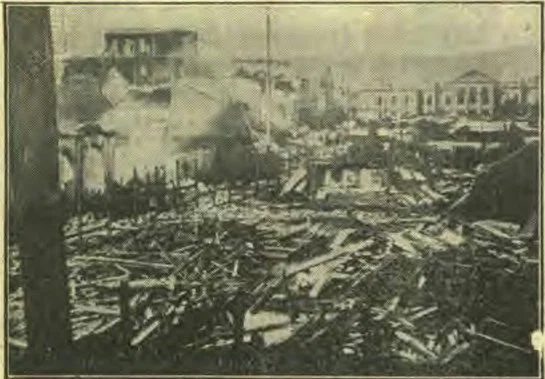
Salvador Donoso Street, Valparaiso.
It is still waiting for that better day when all God's universe shall swing in majestic unison to perfect law, when wandering comets and lawless meteors shall no longer bode destruction, when consuming suns and dead moons shall no longer mar the handiwork of the Creator, but all shall be in harmony.
But not yet. The sons of earth are still sinning. The work of the deceiver is not over. The sons of God are still subject to vanity, to suffering, to trial, to conflict. And with all this the apostle declares, "We know that the whole creation groaneth and travaileth in pain together until now." All the violent, unseemly, destructive manifestations we see and experience in earth and sky are the groanings and travaillings caused by sin.
Under sin the world has waxed old, "as [[FIGURE]] doth a garment," and as an old garment is changed for a new so shall He whose "years shall not fail" change the racked and frayed and olden earth to a new. But now it is old, and the increasing earthquakes and calamities, despite all that the skill and science of modern men and methods can do, betoken the end. So Jesus declared that the "famines and earthquakes in divers places" would be the "beginning of travail." Matt. 24: 7, 8. In the beginning of sin's entrance such fearful convulsions occurred as men can only guess from the records left in the seamed and wrinkled planet. For centuries she settled down to fairly steady revolution along the channels of law still unperverted. But now she is nearing her end, and the throes of violence are returning, fierce as the end of a maniac.
When thousands went down in the mighty convulsions which shook Formosa to its center, and caused Vesuvius to belch forth its myriameters of lava in the beginning of 1905, it was thought the earth would rest, and surely there was no danger to be apprehended outside of the "earthquake lands." But on April 18, 1906, came the earthquake which laid low San Francisco, followed a few months later by an equal in Valparaiso, followed by another in China; April 14, of this year, came the earthquake in southern Mexico, followed by the awful Kingston temblor.
October 16 the seismographs of the world [[FIGURE]] reported a very great earthquake which must have had its center out in the ocean somewhere. Seismographic pens were swung from the record sheet in both Washington and Albany, and in both intensity and duration it was reported as remarkable.
A little later news comes to us from a missionary in the Friendly Islands, who writes:
"We are having somewhat of an uncomfortable experience thru the submarine eruption that has recently broken out a few miles from here. The earth is shuddering and vibrating a large part of the time, and the air is filled with the sound as of a roaring lion. Occasionally there are loud explosions. The quantities of lava and stones being thrown up are forming a large island, which is slowly coming up out of mid-ocean. The natives here have been terrified, and the Europeans are somewhat disturbed concerning it."
October 24 a series of earthquakes occurred in the district of Calabria in the south of Italy, and in the island of Sicily. Many towns were destroyed, lives were lost, and thousands left homeless. November 18 heavy shocks were again reported and much damage done.
The worst disaster of the year occurred October 27 at Kartagh, in Bokhara, in Russian Turkestan, Asia. A fearful earthquake caused a mountain to topple over and the whole town was destroyed, and from 15,000 to 20,000 people killed. The earthquake was recorded in Washington and London.
November 8 the Lusitania reported that a wave over eighty feet high swept over the ship, smashing three windows in the captain's house, eighty feet above the water-line.
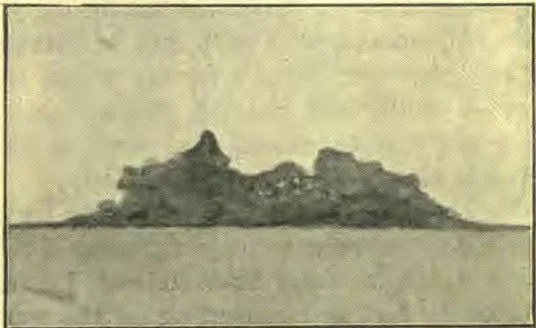
November 15 the United States revenue cutter McCulloch, in San Francisco harbor from a cruise in Alaskan waters, reported that a volcanic island was thrown up in Bering Sea in 1906 to a height of 395 feet, and was named after their ship by the officers of the McCulloch [[FIGURE]] on July 4 of last year. This year the island had disappeared in an earthquake. A little spit of land rose to the height of 100 feet, which contained "millions of tons of solid material." The sea was still hot and boiling when the cutter arrived. Photographs were taken and drawings made.
What do these convulsions of nature mean to you, reader? All nature is warning us of the end. "But," you say, "are we not safe here?" That is what was said years ago. A gentleman in Chicago sends us the following from "Harper's Monthly," of March, 1869, thirty-eight years ago. Read its assurances of safety:
"The Lands of the Earthquake."
"Will the earthquake in all its terrors ever visit us? Is New York ever to be humbled? . . . or Pittsburg and Chicago? . . . Must San Francisco become a new Callao? . . . If we have ever for a moment entertained such fears, history at once reassures us. History, mother of science, points to the unchangeable unity of nature. . . . The laws of nature are immutable. . . . The stars rise and set as they did of old; the seasons come with their wonted regularity, and summer keeps us every year as it fed the Assyrians and the Greeks; the ocean keeps its appointed bounds. . . . Hence history assures us that even the11terrible earthquake is bound by the unchanging laws of nature to a single path, from which it is not permitted to diverge. And history marks out upon the map of the world where that path lies. . . . Rome and Naples, for example, lie close to the path of the earthquake, and have been subject to slight shocks for centuries, yet they are probably as safe as London or Paris; . . . yet San Francisco is as safe as Rome or Florence, and the North Pacific shore as the coast [[FIGURE]] of England. History, in fact, assures us that ours is not one of the lands of the earthquake; that our exemption from its terrors is as certain as that the seasons will not vary or the summer fail to come; that maternal nature has sheltered us from the destroyer that we may enjoy her gifts at leisure and unfold her vast resources by incessant toil; and that He who holds the earthquake in check has ordained that we may do His work unimpeded by the perpetual horror that broods over other lands."
But it came, nevertheless, a warning from God of what is to be when a mightier earthquake than the planet has yet known shall shake it from center to circumference, and the "cities of the nations" shall fall. Rev. 16: 18-20. Men laughed before the Charleston earthquake, and thought they were exempt, assured by such messages as the above, but it came. San Francisco felt assured of safety; the city by the Golden Gate had nothing to fear, but the temblor came. And they will come, till the old earth's torrent of sin ceases, till its load of iniquity is destroyed in the glory of Christ's presence. Joaquin Miller, "the poet of the Sierras," well said in writing on one of the bloody prize-fights in San Francisco:
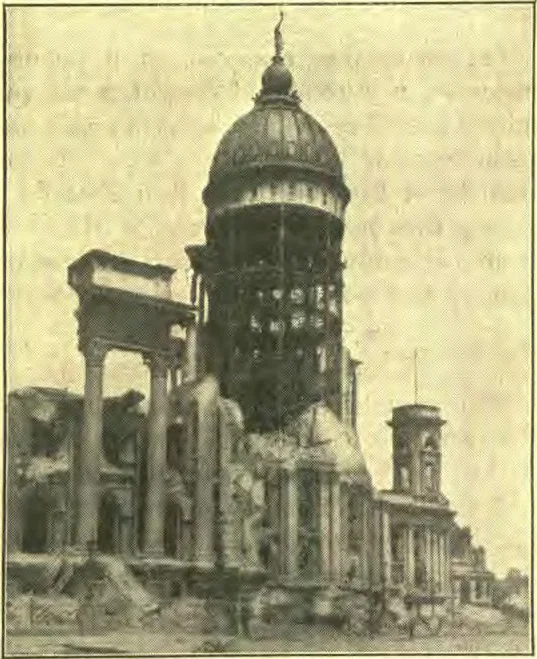
"But this sort of thing to-day is right straight along on the road of destruction. She [San Francisco] seems to be learning nothing at all from the fearful lesson she has just had. The preachers from their high places above all laymen, with their wonderful opportunities to see and [[FIGURE]] to say, are saying nothing. But there stands at the heart of the city the one most eloquent orator on earth to-day. That is the rent and ruined City Hall. Here under this torn dome that utters all day and utters all night the full year thru let us take heed. This warning sermon comes from the rended lips of stone and steel. Here under this impressive ruin once beat the
great, strong heart of a great city, and here crime, all sorts of crime were hatched and housed. And here the hand of God fell hardest. Yet no one seems to see nor care at all, or at all comprehend the fearful sermon written on the silent and ever-lifted lips. Go see for yourselves. Go any day or any night. There the ruin stands, and there it will stand; for man seems instinctively afraid to try and restore what God so utterly destroyed.
"San Francisco wills to go straight to ruin again just as fast as she can go. These little dog shows, such as I encountered to-day, are milestones on the steep downhill road. I have said I am of age, and I, and I only, am responsible for what I say."
Sometime men will listen without scoffing, but it may be everlastingly too late.
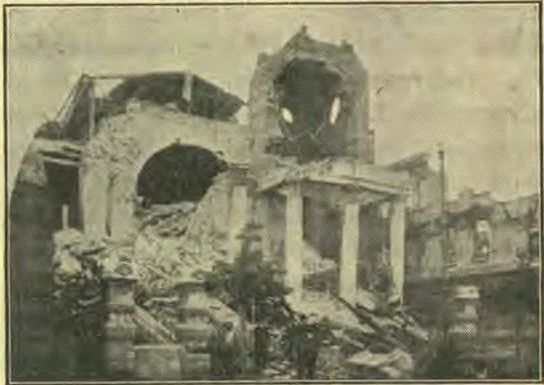
Merced Temple, Valparaiso.
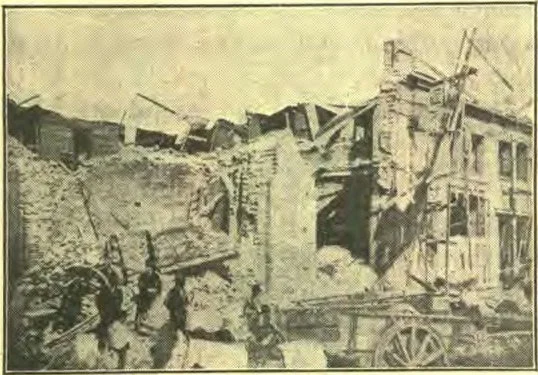
A Street in Kingston, Jamaica.
McCulloch Peak, as it appeared a year ago, shortly after it rose from the sea, 395 feet high, with a base about 2,000 feet square. It is now gone.
City Hall, San Francisco, after the Earthquake.
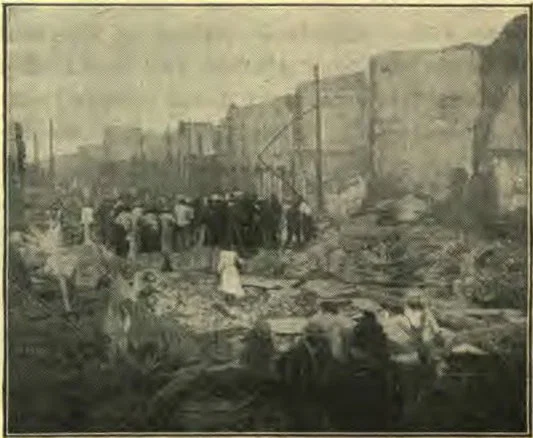
Brazil Avenue, Valparaiso.
The Financial Straitness.
For weeks the country has been suffering from an almost financial panic. When the inflated, speculating Knickerbocker Trust Company's bank of New York failed, the country became frightened, so insecure is our financial system. Governor Gillett has well expressed the cause in his message to a special call of the California legislature:
“The country generally is very prosperous, our state is particularly so, and there is no reason why this prosperity should not continue. Legitimate business never was better. The farmers in every state have been blessed with large crops for a number of years, for which they have received good prices. All the wheels of industry are turning, trying to supply the enormous demands made upon them. All labor is employed at the highest wages ever known, and the merchants have been enjoying a large trade. There is no poverty in the land, yet in the midst of plenty, and apparently on a most solid basis and with more money in the country and a larger per capita than we ever enjoyed before, the nation finds itself in the throes of a money panic.
“It is quite evident that there must be some cause for this condition of affairs, and it is found in the extravagant living, wild speculation, the effort to get rich quickly by giving nothing for something, the frenzied finance of the stock and bond manipulators of Wall Street, and the attempt dishonestly and by misrepresentation to float all manner of enterprises upon a sea of water. These are the things which have been mostly, if not entirely, responsible for the present financial stringency, and it is only the unparalleled prosperity, distributed among the masses, that saved us from financial ruin.”
The Government has come to the relief of banks by issuing certificates of indebtedness to the amount of $100,000,000, and floating $50,000,000 in Panama bonds. It is hoped that the sale of these, together with the gold from Europe in payment of American products, will soon restore normal conditions. Until that time, clearing-house certificates, checks, and notes must take the place of money. This, it has been well said, is not a people's panic, but a banker's panic.
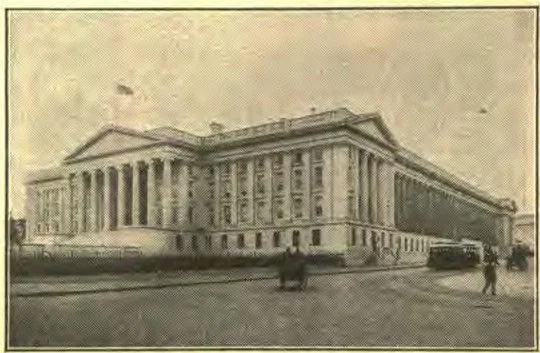
United States Treasury Building, Washington, D. C.
The Climax of Revolution and Change.
There are many prophets in these days of trouble and turmoil. Not long ago prominent men in church and state in Europe confessed that the prospect was dark, and they knew not what lay before. The latest prominent predictor of the future is Count Witte, ex-premier of Russia. In a recent interview reported in the Examiner of October 28, by Count R. V. Stackelberg, of St. Petersburg, Mr. Witte said:
"The financial condition is attracting not only my attention, but that of the politicians and financial specialists of the whole world. It is only the beginning of a new period in social life, and I feel safe to predict that it is the signal for a revolution of labor against capital.
"The financial crisis of America, either present or coming, will stir up the large mass of the middle and working classes, who are going to suffer more than any others, and violent conflicts between the capitalists and people of America will be inevitable.
"As soon as that happens in America, similar crises will sweep Europe, and in Europe the struggle will be between the people and bureaucracy, instead of between labor and capital. In America the struggle will mean victory for the people and government ownership of railroads, banks, and other institutions. In Europe this struggle will sweep the way for democratic republics."
These are not the utterances of an ordinary man. Neither are they matters of imagination or fancy, but they are conclusions from premises of living fact. Struggle, conflict, and revolution lie before the world. So also says the Bible.
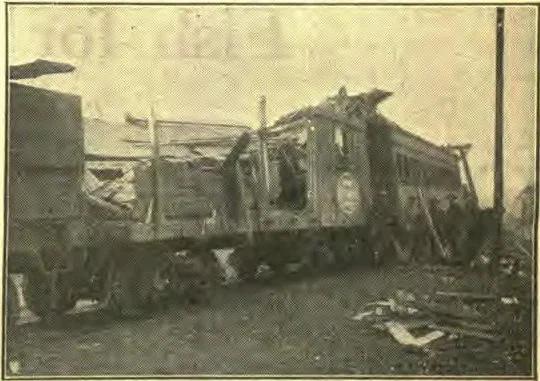
Freight Cars on Side Track a Mile from the Fontanet Explosion.
In the Interest of Shippers
In the Interest of Shippers.—One of the proposed amendments to the Interstate Commerce Law is to the effect that no change of freight rates should be made by the railways till shippers have had opportunity to protest, and the freight tariffs be settled equitably by the railway commissioners. In Canada the shipper knows just what he can depend upon; but in this country he does not. Rates may be raised immediately, and the shipper must pay it or hold his goods perhaps for months until the matter is settled. The Canadian way is the better way. It protects both shipper and the railway.
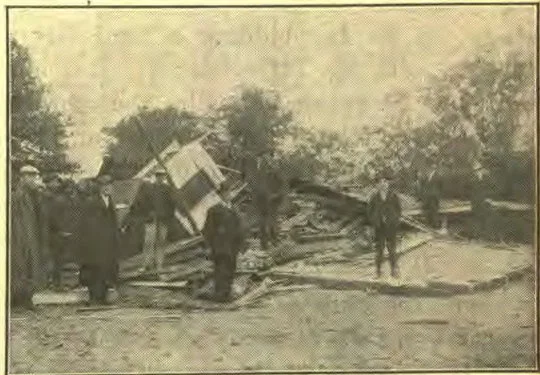
A Schoolhouse Wrecked by the Powder Explosion as It Fell on 57 Children. None Were Killed.
An Artificial Earthquake
An Artificial Earthquake.—We present on this page, by the courtesy of the Indianapolis News, two other reproductions of photographs of the results of that fearful explosion, October 15, at the DuPont Powder Mills, Fontanet, Ind., by which the entire town was wrecked, sixty people killed, and many injured. Forty thousand kegs of gunpowder first exploded, and that was followed by the explosion of fifty tons of dynamite. The shock was felt at Cincinnati and Louisville and recorded by seismographs as an earthquake. The explosion sprang the walls of a schoolhouse at Rockville, twenty-three miles away, and threw the children into a panic; $10,000 worth of damage was done in the town of Brazil, twelve miles away; and in the city of Terre Haute $25,000 damage was done, seventeen miles away; and a corresponding amount in twenty-four surrounding towns, villages, and cities. Windows were broken in Danville sixty miles away.
Fish for Persistency
By Emma H. Adams
By Emma H. Adams
ON one corner of a street, climbing several low heights in beautiful Redondo, a brisk little pueblo adorning the shore of the great Pacific in Southern California, lived Collin Cressey (not his true name), a lively lad of some twelve years.
A few days before the close of the public schools last June, Collin was "held up" suddenly and forcibly by the idea of studying the Spanish language during vacation.
So unexpected was the attack, and also so agreeable was it, that it expelled from his eager mind all thought of vacation trips, plays, amusements, and even his fascinating pastime of fishing at the head of Pier Number One,—a fine point of outlook upon the ever-changing sea, that home for countless creatures which get the breath of life thru gills.
In school, the past year, Collin had had several fellow pupils who spoke the soft-flowing Spanish in true boy style, not worrying about correctness, nor making themselves unhappy over idioms for which equivalents in English are sometimes difficult to find.
To be able to talk with these lads with the same rapid utterance, Collin thought would afford him mountains of pleasure. Therefore, there was purchased for him an elementary work in Spanish, the text of which contained not a word of English, and the study began with first-class enthusiasm.
His teacher, conscientiously careful to make his effort a success, helped him to apply the musical language in speaking of all surrounding objects,—of trees, plants, flowers, streets, houses, railways, animals, men and women, out-of-doors; of windows, doors, beds, chairs, tables, and many other things, indoors.
For three or four weeks the acquisitive boy gathered delightful harvests from his study, on no day bidding a total farewell to play with his little friends. But about this time he began to realize that to climb a mountain requires more effort and more time than to plant the foot upon a mole-hill; that it is much easier to listen to a charming language than to acquire a working knowledge of it.
Hence the distance to the goal where smiles success and where sweet rewards await, began to lengthen strikingly. Quickly then swept enticing memories of recreation at the waterside. These were irresistible. For were not the darting finny people flashing a merry welcome to him from the sheen of their scales? Was there not, out among the pearl-crested waves, sailing away gracefully, many a craft sending back speechless invitations to voyages here and there? Were there not, daily, people of all ages seated upon the edge of the pier, awaiting wireless messages from the end of their pole lines?
Then the lessons were deferred for a morning with the fish; for a second day with a baseball club playing just beyond the green hills; for a third day with a picnic at a pretty coast town. Now came a lesson, and now a real vacation of some days among relatives, a half-day's ride away by train.
After the return followed three or four lessons showing that not a few very important points and facts had been expelled from the memory by the various diversions, and, worse than that, there had walked in a weakening of the study habit. The purpose to complete the study of the book before the opening of the next year's schools had dropped out of sight.
Child of Nature. Perot.
And with it had gone that indefinable, wonderful accretion to human power which takes place in boy or man, girl or woman, when a course of right action has been completed; when a task undertaken has been finished; when the better elements in self triumph over the less estimable.
If the test pertain to a matter of daily, homely, uninviting task, and one overcomes, wins in the struggle, then does one's mental and moral nature become just so much the stronger. One's inherent power takes on an addition more valuable than fine jewels. It is character building of a telling sort.
If parents could but realize the vast importance of training their children to "stick to" a course of right action, a line of right work, and would help them by example, influence, and opportune advice to accomplish difficult tasks, there would be in the world fewer men and women weak in force, resolution, and ability "to do things."
The writer has observed, in a hundred instances, how sons and daughters are permitted to half accomplish some laudable task, some valuable line of study, some preparation for a life-work, and then abandon it simply thru lack of perseverance, thus carelessly, unwisely throwing away time, effort, money, and oftentimes precious rewards.
How Alone to Keep Pure.
A TRAVELER in Switzerland was walking on the neck of land which leads to the place where the dark-blue Rhone rushes from the waters of Lake Leman to embrace its pale companion, the Arve. He was thinking whether it were possible to be in the world, and yet not of the world. As he wandered on, the two streams flashed before him,—the one, strong, calm, and grand; the other, white, slow, and troubled; and, as they met his sight, they seemed to return an answer to his doubts.
Side by side the streams flowed on, yet,13for a while, their waters never mingled. The Rhone was still strong and dark; the Arve, still slow and white. Then he asked himself why it was, tho flowing in the same channel, the two rivers remained separate; and he found that it was owing to the impetuous torrent of the Rhone, which was so swift in its course that it outstripped its weaker companion.
Thus he learned that if the current of his life were tending onward with a swiftness more than earthly, his life might flow beside the evil of the world without being corrupted by it.