Your ShelfYour Projects

Review and Herald, Vol. 86, No. 47.

Not As I Will
Earlier text: South Africa

Laurelwood (Ore.) Academy

LAURELWOOD ACADEMY has been open a month. The enrolment is thirty-seven, of whom twenty are in the school home. Classes have been formed in the seventh to eleventh grades inclusive. Nearly all are mature young people, many of whom are paying their own way. These are devoted Christians preparing for some branch of missionary work, with but few exceptions. The faithfulness with which they pursue their work is certainly commendable. Nearly a dozen are planning to make teaching their future work.
F. A. DETAMORE.

Vienna (N. Y.) Intermediate School

SCHOOL opened October 5, with a larger attendance than has been usual on the opening day. There are prospects of a few more students entering soon.
We have an excellent class of young people this year, seemingly anxious to get an education to fit themselves for the Lord’s work. Nearly all are looking forward to entering a higher school, or engaging in some line of gospel work. A spirit of helpfulness pervades the school. The outlook for a profitable year’s work is very encouraging.
Formerly, this was a church-school doing intermediate work, but by late action of the New York Conference, we became a conference intermediate school, the first and only school of this kind in this conference.
W. C. MATHEWSON.

Oakwood (Ala.) Manual Training School

Regular class work was begun on the morning of October 3. The enrolment was good for the time of the year. The daily program has been so arranged that classes recite in both the morning and evening, leaving the larger portion of the day free for industrial work. The greater number of our students must meet their own expenses in school by their labor, and with our present plan, they will be able to work enough to meet their current expenses and carry from one to three literary branches.
All seem anxious to succeed in getting a good practical education, and are quite diligent in their studies. Besides the regular work in the lower grades, we have organized classes in Bible doctrines, algebra, geometry, English literature, bookkeeping, and general history. A commendable interest is also manifested in the industrial classes. Instruction is being given in plain sewing and dressmaking. In a short time classes will be opened in blacksmithing, carpentry, broom making, agriculture, and printing.
Faithful work is also being done in the music department, including both vocal and instrumental. Two nurses’ classes are carrying on their regular course of instruction.—Southern Field Echo.

Christian Education

Conducted by the Department of Education of the General Conference
FREDERICK GRIGGS      -      -      -      -      Secretary

The Harvest Ingathering Campaign

THE Ingathering campaign is certain to be of great benefit to our schools, for it gives a practical education, during the school term, in the very thing that we are preparing our students to do after they leave school. It gives to them an opportunity to become acquainted with the people in the vicinity of the school, and to find openings for Christian Help work, Bible readings, and other ways of doing good.
From E. A. Manry, principal of the Tunesassa (N. Y.) School, we have this word: “Our school ordered one thousand copies of the Missions REVIEW, and to-day the majority of our students are out with them.”
E. A. Sutherland, president of the Nashville Agricultural and Normal Institute, writes: “Last year we spent two days in the Harvest Ingathering campaign. We are planning to do a good work in the neighborhood this year. We are also planning a campaign with ‘Christ’s Object Lessons’ and ‘Ministry of Healing.’ Each church-member is requested to take two copies of ‘Ministry of Healing’ to help the Nashville Sanitarium. This will make quite a large number for our school.”
Clifton L. Taylor, principal of Beechwood Manual Training Academy, Fairland, Ind., says: “Beechwood Academy is doing active work in the Harvest Ingathering campaign. We have started out to raise one hundred dollars for our missions, and have already secured about two thirds of this sum.”
Our schools should enter heartily upon every movement for the advancement of this message. The education which the students receive in these campaigns is of inestimable value. F. G.

The First Canvassers Institute in Spain
I ARRIVED here the evening of September 19, expecting to sail for South America the twenty-fourth, but the boats were all full, so I could get no passage until October 2. As soon as we learned that, Brother W. G. Bond wrote to his workers, telling them we would have a week's institute. We began last Sunday, September 26, and close to-morrow. The workers go out with the paper every morning, and in the afternoon we have our classes. Their average sales of the papers have been just about the same here in a half day as for a whole day before they came.
We have made a special study of the book “Coming King.” Including the Bond brothers, there are ten in the class taking the instruction. We are also studying how to present “His Glorious Appearing” with the paper. I have emphasized the matter of their trying to reach the better classes with the book, telling them how our workers have succeeded among this class in Mexico. They are all enthusiastic, and those who take up the book work, I believe, will make a success.
During the first nine months of this year the canvassers here in Spain have worked 5,662 hours, sold 30,289 papers, 1,288 tracts, 167 books; total value 3,452.05 pesetas. (The value of a peseta is 18 cents.) They have had an average of five canvassers.
There were lively times here in Barcelona during the revolution in the last days of July. It started because the government called out the reserves to go to the front in Melilla. Some of these reserves were men with families, and the people objected to their going. Some were widowers with children. When called, they presented themselves, together with their children. The officers asked them what those children were doing there. They replied that they had no place to leave them, as their mothers were dead, and so had to bring them along. The officers took the children from them and sent them to the poor asylums, and marched the fathers to the front. When they came to embark the troops, a general strike and stoppage of business was declared. Everything in Spain stopped. In the afternoon, as the troops were marched down toward the boats, crowds of men, women, and children crowded in between the soldiers and the wharf, so that the soldiers could not be embarked. The officials then ordered these soldiers to fire on the crowd. They fired into the air instead of into the crowd. Then the officials called the civil guards, and they fired on the crowd, killing a good many.
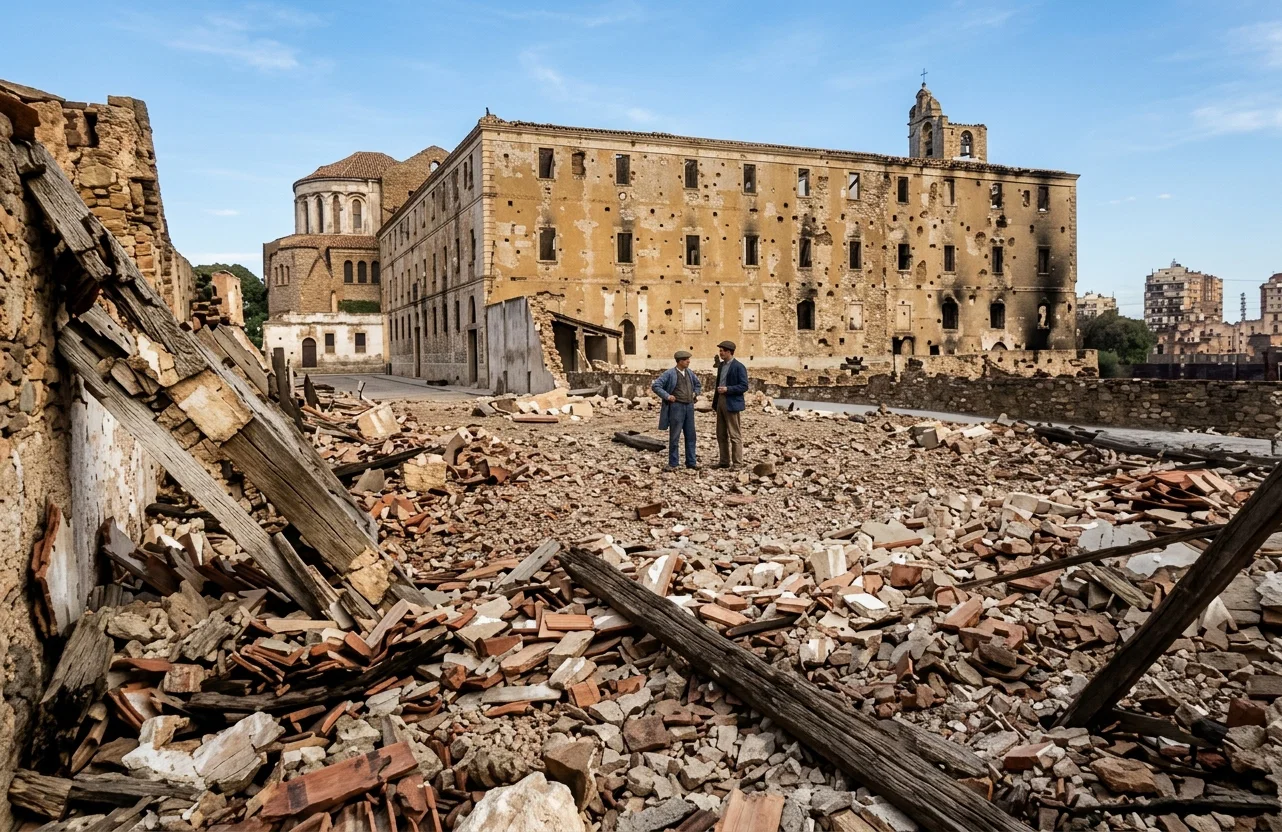
RUINS OF A CATHOLIC MISSION AND COLLEGE, AT BARCELONA
Then the battle was on. During the next few nights, forty-eight Catholic churches and convents were burned. The populace tore up the stones out of the streets and carried them to the houses, whence they hurled them down on the soldiers' heads. They also built barricades with these stones in different parts of the city. The mobs who burned the convents made all the inmates leave before firing them. The priests and some others were so enraged at the soldiers because they would not fire on the crowd that they in turn fired on the soldiers.
I am sending a few views, which show something of the destruction, although they do not show the worst, as these cards have all had to pass the censor.
Since order has been restored, court martials and shooting of revolutionists have been almost daily occurrences. “Después de los successos” (after the events) is one of the headings in nearly every daily paper now. Since I have been here, we hear of bombs nearly every day, but the Lord has cared for his children, and none of our brethren have suffered. N. Z. TOWN.

Pioneer Canvassers Wanted at the Front

Recently, in a missionary talk, Elder O. A. Olsen made the following statement in emphasizing the influence of the printed page in foreign fields: “The fact is, our publications have pioneered the work in every foreign field that I know of.”
Coming, as this statement does, from an ex-president of the General Conference who has had many years of experience in foreign fields and in the general work, it should be a great encouragement to our canvassers to volunteer to do pioneer work in foreign lands.
Many are doing this, and are being sent to the front, — to Mexico, to Central America, to South America, to India, to Africa, and to other countries. Still the need is greater than the supply.
Volunteers are needed in Mexico, where a little handful of brave young men have been pioneering most successfully.
Elder Steele, who was recently sent to Porto Rico, has made a beginning by demonstrating that books can be sold successfully there. In the first four and one-half days that he worked, he sold one hundred sixteen dollars’ worth of books. Now he sends a most urgent call for at least one canvasser.
Recently the General Conference has voted to send two single young men to India to work under the direction of Brother Carl Weaks, formerly general agent of the North Pacific Union Conference, now on his way to the East.
Two young men from the Avondale school in Australia have for several years been pioneering along the eastern coast of Asia, from Singapore to Shanghai. They have been very successful.
We need volunteers for China, Japan, and the Philippines. For nearly two years a call has been out for six young men to volunteer to pioneer the work in southern Ireland, but thus far no one has been found.
Recently our hearts were made glad on receiving a letter from two young men who volunteer for South America. They accepted the truth three years ago from reading “Great Controversy” and “Bible Readings,” and now they wish to become self-supporting missionaries in some more needy field. We trust that arrangements may be made for them to carry out their desire in the near future.
We wish to hear from others, and especially from hardy, consecrated young men who do not flinch from bearing the yoke in their youth. What better task could any young man wish than to go abroad to some needy field, learn a language, learn the manners and customs of the people, help plant the good seed, and grow up in experience with the message which he has been instrumental in establishing. We shall be glad to hear from any whom the Spirit of God may stir up for such work. E. R. P.

The Angel of the Lord

“THE angel of the Lord encampeth round about them that fear him, and delivereth them.” Ps. 34:7.

The Missionary and Publishing Work

Notes, Plans, Reports, Statistics, and Other Information Regarding Missionary Endeavor and the Circulation of Gospel Literature.
Conducted by the Missionary and Publishing Department of the General Conference
E. R. PALMER           -     -     -         Secretary
N. Z. TOWN              -     -     -         Assistant Secretary
A. J. S. BOURDEAU      -     -     -         Missionary Secretary

Sanitarium Management

MANY difficulties and failures in our institutional work are due to ignorance as to the duties and responsibilities of its various officers and department leaders and a failure upon their part to realize the importance of co-operation. Whatever may be the plan of organization or management, it is the success of the institution as a whole that is desired. This requires the careful and unselfish operation of its departments individually and collectively.
In planning for successful sanitarium management, we should begin with its board of directors, who should be selected with a view to active service rather than of honorary membership. In other words, men should be selected who are adapted to the work by experience and inclination, and who are willing to help carry the load, rather than those who are already overloaded with the weighty affairs of conference or other institutional administration, with little prospect of giving more than a very limited amount of their time and counsel.
With the board properly organized, the basis upon which the enterprise will be operated is to be considered. Right here is where many mistakes have been made, and some of our larger institutions are crippling along, overburdened with debts, because they were not willing to begin in a small, simple way, and grow, adding to their facilities as the increase of patronage demanded and their experience increased. They wanted to be full-grown immediately, even though lacking in enough experience to operate a small work. The result is that large indebtedness has been incurred, the interest upon which overburdens and discourages the workers until they are dwarfed in their experience, and the work has been permanently injured. Many of our institutions have never fully recovered from these blighting influences of debt, and still worse results will follow unless they are rescued.
It is far better to start in a modest way, providing additional facilities as the profits warrant and the patronage demands, always from the income of the business. Thus a healthy growth is realized and appreciated by the workers, which serves to encourage them in their efforts.
The affairs of our sanitariums must not be conducted after a banking policy. Our business is to save souls, and while we should have value received from those patients who are able to pay, all must be treated with consideration and courtesy, always if possible retaining their confidence and respect.

Relations of Medical Superintendent and Business Manager

Naturally our sanitarium work is divided into two branches, which for convenience we will designate as the medical division and the business division, the former supervised by the medical superintendent, with the business manager as a counselor, the latter headed by the business manager, with the medical superintendent as counselor. These two individuals are directly responsible to the board of directors, and should receive from them their general instruction for the direction of the work. Here is the vital point. These positions should not be filled by those whose greatest desire is to rule something, but by men who are consecrated, unselfish, broad-minded, and liberal, willing to counsel and to be counseled with, and to share responsibilities with others. Neither should feel that the whole institution rests upon his shoulders, but that he is leader of a certain division, and that he has been provided with the very best man available as an advisor, and that in turn it is his privilege to be a helper to his associate in planning for the good of the whole work. Many of the details of the work should be gone over together; if the business manager feels called upon to make unusual purchases, let there be the fullest agreement and understanding between the two as to the necessity and as to how the money can be invested to the best advantage. To ask the physician to assist in the work will tend to enlist his co-operation and confidence. In turn, if the medical superintendent feels the need of additional apparatus or of making important changes, let him advise with the business manager as to the propriety of the action, considering the conditions. If an agreement between themselves is not sufficient, the matters should have the approval of the board of directors. Thus they should feel that it is not only a duty but a privilege to counsel together regarding the work entrusted to their care. No opportunity should be let slip to gain each other's sympathy and support, realizing that independently neither can make his division of the work a success.
Get close together, and keep close together. While differences of opinion will doubtless arise regarding some of the details of administration, never allow them to become personal, but remember that these differences are opportunities to practise the principles of Christianity, "In honor preferring one another," and that it requires two to make a quarrel. Never, under any circumstances, if differences do arise, allow your associates or family of workers to know it, for it is almost sure to be magnified, and the workers will take sides, to the great detriment of the work and disgrace of the principals. Be examples to your workers; as you would have them co-operate with you, you must co-operate with each other. Advantage should also be taken of the advice and counsel of the chaplain.
A business manager should be secured, if possible, who has had experience in conducting a similar business, and who realizes the value of a dollar; whose principles is to make the income to the business meet its expenses, and who fears debt; who is willing to handle the institutional funds as carefully, or more so, than he would his private means. He should also be willing to counsel with his associates and to lead where he expects others to follow; not selfish to draw a large salary regularly, and expect the other workers to sacrifice and receive their allowance in small amounts as the treasury can spare it; and if occasion warrants a donation, he should head the list. He must be approachable alike to patients and fellow workers.
As the duties of the medical superintendent are generally to have the leadership of the medical departments,—which constitute the medical division—and all professional work of the institution; to attend promptly to the needs of the patients as they enter, either personally or by assignment, as he may elect, providing necessary treatment; to supervise the professional training and education of workers; to educate patients and guests by means of classes, lectures, and by personal contact, in the principles to which the institution is dedicated; to give attention to the discipline of all workers connected with the medical departments, and, in conjunction with the business manager, the whole family of workers: so the business manager, as the name implies, is to direct the financial affairs of the institution. He or his deputy should give prompt attention to the location of patients as they enter the sanitarium, having a definite understanding as far as possible as to prices, terms, etc., and if in doubt as to the financial standing of the new arrival, begin at once to look it up. He attends to the prompt collections of bills as they become due. Arrangements for discounts, remitting of charges, correcting bills, etc., should all be handled by the business office.
The pricing of surgical operations, after consultation with the physician, as the latter is better able to judge a fair fee and is very often better acquainted with the circumstances of the patient, is done by the manager. In fact, he represents the institution in all negotiations involving finance, but he should make no arrangement with the patient which is liable to hamper the physician, without consultation.
He should also make financial arrangements with workers, employing and discharging all irregular help, providing for all obligations promptly as they fall due, and attending to the purchase of supplies and apparatus as directed by the board. He should make a continual study of the finances of the institution in order to be able to take advantage of opportunities to better conditions, planning carefully and wisely for the interests of the work. His assistants are the matron, steward, bookkeeper, clerk, and the department leaders.
(To be continued)
L. M. BOWEN.

Medical Missionary Department

Conducted by the Medical Department of the General Conference
W. A. RUBLE, M. D.                                 Secretary

Sanitarium Quarterly

ALL arrangements have been made for starting a medical missionary journal for our sanitarium workers and for our people at large. We are waiting now for a subscription list. This is necessary in order to enter the periodical in the mails, as well as to insure financial support. One call has been made through these columns for subscriptions at twenty-five cents a year. We shall be obliged to place the price at fifty cents unless a list of two thousand subscribers can be secured before we enter upon the project. From this time on we will receive subscriptions for two years at fifty cents, with the understanding that the price will be fifty cents for one year unless two thousand subscribers are secured, when the price will be twenty-five cents a year. We shall now wait to see whether there is a call for this journal before we launch it. There is a great deal of work and anxiety connected with a venture of this kind, and unless there is a demand for such a periodical, we do not wish to undertake its publication.
The plan is to make the journal of value and interest to all our people. It will be supported by many of our best physicians and other workers. There will be a number of departments of general interest, each edited by a competent person; also other departments especially valuable to sanitarium workers. Special attention will be given to reports from our missionaries in foreign lands. It is the plan, at present at least, to issue the journal quarterly.
Are you in favor of this movement? It will cost you fifty cents to vote for it. Send in your subscription. The sooner the list is made up, the earlier the first number will appear.
In case not enough subscriptions are received to justify going ahead with the effort, the money will be returned.
W. A. R.

The Reading Courses

Words of appreciation which we receive from those who are enjoying the reading courses this year are cheering. One secretary writes: “The number of our reading course members is still growing. I have visited some who are reading ‘Quiet Talks on Service,’ and the testimony of all is that it is just splendid. I must say for myself that it is proving a great blessing to me.”
To those who have not enrolled, we again extend the invitation. It is never too late to begin. True, the outlines started in the Instructor of October 5, but with a little earnest effort you can make up this reading. The choice of books, like the choice of friends, is a serious duty. We are as responsible for what we read as for what we do. God has a special work for every young man and woman in this closing message. You may not be privileged to equip with a college education; but just where you are, you may begin to prepare for service. The needs of a dying world never pleaded more earnestly than they do to-day for young men and women of sterling worth. Some opportunities lie in the arms of the past, others are hidden in the bosom of the future, but the present are ours. Among the many which you may seize to-day are the reading courses.
A Missionary Volunteer secretary wrote to her young people: “The long, pleasant evenings of summer have given place to those of autumn, when we close the doors against the outer darkness, and turn to the light within. These evenings spent in the home circle are rare opportunities for improving our minds and enriching our characters, but opportunities which, if neglected, will rise up and condemn us in the Judgment.”
Not only the young people, but the whole family, could profitably take up this reading course work. We are told by the spirit of prophecy to “form a home reading circle, in which every member of the family shall lay aside the busy cares of the day and unite in study.” Let parents encourage their children in this good reading.
The books needed are as follows:—

Missionary Volunteer Reading Course No. 3

  1. “Quiet Talks on Service.” Cloth, 75 cents.
  2. “The Moslem World.” Cloth, 50 cents; paper, 35 cents.
  3. “The Great Second Advent Movement.” Cloth, $1.25; paper, 50 cents.

Junior Reading Course No. 2

  1. “Letters From the Holy Land.” Cloth, 50 cents; paper, 25 cents.
  2. “Three historical books of the Bible.”
  3. “My Garden Neighbors.” Cloth, $1.
The Youth’s Instructor is needed in both these courses. That, as well as Nos. 1 and 2 in the Missionary Volunteer Course, should be ordered from the Review and Herald, Takoma Park, D. C.; No. 1 in the Junior Course, from the Pacific Press, Mountain View, Cal.; others from any of our tract societies or publishing houses. Those enrolling should send their names to their conference Missionary Volunteer secretary.
M. E. K.

What Our Young People Are Doing

THE young people of South Dakota have decided to take the responsibility of sending a young man from Russia to the school in Friedensau, Germany, for one year. This training will enable him to labor more efficiently among his own countrymen.
The Missionary Volunteers have been at work in western Colorado. At camp-meeting fifty-five dollars was raised to complete the Foreign Mission Seminary scholarship which they have been trying to raise. Aside from this, fifty dollars was given for the scholarship of a native Burmese.
The young people of Palisades, Colo., have dried a quantity of fruit for the missions in the South.
One secretary writes: “Enclosed please find ten dollars, a donation from the Missionary Volunteers to help fit up a room in one of the new sanitariums in the South.”
Our young people in Maine have given about fifteen dollars for the needy Southern field. Their donations are still coming in to the treasurer.
One of our Missionary Volunteers in western New York has pledged fifteen cents a week toward the support of a student in the Huntsville school.
The Glendale, Cal., Missionary Volunteers recently gave one hundred twenty dollars for the Southern work.
After a special effort of several weeks to get up a program on the Southern work, at which over one hundred dollars was raised by one of our societies, a reaction set in. The programs of the weekly meetings became formal, and the interest lagged. The attendance fell off, the leader became discouraged, and felt almost ready to give up. One of the earnest workers of this society who had been out in the field, came home for a few days and went to work to arouse the interest. He asked a few who had attended the last meeting to unite with two or three others in prayer during the week, that the Missionary Volunteer leader might be encouraged, and that the next meeting might be a success. The Lord blessed their efforts. Thirty-one were present at the meeting, and there was unusual freedom.
The western Pennsylvania young people recently gave two barrels of clothing to the poor.
There are many German young people in the United States. For their benefit it is planned to publish a German young people's paper.
At one of the Western camp-meetings it seemed very hard to reach the hearts of the people. Earnest efforts were made to break through the barrier, and the prayer bands did faithful, earnest work. At the last meeting eighteen young people came forward, several who were backsliders, and a goodly number took their stand for the first time. The Missionary Volunteer secretary is endeavoring to follow up this good work by correspondence, and plans to visit the young people later.
A good word comes from northern Illinois. The secretary writes: “We had some very good meetings at our camp-meeting this year. I think I never saw young people work so hard to make the meetings a success as they did there. We formed prayer bands, and have seen some encouraging results. We in this conference have become firm believers in prayer and personal work at camp-meetings. Both last year and this we have been rewarded with new workers from among the young people. Some of those for whom we worked hardest last year were leaders of bands this year, and one of our most promising church-school teachers is a result of last year's camp-meeting work.”
The Missionary Volunteer work is making good advancement in the British Isles. There are now eleven societies, with a membership of one hundred seventy. The young people of the South England Conference have taken the North Scottish field as a mission to support by their contributions.
One of our conference secretaries, in writing of the young people's work at their camp-meeting, says: “One young lady who did not want to come to the camp-meeting, but came just because she did not like to stay at home alone, was converted. She was very worldly, and her conversion was indeed wonderful and just as sincere. She had been a public-school teacher, but she gave herself to the service of God, attended one of our institutes, and is now teaching a church-school. I saw her not long ago, and she is a firm and happy Christian.”
M. E. K.

The Morning Watch Calendar for 1910

Do our young people need it? Do we not all need a quiet hour with Jesus every day? It will greatly help us keep the world out and the Spirit in. How can we receive power for witnessing except by daily contact with Heaven?
“Our Master's Invitation.—‘Come ye yourselves apart.’
“Our Master's Command.—‘When thou prayest, enter into thy closet, and when thou hast shut thy door, pray to thy Father which is in secret.’
*“Our Master's Example.—‘And in the morning, rising up a great while before day, he went out, and departed into a solitary place, and there prayed.’*
“Our Master's Promises.—‘Lo, I am with you alway.’ ‘And thy Father which seeth in secret shall reward thee openly.’
“The Servant's Response.—‘O God, thou art my God; early will I seek thee: my soul thirsteth for thee.’ ‘My voice shalt thou hear in the morning, O Lord; in the morning will I direct my prayer unto thee, and will look up.’”
The increasing interest in this plan of daily devotion and Bible study is surely an encouraging feature of our Missionary Volunteer work.
The calendar for 1910 follows the same general plan as the one this year. The scriptures for each day are chosen with reference to the Sabbath-school lessons.
This little booklet will help you to form the habit which may mean your eternal salvation. Though it is quite inexpensive, it may be of inestimable value to a friend who is seeking to live a noble life. It will be a dainty Christmas or New-year's gift.
Order from your conference Missionary Volunteer secretary. Price, in any quantity, 5 cents each. Envelopes for remailing will be furnished to those who request them. M. E. K.

Young People's Work

Conducted by the Young People's Missionary Volunteer Department of the General Conference
M. E. KERN       -      -      -      -       Secretary
MATILDA ERICKSON       -       Corresponding Secretary

Church Federation in Colorado

THE formation of a church federation of the three cities, Colorado Springs, Colorado City, and Manitou, in the State of Colorado, is under way. The object of this federation is “to unite the Christian forces of the three cities so that they may act together as far as possible in connection with all movements of a moral and religious nature that are of common interest,” and “to discover and supply any religious, social, and civic needs that may arise, without any unnecessary multiplication of agencies in meeting those needs.”
The federation is to become operative as soon as seven denominations indicate their readiness to co-operate in its formation and maintenance.
The proposed constitution for the federation provides for the election of a federal council to consist of “all the ministers of the constituent denominations,” and lay members according to church-membership.
The subjects outlined for consideration and attention are “international enterprises, civic righteousness, location of churches or missions, Sabbath observance and law enforcement, laymen’s missionary movement, and finance.”
It will be noticed that this church federation is not only to consider the subject of “Sabbath observance,” but that “law enforcement” is brought in immediate connection with this, which, we take it, when expressed in full, means that one of the aims and objects of this federation is to enforce Sabbath observance by law. Well did the United States Senate Sunday Mail Report of 1829 say: “All religious despotism commences by combination and influence; and when that influence begins to operate upon the political institutions of a country, the civil power soon bends under it; and the catastrophe of other nations furnishes an awful warning of the consequence.”
If the churches throughout the land would “federate” and pledge themselves, by the grace of God, to be Christians, and to act Christlike; to obey the golden rule, and grant to their neighbors the freedom they ask for themselves; to seek and to teach righteousness by faith and not by works, and salvation by grace and not by law, they would be in better business than they are when they federate to control politics or to establish religion or to enforce religious observance by law. W. A. C.

“American State Papers”

The work of revising “American State Papers” is nearly completed, and the manuscript for the new, revised, and enlarged edition will soon be placed in the hands of the publishers.
The work has been divided into six parts, under the following heads: “The Colonial Period;” “The Federation Period;” “The National Period;” “Court Decisions;” “State Constitutions and Sunday Laws;” and “Operation of Sunday Laws;” besides an appendix containing the Declaration of Independence and the Constitution of the United States.
This book will contain all the statements in the various State constitutions relating to religious rights and religious liberty, as well as the Sunday laws in every State, Territory, and possession of the United States, revised up to date. This section of the book will be of particular value and interest from now on as the agitation over Sunday enforcement rises all over the country. Besides this, the work will contain a vast amount of most valuable and interesting matter from colonial times down to the present time.
The various movements, measures, and matters of interest which have arisen since the rise of the National Reform movement in 1863, especially those from 1888, when the Blair Sunday-Rest bill was introduced into Congress, and onward, are all noted and treated in chronological order. A list is given of every Sunday bill that has been introduced into Congress since 1888. Such matters as the “National Reform Association,” the Blair “Sunday-Rest Bill,” the Blair “Educational Amendment,” the Breckinridge “District Sunday Bill,” the Supreme Court “Christian Nation Decision,” the “Sunday Closing of the World’s Fair,” the Johnston “District Sunday Bill,” the “Proposed Religious Amendment,” are all presented and dealt with at some length, as well as the Seventh-day Adventist and Seventh-day Baptist memorials to Congress of 1908.
We are sure that all our workers in the United States and a large number of our people generally will wish a copy of this book as soon as it is published. The first edition of the book, gotten out in 1890, was much appreciated; but the revised edition will be found still more complete, and will be of exceptional value as a work of reference and study. W. A. C.

A “Lord’s Day Act” for Bermuda

WRITING from Bermuda under date of October 4, Brother M. Enoch says: “On Monday, September 20, a Sunday ‘Lord’s Day Act’ was brought before our legislature by the Moral Reformers, who are mainly made up of Methodists and Presbyterians. The act was then read for the first time, and was to be read a second time the following Friday.” The proposed act is similar to the one recently passed in Canada.
On Friday, September 24, the measure was called up, and an attempt made to rush it through. Of the thirty-six members composing the house, only seventeen were present, including the speaker. A motion was made that the act “be read the second time this day six months,” which meant to kill it. On this there was a tie vote, eight voting for and eight against it. The speaker casting his vote in the negative, the motion was lost. Brother Enoch says, “I am informed that had there been a full house, the act would have met its death then.”
Those who spoke in favor of the measure made it plain that it was religious, and was desired to check the growing “desecration of the sabbath.” One member, Mr. Dill, said, “There are at the present time in this colony numbers of Christians who do not believe in keeping Sunday as the Sabbath.” Replying to this, Mr. Outerbridge, the member who had the measure in charge, said, “We may or we may not be better off without that element in the community; but if that element is not satisfied to accept what we consider are the wishes of the majority, let that element seek some other field where they can enjoy their rights and privileges.” In this was manifested the intolerance couched in the movement for this legislation.
Action on the measure was deferred in order to “give the house further time to consider the matter.” Brother Enoch has gotten out a leaflet to meet the issue, and has also written some for the public press, exposing the real character and object of the proposed legislation. Judging from the public feeling in regard to the matter, he thinks the measure will not be brought up again. W. A. C.

Finish of the Kansas City Sunday-Law Crusade

The following news item from Kansas City, Mo., under date of November 4, is of interest:—
“More than four thousand indictments which were returned during the ‘Sunday blue-law’ crusade made by Judge William H. Wallace of the criminal court here a year ago, were dismissed by Judge Lashaw in the criminal court here to-day. Prosecutor Conkling moved that they be dismissed, in keeping with his pre-election promise. The Wallace crusade was the most spectacular ever attempted here.”
It will be remembered that Elder K. C. Russell, of our Religious Liberty Department, opened up the campaign against this crusade in Kansas City, two years ago this fall, by delivering several lectures in one of the popular halls of the city, and securing the publication of an “Open Letter to Judge Wallace” in one of the leading daily papers of the place. A little later the campaign was taken up by Elder and Mrs. J. S. Wightman, and carried on not only in the city, but throughout the State. W. A. C.
Continue reading: Department of Religion in the Michigan University