A Chinaman died, leaving his property by will to his three sons, as follows:—
“To Fuen-huen, the oldest, one-half thereof; to Nu-pin, his second son, one-third thereof; and to Ding-bat, his youngest, one-ninth thereof.”
When the property was inventoried it was found to consist of nothing more or less than seventeen elephants; and it puzzled these three heirs how to divide the property according to the terms of the will without chopping up seventeen elephants and thereby seriously impairing their value. Finally they applied to a wise neighbor, Suen-punk, for advice. Suen-punk had an elephant of his own. He drove it into the yard with the seventeen and said:—
“Now we will suppose your father left these eighteen elephants. Fuen-huen, take your half and depart.”
So Fuen-huen took nine elephants and went his way.
“Now, Nu-pin,” said the wise man, “take your third and go.”
So Nu-pin took six elephants and traveled.
“Now, Ding-bat,” said the wise man, “take your ninth and be gone.”
So Ding-bat took two elephants and vamoosed. Then Suen-punk took his own elephant and drove him home again.
Query: Was the property divided according to the terms of the will?—Selected.
KNOWLEDGE OF THE BIBLE.
Last May the Century published an article by President Thwing revealing a shocking ignorance of the Bible among college students. A class of men and another of women were asked to explain the scriptural allusions in a set of twenty-two quotations from Tennyson. Miss Briggs, a teacher in Hampton Institute, well known among our readers, was convinced when she read the results that her class could do better than the college men, and she proceeded to test them with the same examination. The result is given in detail in the December Century. The Hampton class of negro men and women included two Indians. The parents of thirty-four out of the total thirty-eight were born in slavery. Not one of the students could enter college without three years of further study. They had, however, received systematic instruction in Old Testament history as part of their academic course. How did they compare with the college Freshmen known to President Thwing?—Out of 836 possible answers, 645 were given correctly. While the college men averaged 43 per cent. and the college women 49 per cent. of correct answers, the Hampton students averaged 77 per cent. A host of questions and comments are suggested by this comparison, but one inference has such a direct bearing upon the home and the responsibilities of parents that we wish to quote it in the words of Miss Briggs herself: “If young people with much less than ordinary early training can do so well after a brief systematic course of instruction in the day-school, it would certainly seem that there must be weakness in the home instruction given to the children of some educated Christian families.”—Congregationalist.
A MOTHER SEAL'S LONG SWIM.
ERNEST WHITEHEAD captured a young seal near Anacapa Island, California, recently, and took him on board his ship. As the vessel started, the mother seal was noticed swimming about, howling piteously. The little captive barked responsively. After reaching the wharf at Santa Barbara, the captive was tied up in a jute sack and left loose on the deck. Soon after coming to anchor, the seal responded to its mother's call by casting itself overboard, all tied up as it was in the sack. The mother seized the sack, and with her sharp teeth tore it open. She had followed the sloop eighty miles. The maternal passion is proverbially strong; yet God's love is even greater than that of a mother. “Can a woman forget her sucking child, that she should not have compassion on the son of her womb? yea, they may forget, yet will I not forget thee.” Isa. 49:15.—Selected.
SANTA FE ROUTE
ONLY LINE WITH ITS OWN TRACKS
FROM SAN FRANCISCO TO CHICAGO
THE CALIFORNIA LIMITED
The Santa Fe new and sumptuous train, through to Chicago in 75 hours. Leaves every morning at 9 o'clock.
OVERLAND EXPRESS, with through Palace and Tourist Sleepers, to Chicago, every evening at 8 o'clock.
BAKERSFIELD LOCAL leaves every morning at 7.20, and STOCKTON LOCAL every afternoon at 4.20, giving best service through the San Joaquin Valley.
PERSONALLY CONDUCTED Tourist Excursions every Monday, Thursday, and Saturday, in Vestibuled Tourist Cars.
The service on these Personally-Conducted Excursions, is all that counts for comfort and convenience. Clean linen and bedding, the proper lavatory and toilet accommodations are provided. The aisles are carpeted and the windows double, to keep out the dust, and wide to allow an unobstructed view of the scenery en route. Full information regarding the Santa Fe Route, with handsome folder and correct map of the section through which it runs, may be had at the Company's offices.
CALL OR WRITE
1118 BROADWAY, OAKLAND
641 MARKET ST., SAN FRANCISCO
The Overland Limited
When you go East, take
“The Overland Limited”
ViaUNION PACIFIC RAILROAD
Less Than Three Days to Chicago
Four Days to New York
Leaves Oakland Daily at 10:36 A. M.
“The Fast Mail”
Three and One-half Days to Chicago
Both Pullman and Tourist Sleepers through to Denver, Kansas City, Omaha and Chicago Daily without Change. Leaves Oakland at 6:44 P. M.
EVERY DAY IN THE YEAR
PERSONALLY-CONDUCTED TOURIST EXCURSIONS TO THE EAST EVERY WEDNESDAY AND FRIDAY EVENINGS
Steamship Tickets to and from all points in Europe by all trans-Atlantic steamship lines
H. V. BLASDEL, Passenger Agent
1160 Broadway, Oakland, Cal.
Premium Yellow Dent Field Corn
By F. B. Wilson
RIPENS IN 90 DAYS
It is particularly recommended for planting in all Northern states on account of its extreme earliness, great productiveness, and absolute purity. Has deep kernels set very compact, with a small red cob; two good-sized ears are frequently found on a single stalk. It has excellent milling qualities, and is an enormous yielder; has taken premiums at every fair at which it has been exhibited. Has yielded 100 bushels of shelled corn to the acre. If you want to get a stock of a pure distinct variety of field corn, order some of the Premium Yellow Dent.
A trial package by mail for 10c. for postage. One bushel $1.00, sacks 10c. extra; in five-bushel lots, sacks free. Address—
F. B. Wilson,
102 N. Clark St.,
Chicago, Ill.
YE DID IT UNTO ME
Unawares
YE DID IT UNTO ME
(“And He said, ‘The sin is pardoned,
But the blessing is lost to thee,
For, failing to comfort the least of Mine,
You have failed to comfort Me.’”)
Such is the closing verse of one of the two poems found in No. 54 of the Apples of Gold Library under the above title. They are very touching and very good. Price, 50c per 100.
PACIFIC PRESS PUBLISHING CO.
New York City Oakland, Cal. Kansas City, Mo.
Wanted—Salesmen or Ladies
WANTED—Salesmen or Ladies—Do you want to make more money? You can do it by working for the largest manufacturing company in our line, in the country. Salary guaranteed; expenses advanced weekly. Write Monarch Co., 608-46 Jackson St., Chicago, Ill.
Salesmen Wanted for Paints and Varnishes
Wanted.—Salesmen to travel with most complete line of Paints, Colors, and Varnishes on the market. Jewel Refining Co., Paint Department, Cleveland, Ohio.
CHRIST AND THE SABBATH
Or Christ in the Old Testament and the Sabbath in the New, by Elder James White. Paper covers, fifty-six pages, sent post-paid for ten cents. Address, PACIFIC PRESS, Oakland, Cal.
THE SAN FRANCISCO HELPING HAND MISSION.
The San Francisco Helping Hand and Medical Mission was established February 27, 1898. Its third anniversary was held at the mission, 641 Commercial Street, on the evening of February 27, and was a most successful reunion of the founders and patrons of the institution. The chapel was profusely decorated with evergreens, and presented a most attractive appearance. Early in the evening the many friends of the mission began to arrive, and long before the hour appointed for the exercises there was a crowded house.
The first item on the program was the invocation, pronounced by Pastor B. F. Richards. “Ye nations all be joyful” was next rendered by a quartet, with excellent effect. Then came a recitation by Miss Minnie Brown, “The Wood-pile Test.” This remarkable piece, written in pure Hoosier vernacular, is realistic of simple, honest country life, and pathetic in its portrayal of the poor husband who begged, at the close of day, to be allowed to work that he might save “my missus and the young uns” from starvation.
A solo, with quartet chorus, “The First Resurrection,” was followed by Pastor B. F. Richards, who took the place of Pastor M. C. Wilcox and Mr. C. H. Jones in the part allotted them on the program, “Founders’ Remarks.”
Founders’ Remarks.
Pastor Richards said that the idea of establishing a “Helping Hand Mission” originated with the Pacific Press Publishing Company. The project is a noble index of their philanthropy, and the great good that the mission has accomplished in the three years of its existence shows that their “bread has not been vainly cast upon the waters.”
When the mission was under consideration, the chief of police of San Francisco was interviewed as to the point in the city where moral and physical help was most needed; and “Barbary Coast” was indicated. Accordingly two buildings were rented on Commercial and Kearney Streets, on the confines of “Barbary Coast” and “Chinatown.”
These buildings had a notoriety and a history. They were first used as saloons, then as dance halls, then as a police court, and again as a brothel. Here the pugilist John L. Sullivan, on his visit to the Pacific Coast, established his headquarters and fought Paddy Ryan.
The male quartet sang, “A Message from the King;” and the Helping Hand Mission Gospel work was taken up by Pastor B. F. Richards and Pastor J. W. McCord.
Helping Hand Mission Gospel Work.
Pastor Richards, who was the first chaplain of the mission, gave an interesting history of its early Gospel13work, relating many of the remarkable conversions that took place during his pastorate. The relation of his early experiences was eagerly listened to, especially as he told of the strange circumstances which brought about the conversion of a saloon-keeper and circus-rider. He also dwelt on the moral influence of the mission in reuniting families, and in accomplishing other good works which only a place of this kind was able to do.
Pastor J. W. McCord, the present chaplain, told of the later Gospel work of the mission. After relating many interesting instances of Helping Hand conversions, he pointedly dwelt on the silent influences of the mission Gospel work. Quoting from Eccl. 11:1, he said, “Cast thy bread upon the waters; for thou shalt find it after many days.” Men attended the mission Gospel services, many of them dropping in accidentally, and were converted. Then “they folded their tents like the Arabs, and as silently stole away.” Nobody in the mission knew of their departure or their destination. They visited strange cities, and months afterward came news of their whereabouts, with the assurance that they had cause to bless the night of their conversion at the Helping Hand Mission.
One of the examples given was the case of a man who, on landing at one of the wharves, broken down by dissipation and dispirited, plodded his weary way up Commercial Street. He entered some of the places on this street, but found nothing that could place a ray of hope in his breast. Trudging farther west, he noticed in large letters the words, “Helping Hand Mission.” “Ha!” cried he, “this is just what I sorely need, a ‘helping hand.’” He attended the mission services, and at their conclusion was greeted by the chaplain with a warm handshake. He left the mission almost as silently as he had entered, and in a few days wended his way northward, in the direction of Seattle. Overtaken one night by darkness, and overcome by fatigue, he sought rest in a lumber pile, and there, in darkness and solitude, the words of hope and love heard at the Helping Hand Mission came to him with all their burning force. He fell on his knees, confessed his sins to the great Father of mercies, and there and then promised to lead a Christian life. He is now in Seattle, where he gives continual testimony for God, praising Him for the mercy shown him when his steps were directed to the Helping Hand Mission of San Francisco.
The quartet sang, “We thank Thee, O Father.”
Converts’ Testimonies.
Pastor B. F. Richards called for testimonies from those converted in the Helping Hand Mission. Brother Hunt was the first to testify. He said: “I thought the ambition of my life was gained when I became a saloon-keeper, and stood behind the bar to serve men with strong drink. I now smoked cigarettes, increasing the number daily, until I became a cigarette fiend. In my saloon I soon found myself my own best customer, and one day it was the Lord’s will I should be stricken with paralysis. For eighteen months I lay bedridden and speechless; but since my stay at the Helping Hand Mission I have recovered the use of my speech and almost the use of my limbs. I have no desire for drink or cigarettes, and since I gave my heart to God in this mission, I am happier day by day.”
Brother Shera said he had been a slave to drink and tobacco for forty-five years; but since his conversion at the Helping Hand Mission, seven months ago, he has had no desire for either. The Lord took away the desire.
As Brother Adams, one of the earliest converts of the mission, and afterward one of its most prominent workers, was unavoidably absent, Superintendent Dolson said he would act as a substitute and give his testimony. During the early days of the mission, Brother Adams was taking life easy on one of the park benches nearby, when one of our workers, on going through the park distributing cards of invitation to our Gospel services, handed him one. Brother Adams thought he would attend and see what these services were like; and was so impressed with them and the testimonies given, that, with three others, he came forward and found Christ. For nearly three years he was an active and efficient mission worker. He is now married, and the proprietor of a California orchard.
The superintendent also gave testimony for a man converted at the mission, and now a prominent Christian worker in the Hawaiian Islands. This man came to San Francisco from an adjoining state. Thru business failures he had become discouraged, and had deserted his family. Coming to San Francisco penniless, he sought assistance at the mission, and for three months was one of its bed-makers. He attended the Gospel meetings, but seemed unmoved by the services. He obtained employment on a transport, and on arriving at the Hawaiian Islands, secured a good government position. The seed sown at the mission had already germinated, and the ear grew rapidly. He soon became an active Christian worker. In a warm and kindly letter to the superintendent of the Helping Hand Mission, he said he had determined to devote the rest of his life to the service of the Lord.
Secretary and Treasurer’s Report.
Mr. E. E. Parlin, Secretary and Treasurer, read his report for the three years beginning with the opening of the mission, February 27, 1898: Penny dishes served, 1,524,313; lodgings given, 107,594; free baths, 25,233; garments given away, 7,140; free penny dishes served, 379,220; free lodgings given, 59,505; number of men granted use of free laundry, 6,647; medical treatments given, 6,602; surgical operations performed, 232; medical and surgical examinations, 2,539; Gospel meetings held, 1,095; the attendance at these meetings, 75,903; Bible-classes held, 766; the attendance at these classes, 13,036; persons requesting prayers, 10,374; professed conversions, 2,084; Bibles and Testaments given away, 224; men furnished temporary employment, 30,996; men furnished permanent positions, 1,434; literature distributed, 108,000 pages.
Pastor J. O. Corliss made some interesting remarks on the Secretary’s report. He dwelt on the large amount of practical good done by the mission; estimating its total cost for three years at $30,000, yet of this large amount less than $700 had been donated, and the present deficit is about $400.
An Appeal for Funds.
Pastor Corliss dwelt on the vast amount of good accomplished by the mission at such a trifling expense to the California Medical Missionary and Benevolent Association; and in his appeal for the liquidation of the debt, said the association would thereby be enabled to continue the good work without the annoyance of financial embarrassment.
A collection was taken up toward the payment of the mission’s debt, which amounted to $55; and if friends desire to help this missionary enterprise in San Francisco, subscriptions may be sent to the Helping Hand Mission, 641 Commercial Street, San Francisco; to the Pacific Press Publishing Company, Oakland; or to Mr. E. E. Parlin, Secretary and Treasurer of the California Medical Missionary and Benevolent Association, 1436 Market Street, San Francisco.
Need of a Helping Hand.
Superintendent Dolson spoke of the class of men converted in the mission. The bread of this world is offered in one hand, and the bread of life in the other. By this means many of the lost and needy ones in the large cities are reached and reclaimed. The number of men furnished positions thru the Helping Hand Free Employment Office conclusively showed the necessity for such an institution in a large city, where strangers from all parts of the world arrive, in very many instances in a state of destitution. “I shall relate,” he said, “an incident in my own life where I needed a helping hand. I left my home in Indiana when a young man. On leaving, mother said, ‘God bless you, my boy; and when you want money, write to me.’ When I arrived at Cincinnati, I had just $9 in my pocket. I went to a cheap hotel, paid $8 for two weeks’ board, and had one dollar left for car fare, and to purchase the morning papers in order to see by the advertisements where to look for employment. I got up at 4 o’clock every morning, looked over the ‘Help Wanted’ column, and then applied for work. Being unsuccessful thru the advertisements, I sought employment in almost every business and commercial house in the city, but at the end of the two weeks I found myself without employment, and without a five-cent piece. My clothes were getting worn, and my linen needed the laundry. I was in a strange city, without means, friends, or employment, too proud to write home for money, and was glad to get out of Cincinnati, in the depth of winter, in the shelter of a box-car, to reach Pittsburg, Pa., where I fortunately found immediate employment. A helping hand mission in Cincinnati at that time would have been a blessing to me.
“Again, many respectable men fall into poor circumstances, and when sick, can not find shelter. Really, these men are to be pitied. An instance in my life I dare say represents hundreds, and more likely, thousands of cases. On one occasion I became sick in Chicago, without money and without medical attendance. I happened to see the sign, ‘Free Dispensary’ over the door of the Pacific Garden Mission. I entered and received medical treatment, after which I received an invitation to attend the evening Gospel services. I did attend the meeting, and was one of those who went forward for prayers. I found Christ, and thank God for keeping me to this day.”
Do Men Appreciate the Mission’s Kindness?
Do men appreciate the benefits received at the Helping Hand Mission? While ingratitude is a factor in all grades of society, very many appreciate the kindness shown them. It would take too long to go over the list of “gratefuls,” but here are two typical cases: A man who had secured a place thru the Helping Hand Employment Office asked the fee required for getting him the situation. The answer was, “Nothing; but if you desire to donate anything, it shall be used in connection with the employment office.” He donated $10, and this enabled the mission to get out ten dollars’ worth of employment-office cards, which were sent to the merchants and business men of the city.
Another case—a recent one—is that of a man assisted for three weeks. He came to find the amount of his bill. He was told that as he did a few hours’ work daily, there was no bill against him. “Here,” he said, “are $10 to help somebody else.”
In closing the meeting, Brother J. A. Dolson acknowledged the blessing of the Lord which had attended the reunion, and thanked those who, by their presence, had helped to make it a success. He called the attention of the audience to the motto on the wall, prepared for the occasion: “Be not weary in well doing; for in due season we shall reap if we faint not.” They could not do better than rise and sing the doxology, “Praise God, from whom all blessings flow.”
HOMES AND HOME LIFE OF THE TAHITIANS.
By B. J. Cady
TOURISTS visiting Tahiti nearly always take a trip around the island. A good road runs around the outside close to the sea; so as one rides along, he has a view of the sea on one side and the island scenery on the other. We pass by some settlements where for quite a distance the houses stand side by side, and then again we ride thru a lonely glen where no signs of life are visible except vegetable life, where the air is cooled by the dense shade and the water dripping continually from the rocks above. Beautiful ferns and vines cover the hills with their foliage.
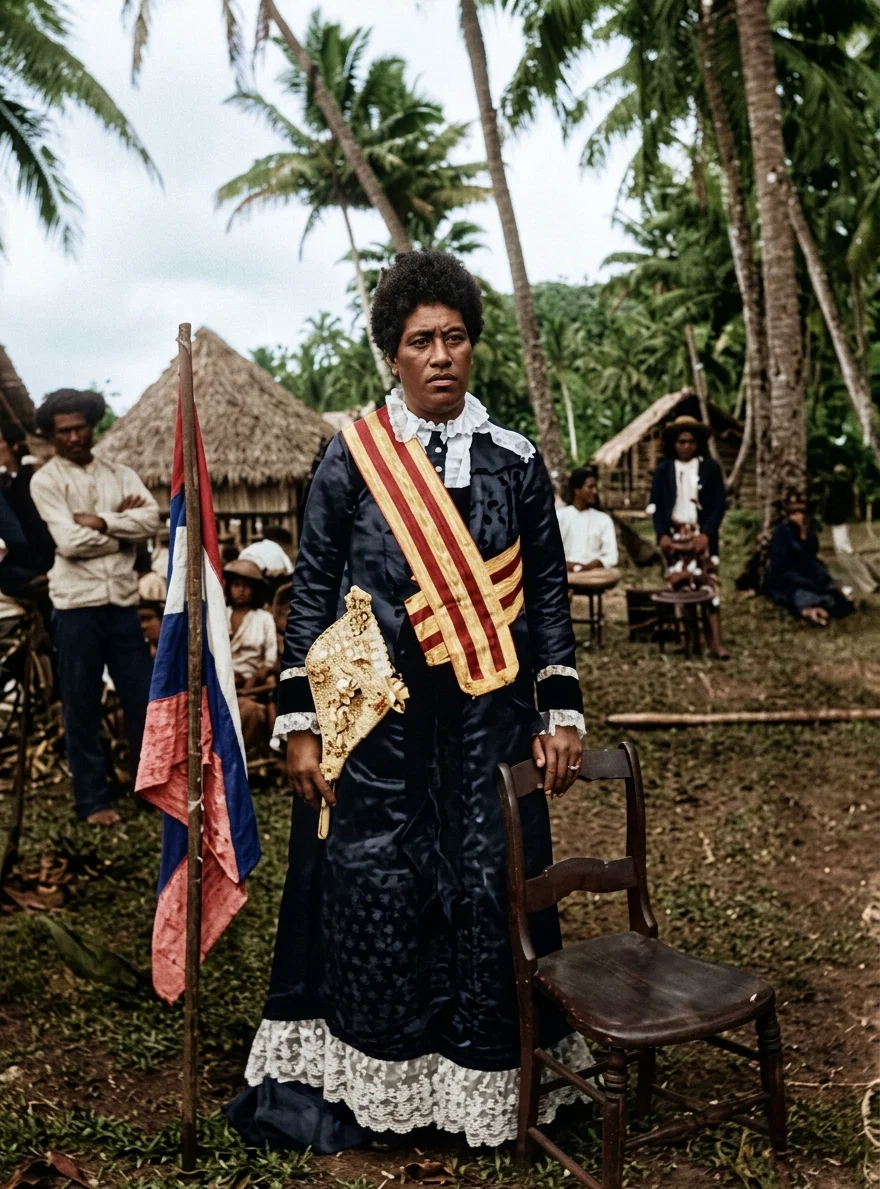
Ex-Queen of Raiatea.
In traveling around the island, one has a chance to see a variety of houses, from a fine European residence down to the poorest and dirtiest of huts. Occasionally we see a house where the surroundings show signs of thrift and industry. Some of the most tasty residences in European style are those belonging to natives, who have had success in the vanilla business, and have accumulated considerable money in a short time. At one time we stopped over night at such a place. The house had just been finished, and was fitted up with nice new furniture; but the family still lived in their old home, a rude hut that stood near the new building. They seemed to think that the new house was too good to use, or perhaps they felt more at home in the old one.
No nails are used in building a native hut. Posts are first set, and poles put up as studding, rafters, etc. The roof of thatch is tied on to the poles with cords, and the walls are of bamboo poles fastened on with either buran bark or cord. Some are provided with a board floor, tho a floor of poles covered with hay is more common. Others have only the bare ground for a floor. A broom for sweeping it is made of a bunch of weeds, tied together, and fastened to a long stick, which serves as a handle.
Even tho they may live in a European house, Tahitian women are seldom neat housekeepers. The floors and windows are not kept clean, and the woodwork is never washed. When it gets too dirty, it is painted over again. Some floors are never washed; others are scrubbed once in six months or a year, and some as often as once a month. Coconut husks are used for scrubbing brushes, and after the floor is rinsed, lime-juice is applied to whiten it.
But little furniture is found in a native house. There are always small chests where they keep their treasures, but that is often all the furniture there is. Occasionally a house affords a table, and an old chair is often brought out for the benefit of a white visitor. When there are several visitors, some have to sit on the chests, or else practise sitting down on the floor with the natives themselves. In the towns, furniture is more plentiful, and some have their houses furnished quite cozily.
But few bedsteads are seen in the country. The natives usually prefer sleeping on the floor, where the bed is composed of a native mat, a pillow, and a thin spread. Each individual has a spread of his own. Others sleep on a tick stuffed with cotton, which is something like a feather bed, and not very healthful.
You might think a cupboard or sideboard would be needed in every house. Some do have a rough shelf nailed up for dishes, and I have seen cupboards, but they are scarce. Soup-bowls are the only dishes commonly used at meals. They hold the liquid food, and the vegetables and other dry foods are laid upon leaves. Nearly every family has plates, but they are not used often. Very few have knives, forks, or spoons. Cooking utensils also are scarce. A teakettle serves as a water-pail, a coffee-pot, and a kettle for boiling vegetables, as it is often the only kettle a family has.
The table-cloth is made of large leaves woven together. It is spread upon the floor or ground either indoors or out; for the people prefer sitting on the floor to eat to sitting at a table. When the meal is over, each person rinses out his own bowl, and leaves it turned over on the floor to dry, and the table-cloth is thrown away.
These household customs make life easy and free from care for the women. They never worry because their houses are not neat, as many American women do, but can lie and sleep for hours at a time during the day, while their houses remain untidy. They do much visiting; and when they feel like working, make hats or patchwork.
Of course they have to do some washing and ironing, since they wear clothing; but they do not use the same washing utensils as we do. They take their soiled clothes and soap to a river or pool of water, then sit down in the edge of the water, and soap and pound the clothes with a stick until they are clean. They lay them on a stone or a board to pound them. This method cleans the clothes well, but is rather hard on the buttons. For those who have not been accustomed to sit down and work in this way, it is very tiring to the muscles; but the natives think it hard to stand up and work. They also sit while ironing. Large charcoal irons are used, which are heated by charcoal fires inside. Our irons would be of no use to them, as they have no stoves upon which to heat them.
Some of their customs are not bad; they are better suited to that climate than our customs would be, tho education makes them seem odd to us. These people belong to the same grand human family that we do, and tho their skin is brown, their souls are just as valuable in the sight of God as are the souls of white men. B. J. CADY.
Old Tahitian Costume.
REFUGE IN STORM.
By Kate Potter
WHEN winter storms are blowing wild,
And winter winds can know no rest,
How sweet to sing with rhythm mild,
“Forever on my Saviour’s breast.”
For raging winds and stormy sea
Are ever subject to His will;
How peaceful all the waves shall be
When Jesus whispers, “Peace, be still.”
And when for days becalmed I lie,
And can not spread my sails abroad,
How soon He answers to my cry,
“Be still, and know that I am God.”
O, may my heart like stormy sea
And raging wave obey His word;
And answer when He calls to me,
“Speak, for Thy servant heareth, Lord.”
Then shall I be in storm or calm
Safe and secure, forever blest;
And find for every ill a balm
Forever on my Saviour’s breast.
—Kate Potter.
OUR WORK AND WORKERS.
There is to be a two weeks' canvassers' institute at Mount Vernon (Ohio) Academy from April 30 to May 14.
The addition of four to our ranks at Harvey, Ill., thru the labors of Sister J. N. Anderson, is reported in the Recorder.
Good reports of success in the work come from Brother R. W. Munson, missionary at Padang, West Coast, Netherland East Indies.
The Bulletin mentions the return to Iowa of Brother I. J. Hankins, after thirteen years of service as a missionary in South Africa.
Of the work in Cleveland, Ohio, the Visitor says they “have baptism every Sabbath,” and that “twenty-eight have united with the church lately.”
As a result of labor by Brethren John Irwin and C. A. Hansen, East Port, Mich., twelve adults are now rejoicing in the truth, and others are investigating.
From Field Echoes we learn that “the school in the South, supported by the Michigan Conference, is progressing finely.” Also, that two colporter wagons are on duty in that State.
From various quarters come reports that the “World’s Outlook” special Signs is still being sold. It ought to sell yet, for it is just as good as it ever was, and just as fresh to those who have not read it.
While en route from California to the General Conference at Battle Creek, Mich., Sister E. G. White, accompanied by Brethren W. C. White and N. C. McClure, attended the dedication of the new house of worship at Vicksburg, Miss., March 17. Nashville, Tenn., is now the headquarters of the Southern Missionary Society.
Sometimes churches are wont to complain because they have not stated ministerial services. The brethren in such places will appreciate the situation in Holton, Kansas, as reported to the Worker by Sister M. C. Lee, who says: “Early in December Brother R. W. Parmele surprised us with a short call, which was truly appreciated, as it was the first visit here by a minister for two years.” Since that time, however, they have had more frequent visits.
Of the work in Spokane, Wash., Brother J. G. Smith says in the Reaper: “We are planning to place a man in this field who will devote his entire time to selling and distributing our literature. . . . The Helping Hand Mission is accomplishing some good. Gospel meetings are held four times a week, and seeds of truth are daily sown. The sanitarium, as a missionary agent, comes in contact with a class of persons who could not be reached in any other way.”
A colporter wagon, in charge of Brother P. N. Kelley, has been operating in Trego County, Kansas. He reports encouraging success and some interesting experiences. In one place he attended services in a Baptist church, and the pastor introduced him to the congregation and asked him to speak. In the same place there was considerable sickness, and Sister Parmele did some good work as a nurse. Such are some of the colporter’s opportunities of doing good while going thru the country.