The American Sentinel, Vol. 10, No. 35.

SOME PROBABILITIES OF THE SOUTHERN CHAIN-GANG SYSTEM
Earlier text: SOME PROBABILITIES OF THE SOUTHERN CHAIN-GANG SYSTEM

IN THE CHAIN-GANG UNDER THE FLAG.

[Reprinted by request from the SENTINEL of August 1.]
It was the evening of the third of July, that the eight Seventh-day Adventists, now in the chain-gang in Rhea County, Tenn., went to prison.
Court had adjourned until the following Monday, and the judge, before whom they had been tried, the attorney-general, who prosecuted them, and the jurors, who found them guilty, had all gone home to spend the Fourth—with their friends.
But not so with the convicted Adventists. Their wives and children, a number of whom had been in court to hear the judge’s sentence, had bidden them a sorrowful good-by, and had gone to their now lonely homes. Most of their friends who had been with them through the trial had also gone home and left them—prisoners.
It was then the sheriff said, “Come on,” beckoning them to fall into line for the march to the jail, which was to be their prison until the temporary workhouse should be ready for the occupancy of—the chain-gang.
A few moments sufficed to reach the prison, and then came the registration of their names with a detailed description of each man, so that should they escape they might be easily identified. But the eight Adventists had no thought of escape. They would not resist wrong and oppression even to the extent of seeking freedom in flight.
As the sheriff registered their names, some, earnest of the patriotic demonstrations of the morrow—“the glorious Fourth”—attracted their attention and reminded them that it was the eve of the National Independence Day; and one of them said, with a smile and yet sadly, and with just a touch of irony in his tone: “Sheriff, won’t you please erect a liberty pole tomorrow where we can see it?”
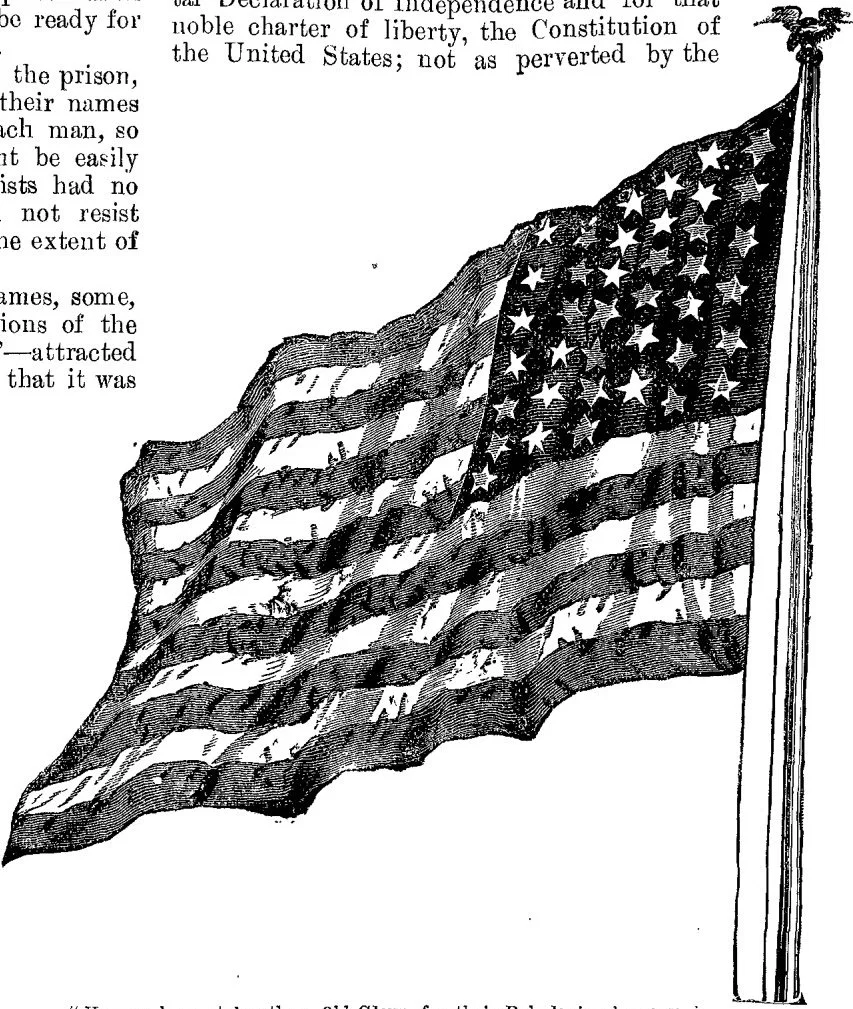
Oh, what a train of thought is started by that question! What! a liberty pole and a flag for convicts? What could “Old Glory,” the “Star Spangled Banner,” the emblem of Freedom, the flag of both the State and the Nation, mean to men who had violated the “law” of the land, who had braved the power which wears the flag? What comfort could chain-gang convicts, “law” breakers, possibly derive from looking upon the banner unfurled by the power that enslaves them—that power that brands them as enemies of the State, and drives them to the stone pile with the vilest criminals, that locks them in loathsome cells
or works them ten hours per day under a broiling sun, for no other offense than worshiping God according to the dictates of their own consciences? In short, What is the flag of the Union to Seventh-day Adventists today?
Ah! thrilling memories cluster around that flag; for while Seventh-day Adventists have no taste for war or carnage, while they as followers of the Prince of Peace are opposed to war, even as are the Quakers, they remember that it was in the providence of God that this land became an asylum for the oppressed of other lands; and they love the old flag because under its folds their forefathers found that liberty to worship, which was denied them in the Old World, and which is to-day denied Adventists in “free America,” not because of the flag nor of that for which it stands, but in flagrant violation of the principles represented by every fiber of that noble banner; principles for which patriots died in 1776, and for which in this year of our Lord, 1895, men toil in the chain-gang in Tennessee. And these men can to-day look upon that flag, and in the language of the poet, say—
Thou art Freedom’s child, Old Glory, Born of Freedom’s high desire.
“Knaves have stolen thee, Old Glory, for their Babylonian bowers;
From their festal walls and towers droops the flag that once was ours;
O’er their crimes thy beauty trails, and the old-time answer fails
When from chain-gangs, courts and jails men appeal to thee, Old Glory.”
“Knaves have stolen thee, Old Glory, for their Babylonian bowers; From their festal walls and towers droops the flag that once was ours; O’er their crimes thy beauty trails, and the old-time answer fails When from chain-gangs, courts and jails men appeal to thee, Old Glory.”
Those stars and stripes stand for the immortal Declaration of Independence and for that noble charter of liberty, the Constitution of the United States; not as perverted by the
Supreme Court decision of February 29, 1892, but as it stood when our fathers had written into it: “Congress shall make no law respecting an establishment of religion or prohibiting the free exercise thereof.” And just as men deprived of water, love to think of “purling streams and crystal fountains,” of rolling rivers and wave-swept lakes, so Christian patriots, men who, living in all good conscience, render to Cæsar the things that are Cæsar’s, and to God the things that are God’s, love to look upon the banner of civil liberty, even though that which it represents has been denied them; yea, even though their hearts bleed for the wrongs which they suffer, and for the violence done to that freedom once cherished, but now lightly esteemed by so many who know not its worth; for they know that religious rights are as lasting as the rock-ribbed hills or snow-capped mountains, yea, that they are as eternal as the Everlasting King who gave them; that such rights “are not exercised in virtue of governmental indulgence, but as rights, of which government cannot deprive any portion of citizens however small;” and that though despotic power may invade those rights, “justice still confirms them.” And they with the poet can say:—
Knaves have stolen thee, Old Glory, For their Babylonian bowers; From their festal walls and towers Droops the flag that once was ours; O’er their crimes thy beauty trails, And the old-time answer fails When from chain-gangs, courts and jails Men appeal to thee, Old Glory.
The flag is not a god, but in the providence of God it stands as the high water-mark of human liberty. But alas! as the sacred name of Christ has been made the cloak of most unchristian acts, so this providential symbol of liberty, has been made the covering for most revolting crimes against the most sacred rights of men. And as Madame Roland, on her way to the guillotine, bowing before the clay statue of Liberty erected in the Place de la Révolution, exclaimed: “Liberty! Liberty! how many crimes are committed in thy name;” so Seventh-day Adventists can to-day salute the stars and stripes with these words: “O banner of liberty, what crimes are committed under thy ample folds! what wrongs are done in thy name! what injustice and oppression is practiced by those who are sworn to maintain the principles by which thou wast begotten!”
“Corrupted freemen are the worst of slaves;” and we have fallen upon evil times, when men know not what true liberty means. Some in the mad pursuit of wealth, others in the fierce struggle for existence, have forgotten that he who fails to protest against the persecution of his neighbor, thereby virtually forfeits the right to protest when he is himself persecuted. Channing has well said: “The spirit of liberty is not merely, as multitudes imagine, a jealousy of our own particular rights, but a respect for the rights of others, and an unwillingness that any man, whether high or low, should be wronged.”
It was the purpose of the founders of this Government to erect, if possible, impassable barriers against religious bigotry and intolerance. As remarked by the compiler of “American State Papers Bearing on Religious Legislation”:—
Both Jefferson and Madison were opposed to the States having anything whatever to do with regulating religious observances of any kind; and the liberal spirit supported them. But as this spirit is supplanted by self-interests, the intolerance of State-Churchism again manifests itself in reviving the old religious laws, and prosecuting Sabbatarians for Sunday labor, etc. Jefferson, foreseeing this, desired to have all religious laws swept from the statute books, not willing to have them remain as a dead letter, which might at any time be revived by the partisan zealot. In his “Notes on Virginia,” query xvii, Jefferson says:—
“Besides, the spirit of the times may alter, will alter. Our rulers will become corrupt, our people careless. A single zealot may commence persecution, and better men be his victims. It can never be too often repeated, that the time for fixing every essential right on a legal basis, is while our rulers are honest, and ourselves united. From the conclusion of this war we shall be going down hill. It will not then be necessary to resort every moment to the people for support. They will be forgotten, therefore, and their rights disregarded. They will forget themselves, but in the sole faculty of making money, and will never think of uniting to effect a due respect for their rights. The shackles, therefore, which shall not be knocked off at the conclusion of this war, will remain on us long, will be made heavier and heavier, till our rights shall revive or expire in a convulsion.”
In the light of current events, Jefferson’s words seem almost prophetic. The spirit of the times have altered; our rulers have, many of them, become corrupt; and the question has been repeatedly asked of petitioners for justice, “How many are there of you? Have you political influence?” Our people have become careless, and in scores of cases a few bigots have commenced persecution and better men have been their victims. But neither the Declaration of Independence, the Constitution of the United States, nor the banner which represents them is to blame; neither is deliverance to be found in any nor in all of these. The fault lies at the door of fallen human nature, and the remedy is the power of God; for such things will be until he comes, whose right all dominion is, for his alone is a righteous rule. And the divine promise is: “At that time shall thy people be delivered; every one that shall be found written in the book.”

THIS “CHRISTIAN” NATION ILLUSTRATED.

[New York Sun, August 19.]
CONGRESSMAN M. W. HOWARD, of Alabama, was the speaker of the day at Prohibition Park yesterday. He was down to speak on the subject, “If Christ Came to Congress,” which is the title of a book of which he is the author, but only a small portion of his address was in any way connected with the subject. Most of his time was taken up in relating humorous stories—and he is a very good story-teller—and in expounding the advantages of Populism. These are some of the few things he did say about the hypothetical coming of the Saviour:—
If Christ came to Congress, he would find it full of men who achieved their seats through bribery and use them for corruption. If he came to the Senate, he would find there among the senators a fugitive from justice, who stole thousands from Washington, and ran away to the West, where he made a fortune, by which he purchased his right to return to Washington as a senator. If Christ came to Alabama, he would find the party which once called itself the white man’s party buying or forcing 65 000 negro votes. I have here pictures of negroes who cannot count to thirty, and who were put in Alabama to count the election returns.
The speaker showed the photographs, which he said were part of an interesting collection. He also read from a New York paper an account of alleged disgraceful scenes attendant upon the closing session of the last Congress.

RAINING PURITANISM.

[Evening Standard, Leavenworth, Kansas, August 2.]
THE old Puritan sabbath is going fast. The old Blue Laws are passing away or sinking into deserved disrepute.—Kansas City Star.
The Star would remind you of the fellow in the tree who hailed the ark as it floated by and asked to be taking aboard. His request being refused he told Noah to sail on with his old scow, he didn’t think there was going to be much of a shower anyhow. The fact is, it is raining ‘puritanism’ all over the country, with a pretty good prospect for a regular deluge. Wichita is all afloat. Atchison and Kansas City are under water, and in every part of the State the people are fleeing to the hills and tree tops.
And Sunday-law puritanism is on a rampage all over the United States. It is more alive and aggressive than at any time for a hundred years. The Puritans are thoroughly organized and last winter succeeded in several States in passing new Puritan laws. Every State has its Puritan code, and with the aid of Comstock, Blair, and others, the United States has, during the last fifteen years, added quite a good-sized Puritan code to its repertory of law.
Only three months ago Massachusetts enacted that: “Whoever is present at a game of sport, a play, or any public diversion except a concert of sacred music on the Lord’s day, shall be fined $5.” For participating, the fine is $50. For being the manager of said sport, play, or diversion, $500. For keeping open a place of business, $50.
This looks a good deal as if “the old Puritan sabbath is going fast.” A fine of $5 for merely looking at “a game of sport, a play, or any public diversion.” At this rate of “going fast” it will soon be a crime to wink or brush a fly off your nose on Sunday. Several State supreme courts, as also the United States Circuit Court, have recently sustained the Puritan laws. The latter court, in the case of R. M. King, who since died, charged with the crime of keeping Saturday instead of Sunday, held that the United States Constitution did not guarantee religious liberty as against State laws.
Of course this is not good law construction of the Constitution, but it is good enough for Adventists who haven’t very many votes. . . .
Public Opinion, a neutral New York journal, says:—
It is in reality a national struggle that has been entered upon in this city. This is equally evident from whichever point of view we look at it, whether as advocates of the strictly religious, Puritan Sunday, or of the European, holiday Sunday. Unless all signs fail, the contest will prove one of the greatest and bitterest in the history of our country.
The Star is simply whistling to keep up its courage.

Illinois Flag Law and Church Conscience

The new Flag Law of Illinois requires the hoisting of the United States flag over all buildings in which schools are taught. This law will require Lutheran churches that are used for school purposes, to fly the flag during school hours. In case of failure to do this, the teacher and pastor will be liable to fine and imprisonment. “The Lutherans,” it is said, “are much stirred by it, but their conference has left action in resisting it to individual churches.” It is no wonder that the Lutherans are “stirred” by this law. It is, as the World, of this city, very properly says, “an attempt openly made to force the church to acknowledge the supremacy of an American State.” The Lutheran conference has done well to leave this matter to the individual churches, for it is a matter directly affecting the conscience. Many persons who are perfectly loyal to the flag, and who would, in case of necessity, fight to defend it, scruple to hoist it over a church; and foolish as such a scruple may seem to some people, the Government has no right to trench upon it.
There is a good deal of nonsense indulged nowadays in regard to the flag. People can not be made patriotic by law any more than they can be made religious by law. It is highly proper that United States history should be taught in all schools, and when properly taught, patriotism will not be lacking. But to make a fetish of the flag and require that it shall be hoisted over churches simply because parochial schools are taught therein, is the height of absurdity. If any Lutheran pastor or teacher sees fit to ignore this statute and to suffer the penalties of the law, he will be entitled to the sympathy and respect of all right-minded people, because he will be standing for the principles which the flag represents much more truly than though he yielded to the demands of such a law.

CHRISTIAN NATIONS.

[Ram's Horn.]
A RADICAL and unadulterated gospel knocks out a lot of unmeaning talk about Christian nations. There is not a Christian nation in the world to-day. A Christian nation would be a nation composed wholly or chiefly of Christian persons. Where is there such a nation? We sometimes hear men talking about England and America sending rum and ruin to other countries as Christian nations. Fiddlesticks! Because a nation formally recognizes the Bible, does that make it Christian? Could a Christian nation fill the high seas with ships of war? Could it keep men armed to the teeth? Could it spend a thousand times more for drink, tobacco, and harmful luxuries than for sending the gospel to the heathen? Of all the bitter delusions that ever filled men's minds, this is the worst. There is not such a thing as a Christian nation on the face of the earth. There are some nations that have a measure of civilization, and for this we thank God. But such a thing as a Christian nation does not exist.

PROSTITUTION OF LIBERTY.

[From the Antigo Herald, Antigo, Wis., Aug. 2.]
To make the first, second, third or seventh day (as the Bible says) the day of rest, is the affair of every religious sect, and each sect has the right of choice. Should all Christian sects decide to keep the first day, while only one sect chooses the seventh, that does not give them any right whatever to prevent the people belonging to this one sect from observing the Seventh day as the Sabbath. . . . Conditions of the Middle Ages are out of place in the nineteenth century. No matter how slowly the step of civilization advances, there can be no backward step or retrogression. Shame to the State and its legislature which passes laws against the liberty guaranteed by the Constitution of the Union. Such a straggler in the march of advancement is seen in the State of Tennessee. It is there where lately religious persecution has secured a foothold, which reminds us of thumbscrews, spanish boots, the rack, the stake, and all other inquisitorial infamies.
Nine Adventists in Dayton, Tenn., were fined $40 for breaking the Sunday law, and as the fine was not paid, they will have to suffer in prison from seventy-five to ninety days. The “criminal” act of these people consisted in doing their daily work on Sunday, after observing the day before as their Sabbath.
Faith is not a thing that can be forced upon any by a majority. Nine hundred and ninety-nine of one belief cannot, and have not the right, to force one of a different faith to believe as they do; and any attempt in this direction is barbarism. The most precious gift to man is personal liberty.

OLD SOLDIERS PROTEST.

The following preamble and resolution, unanimously adopted at a soldiers’ union in Illinois, are sent to us for publication:—
WHEREAS, Comrade E. R. Gillett having honorably served in the legislature of Iowa, and having risked his life in his country’s service for three years, and having served as staff officer and regimental quartermaster, is now at the age of sixty-nine years, turned out with a gang of criminals doing work upon the public highway in the State of Tennessee for obeying the fourth commandment, for the same law which says, “The seventh day is the Sabbath of the Lord thy God: in it thou shalt not do any work,” also says, “Six days shalt thou labor, and do all thy work,” Ex. 20:8–11. Therefore be it
Resolved, That we survivors of 99th and other regiments of Illinois troops at or near Nebo, Pike Co., Ill., assembled in reunion on this 23rd day of August, 1895, do most emphatically object to such treatment of our comrade, and earnestly request that justice be done one who so dearly earned his liberty by exposing his life ’neath the stars and stripes in the hour of his country’s peril.
Attest. { THOMAS CREACH. J. A. PIKE. WILLIAM H. THORP. J. F. SCOTT.
This action was taken under a misapprehension of the facts in the case. “Uncle” Gillett, as he is familiarly known, is not in the chain-gang; for though indicted with others last March, he has not yet been tried. It is probably, however, only a question of about two months’ time till he will be in the chain-gang, as a number of his brethren now are, for the “crime” of obeying the fourth commandment.

Christian Intelligencer Fears for the Sabbath

THE Christian Intelligencer voices a foreboding which is troubling the camp of the adherents of the first-day sabbath, thus:—
What will become of the sabbath? The trials of speed of the Defender have been made on Sundays. They have been made by men of wealth and leisure, who could as well make these tests on another day, and they exhibit the spirit now animating a large portion of society. What with Sunday newspapers, Sunday bicycle runs, Sunday excursions, Sunday yacht races, and Sunday traveling, the outlook in this country for a proper and scriptural observance of the Lord’s day is not hopeful. The destruction of the sabbath advances rapidly.
It may not afford any consolation to the good people who are thus troubled, but we can assure them that the Sabbath is in no danger from the disregard of worldly men or the assaults of all the forces of evil, for we have the Word of the Lord himself that it will continue beyond the time of the creation of the new earth. “As the new heavens and the new earth, which I will make, shall remain before me, saith the Lord, so shall your seed and your name remain. And it shall come to pass, that from one new moon to another, and from one Sabbath to another, shall all flesh come to worship before me, saith the Lord.” Isa. 66: 22, 23. This, however, is said of the Sabbath of the Lord,—the seventh day, which God blessed and sanctified, and which his law upholds. The first-day institution must take its chances, with such aid as it can get from earth.

Sunday Closing Laws and Public Opinion in New York

The World, of this city, figures out that four-fifths of the population of New York are opposed to the “stupid and oppressive enforcement of the Sunday-closing law.” We think the estimate is entirely too high; doubtless four-fifths, or perhaps more, oppose the laws which trench upon their own liberties, but very few comparatively, are opposed to such laws upon broad principles; and it is for this reason that the rights of the people are not respected. They do not respect their own rights; for instance, those barbers who selfishly and foolishly asked the legislature to pass an act prohibiting barbering on Sunday in order that they might not suffer by the competition of shops keeping open on Sunday, have forfeited their right to protest against other measures of Sunday legislation which are demanded by other people; and the same is true of other trades and classes.

Judge Brown Upholds Sunday Barber Law

JUDGE BROWN, of the Supreme Court, decides that the Sunday barber law is “a valid exercise of the legislative power,” and therefore is constitutional. But we do not believe that this gross and ridiculous interference with the private life of the citizen can be so justified. Where there is no disorder involved, no wrong done, and no act performed that can by any possibility have evil consequences, the proceeding is not within the sphere of acts that may be regulated by law. It is contrary to the whole purpose and spirit of the Constitution. What a judge says settles nothing. In all great cases three judges are on one side and four on the other.—N. Y. Morning Journal.

Uplifting the Nation Through Reforming the Individual

A NATION can be uplifted only by uplifting the individuals which compose it. The individual must be touched first; and only through the individual is it possible to reach and affect that which individuals compose. Only a law which can reform a man can reform a nation; and only by reforming the man can it take effect. Human laws and human power can affect the outward conduct, but only the law and power of God can change the heart.

Mill on Religious Duty and Persecution

JOHN STUART MILL well says: “The notion that it is one man's duty that another should be religious was the foundation of all the religious persecutions ever perpetrated, and if admitted, would fully justify them.”

AN OPPORTUNITY FOR CONSECRATED YOUNG WOMEN.

The Medical Missionary College has already begun its first preliminary session. The class numbers nearly thirty. The first regular session will open October 1. Qualified students may be received at any time prior to that date. It is, however desirable that all who can should take the preliminary course. A few more well qualified young women can be received.
For terms, conditions, etc., address,
J. H. KELLOGG, M. D., President S. D. A. Medical Missionary Board.

“Before He Is Twenty,” —OR— “Five Perplexing Phases of the Boy Question,”

IS A VERY HELPFUL BOOK FOR PARENTS.

It is divided into five chapters, by as many different writers, each treating of a particular phase of a boy’s life.
The first chapter, “THE BOY AND HIS FATHER,” by Robert J. Burdette, is alone worth many times the price of the book to any father of a young boy.
The other chapters, “WHEN HE DECIDES,” “THE BOY IN THE OFFICE,” “HIS EVENINGS AND AMUSEMENTS,” and “LOOKING TOWARD A WIFE,” are all important and helpful.
104 pages, bound in cloth, embossed in jet and gold, price, 75 cents.
PACIFIC PRESS PUBLISHING COMPANY,
43 BOND STREET, NEW YORK CITY.

BAGSTER'S - COMPREHENSIVE - TEACHERS' - BIBLE

BIBLES

BAGSTER'S - COMPREHENSIVE - TEACHERS' - BIBLE.

Emerald Type. Size—8½ x 5½ x 1¼ inches.
Swedish Morocco, improved divinity circuit, leather lined to edge, round corners, red under gold edges, with Illustrations, 14 Maps, Concordance, Helps, etc. Post paid, $5 00

GENUINE : OXFORD : TEACHERS' : BIBLES.

Minion Type. Size—5 x 7¾ inches.
Fine Levant Morocco (brown), divinity circuit, calf lined, round corners, gold edges, Maps, Concordance, and many other valuable helps. Post paid, $5.00

LARGE . TYPE . BIBLES

FOR THOSE WITH POOR EYESIGHT.
French Morocco, limp covers, round corners, side and back title in gold, gilt edges, Family Register and Maps. Post paid, $2.00
ADDRESS,

PACIFIC PRESS PUBLISHING CO.,

43 BOND STREET, NEW YORK.
KANSAS CITY, MO.  OAKLAND, CAL.

CYCLONE WASHER!

We Have Struck It! The Champion of All Machines.
It washes in the most satisfactory manner the clothes of farmers, machinists, engineers, and bricklayers, cleaning the dirty collars and cuffs without rubbing. The work is effected by the compressed air forcing the water through the fabric, and therefore without wear to the material washed. The washing done cleaner, quicker, better, and in half the time. No tired feeling. A child of ten can operate it. Satisfaction guaranteed. Agents Wanted in every county. For particulars and circulars address, COON BROS., 131—137 So. Washington St., Battle Creek, Mich.

Rhea County Authorities Penalize Sabbath-Keepers Further

As stated in these columns last week, the authorities of Rhea County, Tenn., not content with depriving honest, Christian men of their God-given rights and driving them in the chain-gang for nearly two months, have decided to require them to serve an additional length of time because they would not work upon the Sabbath of the Lord, the seventh day.
Inasmuch as Sabbath-keepers alone have been singled out for prosecution, while others who have worked much more openly and in a way better calculated to disturb the general quiet of the day, than have Adventists, have not been prosecuted, it is patent to all that Adventists have been imprisoned and driven in chain-gangs, not for Sunday work, but for Sabbath rest. But plain as that is, it is even plainer that this additional penalty is a penalty imposed upon them directly for Sabbath rest. They are thus made to pay directly for the privilege of keeping the Sabbath; and this under a constitution which declares that "no human authority can in any case whatever, control or interfere with the rights of conscience."
A Sunday-keeper must have his day protected by law, but the Sabbath-keeper must pay for the privilege of keeping the Sabbath of the Lord by a hard day’s work for every Sabbath that he keeps while in prison; and by spending in idleness, if he obeys the “law,” one day for every Sabbath he keeps while not in prison.
Certainly the State of Tennessee has reached a point where even the most obtuse can see that its prosecution of Seventh-day Adventists, is persecution, pure and simple.

Sunday League Campaign Claims Nation Is Christian

REV. EDWARD THOMPSON, LL. D., manager of the Sunday League of America, is conducting a Sunday campaign in this State. He spoke at Syracuse on a recent Sunday, the burden of his discourse being to show that this is a “Christian” nation. Of course, the “clinching” argument was Justice Brewer’s decision in the Trinity Church case. “Dr. Thompson announced,” says the Syracuse Post, “that he expected to hold a series of meetings in the city in about six months’ time to agitate the Sunday question. Meanwhile the league, membership blanks for which were passed throughout the congregation, would busy themselves in the distribution of literature, which should set the people of Syracuse to reading, thinking and studying on the subject.”
A few thousand copies of the AMERICAN SENTINEL, judiciously distributed in Syracuse, would do very much toward giving proper direction to the thoughts of the people on this subject. Who will do it?

Seventh-day Adventist Jailed for Sunday Labor in Ontario

JOHN MATHEWS, a Seventh-day Adventist, of Selton, Ont., was on August 28 put in jail at Chatham, Ont., for doing ordinary labor on Sunday. His “crime” was cutting hay on Sunday, July 7, and building a fence on Sunday, August 4. He was given the alternative by the judge of paying $20.65 (fine and costs), or of spending thirty days in a prison cell. As he would not be a party to the iniquitous proceeding by any voluntary act, he refused to pay the fine, and is now in jail. And thus, to borrow the language of Gibbon, the world is fast becoming “a safe and dreary prison” for all such as honor God by keeping his Sabbath, and refuse to honor the rival institution, Sunday.

Sunday Laws and the Unequal Enforcement Against Adventists

THE Knoxville (Tenn.) Tribune remarks that “Sunday laws are taking a new grip on themselves all over the country.” This is true not only of this country but of all the world; with this exception, that said “laws” are taking a grip on Seventh-day Adventists rather than on themselves. If they gripped all violators alike, their purpose would be less evident and the Tribune would not be issued on Sunday as at present.
But an unjust statute is not made better by being universally applied, and we are glad that while Adventists toil in the chain-gang for private Sunday work the Tribune is unmolested. Every man has a natural, God-given right to work on Sunday whether he keeps another day or not, and he has that right even though he gives his voice in favor of denying the same right to his fellow-men.

Kentucky Baptist Standard Rebukes Sympathy for Imprisoned Adventists

The Kentucky Baptist Standard (Waco, Texas), of August 15, has a very ill-natured note upon the imprisonment of Adventists in Tennessee, in which it sharply rebukes the Indiana Baptist and the Journal and Messenger for the sympathy they have given to the persecuted Adventists. The Kentucky Baptist Standard says:—
The Adventists are entirely familiar with the laws of the land on the Sunday question, and they get in jail for the very purpose of eliciting the sympathy of the public. We do not blubber over them at all. If they want to keep out of jail let them obey the law like other decent people, and they will be certain not to get into trouble. We think the authorities in Tennessee did exactly right in enforcing the law, and believe the Sunday laws we have are good laws, and that they ought to be kept on our statute books and rigidly enforced.
This is a strange utterance for a Baptist paper, and shows that intolerance has gained a foothold in that communion as well as in other churches whose past history does not justify us in expecting so much of them.
The statement is false, that Adventists “get in jail for the very purpose of eliciting the sympathy of the public.” Adventists have done everything they reasonably could do to keep out of jail, except to surrender their consciences. We think the Kentucky Baptist Standard would do well to read up a little on the life of Roger Williams and the early history of the Baptist Church. Scores of Baptists have died in past ages for violating civil laws with which they were entirely familiar.

Iowa State Press on Sabbath Persecution in Tennessee

THE Iowa State Press, published at Iowa City, comments as follows upon the persecution of Seventh-day Adventists in Tennessee:—
This sect is quite correct in contending that the Sunday of Christian observance, and the Sabbath kept under the old law, are not the same. The first Christians changed the day to be observed as they changed divers other matters, and the new holy day first obtained civil recognition under Constantine. He allowed them to hold services openly, and protected them from heathen intolerance. We of course know nothing of the gravity of the offense, but if it was only working on Sunday, without doing it so as to annoy people who worshiped on that day, we think the laws of Tennessee should be amended, so as to give the most perfect liberty to all, to keep every day as one of rest, if they can afford it, or not keep any day if so that pleased them better, always providing that the liberty to do as they please, did not extend to preventing anyone else from doing as they pleased.
We do not believe State interference in matters of belief, has ever been of any benefit, and we know it has invariably lessened respect for religion. Those Adventists in Tennessee may have made themselves offensive, not by their pious observance of the old Sabbath, but by a determination to keep it in such a way as to annoy others, to whom they knew it objectionable. Like where Macaulay says the Puritans abolished bear baiting, not because they pitied the bears, but because they knew it angered the Cavaliers, who loved the cruel sport.
We can assure our Iowa contemporary that the Tennessee Adventists have not intentionally disturbed anybody; indeed, we might go further than that, and say that there has been no real disturbance to anybody. Adventists are considerate, not only of the rights but of the prejudices of their neighbors. They are are not only a liberty-loving people, but they are a peace-loving people, and so go just as far as they conscientiously can in respecting the wishes of their neighbors. None of the work complained of in Tennessee was of a character or done in a place to be any real annoyance to anybody. The most noisy work done was putting clapboards on a house. Such work might be a real annoyance in a village, but this house stands in the woods at a distance from any other building; and the noise occasioned by the work, if heard at all by others, would certainly not be loud enough to occasion any real annoyance, except annoyance such as a Protestant might feel in seeing a Catholic making the sign of the cross or sprinkling himself with holy water. Of course, that is very annoying to some people, but no person has any right to be annoyed at such things. Adventists have not made themselves offensive in any proper sense of that term; they have wronged no man; they have defrauded no man; they have trampled upon the equal rights of no man.

EXTRA COPIES.

Extra copies of this paper will be furnished at the usual price, $1 per hundred, or $8 per thousand; or we will send any number to as many different addresses at 1¼ cent per copy.

You have reached the end of this edition.

The American Sentinel · Sep 5, 1895