A S one looks out over the surface of European politics to-day, he sees little but unrest and confusion. It is almost a marvel that month after month goes by without witnessing an outbreak of war. The sullen struggle between Turkey and Italy continues, but the Porte has a far more serious problem on its hands in the tumults raging at home. The Albanians are up in armed insurrection; and on the frontiers, Montenegro and Bulgaria have been on the verge of war with Turkey. The Turks themselves are divided into two hostile parties, and the Parliament has been dissolved in consequence, for a new general election.
From the "Illustrated London News"
Italy is furious because her friends in Europe have not done more in bringing pressure to bear on Turkey to terminate the war. She is declaring that when they themselves get into trouble they need not look to her for help. She is discovering the hollowness of their friendship. England seems to be the principal offender in her eyes.
Russian Naval Expansion
Russia is again entering upon a naval career, and is planning to spend $650,000,000 for a new fleet. As a part of her plan, she has entered into a naval convention with France. Germany is further strengthening her navy as a fighting unit, and England feels bound to respond with a still further expenditure of $20,000,000.
Public opinion in England is perplexed as to whether it is getting from its friendship with France and Russia advantages sufficient to recompense it for the enormous expenditure which German rivalry is forcing upon it. The cabinet claims that the events of recent years have justified the policy followed by them; but the "Daily News," one of the journals which support the government, views the situation otherwise. It writes:
"The last six years have been the most anxious and agitated period within the memory of man. Crisis has followed crisis; we have been within an ace of war at least twice, and under the terror of war constantly; the rivalry in armaments has grown in costly intensity; and there is no prospect of future relief. International law has lost all respect, and treaties have become a byword. Meanwhile France has absorbed Morocco; the Turkish revolution, owing to the mischievous policy of the Young Turks and international intrigues, has been almost undone; the Russian Liberal movement has been stamped out; the Persian constitution has been destroyed; Northern Persia has been occupied by Russia; we are being blackmailed into opening the gates of India to Russia; and China is on the point of being partitioned. That is the harvest which our policy of special friendships has brought us in eight years, and he must be an optimist who is content with it."
No one in public life now pretends to regard Germany otherwise than as our inveterate rival and destined enemy, with whom it would be puerile to think of making any real or lasting peace. The country has now been thoroly educated into this view of our kinsmen across the North Sea.
Everybody is keenly alive to the details of the competition in ship-building and armaments. The man in the street can tell how many war-ships England has, and when they will be ready for service; and on the other hand, what new march Germany has stolen or is preparing to steal upon us. If anything could be relied upon to make the talked-of war inevitable, it would surely be this frame of mind. All diplomatic disguise has been abandoned.
Underwood and Underwood, London. Cardinal Bourne, from his latest portrait
A Great Change Has Come
Mr. Harold Spender, one of our most prominent journalists, says:
"Less than five years ago it would have been regarded as outrageous that the head of the admiralty should refer so openly to a foreign power, and should develop all these comparisons of size and number which are so admirably calculated to stimulate a fighting spirit between the two nations. The effect has certainly been deplorable. It was started just when the German naval program of 1906 was coming to its natural conclusion. It has led directly to a renewal of the program on both sides of the North Sea. There seems every reason to suppose that this system, if continued, will go on having its effect with increasing power until it ultimately produces war."
The tone of the speeches made by Mr. Churchill, the first lord of the admiralty, is hailed with delight by the Conservative Party, but they have been a bitter disappointment to his own party, the Liberals, some of whom regard him as a traitor to the principles which he espoused only a few years ago on leaving the Conservative Party, and it is rumored that erelong he will return to his original allegiance. The new editor of the "Review of Reviews," Mr. W. T. Stead's old paper, suggests, however, that Mr. Churchill is the very man for the place he occupies, and advocates his holding it permanently, irrespective of any change of government, as a trustee of the national defense. Mr. Churchill is a master of vigorous and graphic speech, and his vivid representations of the powerful force that is being steadily created by Germany have laid hold of the public imagination.
Canada and the Naval Program
Mr. Borden, the Canadian premier, and his colleagues in the cabinet, have been here in conference with the Liberal government, and one matter under discussion has been the contribution which Canada should make to the naval forces of the empire. Details are not to be made public until the Canadian Parliament approves them; but it is assumed that the dominion will make an important addition to the existing naval armaments, for use wherever it may be most needed. Thus the area of the struggle widens and its gravity deepens.
Canada and the Catholic Church
Canada, by reason of its remarkable growth, is not only claiming more attention from the British Empire; it is also becoming an object of special interest to the Church of Rome. In the annual congress of that body, which has just been held at Norwich, Cardinal Bourne gave expression to his firm and unchangeable conviction that it would be through Canada, with its forty per cent of Roman Catholics, that the British Empire was to be won back to the papal see. He said:
"A new population with amazing growth has come into existence in Canada, the whole situation has changed, and the church in Canada has to face a responsibility which a few years ago could not have been foreseen. . . .
"It consists of nothing less than welding together into one people, by means of one religion, those who, coming from many different races, are, by the force11of circumstances, quickly becoming members of the far-spread English-speaking world.
"It is religion alone which can make of the Canadian nation one absolutely united people. It is the Catholic religion alone which has this unifying force. Other religious bodies may enter in and gain adherents to their various forms of worship and belief; but which of them would dare to hope to join to itself even a minute fraction of the Catholics of Canada? It is they, and they alone, with their existing forty souls in every hundred of the population, that can essay to weld a whole people into something approaching religious unity."
This is interesting language to the student of prophecy. The book of Revelation indicates that it would be in the New World that Rome would regain for a while the power and influence she had forfeited in the Old World; that there an image would be set up to the beast that had received the deadly wound; and it is surely significant that to-day, when that restoration of the Papacy is in process of fulfilment, the Church of Rome should be basing her hopes for the future on the United States and Canada.
Women's Suffrage
Turning from international to home affairs, England's domestic relations are hardly more peaceful than her foreign. The women's suffrage movement is still with us in its most militant form. Two suffragettes have just been sentenced to five years' penal servitude for attempting to set fire to a theater in Dublin, where Mr. Asquith spoke on his recent visit to Ireland. Recently several members of the cabinet have been personally assaulted. When the pending reform bill is dealt with in Parliament, the House of Commons will be invited to decide for itself whether it wishes to confer the vote on women as well as upon the male adult population. Mr. Asquith has publicly stated that he does not believe, in view of recent developments, that the House will show itself prepared to take such a step; and if his forecast is verified, there will doubtless be a still further outbreak of violence on the part of the militant suffragettes.
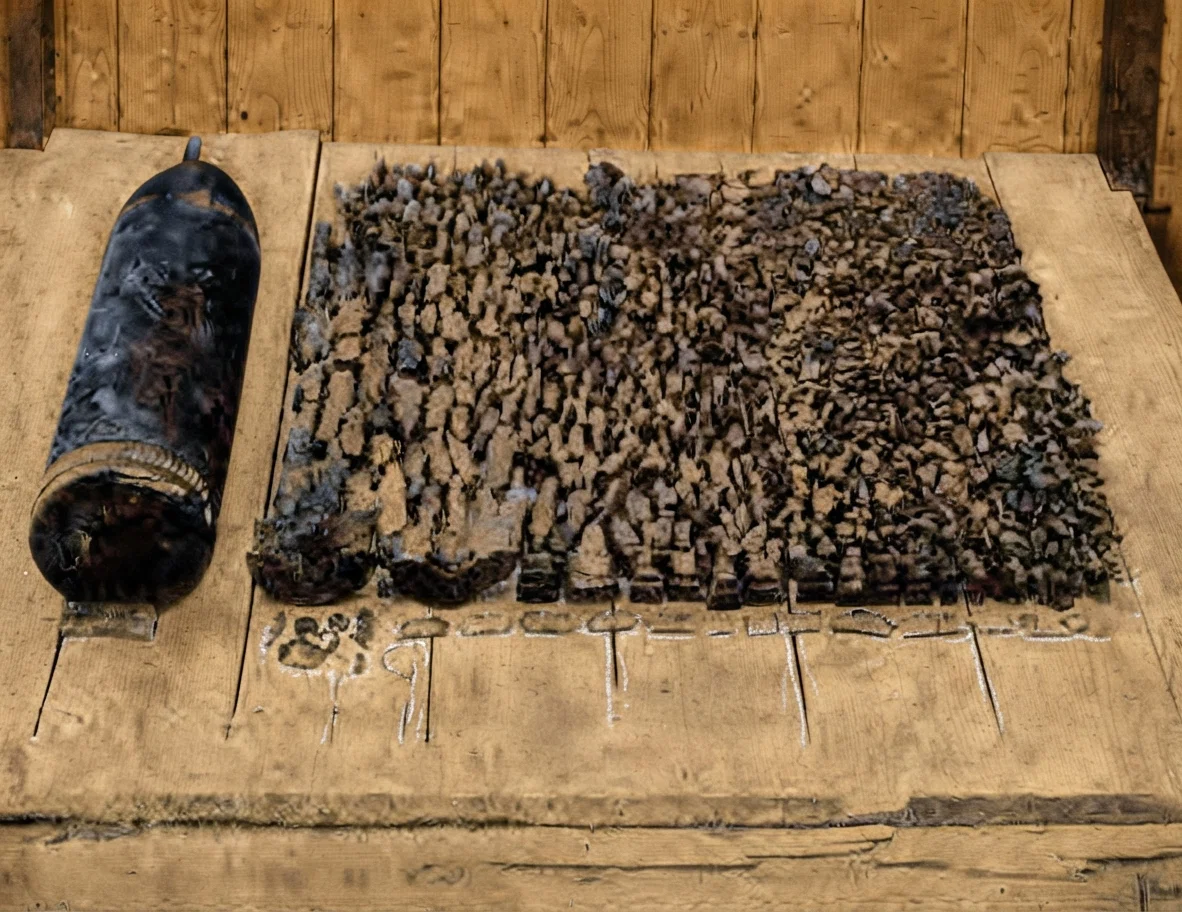
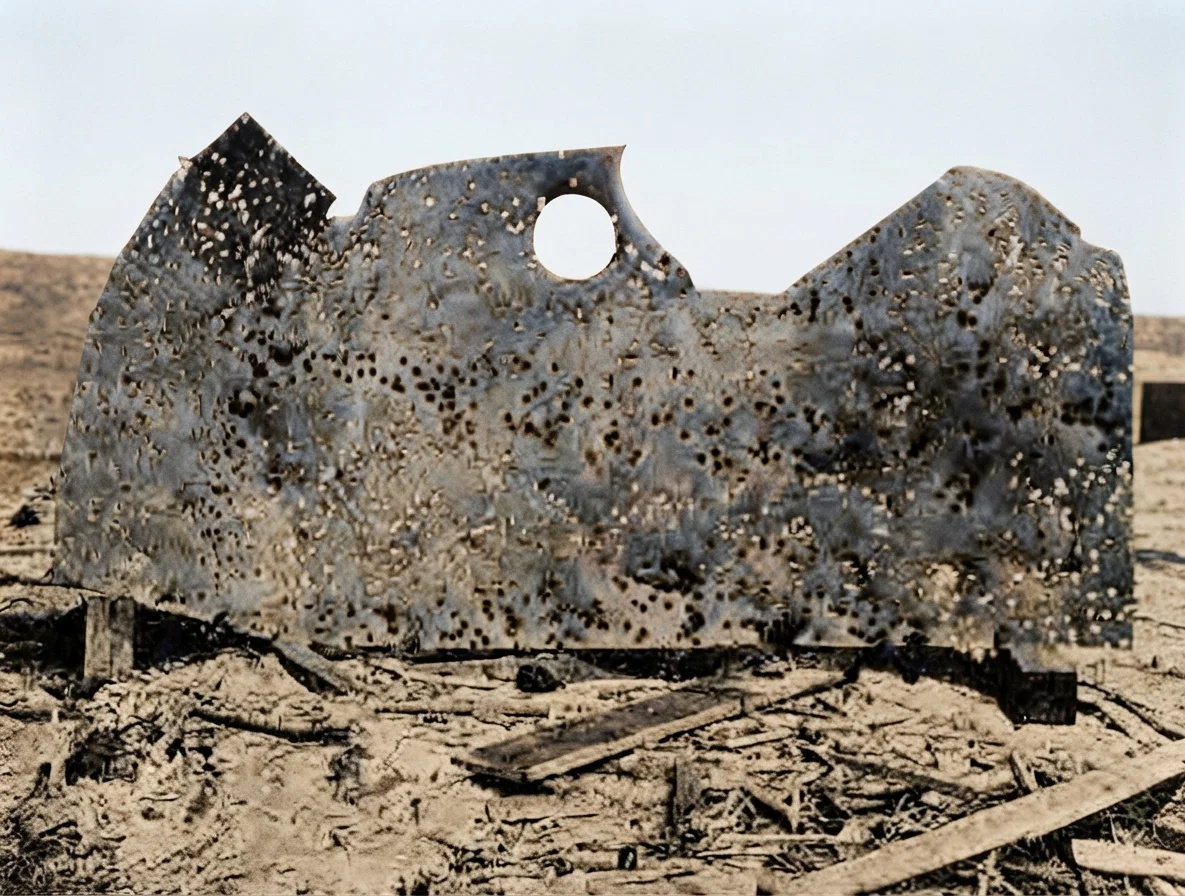
From the "Illustrated London News" A steel plate riddled by the bullets from a 12-inch shrapnel-shell, otherwise spoken of as the "man killer." See illustration on opposite page.
Home Rule in Ireland
In Ireland the agitation over the home rule question has produced something like a reign of terror for the unfortunate Catholics employed in the Belfast shipyards. Bands of Orangemen have hunted Catholic workmen out of the shops where they were at work, and pursued them through the streets, hurling iron rivets and brickbats at them. A large number have been injured so seriously that they had to be taken to hospitals. One man was thrown into a barrel of melted pitch; another was stripped and singed before an open furnace until some of his comrades armed themselves with sledge-hammers and threatened to smash the skulls of his assailants if he were not released. The cause of those who protest against home rule for any reason has been sadly disgraced by this outbreak of murderous violence, for it is apparent that the Orange faction have no room to talk of Romish bigotry and persecution as an argument against giving the Catholic majority of the country self-government. The state of affairs in Belfast simply shows that one may be a persecutor of the worst type, a thorogoing representative of its most diabolical principles, and yet bear the name of being a fierce opponent of Romanism. It is the spirit of Rome that is to be feared, rather than the name.
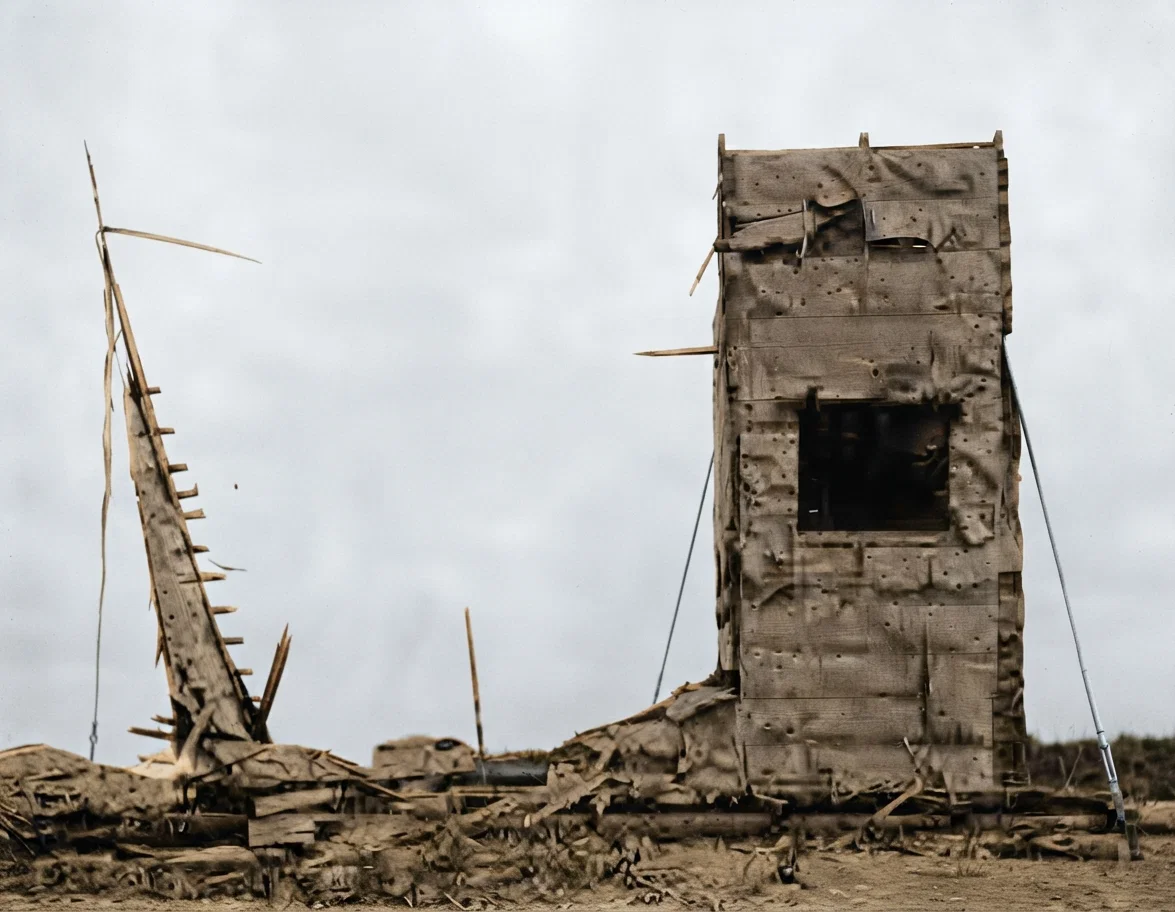
From the "Illustrated London News" "A target used for testing the effect of shell fire,—a frame of scantling sheathed with wood, which originally carried three plates of steel"
Meanwhile the government is pressing on with its measure for conferring self-government on Ireland, altho, when the bill is passed, there will doubtless be many grave difficulties to face in Ulster.
National Insurance Act
The government is not finding the path of reform a smooth one. The National Insurance Act became law on the 15th of July, but up to the present the doctors have almost unanimously refused to accept the scale of remuneration provided for them under the act. It remains to be seen how Mr. Lloyd-George will surmount this difficulty. Now that some twelve millions are compulsorily insured against sickness, doctors will have to be provided somehow to treat them, or the government will be compelled to admit defeat. Naturally it will do its utmost before it surrenders to the opposition, and this may mean that a radical change will soon take place in the system by which medical skill is made available.
The Dock Strike
For over two months the trade of the port of London has been crippled by a dock strike, which has finally ended in the men's going back to work on the masters' terms. The organizers of the strike declared it in despotic fashion in order to compel the masters to employ only such laborers as belonged to the Trade Union Federation. The masters stood out together against this demand, and in an early stage of the struggle Mr. Ben Tillett and his colleagues declared a national strike of dock workers. The response, however, was only partial, and before long the other ports in the country were again in full operation.
In London the strike dragged wearily on for more than another month, accomplishing nothing except to plunge the dock workers and their families into grievous distress. The whole body of strikers, between thirty and forty thousand stalwart men, marched through the principal thorofares of the city of London one day, carrying banners announcing their determination to hold out till their end was gained. The sight of such an army, fully equal in physique to a body of military, brought home to one the remarkable power that labor agitators have acquired over vast masses of toilers. These men were not striking for more pay or fewer hours—their work is altogether too uncertain as it is—but for the right to deny all who did not join their federation the privilege of earning a living at the docks. There was plenty of work waiting to be done if the men would do it, but for ten weeks they stood out, until their leaders were brought to swallow the bitter pill of acknowledged defeat, and ordered them back again.
Something is obviously wrong with our civilization. The bonds that hold society together are visibly weakening. Not only is the old antipathy between capital and labor and between nation and nation stronger than ever; the same spirit of hostility is making itself apparent in almost every section of the internal life of the country. The popular preachers of the day are predicting an era of brotherhood, but the real tendency seems to be in the opposite direction. Federation is the prevailing sentiment, if we are to judge by mere words; but antagonism, mutual suspicion, and class hatred are permeating society more and more. Many express a fear that we may soon find ourselves plunged into a wide-spread reign of violence.
W. T. BARTLETT.
Facts and Figures
The state university at Berkeley, California, has nearly fifteen per cent more students this year than last. It is now expected that the registration for the year will be approximately 7,200.
According to Prof. Irving Fisher, head of the political science department of Yale University, fully 630,000 persons die annually of diseases that might be prevented by the application of methods that are now well known.
The United States navy used 15,000,000 gallons of fuel oil in 1911, and it is estimated that it will use 21,000,000 the present year. Many of the vessels now in commission use oil as an auxiliary to coal, and some that are now in building are being fitted to use oil exclusively.
Thirty million dollars worth of American automobiles were shipped out of the country during the last fiscal year. The growth of the automobile business is shown by the fact that the value of the machines manufactured in this country in 1899 was $4,748,000, while the last census shows that the value of those manufactured in 1910 was $249,202,000.
Professor Davenport says that about one per cent of the whole population of the United States are mentally defective, insane, feeble-minded, or epileptic. That means that about 1,000,000 of our population are mentally out of tune. That is quite an army. The same authority says that if the present increase of insanity is kept up, it would not take over three centuries to have the whole race insane.
If Horses Could Scream
By Humane Press Bureau
THERE are still people in the world who regard the horse as a dumb animated machine, created solely for the use of men and women, and having no rights of his own.
That is largely because the horse is in the fullest sense a dumb animal. If you strike a dog, he yelps; if you step on the tail of a cat, she screams. A horse, on the other hand, may be beaten almost to death and make no sound. Pleasure he expresses by whinnying; but it is only in his death agony that his suffering finds audible expression, and frequently not even then.
It is this pathetic silence, this inability of the horse to give utterance to his pain, that causes so many persons to ignore his sufferings. They have no imagination, and he has no cries with which to impress their indurated senses. If he could cry out as the dog does, our city streets would reecho sounds that could not be borne a day. The change in the treatment of horses would be instant and enduring.
Take, for example, navicular disease, of which many horses suffer. It attacks one of the bones of the fore foot. The bone decays just as a human tooth decays. Imagine the suffering of a horse obliged to walk on a foot in that condition.
Some forms of spavin are so painful that horses afflicted with them become thin, even if they are generously fed and do no work. The troubles may, indeed, be recognized by this peculiar emaciation — an excessive thinness about the waist or loins.
But altho the horse does not speak nor cry out, he tells his story plainly enough to those who can understand it. It is his eye that speaks. When he suffers, his eye is contracted, and has a nervous, flurried, restless expression, indescribable, yet easily recognized. When he is comfortable, his eye seems large and full and has a quiet and serene look, the expression of fun and mischief. From a stableful of city work horses, an expert will select by the expression of their eyes alone the horses that have good drivers and those that have cruel ones.
That the ears of the horse also express his emotion is too well known to need more than a reference. When he is unhappy, ill-treated, or neglected, his ears have a backward slant that is characteristic. You sometimes see it in animals that are vicious; you always see it in those that are abused.
Since the horse's vocabulary is so limited, owners and drivers can learn it all. — Humane Press Bureau.
Where Tom Found His Manners
By Florence V. Halliwell
Tom's father was a rich man, and Tom lived in a large house in the country. He had a pony and many other pets, and wore fine clothes. Tom was very proud of all the fine things his father's money bought. He began to think that being rich was better than being good. He grew very rude, and was cross to the servants. Once he kicked Towser; but the dog growled, and Tom was afraid to kick him again.
One day, when Tom was playing in the yard, he saw a boy standing by the gate. He was ragged and dirty, his hat was torn, and his feet were bare; but he had a pleasant face. In one hand he carried a pail half full of blackberries.
"Go away from here," said Tom, running to the gate. "We do not want any boys around."
"Please give me a drink," said the boy. "If you are so rich, you can spare me a dipper of water."
"We can't spare you anything," said Tom. "If you don't go away, I will set the dogs on you."
The boy laughed, and walked away, swinging the tin pail in his hand.
"I think I will get some blackberries, too," said Tom to himself. He went out of the gate into the lane leading to a meadow where there were plenty of berries.
Tom saw some fine large ones growing just over a ditch. He thought he could leap over it very easily. He gave a run and a big jump. The ditch was wider than he had thought; and instead of going over it, he came down in the middle of it.
The mud was very thick and soft, and Tom sank down in it to his waist. He was frightened, and began to scream for help; but he had not much hope that help would come, for he was a long way from any house.
He screamed until he was tired. He began to think that he would have to spend the night in the ditch, when he heard steps on the grass. Looking up, he saw the boy he had driven from the gate.
"Please help me out," said Tom, crying. "I will give you a dollar."
"I don't want the dollar," said the other boy. Lying down flat on the grass, he held out both of his hands to Tom, and drew him out of the ditch.
Tom was covered with mud, his hat was gone, and one shoe was lost in the ditch. He looked very miserable.
"Who is dirty now?" asked the boy.
"I am," said poor Tom; "but I thank you very much for helping me out of the mire, and I am sorry I sent you away from the gate."
"The next time I come, perhaps you will treat me better," said the boy. "I am not rich; but I am stronger than you are, and I think I have better manners."
"I think so, too," said Tom.
The next day, when Tom saw the boy going by the gate, he called him in, showed him his rabbits, doves, and ducks, and gave him a ride on his pony.
"You have better manners now," said the boy.
"Yes," said Tom; "I found them in the ditch." — Florence V. Halliwell, in the Sunday School Visitor.
Shadows
By Clara Edna Rosencrans
By Clara Edna Rosencrans
When my life went into the shadow,
I shivered, and thought it chill,
As the shade that creeps over the valley
When the sun sinks under the hill.
I feared to enter the shadow,
For the way seemed dark and lone,
And my heart was sick with dreading
The unseen, the unknown.
I did not know that the shadow
Was that of my Saviour's cross;
That the joy of all fruition
Lay under the seeming loss.
I could see that the path was thorny,
And the pitfalls I could see;
But I could not see the Presence
That walked so close to me.
Since my life has entered the shadow,
I have found a blessing sweet;
For the shade of the cross falls over
Close, close to my faltering feet.
Its coolness and rest invite me,
And the flowers of peace are there,
Forgiveness after sinning,
And many an answered prayer.
And the darkness about is brightened
With the light of my Saviour's smile
So I fare me on in the darkness,
And sing a song the while.
What if my lips do falter,
And the song oft ends in a sob?
The crown will but be brighter,
And fairer the shining robe,
When my life goes out of the shadow,
And the weary task is o'er.
In the brightness, and not the shadow,
I shall dwell forevermore.
The path is growing brighter,
And the end of the way seems near;
For I catch faint gleams of its beauty,
And the music I sometimes hear
Is leading me ever onward
Into the perfect light,
From the earth-life with its shadows
To the land where there is no night.
No Clock Watcher
How many clerks measure up to the standard of the young bookkeeper in this story? He was employed in the passenger department of a great railroad. It was just a little before lunch. Some of the clerks were putting on their coats, some leaving for the wash-room, some consulting the clock, some were still busy. Suddenly the "boss" entered. He glanced about him, and then he approached the young bookkeeper.
"What time is it?" he asked.
The young man kept on figuring, and the boss put a hand on his desk and repeated the question.
Instantly the other looked up, surprised to see the chief at his elbow.
"I beg your pardon; were you speaking to me?" he asked.
"Merely inquired the time—that was all," said the other.
The bookkeeper glanced about the room, located the office clock, and said, "It's ten minutes to twelve."
"Thank you," said the general manager and vice-president, and strolled out.
That conversation cost the young bookkeeper his place—in the passenger department—and put him under a higher officer.
Nine years later he was assistant general manager, and while still in the thirties became general manager, full-fledged.—Human Life.
Cheerfulness
"CHEERFULNESS is what greases the axles of the world; some people go through life creaking."
Not in Entire Forgetfulness
By William Wordsworth
Not in entire forgetfulness,
And not in utter nakedness,
But trailing clouds of glory, do we come
From God, who is our home.
Bible and Nature Series of Text-Books
For the Home and Church Schools
In harmony with the actions of the Educational Department, the Pacific Press Publishing Association has published beautiful Bible stories, easy reading lessons, and simple singing lessons, for the first three grades, or school years, as follows:
Helps and Text-Books Grades One to Three
1. MEMORY VERSE POSTER PATTERNS.—To assist the parent and the teacher in impressing the “Oral Bible Lessons or Talks” outlined by the Educational Department for use in these grades (“School Manual,” pages 172-194), a series of Poster Patterns has been prepared to illustrate the more important memory verses in the series. These pattern outlines have been drawn by Delpha Sheffer Miller, a normal teacher of wide and successful experience. From them the child can trace or cut on white or colored paper such pictures as will indelibly impress the memory verse on its mind.
There are 32 patterns for each of the first three grades—96 in all. The patterns for each grade are wrapped separately. Price 25 cents each, or 75 cents for the three.
2. READERS.—“True Education Readers” 1, 2, and 3 put the child in possession of a complete key to English reading, and also familiarize him with the most important Bible truths. Three times over they tell of God’s plan for the earth in the beginning, the successive steps in the work of creation, something about each of these steps, a sketch of certain selected Bible child biographies, including the life of the perfect Child, Jesus, His work, His sacrifice, the plan of salvation finished, and the new earth.
3. SIGHT-SINGING.—Music is an important factor in the child’s school life; and “Standard Graded Course of Sight-Singing,” by Prof. Gerard Gerritsen, formerly of Walla Walla College, and later of Berrien Springs, Michigan, presents methods which recommend themselves to educators generally. The children are taught to connect the value of various tones with some manual sign, as “doh,” the firm strong tone, “by the closed hand;” “soh,” the bright tone, “by the open hand,” etc. This adds materially to the interest children take in their music work.
Ruled examination blanks are inserted at the close of each section, for the convenience of students and teachers. As these blanks are perforated, they may be easily removed for correction. Note Books Nos. 1 and 2, combined in one paper-covered volume, price 35 cents; No. 3, paper covers, 25 cents. The manual or handbook for teachers covers the entire series. Contains 202 pages. Price in cloth covers, $1.00.
Address your tract society
Text-Books for Grades Four to Seven
1. READERS.—“True Education Readers” 4, 5, 6, and 7 continue the reader work of grades one to three. A special feature of these readers is that they provide in a natural way all the work in English needed for the first six grades. This study of closely related subjects—such as reading, language, spelling, etc.—in their natural setting, tends to reduce the confusion in the mind of the pupil, and insures more efficient work. Prices are as follows:
2. BIBLE LESSON TEXT-BOOKS.—“Bible Lessons” Nos. 1, 2, 3, and 4 develop and adapt to the growing comprehension of the child the oral Bible studies of the preceding three years.
Carefully and reverently has Mrs. Alma E. McKibbin, a teacher of long experience and marked ability, worked out, question by question, and lesson by lesson, the books comprising this series. During the years these lessons were developing, carbon and neostyled copies were passed around and successfully used by hundreds of teachers in class room work. Later, temporary editions were printed. They proved so satisfactory that the author was encouraged to revise and rewrite the entire series for permanent use.
Book 1, Creation to death of Joshua . . . . . . . . $0.90
Book 2, Judges to Esther and the Restoration . . . . . .90
Book 3, the time between the Old and the New Testament, including sketch of John the Baptist, and the life and crucifixion of Christ . . . . . . . . . . . . . . . 1.35
Advance pages covering the lesson questions of the first half of Book 4, may be had for 25 cents.
3. ELEMENTARY SCIENCE, OR “BIBLE NATURE SERIES.”—A natural development of geography, physiology, and the other elementary sciences, with the Bible and nature as a basis of study.
It presents in three graded texts elementary studies in nature, including introductory lessons in geography, and lessons in elementary physiology. Following the lessons in nature work, the student is prepared for an introduction to the elementary sciences as separate studies. Having been introduced in the “Bible Nature Series” to the subject of geography, and having mastered all of that subject usually included in a primary geography, he should now be able to complete an advanced geography in the seventh year. Likewise, a text in physiology is now needed, and may be completed in the eighth year.
Book 3 will be ready about February 1. Advance pages, covering a portion of the book, may be had for 25 cents.
“BIBLE NATURE NOTE BOOKS.”—To accompany the “Bible Nature Series,” Note Books have been prepared for the pupil’s use. They contain 112 pages each, and are bound in heavy paper covers. Price 40 cents each. A series of helpful outline maps is furnished free with each book.