The Youth’s Instructor, Vol. 27, No. 6.

NOAH AND THE FLOOD

The Youth’s Instructor

Feb 5, 1879

S. D. A. Publishing Association · Battle Creek, Mich. · Feb 5, 1879

NOAH AND THE FLOOD.

WHEN Adam and Eve disobeyed God by eating of the forbidden fruit, a sad change came over them. They were no longer pure and happy as the angels. In yielding to the tempter, they lost moral power, so that it was not easy for them to do right and obey God as before. Some of their descendants trusted in the Saviour, and obeyed God; but as these died, and the people continued to increase in numbers, they wandered farther and farther from the path of obedience, till there was only one man and his family who loved and feared God. This man's name was Noah. Gen. 6:9. God was grieved, and greatly displeased with the wickedness of men; and when he saw that they would not repent, he saw that it was best to deprive them of the gift of life.
Because of Noah’s obedience, he found grace, or favor, with God; and to preserve him and his family, God commanded him to build an ark, the length of which should be 300 cubits, the breadth 50 cubits, and the height 30 cubits. A cubit is nearly 22 inches, hence this building was about 550 ft. long, 92 ft. wide, and 55 ft. high. There was only one window in it, and that was in the top; and there was only one door.
It took one hundred and twenty years to build the ark, but when it was completed, God commanded Noah to take some of every kind of beasts, birds, insects, etc., with him into the ark, and to provide food for them while they should be confined there. These all followed Noah into the ark, for God made them gentle and obedient.
Then God told Noah and his family, eight persons in all, to enter the ark, and an angel shut the door. But it did not commence to rain until seven days had passed. This gave the wicked people outside a chance to ridicule still more, and to think they were quite right in their unbelief. At the end of seven days it began to rain, and the rain increased till it poured in torrents, for the “windows of heaven were opened.” After the rain ceased it was one hundred and fifty days before the waters were dried away. At length the ark rested upon one of the mountains of Ararat, in Asia. Nearly three months later the tops of the mountains could be seen. Forty days after, Noah opened the window of the ark and sent out a raven. The raven is a fierce bird, and not liking the confinement of the ark, though there were no trees to be seen, it did not return. Then Noah chose a dove, and put it out of the window.
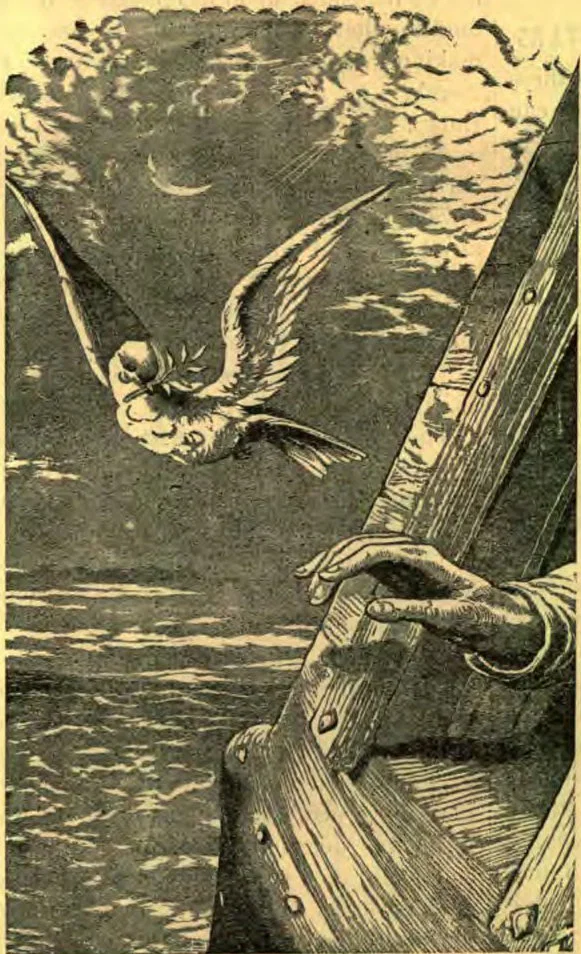
The dove is a gentle, lovable bird, and finding nothing but water, it came again to the ark, perhaps pecked at the window, and Noah put forth his hand and took it in.
He waited seven days more, and then sent out the dove again. In the evening the dove returned, and when Noah took it in, lo, he saw in its beak an olive-leaf which it had plucked. This made Noah glad, for now he knew that the waters were nearly dried away, and soon he could step forth upon the green earth. How they all must have loved the gentle dove, that had brought them such glad tidings.
After waiting seven days more, he sent forth the dove again. This time it did not return, so Noah knew that the waters were drying away; but he waited patiently till God told him to go out of the ark. To show his joy and thankfulness, Noah made a heap of stones for an altar, and offered a sacrifice to God. This sacrifice also reminded him of the promised Saviour, who would give his life a sacrifice for the world. God was pleased with this act of Noah, and promised him that he would never again bring a flood to destroy all creatures. To remind Noah and all who should live after him of this promise, he gave him a token. What was this token? It was the rainbow. When we look upon the clouds after a rain, and see this bow of beautiful colors, it should call to mind God’s kind promise to Noah, and to us his descendants.
But though God will never again destroy the earth by a flood, he has plainly told us that he will some day destroy it by fire. 2 Peter 3:6, 7, 10, 12, 13. Our Saviour has told us that the days just prior to his second coming will be like the days before the flood. Matt. 24:37–39. Only a few will believe, and watch for the signs that proclaim his coming, while many will follow the example of those who lived before the flood. In which class will we choose to be found?
“Oh, tell me how the nations passed The day before the flood; Oh, did they know it was the last? And did they call on God?
“In merriment their time is spent; They sing and play, and dance away; They eat and drink, and little think They stand on endless ruin’s brink.
“Behold just Noah safely ride Upon the mighty deep; While all who once God’s word defied Beneath the waters sleep.
“Sudden as that tremendous day, The Judgment hour will come; Thousands shall then be swept away, And meet an awful doom.
“Let me not count these words a dream, And still refuse to hear; However far the time may seem, Each hour it draws more near.”
NELLIE F. HEALD.

LONGINGS

The weak must long for greater strength, or be Forever weak. The only strong are they Who long for greater strength unceasingly; But whosoever he that will not pray, Lest he may be accounted weak—ah, he Shall weaker grow until he cannot see How far from strength his soul has made its way.
Oh! let us tremble, lest our weakness grow So great we cannot see it; or, if so, Behold it as ’t were strength; let us each day, With all our hearts, desire to be made strong; God never lets the yearning heart wait long; Indeed, to him that trusts there’s no delay, But ready strength for every step the way.
—Christian Advocate.

INTERESTING FACTS ABOUT THE STARS.

BETWEEN our earth and the stars there is a vast chasm which no imagination can bridge. A distance so immense that figures are meaningless, and we only call it SPACE.
At the present time it is supposed that the star Alpha, in the southern heavens, is the nearest to the earth. Yet its distance is more than 200 thousand times that of the earth from the sun, or 19 trillions of miles! These figures can convey to our minds no real idea of the distance.
To a spectator standing on the star Alpha, the entire radius of the earth’s orbit around the sun would be hidden by a thread 1/25 of an inch in diameter, held at a distance of 650 feet from the eye! That is to say, a line 183 million miles long would shrink into a mere point! If our sun were removed to that distance it would shine with a light equal only to that of the North Star.
The 6000 stars which are visible to the naked eye are divided into six classes of brightness called magnitudes. Astronomers speak of a very brilliant star as “a star of the first magnitude;” of the very feeblest visible, as “a star of the sixth magnitude,” and so on.
With powerful telescopes, at least 20 million stars down to the sixteenth magnitude are visible. Such are called Telescopic Stars.
The brilliancy of the stars is classified by astronomers about as follows: Of the first magnitude, 20; of the second, 65; of the third, 200; of the fourth, 450; of the fifth, 1100; of the sixth, about 4000. The number increases largely as we descend in the scale of brilliancy.
On an average it takes the light 15½ years to come to us from stars of the first magnitude; 28 years, from a star of the second; 43 years, from a star of the third; and 3500 years, from a star of the twelfth magnitude. So if a star of the twelfth magnitude of brightness should now be created it would be 3500 years before its tiny rays would reach our earth! G. W. A.

LEARN TO REMEMBER.

Very many of the accidents, failures, and seeming misfortunes of life may be traced to a neglect, on the part of some individual, of the duty assigned him. The engineer fails to stop the train at the right moment, a collision follows, and many lives are sacrificed. The clerk forgets to mail his employer’s letter, and a loss of thousands of dollars is the result. These persons did not intend to be unfaithful, but they were careless and inattentive.
The same habit is common among boys and girls, and many think it a sufficient excuse for any neglect of duty to say, “Oh, I forgot all about it!” Such a habit, if indulged, will destroy their usefulness. Nobody wishes to employ a person who cannot be depended upon to remember and attend to what is committed to his care. By making a proper effort we may learn to remember, as the following anecdote will show:—
A successful business man says that in early life he learned two lessons that were always of great use to him; never to lose anything, and never to forget anything. An old lawyer sent him to deliver a very important paper, with certain instructions what to do with it.
“But,” inquired the young man, “what shall I do if I lose it?”
The answer was given with great emphasis, “You must not lose it!”
“I don’t mean to,” said the young man, “but suppose I should happen to?”
“But you must not happen to! I shall make no provision for any such occurrence. You must not lose it.”
Of course, accidents sometimes occur, beyond our power to control; but the old lawyer well knew that these are far less frequent than we often imagine.
A new train of thought was awakened in the young man’s mind, and he found that if he was determined to do anything he could do it. He made such provisions against every contingency that he never lost anything. He found this equally true about forgetting. If anything of importance was to be remembered, he fixed it upon his mind and made it stay there.
This is the secret of a good memory, and the lesson should be learned in youth, for in after years it will be more difficult to acquire.
The same habit of attention is necessary in the service of God. Our Heavenly Father knew that we would be in danger of forgetfulness, and he has given us special admonitions on this point: “Remember now thy Creator in the days of thy youth.” There is much to attract the attention, and unless we make an earnest and persevering effort to remember our duty to him we shall be so interested in the things of the world that life will pass, and the day of Judgment find us unprepared, to be destroyed with those who forget God.
If we remember God, he has promised to remember us. A book of remembrance is written before him “of them that feared the Lord, and that thought upon his name.” And very great blessings are pronounced upon those who “remember his commandments to do them.” Shall we share these blessings? M. A. D.

LESSONS FOR CHILDREN.

LESSON VI.—THE BLESSINGS AND CURSES.

Nearly twenty miles northward from Ai are two remarkable mountains, called Mount Ebal and Mount Gerizim. Between them lies a narrow valley about one-fourth of a mile wide. In this valley is the city of Shechem. The mountains are nearly the same height, and rise about seven hundred feet above the valley. The one on the south side is Mount Gerizim; the one on the north, Mount Ebal.
While the children of Israel were yet in the wilderness, Moses had commanded that when they should come into the land of Canaan, they should go up to this place and perform a very solemn ceremony. On Mount Ebal they were to build an altar of unhewn stones. They were to cover the sides of the altar with plaster, and to write on the plaster all the law of Moses.
Then six of the twelve tribes of Israel were to stand on Mount Gerizim, and six on Mount Ebal. The tribes standing on Mount Gerizim were to repeat the blessings found in the first part of the twenty-eighth chapter of Deuteronomy, and those standing on Mount Ebal were to repeat the curses found in the last part of that chapter.
After the city of Ai was destroyed, Joshua and all the people went up to Shechem and did as the Lord had commanded by Moses. They built the altar on Mount Ebal, and wrote the law upon it. The people upon Mount Gerizim pronounced the blessings, and those upon Mount Ebal, the curses, while the priests with the ark of God stood in the valley between.
In the days of Joshua there were no printed books as at the present time. The precepts of God had to be kept, for the most part, in the mind; so it was necessary that they should be repeated very often. The Lord commanded his people to talk of them when they went out, and when they came in; when they rose up, and when they sat down; and they were even to write them upon the posts of their doors. In this way their children were brought up to know the will of God.

QUESTIONS.

  1. What remarkable mountains are situated nearly twenty miles northward from Ai?
  2. What lies between them?
  3. How wide is the valley?
  4. What city is situated in this valley?
  5. How high are the mountains?
  6. Which is Mount Gerizim, and which Mount Ebal?
  7. What had Moses commanded in regard to these mountains while the children of Israel were yet in the wilderness?
  8. What were they to build on Mount Ebal?
  9. How were they to build it?
  10. With what were the sides to be covered?
  11. What was to be written on the plaster?
  12. Who were to stand on Mount Gerizim, and who on Mount Ebal?
  13. What were the tribes to do that stood on Mount Gerizim?
  14. What were those to do that stood on Mount Ebal?
  15. When did Joshua and all the people go up to Shechem to do all that the Lord had commanded by Moses?
  16. Where were the priests with the ark of God, while the people were pronouncing the blessings and curses?
  17. In the days of Joshua, how did the precepts of God have to be kept, for the most part?
  18. Why was it so then more than now?
  19. What was necessary in order to keep these precepts in mind?
  20. What did the Lord command in regard to this?
  21. Where were these precepts sometimes written?
  22. Why was all this done?

BIBLE LESSONS FOR YOUTH.

LESSON XXXII.—MURMURINGS.

1. WHAT is recorded in the first part of Ex. 15?
2. Of what does this song consist?
3. What does it contain?
4. Where was their next encampment? Ex. 15: 23, etc.
5. How long had the people been without water when they came to Marah?
6. In what condition did they find the waters of Marah?
7. What did they then do? Verse 24.
8. How were the waters made sweet?
9. What promise did the Lord make the people at this place? Verse 26.
10. To what place did they next journey?
11. To what place did they next come after leaving Elim?
12. Of what did they here accuse Moses and Aaron? Ex. 16: 3.
13. When Moses took the matter to him, what did the Lord tell Moses that he would do?
14. What did he say that he had heard?
15. What came to pass at even?
16. What was seen upon the ground in the morning?
17. What did Moses say to them about the manna?
18. How were they told to gather the manna?
19. How much were they to gather on the sixth day?
20. What reason did Moses give for their doing so? Verses 23, 26.
21. What did the Lord say when the people disobeyed him by going out to gather manna on the Sabbath? Verse 28.
22. How long were the Israelites fed with manna? Verse 35.
23. How was a memorial of it preserved?

SYNOPSIS.

In the fifteenth chapter of Exodus is recorded the remarkable song which Moses and the children of Israel sang after they had witnessed the overthrow of the Egyptians in the midst of the sea. It consists of ascriptions of praise and honor to Him who had so miraculously delivered them from their enemies, and contains some of the most beautiful passages in the whole Bible.
Their next encampment was at Marah. They had been three days without water, and when they came to taste the water at Marah, they found it so bitter that they could not drink of it. Therefore they murmured against Moses; but when Moses had cried unto the Lord, he showed him a tree, which, when he had cast into the waters, they were made sweet. Having received precious promises from the Lord, they journeyed on to Elim, where were twelve wells of water, and threescore and ten palm-trees. From thence they came to the wilderness of Sin, which is between Elim and Sinai. Here they murmured against Moses and Aaron, and accused them of bringing them out into the wilderness to kill the whole assembly with hunger. Moses took the matter to the Lord, and the Lord told him that he would rain them bread from heaven. He said unto Moses, “I have heard the murmurings of the children of Israel: speak unto them, saying, At even ye shall eat flesh, and in the morning ye shall be filled with bread.”
And it came to pass that at even the quails came up and covered the camp; and in the morning when the dew was gone up, behold upon the face of the wilderness there lay a small round thing, as small as the hoar frost on the ground. The children of Israel called it manna, for they wist not what it was. “And Moses said unto them, This is the bread which the Lord hath given you to eat.”
He then gave them directions in regard to gathering the manna. They were to gather it in the morning, every man an omer; for when the sun waxed hot, it melted. None of it was to be kept until the morning; and when some of them disobeyed, and kept it over, it spoiled. Moses said unto them, “Six days ye shall gather it; but on the seventh day, which is the Sabbath, in it there shall be none.” Therefore they were commanded to gather on the sixth day twice as much manna as usual; and when it was kept over, it did not spoil as on other days. Thus we see that a miracle was performed, not only in the falling of the manna, but also in its being kept fresh on the seventh day.
Although they had received such plain instructions in regard to it, some of them did go out on the seventh day to gather manna. This displeased the Lord, and he said unto the people by Moses, “How long refuse ye to keep my statutes and my laws?”
A golden pot of this manna was laid up before the Lord, to be kept throughout their generations, that their children might see how the Lord had fed them in the wilderness.
G. H. BELL.

Partial Report of the Michigan Sabbath-School Association for Quarter Ending December 28, 1878.

Names of Schools Names of Superintendents Membership Average Attendance No. Under 14 No. Over 20 No. of Classes No. of Members in First Division Second Division Third Division Fourth Division School Held Before Meeting Schools Keeping Class Second No. of “Instructors” Taken
Allegan James Baker 30 24 1 13
Alaledon M. D. Matthews 41 28 21 20 6 12 9 14
Armada William C. Hebner 25 20 7 15 3 7 6 12 1
Bancroft C. N. Stuttle 34 23 18 16 4 1 2 1 1 10
Battle Creek G. H. Bell 387 338 100 150 38 49 18 77 243 1 1
Sanitarium H. P. Holser 35 30 5
Burlington A. B. Castle 39 21 11 17 4 6 8 19 1 12
Bunker Hill Mrs. Amy P. Curry 28 19 14 13 4 15 5 8 1 10
Bushnell James Haymer 35 28 15 16 5 16 4 18 1
Birch Run F. N. Bartholomew 19
Carson City A. F. Kellogg 50 35 12 26 4 1 12
Dimondale 63 42
Douglas David McCallum 37 28 15 15 5 9 14 14 1
Deerfield James Buruham 21 10 8 10 2 12 9
Duplain O. B. Sevey 30 20 11 14 5 11 10 9 1 10
Estella John Langdon 42 14 8 45 4 4 1
Fairgrove C. Cramer 28 20 11 13 4 7 9 17 1
Flint William Farrand 40 21 8 20 5 8 5 5 15
Gowen August Rasmussen 20 15 8 20 8 20 1
Greenville Mrs. M. C. Cyphers 34 25 2 18 4 3 23
Hillsdale S. E. Daigneau 22 8 13 4 8 12
Jefferson J. Iden 48 30 20 28 6 1 1 4 1
Lyons and Muir Franklin Howe 46 35 18 22 6 11 10 17 1 10
Locke Albert Avery 20 11 18 2 2 1
Leslie Gideon G. Dunham 18 10 7 6 3 2 7 6 1
Lapeer Nelson Stringer 25 23 10 12 3 1
Marshall O. A. Kelsey 20 15 8 9 3 10
Montrey J. L. Rumery 48 40 18 21 5 13 5 12 18
Mt. Pleasant Charles Brown 60 35 5 25
North Lansing H. J. Newcomb 11 6 6 1 1
Newton Henry Hilliard 22 14 6 14 3 3 2 17
Otsego Mrs. M. Shepherd 51 41 23 20 8 8 43 1 25
Orleans W. A. Towle 26 11 9 16 4 1 1 2 1 5
Ovid Nelson Brown 20 15 10 10 2 9 10
Orange Luman C. Smith 48 25 17 21 5 15 2 23 1
Quincy J. H. Thompson 40 21 9 31 6 9 3 21 1
Rochester D. W. Randall 13 11 6 6 3 2 11 12
Sheridan A. D. Jones 19 10 12 9
St. Charles H. S. Guilford 48 30 20 15 6 19 28 1
Springbrook Dr. McWolfe 9 9 4 3 1 9 1
Spring Arbor E. P. Butcher 71 45 25 20 5 12 16 43 1
Vassar David Malin 18 10 3 4 4 6 8 10
Vergennes Gilbert Russell 31 20 6 23 3 25 6 1
No. of Schools, 43 Totals 1753 1227 531 760 190 263 199 241 534 26 2 183
Schools that did not report this quarter:—
Alma, Hammond, Portland,
Birmingham, Ithaca, Parma,
Charlotte, Jackson, Pittsford,
Clio, Jay, Pierson,
Coopersville, Lakeview, Ransom,
Elmwood, Matherton, Shelby,
Eaton Rapids, Memphis, Saranac,
Fenwick, Mt. Morris, Saugatuck,
Flushing, Olivet, West Liberty,
Greenbush, Owosso, West Windsor,
Horton, Potterville,
Names of churches not yet heard from, that ought to have Sabbath-schools:—
Almont, Blendon, Convis,
Antrim, Bronson, Colon,
Assyria, Coral, Casnovia,
Adrian, Chesaning, Cedar Springs,
Coldwater, Johnstown, Ravenna,
Dowagiac, Kendall, Richfield,
Dryden, Leighton, Smith’s Creek,
East Saginaw, Marlette, Stoddard,
Ellington, Mattawan, Thet’d Cent’r,
Edenville, Monroe C’nt’r, Tuscola,
Greenwood, Montague, Vernon,
Genoa, North Plains, Vermontville,
Gurney, Napoleon, Wright,
Grand Rapids, Oneida, Watrousville,
Hastings, Oceana, Williamstown,
Hart, Parkville, Weeks,
Hazelton, Partello, West Plains,
Holly, Rockwood,
In unity there is strength. If all our Sabbath-schools in Michigan will act in harmony, and work on one general plan; and if they will give a full report of their school each quarter and of what they are doing, then we will know just what the various schools need, and can provide such articles for the S. S. department of the INSTRUCTOR as will be right to the point, and of great service to both scholars and teachers. We therefore make

A Special Request

That the superintendent of every S. D. A. Sabbath-school in Michigan, whose school is not reported in the above table, immediately send, or see that the secretary sends, us a report of their school for the quarter ending Dec. 28; also the names and addresses of the superintendent and secretary now in office.
If you cannot report on all the points mentioned in the table, please report what you can. There is no school that cannot give us the names of officers and number of members.
It will be noticed from the table that forty-three of the seventy-five schools in the State have reported, showing a total membership of 1753. Setting aside the Battle Creek school which has 387 members, the remaining forty-two schools have an average membership of 32. Taking this as an average, the thirty-two schools that did not report must have about 1024 members. Then, if two-thirds of the sixty churches not heard from have schools of the same average number, there must be about 1280 members in them all. These numbers added to the 1753 already reported would make the estimated S. S. membership of Michigan stand at about 4000.
What a Sabbath-school army 4000 would make, and how much good they could do all working together. What a grand Sabbath-school we would have if all could meet in a S. S. convention at the time of our next State camp-meeting, and then how pleasant it would be to find all prepared with the same lessons, that is, the lessons in the INSTRUCTOR designed for that week.
The lessons in the INSTRUCTOR are so well suited to the different divisions of our schools, and the INSTRUCTOR contains so much that is useful to scholars, teachers, and officers, that we hope to see every school in the State subscribe for a club and adopt the lessons. Do not lose precious time. The lessons are dated for the Sabbath on which they should be recited, and much will be gained by our keeping together. Those who neglect to subscribe soon will lose part of the lessons.
W. C. WHITE, Pres. MRS. LETTIE MARVIN, Sec.

THE MARBLE BLOCK.

In the house where I was once staying, there lived a little lame girl. Her name was Annie. Often did I pity her as I saw her sitting by the window looking at the other children on the play-ground. Sometimes she was sick, too, and could not even be at the window. At last spring came, and the little girl seemed better. “Now,” thought I, “would it not be well to try and comfort this child in some way?” So I carried her a few oranges and candies, and read her a pretty book; but still the cloud did not leave her brow.
“Why are you so sad, Annie?” said I, one day.
“Oh, sir,” she replied, “I can’t see why God should afflict me so, and yet give the other children so much happiness. If I only knew that God is not angry with me, I would not care so much.”
That day was a very pleasant one, so I asked the little girl to go with me to a sculptor’s room near by. Here were a great many blocks of marble. Marble, you know, is a very hard stone, often white. A sculptor is one who carves beautiful images out of it. Annie and I watched him with great interest. At last I pointed to a piece of marble rather dark and rough. “Do you like the looks of that?” said I to her.
“Oh, no,” replied the child; “Why did they bring such an ugly block here?”
“That piece,” said the gentleman, “I take in hand to-morrow.”
So the next day Annie and I went again to see him. He spent the most of that day in cutting off the rough places. Day by day we watched him, and day by day the block became more attractive. His sharp chisel cut in here and there and everywhere. We both thought, “If that stone were only alive, how it would suffer!”
At last one day we received an invitation to visit him again. “I have something to show to Annie,” said he. So speaking, he drew aside a thin white veil, and behold! a lovely image of an angel had been made out of the rough stone.
Annie almost cried with joy when she saw it.
“Now, my child,” said I, “did the sculptor hate the poor ugly piece of marble which we saw one day?”
“Oh, no,” said she, “he loved it.”
“So,” said I, “my little girl, does God love us when he cuts us with sharp trouble and sickness. He is fitting us for his kingdom. Let us only trust him. All will be well.”
“Now,” said Annie, “I see that God does not hate me, but that he has some good purpose in view.”—Sel.

ARMED FISHES.

Not fish with arms, but armed fish. There is the Sword-fish, which carries a weapon powerful enough to pierce through the bottom of a ship; the Saw-fish, with a long snout set upon each side with sharp spikes; fishes that carry daggers, and others furnished with sharp spears. The Shark has a terrible pair of shears that can easily cut a man in two at one blow, and the Thresher has a tail curved like the blade of a scythe, which is a most dreadful weapon.

LOOK ON THE CHEERFUL SIDE.

It is a great misfortune to have a fretful disposition. It takes the fragrance out of one's life, and leaves only weeds where a cheerful disposition would cause flowers to bloom. The habit of fretting is one that grows rapidly unless it be sternly repressed; and the best way to overcome it is to try always to look on the cheerful side of things.

THE TWELVE MONTHS.

In January falls the snow; In February, cold winds blow; In March, peep out the early flowers; In April, come the sunny showers; In May, the roses bloom so gay; In June, the farmer mows his hay; In July, brightly shines the sun; In August, harvest is begun; September turns the green leaves brown; October winds then shake them down; November fields are bleak and sere, December comes, and ends the year. —Sel.

LETTER BUDGET.

It always makes us happy to have a talk with the children. We wish you were all right here; but we suppose even the great Tabernacle in this place would not hold us all. Well, we could find room outside, under the broad canopy of heaven. Dear little friends, we want to inspire you to be good; it will make you so happy here, and then, by and by, you will be happy forever. There will be room for the INSTRUCTOR family to meet then, for we can “dwell safely in the wilderness, and sleep in the woods.”
Ludlow, Vermont.
Dear Editors: When we lived in Jackson, I took the INSTRUCTOR, and liked it much. I am eight years old. I can read and write very well, mother thinks. I attend Sunday-school here, but mother thinks if I can take the weekly INSTRUCTOR, I can learn the Sabbath-school lessons every week, and be just as well off at home; therefore I will now take the weekly INSTRUCTOR.
Yours truly, Etta B. Moore.
Red Bluff, Cal.
Dear Editors: I am a reader of the YOUTH’S INSTRUCTOR and am much pleased with it. I have been trying to get others to take it; have succeeded in getting one subscriber, and the promise of more as soon as they can get the money. I wish you the best of success in your work. I am fourteen years old. My parents are keeping the Sabbath, and I want a home with the redeemed.
Anna Wible.

You have reached the end of this edition.

The Youth’s Instructor · Feb 5, 1879