The Youth’s Instructor, Vol. LIII, No. 21

It Pays

The Youth’s Instructor

May 23, 1905

Review and Herald Publishing Assn. · Washington, D. C. · May 23, 1905

It Pays

IN 1877, when Stanley, after following the course of the great Kongo, gave to the world a knowledge of this unknown river and country bordering its banks, this part of Africa was wholly unknown to civilized man. Since Stanley’s unparalleled effort in following this mysterious river, and since steamers have been placed upon its mighty bosom, there has been a wonderful change in the region. Missions have been established at many points along the Kongo, going eastward from the west coast; and now that the secret of its sources is out, this part of Africa is open alike to missionary and merchant. Thus Inner Africa—full of running streams and far-stretching lakes, with its richness of tropical verdure, and abundance of animal life—is open to the possibilities of commerce, agriculture, and enlightenment. But do not think for a moment that the work of the missionary is an easy one. While many hundreds of the natives living near the banks of the Kongo have embraced Christianity during the last fifteen years, the most of the people in this dark country require years of patient teaching and example. An interesting incident illustrating this is found in the Christian Express, taken from the Missionary Herald, entitled, “A Soul’s Awakening:” —
He is sitting on the veranda just outside my doorway, very slowly and very earnestly repeating the letters and syllables in our school primer. He is about twenty-eight years old, as near as one can judge. His face has been cicatrized until it can be called almost a typical Ngombe face. But Sweye is a typical Ngombe man no longer, for the work of the Holy Spirit has entered his heart, and is manifesting itself in various ways, one of which is this steadfast application to the Book, so that by and by he may be able to read the Word of God in his own tongue. The Ngombes are naturally warlike, blood-thirsty, and are cannibals. Sweye daily seems to grow more and more gentle in disposition, no longer delights in scenes of blood and cruelty, and would be hurt if one suggested that he ate human flesh. I look at him as he spells out his letters, and all unconsciously contorts his lips as he so deliberately utters the sounds of some of the syllables; and knowing something of the man before me, I see a vision of our first adult Ngombe Christian. I have had many a talk with Sweye. He was one of our workmen during my first term of residence at Bopoto, and showed on more than one occasion to what depth of iniquity a heathen could sink. So far as he was concerned, our teaching seemed to fall on barren soil. No fruits became apparent; even the first tender shoots of promise failed to appear. Two, four, six, seven years have passed. During three different terms of service at the mission Sweye has heard in song and in addresses the things concerning the kingdom of God, and just as at dawn the night gradually gives place to light, so the heart of Sweye seems to have received the true light, and for him the thick darkness is surely past.
Although I had spoken personally and directly to him before concerning his soul’s salvation, Sweye first responded really seriously only a few months ago. It was after a Sunday morning service in our school chapel. Although no longer a workman, Sweye had come from his village, and had been in attendance. He was standing on the steps which lead up the hill. Under the shadow of the acacia tree he was waiting, instead of walking homeward. I placed my hand upon his shoulder and attempted to drive home a point in the morning’s discourse. To my joy his face lit up in quick response. Had he been waiting for my words? I seized the opportunity, and took him along to my home. He had, he said, already begun to pray in his village. What those first attempts at prayer were is known only to the Father of spirits. As this untutored savage first breathed out in human speech the aspirations of his soul toward God, and life, and light, I think there was joy in the presence of the angels of God. “Behold, he prayeth!” Even if one had heard those broken utterances, he would reverently drop the veil of the sanctuary into which that soul had entered as Sweye first communed with his Maker and new-found Father and God.
Sweye became a marked man. By many a fireside in the long evenings he had to uphold his faith in God, and Jesus, and prayer, against the arguments and superstitions of his townspeople. Faithfully he stood the test, and each discussion strengthened his faith. For Sweye it was no longer demon worship, but the worship of God; no longer faith in charms and fetishes, but faith in Jesus Christ. Then came ridicule, and Sweye has come off conqueror. The shafts of ridicule have not wounded him through the joints of his armor. “I have determined,” said Sweye one day, “to obey God, to possess only my present wife, and to remain faithful to her.” Those who know the Upper Kongo, and are familiar with the Upper Kongo native and his ways, will best appreciate what this decision meant for Sweye, and how much it cost him.
A little time ago Sweye paid a visit to Bosoitunda, a Ngombe village in the interior on the south bank of the river, where as yet no missionary has been, and Sweye became the first messenger of God to these people. Telling me afterward about his visit, he said: “Before I got into the canoe to go up, I stood on the beach, closed my eyes, and prayed aloud that God would bless me on the journey; and when I had crossed the river, I prayed again before I went inland. I was sitting one day in Bosoitunda, and the people came and said: ‘Why do your white men teach the book palaver every day?’ I said: ‘Stay awhile, and I will tell you.’ Then I said: ‘The white men came a long time ago to tell us about God. You say you have only heard indirectly about the palaver of God, and that you do not understand very clearly. Have patience and I will tell you. God is in heaven, and he made all things. He is our Chief and Father. He does not like bad palaver. You who are here! Do not steal. That is the palaver of God. You who are here! Do not kill. That is the palaver of God. You who are here! Do not commit adultery. That is the palaver of God. You who are here! Do not lie. That is the palaver of God.’
“Some young men commenced to laugh and talk, but an elder of the people said: ‘You young men sit quiet; I think this is a good palaver. Let us all hear it.’ When all was quiet again, I said: ‘If we die, and we die with good hearts, and if we have believed and obeyed God who is above, and Jesus his Son, our bodies, when burned, will return to dust, but our spirits will go to God. If we die with the palaver of God, we shall go to God, but if we die with bad hearts, we shall be destroyed. Jesus, the Son of God, died for men, and took the punishment of sin. He will judge all men, and those who believe on him and are on the good path will live with God, where there is no sickness, or pain, or trouble. What I say is true, for our white men teach us.’ Then I sang to them:—
‘Akongo Sango su bato, Obolondo njea e we; Iso boditi na opipu, Iso bene ko bogwa. O Akongo! O Akongo! Bo’ngaka bobengeja.’
‘God the Father of thy children, Lead us on thy path alway; We, alas, have naught but weakness; Dying men, to thee we pray. God, Jehovah! God, Jehovah! Help us in our need we pray.’
“After singing some hymns, I said: ‘Shut your eyes,’ and I prayed: ‘God, Father! I am here. I have told these people about you. Help them. Jesus, I want you to go with me when I return home. Drive away all my foolishness. I can not go aright unless you are with me.’”
Said Sweye to me on another occasion: “One day Ngako [a relative] and I, with others, went to the islands. We became very hungry, for all our food was gone. Ngako said: ‘We will return to-morrow.’ I called the boys who were with us, some of whom had worked at the mission, and I said: ‘Let us pray to God about food for our journey.’ We shut our eyes. I prayed to God about giving us food. We all slept. In the morning before we embarked in the canoe, I prayed again. I said: ‘God, Father, we go to our village with hunger; you can help us by giving us food on our way, so that we reach our homes with joy.’ We paddled along, and after some time landed on an island. I was still in the canoe, when I heard Ngako shouting my name. ‘Sweye, come; come quickly!’ I went, and there was food for our dinner. Ngako said: ‘Sweye, I believe in your God.’”
Last Sunday Sweye came to our chapel service, bringing seven others with him. Yesterday he said: “I pray every night before I go to sleep.” “And your wife?” I remarked. “If she says anything,” said Sweye, “I appeal to her to be quiet, and she remains quiet until I have finished.”
Sweye as yet does not profess to be a Christian. He has not applied for church-membership, nor has he yet spoken about baptism. He only says that “the palaver of God is much in his heart now,” and that “he wants to walk on the good path,” and this beautiful humility adds an additional charm to the beauty of the spiritual flower which seems to be opening day by day in his soul.
Such “awakenings” as this of Sweye should fill our hearts with a zeal to do our part in making it possible for many more to be led into the light of the gospel. The third angel’s message has not been taken to the shores of the Kongo, but many earnest, sacrificing men and women have entered into this country from the west coast, and missions and schools have given the old, old story to the darkened minds of the poor African.
Mrs. L. E. LABONTE.

Korean Sketches

Costumes of the People
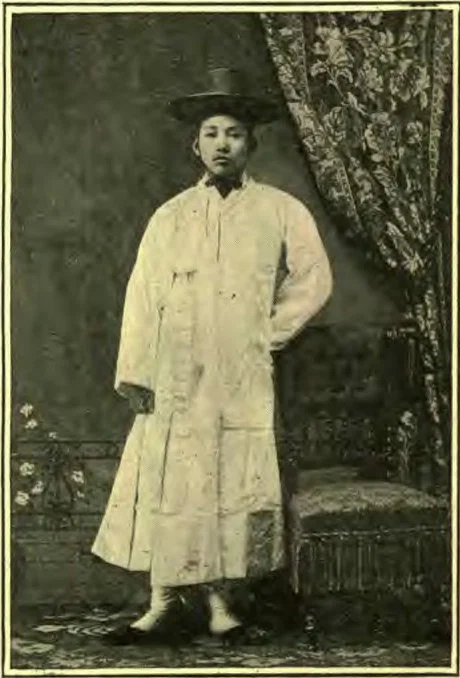
WEALTHY Koreans wear garments of rich and costly silks; but I prefer to describe the costume of the masses. The most marked peculiarity of the clothing worn is that almost every garment is white, or at least uncolored, though it may not be bleached. However, small children are often dressed in very bright colors, with somewhat startling combinations. I have seen a small jacket with body and sleeves of pink, collar of greenish yellow, cuffs of bright blue, and a sash or tie of a rich red. The jackets worn by boys are often of a pale-pink color. The long outer garments for men are sometimes black. The hats and jackets of the servants are black or some dark color. Men and boys wear a loose-fitting jacket reaching to the waist. The sleeves are loose and rather short. The pantaloons are very loose and baggy, and are made with a wide band. They are confined about the waist by a cord, the upper part of the band hanging down over the cord. A sleeveless waistcoat or vest is sometimes worn over the jacket just as described. The feet are covered with socks made of white cloth, padded with cotton; these reach several inches above the ankles. The wide trouser legs are wrapped about the ankles, over the socks, and then tied with a cord or narrow band. Over the socks are worn slippers of white rawhide or slipper-like sandals, which so enclose the feet that they require no fastenings. The former are worn by well-to-do people.
This is the costume worn about home. But when a Korean gentleman goes abroad, he dons a long loose gown or coat, reaching almost to the ankles; and a hat with a small, tapering crown, and a stiff, straight rim. The material for summer clothing may be of cotton or linen, often very light and gauzy. Winter garments are made warm by being padded with cotton.
KOREAN GENTLEMAN IN FULL DRESS
Women and girls wear a waist or jacket barely long enough to allow sleeves to be set in; an under garment very much like the pantaloons worn by the men; and over this a long, full skirt, with a wide band at the waist. This band covers the breast and reaches to the short jacket, at least in the case of well-dressed and modest ladies. With the common people in their work-a-day clothes, the jacket falls considerably short of our ideas of modesty, leaving the breasts exposed. The footwear of women does not differ materially from that of men. The common head-dress worn by women is simply a wide piece of white cloth folded, and tied about the head with a single knot, the ends hanging down behind; or so starched and tied, that the ends project upward behind the head. Arranged in this way, it looks very quaint and tasty.
A Korean has no pockets in his clothes; so his purse and tobacco pouch, and possibly a knife and a spectacle case, dangle from bright-colored cords tied about his waist. His long-stemmed pipe, a constant companion, he usually carries in his hand.
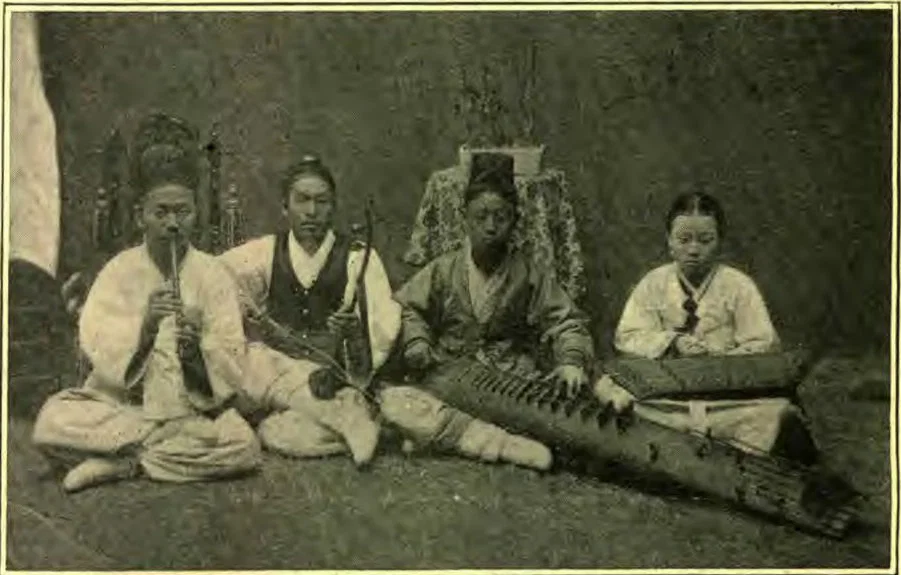
KOREAN MUSICIANS
KOREAN MUSICIANS
Korean women wear very few ornaments. Occasionally one sees a girl with ear-rings made simply of silver wire with the ends twisted together. Some women wear silver finger-rings, two on a finger, yet so thick and wide that they are removed when their owner has work to do. But if these people have few outward adornments, it may be all the easier to teach them how to possess “the ornament of a meek and quiet spirit.” F. W. FIELD.

“More Than Any Man”

His weary head drooped sadly, with not a hand to stay; While from the thorn-wounds dropping, his life-blood oozed away.
The death dew from his forehead none wiped with tender care, Nor for my dying Saviour sent up a word of prayer.
Kind hands smooth out my pillow, and fan my fevered cheek; Attentive ears bend o’er me to catch my accents weak; And tender hands and gentle are laid on brow and hair, While for me every moment there rises pleading prayer.
Upon the cross uplifted his tender hands were nailed; His feet with travel weary, on cruel spikes impaled. The air was filled with curses, with jeers and scoffings loud, While ’round my dying Saviour there surged a mocking crowd.
My limbs with softest linen are covered tenderly; Dear hearts and eyes untiring wake day and night for me. The room is cool and silent to soothe the head that aches; And all my bed in sickness, my Heavenly Father makes.
He died. A Roman soldier from out the cruel band About the cross of Jesus, stretched forth an impious hand, And with the spear he carried he drew a healing tide Of blood and water mingled, from out my Saviour’s side.
But if I die my people will stand o’er me and weep; With loving hands and tender, they’ll robe me for my sleep. And through the darksome valley where He went all alone, His feet, which went before me, shall keep step with my own.
MRS. ELIZABETH ROSSER.

The Edison of the Plant World

A Dialogue Condensation of Two Articles in the Century Magazine for March and April, 1905
What is the new fadeless flower?
The Australian starflower cultivated so as to make it larger, more beautiful, fragrant, and keeping fresh for months, so that it has been suggested that it might replace artificial flowers in millinery.
Who developed it?
Luther Burbank, a native of Massachusetts, who went to Santa Rosa, California, when about twenty-five years old, and has been experimenting there with plants for thirty years.
What other flowers has he produced?
A dahlia of great beauty with the scent of the magnolia; the Shasta daisy, five to seven inches in diameter; a fine verbena with the fragrance of arbutus; callas ranging from an inch and a half to nearly a foot across; a gladiolus that bears blossoms all around its stalk; an amaryllis with a huge flower; a blue poppy; and many varieties of larkspur, lilies, and other flowers.
What has he done to improve fruits?
He has greatly developed blackberries, has produced a thornless blackberry and a white blackberry, a plum with the flavor of a Bartlett pear, a plum without a stone, a very large prune, a walnut having a very thin shell and white meat without any bitter taste. He has secured a walnut-tree that will grow faster than any other tree in the temperate zone, a chestnut-tree that bears nuts when eighteen months old, and peach- and plum-trees that can endure the freezing of their buds.
What new fruits has he produced?
The plumcot, combining characteristics of the plum and the apricot; the primus berry, something between the blackberry and the raspberry; and the pomato, an excellent fruit made to grow on a potato plant.
Have any of his products come into common use?
The Burbank potato, a result of his work when a boy, and the Wickson and other varieties of plums, are well known.
What experiments promise to be of special importance?
Those by which he has succeeded in gaining a thornless cactus that will thrive in any climate, furnishing an abundance of food for animals, and a delicious fruit for human beings.
How are such results reached?
By keen observation of individual plants, careful selection of the fittest specimens, and innumerable experiments in combining different ones by fertilizing the flower of one with pollen from another.
How long has Mr. Burbank been doing this?
Thirty years. For twelve years he has devoted his time wholly to breeding plants.
How many investigations has he made?
On more than twenty-five hundred species of plants, involving the use, on an average, of a million new plants a year, and in some cases a million plants in a single test.
What is the need of so many?
Because only very infrequent specimens may show the peculiarity that he is trying to develop. Fourteen heaps of berry bushes, containing twenty-five thousand bushes apiece, were destroyed as useless for his special purpose at one time.
How are the specimens chosen?
By his almost unerring judgment as the plants are put before him. In one case a test was made. Several thousand seedlings were brought to him, and he classified them at once into three grades of quality. All were planted, and after they had grown long enough, it was found that he was right in every case.
How has he obtained means to carry on his work?
By great economy and sacrifices. Since he gave up his nursery business in 1893 to have his time free for experiments, he has worked at a loss every year. He has refused offers of help that would at all affect his independence. The Carnegie Institution has now granted him ten thousand dollars a year for ten years, so that experiments may be carried still further by this man who has brought forward more new varieties of plants than any other man in history.—Christian Endeavor World.

A Dog That Kept Chickens

A BIG St. Bernard dog used to go with the farmer’s wife when she collected the chickens to coop them for the night. She carried an apronful at a time, returning for the rest, which, in the meantime, had scattered in the long grass at the foot of the hill. After two or three trips, the St. Bernard, which had been watching her, thought of a better way. When she came back, she found him lying with his great paws outstretched in a circle, within which he had corralled the rest of the brood, and was keeping them for her. Would all of us be as thoughtful as that?—Junior Christian Endeavor World.

In Girlhood's Hour

Having Fun

ISABEL and Carrie have been talking to me for the last half-hour, fairly bubbling over with fun. They laugh as naturally as birds sing; they are at what a disapproving old gentleman calls the giggling age. I don't mind their laughing, it is not ill-humored, and if at sixteen one doesn't see the fun that brightens the day's work, one will never see it. A quick perception of the ludicrous is as useful as salt in porridge.
The girl who is born without an appreciation of fun is to be pitied. She will miss two thirds of life's pleasure as she journeys. Well did Shakespeare tell us,—
“The merry heart goes all the way, Your sad heart tires in a mile—oh.”
And long before Shakespeare, Solomon affirmed, “He that is of a merry heart hath a continual feast.”
Having said this, may I be pardoned if I suggest that in girlhood's precious hour, we must have certain protections and boundaries about our fun? Suppose our home daughter is going on a trip across the continent. She may travel from New York to San Francisco, from Portland, Maine, to Portland, Oregon, in absolute safety, without embarrassment, without insult, if she simply behaves like “a lady,” refrains from making acquaintances with strangers, especially with men, and preserves her dignity.
A party of young girls one day lately thronged into a public conveyance in which I was seated. In effect they swarmed over it like bees on a bough. They laughed and talked loudly, mentioning names freely; they were rude and boisterous; they so possessed the car that the business man who was reading the newspaper folded it up with a sigh, and the pallid woman who had a headache looked as if undergoing torture. This was having fun at the wrong time and in the wrong way. Such pretty girls, too! I felt sorry to have them show so little breeding, and so much selfish unconcern about other people.
When a company of young folk, girls and boys, are going anywhere on an excursion or picnic, or wherever there may be fun afoot, they should have a chaperon with them. Some older friend, a married woman, or a spinster who has left her giddy days behind, a mother, or an aunt, should accompany the young people, not to hinder or repress their fun, but on occasion to keep it from flowing into mistaken channels. A father, if he have time to spare, is a delightful chaperon. Should a sudden calamity occur, or an unforeseen delay, as when a carriage breaks down, or a yacht is becalmed for hours, it is pleasant for every one to have an experienced friend at hand who will know what to do, and by her very presence calm the fears of the timid. Besides, though young people sometimes overlook this, the fathers and mothers at home are concerned about them while they are absent, are anxious if there be any postponement of their return, and feel much more at ease if some one be in the group who is charged with its care, and to some extent responsible. This is so generally understood and accepted now that on sleigh ride and straw ride and mountain climb and moonlight sail, girls and boys are, as a matter of course, provided with a suitable chaperon.
Having fun is right, but in the fun there must be no malice. Need I tell girls that practical jokes of every kind are in very bad taste, and are what we call bad form? Surprise parties are seldom in order. Never should a girl join one, unless she is assured that at least one member of the family to be visited has been taken into the secret. One never knows how inopportune a surprise party may be, nor how unwelcome, so that the precaution mentioned above should never be omitted, and the fun should be made free from all objections, before it begins.
In home life, the more fun, the more innocent hearty laughter, the more joy there is, the dearer will be the fellowship, and the firmer the household bond. A daughter who is in sympathy with her parents, a sister who loves her brothers, will help them not only to be cheerful, but day by day to have fun, to have what Rudyard Kipling happily calls, “Clean mirth.” One who has the gift of amusing others is worth her weight in gold. Hers is the timely jest, the bright anecdote, the conundrum, the light touch that starts the ball of cheery talk.—Margaret E. Sangster, in The Wellspring.

Some By-Products of Camphor

CAMPHOR is found in the form of crystals in the wood tissues, and is separated from the crude oil by double distillation. From the first distillation is secured an oxidized product, camphogenol, the principle of the camphor oils of commerce.
Among the by-products may be mentioned crude camphor oil, which comes out simultaneously with the camphor; white oil, obtained by sublimating the crude oil, and used in the manufacture of soap. Red oil also is obtained from the crude camphor oil, as well as black oil, which is extensively used in the preparation of varnishes.
A turpentine is secured from the white oil that is in great demand for medical and industrial purposes. From red oil is obtained the product known as safrol, employed to a considerable extent in the manufacture of perfumery, and also soap; and a disinfectant is also distilled from red oil, after the addition of other substances claimed to kill the cholera bacillus. Another product is an insecticide, which, when mingled with one hundred parts of water, destroys insects injurious to farm crops.—Search-Light.

A Dangerous Liquid

A SOLID-GOLD bottle stood on the chemist’s table, says a writer in the Philadelphia Bulletin. “In that bottle,” said the chemist, “my hydrofluoric acid is kept. Hydrofluoric acid is used in glass-etching. The etching on glass thermometers is all done with it. It is colorless. It looks like water. But a drop of it on your hand would bore through to the other side like a bullet. Its inhalation is sure death.
“Hydrofluoric acid can be kept safely in gold bottles alone. Sometimes bottles of India-rubber, of lead, or of platinum are used. None of these, though, is as safe as gold.
“Even when this acid is in a gold bottle, precautions must be taken with it. It is volatile, and hence a paraffin-covered plate must be clamped tight over the bottle’s mouth. Also, the temperature of the room must not rise over sixty degrees, or the gold bottle will burst.
“This acid, whose sole use is in glass-etching, is probably the most dangerous thing in the world to work with. The steeple-jack, the lion tamer, the diver, even the Japanese and Russian soldier, do not take their lives in their hands to half the extent the glass-etcher does when, with his gold vial of hydrofluoric acid, he etches the scales on our thermometers.”

Worth Receiving

THE following letter is one written recently by a young man to his sister. It contains so much good counsel for all young people that I begged permission to give it to the readers of the INSTRUCTOR.
MY DEAR SISTER: I hope you are enjoying your work and the associations in Washington. Everything will be new and strange to you. You will be surrounded by new faces; the ways of the people will be quite different; and because of this you will probably often feel lonely—a loneliness bordering on to homesickness. But I do hope not. I have suffered so much from it that I wish others who go away from home might be free from it.
I shall enjoy talking with you about your first experience away in a large city, and comparing notes. How well I remember the first time I went to New York. I hope you will enjoy living in Washington, and that you will avail yourself of the many opportunities that you will have there of becoming informed. Do not be satisfied with simply working in Washington. Learn Washington. Those things that are new and that you can not understand, do not pass by until you do understand. In this way you will pick up information; your mind will become trained to observation, and whenever you go to other places, you will at once notice the difference in the two places, and learn readily the peculiarities and characteristics of a place. I remember when I went to New York, I was impressed by some examples of architecture that I thought especially fine, though I did not know why, and did not understand their technical construction. So I began to read up on architecture, and attended some lectures on styles and orders of architecture. You can not appreciate the good this did me. I never went to a large church or to a public building without enjoying a study of the architecture, knowing what period of history was represented in the different styles or “orders” of columns. Then I read the history of New York, and learned the places of historical interest, and in every way tried to become familiar with all that went on about me; and when I came to London, I could appreciate it heartily. I thoroughly enjoy studying the architecture here; studying the local history of London, and studying the people. So you are surrounded by wonderful opportunities if you take advantage of them, as I am sure you will.
It always made me out of patience to see the girls working away there in Battle Creek without any care of improving their minds and to make the best of their time. I hope, dear, that you won't do that. I want to see you become clever and well developed in every way. It always seemed to me a miserable way of getting through life, being a lady stenographer, or worker of any kind, and simply working for a weekly or monthly wage, and having nothing to work to, no desire to get anything out of life outside of her daily life. But when one conceives an intense love for the mind, and seeks to develop it, and make the most of everything that comes into her life, then life becomes worth living. I sometimes think that I may be a sort of heathen, a mind worshiper. But I love my mind, and I so much enjoy training it and improving it as far as possible. I am not clever, and can never hope to be. But I do sometimes feel a sort of satisfaction in believing that I have endeavored at all times to improve what the Lord gave me to begin with. I admire a sharp, keen brain; one that is refined, cultured, and well-informed, and think that this is to be desired by every one, above all by a Christian.
Your brother,

Teach Us to Number Our Days

“So teach us to number our days, That we may apply our hearts unto wisdom.”

Mt. Vernon Academy Missionary Society

We thought that you would probably be interested to know of our work during the past year. We hold our meetings every Wednesday morning, in place of the usual chapel exercises; and we regret that we shall have but few more this year.
We have been greatly blessed during the past year, and feel that the Lord has been with us and helped us in many ways. We send papers each week to individuals who we think will be interested in the truth, and sometimes get good reports from them. This is encouraging to others besides those who send the papers. Although while in school we can not go out and give the message ourselves, we can send the printed pages, and eternity alone will reveal the good they have done.
A missionary spirit has pervaded the school this year, and it was greatly strengthened by the hearty response given to the call from Japan. The fact that we made up the money to buy the church for the Koreans has increased our interest in that field especially, and as we give to the different fields, the missionary spirit is developed.
The time for us to work is short, and we must make a speedy preparation to get out into active service, if we accomplish what the Lord would have us. The burden of warning the world of the coming destruction is placed upon the young people of to-day, and if we do not arouse and give it in all its power, others will take the place that we should have filled here on earth, and also in the world to come. We are all striving to gain that heavenly home, and how important it is that we commit our lives to God each day for service. It is only by thus momentarily committing our lives to him that we can become perfect. Several of the young men here have given their hearts to the foreign work, and it is our prayer that many will go out from the different missionary Societies over the land.
ETHEL POPE, Secretary.

Keep a Smile

KEEP a smile on your lips; it is better To joyfully, hopefully try For the end you would gain than to fetter Your life with a moan and a sigh. There are clouds in the firmament ever The beauty of heaven to mar, Yet night so profound there is never But somewhere is shining a star. — Nixon Waterman.

The League of the Golden Pen

“THE League of the Golden Pen” is the beautiful name given to a beautiful effort to make the world happier and more sunshiny. Its originator is Rev. E. H. Byington, of Beverly, Massachusetts. We can almost guess the purpose of the league from its name. It is the writing of letters “in the spirit of Christ to give gladness, comfort, counsel, and inspiration to others.” “When such are written, the spirit of the writer translates the steel of the pen into gold.” In this list, says Mr. Byington, may come family letters, if only there is plenty of love in them, letters to children which will make the bright eyes sparkle and the little feet dance as the child cries out, when he gets it, “O mother, I have a letter. Who do you suppose wrote it?”
It includes letters of praise to people who are doing some noble, self-sacrificing work in the world, and who get more “kicks than ha’pence,” according to the old proverb. It would surprise many people to know how few letters of appreciation even those who are most appreciated for their life’s work ever receive. They may be burdened with correspondence from all parts of the world; but in nine cases out of ten their mail will consist of letters asking for some favor, a money contribution, an article, a commendation, an introduction—a favor of some sort; a letter purely of appreciation would be to some like an oasis in the desert, not the gratitude which is a “lively appreciation of future favors,” but gratitude pure and simple for some word well spoken or deed well done.
Mr. Byington, too, would have us write love-letters, however old we may be, love-letters to mother and father, to brother or sister or wife.
“Write your love-letter,” he says; “put a stamp on it; and keep out of sight when it is delivered and read. Then note that new radiance in your mother’s eye, and feel in the gentle pressure of her hand and the touch of the good-night kiss an unspeakable gladness.” Even the bread-and-butter letters are not despised by Mr. Byington. Then surely these “love-letters” are not despised by those who receive them, if written in genuine heartiness.
You need not sign your name; for Mr. Byington believes in anonymous letters, if they are only of the right sort. He does not believe, of course, in rasping, ill-tempered, unkind anonymous letters. These are always cowardly; but he tells us that “often an anonymous letter, written with a golden pen, thrills and sustains more than one whose authorship is known.”—Frances E. Clark, in Christian Endeavor World.

Report from Hutchinson, Kansas

We have a Young People's Society of seventeen members here in Hutchinson. All are active and willing to work in the Master's vineyard. We have not done much missionary work but I will speak of the few things we have done. The children of the church have a rack in one of the depots, and I keep it supplied with papers and tracts. We also take the Signs, and one of the members distributes them to the different hotels. We have been taking copies of the Life Boat, going to the jail with them and holding meetings, but our subscription has just expired. A number of missionary visits have been made, and missionary letters have been written. During the winter some of the members passed bills announcing a series of meetings which were being held. We are studying the lessons outlined in the INSTRUCTOR, and like them very much. We have seventeen members. Although we do but little, we hope to do better, and with the help of the Lord I know we shall succeed in our undertakings. We ask the prayers of all the young people for our work. CLARITA JAMESON.
Continue reading: THE WEEKLY STUDY