REFERENCE STUDY: “Sketches from the Life of Paul,” pages 218-222.
TOPICS FOR STUDY:—
Paul makes known citizenship.
Liberty given to speak.
Tongue used.
Birthplace.
Early life.
Details of conversion.
Address interrupted.
Imprisoned.
Appeal to Roman law.
Terror of the chief captain.
Notes
They cried out, “Away with him.” Compare this cry raised against Paul with that raised against Christ. Luke 23:18; John 19:15.
A detailed account of Paul’s conversion is given twice in the book of Acts, as spoken by the apostle on two separate occasions. There is power in telling what the Lord has done for our own soul. Ps. 66:16.
That which we have experienced in our own heart we can give to others, “Such as I have give I thee.” When we have a deep, rich experience in the things of God, we can move others to love him. Give prayerful study to the narrative of Paul’s conversion.
“In the midst of the tumult the apostle remained calm and self-possessed. His mind was stayed upon God, and he knew that angels of heaven were about him.”
“Accustomed to look upon themselves as the only people favored of God they could not endure the thought that the despised Gentiles should share the privilege which had hitherto belonged exclusively to themselves. National pride bore down every argument which could influence their reason or command their reverence. An outburst of rage interrupted his speech, as all with one voice cried out, ‘Away with such a fellow from the earth; for it is not fit that he should live.’ In their excitement they flung off their garments, as they had done years before at the martyrdom of Stephen, and threw dust into the air with frantic violence. This fresh outbreak threw the Roman captain into great perplexity. He had not understood Paul’s Hebrew address, and concluded from the general excitement that his prisoner must be guilty of some great crime.”
“The body of the apostle was stretched out, like that of a common malefactor, to receive the lashes. There was no friend to stand by him. He was in a Roman barracks, surrounded only by brutal soldiers. But, as on a former occasion at Philippi, he now rescued himself from this degradation, and gained advantage for the gospel, by appealing to his rights as a Roman citizen. . . . The preparation for torture went no farther, and those commissioned to conduct his examination left him. Paul was, however, still held in custody, as the nature of his offense had not yet been enquired into.”},{
Mary Lyon's Three Guiding Principles
The three great guiding principles of Mary Lyon’s life were:—
“To know the need should prompt the deed.”
“What ought to be done can be done; and if no one else is ready, you are the one to do it.”
“There is nothing in the universe that I fear but that I shall not know all my duty or shall fail to do it.”
These take away the pretexts which cover nearly all evasions of duty.
The Christian’s Mission
“WHEREVER in the world I am,
In whatsoever estate,
I have a fellowship with hearts
To keep and cultivate;
A work of lowly love to do
For Him on whom I wait.”
Why The Mite Boxes Were Full
By Mary E. Bamford
Rosella had a blue mite box. So had her brother Drew. The mite boxes had been given out in Sunday-school, and were to be kept two months. All the money saved in the mite boxes was to go toward sending the news about Jesus to the heathen girls and boys across the ocean. The Sunday-school superintendent said so. So did the sweet old, blind missionary woman, who had talked to the scholars.
Rosella and Drew carried their mite boxes across the fields toward their tent. They and their mother and aunt and cousins had come several miles from their farm to tent with a number of other folk near the Farmers’ Co-operative Fruit-Drying Buildings during the fruit season, to cut fruit for drying.
Another girl was going across the fields with a blue mite box. She was the Chinese girl, Louie Ming, whose father and mother had come from the city to cook for some of the owners here.
“Louie Ming’s got a mite box!” said Rosella.
Drew laughed.
“Suppose she’ll save anything in it?” he asked.
“I don’t believe she will,” said Rosella.
Rosella and Drew carried their mite boxes into their mother’s tent.
“We’re going to cut apricots and peaches to help the heathen!” announced Rosella.
Mother nodded.
“We’ll have a whole lot of money in our mite boxes when we carry them back,” said Rosella.
“We’ll see,” said mother.
For two or three mornings Rosella and Drew rose early, and after breakfast hurried to the cutting-sheds to work. But after a while, Rosella and Drew grew tired. It was more fun to run over the fields, and mother never said Rosella and Drew must cut fruit, anyhow, though mother looked sober.
“The heathen children won’t know,” said Rosella to herself. “Suppose the heathen children were me, I wonder if they’d cut apricots every day to send me Bibles and missionaries? I don’t believe they would.”
The first month melted away. When it was over, Rosella had two nickels in her mite box, and Drew had three in his.
“The heathen children won’t know,” said Rosella.
But, one Saturday night, Rosella and Drew were going by the tent where Louie Ming lived. Inside the tent sat Louie Ming, with her week’s pay in her lap. In the Chinese girl’s hand was her blue mite box. Louie Ming was putting her money into her mite box, and did not notice Rosella and Drew.
“Why-ee!” whispered Rosella. “See there! Why, Drew! I do believe Louie Ming’s putting every bit of her pay into her mite box! Do you suppose she knows what she’s doing?”
Rosella and Drew stood watching.
“Do you suppose Louie Ming understands?” whispered Rosella again. “Why, she’s giving it all! Drew she’s been working in the cutting-sheds every time I’ve been there. She didn’t cut fruit till she got her mite box! There! She’s given every cent!”
Louie Ming looked up, and suddenly discovered Rosella and Drew. Louie Ming looked half scared.
Rosella stepped toward the tent.
“What made you give all your money?” asked Rosella. “Why didn’t you save some? You’ve worked hard for it. The heathen children wouldn’t know if you kept some money for candy and things.”
Louie Ming looked shy.
“You say wha’ fo’ I give money?” she asked, softly.
“Yes,” said Rosella. “Why do you give so much?”
Louie Ming looked down at the blue mite box. Somehow it seemed hard for Louie Ming to answer, at first. Then she spoke. “One time I have baby brudder,” said Louie Ming, softly. “He die. Mu mudder cry—cry—cry. I cry—cry all time. I say, ‘Never see poor little baby brudder again—never again!’ An’ I love little brudder. Then I go mission school. Teacher say, ‘Louie Ming, love Jesus an’ some day you go heaven an’ see your baby brudder again.’ Oh, teacher make me so happy! See little brudder again! I go home and tell my mudder. She not believe; but I get teacher to come tell. She talk about Jesus to my fader an’ mudder. They learn love him. Some day we all go heaven an’ see little brudder! Now I save money to put in mite box. Way over in China many little girls don’t know about Jesus. Their little brudders die. They cry—cry—all the same me did. Maybe some my money send teacher tell those poor Chinese girls how go to heaven, see their baby brudders again. So I work very hard to put money in my box, because Jesus come into my heart.”
Rosella did not answer. She stood looking at Louie Ming. Then suddenly Rosella turned and caught Drew’s hand. She pulled him along till they were running toward their own tent. Rosella rushed in. The baby was sitting on the straw floor. Rosella caught him up.
“O baby, baby brother, don’t you ever go and die!” cried Rosella, hugging him. “I couldn’t spare you!”
“Goo!” said baby brother, holding out his arms to Drew.
Drew did not say anything, but he took baby brother.
“Drew,” said Rosella, “I’m going straight to work! Aren’t you? I’m ashamed of myself! To think a Chinese girl, who didn’t use to know about Jesus once, would work so hard now for her mite box! And you and I haven’t! Why, Drew Hopkins, I haven’t acted as though I cared whether the heathen boys and girls knew about Jesus or not! I’m going to work to fill my mite box. Why, Drew, Louie Ming’s box is ’most full! And she used to be a heathen!”
Drew nodded. He hugged baby brother tighter.
The next Monday Rosella and Drew began working hard cutting fruit.
How Rosella and Drew cut fruit the remaining month! How they saved, and how glad they were their mite boxes were heavy when the Sunday came to carry the mite boxes back!
The blind missionary woman was at Sunday-school again, and after Sunday-school the superintendent, who knew Rosella and Drew, introduced6them to the missionary. And the blind missionary said: “Bless the dear girl and boy that have cut peaches for two whole months to help send the gospel to heathen children!”
Then Rosella, being honest, could not bear to have the missionary think it had been two months instead of one, and Rosella suddenly burst out, half-crying, and said, “Oh, I wasn’t so good as that! I didn’t work two months, and I—I’m afraid if Louie Ming hadn’t loved Jesus better’n I did, Drew and I wouldn’t have had hardly any money in our mite boxes!”
So the blind missionary wanted to know about Louie Ming, and Rosella told the missionary all about her. Then the blind missionary kissed Louie Ming’s cheek, and said, “Many that are last shall be first.”
But Rosella was so glad that she and Drew had worked to send the news about Jesus to heathen children.—Mary E. Bamford, in Over Sea and Land.
The Books of the Bible
In Genesis the world was made;
In Exodus the march is told;
Leviticus contains the law;
In Numbers are the tribes enrolled.
In Deuteronomy again
We're urged to keep God's law alone:
And these five works of Moses make
Perhaps the oldest writings known.
Brave Joshua to Canaan leads;
In Judges oft the Jews rebel;
We read of David's name in Ruth,
And First and Second Samuel.
In First and Second Kings we read
How bad the Hebrew state became;
In First and Second Chronicles
Another history of the same.
In Ezra captive Jews return,
And Nehemiah builds the wall;
Queen Esther saves her race from death:
These books “historical” we call.
In Job we read of patient faith;
The Psalms are David's songs of praise;
The Proverbs are to make us wise;
Ecclesiastes next portrays
How fleeting earthly pleasures are;
The Song of Solomon is all
About the love of Christ: and these
Five books “devotional” we call.
Isaiah tells of Christ to come,
While Jeremiah tells of woe,
And in his Lamentations mourns
The holy city's overthrow.
Ezekiel speaks of mysteries,
And Daniel foretells kings of old;
Hosea calls men to repent,
In Joel blessings are foretold.
Amos tells of wrath; and Edom
Obadiah's sent to warn;
While Jonah shows that Christ should die,
And Micah where he should be born.
In Nahum, Nineveh is seen;
In Habakkuk, Chaldea's guilt;
In Zephaniah, Judah's sins;
In Haggai, the temple built;
Zachariah speaks of Christ.
And Malachi, of John, his sign.
The Prophets number seventeen,
And all the books are thirty-nine.
Matthew, Mark, and Luke and John
Tell what Christ did in every place;
Acts shows what the apostles did,
And Romans how we're saved by grace.
Corinthians instructs the church;
Galatians shows of faith alone;
Ephesians, true love; and in
Philippians God's grace is shown,
Colossians tells us more of Christ,
And Thessalonians of the end;
In Timothy and Titus both
Are rules for pastors to attend;
Philemon Christian friendship shows,
Then Hebrews clearly tells how all
The Jewish have prefigured Christ,
And these epistles are by Paul.
James shows that faith by works must live,
And Peter urges steadfastness,
While John exhorts to Christian love,
For those who have it God will bless.
Jude shows the end of evil men,
And Revelation tells of heaven.
This ends the whole New Testament,
And all the books are twenty-seven.
—Selected.
[Will not every boy and girl before writing a letter for the Letter Box read one of these books through, and tell us, when you write, which book you read, and what was one of the best lessons you learned from the reading?—Ed.]
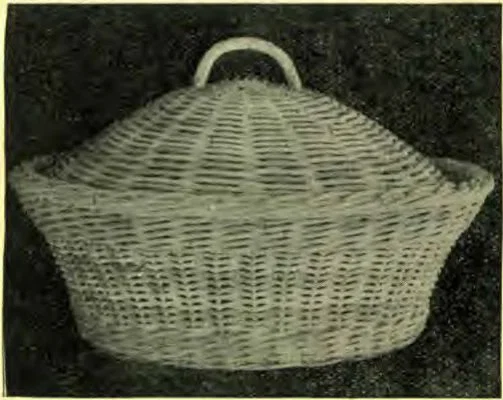
A Darning Basket
By Mrs. E. M. F. Long
Model No. 7
MATERIAL, reeds Nos. 1, 3, 4, 5, and 6. Diameter of base, seven inches; top, ten inches; height, four inches. Thirty-seven stakes, sixteen inches long, of No. 4 reed. Insert one each side of each spoke but one. At the last spoke use but one, to make an odd number, as the stakes will be used singly. Use No. 3 reed for all the weaving.
Rope twist, three rows of triple twist, two inches of single weaving. Above the single weaving put one row of triple twist. At the point where this row ends, insert two new weavers, one in each of the first two vacant spaces at right of the three weavers already in use. These five weavers are used to form a ridge on which the cover may rest. Take the one at left, pass it to right in front of two stakes and back of three. This will bring it out in first vacant space at right. Continue the same stroke once around the basket, always taking the left weaver. Notice the ridge formed by passing back of three stakes. When a weaver reaches the space where the first extra one was inserted, lift the inserted end, pass the other end back of it under the ridge, and draw it through to the front. Make the next stroke with left weaver, and bring this out back of second inserted weaver below the ridge. This completes the ridge, and leaves it even.
FIG. 1
FIG. 2
Cut these two weavers on outside of basket. With the remaining three weavers make three rows of triple twist. Using five weavers makes no difference on outside of basket, as each stroke is in front of two stakes, same as with triple twist. The border is slightly different from that on the “handy basket.” Turn down four stakes each back of two. Pass the left one over the other three, in front of first standing stake, back of the next, and out at first vacant space at right. Lay first standing stake down back of it. Repeat until finished. Fig. 1. Weaving the last ends in may be somewhat perplexing, but will not be too difficult for those who have followed the work from the beginning.
For the cover use ten fifteen-inch spokes of No. 5 or No. 6 reed. Split five and insert five. Open the center as usual. Notice that the second row of pairs does not divide the first row, because there is now an even number of spokes.
When the second row of pairs is completed, drop the short weaver; with the long one pass in front of two spokes, and back of one. Fig. 2. (This gives the same effect as the triple twist.) Continue this weave until the cover is the right size, which is when the diameter is one-half inch less than that of the inside of basket just above cover ridge. In using larger or smaller reeds a different allowance would, of course, be necessary. Shape by bending spokes well from you and drawing weaver tight at each stroke. Bind off by passing weaver under last row of weaving at each downward stroke last time around. Cut spokes close to cover. Insert one nine-inch stake of No. 4 reed beside each spoke for border. Pinch close to cover. Hold the cover on edge with the under side toward worker. Turn two stakes down, each back of first one at its right. Pass left one in front of first standing stake at right, back of next, and out at first vacant space. Lay first standing stake down back of it. Repeat until border is finished. Fig. 3. It should be very firm and close. See that the cover is just the right size before trimming stakes. It should go on without crowding, and should not be so small as to slip below cover ridge. If it is a trifle large, it may be sufficiently reduced by giving each stake a firm pull. If a little small, lay it on the table right side up, and with the palms of the hands apply firm, even pressure to the top. If proper care is used in measuring, it will need no more adjusting than can be done in this way. But if necessary the border may be taken out, and more or less weaving used as the case may require.
FIG. 3
For the handle use a five-inch piece of No. 6 reed. Sharpen each end on the under side only a distance of half an inch. Insert slanted ends on top of middle spoke just outside of the two rows of pairs on either side of center. Wind same as handles on plain waste basket and handy basket. Use No. 1 reed for winding.
MRS. E. M. F. LONG.
“He's Barefoot”
By E. W. Thurber
ONE day as I was working near an open window, my attention was attracted to the conversation of some small boys who were playing outside. They had a wheelbarrow, and were wheeling something across the yard, a part of which was covered with stone chips from a newly built wall. One of the boys was barefoot, while the others had on shoes.
At the time when I noticed their play, they were trying to decide which of them should ride back in the empty wheelbarrow. Soon I heard one of the boys say, “Let Mike; he's barefoot.” To this the others agreed, and Mike climbed into the wheelbarrow, and rode off.
Many times those words have come back to me, and forcibly impressed the lesson of unselfishness. How easy it would have been for one of the larger boys to claim the right to ride back, and leave Mike to walk barefooted over the stones. How easy it is for us all to forget, as we do so often, to give up to another the pleasure we ourselves would so much enjoy.
All around us are people longing for loving words and tender sympathy, so let us bestow upon them the fragrance of kindly deeds, thus helping them along in the upward way, cheering and brightening their lives, and asking God to develop in us the character of him “who went about doing good.” E. W. THURBER.
New Lighting Apparatus for the Capitol
THE superintendent of the Capitol building has just completed the installation of an entire new set of lighting apparatus for the corridors of the building, at a cost of ten thousand five hundred dollars.
Of this amount about seven hundred dollars was expended on a single chandelier, one of the finest in any public building in Washington. In fact, the Capitol building has some of the handsomest and most expensive chandeliers in Washington. The largest chandelier installed in the building is placed in the corridor just in front of the Supreme Court chamber. It is of such large proportion that an extra beam was placed in the ceiling to hold its weight. It is of bronze, and weighs about seventeen hundred pounds.—The Washington Times.
They Wear Crosses but Shrink from Bearing Them
“THEY wear crosses, but shrink from bearing them.”
INTERMEDIATE LESSON
X—The Healing of Peter’s Wife’s Mother—Other Miracles
MEMORY VERSE: “And immediately he rose up before them, and took up that whereon he lay, and departed to his own house, glorifying God.” Luke 5:25.
“And he came to Nazareth, where he had been brought up: and, as his custom was, he went into the synagogue on the Sabbath day, and stood up for to read. And there was delivered unto him the book of the prophet Esaias. And when he had opened the book, he found the place where it was written, The Spirit of the Lord is upon me, because he hath anointed me to preach the gospel to the poor; he hath sent me to heal the broken-hearted, to preach deliverance to the captives, and recovering of sight to the blind, to set at liberty them that are bruised, to preach the acceptable year of the Lord.
“And he closed the book, and he gave it again to the minister, and sat down. And the eyes of all them that were in the synagogue were fastened on him. And he began to say unto them, This day is this scripture fulfilled in your ears. And all bare him witness, and wondered at the gracious words which proceeded out of his mouth. And they said, Is not this Joseph’s son?”
“And he said unto them, Ye will surely say unto me this proverb, Physician, heal thyself: whatsoever we have heard done in Capernaum, do also here in thy country. And he said, Verily I say unto you, No prophet is accepted in his own country. But I tell you of a truth, many widows were in Israel in the days of Elias, when the heaven was shut up three years and six months, when great famine was throughout all the land; but unto none of them was Elias sent, save unto Sarepta, a city of Sidon, unto a woman that was a widow. And many lepers were in Israel in the time of Eliseus the prophet; and none of them was cleansed, saving Naaman the Syrian. And all they in the synagogue, when they heard these things, were filled with wrath, and rose up, and thrust him out of the city, and led him unto the brow of the hill whereon their city was built, that they might cast him down headlong.
“But he passing through the midst of them went his way, and came down to Capernaum, a city of Galilee, and taught them on the Sabbath days. And they were astonished at his doctrine: for his word was with power. . . .”
“And he arose out of the synagogue, and entered into Simon’s house. And Simon’s wife’s mother was taken with a great fever; and they besought him for her. And he stood over her, and rebuked the fever; and it left her: and immediately she arose and ministered unto them. Now when the sun was setting, all they that had any sick with divers diseases brought them unto him; and he laid his hands on every one of them, and healed them. . . .”
“And it came to pass, that, as the people pressed upon him to hear the word of God, he stood by the lake of Gennesaret, and saw two ships standing by the lake: but the fishermen were gone out of them, and were washing their nets. And he entered into one of the ships, which was Simon’s, and prayed him that he would thrust out a little from the land. And he sat down, and taught the people out of the ship.
“Now, when he had left speaking, he said unto Simon, Launch out into the deep, and let down your nets for a draught. And Simon answering said unto him, Master, we have toiled all the night, and have taken nothing: nevertheless at thy word I will let down the net. And when they had this done, they enclosed a great multitude of fishes: and their net brake. And they beckoned unto their partners, which were in the other ship, that they should come and help them. And they came, and filled both the ships, so that they began to sink.
“When Simon Peter saw it, he fell down at Jesus’ knees, saying, Depart from me; for I am a sinful man, O Lord. For he was astonished, and all that were with him, at the draught of the fishes which they had taken: and so was also James, and John, the sons of Zebedee, which were partners with Simon. And Jesus said unto Simon, Fear not; from henceforth thou shalt catch men. And when they had brought their ships to land, they forsook all, and followed him. . . .”
“And it came to pass on a certain day, as he was teaching, that there were Pharisees and doctors of the law sitting by, which were come out of every town of Galilee, and Judea, and Jerusalem: and the power of the Lord was present to heal them. And, behold, men brought in a bed a man which was taken with a palsy: and they sought means to bring him in, and to lay him before him. And when they could not find by what way they might bring him in because of the multitude, they went upon the housetop, and let him down through the tiling with his couch into the midst before Jesus. And when he saw their faith, he said unto him, Man, thy sins are forgiven thee.
“And the scribes and the Pharisees began to reason, saying, Who is this which speaketh blasphemies? Who can forgive sins, but God alone? But when Jesus perceived their thoughts, he answering said unto them, What reason ye in your hearts? Whether is easier, to say, Thy sins be forgiven thee; or to say, Rise up and walk? But that ye may know that the Son of man hath power upon earth to forgive sins (he said unto the sick of the palsy), I say unto thee, Arise, and take up thy couch, and go into thine house. And immediately he rose up before them, and took up that whereon he lay, and departed to his own house, glorifying God. And they were all amazed, and they glorified God, and were filled with fear, saying, We have seen strange things to-day.”
Questions
1. What little town did Jesus now visit? What did he do on the Sabbath? What was given to him? What did he read? When he had finished, what did he do? What did he say?
2. To what did all who heard him bear witness? At what did they wonder? What did they say to one another? What did Jesus then tell them about his work? Of what incident in the life of Elijah did he speak? What in the life of Elisha?
3. When those in the synagogue heard these things, what did they do? How did Jesus escape from them? Where did he go? What did he do on the Sabbath?
4. Into what house did Jesus enter one day? Who lay ill there? What was Jesus asked to do? Tell how the woman was cured. Mark 1:31. What did she immediately do? At sunset who came to Jesus? How many who came were healed?
5. After this, where did Jesus teach the people? How great was the company? Into whose boat did he enter? When they had pushed off a little way from shore, what did Jesus do?
6. When he had finished teaching the people, what did Jesus command Simon to do? Did Simon obey willingly? What did he say? What do these words show? How many fishes were taken in the net? What happened to the ships?
7. What did Simon now do? Were the others astonished? What did Jesus say to Simon? What should he henceforth do? When the disciples had brought their ships to land, what did they do?
8. Who had gathered in a house one day to hear Jesus? As he was teaching, who was brought to him to be healed? What was it necessary to do in order to bring the sick man near Jesus? What did he say when he saw the man?
9. What did the scribes and Pharisees who were present at once begin to question in their hearts? What did Jesus know? How did he answer their unspoken thoughts?
10. What did Jesus now say to the sick of the palsy? What did the man immediately do? Whom did he glorify as he went to his own house? What was the effect of this miracle on that company?
X—The Gifts of the Spirit
(June 3)
MEMORY VERSE: “When he ascended up on high, he led captivity captive, and gave gifts unto men.” Eph. 4:8.
Questions
Concerning what are we admonished not to be ignorant? 1 Cor. 12:1.
What did Jesus give to men when he ascended? Eph. 4:8.
Are all the gifts of the Spirit the same? 1 Cor. 12:4-6.
1. So long as the Spirit of God is in the earth, the gifts of the Spirit will be seen in a greater or less degree. In the closing days of earth’s history, when the power of Satan will be manifested in no ordinary manner, it is reasonable, as well as Scriptural, that the operations of the Holy Spirit will be witnessed in a special manner, and the gifts of the Spirit be revealed in the church. God placed these gifts in the church, “for the perfecting of the saints, unto the work of ministering, unto the building up of the body of Christ,” and they will remain there until the church militant becomes the church triumphant. Note that among other gifts in the church is that of prophecy. As this is the greatest gift (1 Cor. 14:1, 39), we may expect that it will be the leading gift.
2. The gift of prophecy is important because it teaches God’s will, and all the other gifts in their fulness are dependent upon its reception. Only as the spirit of prophecy is confirmed in us, may we hope to have all the gifts. 1 Cor. 1:4-8.
Quotes on Strength, Honor, and Service
Oh do not pray for easy lives. Pray to be strong men! Do not pray for tasks equal to your powers. Pray for powers equal to your tasks.—Phillips Brooks.
“Ambassador Choate, in being elected a bencher of the Middle Temple, receives the highest honor within the gift of British lawyers, an honor not conferred upon an American since the Revolution.”
Mrs. Fairbanks, wife of Vice-President Fairbanks, holds three collegiate degrees. She was graduated from the Ohio Wesleyan University in 1872. Later she received the degree of bachelor of laws, and then took a full course of international law.
“When Mr. Gladstone was twenty-one years old, he made the following entry in his diary: ‘In practise, the great end is that the love of God may become the habit of my soul, and particularly these things are to be sought: the spirit of love, of self-sacrifice, of purity, of energy.’”
The Japanese are forming a colony in Texas, this State still having much land to spare for the industrious farmer. There has been some opposition to the colonization scheme; but the governor and other leading officials have succeeded in setting the door wide open to all thrifty, self-supporting Japanese.
You will see the pools and standing waters frozen through the winter, when the little running streams are bounding along between fringes of icy gems. Why is this? The streams have something else to do than stand still to be frozen up. Be like them. Keep your hearts warm by feeling for others, and your powers active by work done in earnest.—John Hall.
The body of John Paul Jones was discovered in Paris on April 14, 1905, one hundred thirteen years after burial. It was identified by the highest medical experts, and is in a good state of preservation. The body had been soaked in alcohol and interred in a leaden coffin. It will doubtless be given appropriate burial in the Arlington National Cemetery.
In the National Museum at Washington is the picture of the Dowager Empress of China that was on exhibition at the St. Louis exposition. It was painted by an American lady artist. The empress is a picture of vigor, with piercing black eyes, jet-black hair, and pretty little hands, whose nails, several inches long, are protected by golden shields like elongated thimbles. Tsi An is proud of her hands, which, according to Chinese ideas, are extremely beautiful. She has long black hair, which she wears parted in front, and brushed smoothly over her ears.
An article which endeavored to answer the question, “Is Chicago Meat Clean?” appeared in a recent number of Collier’s Weekly. After speaking in detail of the various phases of the work in the Chicago stockyard, the author adroitly remarked, “And, incidentally, it is worth while to call attention to the fact that the stockyard business in no way relates to or has any correlation with an art gallery or with any of the refinements of civilized life. Neither is it calculated to discourage any spectator who witnesses its operations from adopting and pursuing a vegetarian diet,”—a significant disclosure.
“When miners go to work, their faces are clean, but at night they are black as coal; yet still their eyes are clean, because the tear-glands have washed away all impurities. Such is the influence of the Holy Spirit amid the impurities of the world.”
Margaret Gatty, in one of her stories, tells of a schoolboy who had a high reputation as a mimic. It seemed as if he could be just like any one whom he pleased to imitate. But a wiser friend asked him to show how the handsomest boy in school looked, and how the best speaker declaimed. Then, as the young mimic found himself quite incompetent to do this, he realized that all his power of imitation lay in the direction of lowering his own standard, and of mimicking defects which had not yet become his own.—W. F. Crafts.
Nearly three hundred fifty years ago Francis Xavier stood before the “Walled Kingdom,” China, and as he felt the power of its adamantine exclusiveness and proud self-sufficiency, exclaimed, “O rock! rock! when wilt thou open to my Master?” Since then China has heard from on high a voice commanding it to throw open its doors, and though not knowing the full meaning of the command, she obeyed.
The gates are wide open, the people wait, but where are the ones with the Bread of life to disperse to the famishing multitude? Where are the Seventh-day Adventist young men and women who are ready to enter this field? Who has the money that is necessary to send them? We must hasten, else the gates will swing to again, never more to open.